Tag: SDG1

  • Pulque: Aztec Drink Ferments New Economy

    Pulque: Aztec Drink Ferments New Economy

    By David SouthDevelopment Challenges, South-South Solutions

    SOUTH-SOUTH CASE STUDY

    Reviving traditional foods and drinks can be an income-boosting source of new economic activity. Many cultures can benefit from looking again at their rich traditions to find new ways to increase enterprise. This can be difficult at first. Big global brands have many initial advantages: they are backed by wealthy and experienced international companies and can deploy aggressive marketing and distribution power to get products into the hands of consumers. The power of Coca Cola to reach all corners of the earth is legendary.

    But the case of Mexican drink pulque shows how marrying the power of an ancient taste with a younger demographic can rejuvenate businesses. This is important because many emerging countries across the South have young populations – and yet unemployment is also high among these youthful populations. Engaging the youth market will be critical to the future prosperity and development of these countries.

    Pulque is also playing a part in Mexico’s tourism strategy: the state government in Tlaxcala (http://www.tlaxcala.gob.mx)has created a ‘Pulque Route’ to draw in tourists.

    Having for decades lost ground to slickly marketed alternatives like beer and tequila, pulque drinking is being revived with the help of a new generation of Mexicans re-discovering a beverage that boasts origins reaching back to the Aztecs (http://en.wikipedia.org/wiki/Aztec).

    There is also another benefit to reviving ancient food and drink: alarm has been raised over the diminishing range of food products consumed by people around the world. Throughout the history of farming, around 7,000 species of plants have been domesticated. Yet everyday diets only draw on 30 percent of these plants, and even this number has been going down as more people consume mass-market foods (FAO).

    Once-rich culinary traditions have wilted and left many people unsure what to do with formerly common vegetables and fruits, even if they can actually find them in markets.

    One consequence has been poor nutrition resulting from the reduction in consumption of high-vitamin foods, leading to stunted mental and physical development across the global South.

    Pulque (http://en.wikipedia.org/wiki/Pulque) is made from the juice of maguey or agave (http://en.wikipedia.org/wiki/Agave), a spiky green plant. It has between three and four percent alcohol content. Unlike the well-known Mexican drink tequila, which is fermented and distilled to make a strong, clear alcoholic drink, pulque is a foamy and milky beverage that is fermented, not distilled.

    Made from a sap harvested when the agave is mature, it appears in the Codex Borbonicus written by Aztec priests in the 1530s.

    Advocates for the drink say it is high in Thiamine, Riboflavin, Niacin, Pantothenic Acid and packed with beneficial microbes for human digestion. It also has vitamins C, B-complex, D, E, amino acids and minerals such as iron and phosphorus.

    Pulque had developed a bad reputation, with an image as a peasant drink lacking the class of tequila or beer. The stigma had built up over decades from its reputation as the favourite drink of alcoholic farmers, commonly depicted drinking pulque all day long.

    Once pulque was available only at makeshift pulquerias: a few tables and chairs with farm animals roaming about. Portions were large, using gourds or, by the 1970s, plastic buckets. Some still sell the drink in this rough-and-ready fashion from containers hitched to donkeys.

    Those behind the rebranding of the drink hope to move away from the former drinkers – largely poor, old and rural – to young urban drinkers. Pulque has taken on a “cool, retro” image tapping into a taste for connecting with Mexico’s Aztec roots.

    In Pulqueria Las Duelistas in Mexico City, the young crowd like the new taste. “It is cooler than beer and a lot cheaper than Tequila,” Jaime Torres, a 22-year-old design student and computer tech for an advertising agency told the Washington Post. “It’s old Mexico.”

    By 1886 a census found 817 pulquerias in Mexico City serving the residents of just 9,000 homes. By the 20th century, they had become so common that neighbourhoods would have a handful each. Now estimates place the number in Mexico City at between 60 and 100, with many closing when their owners die.

    Las Duelistas is trying to buck that trend.

    “This place has been in business for 92 years, and I have six as the owner, and I have totally changed the image of the pulqueria, a totally new concept, with different clientele,” said proprietor Arturo Garrido. “Most of my clients are young, and it is my way to continue giving life to the pulque.”

    So, how have the pulquerias made themselves appealing to a new generation of drinkers? Music and new interior design have made the establishments more attractive to youth.

    Pulque sells for 30 pesos, or about US $2.50, a litre. The most popular version is called curado (cured) and is infused with other flavours like strawberry, guava and celery to add greater appeal to a younger demographic.

    “My customers aren’t old anymore. Now they’re young people,” said Nabor Martinez, the owner of another pulqueria, La Risa.

    The drink is difficult to export because it keeps fermenting in the bottle or can. This makes it something special to Mexico, only enjoyed by a visit to the country.

    Some, however, like Everado Gonzalez, director of the 2003 documentary “Pulque Song,” about an old-school establishment, lament the loss of the old atmosphere.

    “A pulqueria is not a cantina. It’s not a bar,” Gonzalez said. “It is a refuge, or was, for the lowest classes of society. Your drink is cheap. You are not sitting at a table, with good manners. You don’t need a table. You sit on a bench, where you can do what you want, say what you want.

    “It was a beautiful island of freedom.”

    Published: September 2011

    Resources

    1) Teh Botol Sosro: It is a drink of cool, black, sweetened tea with a hint of jasmine. Invented by the Indonesian family of Sosrodjojos, Sosro was founded in central Java in the 1940s. Website: http://www.sosro.com

    2) Just Food is a web portal packed with the latest news on the global food industry and packed with events and special briefings to fill entrepreneurs in on the difficult issues and constantly shifting market demands. Website:http://www.just-food.com

    3) Small businesses looking to develop their brand can find plenty of free advice and resources here. Website:http://www.brandingstrategyinsider.com

    4) Brandchannel: The world’s only online exchange about branding, packed with resources, debates and contacts to help businesses intelligently build their brand. Website:http://www.brandchannel.com


    Mezcal or mescal, is a distilled alcoholic beverage made from any type of agave (Wikipedia). In the summer of 2022 Southern Innovator was introduced to the brand Marin&Marin (https://www.marinymarinmezcal.com). Their mezcal is hand made in a traditional Mexican way and is 100% organic and Fair Trade.  

    Development Challenges, South-South Solutions was launched as an e-newsletter in 2006 by UNDP’s South-South Cooperation Unit (now the United Nations Office for South-South Cooperation) based in New York, USA. It led on profiling the rise of the global South as an economic powerhouse and was one of the first regular publications to champion the global South’s innovators, entrepreneurs, and pioneers. It tracked the key trends that are now so profoundly reshaping how development is seen and done. This includes the rapid take-up of mobile phones and information technology in the global South (as profiled in the first issue of magazine Southern Innovator), the move to becoming a majority urban world, a growing global innovator culture, and the plethora of solutions being developed in the global South to tackle its problems and improve living conditions and boost human development. The success of the e-newsletter led to the launch of the magazine Southern Innovator. 

    Creative Commons License

    This work is licensed under a
    Creative Commons Attribution-Noncommercial-No Derivative Works 3.0 License.

    ORCID iD: https://orcid.org/0000-0001-5311-1052.

    © David South Consulting 2023

  • Diaspora Bonds to Help Build up Infrastructure

    Diaspora Bonds to Help Build up Infrastructure

    By David SouthDevelopment Challenges, South-South Solutions

    SOUTH-SOUTH CASE STUDY

    Many people are aware of the significant role played in global development by remittance payments from migrant workers working in the wealthy North to the global South. But they may not be aware of the significant sums migrant workers have saved in bank accounts in these wealthy countries. Across the global South, efforts are underway to lure these sums back to home countries to boost development efforts.

    As the hard-earned money migrant workers save sits in bank accounts in wealthy Western countries earning very low interest rates – a consequence of the current global economic crisis – so-called “Diaspora Bonds” seek to offer a way to earn good interest returns and help build up home countries at the same time.

    The money can help developing countries build facilities they need but cannot afford: roads, bridges, railways, water supplies, power, sewerage, street lighting. It is a way to bypass dependence on foreign aid and borrowing from aid agencies or the general marketplace.

    US $501 billion in remittance payments was sent in 2011, of which US $372 billion went to developing countries, involving some 192 million migrants or 3 per cent of the world’s population (World Bank). On top of this, migrants from developing countries have saved an estimated US $400 billion – and these funds are being targeted by those selling diaspora bonds (The Economist).

    The idea is being promoted by the World Bank and draws on the successful experiences with bonds for Israel and India. Both countries have long histories of turning to diaspora communities to raise funds through bonds.

    The bonds work by playing on patriotism and the genuine desire of migrants to want to see conditions improve back home. As the thinking goes, patriotic investors are more likely to be patient. This is critical because many countries cannot offer rapid profits and a quick pay off – something sought by short-term investors obsessed with the ups and downs of the stock market. They are also sterner investors, less likely to run away when the going gets tough. Their local knowledge means they will not panic and pull their investments when bad news hits the headlines. And probably best of all, they don’t mind if the local currency declines in value – that just means they can pick up a local house on the cheap or buy a business for even less money.

    One business working in this area is Homestrings (homestrings.com): Motto “Come make a difference.” An Internet platform offering diaspora bonds, it is run by founder and chief executive officer Eric-Vincent Guichard. An American born to a Guinean father and American mother, he spent 20 years growing up in rural Guinea and knows the country well. He also heads up GRAVITAS Capital Advisors, Inc. (gravitascapital.com), founded in 1996, which advises governments on how to manage their assets. A graduate of HarvardBusinessSchool and a former World Bank scholar, he is based in Washington, D.C.

    According to its website, Homestrings works like this: “It all starts with your ability to scan through a catalog of projects, funds and public-private partnership opportunities that focus on regions you come from or that you care deeply about. Each of these projects and/or funds is detailed in a Fact Sheet that is set up to help you do the due diligence needed to make an investment decision. Then, Homestrings directs your investment into the selected project or fund, with the help of our administrator.”

    Investments are monitored on a monthly or quarterly basis and are selected for their socio-economic impact and investment profitability.

    The website has a personal “Dashboard” that allows investors to use the site to vote for or against investments and make comments. And Homestrings will promote the investments that receive the most support and positive comments.

    To make an investment, a potential investor selects a fund or project that matches their interest. They read the Fact Sheet and choose. The funds are then passed on to the investment bond and an interest percentage or dividend is paid at regular intervals. Investors can keep track of the investment through the personal Dashboard on the website.

    Fact Sheets are organized by geographical region, industry focus, and development theme. Investments “cover infrastructure, health care, education, transportation, and small and medium sized enterprise finance – all critical areas of economic growth.”

    The Homestrings Catalog of investments includes the governments of Kenya, Senegal, Ghana, Nigeria and also AFREN PLC, which is looking to finance oil and gas exploration off the coast of Nigeria.

    Dramatic improvements in global communications in the past five years have also made it much easier for everyone involved to stay in touch and for bond promoters to identify and target potential customers.

    The World Bank is currently advising countries on how to run diaspora bond schemes. Kenya, Nigeria and the Philippines have schemes in the works, according to The Economist.

    Ethiopia has announced the “Renaissance Dam Bond” (http://grandmillenniumdam.net/). Proceeds will be used to fund the construction of the Grand Renaissance Dam, the largest hydroelectric power plant in Africa, able to generate 5,250 megawatts. Ethiopia tried a similar scheme before with the Millennium Corporate Bond to raise funds for the Ethiopian Electric Power Corporation (EEPCO). This did not entirely meet expectations and sales were slow. Reasons given for this included a perception that EEPCO could not meet payment expectations when the hydroelectric power plant was operating. There was also a lack of trust in the government and its financial stability and the overall political risks.

    The second attempt at a bond is believed to better thought through. It comes with an aggressive marketing and awareness-raising campaign aimed at the diaspora, and it starts at US $50, making it more affordable for more people.  It can be used as collateral in Ethiopia – an advantage for those wanting to do business back in the home country.

    For potential investors, it is worth remembering that bonds are debts that are rewarded with regular interest payments and paid back at the end of the bond term. They are not risk-free and the risk can lie either in the sovereign solvency of the country or in the investment.

    The secret to a successful bond issue is to keep up good relations with the diaspora; countries that are too oppressive could find themselves short of people willing to take up the offer.

    Published: October 2012

    Resources

    1) Remittance Payments Worldwide: A website by the World Bank tracking remittance prices worldwide. Website:http://remittanceprices.worldbank.org/About-Us

    2) The World Bank blog on diaspora bonds. Website:http://blogs.worldbank.org/category/tags/diaspora-bond

    3) A critical perspective on diaspora bonds at Africa Unchained. Website:http://africaunchained.blogspot.co.uk/2012/03/are-diaspora-bonds-worth-risk.html

    Development Challenges, South-South Solutions was launched as an e-newsletter in 2006 by UNDP’s South-South Cooperation Unit (now the United Nations Office for South-South Cooperation) based in New York, USA. It led on profiling the rise of the global South as an economic powerhouse and was one of the first regular publications to champion the global South’s innovators, entrepreneurs, and pioneers. It tracked the key trends that are now so profoundly reshaping how development is seen and done. This includes the rapid take-up of mobile phones and information technology in the global South (as profiled in the first issue of magazine Southern Innovator), the move to becoming a majority urban world, a growing global innovator culture, and the plethora of solutions being developed in the global South to tackle its problems and improve living conditions and boost human development. The success of the e-newsletter led to the launch of the magazine Southern Innovator. 

    Creative Commons License

    This work is licensed under a
    Creative Commons Attribution-Noncommercial-No Derivative Works 3.0 License.

    ORCID iD: https://orcid.org/0000-0001-5311-1052.

    © David South Consulting 2022

  • Cashing in on Music in Brazil

    Cashing in on Music in Brazil

    By David SouthDevelopment Challenges, South-South Solutions

    SOUTH-SOUTH CASE STUDY

    Brazilian musicians have found a way to prosper and exploit the realities of music distribution in the modern age. The biggest problem for most artists – both beginners and those who are more established – is how to earn an income from their work. In the digital age, it is next to impossible to stop people freely copying your work and passing it on.

    The impact of digital technology on the global music business has been earth-shattering. It’s estimated 95 percent of music digital downloads are unauthorized, with no payment to artists and producersWhile the legal digital music business grew for the sixth consecutive year in 2008, with a 25 percent increase in global sales to a trade value of US$3.7 billion, this only makes up 20 percent of total music sales (IFPI) (http://www.ifpi.org/). Even legal digital services like Apple’s iTunes have suffered (http://www.apple.com/downloads/).

    An economic solution to this conundrum is critical for the growth of creative economies in the South.

    The traditional music industry model from the analogue age – where copies of music are tightly controlled and royalties and profits funnel back to recording companies – has come unstuck in the digital age. With digital recordings, it is easy to copy high quality music and distribute it for free through the Internet, by audio music players like the iPod or on discs.

    Many are saying a corner has been turned: free distribution is the new future and illegal copying is the new normal. The model for music making has been turned on its head: from high investment and high returns, it is now low investment and low returns. And this model chimes very well with the world most Southern musicians live in. The chances for most of emulating the champagne and jets lifestyle of the Rolling Stones or Beyonce is beyond their reality. But they can build a slower and more sustainable income with the new digital model.

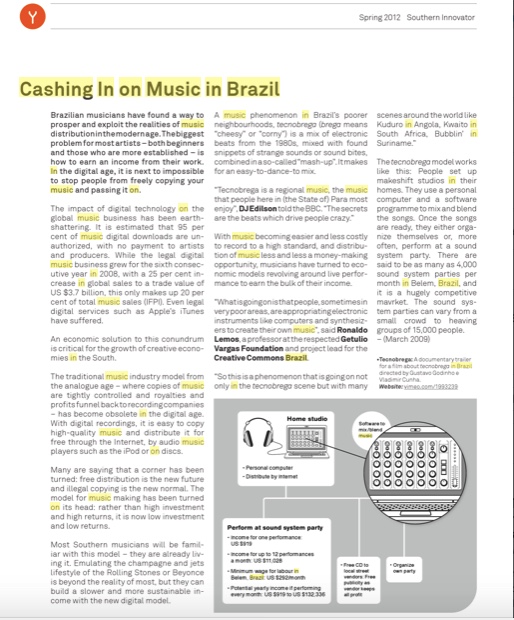
    A music phenomenon in Brazil’s poorer neighbourhoods, tecnobrega (brega means cheesy or corny) is a mix of electronic beats from the 1980s, mixed with found snippets of strange sounds or sound bites, combined in a so-called ‘mash-up’ (http://en.wikipedia.org/wiki/Mashups). It makes for an easy-to-dance-to mix.

    “Tecnobrega is a regional music, the music that people here in (the state of) Para most enjoy,” DJ Edilson told the BBC. “The secrets are the beats which drive people crazy.”

    With music becoming easier and cheaper to record to a high standard, and distribution of music less and less a money-making opportunity, musicians have turned to economic models revolving around live performance to make the bulk of their income.

    “What is going on is that people, sometimes in very poor areas, are appropriating electronic instruments like computers and synthesizers to create their own music,” said Ronaldo Lemos, a professor at the respected Getulio Vargas Foundation (http://www.fgv..br/ ) and project lead for the Creative Commons Brazil (http://creativecommons.org/international/br/).

    “So this is a phenomenon that is going on not only in the tecnobrega scene but with many scenes around the world like Kuduro in Angola, Kwaito in South Africa, Bubblin’ in Suriname.”

    The tecnobrega model works like this: People set up makeshift studios in their homes. They use a personal computer and a software programme to mix and blend the songs. Once the songs are ready, they either organize themselves, or more often, perform at a sound system party. There are said to be as many as 4,000 sound system parties per month in Belem (http://en.wikipedia.org/wiki/Bel%C3%A9m) and it is a hugely competitive market. The sound system parties can vary from a small crowd to heaving groups of 10 to 15,000 people. 

    The money for performing at these parties is good. A musician performing just once can make 2,200 realis (US $919), and can do this 12 times a month. This is a good income compared to the minimum wage in Belem: 700 realis (US $292). It is estimated it generates US $1.5 million a month in Belem.

    In Brazil, where many do not have broadband Internet and thus can’t download music, fans buy pirated and cheap compact discs (CDs) in markets. Local musicians make their own CDs and give them free to local street vendors. While they make no money off the CDs that are then sold by the vendors, they do drum up publicity and profile. And they then use this to draw large paying crowds to their live gigs.

    In just a few years, tecnobrega has become a multi-million dollar music business in Brazil. Once an artist has gained experience performing live at the parties, they can develop the skills to organize their own events, and boost their income accordingly.

    One singer who has successfully exploited the opportunities raised by the tecnobrega phenomenon is Gaby Amarantos (http://www.youtube.com/watch?v=ZKjH__ghQa4 ). She now regularly appears on TV. 

    “We have found a new way to work,” she told the BBC. “It is a new format and a new market model because we produce the music ourselves and the cost to make one song is very cheap.”

    “What happens is that the musicians skip the intermediaries,” said Ronaldo Lemos.

    “So the musicians do not make money from the CDs that are sold by the street vendors, they actually make money by playing live at the so-called sound system parties – the aparelhagem parties as we tecnobrega say here in Brazil – and also by selling CDs after they play live.

    “No-one expects to make money from the CDs – they use it as a way to advertise the music and to advertise themselves as artists, and then their expectation is that they get invited to play at the sound system parties and clubs.

    “The more their music gets distributed, the more they will make money in return.”

    The furious pace of innovation in the tecnobrega scene is all about generating more revenue and more income. New styles emerge to cater to new tastes: cyber tecnobrega, brega melody, electro melody. And this passion for innovation has kept the tecnobrega entrepreneurs ahead of the traditional music business in how it uses digital technologies.

    Lemos calls tecnobrega a “globoperipheral music”: it transcends rich and poor divisions and geographical boundaries.

    Other examples include Argentina’s Cumbia Villera, or Brazil’s Funk Carioca.

    “The number one lesson would be innovation – if you want to survive in the music industry right now you have to innovate,” said Lemos.

    Published: March 2009

    Resources

    • Good Copy, Bad Copy: A Danish documentary film by director Andreas Johnsen about the global explosion in movie- and music-making because of the digital revolution. Website: http://www.goodcopybadcopy.net/
    • A documentary trailer for a film about tecnobrega in Brazil directed by Gustavo Godinho e Vladimir Cunha. Website:http://www.vimeo.com/1993239

    Development Challenges, South-South Solutions was launched as an e-newsletter in 2006 by UNDP’s South-South Cooperation Unit (now the United Nations Office for South-South Cooperation) based in New York, USA. It led on profiling the rise of the global South as an economic powerhouse and was one of the first regular publications to champion the global South’s innovators, entrepreneurs, and pioneers. It tracked the key trends that are now so profoundly reshaping how development is seen and done. This includes the rapid take-up of mobile phones and information technology in the global South (as profiled in the first issue of magazine Southern Innovator), the move to becoming a majority urban world, a growing global innovator culture, and the plethora of solutions being developed in the global South to tackle its problems and improve living conditions and boost human development. The success of the e-newsletter led to the launch of the magazine Southern Innovator. 

    Creative Commons License

    This work is licensed under a
    Creative Commons Attribution-Noncommercial-No Derivative Works 3.0 License.

    ORCID iD: https://orcid.org/0000-0001-5311-1052.

    © David South Consulting 2023

  • Fashion Recycling: How Southern Designers are Re-using and Making Money

    Fashion Recycling: How Southern Designers are Re-using and Making Money

    By David SouthDevelopment Challenges, South-South Solutions

    SOUTH-SOUTH CASE STUDY

    With the rising awareness of the importance of doing fashion in an ethical and sustainable way, more and more fashion designers in the South are getting very creative. Fashion earns big money around the world: The global clothing industry is estimated to be worth US $900 billion a year.

    In Paris, the Ethical Fashion Show, now in its fifth year, showcases fashion that respects people and the environment while still being glamorous, luxurious and trendy. It has attracted designers from around the world, including Mongolia, Thailand, China, Peru and Bolivia. The show demands that all participants adhere to International Labour Organization conventions – including banning forced and child labour – respect for the environment, creating local employment and working with craftspeople to ensure skills are retained and the fashion reflects the diversity of the world’s cultures.

    In Abidjan, Ivory Coast, Felicite Mai is using pride in her nation’s top export commodity, cocoa (Ivory Coast is the world’s number one exporter of cocoa), to make smart fashion wear at affordable prices. She has turned the beige-coloured jute sacks used to ship cocoa beans around the world into clothes for men and women.

    “Ivory Coast’s economy is based on agriculture, especially cocoa and coffee. So I decided to promote these crops by creating these fashion designs,” Mai, whose real name is Maimouna Camara Gomet, told the Reuters news agency.

    “For me, it’s a way of drawing the whole world’s attention to cocoa and coffee,” she said

    Mai comes from a family of cocoa planters and is a graduate of a sewing school. She works out of a studio-cum-shop in the Treichville suburb of Abidjan.

    The clothes are usually beige, but some are dyed dark brown or blue. They include skirts, tops, trousers, shirts, waistcoats, caps, bags and accessories; she gets the sacks – most emblazoned with “Product of Ivory Coast, Cocoa” — from the city’s port warehouses. She cleans the jute cloth first, before creating the fashions.

    “I had this idea from when I was still at sewing school in 1987. Then I opened my own workshop in 1996 and I first launched these kind of designs in 2003 during a fashion contest at Divo (in the south of Ivory Coast)” said Mai, who has several assistants at her shop.

    She has been able to attract as clients local celebrities, artists and musicians and even a few from abroad.

    In Brazil, it is footwear that is getting the recycled-look treatment. The brand Melissa specializes in plastic shoes that are eco-friendly and made from 100 percent recycled materials. They use a plastic called melflex made from recovered plastic. The shoes are made in injection molds and the factory is so efficient, it has next to no waste as a byproduct. It recycles all the waste and water used in the production process. And as a plus, they make a point of paying the workers well, and supporting social and environmental causes in Brazil.

    Their secret to putting zing into recycled plastic shoes is to have high-profile, celebrity designers design some of the shoes. So far, they have had UK fashion mistress Vivienne Westwood, the Campana Brothers, and the UK-based, Iraqi-born architect Zaha Hadid. Hadid is a controversial figure who always stirs up debate, and her rubber shoes have brought attention to the brand.

    The Chilean studio Modulab has turned to recycled rubber from the car industry to make bags. The rubber comes in sheets so it is easy to cut and shape into bags, thus reducing the amount of time and energy used to make the bags. The line is called RTA (ready to assemble) and includes three types of bags: an envelope, a handbag and a messenger bag. Each sheet of recycled rubber comes with the specific slots and pins for the consumer to put the bag together at home, without any glue or sewing involved. Energy used in the making of the entire bag is 100 percent human, except in the production of the material itself.

    In Ghana, the cheeky Ghanaian businessman-cum-fashion designer Kwabena Osei Bonsu wanted to do something about the ubiquitous plastic bags that pollute the landscape of the capital, Accra.

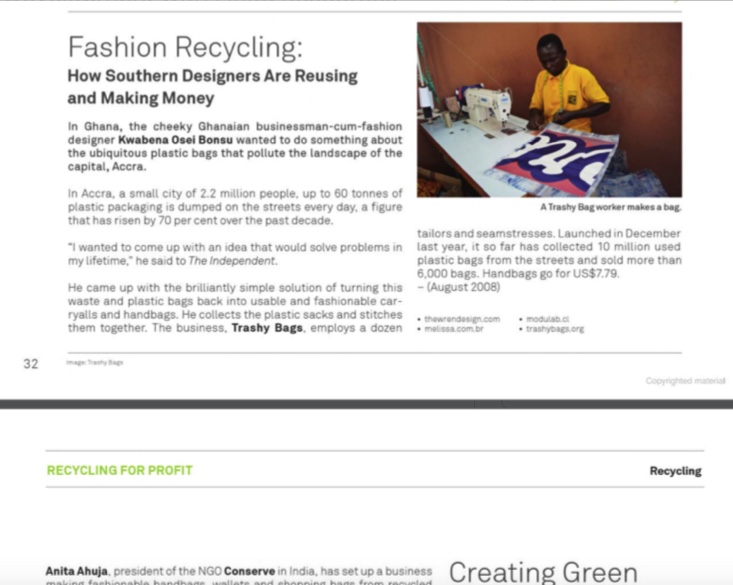
    In Accra, a small city of 2.2 million people, up to 60 tons of plastic packaging is dumped on the streets every day, a figure that has risen by 70 per cent over the past decade.

    “I wanted to come up with an idea that would solve problems in my lifetime,” he said to the Independent.

    He came up with the brilliantly simple solution of turning these wasted and damaging plastic bags back into usable and fashionable carryalls and handbags. He collects the plastic sacks and stitches them back together. The business, Trashy Bags, employs a dozen tailors and seamstresses. Launched in December last year, it so far has collected 10 million used plastic sachets from the streets, and sold more than 6,000 bags. Handbags go for US $7.79.

    Ghana’s huge quantity of discarded plastic water bottles are gathered up for recycling too. A storage room overflows with more than 3 million sachets that have been collected and cleaned ready for recycling.

    Bonsu’s business has turned into a source of income for local people, who receive US $3.89 for 1,000 sachets – a good return where the average yearly income is US $495

    “I collect sachets because I am jobless and this gives me money,” said Hadiza Ishmael, a 55-year-old grandmother who has delivered 4,000 plastic bags. “It also makes the place look nicer.”

    Published: August 2008

    Resources

    • The Re: Fashion Awards show is a brand new fashion phenomenon, set to transform social and environmental standards in the fashion industry within a decade. The RE:Fashion Awards will take place in London in November 2008. The glittering event will see major faces from the fashion world come together to recognise the most significant development in the fashion industry of the 21st century. The deadline for budding fashion designers to enter their contest is August 20th.
      Website: http://www.refashionawards.org/
    • A photogallery of the cocoa fashions:
      here: Photogallery 1
      and here: Photogallery 2
      And a video of Mai making the garments here: Video
    • Ethical Fashion Show: Isabelle Quehe, who established the event, said “You almost never see designers from developing countries doing shows in Paris, so this brings together natural products, local fair labour, respect for the environment and finding sales outlets in Paris.” Potential designers and exhibitors can contact the Ethical Fashion Show by sending collection photos and a brief explanation on how the fashions contribute to the ethical fashion movement.
      Send contributions to: 4, rue Trousseau 75011 Paris
      Email: unilove@wanadoo.fr
    • Once inspired to get into the global fashion business, check out this business website for all the latest news, jobs and events.
      Website: http://us.fashionmag.com/news/index.php
    • A creative agency specialising in the promotion of African culture to the world. They organise RUNWAY AFRICA—Africa’s annual Fall Fashion Show featuring five of Africa’s most promising rising design stars on the runway.
      Website: http://inspirationafrica.org/aboutus.html
    • Green fashion must really be making an impact–the BBC, Britain’s venerable public broadcaster, has started an on-line fashion magazine. Called Thread. Fashion Without Victim, it is dedicated to bringing the “latest of eco-fabulous style”. Through a “unique mix of affordable fashion, exclusive videos, photo galleries and thought-provoking features” the site is committed to promoting all aspects of ethical fashion.
      Website: http://www.bbc.co.uk/thread/
    • Traidcraft fights poverty through trade, helping people in developing countries to transform their lives. Established in 1979 as a Christian response to poverty, we are the UK’s leading fair trade organisation.
      Website: http://www.traidcraftshop.co.uk/default.aspx

    Development Challenges, South-South Solutions was launched as an e-newsletter in 2006 by UNDP’s South-South Cooperation Unit (now the United Nations Office for South-South Cooperation) based in New York, USA. It led on profiling the rise of the global South as an economic powerhouse and was one of the first regular publications to champion the global South’s innovators, entrepreneurs, and pioneers. It tracked the key trends that are now so profoundly reshaping how development is seen and done. This includes the rapid take-up of mobile phones and information technology in the global South (as profiled in the first issue of magazine Southern Innovator), the move to becoming a majority urban world, a growing global innovator culture, and the plethora of solutions being developed in the global South to tackle its problems and improve living conditions and boost human development. The success of the e-newsletter led to the launch of the magazine Southern Innovator. 

    Creative Commons License

    This work is licensed under a
    Creative Commons Attribution-Noncommercial-No Derivative Works 3.0 License.

    ORCID iD: https://orcid.org/0000-0001-5311-1052.

    © David South Consulting 2023