Tag: SDG1

  • A New House Kit for Slum Dwellers that is Safe and Easy to Build

    A New House Kit for Slum Dwellers that is Safe and Easy to Build

    By David SouthDevelopment Challenges, South-South Solutions

    SOUTH-SOUTH CASE STUDY

    By 2030, some 5 billion people around the world will live in cities. Next year, 2008, is predicted to be the tipping point, when urban dwellers (3.3 billion people) will outnumber rural residents for the first time. These are the conclusions of UNFPA’s State of the World Population 2007 Report. Even more strikingly, the cities of Africa and Asia are growing by a million people a week. And 72 percent of the population in sub-Saharan Africa live in slum conditions.

    But as populations grow — and most will be poor, unemployed and under 25 — it becomes critical that effective solutions are found to ensure people can live with dignity and comfort. And design is being used more and more to overcome this challenge.

    George Martine, author of the UNFPA report, is blunt: “We’re at a crossroads and can still make decisions which will make cities sustainable. If we don’t make the right decisions the result will be chaos,” he told the UK newspaper The Independent.

    Guatemala-born architect Teddy Cruz of Estudio Teddy Cruz in San Diego, California, joins a small but growing number of socially responsible architects. He applies a concept more associated with middle class shoppers at the furniture design emporium Ikea to the world’s estimated one billion urban slum dwellers (UN-Habitat). Without legal title to the land they live on, packed tightly into densely overcrowded shantytowns, most squatters and slum dwellers live in makeshift homes made from whatever they can get their hands on. This is estimated to include half the urban population of Africa, a third of Asia and a fourth of Latin America and the Caribbean (Click here for more information).

    The ad-hoc shelters and houses they build can be dangerously unstable, and vulnerable to natural disaster from flash floods to earthquakes. Cruz had noticed that while building supplies and materials were plentiful, nobody was selling safe and affordable housing frames for slum dwellers. According to the International Labor Organization, formal housing markets in developing countries rarely supply more than 20 percent of housing stock.

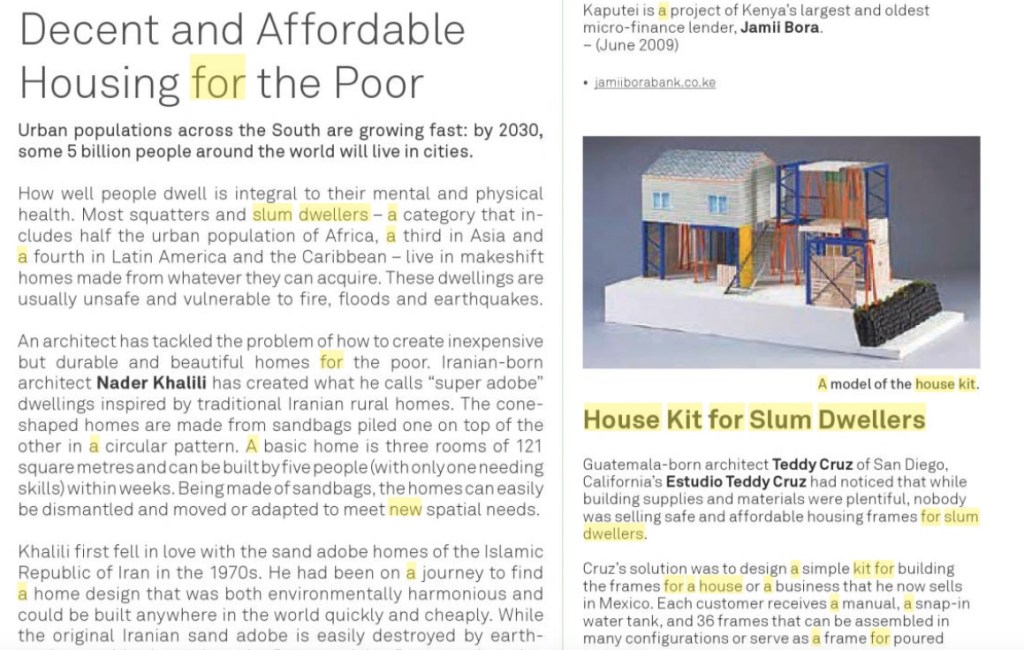
    Cruz’s solution was to design a simple kit for building the frames for a house or a business that he now sells in Mexico. Each customer receives a manual, a snap-in water tank, and 36 frames that can be assembled in many configurations, or serve as a frame for poured concrete. These sturdy frames can also be added to with locally found materials. Cruz said he was inspired by “the resourcefulness of poverty” and by the cheap and affordable pre-fabricated homes that once were sold by catalogue by the American retailer Sears.

    Cruz has been testing the structures in Tijuana, Mexico – a rapidly growing city on the border with the United States and a destination for Mexico’s poor. His work as an architect has centred on exploring how informal settlements grow faster than the cities they surround. These settlements, he says, break the rules and blur the boundaries between what is urban, suburban and rural. Cruz’s frame kits can be used to build a home, or combination of home and business, acknowledging the fact many people need to use their home as a business for a livelihood.

    “These start-up communities gradually evolve,” said Cruz., ”or violently explode out of conditions of social emergency, and are defined by the negotiation of territorial boundaries, the ingenious recycling of materials, and human resourcefulness.”

    Published: July 2007

    Resources

    There are many ways to play around with your dwelling and architecture ideas. Here are some products available online:

    1. Arckit: Arckit is a tangible and hands-on design tool for spontaneously bringing your architectural ideas to life right before your eyes. Website: https://www.arckit.com
    2. SmartLab Archi-TECH Electronic Smart House: Build your house and power it up! This creative STEAM toy allows aspiring architects and engineers to design and build modular structures – and then power them up with lights, sounds, sensors, and motorized parts! Website: https://www.mastermindtoys.com/products/smart-lab-archi-tech-electronic-smart-house

    Development Challenges, South-South Solutions was launched as an e-newsletter in 2006 by UNDP’s South-South Cooperation Unit (now the United Nations Office for South-South Cooperation) based in New York, USA. It led on profiling the rise of the global South as an economic powerhouse and was one of the first regular publications to champion the global South’s innovators, entrepreneurs, and pioneers. It tracked the key trends that are now so profoundly reshaping how development is seen and done. This includes the rapid take-up of mobile phones and information technology in the global South (as profiled in the first issue of magazine Southern Innovator), the move to becoming a majority urban world, a growing global innovator culture, and the plethora of solutions being developed in the global South to tackle its problems and improve living conditions and boost human development. The success of the e-newsletter led to the launch of the magazine Southern Innovator.  

    Follow @SouthSouth1

    Like this story? Here is a dirty secret: this website is packed with stories about global South innovators. We spent 7 years researching and documenting these stories around the world. We interviewed the innovators to learn from them and we visited them to see how they did it. Why not use the Search bar at the top and tap in a topic and see what stories come up? So, stick around and read some more!    

    Archive.org: https://archive.org/details/Httpwww.slideshare.netDavidSouth1development-challengessouthsouthsolutionsjuly2007issue

    Slideshare: http://www.slideshare.net/DavidSouth1/development-challengessouthsouthsolutionsjuly2007issue

    Southern Innovator Issue 1: https://books.google.co.uk/books?id=Q1O54YSE2BgC&dq=southern+innovator&source=gbs_navlinks_s

    Southern Innovator Issue 2: https://books.google.co.uk/books?id=Ty0N969dcssC&dq=southern+innovator&source=gbs_navlinks_s

    Southern Innovator Issue 3: https://books.google.co.uk/books?id=AQNt4YmhZagC&dq=southern+innovator&source=gbs_navlinks_s

    Southern Innovator Issue 4: https://books.google.co.uk/books?id=9T_n2tA7l4EC&dq=southern+innovator&source=gbs_navlinks_s

    Southern Innovator Issue 5: https://books.google.co.uk/books?id=6ILdAgAAQBAJ&dq=southern+innovator&source=gbs_navlinks_s

    Creative Commons License

    This work is licensed under a
    Creative Commons Attribution-Noncommercial-No Derivative Works 3.0 License.

    ORCID iD: https://orcid.org/0000-0001-5311-1052.

    © David South Consulting 2023

  • Ugandan Fish Sausages Transform Female Fortunes

    Ugandan Fish Sausages Transform Female Fortunes

    By David SouthDevelopment Challenges, South-South Solutions

    SOUTH-SOUTH CASE STUDY

    What to do when your food production enterprise is just not making much money? It is a common problem in the global South, where farmers and fishers often struggle to survive and can face the threat of bankruptcy and destitution when trying to provide essential food for their communities.

    Some fish farmers in Uganda – many of them women – were caught up in this dilemma, unable to find a way to make a good income from the fish they were harvesting.

    But a lucky hire for one fish cooperative, in the form of a humble secretary, has turned into a business and food success story that is getting set to jump across borders in Africa.

    Lovin Kobusingya is the former secretary and university graduate who, through tenacity and ingenuity, has built a business selling fish sausages that has become a hit in Kampala, Uganda in East Africa.

    Through trial and error, Kobusingya came upon the idea of turning the fish into sausages. The product, basically unknown in Uganda before, became a tidy solution to the dilemma of how to sell fish at a premium price that could boost the income of the farmers.

    She joins the growing number of female entrepreneurs in Africa. Africa has the highest rate of female entrepreneurship in the world, according to the World Bank, which says two-thirds of women in Africa are in the labour force.

    The 29-year-old mother of two set up Kati Fish Farms (http://katifarms.org) and Kati Farm Supplies Ltd. and now sells 500 kilograms of fish sausage a day.

    Located in the country’s capital, Kampala, Kati Farm Supplies Ltd. prepares and sells a wide range of food products made with chicken, beef, fish, pork, goat, lamb and honey.

    Kobusingya is notable not only for her success as a food entrepreneur, but also for the way she has generated attention and excitement around her business and products.

    According to Kenya’s Nation newspaper, Kobusingya boosted her profile by gaining customers in Uganda’s hotels.

    She graduated six years ago from Makerere University in Kampala (http://mak.ac.ug) and originally planned to go into banking. Like many graduates, she found it hard to break into the sector and get a steady job. After a year of frustrating job hunting, she found a position as a secretary with a fish cooperative society.

    “I got a job after a rigorous interview,” she told the Nation. “It was not well-paying.

    “The most challenging part of the job was dealing with fish farmers, who were grappling with an unsteady market for their produce.”

    Despite all the problems facing the fish industry, Kobusingya became inspired to do something about it. Rather than just hoping market prices would turn in favour of the fish farmers, she diversified the cooperative’s products to add value to the raw fish ingredients.

    “Most of our members were women who had taken up aquaculture (fish farming),” she said. “At the time, this was still a novelty.”

    It is a tale of trial and error, as Kobusingya tells it.

    “We tried selling our products, such as fish feeds, and even selling directly to consumers. But I felt that there was something more we could do to help the farmers even more.”

    Becoming frustrated with the constraints of her role, she decided to start the business on top of her day job. She started buying fish directly from the farmers, filleting it herself and selling it to customers.

    Yet, still fish was not selling and going to waste.

    Then the eureka moment came: make fish sausages. This had never been done in Uganda and she set about undertaking research on the Internet to learn how to do it.

    “I assembled bits and pieces of information from the Net on how to make the sausages,” Kobusyingya said.

    “Everywhere I went seeking more information, people thought I was out of my mind.

    “Nobody had heard of fish sausages but I received support from the Uganda Industrial Research Institute in 2011. They helped me to develop a formula for the product,” she said.

    With the new product developed, Kobusingya tried selling it to the hotels in Kampala. And this was the crucial moment when her fortunes changed: people were excited by the new and novel product.

    The first orders earned her US $800 and with that jolt of cash, she was able to launch the product in February 2012.

    Production started at 100 kilograms of fish sausage a day. By the third month, she was able to produce 500 kilograms a day. And because the product is so popular, she is running hard to meet demand from hotels, food outlets and institutions.

    Expanding into selling smoked fish and frozen chicken and beef, she is now working with 470 fish farmers, most of whom are women.

    “This business has motivated farmers throughout Uganda,” she said.

    “The enterprise, now worth about Ush50 million (US $19,230), has 16 permanent employees,” she said.

    She also took the fish sausages on the road and introduced them to the SmartFish trade event in Lusaka, Zambia, where they became a hit with attendees.

    SmartFish (http://www.smartfish-coi.org/#!home/mainPage) is funded by the European Union through the European Development Fund and is implemented by the Indian Ocean Commission in partnership with regional trade organizations. The objective of the event was to increase trade within the region.

    With her confidence further boosted by the positive international reaction, Koubusingya is exploring how to sell into Kenya, Tanzania, Rwanda and Burundi.

    “I always knew I was a businesswoman,” she told The New York Times. “When I was in high school, I used to sell illegal sweets. And I made money.”

    “I am very happy and proud” of being a female entrepreneur. “When I was young, they said: ‘A woman is a woman – a man should take care of you.’ But women are actually contributing a lot more than men. We always find ourselves multitasking,” when juggling work and a family.

    Published: November 2012

    Resources

    1) SmartFish: The SmartFish Programme aims at contributing to an increased level of social, economic and environmental development and deeper regional integration in the ESA-IO region through improved capacities for the sustainable exploitation of fisheries resources. Website: http://fisheries.ioconline.org/smartfish.html

    2) Southern Innovator Issue 3: Agribusiness and Food Security: Packed with tips and tales on how to tackle the challenges of making food production pay. Website: http://www.scribd.com/doc/105746025/Southern-Innovator-Magazine-Issue-3

    3) Uganda Industrial Research Institute: Uganda Industrial Research Institute is Uganda Government’s lead agency for industrialization. Website: http://www.uiri.org/

    4) A photo gallery showing the harvesting of the fish and the making of the sausages. Website: http://katifarms.org/index.php?option=com_content&view=article&id=70&Itemid=90 

    https://davidsouthconsulting.org/2022/11/21/agribusiness-food-security/

    https://davidsouthconsulting.org/2021/06/04/an-innovators-big-chicken-agenda-for-africa/

    https://davidsouthconsulting.org/2021/03/04/food-diplomacy-next-front-for-souths-nations/

    https://davidsouthconsulting.org/2022/02/10/food-inflation-ways-to-fight-it/

    https://davidsouthconsulting.org/2021/02/22/new-paper-citation-for-southern-innovator-issue-3/

    https://davidsouthconsulting.org/2021/09/16/small-fish-farming-opportunity-can-wipe-out-malnutrition/

    https://davidsouthconsulting.org/2021/03/05/southern-innovator-issue-3/

    https://davidsouthconsulting.org/2022/10/18/woman-wants-african-farming-to-be-cool/

    Development Challenges, South-South Solutions was launched as an e-newsletter in 2006 by UNDP’s South-South Cooperation Unit (now the United Nations Office for South-South Cooperation) based in New York, USA. It led on profiling the rise of the global South as an economic powerhouse and was one of the first regular publications to champion the global South’s innovators, entrepreneurs, and pioneers. It tracked the key trends that are now so profoundly reshaping how development is seen and done. This includes the rapid take-up of mobile phones and information technology in the global South (as profiled in the first issue of magazine Southern Innovator), the move to becoming a majority urban world, a growing global innovator culture, and the plethora of solutions being developed in the global South to tackle its problems and improve living conditions and boost human development. The success of the e-newsletter led to the launch of the magazine Southern Innovator.  

    Follow @SouthSouth1

    Google Books: https://books.google.co.uk/books?id=D_A1VeiJWycC&dq=development+challenges+november+2012&source=gbs_navlinks_s

    Slideshare: http://www.slideshare.net/DavidSouth1/development-challenges-november-2012-issue

    Southern Innovator Issue 1: https://books.google.co.uk/books?id=Q1O54YSE2BgC&dq=southern+innovator&source=gbs_navlinks_s

    Southern Innovator Issue 2: https://books.google.co.uk/books?id=Ty0N969dcssC&dq=southern+innovator&source=gbs_navlinks_s

    Southern Innovator Issue 3: https://books.google.co.uk/books?id=AQNt4YmhZagC&dq=southern+innovator&source=gbs_navlinks_s

    Southern Innovator Issue 4: https://books.google.co.uk/books?id=9T_n2tA7l4EC&dq=southern+innovator&source=gbs_navlinks_s

    Southern Innovator Issue 5: https://books.google.co.uk/books?id=6ILdAgAAQBAJ&dq=southern+innovator&source=gbs_navlinks_s

    Creative Commons License

    This work is licensed under a
    Creative Commons Attribution-Noncommercial-No Derivative Works 3.0 License.

    ORCID iD: https://orcid.org/0000-0001-5311-1052.

    © David South Consulting 2023

  • Microwork Pioneer Transforms Prospects For Poor, Vulnerable

    Microwork Pioneer Transforms Prospects For Poor, Vulnerable

    By David SouthDevelopment Challenges, South-South Solutions

    SOUTH-SOUTH CASE STUDY

    A pioneering technology social enterprise has found a way to connect people around the world to the new digital economy, transforming their lives and providing long-term employment opportunities. It is closing the digital divide in a very practical way, teaching new skills and, most importantly, providing income to the poor and vulnerable.

    The San Francisco, USA-based non-profit social enterprise Samasource (samasource.org) uses what it calls microwork – a virtual assembly line of small tasks broken down from a larger project so they can be completed over the Internet – to outsource work to its network of workers around the world.

    The tasks in this virtual piecework range from writing to transcribing to organizing online content.

    The company organizes the projects using its own online work distribution system connecting workers around the world to the SamaHub in San Francisco. Most of the workers are women, youth and refugees. When they complete their task, it is sent back to the SamaHub in San Francisco where the staff check it and assure its quality. Once approved and completed, the project is returned to the client.

    The company was founded in 2008 and draws on experts in “distributed work, economic development, and outsourcing.”

    The microwork is divided into three areas: content services, data enrichment and transcription.

    Content services can include writing descriptions for online business listings, organizing large databases on information or creating brief descriptions of existing content to make it easier for search engines to find it. “Data enrichment” tackles the vast quantity of information on the Internet that needs to be kept up to date and reliable. It also includes ‘tagging’, where text or images on the Internet need to have appropriate ‘tags’ or labels. And finally, transcription services include digitizing paper documents like receipts or books or transcribing audio and video files for the web.

    All these tasks are labour intensive and require high attention to detail. And they are critical to any online business’s success if it wants a reputation for accuracy and consistency.

    Samasource is optimistic about its future potential because of the sheer size of the market for business process outsourcing: estimated to be worth over US $100 billion. What Samasource does, called ‘impact sourcing’ – outsourcing to people in the developing world living in poor or remote communities – is a market worth US $5 billion, according to Samasource’s website.

    It differs from conventional business process outsourcing in a number of respects, including the educational background of the workers. Most conventional outsourcing goes to college graduates in cities in India, China and the Philippines. Impact outsourcing is done by people with at most a high school education.

    The digital economy needs these workers to handle the many millions of detailed tasks required to link together information. It is easy to take this for granted because it is hidden from view, but it is what enables the Internet to function and businesses to thrive. Samasource provides outsourcing services including content moderation and data entry to clients like LinkedIn, Intuit and the US State Department.

    “We bring dignified, computer-based work to women, youth, and refugees living in poverty,” said Samasource’s founder and chief executive officer, Leila Janah.

    Janah has a background in development studies and formerly worked for the World Bank. This experience convinced her that much foreign aid was failing to target what poor people are really looking for: a job that pays well.

    Samasource sees what it does as work, and not handouts.

    It also believes it is changing perspectives, proving people from the poorest places on earth can become trustworthy, hard-working knowledge workers.

    The Internet is a unique medium because it transcends borders and smooths contact between people with varying linguistic, cultural and educational capabilities.

    “The Internet reduces the friction of collaboration across all of these centres and time zones, and with a highly distributed workforce,” said Janah.

    Samasource claims to have paid out US $1 million in wages to more than 1,500 workers around the world. Ambitiously, it wants to expand this to reach some of the 144 million youth between 16 and 24 living on less than US $2 a day.

    Youth are a particular focus for Samasource. Samasource targets young people who are literate and have received an education but still can’t get a job.

    As for the many women employed by Samasource, they were either unemployed or earning poverty-level wages doing precarious work in low-level manufacturing and not building their skills.

    Samasource currently has 16 partnerships in Haiti, India, Pakistan, Kenya, Uganda and South Africa. Criteria to work with Samasource includes being in a high-poverty region. Another criteria is for most of the money earned to stay within the region where the work is done and adhere to the standards laid down by Samasource.

    Samasource’s success means it has attracted further funding. In December 2011, it was given a US $1.5 million grant from Google.org – the Google.com search engine’s charity. It has also raised US $5 million from non-profit investors, including the Ford Foundation, the Rockefeller Foundation and the eBay Foundation. The challenge for the Samasource model will be to prove, with this new funding, that it can scale its operations to pay out more to its workers than it is taking in to meet its operating costs.

    Microwork is turning out to be big work indeed!

    Published: January 2012

    Development Challenges, South-South Solutions was launched as an e-newsletter in 2006 by UNDP’s South-South Cooperation Unit (now the United Nations Office for South-South Cooperation) based in New York, USA. It led on profiling the rise of the global South as an economic powerhouse and was one of the first regular publications to champion the global South’s innovators, entrepreneurs, and pioneers. It tracked the key trends that are now so profoundly reshaping how development is seen and done. This includes the rapid take-up of mobile phones and information technology in the global South (as profiled in the first issue of magazine Southern Innovator), the move to becoming a majority urban world, a growing global innovator culture, and the plethora of solutions being developed in the global South to tackle its problems and improve living conditions and boost human development. The success of the e-newsletter led to the launch of the magazine Southern Innovator.  

    Follow @SouthSouth1

    Like this story? Here is a dirty secret: this website is packed with stories about global South innovators. We spent 7 years researching and documenting these stories around the world. We interviewed the innovators to learn from them and we visited them to see how they did it. Why not use the Search bar at the top and tap in a topic and see what stories come up? As for my work, I have been involved with start-ups and media ventures since the early 1990s. In the years since I have learned a great deal about innovation and digital and have shared these insights in the stories on this website as well as in the 5 issues of Southern Innovator magazine. So, stick around and read some more!    

    Google Books: https://books.google.co.uk/books?id=qLYTxcC8HgcC&dq=development+challenges+january+2012&source=gbs_navlinks_s

    Slideshare: http://www.slideshare.net/DavidSouth1/development-challengessouthsouthsolutionsjanuary2012issue

    Southern Innovator Issue 1: https://books.google.co.uk/books?id=Q1O54YSE2BgC&dq=southern+innovator&source=gbs_navlinks_s

    Southern Innovator Issue 2: https://books.google.co.uk/books?id=Ty0N969dcssC&dq=southern+innovator&source=gbs_navlinks_s

    Southern Innovator Issue 3: https://books.google.co.uk/books?id=AQNt4YmhZagC&dq=southern+innovator&source=gbs_navlinks_s

    Southern Innovator Issue 4: https://books.google.co.uk/books?id=9T_n2tA7l4EC&dq=southern+innovator&source=gbs_navlinks_s

    Southern Innovator Issue 5: https://books.google.co.uk/books?id=6ILdAgAAQBAJ&dq=southern+innovator&source=gbs_navlinks_s

    Creative Commons License
    This work is licensed under a
    Creative Commons Attribution-Noncommercial-No Derivative Works 3.0 License.

    ORCID iD: https://orcid.org/0000-0001-5311-1052.

    © David South Consulting 2021

  • Gobi Desert Wine to Tackle Poverty and Boost Incomes

    Gobi Desert Wine to Tackle Poverty and Boost Incomes

    By David South, Development Challenges, South-South Solutions

    SOUTH-SOUTH CASE STUDY

    In the arid Gobi Desert spanning the two Asian nations of China and Mongolia is a bold attempt to make wine and reduce poverty. The environment is harsh, with temperatures swinging from sub-zero winter cold to sweltering summer heat. The desert is also home to high winds and notorious dust storms that plague China’s capital Beijing every year.

    China’s wine industry is booming as people have embraced the drink’s perceived health-giving qualities and are using it to celebrate new-found wealth as the economy has flourished. Current wine consumption in China is half a litre per person per year, low compared to the French average of 55 litres a year. But this is growing quickly.

    Well-known brands include Great Wall, Dynasty and Changyu (http://www.changyu.com.cn/english/index.html), which is considered the world’s 10th largest wine producer.

    One innovative winery is using this wine boom to tackle poverty and increase local wealth.

    Chateau Hansen (hansenwine.com) in Inner Mongolia has been operating since the 1980s, but recent expansion and modernization have significantly increased its earning power and the number of people it employs. Located in an area with high levels of poverty, it has developed a successful wine business in the desert by tapping the plentiful water supplies from the Yellow River. The area is now considered one of the best for growing wine grapes in China.

    Located near Wuhai city (http://en.wikipedia.org/wiki/Wuhai), 670 kilometres west of Beijing, Chateau Hansen has 250 hectares of Merlot, Cabernet Sauvignon and Cabernet Gernischt grapevines.

    The vines are buried under the sand to protect them from the harsh weather in the winter.

    “The lowest temperature gets down to is below -20 degrees C (Celsius), but in summer, it can reach 38 or 40 degrees C (102 or 104 F),” Li Aixin, Chateau Hansen’s head of viticulture, told MSNBC. “Here the four seasons are good for the growth of the grapes, but in the winter we need to bury them in the earth” to keep them from freezing. Hansen has been ambitious in its approach. It has a European-style chateau, hotel and even a French wine expert, Bruno Paumard, on site to help with the wine making. The chateau’s cellar now stores 1,000 barrels of wine.

    Paumard arrived in China in 2005. He has thrown himself into Chinese culture and tasted and tested the country’s wines. Hansen has produced 400,000 bottles of wine, mostly sold in China, where red wine drinking has become a big part of the culture of celebration.

    Hansen sells the majority of its wine to government organizations and regional enterprises. It has seen its profits double to 100 million yuan (US $18 million) in 2011 and hopes sales will double again in 2012.

    “Eighty per cent of the market in China is really the local governments who encourage the enterprises in their cities to consume red wine, of a certain brand, at their banquets in the place of Chinese ‘baijiu’ for their incessant and never-ending toasts,” said Paumard, referring to China’s home-grown rice wine. “So it’s actually a market that’s totally unique.”

    Hansen’s Cotes du Fleuve Jaune du Desert de Gobi has become one of the biggest award-winning wines in China. It received a bronze medal from the International Wine Challenge of Blaye, near Bordeaux, France.

    China now stands as the world’s fifth-largest consumer of wine (International Wine and Spirit Research study) (http://www.iwsr.co.uk/). The market in China is forecast to grow by 54 per cent from 2011 to 2015, adding up to a billion bottles.

    A map of China’s vineyards and their terroir or soil conditions shows a diverse wine-making sector (http://www.hansenwine.com/english/vineyardlink.html).

    In this busy marketplace, Hansen prides itself on being organic. It also has the goal of turning the arid desert into green vineyards using irrigation from the Yellow River and groundwater. It wants to create employment and raise living standards in the region and is fitting into a national strategy to raise living standards for poor regions.

    There is a training programme for the around 400 workers employed by the winery. No pesticides are used and only sheep dung is used as a fertilizer provided by 3,000 sheep on site. Trees also play a role in providing humus (http://en.wikipedia.org/wiki/Humus) for the vines. There is also accommodation in a nearby village for the employees.

    There are 250 hectares of vineyards and the grapes are harvested by hand. Expansion began in 2001 when the chateau and winery were built. It is strategically located just 500 metres from an airport and the chateau has a luxury hotel. Around 20,000 people visit a year, according to Hansen’s website, bringing in further income for the winery. The winery also uses Mongolian culture and cuisine as a selling point to attract tourists.

    The chief executive of Hansen is Han Jianping, who made his first fortune in real estate development.

    Han believes that “the momentum of growth in the wine industry is huge.”

    “With a great foundation of more than 1 billion people as we have in China, and (the industry) growing at 20 or 30 per cent a year, there is a huge potential for more growth,” he said.

    Republished in 2021 in cnwinenews.com.

    Resources

    1) China Wine Online: An information service that also produces the China Wine Business magazine and runs the China Wine Study Tour. Website: http://www.winechina.com/en/index.asp

    2) The 10th Shanghai International Wine and Spirits Expo 2013: Website: http://www.winefair.com.cn/sugar/en/index.asp

    Creative Commons License

    This work is licensed under a
    Creative Commons Attribution-Noncommercial-No Derivative Works 3.0 License.

    We accept payments and donations. We use any funds received to keep content online, or to create new content. Thank you! https://www.paypal.me/davidsouthconsulting.

    Scan code with your phone and help us out.

    More on the Gobi Desert here:

    Development Profile: UNDP In The Southern Gobi Desert | May-June 1998

    Kommunikation total: Der siebte Kontinent

    Wild East 17 Years Later | 2000 – 2017

    ORCID iD: https://orcid.org/0000-0001-5311-1052.

    © David South Consulting 202421