Tag: SDG1

  • Traditional Medicine is now a Proven Remedy

    Traditional Medicine is now a Proven Remedy

    By David SouthDevelopment Challenges, South-South Solutions

    SOUTH-SOUTH CASE STUDY

    Once dismissed as old fashioned, ineffective and unscientific, traditional medicine is now seen as a key tool in bringing healthcare and healing to poor people bypassed by existing public and private health measures.

    Acknowledging traditional medicine as a useful tool goes back to the World Health Organisation’s Alma-Ata Declaration in 1978, which urged governments for the first time to include traditional medicine in their primary health systems and recognise traditional medicine practitioners as health workers. During the last 30 years there has been a considerable expansion in the use of traditional medicine across the world. Despite their ancient origins, it is still critical these medicines do meet efficacy and health standards and are proven to work.

    In Mongolia, when the Soviet Union collapsed a decade and a half ago, new market forces meant that supplies of conventional medicines became prohibitively expensive for most of the population. With one doctor for 600 people in the rural areas – and the vast distances to be covered – medical services were virtually unobtainable in rural communities.

    This situation led to a revival of Mongolia’s 2,000-year-old traditional medicine. This includes acupuncture, cauterisation, manual therapy, blood letting and therapies using mares’ milk – all integral to the rural way of life.

    Research by the Japanese Nippon Foundation – the largest private foundation in Japan – explored how Mongolia’s public health care could be improved through traditional medicine. It focused on the possible use of traditional medicine alongside Western medicine, the depth of faith in traditional medicine, the affordability of traditional medicine, and the lifestyles of herdsmen living in remote areas away from hospitals. The project, launched in 2004, distributes medical kits with 12 types of traditional medicines to households in rural areas. As they use them, the households pay for them. The kits, which mostly target stomach and intestinal ailments and fever, have so far been distributed to 10,000 households (50,000 people) across the country. The Foundation found doctors’ house calls were down by 25 per cent after one year of the project.

    In India, Gram Mooligai and its Village Herbs label helps bring quality healthcare to the country’s 170 million rural poor currently left out by public healthcare programmes, or who can’t afford private services. At present, the Indian government has been unable to find adequate funds to provide healthcare to all its people. Gram Mooligai uses a network of 300 women health practitioners to reach villagers who spend on average US $50 a year on health services – so far, they reach 30,000 households. It has built trust with the poor by offering herbal remedies based on India’s strong Ayruvedic heritage of herbal healing. It also draws on India’s rich biodiversity by harvesting medicines sustainably from native plant species – over 18,000 are known.

    The company is owned by a network of rural growers that manufacture herbal remedies like Trigul balm for joint pain, Sugam cough syrup and Jwaracin fever reducer. Gram Mooligai combines modern heathcare with local remedies familiar to rural villagers.

    The website gives a good example of this folksy approach. In answer to a villager whose daughter is complaining of pain in her legs and back, the villager is advised to give her milk and ghee (clarified butter). “Add nuts and dry fruits to her daily diet in small quantity. If she is lean, then a weekly massage with Lakshadi Thailam (which is available in the Ayurvedic shops) is very useful. Slightly warm the oil before massage and add a pinch of common salt to the oil for better absorption.”

    Published: September 2007

    Resources

    • Mongolian Traditional Medicine Website: www.baigal.com
    • Asia-Pacific Traditional Medicine and Herbal Technology Network: an excellent first stop for any entrepreneur, where they can find out standards and regulations and connect with education and training opportunities: www.apctt-tm.net and www.aptm.cn

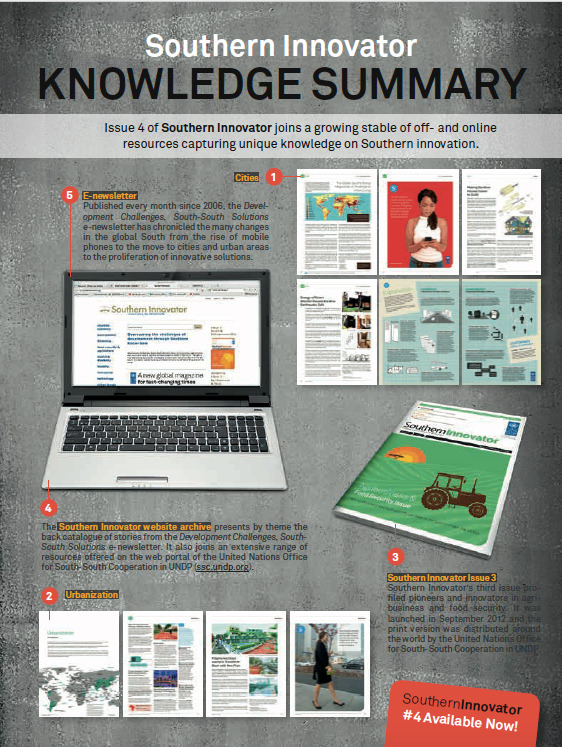
    Development Challenges, South-South Solutions was launched as an e-newsletter in 2006 by UNDP’s South-South Cooperation Unit (now the United Nations Office for South-South Cooperation) based in New York, USA. It led on profiling the rise of the global South as an economic powerhouse and was one of the first regular publications to champion the global South’s innovators, entrepreneurs, and pioneers. It tracked the key trends that are now so profoundly reshaping how development is seen and done. This includes the rapid take-up of mobile phones and information technology in the global South (as profiled in the first issue of magazine Southern Innovator), the move to becoming a majority urban world, a growing global innovator culture, and the plethora of solutions being developed in the global South to tackle its problems and improve living conditions and boost human development. The success of the e-newsletter led to the launch of the magazine Southern Innovator.

    Creative Commons License

    This work is licensed under a
    Creative Commons Attribution-Noncommercial-No Derivative Works 3.0 License.

    ORCID iD: https://orcid.org/0000-0001-5311-1052.

    © David South Consulting 2022
  • Cooking up a Recipe to End Poverty

    Cooking up a Recipe to End Poverty

    By David SouthDevelopment Challenges, South-South Solutions

    SOUTH-SOUTH CASE STUDY

    Like music, food has a powerful ability to jump across cultural and regional barriers and unite people in the sheer pleasure of the meal. Tapping the rich vein of regional culinary heritages is also a great way to make money. Promoting local recipes and foods has other benefits: as the global obesity (or globesity as WHO calls it) epidemic reaches into the urban areas of cities in the developing world, anything that pulls people away from fast food and high-fat foods is a good thing. Doctors have found home cooking keeps people thin and is better for them.

    The trend across the developing world towards eating away from home is another factor in the growing obesity crisis. While cooking at home allows for control of ingredients and portion sizes, eating out usually means more high energy and fatty foods. The global obesity crisis is threatening to reverse many essential health gains brought about by development. As communities prosper, diets become more reliant on junk food and fast food.

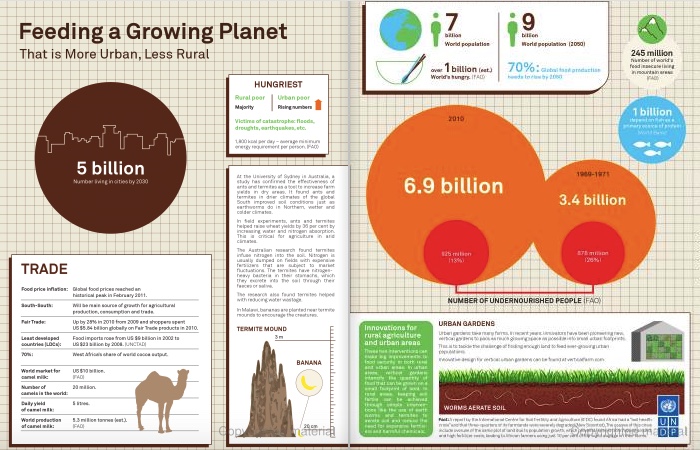
    The International Obesity Task Force found 1.7 billion people in the world need to lose weight. There are now more overweight people in the world than hungry people. Neville Rigby, the policy director of the task force, told The Associated Press, “What’s clear is that the developing world in particular is going to bear the enormous brunt of this weight gain. It’s rapidly accelerating. We’re even seeing obesity in adolescents in India now. It’s universal. It has become a fully global epidemic – indeed, pandemic.”

    According to Dr Susan Jebb, Medical Research Council Director of Studies, Human Nutrition Centre, University of Cambridge, “getting back to a bit of home cooking could be a good start” to tackling the obesity crisis.

    Increasing awareness of traditional and local recipes can generate income in many ways. From publishing cookbooks to inspiring restaurant and food vendor menus to sparking up supermarket product lines, whole industries can be built up from the humble recipe. Supermarkets in Africa are a growing sector. Executives from South Africa’s Shoprite supermarket chain recently announced a doubling of their supermarkets in Uganda, and called supermarkets one of the fastest growing businesses in East Africa. UK supermarket chain Sainsbury’s has already started to dispatch Fairtrade Ambassadors to Africa to trawl the continent for new products to stock their shelves.

    So, the time is right for entrepreneurs to target the African food market and raise its profile. Seizing this opportunity is an ambitious project to digitally archive the vast and often hard-to-find treasure trove of African cookbooks. Announced at a conference in Tanzania this summer, the African Cookbook Project is seeking to gather together in one place all the past and present African cookbooks, effectively creating the most comprehensive resource of African recipes.

    Published: August 2007

    Resources

    • Africooks: Culinary Literature by Jessica B. Harris: This established African cookbook writer offers an excellent role model for budding cookbook authors: www.africooks.com
    • A success story about a Senagalese restaurant in the US: NYTimes article
    • BetumiBlog and Betumi.com (www.betumi.com): Betumi is the African Culinary Network and “connects anyone who delights in African cuisine, foodways and food history.” View photos.
    • An extensive list of African cookbooks available for sale: here
    • Africa’s Big Seven: held every year, it is the main event that brings together food retailers and producers and is a perfect place to bring a new product looking to be launched.

    https://davidsouthconsulting.org/2022/11/21/agribusiness-food-security/

    https://davidsouthconsulting.org/2022/11/10/brazilian-restaurant-serves-amazonian-treats/

    https://davidsouthconsulting.org/2022/06/24/dabbawallahs-use-web-and-text-to-make-lunch-on-time/

    https://davidsouthconsulting.org/2022/11/11/havanas-restaurant-boom-augers-in-new-age-of-entrepreneurs/

    https://davidsouthconsulting.org/2022/10/14/indias-modernizing-food-economy-unleashing-new-opportunities/

    https://davidsouthconsulting.org/2022/05/04/insects-can-help-in-food-crisis/

    https://davidsouthconsulting.org/2022/10/24/latin-american-food-renaissance-excites-diners/

    https://davidsouthconsulting.org/2022/10/20/new-appetite-for-nutritious-traditional-vegetables/

    https://davidsouthconsulting.org/2023/03/27/rats-a-solution-in-food-crisis/

    https://davidsouthconsulting.org/2021/03/05/southern-innovator-issue-3/

    https://davidsouthconsulting.org/2022/11/16/thai-organic-supermarkets-seek-to-improve-health/

    https://davidsouthconsulting.org/2022/11/11/woman-restaurant-entrepreneur-embraces-brand-driven-growth/

    Development Challenges, South-South Solutions was launched as an e-newsletter in 2006 by UNDP’s South-South Cooperation Unit (now the United Nations Office for South-South Cooperation) based in New York, USA. It led on profiling the rise of the global South as an economic powerhouse and was one of the first regular publications to champion the global South’s innovators, entrepreneurs, and pioneers. It tracked the key trends that are now so profoundly reshaping how development is seen and done. This includes the rapid take-up of mobile phones and information technology in the global South (as profiled in the first issue of magazine Southern Innovator), the move to becoming a majority urban world, a growing global innovator culture, and the plethora of solutions being developed in the global South to tackle its problems and improve living conditions and boost human development. The success of the e-newsletter led to the launch of the magazine Southern Innovator.

    Creative Commons License

    This work is licensed under a
    Creative Commons Attribution-Noncommercial-No Derivative Works 3.0 License.

    ORCID iD: https://orcid.org/0000-0001-5311-1052.

    © David South Consulting 2023

  • Securing Land Rights for the Poor Now Reaping Rewards

    Securing Land Rights for the Poor Now Reaping Rewards

    By David SouthDevelopment Challenges, South-South Solutions

    SOUTH-SOUTH CASE STUDY

    The hotly debated issue of land rights for the poor has never been more relevant. There is mounting evidence that access to land rights can catapult the poor out of poverty and spur growth for the economy. Experience in India and China is now showing the economic power unleashed when the poor gain full legal rights over their land. But it can be a thornier issue in Africa, where much land is still held under customary law, with people either holding it through their clan or tribe, or being considered as owners of where they live, without formal documents. Many countries are now adapting their laws to switch to a system of formal titles, but the process is very uneven and some question whether western-style property titles are appropriate in an African context.

    While there are many schemes to alleviate or eliminate poverty through micro-credit, grants or aid, some believe the secret is in creating a sound framework of property rights, giving poor people important collateral to raise money against the value of the land on which they live. The Peruvian economist, Hernando de Soto, has calculated that the total value of informal urban dwellings and rural land owned under customary law is around three times greater than Africa’s entire gross domestic product and 100 times greater than its foreign direct investment.

    But the urgency of this problem can be seen in the numbers of rural poor – many of whom will migrate to the world’s fast-growing cities. In China there are 800 million, in India the rural poor number 270 million and 70 percent of Africa’s 888 million (2005,UN) are rural poor.

    The Rural Development Institute (www.rdiland.org), an NGO based in Seattle, Washington, USA – and with offices and projects in India, China, Indonesia, Russia, Africa – uses lawyers to advocate and fight for land rights for the rural poor. To date, RDI has helped provide land rights to more than 100 million poor families worldwide. Their approach is called micro-owning whereby the poor are helped to acquire land assets. These are often small plots of land – sometimes 1/10th acre – that can provide the nutritional needs for a family and help them on the road to the virtuous cycle of long-term, sustainable and generational poverty alleviation.

    “Micro-ownership transforms the lives of the rural poor,” according to Radha Friedman, Associate Director, Development and Communication, just back from visiting RDI’s Indian projects. “Outside Bangalore in the state of Karnataka one woman who was landless worked two shifts a day in the hot sun. She was barely able to feed her children. She was making 8 to 10 rupees a day – when a bottle of water costs 10 rupees. We helped her secure a plot of land to grow jasmine flowers which she sells in the market. She now makes between 85 to 200 rupees a day. She can eat three times a day and her kids can afford to go to school. She said she had not thought about how far she had come, but it clearly showed she had such pride in what she had achieved. A number of Indian states have adopted this program, enabling people to purchase micro-gardens and micro-plots of land. It has been such a success that other Indian states are now showing interest.”

    “All of this didn’t happen overnight,” said Lincoln Miller, Chief Operations Officer at RDI. “We conducted lots of research and surveyed the rural poor. We analyzed how the laws were affecting them. It took a long time to change government attitudes. We hopefully find a voice in the government who will listen to us. They need to recognize that land rights are one of the best routes out of poverty. In Africa we are primarily working in Burundi, Rwanda and Angola. In addition to working with government to change national policy and laws, we also conduct awareness-raising and education at the grassroots level, especially targeting women. Land rights are a political issue. The majority of the world’s poor is rural. By giving them land rights this process can help mitigate migration to the city.”

    The benefits of owning land include improved family status, pride and hope, reduced hunger and improved family nutrition from crops produced on land , increased income from sale of excess production, improved rural health, including reduction in infant mortality and reduction in death from disease or infection due to malnutrition, labor-intensive and productivity-enhancing, investments in land motivated by secure land rights, increased family savings as a result of ability to invest in land improvements, ability of poor to benefit from any market increases in land values, enhanced capacity to conduct micro-enterprise activities, empowerment of women, and decreased pressure to migrate to already crowded urban areas.

    However in South Africa, land rights have been further complicated by the legacy of apartheid. In 1994, 80 percent of farmland was in white hands. The ruling African National Congress (ANC) want to see 30 percent of that transferred to black ownership by 2015. Blacks are also able to claim ownership for land as long as they live on it.

    The strong reaction against past experiments in collectivizing land can be understood in the experience of Zambia. Under President Kenneth Kaunda, everything was nationalized, from copper mines to corner shops. Average annual incomes almost halved in 40 years despite the country receiving more aid per head of population than virtually any other in the world.

    Any organizations or individuals seeking land rights need only to contact the RDI by email to get the legal ball rolling.

    Published: February 2007

    Resources

    • The Centre on Housing Rights and Evictions tracks forcible evictions from land. In its latest global survey of forced evictions from 2003-2006 reveals that nearly 2 million people in Africa and over 2.1 million people in Asia and the Pacific have been forcibly evicted from their homes since 2003. http://www.cohre.org/
    • Based in Cape Town, South Africa, the Shack/Slum Dwellers International targets the plight of people living in semi-urban and urban areas: http://www.sdinet.org/
    • The Cities Alliance: Cities without Slums links together a global coalition of cities and their development partners committed to scaling up successful approaches to poverty reduction: http://www.citiesalliance.org/index.html
    • Rural Development Institute: Email: info@rdiland.org Website: http://www.rdiland.org

    Development Challenges, South-South Solutions was launched as an e-newsletter in 2006 by UNDP’s South-South Cooperation Unit (now the United Nations Office for South-South Cooperation) based in New York, USA. It led on profiling the rise of the global South as an economic powerhouse and was one of the first regular publications to champion the global South’s innovators, entrepreneurs, and pioneers. It tracked the key trends that are now so profoundly reshaping how development is seen and done. This includes the rapid take-up of mobile phones and information technology in the global South (as profiled in the first issue of magazine Southern Innovator), the move to becoming a majority urban world, a growing global innovator culture, and the plethora of solutions being developed in the global South to tackle its problems and improve living conditions and boost human development. The success of the e-newsletter led to the launch of the magazine Southern Innovator.

    Creative Commons License

    This work is licensed under a
    Creative Commons Attribution-Noncommercial-No Derivative Works 3.0 License.

    ORCID iD: https://orcid.org/0000-0001-5311-1052.

    © David South Consulting 2022

  • Tourist Passion for Quirky Holidays Helps South

    Tourist Passion for Quirky Holidays Helps South

    By David SouthDevelopment Challenges, South-South Solutions

    SOUTH-SOUTH CASE STUDY

    Conventional thinking holds that any country with a poor or non-existent reputation in the international media will not attract tourists. But this conventional thinking is wrong: The hottest tourist trend for 2009 is directly benefiting the South’s more out-of-the-way and under-appreciated countries. So says a travel expert who specializes in overlooked travel destinations.

    Prior to the economic downturn, tourism accounted for more than 10 percent of global GDP and 8 percent of total employment worldwide. It grew by 6 percent in 2007, according to the UN World Tourism Organization. Tourism in the Asia-Pacific region grew by 10 percent and Africa by 8 percent.

    But it has since declined by 8 percent between January and April of 2009 compared to the same period in 2008. Destinations worldwide recorded a total of 247 million international tourist arrivals in those four months, down from 269 million in 2008 (UNWTO World Tourism Barometer).

    This means competition is heating up for tourists. Well-travelled tourists are now looking for out-of-the-way places and places far off the beaten track. They want to be unique and have a tale to tell when they get home.

    Tony Wheeler, author of the book Bad Lands: A Tourist on the Axis of Evil and co-founder of the Lonely Planet travel guides, said “Lots of tourists want to be the first through the door.”

    During the Fitur Travel Fair in Madrid in January 2009, Myanmar (formerly Burma) appeared for the first time. Europe’s biggest travel fair also saw Zimbabwe, the Palestinian territories and Iran chasing travellers to come and see the sights.

    Wheeler told Britain’s Daily Telegraph newspaper that, ironically, the more negative reports in the media a country gets, the more this new breed of tourist want to visit and find out the truth.

    And his travel experiences have taught him, for example, the Burmese people do not believe in isolation and boycotts, as he wrote in the Guardian.

    “Over the three decades since my first visit, tourism has grown from 20,000 tourists a year to more than 100,000.”
    “Cutting the country off from the rest of the world isn’t going to help. We recently received a letter from one of our Burma authors saying the psychological damage of being isolated can be as bad as the economic damage.”

    North Korea – which was labelled part of the “axis of evil” by President George W. Bush – saw its foreign tourist numbers rise to 4,500 in 2008 from just 600 in 2001.

    Ross Kennedy of Africa Albida Tourism, which operates safari lodges in Zimbabwe, said bad headlines hurt but presenting an alternative view can reverse apprehension and lure tourists to come.

    The lodges saw a 4 percent rise in visitors in 2008 in spite of chaotic elections in Zimbabwe that drew negative press.

    “You certainly can’t write off an entire destination because of the choices or behaviour of a few individuals,” Kennedy told the Telegraph.

    Tourism is now generally recognized to be one of the largest industries in the world, if not the largest. It has grown rapidly and almost continuously over the past 20 years, and is now one of the world’s most significant sources of employment and of Gross Domestic Product (GDP). Tourism particularly benefits the economies of developing countries, where most of the sector’s new tourism jobs and businesses are being created.

    Tourism, because it is a labor-intensive industry, is seen as a great way both to reduce poverty and to meet all the Millennium Development Goals. It favours small-scale businesses, it is decentralized and can diversify regional economies, it is relatively non-polluting and can contribute to the conservation and promotion of natural and cultural heritage, and most importantly it can act as a catalyst for kick-starting other sectors of the economy.

    In Iran, the Laleh Kandovan International Rocky Hotel, located in the province of East Azerbaijan in the north-west of the country, has been luring in tourists with the villages’ cave homes. Located in the village of Kandovan, where residents speak a Turkish dialect, the homes look like craggy sandcastles with holes in them; around 700 people live in the hollowed out rocks.

    Prior to the hotel opening, it was only possible to visit for a day and the locals, who make their money harvesting fruit and walnuts, were suspicious of outsiders.

    Kandovan means “Land of the Unknown Carvers”. An added attraction to visiting Kandovan is the mystery surrounding the houses. No one knows how long people have been there or when the homes were carved out of the rock. Others claim it is the biblical land of Nod, where Cain was left to wander after murdering his brother Abel.

    The hotel occupies a hillside of caves and has a large restaurant and rooms that blend traditional décor like Persian rugs with modernist touches like recessed lighting. The rooms offer under-floor heating and some even have whirlpool baths. The hotel currently has 10 rooms, but plans to expand to 30.

    Published: July 2009

    Resources

    United Nations World Tourism Organization (UNWTO). Website: www.unwto.org

    Magic Carpet Travel: It specializes in trips to Iran and bookings for the Laleh Kandovan International Rocky Hotel. Website: www.magic-carpet-travel.com

    African Travel and Tourism Association: ATTA creates the platform for buyers across Europe to meet suppliers of African tourism products at networking events, trade shows and through its links with the media. Website: www.atta.co.uk

    Planeta: One of the first ecotourism resources to go online (since 1994) and still offers plenty of information for those wanting to start a business. Website: www.planeta.com

    Off The Beaten Track Travel Magazine: Off The Beaten Track is a site for the traveller who avoids the beaten path of mass tourism. Website: www.off-the-beaten-track.net

    World Tourism Cities: Developing Tourism Off the Beaten Track, edited by Robert Maitland and Peter Newman, Publisher: Routledge. Website: www.amazon.com

    https://davidsouthconsulting.org/2022/10/20/african-tourism-leads-the-world-and-brings-new-opportunities/

    https://davidsouthconsulting.org/2022/10/20/africas-tourism-sector-can-learn-from-asian-experience/

    https://davidsouthconsulting.org/2022/02/07/boosting-tourism-in-india-with-surfing-culture/

    https://davidsouthconsulting.org/2022/09/27/caribbean-island-st-kitts-goes-green-for-tourism/

    https://davidsouthconsulting.org/2022/11/20/ecotourism-to-heal-the-scars-of-the-past/

    https://davidsouthconsulting.org/2022/11/23/kenyan-safari-begins-minutes-from-airport/

    https://davidsouthconsulting.org/2022/10/10/a-solution-to-stop-garbage-destroying-tourism/

    https://davidsouthconsulting.org/2021/03/05/southern-innovator-issue-2/

    Development Challenges, South-South Solutions was launched as an e-newsletter in 2006 by UNDP’s South-South Cooperation Unit (now the United Nations Office for South-South Cooperation) based in New York, USA. It led on profiling the rise of the global South as an economic powerhouse and was one of the first regular publications to champion the global South’s innovators, entrepreneurs, and pioneers. It tracked the key trends that are now so profoundly reshaping how development is seen and done. This includes the rapid take-up of mobile phones and information technology in the global South (as profiled in the first issue of magazine Southern Innovator), the move to becoming a majority urban world, a growing global innovator culture, and the plethora of solutions being developed in the global South to tackle its problems and improve living conditions and boost human development. The success of the e-newsletter led to the launch of the magazine Southern Innovator. 

    Creative Commons License

    This work is licensed under a
    Creative Commons Attribution-Noncommercial-No Derivative Works 3.0 License.

    ORCID iD: https://orcid.org/0000-0001-5311-1052.

    © David South Consulting 2023