Tag: SDG1

  • China Consumer Market: Asian Perspective Helps

    China Consumer Market: Asian Perspective Helps

    By David SouthDevelopment Challenges, South-South Solutions

    SOUTH-SOUTH CASE STUDY

    The rise of China since 1989 has been the most remarkable development story of our times. The number of people lifted out of poverty is historically unprecedented: 65 percent of Chinese people lived below the poverty line in 1981; in 2007 it was 4 percent (World Bank).

    Many commentators have focused on China’s astonishing work ethic, vast labour resources and ability to export great quantities of products. But while China has been busy meeting the needs of the world economy, domestic Chinese consumption has received less attention.

    Yet, with the Chinese firmly established as keen savers and very ambitious to improve their living standards, a vast new opportunity has emerged: the Chinese consumer market. But it will be a tricky market to tap. Chinese consumers are notorious bargain hunters and prefer to save and invest rather than consume. Poor rural families earning less than US $200 per person a year still are able to save 18 percent of their income.

    This makes a lot of sense: social supports have been stripped away as China’s economy embraced the market system. If you do not save and invest, then you will not have the resources to meet the costs of education and health care, for example. China has also seen a dramatic move to urban areas, with over 43 percent of the population now urban.

    China, despite all the hype, is still a marketplace that is difficult to easily enter for Western brands and businesses. And this makes for an opportunity for local brands to raise their game.

    In order to compete in the consumer market, businesses need to do more than compete on price: they need to also offer something more and that usually involves building a strong brand.

    The Chinese urban consumer market could grow from around US $570 billion in 2005 to around US $4.7 trillion by 2025 (PWC) (http://www.pwc.co.uk). Fast growth will be seen in discretionary spending, things other than food, clothing and utilities.

    While Chinese businesses have focused on export markets and meeting the needs of the global marketplace – a focus which has been very successful and led to remarkable wealth gains – the Chinese consumer has come lower down the list of priorities.

    Growing the domestic consumer market offers a substantial wealth-creating opportunity. Since the global economic crisis erupted in 2008, it has become apparent that the old model of exporting vast quantities of products to Western consumers alone will not be enough to keep living standards rising. Western economies are highly indebted and will take many years to recover from the mistakes and debts from the boom years and the economic crisis.

    This is an opportunity for South-South trade, which made up 20 percent of global exports by 2010. Foreign direct investment to developing economies rose by 10 percent in 2010 due to a rapid economic recovery and increasing South-South flows.

    One company successfully targeting this market is the Singapore-based Banyan Tree Hotels and Resorts brand (www.banyantree.com), which bills itself as specializing in luxury sanctuaries to rejuvenate the body, mind and soul. It is notable for deliberately not competing on price but on its brand reputation and for tailoring its offering explicitly to Asian tastes. The company claims its resorts are “naturally-luxurious, ecologically sensitive, culture-aware experiences for the discerning, responsible traveller.”

    The first Banyan Tree resort was built in Phuket, Thailand in 1987. It now employs 8,200 people from 50 nationalities in 26 resorts. Founder and executive chairman Ho Kwon Ping focused from the start on the business’s brand as critical to driving the growth of the company.

    He told INSEAD Knowledge: “The difference between us and some others is that, for many other companies having a strong brand is a reward for being successful in many things that you do but it’s sort of coincidental. It comes afterward; it’s a reward for success in other areas. For us, we’ve always said from the very beginning – having a strong brand is imperative for our survival.”

    Banyan Tree has also eschewed quick-growth models, instead trying to do as little environmental damage as possible and to include community development and environmental projects at each resort.

    Its Banyan Tree Ringha resort in China’s Yunnan province tries to bring the atmosphere of the fictional earthly paradise of Shangri-La to China. Ringha Valley sits near the Temple of the Five Wisdom Buddhas, 3,600 meters above sea level. The resort has 15 one-bedroom suites, 11 two-bedroom lodges, and six spa suites, decorated in a Tibetan style. The area is home to the Naxi people who trace their origins to nearby Tibet (http://en.wikipedia.org/wiki/Naxi_people).

    The accommodation is rustic and the resort is located in the middle of a village. Visitors can see farmers at work right from the resort. Overlooked by Tibetan mountains and settled in a lush, fertile valley the sight was picked for its tranquillity and isolation. The appeal of the area to tourists is clear: mountain peaks, deep canyons, rivers, valleys, streams and tranquil lakes. And in polluted urban China, it is an area free from pollution.

    The resort is built from transplanted Tibetan farm houses and offers hikes, mountain lakes, hot springs, gorges, forests. There are Asian touches like a welcome at the resort of Tibetan horns, songs and a tea ceremony.

    Tourism is transforming the area. Towns and villages have been renovated to showcase traditional architecture.

    The hotel and resort chain gets its name from the tradition of ancient merchants gathering under the branches of the banyan tree to conduct business in the cool shade.

    “The 21st century is really going to be the age of Asia – both India and China,” said Ho Kwon Ping. “The huge consumer markets are going to be Asian … Now there’s a real opportunity for people of Asian origin, who have an instinctive cultural feel for where their consumers are moving towards, to come out and create a brand which can be primarily rooted in their own Asian context, but have a global relevance.”

    Published: March 2011

    Resources

    1) How big will the Chinese consumer market get by 2025? A report by PriceWaterhouseCoopers. Website: http://tinyurl.com/5upqew8

    2) An interactive map of Africa’s new wealth and where to find it. Website: http://online.wsj.com/article/SB10001424052748704720804576009672053184168.html#project%3DAFRICAMAP0111%26articleTabs%3Dinteractive

    3) A video on the rising African consumer market. Website: http://annansi.com/blog/2010/12/growth-and-spending-of-african-consumer-video/

    4) Environmental Public Awareness Handbook: Case Studies and Lessons Learned in Mongolia: Tested approaches to community development and environmental protection in Asia. Website: http://www.scribd.com/doc/28633063/Environmental-Public-Awareness-Handbook-Case-Studies-and-Lessons-Learned-in-Mongolia-Part-One?in_collection=2521442
    https://davidsouthconsulting.org/2022/10/26/african-trade-hub-in-china-brings-mutual-profits-2/

    https://davidsouthconsulting.org/2022/10/26/africas-consumer-market-in-spotlight-for-2011/

    https://davidsouthconsulting.org/2020/12/10/china-sets-sights-on-dominating-global-smartphone-market/

    https://davidsouthconsulting.org/2022/11/21/chinese-trade-in-angola-helps-recovery/

    https://davidsouthconsulting.org/2021/03/20/computer-gold-farming-turning-virtual-reality-into-real-profits/

    https://davidsouthconsulting.org/2021/01/26/designed-in-china-to-rival-made-in-china/

    https://davidsouthconsulting.org/2022/11/15/indonesian-middle-class-recycle-wealth-back-into-domestic-economy/

    https://davidsouthconsulting.org/2022/10/04/popular-chinese-social-media-chase-new-markets/

    https://davidsouthconsulting.org/2022/11/17/pulque-aztec-drink-ferments-new-economy/

    https://davidsouthconsulting.org/2022/10/26/shopping-and-flying-in-africas-boom-towns/

    https://davidsouthconsulting.org/2020/04/17/virtual-supermarket-shopping-takes-off-in-china/

    Development Challenges, South-South Solutions was launched as an e-newsletter in 2006 by UNDP’s South-South Cooperation Unit (now the United Nations Office for South-South Cooperation) based in New York, USA. It led on profiling the rise of the global South as an economic powerhouse and was one of the first regular publications to champion the global South’s innovators, entrepreneurs, and pioneers. It tracked the key trends that are now so profoundly reshaping how development is seen and done. This includes the rapid take-up of mobile phones and information technology in the global South (as profiled in the first issue of magazine Southern Innovator), the move to becoming a majority urban world, a growing global innovator culture, and the plethora of solutions being developed in the global South to tackle its problems and improve living conditions and boost human development. The success of the e-newsletter led to the launch of the magazine Southern Innovator. 

    https://davidsouthconsulting.org/2021/03/05/southern-innovator-issue-1/

    https://davidsouthconsulting.org/2021/03/05/southern-innovator-issue-2/

    Creative Commons License

    This work is licensed under a
    Creative Commons Attribution-Noncommercial-No Derivative Works 3.0 License.

    ORCID iD: https://orcid.org/0000-0001-5311-1052.

    © David South Consulting 2023

  • Online Education Could Boost African Development

    Online Education Could Boost African Development

    By David SouthDevelopment Challenges, South-South Solutions

    SOUTH-SOUTH CASE STUDY

    Education is recognized as a major catalyst for human development. During a high-level meeting on the Millennium Development Goals (MDGs) (http://www.undp.org/content/undp/en/home/mdgoverview.html) in 2010, UNESCO – the United Nations Educational, Scientific and Cultural Organization – pointed out the necessity of making rapid gains in education if all the MDGs are to be achieved. The goals deadline is 2015 – just two years away.

    Two of the eight goals are directly related to education systems. MDG2 focuses on boosting universal primary education by 2015, and MDG3 calls for the elimination of barriers to primary and secondary education for women and girls.

    UNESCO found that between 2000 and 2007, the share of total government education expenditure devoted to primary education across sub-Saharan Africa fell from 49 per cent to 44 per cent (Rawle, 2009). It also found total aid for education was on the decline and foreign aid for basic education began to stagnate in 2008. This contrasted, UNESCO stated, with the “strong advances made over the past decade.”

    Overall, in the countries of sub-Saharan Africa, resources for education fell by US $4.6 billion a year on average in 2009 and 2010 (UNESCO, 2010).

    With funding for education dependent on fluctuating factors such as foreign aid, government budgets and the state of the global economy, alternatives are needed to retain the gains made in education and to improve them even further.

    Thankfully, one new innovative learning tool, dubbed massive open online courses (MOOCs) (http://en.wikipedia.org/wiki/Massive_open_online_course), is about to have a major impact in Africa. Rapid improvements in access to the Internet in Africa means that online learning tools could be a growing solution to the education deficit.

    MOOCs mean people will have access to a global treasure trove of free online courses in science, technology, engineering and math. Many believe the leapfrog into digital education will do for education what mobile phones have done for African’s ability to communicate and do business.

    These online courses vary in approach – some have set start and finish dates and can last from six to 10 weeks, while others are more loosely structured. But they all offer students the ability to learn from online video lectures and use online forums as a replacement for seminars, debates and question-asking.

    According to a recent paper by Harvard University Professor of International Development Calestous Juma, “There is a real possibility for Africa to dramatically improve its teaching – especially in science, technology, engineering, and math – through the deployment of MOOCs.”

    The diffuse nature of the Internet means many of the drivers behind promoting this trend in Africa will be found at the regional rather than the national level. The Internet helps remove the dependence on national governments and their education policies and funding – or lack thereof – to further education goals. This means the ability to make the most of the powerful new resource of MOOCs will be amplified by innovators within Africa, from entrepreneurs to information technology pioneers.

    Their solutions will help make it easier to access these learning resources.

    MOOCs are a variation on OpenCourseWare (http://en.wikipedia.org/wiki/OpenCourseWare) university courses, created for free distribution on the Internet. MOOCs bypass the hazard in the past of digital courses going missing or being mislaid: they are online and always available. Nobody can mislay the content by accident.

    The Khan Academy (khanacademy.org) is one of the best-known popular MOOCs pioneers. It was founded in the United States in 2008 by Salman Khan, who quit his job as a hedge fund manager to run the business full time. Khan is academically highly accomplished – he has three degrees from MIT and an MBA from Harvard University. The Khan Academy targets mainly secondary school students and claims to have 5.5 million unique users a month. It is run as a not-for-profit and receives donations to keep it going.

    It does this with a staff of just 37: proof of how much can be achieved when the power of the Internet is leveraged to pass on knowledge.

    The Khan Academy platform greets readers with questions such as “What is the eccentricity of an ellipse?” or “What if there’s a negative exponent?” And if you do not know, you better get cracking doing their problem sets. Students can practice their math skills, answer other students’ questions or watch a video walk-through of the services on offer on the website. The main categories are math, science and economics, computer science, the humanities and help with preparing for various standardized tests such as the GMAT (Graduate Management Admission Test). There are over 4,000 videos on offer on the website.

    “Each video is a digestible chunk, approximately 10 minutes long, and especially purposed for viewing on the computer,” the website states.

    “I teach the way that I wish I was taught. The lectures are coming from me, an actual human being who is fascinated by the world around him,” states Khan.

    MOOCs offer not just course materials, videos, readings and problem sets but also discussion forums for the students, professors/teachers and tutorial assistants to build a community. This is considered an ideal model for reaching students over great distances and in remote regions. So-called “open” educational resources are used and often no fees or tuition are charged.

    The OpenCourseWare (OCW) (http://ocw.mit.edu/index.htm) project at the Massachusetts Institute of Technology (MIT) seeks to “publish all of our course materials online and make them widely available to everyone,” according to Dick K.P. Yue, Professor at MIT’s School of Engineering.

    Through its website, it offers nearly all of MIT’s course content, a treasure trove from one of the top research universities in the world, a long-standing home for pioneers and innovators in science and technology.

    By way of the Internet, anybody anywhere in the world can access this resource. The most visited courses online as of February 2013 included undergraduate “Introduction to Computer Science and Programming,” “Physics I: Classical Mechanics,” “Introduction to Electrical Engineering and Computer Science I,” “Principles of Microeconomics,” “Introduction to Algorithms,” and “Principles of Chemical Science.” There are 2,150 courses and so far 125 million visitors to the website.

    Having access to the courses allows teachers to gain new insights into the subjects they teach and benefit from the impressive resources of MIT.

    MIT also sees it as a way to aid people to tackle the big development issues of our time, including climate change and health problems such as cancer.

    Other MOOCs providers include Peer-to-Peer University (https://p2pu.org/en/), Udemy (udemy.com), Coursera (coursera.org), Udacity (udacity.com), and
edX (edx.org), a not-for-profit partnership between Harvard and MIT to develop courses for interactive study on the Internet.

    In the United Kingdom, the Open University (open.ac.uk) and Futurelearn (http://futurelearn.com/) also offer online courses, as does Open2Study (http://www.open.edu.au/open2study) in Australia.

    Boosting access to MOOCs presents a great business opportunity for Africa’s mobile phone entrepreneurs and its mushrooming information technology (IT) hubs (https://africahubs.crowdmap.com/).

    “I view online learning as a rising tide that will lift all boats,” Anant Agarwal, professor of electrical engineering and computer science at MIT and president of edX, told The Financial Times. “It will not only increase access, it will also improve the quality of education at all our universities.”

    All of this matters because it means Africans will increasingly have the tools to participate in the global marketplace of ideas and products and services on a more level playing field. By far the biggest obstacle to competing is the lack of timely information and knowledge about what is happening in the global economy. It is a frequent complaint, from the farmer desperate for the latest news on market prices and trends and innovations, to the strivers in the growing megacities of the continent who have their sights set on global success.

    Published: May 2013

    Resources

    1) African Union’s High Level Panel on Science, Technology and Innovation. Website: http://belferinthenews.wordpress.com/2012/08/03/calestous-juma-to-co-chair-new-au-panel-on-science-technology-and-innovation/

    2) Queen Elizabeth Prize for Engineering: The Queen Elizabeth Prize for Engineering is a new global engineering prize that will reward and celebrate an individual (or up to three individuals) responsible for a ground-breaking innovation in engineering that has been of global benefit to humanity. Website: http://www.qeprize.org/

    3) Belfer Center for Science and International Affairs: The Belfer Center is the hub of the Harvard Kennedy School’s research, teaching, and training in international security affairs, environmental and resource issues, and science and technology policy. Website: http://belfercenter.ksg.harvard.edu/

    4) A place to host MOOC news and information. Website: http://mooc.ca/

    5) OpenCourseWare Consortium: The OpenCourseWare Consortium is a collaboration of higher education institutions and associated organizations from around the world creating a broad and deep body of open educational content using a shared model.  Website: http://www.ocwconsortium.org/

    6) Engineering the Future by Calestous Juma, Professor of the Practice of International Development at Harvard Kennedy School. Website: http://www.technologyandpolicy.org/2013/03/18/engineering-the-future/#.UUeWY1fm8
g4

    7) Hiobo MoPC: Joining the ongoing push to drive down the price of personal computers in Africa is the latest offering from Mauritian information technology company, Hiobo. Website: http://www.hiobo.com/mopc/

    Southern Innovator logo

    London Edit

    31 July 2013

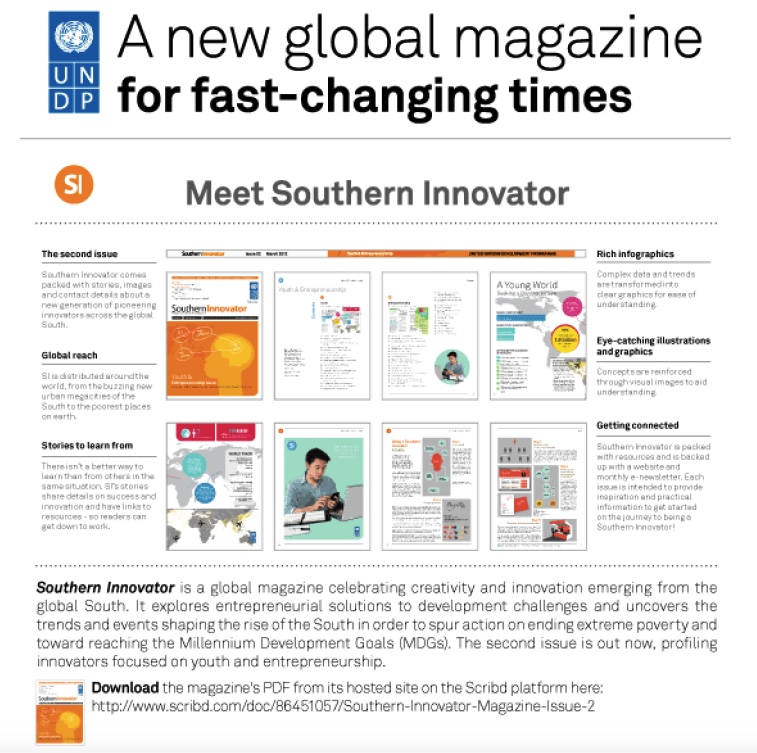
    Development Challenges, South-South Solutions was launched as an e-newsletter in 2006 by UNDP’s South-South Cooperation Unit (now the United Nations Office for South-South Cooperation) based in New York, USA. It led on profiling the rise of the global South as an economic powerhouse and was one of the first regular publications to champion the global South’s innovators, entrepreneurs, and pioneers. It tracked the key trends that are now so profoundly reshaping how development is seen and done. This includes the rapid take-up of mobile phones and information technology in the global South (as profiled in the first issue of magazine Southern Innovator), the move to becoming a majority urban world, a growing global innovator culture, and the plethora of solutions being developed in the global South to tackle its problems and improve living conditions and boost human development. The success of the e-newsletter led to the launch of the magazine Southern Innovator. 
    Creative Commons License

    This work is licensed under a
    Creative Commons Attribution-Noncommercial-No Derivative Works 3.0 License.

    ORCID iD: https://orcid.org/0000-0001-5311-1052.

    © David South Consulting 2023

  • Ghanaian Coffins Prove Design and Craftsmanship Boost Incomes

    Ghanaian Coffins Prove Design and Craftsmanship Boost Incomes

    By David SouthDevelopment Challenges, South-South Solutions

    SOUTH-SOUTH CASE STUDY

    In many parts of the world, indigenous ingenuity and craft skills are finally getting the recognition they deserve. The quirky but very inventive gadgets and solutions featured on the Afrigadget blog (http://www.afrigadget.com) never fail to inspire and amaze. The Democratic Republic of the Congo’s (DRC) fashionable gentlemen (http://www.henryherbert.com/gentlemen-of-bacongo/) grabbed the attention of – and inspired – European fashion designers with their creativity and flair. And then there are the Africa Maker Faires, gatherings of clever and innovative thinkers and inventors who get down to work generating solutions to today’s problems.

    Beyond the grim stories of development failures and human tragedies, there is another Africa full of creativity and can-do attitude.

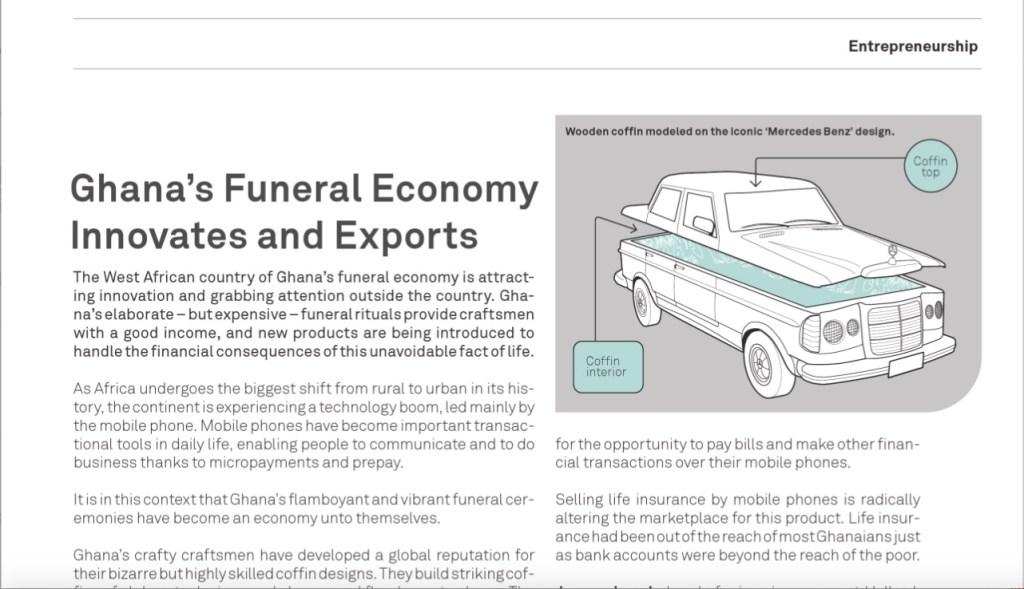
    Amongst the Ga people (http://en.wikipedia.org/wiki/Ga_people) of Teshi, Ghana there is a tradition with a twist: custom-designed coffins. A Ghanaian pioneer has been transforming the way people deal with that most sombre and respectful of rituals, the funeral. Coffin-artist Paa Joe is drawing on a modern-day tradition in Ghana dating back to the 1950s. Coffins – which are normally made from wood and follow the standard template of a narrow, body-length box – are transformed into grand and lively statements about the deceased person’s life.

    Designs have included a giant pink fish, a Ghana Airways plane, a souped-up Mercedes Benz and an African eagle.

    “The Ga people (http://www.ghanaweb.com/GhanaHomePage/tribes/ga.php), from the south-east coast of Ghana, revere their ancestors and give great importance to funeral celebrations,” Jack Bell, a London gallery owner exhibiting the coffins, told The Observer newspaper. “Their tradition of creating beautifully carved figurative coffins originated in the 1950s.”

    Paa Joe was born in the Akwapim hills north-east of Accra in 1945. He is considered the top sculpted coffin maker of his generation. He apprenticed with the pioneer of the craft, Kane Kwei (http://www.culturebase.net/artist.php?153) – the man who began this unique vocation in the 1950s. The skill and artistry involved is now recognized in museums around the world, including London’s British Museum.

    The community had a history of highly skilled woodwork and elaborate carvings were regularly created for village chiefs – giant eagles or even the surreal spectacle of a giant cocoa pod.

    The bespoke coffins are an example of how long-standing skills were applied to a new product. The idea of making custom-sculpted coffins begun by Kane Kwei evolved from being a livelihood for Kwei to an apprenticed craft passed down to younger craftsmen. When Kane Kwei’s grandmother died in 1951, without fulfilling her lifelong wish to fly on a plane, Kane made a plane-shaped coffin for her. This coffin was admired by others and Kane got the idea of setting up a workshop and making custom-designed coffins symbolizing the
    deceased’s status and achievements in life.

    “Families commission the coffins – sometimes to a brief designed by the deceased – to represent the aspirations or achievements of a deceased relative, or to characterize their personality: a car for a businessman, a cocoa pod for a farmer, a bible, or even a camera,” Bell said.

    For people with modest means, there are simpler designs of boats, canoes and books. Prices are negotiated with the coffin maker.

    Where there were none, now there are multiple workshops providing custom coffins for funerals. Traditional Ghanaian funerals are lively, colourful events, but the coffin sculptures of Teshi are a modern phenomenon and proof that innovation and good design can transform the most sombre of items into something special.

    Published: December 2010

    Resources

    • Maker Faire Africa: Flickr photo gallery: A clickable archive of the Maker Faire inventors and their inventions. Website:http://www.flickr.com/groups/makerfaireafrica/pool/
    • Afrigadget: Afrigadget: ‘Solving everyday problems with African ingenuity’: This blog never ceases to amaze and fascinate. Website: http://www.afrigadget.com/
    • E-machine Shop: eMachineShop: This remarkable service allows budding inventors to download free design software, design their invention, and then have it made in any quantity they wish and shipped to them: Amazing! Website: http://www.emachineshop.com/ 4) Maker Faire Africa 2010: Catch up on the last Maker Faire Africa. Website: (http://makerfaireafrica.com)
    • Afrigadget: ‘Solving everyday problems with African ingenuity’: This blog never ceases to amaze and fascinate. Website: http://www.afrigadget.com/
    • International Development Design Summit: The Summit is an intense, hands-on design experience that brings together people from all over the world and all walks of life to create technologies and enterprises that improve the lives of people living in poverty. Website:http://iddsummit.org/

    https://davidsouthconsulting.org/2022/10/20/bangladesh-coffin-maker-offers-an-ethical-ending/

    https://davidsouthconsulting.org/2022/10/20/ghanas-funeral-economy-innovates-and-exports/

    Development Challenges, South-South Solutions was launched as an e-newsletter in 2006 by UNDP’s South-South Cooperation Unit (now the United Nations Office for South-South Cooperation) based in New York, USA. It led on profiling the rise of the global South as an economic powerhouse and was one of the first regular publications to champion the global South’s innovators, entrepreneurs, and pioneers. It tracked the key trends that are now so profoundly reshaping how development is seen and done. This includes the rapid take-up of mobile phones and information technology in the global South (as profiled in the first issue of magazine Southern Innovator), the move to becoming a majority urban world, a growing global innovator culture, and the plethora of solutions being developed in the global South to tackle its problems and improve living conditions and boost human development. The success of the e-newsletter led to the launch of the magazine Southern Innovator. 

    https://davidsouthconsulting.org/2021/03/05/southern-innovator-issue-2/

    Creative Commons License

    This work is licensed under a
    Creative Commons Attribution-Noncommercial-No Derivative Works 3.0 License.

    ORCID iD: https://orcid.org/0000-0001-5311-1052.

    © David South Consulting 2023

  • Ghana: Oil-rich City Sparks Entrepreneurs and Debate

    Ghana: Oil-rich City Sparks Entrepreneurs and Debate

    By David SouthDevelopment Challenges, South-South Solutions

    SOUTH-SOUTH CASE STUDY

    Commodity booms can seem like the answer to a poor nation’s prayers, a way to fulfil all their development dreams and goals. The reality, however, is far more complex. More often than not, the discovery of resources sparks a mad scramble for profits and patronage, as politicians and politically connected elites carve out their slice of the new resource boom before anyone else.

    The twin cities of Sekondi-Takoradi (http://en.wikipedia.org/wiki/Sekondi-Takoradi) in the Western Region of Ghana are now experiencing an oil boom. Ghana’s oil production went online in December 2010 and the government is hoping it will double the country’s growth rate.

    Large supplies of oil were found off the coast in 2007, transforming Takoradi from a sleepy, rundown port city into the hub for the oil boom.

    Local man Peter Abitty told the BBC he was renting out an eight-bedroom house for US $5,000 a month. The house overlooks the sea and comes with banana and coconut trees.

    “Tenants that come here can take the coconuts for free! We don’t charge anything,” Abitty said.

    He put the strong interest in the house down to a simple fact: “It’s out there: oil, oil, oil.”

    People’s hopes are being raised in Ghana’s case because it has built a reputation as a better-governed country than other African petro states like Nigeria and Angola.

    But others argue that price increases caused by the boom are destroying local businesses. A report on the Ghana Oil news website found popular local businesses suffering. One example it gave was the Unicorn Internet Café, an employer of local youth, which shut down in 2010 because of high rents.

    It found businesses have shut down in the following sectors: timber, sawmilling, super markets, mobile phone shops, boutiques and trading shops. But it also found many new businesses opening up, including banks, insurance companies and hotels.

    The challenge facing Ghana is to ensure oil brings a long-term change to a higher value business environment and economy, rather than just an unequal and temporary boom.

    Another challenge is to connect the many youth leaving education in the city with the jobs and opportunities being created by the oil industry. The twin cities are a regional educational centre with a lot of technical colleges and secondary schools.

    To counter these concerns, a Regional Coordinating Council is promising to place the growth of small and medium enterprises at the centre of regional development.

    The dreams and promises for Takoradi are very ambitious. “In five years time, I see Takoradi becoming one of the modern cities of the world,”  Alfred Fafali Adagbedu, the owner of Seaweld Engineering (www.seaweldghana.com), a new local company set up to service the oil sector, told the BBC.

    “I can imagine skyscrapers, six-lane highways and malls.”

    “The transport industry is going to improve, because workers on the rig are going to need to be transported. Agriculture is going to see a boom because all those people on the rig will need to be fed.

    “Even market women are going to see more business, because a lot of workers are going to have very fat paychecks. Everyone in this city is going to gain in business.”

    How far Takoradi has to travel to come close to meeting these dreams and expectations can be seen in its current state. The railway station has a train with laundry hanging from it because it hasn’t moved in years, reported the BBC. People are living in the sleeping car of the train.

    But the typical signs of a boom are all visible: traffic jams, booked hotels, rising rents and prices, and it is already hurting people on fixed salaries.

    Local authorities have plans to demolish rundown parts of the city and rebuild with modern office environments for the new businesses resulting from the oil economy.

    An estimated US $1 billion a year in revenue will go to the Ghanaian government and local authorities want 10 percent of this to be ring-fenced for regional development.

    “Many resources are coming from the western region. From years back, gold is here, timber is here, diamonds are here,” said Nana Kofi Abuna V, one of the few female chiefs in the area.

    “But when they share the cake up there, they leave out the western region. This time, if there is oil and gas in the region we should benefit more than everybody else.”

    But Adagbedu at Seaweld Ghana believes Ghana will see real improvements.

    “I’m very sure we will avoid the mistakes,” he said. “Ghana is a democracy, everyone is watching, so there is going to be a lot of improvement here.”

    And to help in keeping these promises, the BBC will continue to return to Sekondi-Takoradi to track its changes and see how things improve.

    Published: September 2011

    Resources

    1) BarCamp Takoradi: BarCamp is an international network of user-generated conferences (or unconferences). They are open, participatory workshop-events, the content of which is provided by participants. Website:http://twitter.com/#!/barcamptakoradi

    2) Ghana Ports and Harbours Authority: The Authority overlooks the Takoradi port. Website:http://www.ghanaports.gov.gh/GPHA/takoradi/index.html

    3) Friends of the Nation (FON): The NGO serves as a catalyst towards increased action for sustainable natural resource management and health environment in the Takoradi region. Website: http://www.fonghana.20m.com/aboutus1.htm

    4) Takoradi City: A website packed with information and photos on the city. Website:http://www.takoradicity.com/pages/sections.php?siteid=takoradicity&mid=39

    Development Challenges, South-South Solutions was launched as an e-newsletter in 2006 by UNDP’s South-South Cooperation Unit (now the United Nations Office for South-South Cooperation) based in New York, USA. It led on profiling the rise of the global South as an economic powerhouse and was one of the first regular publications to champion the global South’s innovators, entrepreneurs, and pioneers. It tracked the key trends that are now so profoundly reshaping how development is seen and done. This includes the rapid take-up of mobile phones and information technology in the global South (as profiled in the first issue of magazine Southern Innovator), the move to becoming a majority urban world, a growing global innovator culture, and the plethora of solutions being developed in the global South to tackle its problems and improve living conditions and boost human development. The success of the e-newsletter led to the launch of the magazine Southern Innovator. 

    Creative Commons License

    This work is licensed under a
    Creative Commons Attribution-Noncommercial-No Derivative Works 3.0 License.

    ORCID iD: https://orcid.org/0000-0001-5311-1052.

    © David South Consulting 2023