Categories
Archive Development Challenges, South-South Solutions Newsletters Southern Innovator magazine

Indian Toilet Pioneer Champions Good Ideas

By David SouthDevelopment Challenges, South-South Solutions

SOUTH-SOUTH CASE STUDY

Access to adequate sanitation and toilet facilities is critical to making development gains. Yet this simple fact of life often gets overlooked, especially in fast-growing cities where populations are on the rise or in transit. Out of an estimated 2.6 billion people in the world without toilets, two-thirds are in southern and eastern Asia (World Toilet Organization).

It is easy to take toilet technology for granted in developed countries, but in the fast-growing urban world of the global South, increasing access will be the dividing line between a future of good human health and dignity, or misery and poor health. The biggest gains in human health always come about once people have access to clean water and sanitation. Yet this proven fact gets lost in many places for a wide variety of reasons.

One country currently failing to meet the needs of its population is India. According to the McKinsey Global Institute, by 2030, 70 percent of India’s jobs will be created in its cities, and 590 million Indians will be city-dwellers. An enormous infrastructure task lies ahead for India: a city the size of Chicago needs to be built every year. But so far this challenge is not being met, leaving the country with the largest number of urban slum dwellers anywhere in the world. Housing is just not keeping up with populations’ needs.

As K.T. Ravindran, a professor of urban development, told the New York Times: “We require radical rethinking about urban development. It is not that there are no ideas. It is that there is no implementation of those ideas.”

It is this ability to act that makes the Sulabh International Social Service Organization stand out. The Indian non-governmental organization (NGO) sees itself as a movement and is a passionate advocate for toilets and toilet innovation for the poor and underserved.

Sulabh was founded in 1970 by Dr. Bindeshwar Pathak, who saw the vast task ahead. “I thought the challenges to provide toilet facilities have been overcome in rich countries; it has still to be met in developing countries like India,” he said.

So far, Sulabh has brought together 50,000 volunteers across the country to build toilets and sanitation facilities.

The organization’s success flows from understanding that it needs to do more than supply the ‘hardware’ of the toilets; it also needs to address the ‘software’: ideas and innovation and concepts.

The organization has directly built 1.2 million household toilets – but the government of India has built a further 54 million toilets based on the designs made by Sulabh. It’s an example of a good idea multiplying its impact when picked up by others.

While 10 million Indians use a Sulabh-built sanitation facility each day, according to the group’s website, an estimated 300 million are using a toilet based on Sulabh’s designs.

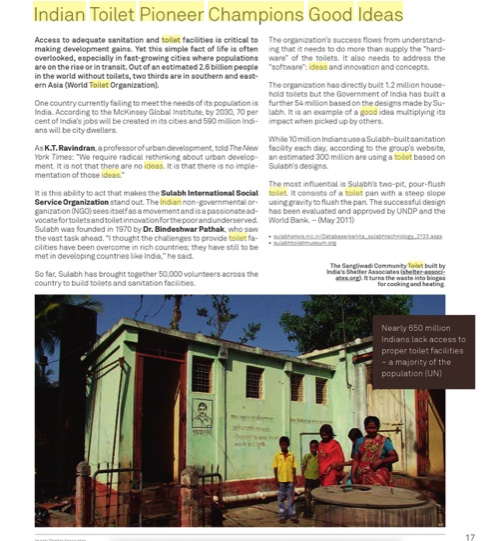
Most influential is Sulabh’s two-pit, pour-flush toilet (www.sulabhenvis.nic.in/Sulabhtechnology.htm). It consists of a toilet pan with a steep slope using gravity to flush the pan. Water is poured in to the pan to flush the toilet and the waste goes into either one of two pits. As one pit fills up with waste, waste is diverted to the second pit. After around 18 months, the first, filled pit’s waste becomes a safe, organic fertiliser suitable for agriculture and the fertiliser’s value covers the cost of emptying the pit. The successful design has been evaluated and approved by UNDP and the World Bank.

Sulabh has also been designing ways to get power and energy from toilets, building 200 biogas plants that turn the gas generated from the human excrement deposited in the toilets into a source of energy. Biogas (http://en.wikipedia.org/wiki/Biogas) is a clean-burning gas that can be made from animal, plant and human waste with the right technology and is a green solution to the need for gas to cook and run electricity generators.

Pride of place for the NGO is its vast toilet and bath complex at the holy shrine of Shri Sai Baba in Shirdi, Maharashtra (http://en.wikipedia.org/wiki/Maharashtra). Millions flock to the shrine every year, but it lacked proper sanitation facilities. To solve this problem Sulabh’s local branch has built a vast complex occupying two acres. The brightly coloured and palace-like facility has 120 toilets, 108 bathing cubicles, six dressing rooms, and urinals and can serve 30,000 people a day. There are telephones and 5,000 lockers for tourists to keep possessions safe.

There are also three biogas plants connected to the facility, generating electricity and hot water for bathing used by the toilet and bath complex. This solves the puzzle of how to fund the utilities. Water discharged from the facility is used to irrigate the surrounding green spaces.

Sulabh has also built a museum dedicated to toilets and toilet technology (http://www.sulabhtoiletmuseum.org). The museum places the toilet as a critical part of human civilisation and shows how it fits in with the cultural context of India. Toilets and toilet designs from around the world and throughout history are gathered together and make a fascinating journey through this essential human need.

Published: May 2011

Resources

1) World Toilet Organization: World Toilet Organization (WTO) is a global non- profit organization committed to improving toilet and sanitation conditions worldwide. Website: http://www.worldtoilet.org

2) World Toilet Day: On November 19 every year, this event draws attention to the lack of access for 2.6 billion people. Website: http://www.worldtoilet.org

3) Dirt: The Filthy Reality of Everyday Life: An exhibit by the prestigious Wellcome Collection on the human relationship with dirt and hygiene in history. Website:http://www.wellcomecollection.org/whats-on/exhibitions/dirt.aspx

4) World Toilet College: Established in 2005, the World Toilet College (WTC) started as a social enterprise, with the belief that there is need for an independent world body to ensure the best practices and standards in Toilet Design, Cleanliness, and Sanitation Technologies are adopted and disseminated through training. Website:http://worldtoilet.org/ourwork3.asp

Development Challenges, South-South Solutions was launched as an e-newsletter in 2006 by UNDP’s South-South Cooperation Unit (now the United Nations Office for South-South Cooperation) based in New York, USA. It led on profiling the rise of the global South as an economic powerhouse and was one of the first regular publications to champion the global South’s innovators, entrepreneurs, and pioneers. It tracked the key trends that are now so profoundly reshaping how development is seen and done. This includes the rapid take-up of mobile phones and information technology in the global South (as profiled in the first issue of magazine Southern Innovator), the move to becoming a majority urban world, a growing global innovator culture, and the plethora of solutions being developed in the global South to tackle its problems and improve living conditions and boost human development. The success of the e-newsletter led to the launch of the magazine Southern Innovator. 

Creative Commons License

This work is licensed under a
Creative Commons Attribution-Noncommercial-No Derivative Works 3.0 License.

ORCID iD: https://orcid.org/0000-0001-5311-1052.

© David South Consulting 2023

Categories
Archive Development Challenges, South-South Solutions Newsletters Southern Innovator magazine

Ending Gang Violence While Cleaning the Streets in Haiti

By David SouthDevelopment Challenges, South-South Solutions

SOUTH-SOUTH CASE STUDY

The Caribbean nation of Haiti is the poorest country in the western hemisphere, with 80 percent of the population living below the poverty line (CIA World Factbook). The country had been enjoying some positive economic growth since 2005 after decades of economic and political turmoil.

The country’s political vacuum and economic problems gave rise to violent gang rule on its streets and a collapse in public services, in particular garbage collection. The piles of waste became a source of disease and squalor as well as providing barricades for gangs to wage their street battles.

Haiti was also hit by four devastating hurricanes in 2008, with heavy damage to the country’s agricultural sector and transport infrastructure.

But a project by UNDP’s Special Unit for South-South Cooperation (http://ssc.undp.org/Home.118.0.html) has turned around a Haitian neighbourhood by simultaneously cleaning up the garbage, creating employment and income and reducing gang violence and despair. The United Nations has been working in Haiti to restore the economy and bring peace and good government to the country since the 1990s. Its most recent mission, MINUSTAH (http://minustah.org/),has been running since 2004.

Called ‘Love n’ Haiti’ and located in the Carrefour-Feuilles district (http://www.maplandia.com/haiti/ouest/carrefour-feuilles/) of the capital Port-au-Prince, the project used a ground-up strategy to tackle the problem of waste removal.

“I know we have a bad image. But the violence is going down in my neighbourhood,” said Gislène La Salle, a widow and a mother of six from Carrefour-Feuilles, to the Indo-Asian News Service (IANS).

“But when the security situation deteriorated sharply, I could not work in the streets. Luckily, six months ago, I found work in this project. Now, life is more stable. I have a regular income,” she said.

“The money I earn allows me to feed my family better and send three of my six children to school.”

The neighbourhood has a population of 150,000. Nine community leaders were identified and a management committee set up called the Committee d’Action Sanitaire de Carrefour Feuilles (CASCAF). The management committee then undertook difficult negotiations with local street vendors to establish garbage collection points. A waste collection plan was drawn up, and around 400 workers were hired to clean the streets and canals and collect the waste.

The workers were divided up into nine street cleaning teams and three waste collection teams, comprising people who were members of rival groups.

The project started in 2006 from a very basic point: generating awareness in the population about the dangers of waste and the need for it to be disposed of. The breakdown in public services from decades of political turmoil and poverty had meant a culture of waste disposal no longer existed. The project drew on similar experiences in Brazil and used Brazilian expertise.

A triage (http://en.wikipedia.org/wiki/Business_Triage)centre was set up to sort the waste into paper, plastic, metal, glass and organic matter for recycling. Two products are made from the waste to earn income: cooking briquettes and fertilizer.

The cooking briquettes may also help stem Haiti’s horrific deforestation. The country shares its island with the Dominican Republic in the Caribbean, and anyone flying over the island can see a sharp dividing line between the green and lush forests of the Dominican Republic and the almost-barren and dusty Haitian hills.

By turning the trash into cooking briquettes, people are being offered an alternative to chopping down the forests and burning trees to make charcoal fuel for cooking.

Income for the waste collectors has increased to US $3 a day and the project has removed 70 percent of the neighbourhood’s waste, making it easier to get around and get things done (another boost to incomes).

Georginette is also a widow. Like Gislène, this mother of seven is thrilled to find a regular job. “Earlier, only three of my seven children went to school. Many children from the neighbourhood roamed the streets. But since November 2007 when I began working here, I can afford to send five,” she said.

Prior to the project, the neighbourhood was one of the most dangerous in Port-au-Prince. The project unexpectedly found the history of violence and conflict were quickly overcome when the project began to make quick progress.

Collecting the waste now earns an income for 380 families. And by gravitating community leadership to nonviolent leaders, relationships between people and groups improved.

The 50 waste collection points and public garbage bins now contribute to a reduction in common diseases that are rife in other parts of Haiti: leptospirosis, worms, canicola fever, tetanus, yellow fever, typhoid, dengue, and malaria.

Originally, the government of Haiti appealed to the India, Brazil and South Africa Facility for Poverty and Hunger Alleviation (IBSA Trust Fund) (http://www.indianembassy.org/newsite/press_release/2007/Sept/17.asp) to get to grips with the woeful garbage collection in the capital, while tackling the violence in the slums and lack of economic opportunity.

The project is also a partnership between Port-au-Prince’s city hall, the Ministry of Public Works and other government ministries, Quisqueya University, UNDP Haiti, IBSA, and the Special Unit for South-South Cooperation. The project is run on the ground by UNDP Haiti.

Where once the trash made flooding worse by blocking canals, having it removed has prevented the stew of waste that was produced when floods occurred.

“Impressed by the positive results so far, the Haitian government would like to replicate this model in other regions of the country,” said Eliana Nicolini, the UNDP project coordinator.

It is hoped the project can be scaled up to reach across Haiti and even be replicated in other countries. The UN Special Envoy for Haiti, former US President Bill Clinton, has been drafted in to help with raising funds for expanding the project.

The Love n’ Haiti project has been selected by the BBC’s World Challenge contest, which invites the general public to vote for which project they think is the best. Voting takes place on their website:http://www.theworldchallenge.co.uk.The project is number eight in the list on the website.

“It is not easy to choose who to hire in a place where so many are desperately in need of work. Many people beg us for work but we don’t have vacancies at the moment. If we can hire even 100 more persons, it would solve a lot of problems,” said Patrick Massenat, a local youth heading a committee created to implement activities contributing to waste management and to ensure effective involvement of governmental institutions.

“Most people in this area never knew real work. Now, they have experienced it. They also have families. The area is cleaner; the women who lost their husbands in gang wars and police firing are happier. It’s a beginning.”

Published: October 2009

Resources

1) A Bangladesh case study on social entrepreneurs turning refuse into wealth. Website:http://proxied.changemakers.net/journal/01may/index.cfm

2) The Ethical Super Store has a wide range of recycled shopping bags and hand bags made to Fair Trade standards. Website:http://www.ethicalsuperstore.com/search/bag/recycled.htm

3) A collective of women in the slums of Delhi, India sell fashionable recycled shopping bags online. Website:http://www.theindiashop.co.uk/

4) Proyecto Alcatraz (Project Alcatraz): This Venezuelan project offers violent gang members the opportunity to go straight and make their way into the economic mainstream with real job opportunities and skills. Website:http://www.proyectoalcatraz.org/home_eng.php

https://davidsouthconsulting.org/2022/10/24/business-leads-on-tackling-violence-in-mexican-city/

https://davidsouthconsulting.org/2023/02/03/environmental-public-awareness-handbook-case-studies-and-lessons-learned-in-mongolia/

https://davidsouthconsulting.org/2021/09/01/haiti-earthquake-prompts-tech-aid/

https://davidsouthconsulting.org/2021/01/08/haitian-coffee-becoming-a-hit-with-american-connoisseurs/

https://davidsouthconsulting.org/2021/10/28/milk-co-operatives-help-hungry-haiti/

https://davidsouthconsulting.org/2022/09/23/opinion-canada-is-allowing-u-s-to-dictate-haitis-renewal-more-news-and-opinion-on-what-the-un-soldiers-call-the-haitian-vacation/

https://davidsouthconsulting.org/2020/04/22/state-of-decay-haiti-turns-to-free-market-economics-and-the-un-to-save-itself/

https://davidsouthconsulting.org/2021/01/02/a-undp-success-story-grassroots-environmental-campaign-mobilizes-thousands-in-mongolia-1998/

https://davidsouthconsulting.org/2021/01/26/u-s-elections-update-clinton-is-using-canada-to-keep-control-of-haiti/

Development Challenges, South-South Solutions was launched as an e-newsletter in 2006 by UNDP’s South-South Cooperation Unit (now the United Nations Office for South-South Cooperation) based in New York, USA. It led on profiling the rise of the global South as an economic powerhouse and was one of the first regular publications to champion the global South’s innovators, entrepreneurs, and pioneers. It tracked the key trends that are now so profoundly reshaping how development is seen and done. This includes the rapid take-up of mobile phones and information technology in the global South (as profiled in the first issue of magazine Southern Innovator), the move to becoming a majority urban world, a growing global innovator culture, and the plethora of solutions being developed in the global South to tackle its problems and improve living conditions and boost human development. The success of the e-newsletter led to the launch of the magazine Southern Innovator.  

Follow @SouthSouth1

Google Books: https://books.google.co.uk/books?id=tRKYBgAAQBAJ&dq=development+challenges+october+2009&source=gbs_navlinks_s

Slideshare: http://www.slideshare.net/DavidSouth1/development-challengessouthsouthsolutionsoctober2009issue

Southern Innovator Issue 1: https://books.google.co.uk/books?id=Q1O54YSE2BgC&dq=southern+innovator&source=gbs_navlinks_s

Southern Innovator Issue 2: https://books.google.co.uk/books?id=Ty0N969dcssC&dq=southern+innovator&source=gbs_navlinks_s

Southern Innovator Issue 3: https://books.google.co.uk/books?id=AQNt4YmhZagC&dq=southern+innovator&source=gbs_navlinks_s

Southern Innovator Issue 4: https://books.google.co.uk/books?id=9T_n2tA7l4EC&dq=southern+innovator&source=gbs_navlinks_s

Southern Innovator Issue 5: https://books.google.co.uk/books?id=6ILdAgAAQBAJ&dq=southern+innovator&source=gbs_navlinks_s

Creative Commons License

This work is licensed under a
Creative Commons Attribution-Noncommercial-No Derivative Works 3.0 License.

ORCID iD: https://orcid.org/0000-0001-5311-1052.

© David South Consulting 2023

Categories
Archive

Indian Entrepreneur Brings Dignity to Poor Women

By David South, Development Challenges, South-South Solutions

SOUTH-SOUTH CASE STUDY

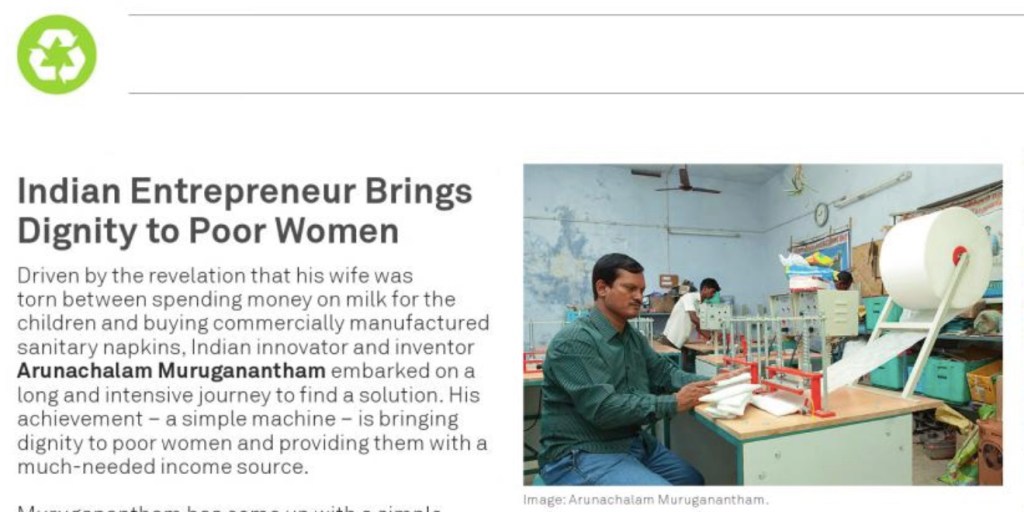
Driven by the revelation that his wife was torn between spending money on milk for the children and buying commercially manufactured sanitary napkins, Indian innovator and inventor Arunachalam Muruganantham embarked on a long and intensive journey to find a solution. His achievement – a simple machine – is bringing dignity to poor women and providing them with a much-needed income source.

This is a story of a man who was considered crazy for his persistence and made many personal sacrifices to achieve his goal. The innovation is both a technological and a business solution. Muruganantham has come up with a simple machine to manufacture affordable hygienic sanitary napkins for poor women. It works by turning the pulp of pine wood into the flat, white sanitary pads (http://en.wikipedia.org/wiki/Sanitary_napkin) commonly used by women during their monthly menstruation. The machine’s simplicity means it can be expanded easily to other communities and is designed to fit well with the way women’s cooperatives work and help them earn an income.

Muruganantham sees it is a business model that “can deliver livelihood, hygiene and dignity to poor women, and help them strengthen society,” according to his website.

The manufacturing process produces the sanitary napkins in just five steps. This simple intervention is revolutionizing women’s health in India by giving them an alternative to using found and unhygienic rags every month when they menstruate.

It took Muruganantham four years of research to create a patented machine that sells for between US $1,332 and US $5,330. It can make 120 sanitary pads an hour. Each one sells for 10 rupees (US 18 cents). By comparison, the multinational company Procter & Gamble sells its product for 30 rupees (US 54 cents) a packet.

Two multinationals dominate the marketplace for sanitary napkins in India: Procter & Gamble and Johnson & Johnson, with the Stayfree and Carefree brands.

Muruganantham’s machine was awarded the best innovation national award by the former President of India, Prathiba Patil, in 2009.

Like many innovators and inventors, his work at first was little understood by others and meant he had to plough a lonely furrow. But his persistence paid off and is now receiving attention from countries across the global South.

Apart from its technological simplicity, the idea is to make it easy for women to form cooperatives and businesses to boost their incomes. India has seen the concept of so-called Ladies Self Help Groups (SHGs) (http://en.wikipedia.org/wiki/Self-help_group_%28finance%29) become more popular as a source of income. One of the problems they encounter is finding a successful business to undertake. The machine invented by Muruganantham is being seen as a good business model for the SHGs to follow. The key is the simplicity of operating the machine, the growing and stable market for the product, and its affordable and competitive price.

Typical businesses that can be set up using the machine can employ 10 women.

Muruganantham set up his main business, Jayaashree Industries (motto: ‘new inventions… small is beautiful’) (http://newinventions.in/aboutus.aspx), after his education was disrupted due to family problems and he took up a job in a welding shop.

At first, he had a difficult time convincing people of the utility of the machine. He enlisted his wife to help with the marketing of the new napkins to nearby women. He says the advantage of his business model is that it turns the making of the napkins into a sustainable, grassroots activity. It provides an essential commodity for poor women at an affordable price, removing middlemen and using a simple, non-chemical technology.

It also cuts down on expensive transport costs by keeping manufacturing local.

Over 225 machines have been delivered to 14 Indian states and also to Nigeria, Ethiopia, Kenya, Uganda, Nepal and Bangladesh.

And while Muruganantham is focused on making the machine a success, he is already looking forward to working on his next big invention. The only question is: what will it be?

Resources

1) Women’s Health: A website packed with facts and advice from the UK’s National Health Service. Website: http://www.nhs.uk/livewell/women1839/Pages/Women1839home.aspx

Creative Commons License

This work is licensed under a
Creative Commons Attribution-Noncommercial-No Derivative Works 3.0 License.

ORCID iD: https://orcid.org/0000-0001-5311-1052.

© David South Consulting 2021