Categories
Archive This Magazine

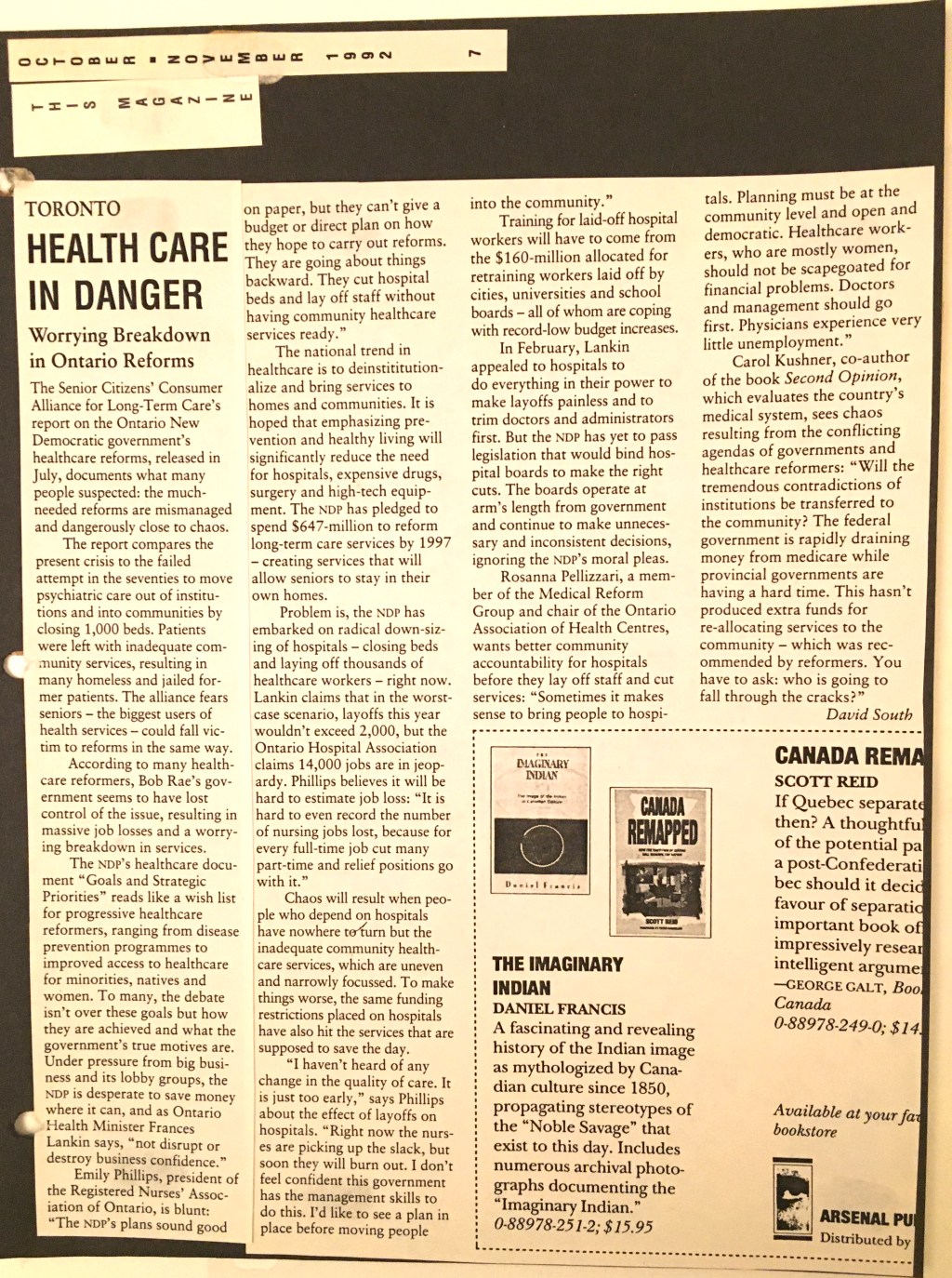
Health Care In Danger

Worrying breakdown in Ontario reforms

By David South

This Magazine (Canada), October-November, 1992

The Senior Citizens’ Consumer Alliance for Long-Term Care’s report on the Ontario New Democratic government’s health care reforms, released in July, documents what many people suspected: the much-needed reforms are mismanaged and dangerously close to chaos.

The report compares the present crisis to the failed attempt in the seventies to move psychiatric care out of institutions and into communities by closing 1,000 beds. Patients were left with inadequate community services, resulting in many homeless and jailed former patients. The alliance fears seniors – the biggest users of health services – could fall victim to reforms in the same way.

According to many health care reformers, Bob Rae’s government seems to have lost control of the issue, resulting in massive job losses and a worrying breakdown in services.

The NDP’s health care document “Goals and Strategic Priorities” reads like a wish list for progressive health care reformers, ranging from disease prevention programmes to improved access to health care for minorities, natives and women. To many, the debate isn’t over these goals but how they are achieved and what the government’s true motives are. Under pressure from big business and its lobby groups, the NDP is desperate to save money where it can, and as Ontario Health Minister Francis Lankin says, “not disrupt or destroy business confidence.”

Emily Phillips, president of the Registered Nurses’ Association of Ontario, is blunt: “The NDP’s plans sound good on paper, but they can’t give a budget or direct plan on how they hope to carry out reforms. They are going about things backward. They cut hospital beds and lay off staff without having community health care services ready.”

The national trend in health care is to deinstitutionalize and bring services to homes and communities. It is hoped that emphasizing prevention and healthy living will significantly reduce the need for hospitals, expensive drugs, surgery and high-tech equipment. The NDP has pledged to spend $647 million to reform long-term care services by 1997 – creating services that will allow seniors to stay in their own homes.

Problem is, the NDP has embarked on radical down-sizing of hospitals – closing beds and laying off thousands of health care workers – right now. Lankin claims that in the worst-case scenario, layoffs this year wouldn’t exceed 2,000, but the Ontario Hospital Association claims 14,000 jobs are in jeopardy. Phillips believes it will be hard to estimate job loss: “It is hard to even record the number of nursing jobs lost, because for every full-time job cut many part-time and relief positions go with it.”

Chaos will result when people who depend on hospitals have nowhere to turn but the inadequate community health care services, which are uneven and narrowly focussed. To make things worse, the same funding restrictions placed on hospitals have also hit the services that are supposed to save the day.

“I haven’t heard of any change in the quality of care. It is just too early,” says Phillips about the effect of layoffs on hospitals. “Right now the nurses are picking up the slack, but soon they will burn out. I don’t feel confident this government has the management skills to do this. I’d like to see a plan in place before moving people into the community.”

Training for laid-off hospital workers will have to come from the $160-million allocated for retraining workers laid off by cities, universities and school boards – all of whom are coping with record-low budget increases.

In February, Lankin appealed to hospitals to do everything in their power to make layoffs painless and to trim doctors and administrators first. But the NDP has yet to pass legislation that would bind hospital boards to make the right cuts. The boards operate at arm’s length from government and continue to make unnecessary decisions, ignoring the NDP’s moral pleas.

Rosana Pellizzari, a member of the Medical Reform Group and chair of the Ontario Association of Health Centres, wants better community accountability for hospitals before they lay off staff and cut services: “Sometimes it makes sense to bring people to hospitals. Planning must be at the community level and open and democratic. Health care workers, who are mostly women, should not be scapegoated for financial problems. Doctors and management should go first. Physicians experience very little unemployment.”

Carol Kushner, co-author of the book Second Opinion, which evaluates the country’s medical system, sees chaos resulting from the conflicting agendas of governments and health care reformers: “Will the tremendous contradictions of institutions be transferred to the community? The federal government is rapidly draining money from medicare while provincial governments are having a hard time. This hasn’t produced extra funds for re-allocating services to the community – which was recommended by reformers. You have to ask: who is going to fall through the cracks?”

Find in a library:

Worldcat.org: Health care in danger: worrying breakdown in Ontario reforms, This Magazine, 26, Oct-Nov 1992, 6

ISSN: 1491-2678

OCLC Number / Unique Identifier: 8250614985

Available to subscribers to Gale In Context: College database.

https://davidsouthconsulting.org/2022/02/09/african-health-data-revolution/

https://davidsouthconsulting.org/2022/10/06/african-technology-tackles-health-needs/

https://davidsouthconsulting.org/2021/06/02/case-study-5-gosh-ich-child-health-portal-2001-2003/

https://davidsouthconsulting.org/2021/02/05/changing-health-care-careers-a-sign-of-the-times/

https://davidsouthconsulting.org/2022/10/08/dodging-the-health-insurance-minefield/

https://davidsouthconsulting.org/2022/11/18/finding-fortune-in-traditional-medicine/

https://davidsouthconsulting.org/2017/10/18/hannah-institute-for-the-history-of-medicine-1992-1994/

https://davidsouthconsulting.org/2022/11/22/happy-nigeria-west-african-nation-has-good-attitude/

https://davidsouthconsulting.org/2021/07/13/health-human-development-communicator-1991-2017/

https://davidsouthconsulting.org/2021/02/05/health-care-on-the-cutting-block-ministry-hopes-for-efficiency-with-search-and-destroy-tactics/

https://davidsouthconsulting.org/2022/03/08/mobile-phone-microscopes-to-revolutionize-health-diagnostics/

https://davidsouthconsulting.org/2022/02/05/mongolian-enterprises-target-healthy-urban-lifestyles/

https://davidsouthconsulting.org/2022/10/31/new-kenyan-services-to-innovate-mobile-health-and-farming/

https://davidsouthconsulting.org/2021/10/20/research-reviews-2001-2002/

https://davidsouthconsulting.org/2022/10/19/safe-healthcare-is-good-business-and-good-health/

https://davidsouthconsulting.org/2021/03/24/solar-powered-mobile-clinics-to-boost-rural-healthcare-in-africa/

https://davidsouthconsulting.org/2022/10/19/south-africa-innovates-healthcare-with-prepay-phone-vouchers/

https://davidsouthconsulting.org/2020/04/20/take-two-big-doses-of-humanity-and-call-me-in-the-morning/

https://davidsouthconsulting.org/2020/04/17/taking-medicine-to-the-people-four-innovators-in-community-health/

https://davidsouthconsulting.org/2022/11/16/thai-organic-supermarkets-seek-to-improve-health/

https://davidsouthconsulting.org/2022/11/19/traditional-healers-can-heal-the-mind-as-well-as-body/

https://davidsouthconsulting.org/2022/11/19/traditional-medicine-is-now-a-proven-remedy/

https://davidsouthconsulting.org/2021/02/05/us-health-care-businesses-chasing-profits-into-canada/

Creative Commons License

This work is licensed under a
Creative Commons Attribution-Noncommercial-No Derivative Works 3.0 License.

ORCID iD: https://orcid.org/0000-0001-5311-1052.

© David South Consulting 2023

Categories
Archive Blogroll Today's Seniors

Critics Blast Government Long-Term Care Reforms

“They cut hospital beds and lay off staff without having community health care services ready…”

“When the elderly… decide that facility-based care is the best option, they can’t get it…”

By David South

Today’s Seniors (Canada), October 1992

Seniors should keep a close eye on the Ontario government’s proposed long-term care reforms. According to critics, the plan has more than a few bugs. 

The term long-term care encompasses an often confusing web of services, from home-provided community services like meals on wheels to institutional care including homes for the aged, seniors’ apartments and chronic care hospitals. 

Like other provincial governments, the Rae government is trying to rein in escalating health care costs – and long-term care services aren’t immune. They hope that emphasizing prevention and healthy lifestyles, plus providing more services in the home and community, will reduce reliance and expensive health care services like high-cost drugs, surgery and high-tech equipment. According to health minister Frances Lankin, this will preserve medicare in the age of fiscal restraint. 

The government has outlined seven goals for its long-term care reforms: prepare for the coming surge in the over-65 population; cater services to better reflect the cultural, racial and linguistic make-up of Ontario; eliminate confusion over what services are available; involve the community in planning so that services reflect community needs; lessen reliance on institutions; provide support to family caregivers; tighten regulations governing government-run and private facilities; and improve working conditions for the largely female caregiving workforce. 

But many people are wary of the proposed reforms and worry that if they aren’t managed properly, some seniors will fall through the cracks. 

A report released in July by the Senior Citizens’ Consumer Alliance for Long-Term Care Reform blasts the government for being simplistic in its plans. The report compares the present reforms to the failed attempt in the 1970s to move psychiatric care out of the institutions and into communities by closing 1,000 beds. The tragic result in that case was homelessness for many psychiatric patients who found community services unable to help, or, more often than not, non-existent. The Alliance fears seniors – the biggest users of health services – could fall victim to reforms in a similar way. 

Emily Phillips, president of the Registered Nurses’ Association of Ontario, is blunt: “The NDP’s plans sound good on paper, but they can’t give a budget or direct plan on how they hope to carry out reforms. They are going about things backwards. They cut hospital beds and lay off staff without having community health care services ready.”

The Ontario Association of Non-Profit Homes and Services for Seniors (OANHSS) – which operates charitable and municipal homes for the aged, non-profit seniors’ apartments. chronic care hospitals and community services serving over 100,000 seniors – says 4,300 seniors are on waiting lists for their member facilities right now, and things won’t improve if the government continues to reduce the number of long-term care beds. 

But Lankin insists that beds are available in homes and hospitals and it is funding formulas that prevent them from being filled. 

To help carry out its reforms, the NDP will reallocate $647 million by 1996-97. In bureaucratese, this funding is said to be “back-end loaded”, or mostly spent close to 1996-97. 

The problem with this, according to the Alliance, is that the government has already embarked on a radical “downsizing” of hospitals, closing beds and laying off health care workers. Lankin claims the worst case scenario for layoffs this year won’t exceed 2,000, but the Ontario Hospital Association claims 14,000 jobs are in jeopardy. Because of this, the Alliance wants money to be spent earlier to avoid gaps in services. 

Phillips believes it will be hard to pin down the extent of job losses. “For every full-time job cut many part-time and relief positions go with it,” she says. 

Dr. Rosana Pellizzari, a member of the Medical Reform Group and chair of the Ontario Association of Health Centres, wants better community accountability for hospitals before they lay off staff and cut services. “Sometimes it makes sense to bring people to hospitals,” she says. “Planning must be at the community level, open and democractic. Health care workers, who are mostly women, should not be scapegoated for financial problems. Doctors and management should go first. Physicians experience very little unemployment.” 

Many nursing and charitable homes for the aged are facing financial crisis. According to OANHSS, six charitable homes for the aged have closed since 1987 due to deficits. In 30 homes, the total annual deficit has increased 125 per cent since 1987. The Ministry of Health recently allocated special funds of $8.1 million to ensure these facilities survive until January, when a new, needs-based funding formula will be introduced. It is intended to better match the actual care requirements of the 59,000 consumers living in long-term care facilities. 

Michael Klejman, executive director of OANHSS, agrees with helping seniors to stay in their homes. “But when the elderly and their care-givers in Ontario decide that facility-based care is the best option, they simply can’t get it,” he notes. “We know from experience that many of them remain in acute care hospital beds with a cost to the province of about four times what it would cost them to fund a long-term care bed. And many, unfortunately, remain in their own flats or apartments at considerable risk to themselves, isolated and dependent on a patchwork of services.” 

Beatrix Robinow, who worked on the Alliance’s report, was not impressed with the government’s initial plans, especially the proposed creation of 40 service coordination agencies whose mandate would be to control the delivery of home care services to seniors. Robinow thinks this would add to the confusion and just be another layer of bureaucracy. Many people who appeared at the Alliance’s public hearings expressed confusion over how the long-term care system worked. 

Robinow says that the government could save money by trimming the bureaucracy and using present organizations like the little-known District Health Councils. 

“District Health Councils have nothing to do with social services,” says Robinow. “But we want them to be expanded to include long-term care and general supervision of community services. We are waiting to hear if they are interested. I would urge the government to make sure that services are in place before pushing people out of institutions.” 

The health minister is cautious about the government’s next steps. “The Alliance’s report has been very helpful,” she says. “We are in the process of developing options. Two other ministers are involved and we also need to take this through Cabinet.

“Ontario is much larger and more complex (than other provinces). The range of services is more developed. We also have a mess in jurisdictions between municipalities and the province. And in Ontario there isn’t a concensus that this is the way to go. 

“We have been doing a lot of rationalization and streamlining for longer than other provinces. Most thinking people looking at the situation agree that doing nothing would hurt the system. It is not sustainable at present. You hear a lot of things about user fees. That would be the slippery slope for medicare. That would make people think they could buy better services.”

Ironically, user fees were recently endorsed by the Canadian Medical Association, suggesting the minister will have a fight on her hands with angry doctors. 

Amidst all the confusion, Dr. Perry Kendall was appointed on Aug. 24 as the provincial government’s special advisor on long-term care and population health. This veteran of both the City of Toronto as Medical Officer of Health – and the groundbreaking Victoria Health Project in British Columbia (often seen as the model for community services to seniors) seems well qualified. “One problem in the past has been the creation of smaller and smaller organizations every time somebody felt the system was not responsive to their needs,” he says. “This created organizational chaos. The challenge  now is to get all the organizations back together to share their expertise.”

Lankin says she hopes to have a conference on the reforms in the fall. 

ORCID iD: https://orcid.org/0000-0001-5311-1052.

© David South Consulting 2021

Categories
Archive The Toronto Star

Take Two Big Doses Of Humanity And Call Me In The Morning

By David South

The Toronto Star (Toronto, Canada), January 1, 1993

“Anybody going into medicine should read a whole bunch of good novels.” Dr. Alvin Newman isn’t kidding. The head of curriculum renewal at the largest English-speaking medical school in the world, the University of Toronto, feels strongly that doctors have been ill-prepared for their profession’s challenges.

How doctors become doctors is being hotly debated as Ontario’s five medical schools institute a potpourri of curriculum reforms. After a century of taking a back seat to scientific achievement, bedside manners and the art of medicine are in vogue again.

“Around the world, medical education is undergoing significant changes,” says Newman. “Medical schools must strike a balance between the incredible explosion of scientific knowledge and re-establish the role of the physician as wise counsel and empathic healer.”

It’s a role that many feel doctors have ignored. An American Medical Association poll, conducted between 1985 and 1988, found that fewer than 50 per cent of respondents said they thought doctors listened well and half believed doctors no longer care as much about patients as they used to.

In response to these criticisms, current reforms are shifting medical education away from reliance on the turn-of-the-century science-based approach, says Professor Jackie Duffin, a medical historian at Queen’s University who helped organize the new curriculum introduced there in 1991.

“In the old days doctors could probably make a diagnosis and tell people what was happening to them, but not do very much for them,” says Newman.

“Yet society had more trust and fondness for physicians than they do now. Much of the condemnation of the medical profession is because we have become the custodians of high-tech medicine.”

While the Ontario government embarks on the most sweeping reforms to health care since the 1966 introduction of comprehensive health insurance in Ontario and the founding of national medicare in 1968, many doctors feel their profession cannot afford to maintain the status quo.

The concensus at Ontario’s five medical schools – U of T, Queen’s, University of Western Ontario, University of Ottawa and McMaster University – has gelled around a belief that doctors need to be as comfortable dealing with people as they are with scientific medicine. To this end, revamped curricula supplement basic science and clinical medicine with emphasis on early exposure to patients, communication skills, psychological issues, medical ethics, medical literacy and health promotion.

These schools hope to produce new doctors to fit into a rapidly-changing health care system – one that many believe will rely far less on large hospitals.

Instead, many procedures will take place in the home or in the day clinics. Expanding community health care care centres will try to tackle extensive social and health problems. This preventive approach ot medical education was pioneered by Hamilton’s McMaster medical school.

Since its founding in 1967, McMaster has experimented with teaching methods that steer away from mass lectures to concentrate on the individual student. The evolution of McMaster’s curriculum has placed greater emphasis on communication skills, psychosocial aspects of medicine, community issues, and disease prevention and health promotion.

How do McMaster students rate against other medical students?

Last year they scored above the national average on licencing exams. A higher proportion of McMaster students enter research and academic medicine than their counterparts from other schools. One study comparing them to U of T suggested they were more motivated to be life-long learners.

Dr. Rosana Pellizzari practices the kind of medicine everyone is talking about these days. Working out of renovated church, Pellizzari’s practice at the Davenport/Perth Community Health Centre in west end Toronto serves a working class neighbourhood that has been home to generations of recent immigrants.

A member of the Medical Reform Group – which has long advocated significant reforms to health care – and trained at McMaster, Pellizzari can be seen to represent the doctor of the future: Sensitive, salaried and working in community health.

“McMaster’s curriculum attracts people with innovative ideas,” says Pellizzari, who was active in community health education before going to medical school. “It is a very supportive environment.

“I think the important question is: Who do we choose to be medical students? They should open up medical schools to those who know what it’s like to be a parent, a mother or disabled. Doctors should represent the population they serve. We are still getting mostly white, inexperienced young males as physicians. They aren’t going to practice the way that is necessary.”

In Ontario, many doctors see the 1986 doctors’ strike as a watershed for public opinion.

As a result of the negative fallout from the strike and perceived gap between physicians andhe public they serve, a five-year project entitled Educating Future Physicians for Ontario became a major advocate for reform.

Started in 1988, EFPO has examined fundamental issues in designing and implementing new medical school curricula. These issues include defining societal health care needs and expectations, faculty development and student evaluation. While each medical school has adapted reforms to its particular situation, EFPO hopes to prod further reforms.

“This is a unique venture in Canada, and could have implications far beyond Ontario if successful,” says Dr. William Seidelman, a key player in EFPO. “It captures the unique sense of the Canadian scene, and will build on the implied contact in the Canadian health system.”

Pellizzari sees the attitude of medical schools and teaching hospitals towards medical students as a significant factor in creating insensitive doctors. She recalls the high rate of suicide among medical students and the abusive work environment that forces doctors-in-training to work shifts unthinkable for other workers.

“The way we train doctors is inhumane,” she says. “We don’t expect other workers to put in 30-hour shifts. It creates in new physicians the attitude that they paid their dues and now society owes them.”

Many critics feel that changing training methods isn’t enough; the whole ethos and selection process must be changed. If doctors are to better serve the population, they must better reflect it.

“We are getting very close to gender equality and a laudable distribution of ethnic and racial backgrounds,” says Newman. “But students still come from a fairly narrow social spectrum,  very middle class kids. Their exposure to the extremes of society, to poverty, to homelessness and related illnesses have been very limited.”

Pellizzari found how out-of-date the medical profession was in her first year. One teacher wanted her to work till 10 at night. When told that she needed 24 hours notice for a babysitter, the teacher shot back that motherhood and medicine don’t mix.

“I was a mother before I was a physician. When I get a call at night from a mother, I understand this. With 30 per cent of visits to doctors having no biological basis – like depression due to unemployment – you can’t do anything unless you have experienced life.

“If we don’t address this, you can design the best training in the world, but things won’t change.”

But Newman also feels many factors outside of medical school discourage a more diverse student body.

“To go through medical school in the United States requires large indebtedness. That’s not true in Canada. You can calculate what a year of medical school costs in terms of a finite number of CDs, a leather jacket and ghetto blaster. So something is dissuading people from pursuing this career, and it isn’t money.”

While there is a concensus among academics that medical schools haven’t prepared doctors well enough, there is little support for a dramatic change in selection criteria. “I can’t muster a lot of support from colleagues for serious changes,” says Newman.

Dr. Jock Murray, the former dean of Dalhousie medical school in Halifax, recently told an EFPO meeting he doesn’t see any significant changes ahead.

“Physicians have a reputation for being conservative and self-serving,” says Murray. “If reform is going to be successful we have to be clear that it is about what is good for the people.”

Pellizzari believes life experience and empathy with social circumstances just can’t be taught.

“I grew up in this neighbourhood. I understand their powerlessness, the conditions. Doctors have to see themselves as a member of a team of health professionals, not as the top of the social and medical totem pole.”

U of T’s experience is a classic example of the hurdles ahead. Newman admits it has come as a shock to students loaded with society’s ingrained expectations.

“They spend half a day a week in the community seeing things like drug rehab clinics and community health centres. But being out in the community doesn’t make the students feel comfortable. Their image of what they are going to do involves big buildings, chrome and steel, scurrying personnel and banks of computers.”

This work is licensed under a Creative Commons Attribution 4.0 International License.

“… in recent years it has become a pursuit for a growing number of researchers. … Behind much of this growth has been the Hannah Institute for the History of Medicine …” 

Read more about Canadian innovation in healthcare delivery here: Taking Medicine To The People: Four Innovators In Community Health

Read more on my work promoting Canadian medical history scholarship here: Hannah Institute For The History Of Medicine | 1992 – 1994

Read more on my work leading on innovation and modernisation in the UK’s NHS here: CASE STUDY 5: GOSH/ICH Child Health Portal | 2001 – 2003

ORCID iD: https://orcid.org/0000-0001-5311-1052.

© David South Consulting 2021