Categories
Archive Development Challenges, South-South Solutions Newsletters Southern Innovator magazine

Bringing the Invention and Innovation Mindset to Young Kenyans

By David SouthDevelopment Challenges, South-South Solutions

SOUTH-SOUTH CASE STUDY

A highly innovative new way to teach the basics of electronics, computing and technological innovation is being pioneered in the slums of Nairobi, Kenya. Driven by the desire to counter perceptions of apathy among young people, NGO Kuweni Serious is running a training course for girls aged over 8 years in some of the poorest parts of the city to turn on a new generation to the power of technology to make change.

“Technology is pivotal in our work, as Kuweni Serious is a primarily online platform that seeks to create offline action,” according to Kuweni Serious’ Rachel Gichengo. “It’s positive in that you can reach a lot of people with solid messages that are in bite-size pieces that are easy to disseminate and consume. Everyone can pass on the information with a simple click – it’s an easier way to begin socio-political discussion among people who would otherwise not be drawn into these kinds of discussions because they’re not presented in a way that appeals to them. The typical profile of a KS volunteer is someone in their 20s, middle-class, has some experience volunteering, has never been to a slum despite living in Nairobi, but wants more for their country.”

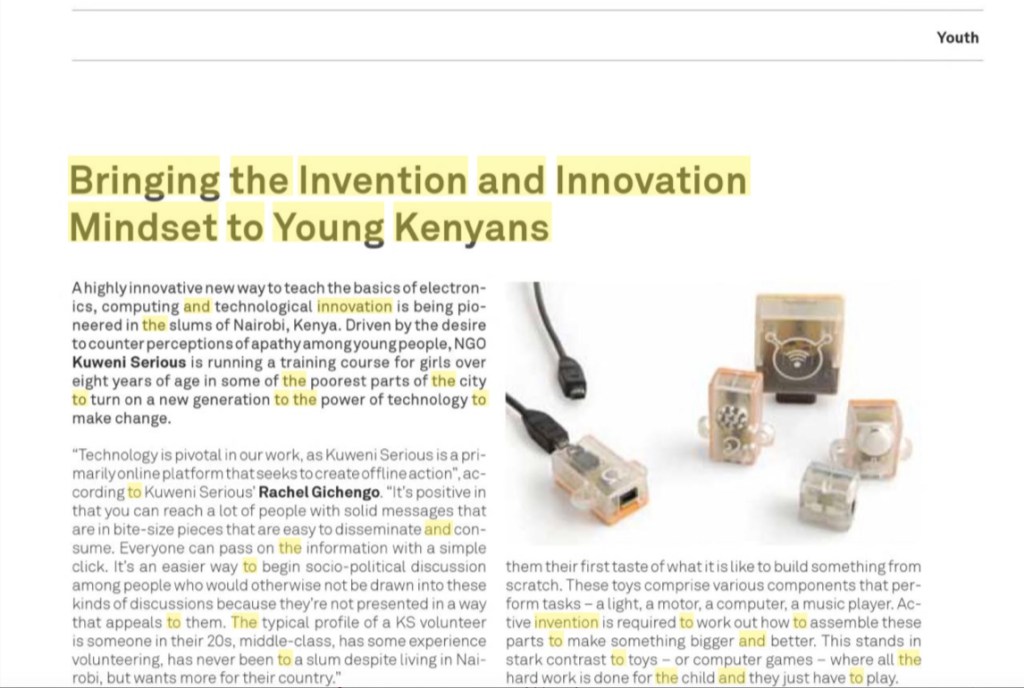
The course uses a clever, hands-on approach to teaching. Instructors use a new generation of learning toys that help young people understand how technology works and gives them the first taste of what it is like to build something from scratch. These toys comprise various components that perform tasks – a light, a motor, a computer, a music player. Active invention is required to work out how to assemble these parts to make something bigger and better. This stands in stark contrast to toys – or computer games – where all the hard work is done for the child and they just have to play.

“We chose tech training because it’s a traditionally under-represented area when it comes to reaching this particular group (underprivileged girls), yet such an important set of skills to be taught in this day and age,” confirms Gichengo. “We want to expand these girls’ thinking – to get them interested in the possibilities of careers in science and tech, rather than perpetuate the idea that all they’ll ever do, based on their circumstances, is tailoring or dance. We hoped to open our girls’ worlds a bit, as well as link them to our Kuweni Serious community of volunteers.”

Called PicoCrickets (www.picocricket.com), and manufactured by the Canadian Playful Invention Company (PICO), the toys were developed from research and ideas at the Lifelong Kindergarten group (http://llk.media.mit.edu/) at the MIT (Massachusetts Institute of Technology) Media Lab (www.media.mit.edu).

“Pico Crickets are cool,” continues Gichengo. “They’re a fun way to learn to build things, to learn the connection between hardware and software, to begin to understand what computers can do. They make learning easy, and they make science seem accessible to a group that tends to see it as too hard for them. The kits were paid for by a grant from the Girl Effect (www.girleffect.org).”

The MIT lab conducted intensive research into creative learning environments for children. One of the first fruits of this research was Lego Mindstorms (http://mindstorms.lego.com), kits that allow children to make and program their own robots.

Inspired by this work, the PicoCricket places more emphasises on artistic expression. The company created the PicoCricket Kit (www.picocricket.com/whatisit.html) as a way to integrate art and technology to “spark creative thinking in girls and boys 8 years and older,” according to its website.

A typical kit includes a central PicoCricket that a child then plugs in to various motors, sensors, lights and other devices to make something that can spin, light up or play music. It is intended to give free rein to both technological innovation and artistic expression.

Kenya experienced violent rioting during the 2007 and 2008 elections. The shock of the events produced a number of initiatives to counter the violence and the social and economic disruption it has caused. One of the most well-known innovations, Ushahidi (www.ushahidi.com), a crisis-mapping platform, has been deployed around the world and led to many other new innovations.

Kuweni Serious (www.kuweniserious.org) is also a result of this crisis. The NGO sets out to counter the stereotype of Kenya’s youth as a “hedonistic generation of brand-obsessed youth, moving from party to party in the night and congregating on Facebook during the day.”

Kuweni Serious believes young people in Kenya were shocked into action when violence broke out during the elections. Prices jumped for everything – from fuel to food – and water and power started to be rationed. It was a wake-up call to youth: it was getting harder and harder to ignore what was happening in the country.

Kuweni Serious was founded by Kenyan youth and asked the question “how do Kenya’s youth feel about all the chaos around us?” It seeks to rally young people to their motto: “Fighting the evil forces of apathy.”

Their 125/100 program set out to train 125 girls on a 100-day course. It ended with a graduation ceremony on July 2, 2011.

The program, run by volunteers from the University of Nairobi, has taught basic computer skills, got the children working on Google Maps and making – and inventing – using the PicoCrickets.

The girls on the course came from Baba Dogo and Kibera, Nairobi’s largest slum.

The technology training program lasted between three and six hours a week for 12 weeks. The inventions made by the children included merry go rounds, a lamp stand and fan and miniature automobiles. Participants even got to grips with Google Maps and learned how to use mobile phones in citizen journalism. At the end of the course, all the children received a certificate reinforcing their sense of accomplishment and achievement.

“We hope to continue doing similar projects, scaling up 125/100, and working on developing a corps of everyday change makers among young, educated, middle class Kenyans,” according to Gichengo. “We’re also preparing for the 2012 elections, so we need to have more conversations about what a new election means, given the outcome of our previous one.”

Another initiative seeking to improve life chances for Kenyan girls is ZanaAfrica (www.zanaa.org). It focuses on educational opportunities for girls, consulting them to find out what would increase their chances of graduation from school. Because of this back-and-forth dialogue with the girls, they have come up with various strategic programs, one example being providing girls with sanitary pads for menstruation (http://en.wikipedia.org/wiki/Menstruation) every month so that they do not skip classes and lose vital class time. ZanaAfrica was born around tackling the issue of lost school days for girls because of poor provision of sanitary pads in Kenya: an estimated 868,000 adolescent girls were missing 3.5 million school days a month, according to ZanaAfrica.  Sanitary pads in Kenya cost twice most people’s daily wage. Just to provide pads to all the school girls in Kenya, they estimated, would cost US $13 million a year, increasing by 5 percent every year.

Another disadvantage for these girls is finding the right support environment and strong, positive role models. ZanaAfrica’s solution is Empowerment Clubs (www.zanaa.org/empowernet-clubs), places where small groups of 15 to 20 students meet with field officers and tackle difficult topics not discussed at home or in school: drugs, relationships, self-confidence, health and disease. There are already 1,000 students in the Kibera area in these Empowerment Clubs. This approach has also been combined with something called EmpowerNet Clubs: these clubs take place in the schools and combine blogging and tweeting (www.twitter.com) with the discussions on life issues. Already in five schools, the clubs include a field officer and 20 girls meeting once a week.

ZanaAfrica was started in 2007 by social entrepreneur and Harvard University graduate Megan White, who has been living and working in Kenya since 2001. ZanaAfrica identifies poverty-eradicating, African-led innovations and then tries to build them up and find ways to replicate them and make them sustainable. They look for innovations in the areas of health, education and the environment.

“Kenyans are definitely early adopters, and are rushing to take advantage of new technologies,” confirms Gichengo. “The Kenyan success stories have been a huge inspiration, largely because they developed localized solutions that could then be exported to the world, rather than the other way around, which tends to be the case. There’s always value in looking further afield to see what else is being done around the world, but the iHub and Ushahidi (and the Kenya ICT Board, Safaricom, etc.) have gone a long, long way in inspiring local innovation.”

Published: July 2011

Resources

1) Make Magazine: “MAKE Magazine brings the do-it-yourself mindset to all the technology in your life. MAKE is loaded with exciting projects that help you make the most of your technology at home and away from home. We celebrate your right to tweak, hack, and bend any technology to your own will.” Website: http://makezine.com/

2) Lego Mindstorms robot-making kits. Website:http://mindstorms.lego.com/en-us/Default.aspx

3) Southern Innovator Issue 1: New global magazine celebrating innovation across the global South. Website:http://www.scribd.com/doc/57980406/Southern-Innovator-Issue-1

4) iHub Nairobi: iHub Nairobi’s Innovation Hub for the technology community is an open space for the technologists, investors, tech companies and hackers in the area. This space is a tech community facility with a focus on young entrepreneurs, web and mobile phone programmers, designers and researchers. It is part open community workspace (co-working), part vector for investors and VCs and part incubator. Website:http://ihub.co.ke/pages/home.php

5) Maker Faire Africa 2011: MFA 2011 continues to cultivate new and existing maker communities across Africa. As was the case in Accra (‘09) and Nairobi (’10), MFA 2011 will present and spotlight the vibrant and endlessly creative individuals that have come to represent the spirit of ‘making’ throughout the continent. These innovators, artists and tinkerers will be exhibiting a fusion of the informal and formal; ideas, inventions, hacks and designs both low-tech & high-tech.  From cuisine to machines, come see their re-imagining of products, exploration of novel materials, and original solutions for some of the continent’s most important challenges and opportunities. Maker Faire Africa 2011 will be a celebratory showcase of unhindered experimentation and curiosity. Website:http://makerfaireafrica.com/2011/06/09/maker-faire-africa-2011-cairo/

6) Social enterprise (http://en.wikipedia.org/wiki/Social_enterprise): Learn more about the vibrant world of social enterprise and connect with others. Website: http://www.socialenterpriselive.com/

Development Challenges, South-South Solutions was launched as an e-newsletter in 2006 by UNDP’s South-South Cooperation Unit (now the United Nations Office for South-South Cooperation) based in New York, USA. It led on profiling the rise of the global South as an economic powerhouse and was one of the first regular publications to champion the global South’s innovators, entrepreneurs, and pioneers. It tracked the key trends that are now so profoundly reshaping how development is seen and done. This includes the rapid take-up of mobile phones and information technology in the global South (as profiled in the first issue of magazine Southern Innovator), the move to becoming a majority urban world, a growing global innovator culture, and the plethora of solutions being developed in the global South to tackle its problems and improve living conditions and boost human development. The success of the e-newsletter led to the launch of the magazine Southern Innovator.  

Creative Commons License

This work is licensed under a
Creative Commons Attribution-Noncommercial-No Derivative Works 3.0 License.

ORCID iD: https://orcid.org/0000-0001-5311-1052.

© David South Consulting 2023

Categories
Archive Blogroll data Development Challenges, South-South Solutions Newsletters Southern Innovator magazine

China Looking to Lead on Robot Innovation

By David SouthDevelopment Challenges, South-South Solutions

SOUTH-SOUTH CASE STUDY

Since the 1950s, science fiction has been telling the world we will soon be living with robots. While robots have emerged, they have been mostly kept to heavy industry, where machines can perform dangerous, hot and unpleasant repetitive tasks to a high standard.

But China is pioneering the move to mainstream robots in more public spheres. And the country is promising big changes in the coming decade.

Robots, strange as it may seem, can play a key role in development and fighting poverty.

If used intelligently, the rise of robots and robotics – itself a consequence of huge technological advances in information technology, the Internet, nanotechnology,artificial intelligence, and mobile communications – can free workers from boring, difficult and dangerous jobs. This can ramp up the provision of public goods like cleaning services in urban areas, or remove the need to do back-breaking farming work.

Robotics also offers a new field of high-tech employment for countries in the global South who are producing far more educated engineering and science students than they can currently employ. These students can help build the new robot economy.

China is considered to be in the early stages of competing with robot pioneers such as Japan, Switzerland, Germany, Sweden and the United States. And China still has a low penetration of industrial robots per population. In 2011 estimates placed the number of industrial robots in China at 52,290 (International Federation of Robotics) (ifr.org).

In the years ahead, China confronts a double demographic problem. It has the world’s largest elderly population, who will need care, and it also has a shrinking number of young people available to work as a result of the country’s one-child policy (http://en.wikipedia.org/wiki/One-child_policy).

Robots can help solve these problems.

China started its robotics research in the 1970s and ramped it up from 1985. It has already made significant progress manufacturing domestic robots for cleaning. The Xiamen Lilin Electronics Co., Ltd. (http://cnlilin.en.made-inchina.

com/) makes vacuum cleaners that are small round robots smart enough to return to their recharging stations when low on power. Another firm, Jetta Company (http://www.jetta.com.hk/home.htm), has built and sells the iRobot Roomba vacuum cleaning and floor-washing robots (http://www.irobot.com/uk/store.aspx?camp=ppc:google:products_roomba:G_790612075_1846279957_iRobot%20roomba:roomba_brand&gclid=CMiezMiG8a4CFc4LtAodYE3MKw).

For the heavy duty stuff, there is Ningbo’s Dukemen Robot, sold with the slogan “man, technology, robot”. The company manufactures arm-like robots for heavy lifting and lifting in dangerous or uncomfortable environments (dukerobot.com/ks/robot-manufacturers/).

A company called Quick specializes in making soldering equipment for manufacturing electronic components and sells robots that can do this with high accuracy and speed (quick-global.com/9-new-soldering-robot-1.html).

Other robotic advances in China include a robot dolphin that swims through the water measuring its quality.

There are also robots in development to do housework and help people who need assistance in the home like the elderly and the disabled. These robots can monitor a person’s physical condition and provide psychological counselling and search for, and deliver, requested items. One example is called UNISROBO, and is based on the Japanese robot PaPeRo robot (http://www.nec.co.jp/products/robot/en/index.html).

Still other robots can perform surgical procedures or even play sport, like Zhejiang University’s ping pong-playing robot (http://www.youtube.com/watch?v=4BtHYHi7trA).

Even more ambitiously, China is developing robots to send to the moon.

The push to introduce robots into the workplace and wider society is receiving considerable attention in China.

The Taiwan-based technology company Foxconn – well-known for assembling products for the American company Apple, maker of the iPad and iPhone -has pledged to deploy a million robots in its Chinese factories in the coming years to improve efficiency.

Some are forecasting that if China starts building robots on the scale it has pledged, then the world’s population of manufacturing robots will grow tenfold in 10 years.

China is also broaching one of the trickiest aspects of robotics – getting robots to interact with humans.

The tricky bit in robotics is getting interaction with human beings right and to avoid the experience being intimidating or frightening. One sector that is already ahead in experimenting with this aspect of robots is the restaurant business. One robot being used in restaurants sits on a tricycle trolley laden with drinks. It cycles from table to table in endless rotation allowing customers to choose drinks when they like.

The first robot restaurant started a trial run in 2010 in Jinan (http://en.wikipedia.org/wiki/Jinan), the capital of Shandong Province. The hot pot restaurant uses six robots to help with the service. The restaurant has also given itself the perfect name for this new approach: Continental Robot Experience Pavilion. Adorned with robot posters, the restaurant is 500 square metres in size and can seat 100 diners.

Diners at the Continental Robot Experience Pavilion are greeted by two ‘female’ “beauty robot receptionists” dressed in uniforms. Inside, the six robot waiters serve the customers. There are two to deliver drinks and two to serve the small tables and two to serve the big tables.

The robot comes to the table and takes the customers’ orders for food dishes and drinks. The robots, designed with sensors to stop them moving when they sense something or someone in front of them, are able to handle 21 tables and deal with the 100 customers at a single sitting.

The robots have proven so effective, the restaurant’s staff can stay focused on administration and providing assistance. The cooking is still done by human beings.

This trial run is designed to test the concept and the novelty of having robots attracting customers, the restaurant’s manager told the People’s Daily Online.

The plan is to increase the number of robots to 40 and also to have robots do cleaning and other tasks.

“They have a better service attitude than humans,” said Li Xiaomei, 35, who was visiting the restaurant for the first time. “Humans can be temperamental or impatient, but they don’t (the robots) feel tired, they just keep working and moving round and round the restaurant all night,” Li said to China Daily.

Published: March 2012

Resources

1) The Robot Report: It boasts compiling more than 1,400 robotics-related links and is about “Tracking the business of robotics”. Website: therobotreport.com

2) The Robot Shop: Bills itself as “The world’s leading source for professional robot technology” and sells online all the parts, kits, toys, tools and equipment to get any enthusiast or small and medium enterprise working with robotics quickly. Website: robotshop.com

3) Robot App Store: Sells ‘apps’ or software applications to expand the capabilities of robots. It also operates as a store for application developers to sell their robot apps to others. Also has information and resources on how to get started making robot apps and making money from making robot apps. Website: robotappstore.com

4) Roboearth: Funded by the European Union, RoboEarth is an online, open source network where robots can communicate with each other and share information and “learn from each other about their behaviour and their environment. Bringing a new meaning to the phrase “experience is the best teacher”, the goal of RoboEarth is to allow robotic systems to benefit from the experience of other robots, paving the way for rapid advances in machine cognition and behaviour, and ultimately, for more subtle and sophisticated human-machine interaction. Website: roboearth.org

5) Robotland: A blog writing about the “visions, ideas, innovations, awards, trends and reports from leading robotics research and development places in the world”. Website: http://robotland.blogspot.co.uk/

6) China Hi-Tech Fair: Running from 16-21 November 2012, the Fair is a great way to see the latest developments in robotics in China. Website: chtf.com/english/

7) Singularity Hub: A cornucopia of robotic resources and news on “science, technology and the future of mankind”. Website: http://singularityhub.com/

Development Challenges, South-South Solutions was launched as an e-newsletter in 2006 by UNDP’s South-South Cooperation Unit (now the United Nations Office for South-South Cooperation) based in New York, USA. It led on profiling the rise of the global South as an economic powerhouse and was one of the first regular publications to champion the global South’s innovators, entrepreneurs, and pioneers. It tracked the key trends that are now so profoundly reshaping how development is seen and done. This includes the rapid take-up of mobile phones and information technology in the global South (as profiled in the first issue of magazine Southern Innovator), the move to becoming a majority urban world, a growing global innovator culture, and the plethora of solutions being developed in the global South to tackle its problems and improve living conditions and boost human development. The success of the e-newsletter led to the launch of the magazine Southern Innovator.  

Follow @SouthSouth1

Slideshare: http://www.slideshare.net/DavidSouth1/development-challengessouthsouthsolutionsnovember2010issue

Southern Innovator Issue 1: https://books.google.co.uk/books?id=Q1O54YSE2BgC&dq=southern+innovator&source=gbs_navlinks_s

Southern Innovator Issue 2: https://books.google.co.uk/books?id=Ty0N969dcssC&dq=southern+innovator&source=gbs_navlinks_s

Southern Innovator Issue 3: https://books.google.co.uk/books?id=AQNt4YmhZagC&dq=southern+innovator&source=gbs_navlinks_s

Southern Innovator Issue 4: https://books.google.co.uk/books?id=9T_n2tA7l4EC&dq=southern+innovator&source=gbs_navlinks_s

Southern Innovator Issue 5: https://books.google.co.uk/books?id=6ILdAgAAQBAJ&dq=southern+innovator&source=gbs_navlinks_s

Citations

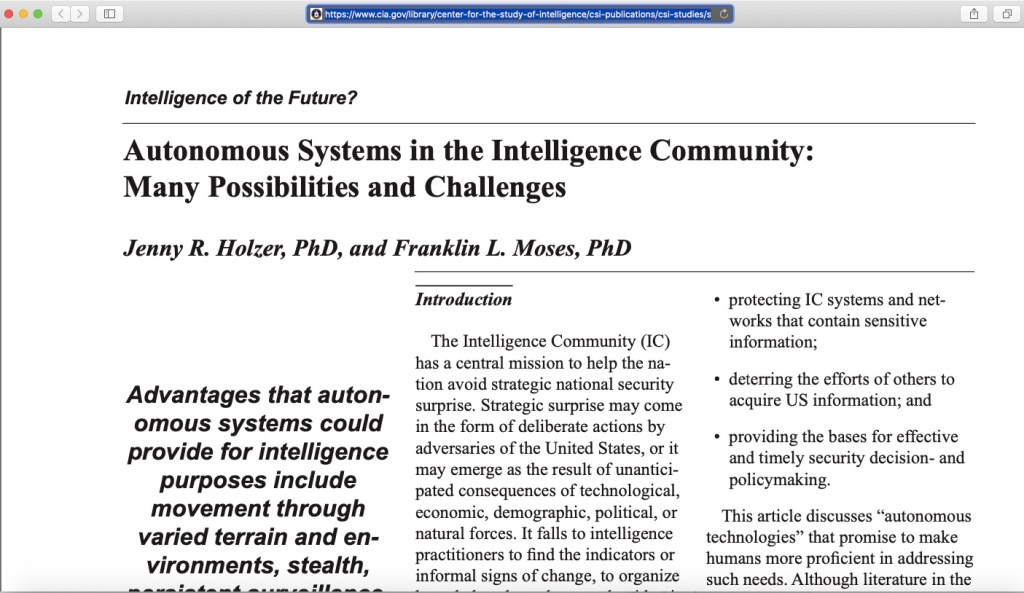
Cited in Studies in Intelligence, Autonomous Systems in the Intelligence Community: Many Possibilities and Challenges, Vol. 59, No.1 (Extracts, March 2015).

Studies in Intelligence, Vol. 59, No.1 (Unclassified articles from March 2015).
Autonomous Systems in the Intelligence Community: Many Possibilities and Challenges by Jenny R. Holzer, PhD, and Franklin L. Moses, PhD in Studies in Intelligence Vol 59, No. 1 (Extracts, March 2015).
Link: https://www.cia.gov/resources/csi/studies-in-intelligence/volume-59-no-1/autonomous-systems-in-the-intelligence-community-many-possibilities-and-challenges/.

More China stories:

Better by Design in China

https://davidsouthconsulting.org/2021/12/20/better-by-design-in-china/

https://davidsouthconsulting.org/2022/10/20/china-consumer-market-asian-perspective-helps/

China Pushing Frontiers of Medical Research

https://davidsouthconsulting.org/2020/04/25/china-pushing-frontiers-of-medical-research/

China Sets Sights on Dominating Global Smartphone Market

https://davidsouthconsulting.org/2020/12/10/china-sets-sights-on-dominating-global-smartphone-market/

https://davidsouthconsulting.org/2022/10/04/chinas-booming-wine-market-can-boost-south/

China’s Outsourced Airliner Development Model

https://davidsouthconsulting.org/2020/04/29/chinas-outsourced-airliner-development-model/

https://davidsouthconsulting.org/2021/03/20/computer-gold-farming-turning-virtual-reality-into-real-profits/

Creating Green Fashion in China

https://davidsouthconsulting.org/2021/01/25/creating-green-fashion-in-china/

https://davidsouthconsulting.org/2020/12/11/cyber-cities-an-oasis-of-prosperity-in-the-south/

Designed in China to Rival ‘Made in China’

https://davidsouthconsulting.org/2021/01/26/designed-in-china-to-rival-made-in-china/

https://davidsouthconsulting.org/2022/10/04/popular-chinese-social-media-chase-new-markets/

https://davidsouthconsulting.org/2021/10/04/putting-quality-and-design-at-the-centre-of-chinese-fashion/

Rammed-Earth Houses: China Shows how to Improve and Respect Traditional Homes

https://davidsouthconsulting.org/2021/02/12/rammed-earth-houses-china-shows-how-to-improve-and-respect-traditional-homes/

Virtual Supermarket Shopping Takes off in China

https://davidsouthconsulting.org/2020/04/17/virtual-supermarket-shopping-takes-off-in-china/

Creative Commons License

This work is licensed under a
Creative Commons Attribution-Noncommercial-No Derivative Works 3.0 License.

ORCID iD: https://orcid.org/0000-0001-5311-1052.

© David South Consulting 2023