Categories
Archive Development Challenges, South-South Solutions Newsletters Southern Innovator magazine

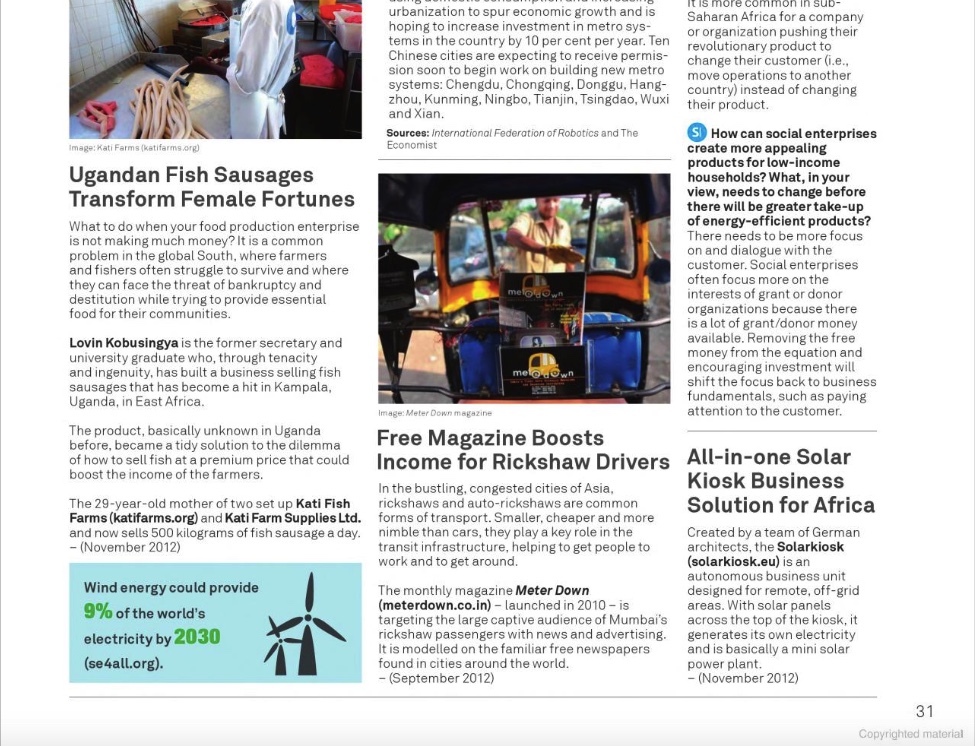
Free Magazine Boosts Income for Rickshaw Drivers

By David SouthDevelopment Challenges, South-South Solutions

SOUTH-SOUTH CASE STUDY

In the bustling, congested cities of Asia, rickshaws and auto-rickshaws are common forms of transport. Smaller, cheaper and more nimble than cars, they play a key role in the transit infrastructure, helping to get people to work and to get around.

According to a report by the World Resources Institute (wri.org) and EMBARQ – a global network of experts on sustainable transport solutions – India’s auto rickshaws are “an increasingly important part of urban transport in cities.”

The report estimates the number of auto rickshaws at between 15,000 and 30,000 in medium-sized cities and over 50,000 in large cities. The report found they make up between 10 and 20 per cent of daily motorized road transport trips for people in Bangalore, Mumbai, Pune and Rajkot.

And it’s not just the economic role played in transporting people: auto rickshaws are made in India and their production there doubled between 2003 and 2010, making them a source of manufacturing jobs too.

As India’s cities continue to grow – estimates forecast urban populations surging from 340 million in 2008 to 590 million by 2030 – auto rickshaws could have a bright future as they remain an affordable and safe transport solution.

The monthly magazine Meter Down (http://meterdown.co.in/) – launched in 2010 – is targeting the large captive audience of Mumbai’s rickshaw passengers with news and advertising. It is modelled on the familiar free newspapers found in cities around the world. Usually, these newspapers are distributed at subway and metro stations or in metal boxes at bus stops. Meter Down takes a different twist on this concept, distributing the publication directly to rickshaw passengers.

Mumbai is a crowded and very busy Indian city with an estimated 14 million people. Many residents spend a lot of time commuting – and a lot of time stuck in traffic jams. They need something to occupy them and to keep them informed about the news. This also presents a significant opportunity for businesses to communicate messages and advertising products and services.

Founded by three university graduates, Meter Down is trying to reach young professionals with a bit of money who can afford to ride to work in auto rickshaws.

It is distributed through 7,000 auto rickshaws in Mumbai, according to The Guardian newspaper, and is also being distributed in Pune and Ahmedabad.

The clever bit is the incentive for the drivers to carry the magazine: they receive 35 to 40 per cent of the profit from advertising sales.

This is added to the 400 to 500 rupees they make in a normal shift, according to the Mumbai Autorickshawmen’s Union.

But isn’t it a challenge to read a printed publication while bouncing along the road? The publishers came up with a solution: no story is to be longer than 300 words and the magazine has many large-size photographs to make it visually appealing and easy on the eye. Then there is the issue of passengers leaving with a copy of the magazine, denying the next passenger their read. The solution they came up for this is to tie the magazine to the rickshaw.

One of the biggest problems for any new start-up publication is how to scale up and reach more readers. Meter Down cleverly has the mechanism to scale built into its business model: “The market for this is as big as the total number of auto-rickshaws in each city,” Dedhia told The Guardian. “We have successfully scaled the model and tweak it as per different specific needs. Since auto-rickshaws are present in every part of the country, we can expand the network everywhere.”

Meter Down’s founders estimate that each rickshaw makes 90 to 95 trips every day. They have calculated this leads to a potential readership of 600,000 people. To increase revenue sources, the magazine also sells advertising space on the back and inside of the rickshaws.

For people in wealthier countries, rickshaws may seem like a rough way to get to work, but they are actually, for Indians, the more expensive option. A three-mile ride in Mumbai costs 68 rupees (US $1.27), according to The Guardian, which is 10 times the cost of a second-class train ticket.

For Meter Down, this means targeting the magazine and the ads at a market of readers with money and a willingness to buy products and services. It looks like things could be on the up for Meter Down!

Published: September 2012

Resources

1) Sustainable Urban Transport in India: Role of the Auto-Rickshaw Sector.
Website: http://www.embarq.org/en/sustainable-urban-transport-india-role-auto-rickshaw-sector 

2) A fleet of auto rickshaws for sale from Bajaj. Website: http://www.bajajauto.com/commercial_vehicle.asp

Development Challenges, South-South Solutions was launched as an e-newsletter in 2006 by UNDP’s South-South Cooperation Unit (now the United Nations Office for South-South Cooperation) based in New York, USA. It led on profiling the rise of the global South as an economic powerhouse and was one of the first regular publications to champion the global South’s innovators, entrepreneurs, and pioneers. It tracked the key trends that are now so profoundly reshaping how development is seen and done. This includes the rapid take-up of mobile phones and information technology in the global South (as profiled in the first issue of magazine Southern Innovator), the move to becoming a majority urban world, a growing global innovator culture, and the plethora of solutions being developed in the global South to tackle its problems and improve living conditions and boost human development. The success of the e-newsletter led to the launch of the magazine Southern Innovator. 

Creative Commons License

This work is licensed under a
Creative Commons Attribution-Noncommercial-No Derivative Works 3.0 License.

ORCID iD: https://orcid.org/0000-0001-5311-1052.

© David South Consulting 2023

Categories
Archive Blogroll Development Challenges, South-South Solutions Newsletters Southern Innovator magazine

Rickshaw Drivers Prosper with New Services

By David SouthDevelopment Challenges, South-South Solutions

SOUTH-SOUTH CASE STUDY

The rickshaw is the world’s oldest form of wheeled transportation and forms a significant part of India’s transport infrastructure. In large cities across Asia, 1 million three-wheeled auto-rickshaws form an important means of daily transportation and a vital source of income for their drivers. There are 8 million cycle rickshaws on the streets of India, the government says. They perform many tasks: as taxis, as couriers, as goods movers. And the Indian government promotes cycle rickshaws as a non-polluting alternative.

But rickshaw drivers in India struggle with a bad image despite being a critical component of the transport infrastructure. They work 12 to 18 hour days, are paid poorly, and are subject to frequent abuse from passengers and other drivers in the crowded and stressful streets.

Many of the men working as rickshaw drivers have left behind families in villages. Because their main home is elsewhere, many just eat, sleep and live next to the roadside.

An innovative company is taking this important service into the 21st century, and in turn boosting income and benefits for the drivers and restoring their dignity. Based in Delhi, Sammaan (www.sammaan.org), meaning dignity, has developed a sophisticated business model that offers a wide range of services to rickshaw passengers – drinks for sale, mobile phone chargers, courier collections, music, magazines/newspapers, first aid and outdoor advertising and marketing – along with professional treatment of the drivers, providing them with a uniform, identity card, bank accounts, profit sharing and insurance. The drivers pay a small maintenance fee of 10 rupees a day (US 20 cents) for renting the rickshaws. It is common in the rickshaw industry in India for drivers to rent their vehicles on a daily basis – 95 percent do so.

Drivers get the full fare from a ride, while they share the profits from the sales of goods with Sammaan (http://uk.youtube.com/watch?v=yUuP16fyTjM).

Sammaan’s founder, 27-year-old Irfan Alam, from the Indian state of Bihar, had the inspiration for his business idea when he was thirsty and riding in a rickshaw. He knew the rickshaw driver made very little money after he paid his rent for the rickshaw. And so he thought about how drivers could increase their income. Why couldn’t they sell drinks, or newspapers or mobile phone cards, he thought?

As well, since they travel more than 6 miles a day on average, why not deliver things and host advertisements on the rickshaws?

Sammaan’s idea is to fully modernize the rickshaw business: an important goal considering it makes up 30 percent of urban transport in India. By turning rickshaws into mobile advertising and marketing vehicles, income is substantially increased, while offering services builds loyalty from passengers.

In order to improve the quality of life for drivers, Sammaan also offers free evening classes for the drivers and their children.

Sammaan’s rickshaws are custom designed to allow for ample space to display the paid-for advertisements. This has proved a highly competitive way to do outdoor advertisements: it is 90 percent cheaper than advertising billboards and other campaigns. The fact the rickshaws go everywhere – from urban back streets to rural areas – makes it an effective way to reach all corners of India.

The rickshaws for the passengers are no more expensive than rickshaws with no services. And passengers are even covered by insurance if there is an accident.

Sammaan currently has hundreds of rickshaws running in Noida, Ghaziabad , Patna , Agra , Meerut , Gurgaon and Chandigarh .

The company also is planning to offer phone services in the rickshaws and the ability to pay utility bills while riding inside.

“We are also in advanced talks with Zandu Pharmaceuticals, Coca Cola and Dabur, and are hopeful of getting advertising contracts from them,” Alam told The Economist magazine. Sammaan expects to make Rs 10,000 to 15,000 (US $204 to US $307) a year from a single rickshaw.
Alam is part of a new breed in India: he is not from an established business family, but is nonetheless well educated. Many educated Indians are turning to entrepreneurship instead of becoming a corporate drone in a big company. This is being called a revolution in middle-class aspirations.

India has long-standing entrepreneurial traditions: merchant community the Marwari baniyas (http://en.wikipedia.org/wiki/Marwaris) are famed for their business acumen. But the new entrepreneurs have different aspirations and inspirations. They look to technology pioneers like Infosys (http://www.infosys.com/) and hire people based on merit and professionalism, not family connections.

The hot areas for this new breed of entrepreneur are technology, entertainment, human resources and education.

Alam’s rickshaws are made out of fiberglass for tourist towns with paved roads, and a rugged version out of iron for places with poor road conditions.

Another initiative to modernize the rickshaw business has come from India’s Centre for Scientific and Industrial Research (CSIR) (http://www.csir.res.in/), which has developed a state-of-the-art, solar powered version of the humble cycle-rickshaw.

The “soleckshaw” is a motorized cycle rickshaw that can be pedalled normally or run on a 36-volt solar battery.

The makeover includes FM radios and power points for charging mobile phones during rides.

The “soleckshaw,” which has a top speed of 15 kilometres (9.3 miles) per hour, has a sturdier frame and foam seats for up to three people.

The fully-charged solar battery will power the rickshaw for 50 to 70 kilometres (30 to 42 miles). Used batteries can be deposited at a centralized solar-powered charging station and replaced for a nominal fee.

Published: January 2009

Resources

  • India’s National Entrepreneurship Network (NEN) promotes the spirit of enterprise on the country’s campuses and has a contest to pick the top 30 Indian hot start-ups. Website: http://www.nenonline.org/
  • Indian venture capital firm Helion Ventures invests in start-ups. Website: www.helionvc.com
  • TATA NEN Hottest Startups — India’s first ever people’s choice awards. Hottest Startups will identify, showcase and support the highest-potential young companies in India. Websitehttp://www.hotteststartups.in/http://www.hotteststartups.in/shortlistedStartupsHome.do?        method=fetch&businessFn=shortlistedStartupsHome
  • Tukshop is a website selling auto rickshaws and tuk-tuks. Website: http://www.tukshop.biz/
  • A wide range of auto rickshaws for sale. Website: http://www.auto-rickshaw.com/
  • The Hybrid Tuk Tuk Battle is a competition to come up with less polluting auto rickshaws, clean up the air in Asian cities, and improve the economic conditions for auto rickshaw drivers. Website: http://hybridtuktuk.com/

Citations:

As cited in A Sociological Approach to Health Determinants by Toni Schofield (2015).

https://davidsouthconsulting.org/2022/11/21/asia/

https://davidsouthconsulting.org/2022/09/29/cheap-indian-tablet-seeks-to-bridge-digital-divide/

https://davidsouthconsulting.org/2022/02/17/digital-mapping-to-put-slums-on-the-map/

https://davidsouthconsulting.org/2022/10/20/the-e-reader-battle-reaches-india/

https://davidsouthconsulting.org/2022/10/09/entrepreneurs-use-mobiles-and-it-to-tackle-indian-traffic-gridlock/

https://davidsouthconsulting.org/2022/10/12/free-magazine-boosts-income-for-rickshaw-drivers/

https://davidsouthconsulting.org/2022/06/10/illiterate-get-internet-at-touch-of-a-button/

https://davidsouthconsulting.org/2022/09/27/india-2-0-can-the-country-make-the-move-to-the-next-level/

https://davidsouthconsulting.org/2022/10/25/indian-city-slum-areas-become-newly-desirable-places-to-live/

https://davidsouthconsulting.org/2021/03/04/indian-id-project-is-foundation-for-future-economic-progress/

https://davidsouthconsulting.org/2022/06/15/indian-mobile-phone-application-innovators-empower-citizens/

https://davidsouthconsulting.org/2022/11/01/indian-newspapers-thrive-with-economy/

https://davidsouthconsulting.org/2022/10/06/indian-solar-power-pack-powers-villages/

https://davidsouthconsulting.org/2022/10/18/indians-fighting-inflation-with-technology/

https://davidsouthconsulting.org/2022/06/10/info-ladies-and-question-boxes-reaching-out-to-the-poor/

https://davidsouthconsulting.org/2022/03/29/model-city-to-test-the-new-urbanism-concept-in-india/

https://davidsouthconsulting.org/2022/10/09/a-new-mobile-phone-aimed-at-the-poor/

https://davidsouthconsulting.org/2021/03/31/new-weapon-against-crime-in-the-south/

Development Challenges, South-South Solutions was launched as an e-newsletter in 2006 by UNDP’s South-South Cooperation Unit (now the United Nations Office for South-South Cooperation) based in New York, USA. It led on profiling the rise of the global South as an economic powerhouse and was one of the first regular publications to champion the global South’s innovators, entrepreneurs, and pioneers. It tracked the key trends that are now so profoundly reshaping how development is seen and done. This includes the rapid take-up of mobile phones and information technology in the global South (as profiled in the first issue of magazine Southern Innovator), the move to becoming a majority urban world, a growing global innovator culture, and the plethora of solutions being developed in the global South to tackle its problems and improve living conditions and boost human development. The success of the e-newsletter led to the launch of the magazine Southern Innovator. 

Creative Commons License

This work is licensed under a
Creative Commons Attribution-Noncommercial-No Derivative Works 3.0 License.

ORCID iD: https://orcid.org/0000-0001-5311-1052.

© David South Consulting 2023