Categories
Archive Development Challenges, South-South Solutions Newsletters

African Bus to Tackle African Roads

By David SouthDevelopment Challenges, South-South Solutions

SOUTH-SOUTH CASE STUDY

Roads in many parts of Africa are rough at best, and hostile to vehicles designed with smooth, flat highways in mind. Even in countries like South Africa, where modern highways are common, a quick turn off the smooth highway to visit many communities will mean tackling makeshift dirt roads. In these conditions, buses imported from Western Europe are at a disadvantage when they hit the bone-jarring reality of potholed roads.

In the West African country of Ivory Coast, a manufacturer has decided to tackle the problem head on by designing and manufacturing a long-distance passenger bus just for African conditions.

The engineering arm of the national transport company, Sotra (http://www.sotra.ci/sotraindustries.php) (http://www.sotra.ci/index.php?rub=act), decided it could save money and create a bus better suited to African conditions.

“We want the transfer of technology in Africa,” Mamadou Coulibaly, Sotra Industries director, told the BBC. “And we want to build our own buses with our specification.

“In Europe the technology is very sophisticated with lots of electronic devices. In Africa we don’t need this.

“We just need robust buses because our roads are not very well done like in Europe. This is an African design for Africa.”

The African bus has fewer seats than European ones, and it can pack 100 people inside. It is a successful formula that has now attracted orders from other African countries.

Three buses are already in operation and more are in the works on a production line. They are designed and made in the largest city, Abidjan, building on an existing chassis and engine base made by European truck company Iveco. Sotra plans to build 300 buses a year in three models: coach, urban and tourist.

“I think it’s a good thing,” Isaac Gueu, an Abidjan accountant, told the BBC. “It’ll help students to move about in more comfort.”

Not only is the accomplishment impressive as an example of made-in-Africa manufacturing, but it was also completed while the country was going through a civil war and political crisis.

Sotra is an experienced manufacturer, and built its reputation with reliable boat-buses (http://tinyurl.com/bot6fv) that ply the country’s lagoons.

Africa’s roads lag behind the rest of the world: In 1997, Africa (excluding South Africa) had 171,000 kilometres of paved roads — about 18 percent less than Poland, a country roughly the size of Zimbabwe. As efforts to complete the trans-African highways continue (http://en.wikipedia.org/wiki/Trans-African_Highway_network), the quality of existing roads is deteriorating. In 1992 about 17 percent of sub-Saharan Africa’s primary roads were paved, but by 1998 the figure had fallen to 12 percent (World Bank). More than 80 percent of unpaved roads are only in fair condition and 85 per cent of rural feeder roads are in poor condition and cannot be used during the wet season. In Ethiopia, 70 percent of the population has no access to all-weather roads.

Africa also has an appalling road accident rate, mainly attributed to the use of minibuses and other makeshift buses. Each year the number of road deaths and disabilities due to road accidents rises. It is estimated if things carry on as they are, the number of yearly traffic deaths across the continent will reach 144,000 by 2020, a 144 percent increase on today’s deaths.

A properly designed bus is a safer option than trying to pack passengers into a tippy minibus.

On top of making road passenger travel safer and more comfortable, Sofra is creating jobs in Africa and reducing dependence on imports. Beholden to importing sophisticated goods from outside the continent, Africa’s wealth is spent to the benefit of others, and at the expense of high-value jobs at home.

Coulibaly is confident Sotra will reach its goal.

“We have been to school in Europe and we think that we are able today to build our own buses; there are no special difficulties,” he said.

In Nigeria, Innoson Vehicle Manufacturing Company Limited (INNOVEMCO) (http://innosongroup.com/ ) is, in collaboration with Chinese manufacturers, building a huge auto plant in Nnewi (http://en.wikipedia.org/wiki/Nnewi) where a wide range of commercial and utility vehicles will be produced for the Nigerian market and some countries in West Africa.

Published: February 2009

Resources

  • Africar: A South African company making four-wheel drive vehicles. Websites: http://www.africarautomobiles.co.za/africar-home.htm
  • AfriGadget is a website dedicated to showcasing African ingenuity. A team of bloggers and readers contribute their pictures, videos and stories from around the continent. The stories of innovation are inspiring. It is a testament to Africans bending the little they have to their will, using creativity to overcome life’s challenges. Website: http://www.afrigadget.com/

Development Challenges, South-South Solutions was launched as an e-newsletter in 2006 by UNDP’s South-South Cooperation Unit (now the United Nations Office for South-South Cooperation) based in New York, USA. It led on profiling the rise of the global South as an economic powerhouse and was one of the first regular publications to champion the global South’s innovators, entrepreneurs, and pioneers. It tracked the key trends that are now so profoundly reshaping how development is seen and done. This includes the rapid take-up of mobile phones and information technology in the global South (as profiled in the first issue of magazine Southern Innovator), the move to becoming a majority urban world, a growing global innovator culture, and the plethora of solutions being developed in the global South to tackle its problems and improve living conditions and boost human development. The success of the e-newsletter led to the launch of the magazine Southern Innovator.

Creative Commons License

This work is licensed under a
Creative Commons Attribution-Noncommercial-No Derivative Works 3.0 License.

ORCID iD: https://orcid.org/0000-0001-5311-1052.

© David South Consulting 2022
Categories
Archive Development Challenges, South-South Solutions Newsletters Southern Innovator magazine

Energy-Efficient Wooden Houses are also Earthquake Safe

By David SouthDevelopment Challenges, South-South Solutions

SOUTH-SOUTH CASE STUDY

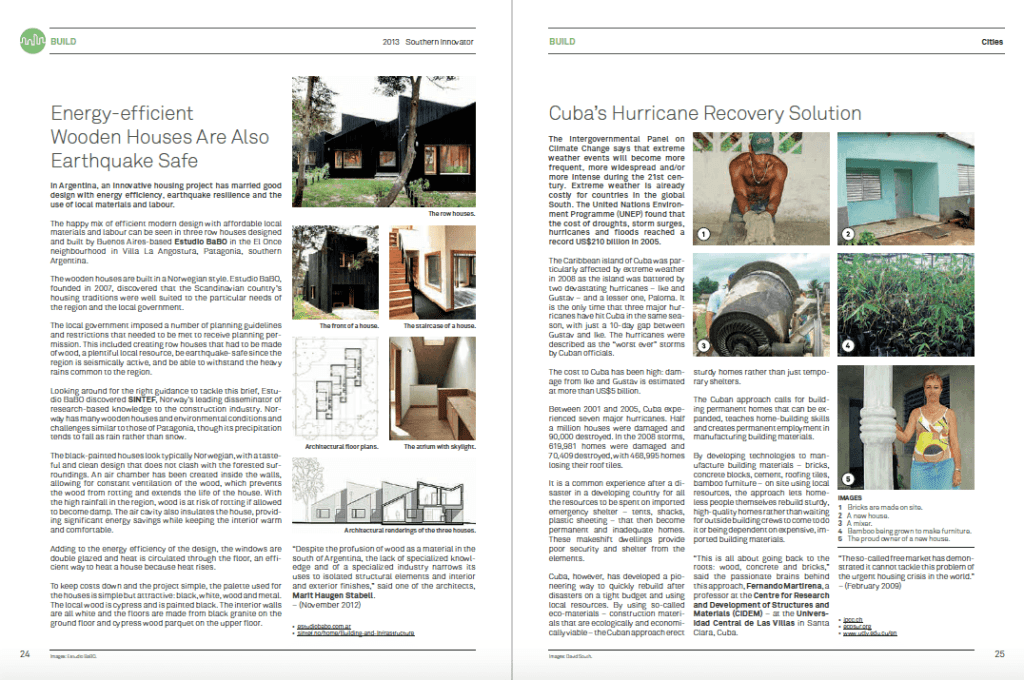
In Argentina, an innovative housing project has married good design with energy efficiency, earthquake resilience and the use of local materials and labour. As energy resources continue to be stretched around the global South, innovative building designs will be critical to the creation of sustainable housing for the future.

The happy mix of efficient modern design with affordable local materials and labour can be seen in three row houses designed and built by Buenos Aires-based Estudio BaBO (estudiobabo.com.ar) in the El Once neighbourhood in Villa La Angostura, Patagonia, southern Argentina.

The wooden houses are built in a Norwegian style. Estudio BaBO, founded in 2007, discovered that the Scandinavian nation’s housing traditions were well suited to the particular needs of the region and the local government.

The local government imposed a number of planning guidelines and restrictions that needed to be met to receive planning permission. This included creating row houses which must be made of wood – a plentiful local resource. They also had to be earthquake-safe since the region is seismically active and be able to withstand the heavy rains common to the region.

Looking around for the right guidance to tackle this brief, Estudio BaBO discovered SINTEF – Norway’s leading disseminator of research-based knowledge to the construction industry (http://www.sintef.no/home/Building-and-Infrastructure/). The Nordic nation has many wooden homes and also has similar environmental conditions and challenges to Patagonia – though its precipitation tends to fall as rain, rather than snow.

The black-painted homes look typically Norwegian, with a tasteful and clean design that does not clash with the forested surroundings. An air chamber has been created inside the homes’ walls allowing for constant ventilation of the wood, which prevents the wood from rotting and extends the life of the house. With the high rainfall of the region, wood is at risk of rotting if allowed to become damp. The air cavity also insulates the house, providing significant energy savings while keeping the interior warm and comfortable.

Adding to the energy efficiency of the design, the windows are double glazed and heat is also circulated through the floor – an efficient way to heat a home because heat rises.

To keep costs down and the project simple, the palette used for the homes is simple but attractive: black, white, wood and metal. The local wood is cypress and is painted black. The interior walls are all white and the floors are made from black granite on the ground floor and cypress wood parquet on the upper floor. The rest of the woodwork in the house is also made of cypress.

Using locally sourced materials also helps to keep costs down.

The project was initially conceived in 2009 and the houses were built in 2010-2011. While wood is plentiful in Patagonia, traditionally the use of wood in construction was rudimentary and local labour skill levels were low. This meant the design had to be simple and easy to build.

“Despite the profusion of wood as a material in the south of Argentina, the lack of specialized knowledge and of a specialized industry narrow its uses to isolated structural elements and interior and exterior finishes,” said one of the architects, Marit Haugen Stabell.

The three units of two-storey row houses each come with a living room, dining room, kitchen, toilet, two bedrooms and a laundry room. Each home also has an outdoor patio. The homes are designed to receive maximum natural light. Deploying this energy efficient design is considered unusual for Argentina and Estudio BaBO has set a new standard for sustainable housing in the country.

It looks like the CLF Houses could inspire others to look again at wood as a building material.

Published: November 2012

Resources

1) A story on how researchers are perfecting wooden home designs to withstand heavy earthquakes. Website:http://inhabitat.com/wooden-house-can-withstand-severe-earthquakes/

2) A website packed with photographs of wooden and other houses for inspiration and lesson learning. Website:http://www.trendir.com/house-design/wood_homes/

3) A step by step slideshow on how a Norwegian wooden house was re-built. Website:http://www.dwell.com/articles/norwegian-wood.html

4) Inspirational wooden home decorating ideas from across Scandinavia. Website:http://myscandinavianhome.blogspot.cz/

https://davidsouthconsulting.org/2022/10/19/chinese-building-solution-for-rapidly-urbanizing-global-south/

https://davidsouthconsulting.org/2021/09/01/disaster-recovery-ten-years-after-the-gujarat-india-experience/

https://davidsouthconsulting.org/2021/09/01/haiti-earthquake-prompts-tech-aid/

https://davidsouthconsulting.org/2017/10/27/information-accelerates-crisis-recovery-and-development-1997/

https://davidsouthconsulting.org/2021/02/12/rebuilding-after-chinese-earthquake-beautiful-bamboo-homes/

https://davidsouthconsulting.org/2021/02/23/southern-innovator-in-southasiadisasters-net/

https://davidsouthconsulting.org/2022/09/26/3d-home-printing-landmark-10-houses-in-a-day/

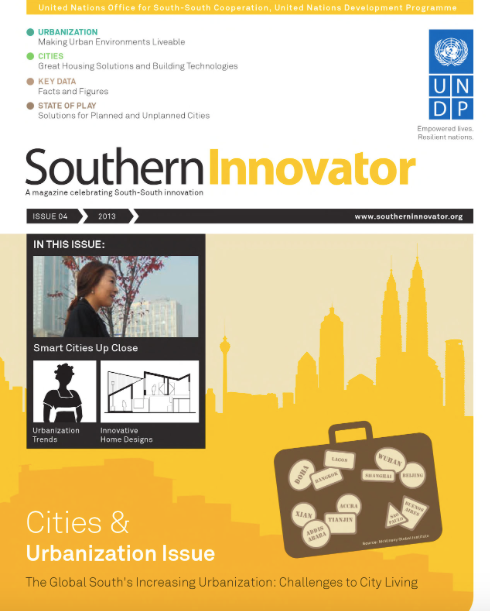
https://davidsouthconsulting.org/2021/03/05/southern-innovator-issue-4/

Development Challenges, South-South Solutions was launched as an e-newsletter in 2006 by UNDP’s South-South Cooperation Unit (now the United Nations Office for South-South Cooperation) based in New York, USA. It led on profiling the rise of the global South as an economic powerhouse and was one of the first regular publications to champion the global South’s innovators, entrepreneurs, and pioneers. It tracked the key trends that are now so profoundly reshaping how development is seen and done. This includes the rapid take-up of mobile phones and information technology in the global South (as profiled in the first issue of magazine Southern Innovator), the move to becoming a majority urban world, a growing global innovator culture, and the plethora of solutions being developed in the global South to tackle its problems and improve living conditions and boost human development. The success of the e-newsletter led to the launch of the magazine Southern Innovator.

Creative Commons License

This work is licensed under a
Creative Commons Attribution-Noncommercial-No Derivative Works 3.0 License.

ORCID iD: https://orcid.org/0000-0001-5311-1052.

© David South Consulting 2023

Categories
Archive Development Challenges, South-South Solutions Newsletters Southern Innovator magazine

Filipino Architect wants to Transform Slum with New Plan

By David SouthDevelopment Challenges, South-South Solutions

SOUTH-SOUTH CASE STUDY

A clash is occurring across the global South over the future of urban planning and the ever-growing slums of the world’s megacities. This will be a decisive clash of visions: should cities flatten slums and relocate their residents, or work with slum dwellers, acknowledge the role they play in city economies and improve their lives with better dwellings?

As the world turned into a majority urban place in the 2000s, cities grew at a phenomenal rate. The cities of Africa and Asia are growing by a million people a week, according to some estimates. Megacities and sprawling slums will be the hallmarks of this new urban world, it seems. In sub-Saharan Africa, 72 percent of the population already lives in slum conditions.

The danger of building unsafe or makeshift homes can be seen in 2010’s devastating earthquake in Haiti, where many buildings collapsed, killing thousands.

One of the Philippines’ leading architects and urban planners,
Felino A. Palafox Jr. of Palafox Associates (www.palafoxassociates.com), is passionate about re-making the slums in his country’s capital, Manila. The city is prone to devastating and sometimes deadly flooding. Palafox believes the vulnerability of slum dwellings and poor urban planning are placing lives at risk.

“We can’t wait for another tragedy,” Palafox told the Philippine Daily Inquirer in 2010. “We have seen how an unprecedented volume of rainfall like what (storm) Ondoy had brought could prove too much for Metro Manila’s river and drainage system. We have also seen what a massive earthquake could do to an unprepared city like Haiti.

“While there is nothing that we could do to control the destructive power of these natural phenomena, there are steps that we could take to limit the amount of damage.”

If the rapid growth in urban populations is to be safe and sustainable, then new dwellings will need to be built that meet high standards of durability.

The UN Challenge of Slums report from 2003 (www.unhabitat.org/pmss/listItemDetails.aspx?publicationID=1156) broke with past orthodoxy that slums must be cleared, arguing that slums should be seen as positive economic forces, incubators for budding entrepreneurs that offer a gateway to better things for new migrants.

Muhammad Khadim of UN-Habitat summed up the new thinking:

“Ten years ago, we used to dream that cities would become slum-free,” he said. But “the approach has changed. People see the positives. The approach now is not to clear them but to improve them gradually (and) regularise land tenure.”

The arguments behind embracing slums come from the economic changes across developing countries since the 1970s. Growing informal economies combined with fewer social provisions and the shift to urban from rural communities have all contributed to the explosion in slums and informal housing.

Manila is a city of stark and startling contrasts: there are glitzy shopping malls and high-rise office buildings, but also large slums and hungry people begging and selling trinkets on the city’s roads.

It’s a place where the slum clearance-vs-renovation debate is hot and current. The Philippines is currently in the midst of a campaign to clear slums in Manila and move people back to the countryside.

“Many of our people are no longer interested in agriculture, so we need to give them incentives to go back,” Cecilia Alba, head of the national Housing and Urban Development Co-ordinating Council, told the New Statesman magazine. “If we had to rehouse the slum-dwellers inside Manila in medium-rise housing, it would cost a third of the national budget.”

Palafox has a different vision – rebuilding a slum community from top to bottom.

An architect, environmental planner, urban planner and development consultant, Palafox runs one of the top architecture firms in the Philippines, employing more than 100 staff and consultants.

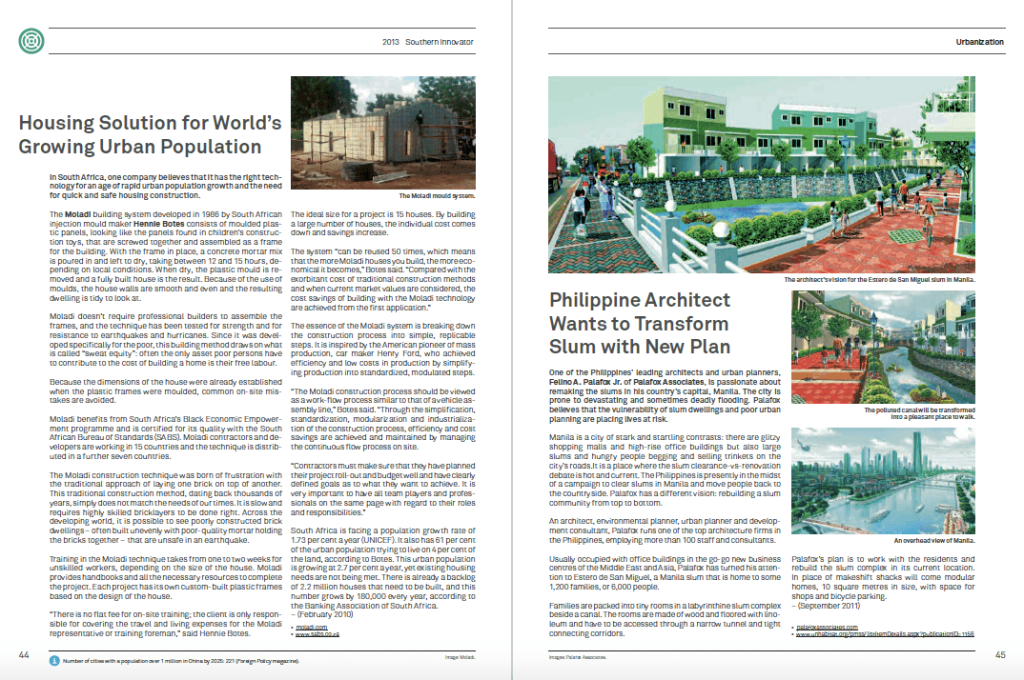
Usually occupied with office buildings in the go-go new business centres of the Middle East and Asia, Palafox has turned his attention to Estero de San Miguel, a Manila slum that is home to some 1,200 families, or 6,000 people.

Families are packed into tiny rooms in a labyrinthine slum complex beside a canal. The rooms are made of wood and floored with linoleum and have to be accessed through a narrow tunnel and tight connecting corridors.

Palafox’s plan is to work with the residents and rebuild it in its current location. In place of makeshift shacks will come modular homes, 10 square metres in size with space for shops and bicycle parking.

The design has the homes extend above a walkway, imitating the way the original slum structures were built.

Palafox is applying innovative thinking to the problem: taking his design direction from the dwellings slum residents build:  “The slum-dwellers,” he explained to the New Statesman, “are experts at live-work space design. They spontaneously do mixed-use! We just have to learn from them.”

Re-housing the residents on site means they can continue to play their role in the city’s economy, and do not have to make a long commute to jobs and opportunities.

Palafox also rebuts complaints about the cost of his plan, arguing the scale of corruption in the Philippines costs just as much.

“OK, the total cost of rehousing slum-dwellers in situ is 30 per cent of GDP (but) I calculate we lose about 30 per cent of the country’s wealth through corruption. If we didn’t have corruption, we wouldn’t need to tolerate slums.”

Another passionate advocate of working with slum dwellers is Father Norberto Carcellar from the Homeless People’s Federation (http://sdinet.org/countries/philippines.htm).

“We have to recognize the value of slum-dwellers to the city,” he said. “These are the ones who drive your car, clean your house and run your store. If these people were cleared from the city, the city would die. Slum-dwellers add social, political and economic value to the city.”

Even in its current form, Estero de San Miguel is a vibrant place, with an Internet café and a volunteer police force.

A BBC report found it lively and economically viable because it has educational and communication technologies that improve living conditions. The residents make their living working as cheap labour for the city.

Oliver Baldera, a carpenter, lives with his wife and four children:

“We’ve been here more than 10 years,” he told the New Statesman. “There’s no choice.

“It’s easier to get a job here and I can earn 400 pesos a day. I can send the kids to school and they eat three times a day – but it’s not enough. I need more space.”

Published: September 2011

Resources

1) More Urban, Less Poor: The first textbook to explore urban development and management and challenge the notion unplanned shanty towns without basic services are the inevitable consequence of urbanization. Website:http://www.earthscan.co.uk/?tabid=649
2) Slum Populations in the Developing World: See a breakdown of the urban/slum population in developing nations. Website: http://news.bbc.co.uk/1/hi/5078654.stm
3) Architecture for Humanity: An NGO to promote architectural and design solutions to global, social and humanitarian crises. Website:http://architectureforhumanity.org/
5) Building and Social Housing Foundation: The Building and Social Housing Foundation (BSHF) is an independent research organisation that promotes sustainable development and innovation in housing through collaborative research and knowledge transfer. Website:http://www.bshf.org
6) NGO called Map Kibera began work on an ambitious project to digitally map Africa’s largest slum, Kibera in Nairobi, Kenya. Website: http://www.mapkibera.org
7) ArrivalCity: The Final Migration and Our Next World by Doug Saunders. Website: http://www.arrivalcity.net
8) Slum TV: Based deep inside Nairobi’s largest slum, Mathare, they have been seeking out the stories of hope where international media only see violence and gloom. Website: http://www.slum-tv.org
9) A Kenyan eco-village is helping slum dwellers to start new lives and increase their wealth. The community, Kaputei, is being built by former slum residents – some of whom used to beg to survive – and is providing new homes with electricity, running water and services like schools and parks. By building their own homes, with the help of affordable mortgage loans, the residents are able to make a big upgrade to their quality of life while acquiring real wealth. Website: http://www.jamiibora.org
8) Cities for All shows how the world’s poor are building ties across the global South. Website:http://globalurbanist.com/2010/08/24/cities-for-all-shows-how-the-worlds-poor-are-building-ties-across-the-global-south.aspx

https://davidsouthconsulting.org/2021/10/21/cities-for-all-shows-how-the-worlds-poor-are-building-ties-across-the-global-south/

https://davidsouthconsulting.org/2022/05/23/debt-free-homes-for-the-poor/

https://davidsouthconsulting.org/2021/11/11/decent-and-affordable-housing-for-the-poor/

https://davidsouthconsulting.org/2022/02/17/digital-mapping-to-put-slums-on-the-map/

https://davidsouthconsulting.org/2022/04/28/envisioning-better-slums/

https://davidsouthconsulting.org/2022/11/16/favela-fashion-brings-women-work/

https://davidsouthconsulting.org/2022/10/25/indian-city-slum-areas-become-newly-desirable-places-to-live/

https://davidsouthconsulting.org/2022/10/25/indian-toilet-pioneer-champions-good-ideas/

https://davidsouthconsulting.org/2022/04/28/innovation-in-the-slums-can-bring-peace-and-prosperity/

https://davidsouthconsulting.org/2020/12/14/innovation-in-growing-cities-to-prevent-social-exclusion/

https://davidsouthconsulting.org/2021/11/22/kenyan-eco-village-being-built-by-slum-dwellers/

https://davidsouthconsulting.org/2021/10/03/a-new-house-kit-for-slum-dwellers-that-is-safe-and-easy-to-build/

https://davidsouthconsulting.org/2022/11/19/securing-land-rights-for-the-poor-now-reaping-rewards/

https://davidsouthconsulting.org/2022/10/24/solar-power-bringing-light-and-opportunity-to-the-poor/

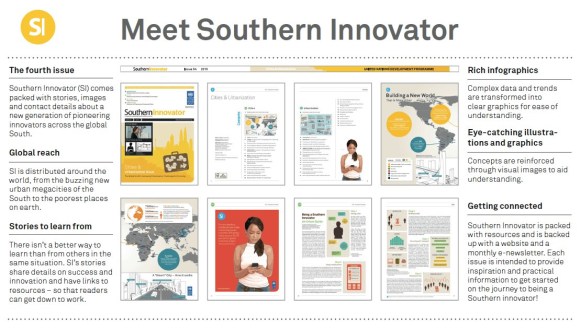
https://davidsouthconsulting.org/2021/03/05/southern-innovator-issue-4/

https://davidsouthconsulting.org/southern-innovator-scale-up-fundraiser/

Creative Commons License

This work is licensed under a
Creative Commons Attribution-Noncommercial-No Derivative Works 3.0 License.

ORCID iD: https://orcid.org/0000-0001-5311-1052.

© David South Consulting 2023

Categories
Blogroll Southern Innovator magazine Special Unit for South-South Cooperation United Nations Development Programme

10 Years Ago

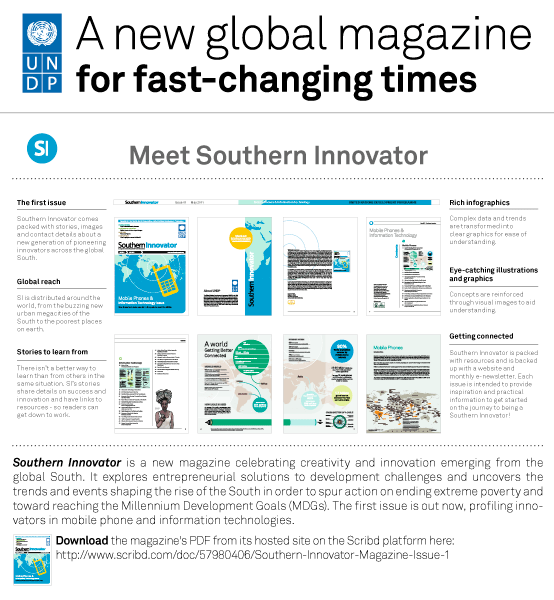
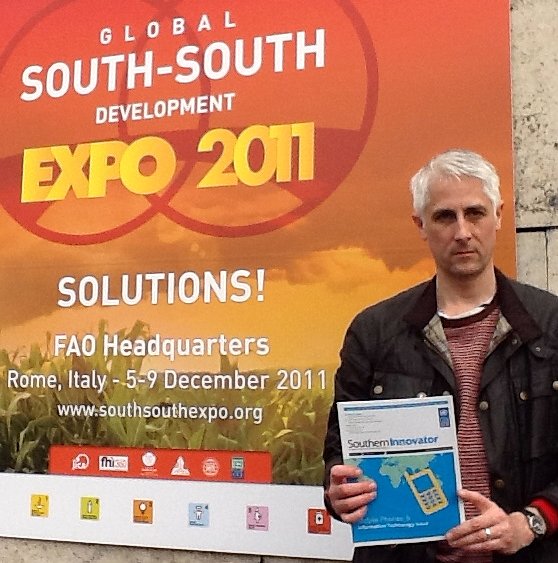
It was 10 years ago this month that Southern Innovator‘s first issue launched in New York during the UN’s General Assembly week (UNGA). It focused on mobile phones and information technology for a reason: these connectivity transformations were re-shaping how people lived their lives, even in the poorest and remotest places on earth.

The content was based on global research, beginning in 2007, funded by the United Nations.

Southern Innovator Editor and Writer David South.

https://davidsouthconsulting.org/2022/05/27/media/

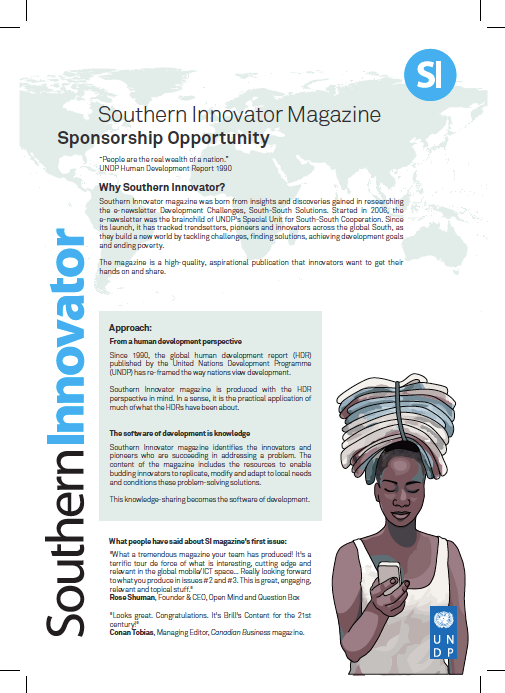
“What a tremendous magazine your team has produced! It’s a terrific tour de force of what is interesting, cutting edge and relevant in the global mobile/ICT space… This is great, engaging, relevant and topical stuff.” Rose Shuman, Founder & CEO, Open Mind and Question Box, Santa Monica, CA, U.S.A.

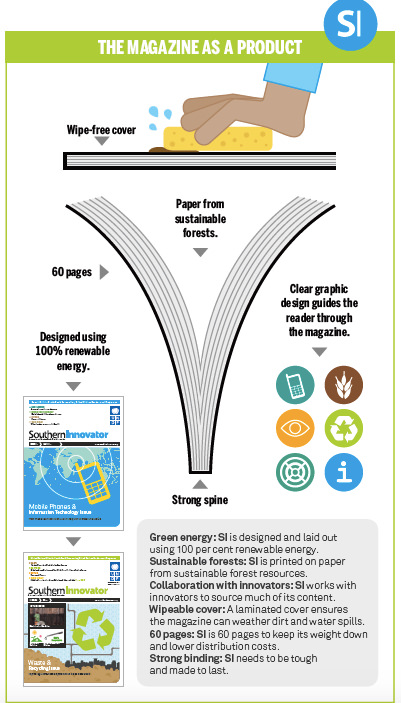
While Southern Innovator’s digital presence has been key to its success and global reach, the hard copy of the magazine was designed with special features. The magazine needed to be robust and able to stand a fair bit of abuse and hard wear. It needed to be easy to read in low light conditions. And it needed to look sharp and eye-catching to reach as wide an audience as possible.

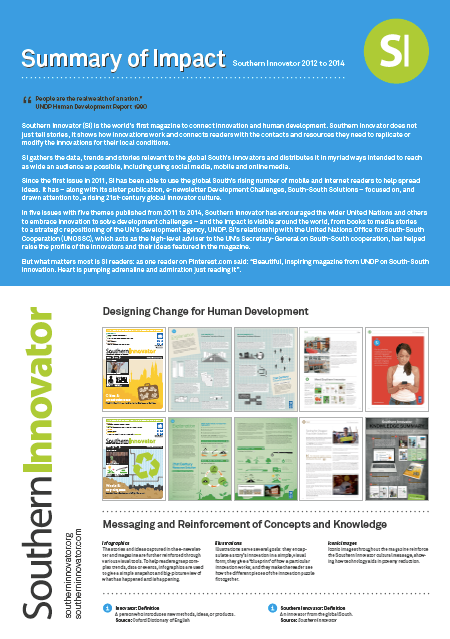
“Beautiful, inspiring magazine from UNDP on South-South innovation. Heart is pumping adrenaline and admiration just reading it.”

New Branding and Website

In 2010, as we prepared to launch Southern Innovator, the branding and website for David South Consulting was re-visioned by Icelandic graphic designer and illustrator Sólveig Rolfsdóttir. David South Consulting has been working with clients around the world since 1991.

Graphic Designer and Illustrator: Sólveig Rolfsdóttir.

20 Years Ago

Over 20 Years Ago

Mongolia’s first web magazine, Ger, launched in September 1998. It was also the first web magazine for the United Nations.

“The transformation of Mongolia from a largely rural nomadic society of herdsmen to a community dominated by the increasingly ultra-globalized city of Ulan Bator, where almost a third of the population lives, is nothing short of astounding. The New Mongolia: From Gold Rush to Climate Change, Association for Asian Studies, Volume 18:3 (Winter 2013): Central Asia

Logo and graphic design: P. Davaa-Ochir.

This work is licensed under a Creative Commons Attribution 4.0 International License.

ORCID iD: https://orcid.org/0000-0001-5311-1052.

© David South Consulting 2021