This timeline is an aid to decision-making during the recovery from the pandemic and how to better prepare for outbreaks in the post-COVID-19 pandemic policy environment.
“This session will explore the issue of major infectious disease outbreaks as a threat to economic and human security, and the need for domestic resource mobilization for pandemic preparedness. Emphasis will be placed on the situations within lower-middle and low-income countries, which often lack the financial, human, and physical resources required to strengthen their global health security infrastructure. This includes but is not limited to emergency response, health workforce, surveillance, procurement of countermeasures, cold and supply chain management, and adequate health systems.”
“The exercise illustrated areas where public/private partnerships will be necessary during the response to a severe pandemic in order to diminish large-scale economic and societal consequences.
In recent years, the world has seen a growing number of epidemic events, amounting to approximately 200 events annually. These events are increasing, and they are disruptive to health, economies, and society. Managing these events already strains global capacity, even absent a pandemic threat. Experts agree that it is only a matter of time before one of these epidemics becomes global—a pandemic with potentially catastrophic consequences. A severe pandemic, which becomes “Event 201,” would require reliable cooperation among several industries, national governments, and key international institutions.”
“This book develops an examination and critique of human extinction as a result of the ‘next #pandemic’ and turns attention towards the role of pandemic catastrophe in the renegotiation of what it means to be human.”
“Anyone with a real interest in business and global trade will have been in London last week. To look on as the government tried to enact Brexit legislation? No — to attend the World Chinese Entrepreneurs Convention.”
“… It is 30 years old, but came to Europe for the first time only last week. …
“3,000 delegates from Chinese-owned businesses representing a large part of world trade were at the ExCel centre in Docklands for three days.
“What’s a girl to do when she gets an invitation to the key dinner for this event?.”
“ONCE YOU’RE IN THE MIDST OF A SEVERE PANDEMIC, YOUR OPTIONS ARE VERY LIMITED. THE GREATEST GOOD CAN HAPPEN WITH PRE-PLANNING.” Eric Toner, Senior scholar, Johns Hopkins Center for Health Security
The scenarios foresaw leaky travel bans, a scramble for vaccines and disputes between state and federal leaders, but none could anticipate the current levels of dysfunction in the United States.
“A Canadian team of scientists has successfully isolated a strain of the coronavirus and grown samples in a lab to help study the pathogen responsible for the deadly global pandemic.
“Researchers from Sunnybrook Research Institute, McMaster University and the University of Toronto, all in Canada, isolated the virus from two specimens and then cultivated it in a secure containment facility.”
“It appears that what you might well call Chinese agents infiltrated one of the highest prized national security elements when it comes to biosecurity and biodefence,” said Christian Leuprecht, a security expert and professor at the Royal Military College and Queen’s University.
“The phrase ‘global health’ appears ubiquitously in contemporary medical spheres, from academic research programs to websites of pharmaceutical companies. In its most visible manifestation, global health refers to strategies addressing major epidemics and endemic conditions through philanthropy, and multilateral, private-public partnerships. This book explores the origins of global health, a new regime of health intervention in countries of the global South born around 1990, examining its assemblages of knowledge, practices and policies.
The volume proposes an encompassing view of the transition from international public health to global health, bringing together historians and anthropologists to analyse why new modes of “interventions on the life of others” recently appeared and how they blur the classical divides between North and South. The contributors argue that not only does the global health enterprise signal a significant departure from the postwar targets and modes of operations typical of international public health, but that new configurations of action have moved global health beyond concerns with infectious diseases and state-based programs.
The book will appeal to academics, students and health professionals interested in new discussions about the transnational circulation of drugs, bugs, therapies, biomedical technologies and people in the context of the “neo-liberal turn” in development practices.”
There is a trend occurring across the global South that some are calling the next great wave of innovation. It has different names but many are dubbing it ‘frugal innovation’. Frugal innovation is basically innovation done with limited resources and investment. In short, innovation on the cheap but packing a big punch.
The phenomenon has several strands. One involves innovators and companies from the developed world setting up in the developing world and beta testing their inventions and innovations there. Another strand involves innovators in companies and governments in the global South increasingly targeting the so-called ‘BOP’ – bottom of the pyramid – market of the poor.
Another strand is focused on capitalizing on innovations for tackling the problems of the poor that are coming from the poor. Many of these innovations are improvised solutions. They may not be slick but they solve a problem.
And finally, there are companies and entrepreneurs in the global South taking their innovations to the markets of the wealthy, developed countries and finding a welcome reception from price-savvy consumers.
In the global South, frugal innovation is transforming lives – and it is finding its way into developed, wealthy countries too. It has been celebrated in the new book Jugaad Innovation: A Frugal and Flexible Approach to Innovation for the 21st Century (http://jugaadinnovation.com/) by Navi Radjou, Jaideep Prabhu and Simone Ahuja. The authors are innovation experts with a wide mix of backgrounds, from an academic to a Silicon Valley “thought leader and strategic consultant” to the founder of a marketing and strategy consultancy specialising in emerging markets innovation.
The authors propose “jugaad innovation” as a solution to the urgent need to innovate quickly and efficiently in a fast-changing world where little can be taken for granted. This breed of frugal innovation comes from India. Jugaad is a Hindi word (http://en.wikipedia.org/wiki/Jugaad) and basically means a work-around, improvised solution to a problem because it is cheaper. This is commonly used to describe makeshift vehicles people construct in India (http://wheels.blogs.nytimes.com/2011/03/25/jugaad-cheaper-than-a-nanobut-watch-for-splinters/).
As champions of the jugaad philosophy, the authors proclaim the old innovation paradigm is obsolete. The idea that throwing more capital and more resources at a problem will boost innovation, no longer works, they contend. Better results can come from being frugal and flexible. Being more creative allows for a fluid and improvised innovation culture to develop.
“In today’s interconnected world powered by social media, top-down R&D (research and development) systems struggle to open up and integrate the bottom-up input from employees and customers,” the authors say on their website.
“Jugaad on the other hand is flexible, frugal and democratic: it is often bottomup rather than top-down and involves a much larger number of people beyond those who are typically tasked with doing innovation in corporations. The strength of jugaad innovators lies in their ability to get more from less,experiment continually, and creatively engage people who are typically left out of the innovation process.”
And they have a message for the Western, developed nations. They must look to “places like India, China, and Africa for a new, bottom-up approach to frugal and flexible innovation,” if they want to experience continuing prosperity in the 21st century.
For global South inventors, entrepreneurs and manufacturers, this will prove a great opportunity. As debt-laden Western consumers deal with their lower spending power and incomes, they will be looking for products that cost less and yet tackle problems and improve their standard of living with minimal expenditure.
The Indian company Mahindra and Mahindra (http://www.mahindra.com/What-We-Do/automotive) sells its small tractors to American hobby farmers. The Chinese company Haier (http://www.haier.net/en/about_haier/haier_global/china/) has a range of frugal products that have become popular sellers. They include air conditioners, washing machines and wine coolers. Haier is so successful with these products it has been able to capture 60 per cent of the market in these categories in the United States.
Some of the hallmarks of frugal products are their efficient production, rapid development cycle, lower price point, and appeal to poorer customers.
The book argues that adopting a “jugaad” mindset will enable people and companies to innovate “faster, better and cheaper,” “generate breakthrough growth” and “outperform competition.”
“Jugaad innovation has three major benefits. First, it is frugal: it enables innovators to get more with less. Second, it is flexible: it enables innovators to keep experimenting and rapidly change course when needed. Third: it is democratic: it can therefore tap into the wisdom of otherwise marginalized customers and employees.”
“In contrast to the traditional structured approach to innovation, jugaad is inherently more customer-centric rather than technology or product centric.
Because jugaad innovators seek to solve a customer problem first and then develop a suitable solution, jugaad is more market-based than more structured approaches (that may be driven by the motivation to develop technology for technology’s sake) are.”
There are so many of these innovations and inventions happening, a culture has emerged to gather and document them and share them with others.
But this dynamic innovators culture is not limited to India. Across Africa,information technology hubs and start-ups have been sprouting up. One of the more well-known is the iHub in Nairobi, Kenya (http://ihub.co.ke/pages/home.php) but there are centres of information technology innovation in Ghana, South Africa, Uganda and Nigeria.
One of the more outstanding and pioneering chroniclers of this frugal innovation culture in Africa has been the Afrigadget website (afrigadget.com).
It is packed with home-grown inventions. These include a young Kenyan boy using a rigged network of light bulbs to ward of lions from the cattle herd, a mobile phone security system for cars, and a home-made remote control toy car for children. Another great way to see this movement in action is at the Maker Faire Africa (http://makerfaireafrica.com/) which has been bringing together every year “handcrafters from Africa’s tiniest villages to her most expansive urban burgs”.
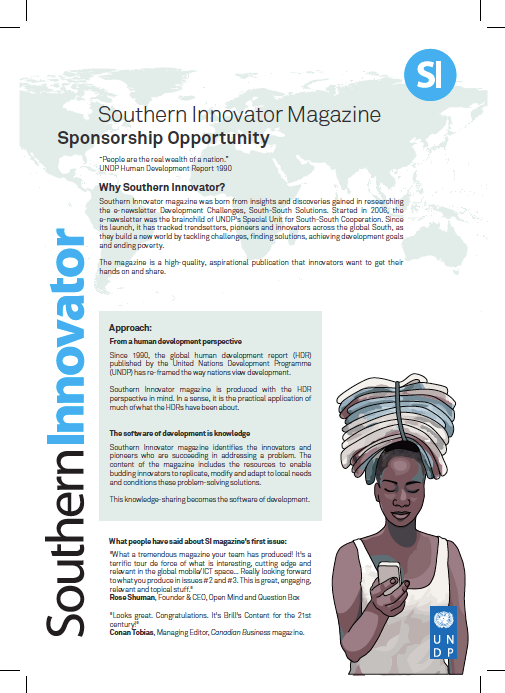
Development Challenges, South-South Solutions was launched as an e-newsletter in 2006 by UNDP’s South-South Cooperation Unit (now the United Nations Office for South-South Cooperation) based in New York, USA. It led on profiling the rise of the global South as an economic powerhouse and was one of the first regular publications to champion the global South’s innovators, entrepreneurs, and pioneers. It tracked the key trends that are now so profoundly reshaping how development is seen and done. This includes the rapid take-up of mobile phones and information technology in the global South (as profiled in the first issue of magazine Southern Innovator), the move to becoming a majority urban world, a growing global innovator culture, and the plethora of solutions being developed in the global South to tackle its problems and improve living conditions and boost human development. The success of the e-newsletter led to the launch of the magazine Southern Innovator.
“What a tremendous magazine your team has produced! It’s a terrific tour de force of what is interesting, cutting edge and relevant in the global mobile/ICT space… Really looking forward to what you produce in issues #2 and #3. This is great, engaging, relevant and topical stuff.”
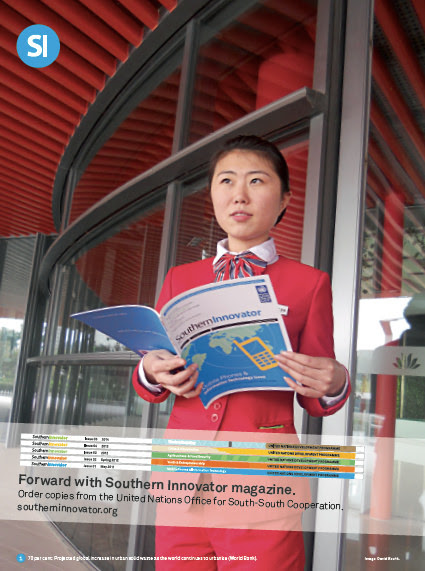
Southern Innovator was initially launched in 2011 with the goal of inspiring others (just as we had been so inspired by the innovators we contacted and met). The magazine seeks to profile stories, trends, ideas, innovations and innovators overlooked by other media. The magazine grew from the monthly e-newsletter Development Challenges, South-South Solutions published by the United Nations Office for South-South Cooperation (UNOSSC) since 2006.
Issue 6’s theme has been decided on: it will focus on Science, Technology and Innovation. For this issue, Southern Innovator is seeking invitations from cutting-edge knowledge and science innovators in the global South to view their work. Time is tight, so don’t miss this opportunity to let the whole global South know about your work. In the past, Southern Innovator has visited green pioneers in Cuba, a smart city in South Korea and an eco-city in China.
Contact me if you wish to receive a copy/copies of the magazine for distribution. Follow @SouthSouth1.
“The e-newsletter Development Challenges, South-South Solutions proved to be a timely and prescient resource on the fast-changing global South, tracking the rise of an innovator culture driven by the rapid adoption of mobile phones and information technology …
“In 2010, work began on the development of the world’s first magazine dedicated to the 21st-century innovator culture of the global South. My goal was to create a magazine that would reach across countries and cultures, meet the UN’s standards, and inspire action. Southern Innovator was the result. Mr. [David] South played a vital role in the magazine’s development from its early conception, through its various design prototypes, to its final global launch and distribution.
“Both the e-newsletter and magazine raised the profile of South-South cooperation and have been cited by readers for inspiring innovators, academics, policy makers and development practitioners in the United Nations and beyond.
“I highly recommend Mr. [David] South as a thoughtful, insightful, analytical, creative and very amicable person who has the unique ability to not only grasp complex problems but also to formulate a vision and strategy that gets things done. … ” Cosmas Gitta, Former Assistant Director, Policy and United Nations Affairs at United Nations Office for South-South Cooperation (UNOSSC) in UNDP
“I think you [David South] and the designer [Solveig Rolfsdottir] do great work and I enjoy Southern Innovator very much!” Ines Tofalo, Programme Specialist, United Nations Office for South-South Cooperation
According to zoominfo in 2023, Southern Innovator is one of the Popular Searches online for the United Nations Office for South-South Cooperation (UNOSSC).
Like our content? Help contribute to the costs of keeping it online.
The transition to a green economy has reached a crossroads: while multilateral global initiatives have been long-running and complex, the idea of a green economy still seems fragile and achieving it far from certain. In the face of the ravages of the global economic crisis that has raged since 2007/2008, countries are now trying to roll back their green pledges or slow the pace of transition.
This exposes a dilemma: a perception that a green economy is in conflict with economic growth, prosperity and the advance of human development, particularly in developing countries seeking to make rapid gains in reducing poverty and building a middle class, consumer society.
Three things need to be foremost in the minds of those who care about creating a global green economy in the 21st century: innovation in design, in market prices and in business models. I think these three factors will be the deciding elements in whether green technologies are taken up quickly and used by large numbers of people to improve their lives.
The green option needs to always be the more appealing, cheaper option that also improves living standards. Happily, many people are doing this all around the world – you just may not have heard of them yet (unless you are reading Southern Innovator magazine that is).
As editor of the magazine Southern Innovator since 2011, I have had the privilege to meet, interview and see first-hand green economy innovators across the global South and profile them in the magazine. What has stood out for me is this: the ones who have achieved sustainable success have put a great deal of effort into design – how the technology is made, what it looks like and how it is used, how efficiently it is made and distributed – while also thinking through the business case for their work and how to make it appealing to others.
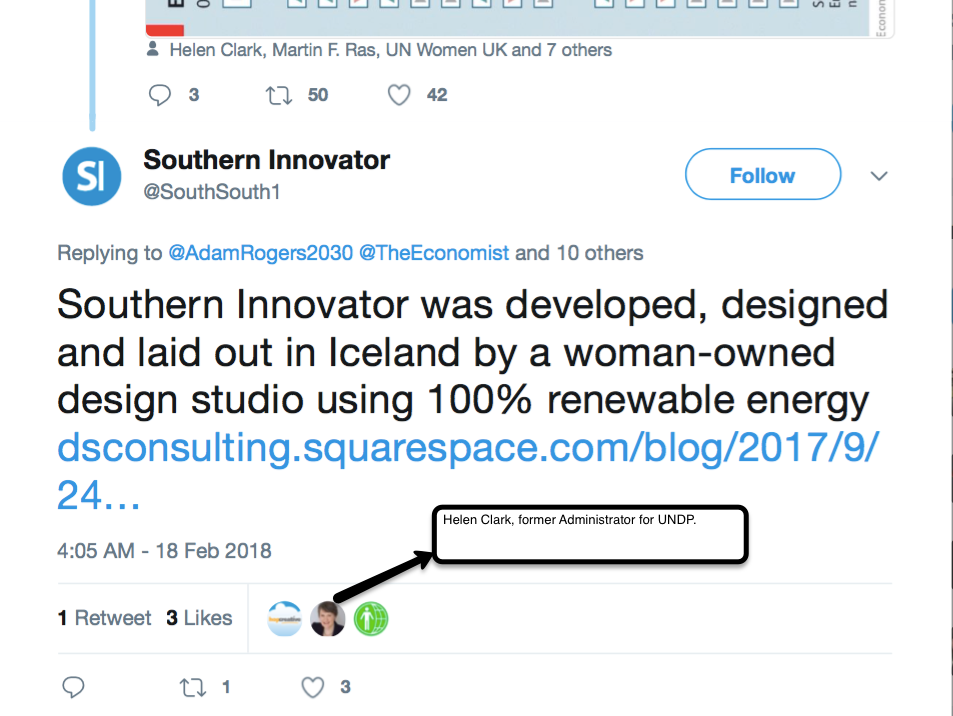
We have tried to apply this thinking to the magazine as well, by using clear and modern design with bright, eye-pleasing colours, and by choosing to use 100 per cent renewable energy (much of it from geothermal sources) for the magazine’s design and layout and to have it printed on paper from sustainable forest sources.
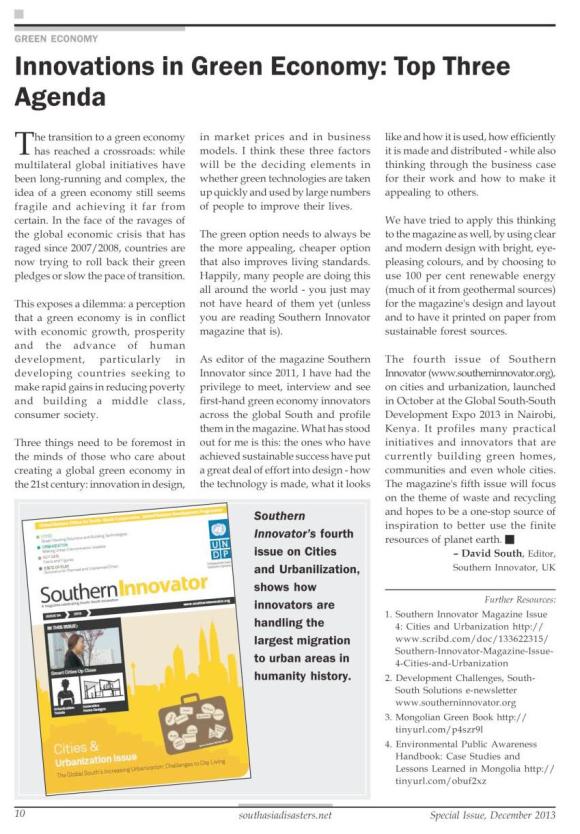
The fourth issue of Southern Innovator (www.southerninnovator.org), on cities and urbanization, launched in October at the Global South-South Development Expo 2013 in Nairobi, Kenya. It profiles many practical initiatives and innovators that are currently building green homes, communities and even whole cities. The magazine’s fifth issue will focus on the theme of waste and recycling and hopes to be a one-stop source of inspiration to better use the finite resources of planet earth.
The coming wave of technological innovations aimed at global South cities will dominate civic debates whether people wish it to or not. Already, futuristic, 21st-century cities are being built around Asia from scratch. I had the privilege of visiting a couple of them in 2012 while researching the fourth issue of our magazine, Southern Innovator ( h t t p : / / w w w . s c r i b d . c o m / SouthernInnovator). Each city had a different focus for its construction – one was seeking to be an “eco-city” and the other one called itself a “smart city,” focused on becoming a regional business and technology hub. Both aimed to use the latest information technologies to make the way Asian cities operate on a day-to-day basis smarter – and greener.
Large information technology companies – including India’s Infosys (infosys.com) – have their sights set on selling all sorts of technological solutions to common problems of urban living. This aspiring revolution is built on two foundations: One is the Internet of Things – in which everyday objects are connected to the Internet via microchips. The other is Big Data, the vast quantities of data being generated by all the mobile phones and other electronic devices people use these days.
Much of this new technology will be manufactured in Asia, and not just that – it will also be developed and designed in Asia, often to meet the challenges of urban Asia.
By their nature, cities are fluid places. People come and go for work and pleasure, and successful cities are magnets for people of all backgrounds seeking new opportunities. This fluidity puts stress on cities and leads to the constant complaints familiar to any urban dweller – inadequate transport, traffic jams, air pollution, poor housing, and a high cost of living.
If handled well and with imagination, new information technologies can ensure Asian cities do more than pay lip service to aspirations to improve human development. They can make cities resilient places – able to bounce back from disasters, whether man made or natural.
During the late 1990s, I saw first-hand the pressures placed on one Asian city, Mongolia’s capital, Ulaanbaatar. The country endured the worst peacetime economic collapse since World War II while confronting the wrenching social and economic stresses of switching from a command economy during Communism to a free-market democracy. The city’s population grew quickly as rural economies collapsed and poverty shot upwards. I can only imagine now how the response could have been different with the technologies available today.
“A lot of social initiatives based on the right to the city are coming from these ‘new cities of the South,’” Mathivet said. “The book highlights original social initiatives: protests and organizing of the urban poor, such as the pavement dwellers’ movements in Mumbai where people with nothing, living on the pavements of a very big city, organise themselves to struggle for their collective rights, just as the park dwellers did in Osaka.”
Recently, an Indian restaurant uploaded to the Internet a video of what it claimed to be the first drone delivering a pizza in an Indian city. While this may or may not be a practical solution to traffic congestion, the subsequent negative fallout – angry police and public officials – from this use of new technology highlights the promise and perils of innovating in the real world of Asian cities (http:/ /www.bbc.co.uk/news/ b l o g s – n e w s – f r o m – elsewhere-27537120).
Micro electronics are becoming cheaper and more powerful by the month. Small businesses armed with a only laptop computer, access to the Internet and/or mobile phone networks, and cloud computing services, can offer very powerful business and public services solutions. And sharing solutions across the global South via information technologies has never been easier.
The U.S. Pentagon published various reports and studies in the 2000s forecasting a dark future for cities in the global South. As author Mike Davis revealed in his seminal work, Planet of Slums (http://www.amazon.com/exec/obido/ASIN/1844670228/nationbooks08), the Pentagon saw the developing world’s cities as the “battlespace of the twenty-first century.” It imagined sprawling, crime ridden cities full of poverty and slums and needing tiny drones and robots darting back and forth, keeping an eye on everything and suppressing unrest. This threat-based view of future cities is one to be avoided. It is possible, through the right application of quick solutions to the challenges that arise as cities grow, to turn to cooperation across the cities of the global South to avoid this pessimistic fate.
Fast-growing cities and urban areas in the global South can be vulnerable because they lack the web of structures and institutions that enable more long-established cities to mitigate risks and, when a disaster does strike, to bounce back quickly. But thanks to many new technologies, and some smart new thinking, it is possible to bring resilience to even the poorest and most deprived urban communities.
The essence of resilience is to build into plans and daily activities a community’s ability to weather any disaster, small or large. All cities, rich or poor, can experience a disaster of some sort, be it weather, civil unrest, war, earthquakes, shortages, or economic, financial and health crises. New technologies make it possible for all cities, no matter how poor and overcrowded, to build in urban resilience. The ubiquity of mobile phones introduces a powerful city and urban planning tool. Mapping chaotic and unplanned areas is already underway in many cities of the global South (in Brazil and Kenya for example (http://tinyurl.com/qgba8kb).
Impressively, innovators in the South are using affordable microelectronics in the form of mobile phones and laptops to gather data and map it. This computing capability was once the sole domain of big information technology companies such as IBM. Now, a single laptop computer combined with a smartphone equipped with the right software can manage a large urban area, a task that once required rooms full of computers. The data can then be used to manage growth today and re-build after a disaster. Any excuse not to be resilient has been wiped out with this technological leap.
But how to deal with the common reality of feeling overwhelmed by the many obstacles to rational planning and building for urban growth in the South? Innovators have stepped in to take matters into their own hands with simple construction technologies as the solution. One example is the Moladi system of recycled plastic moulds (moladi.net). Anybody can master this simple building technique, as the mortar-filled moulds are designed to fit easily together to construct an earthquake-resistant, beautiful home.
This approach has the advantage of bypassing the failings of authorities to enforce building codes and standards in poor, urban communities, creating safer places to live and preventing the growth of unregulated shanty towns at risk to fire and earthquakes.
Others have found social ways to organize people, even in the most desperate of conditions, providing services and laying down the groundwork for an upgrading of an urban area to improve living conditions and long-term opportunities. The concept of ‘cities for all’ has inspired many to re-energize civic organizations and networking in poor areas to ensure they are not left out of economic growth. In Colombia, a famous example of this is the escalator in the city of Medellin, which connects a hillside slum to the centre of the city, opening up economic opportunities to all (http://tinyurl.com/nm47d3u).
Still more exciting, new technologies are in the works to simplify construction of major infrastructure and new buildings. A future city will be able to gather extensive data on an expanding urban area, make detailed development plans with architects and engineers, and then have robots and 3D fabricating machines quickly lay down infrastructure and erect buildings. Sounds far-fetched? Well, in China one company recently used a 3D machine to make 10 houses in a single day (http://www.yhbm.com/index.aspx).
An infographic from Southern Innovator’s fourth issue (http:// tinyurl.com/m9vfwur) shows 10 ways any urban area – either planned or unplanned – can build in resilience. All are proven approaches from cities in the global South.
Southern Innovator’s upcoming sixth issue will explore the interplay of science, technology and innovation in the global South and how people are making the most of 21st century advances to increase wealth and improve human development. Hopefully, all of this innovation will lead to more resilient cities in the future!














 David South Consulting
You must be logged in to post a comment.