Categories
Archive Development Challenges, South-South Solutions Newsletters Southern Innovator magazine

Indonesian Wooden Radio Succeeds with Good Design

By David SouthDevelopment Challenges, South-South Solutions

SOUTH-SOUTH CASE STUDY

One Indonesian industrial designer has pioneered an innovative business that has rejuvenated the economy of a farming village and improved the sustainability of local forests – and he’s doing it all with wood.

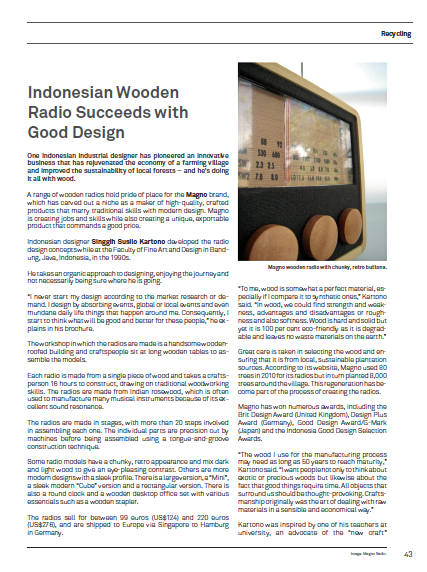
A range of wooden radios (wooden-radio.com) hold pride of place for the Magno brand (http://www.magno-design.com/?id=wr01a), which has carved out a niche as a maker of high-quality, crafted products that marry traditional skills with modern design. Magno is creating jobs and skills while also creating a unique, exportable product that commands a good price.

Indonesian designer Singgih Susilo Kartono developed the radio design concepts while at the Faculty of Fine Art and Design in Bandung, Java, Indonesia in the 1990s.

He takes an organic approach to designing, enjoying the journey and not necessarily being sure where he is going.

“I never start my design according to the market research or demand. I design by absorbing events, global or local events and even mundane daily life things that happen around me. Consequently, I start to think what will be good and better for these people,” he explains in his brochure.

The workshop in which the radios are made is a handsome wooden-roofed building and craftspeople sit at long wooden tables to assemble the models.

Each radio is made from a single piece of wood and takes a craftsperson 16 hours to construct, drawing on traditional woodworking skills. The radios are made from Indian rosewood, which is often used to manufacture many musical instruments because of its excellent sound resonance.

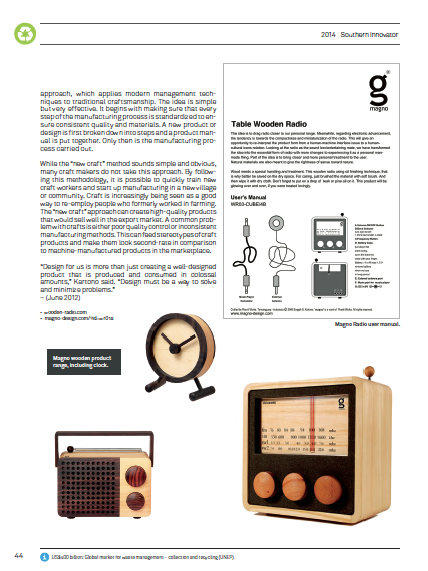
The radios are made in stages, with more than 20 steps involved in assembling each one. The individual parts are precision cut by machines before being assembled using a tongue and groove (http://en.wikipedia.org/wiki/Tongue_and_groove) construction technique.

Some radio models have a chunky, retro appearance and mix dark and light wood to give an eye-pleasing contrast. Others are more modern designs with a sleek profile. There is a large version, a ‘Mini’, a sleek modern Cube’ version and a rectangular version. There is also a round clock and a wooden desktop office set with various essentials like a wooden stapler.

The radios sell for between Euros 99 (US $124) and Euros 220 (US $276), and are shipped to Europe via Singapore to Hamburg in Germany.

“To me, wood is somewhat a perfect material – especially if I compare it to synthetic ones,” Kartono said. “In wood we could find strength and weakness, advantages and disadvantages or roughness and also softness. Wood is hard and solid but yet it is 100 per cent eco-friendly as it is degradable and leaves no waste materials on the earth.”

Great care is taken in selecting the wood and ensuring it is from local, sustainable plantation sources. According to its website, Magno used 80 trees in 2010 for its radios but in turn planted 8,000 trees around the village. This regeneration has become part of the process of creating the radios.

Magno has won numerous awards, including the Brit Design Award (UK), Design Plus Award (Germany), Good Design Award/G-Mark (Japan) and the Indonesia Good Design Selection Awards.

“The wood I use for the manufacturing process may need as long as 50 years to reach maturity,” Kartono said. “I want people not only to think about exotic or precious woods but likewise about the fact that good things require time. All objects that surround us should be thought-provoking. Craftsmanship originally was the art of dealing with raw materials in a sensible and economical way.”

As Kartono tells it, he faced the typical university graduate’s dilemma about his career path. Should he work as an in-house designer in a city or return to his home village of Kandangan and start a business? His choice was unusual. Once somebody with a university education leaves a small village, it is rare they return. And at first, Kartono did not.

But he was drawn back by the dire situation in the village, and decided to apply his knowledge of product design to revive its economic fortunes. He started by visiting just twice a year because that was all he could afford. This had the advantage of giving him perspective on the situation in the village.

“At first glance, these changes (happening to the village) were seen as a ‘progress,’” he said. “But when I looked more closely I concluded that it was only the ‘surface’ which experienced change. The basic structure of the village did not undergo any changes; moreover, some was actually deteriorating.”

He concluded that the village was being damaged by various government attempts to modernize agricultural practices. The debt problems this caused meant many farmers lost their farms and were forced to seek work in the city or look for another way to make money.

Craft work seemed to be the answer to this problem. It has many advantages, as Kartono sees it. It is something that can grow and fits well with village lifestyles. It is labour intensive, doesn’t need sophisticated technology and can use already existing local resources.

Kartono was inspired by one of his teachers at university, an advocate of the ‘New Craft’ approach, which applies modern management techniques to traditional craftsmanship. The idea is simple but very effective. It begins with making sure every step of the manufacturing process is standardized to ensure consistent quality and materials. A new product or design is first broken down into steps and a product manual is put together. Only then is the manufacturing process carried out.

While the New Craft method sounds simple and obvious, many craft makers do not take this approach. By following this methodology, it is possible to quickly train new craft workers and start up manufacturing in a new village or community. Craft is increasingly being seen as a good way to re-employ people who formerly worked in farming. The New Craft approach can create high-quality products that would sell well in the export market. A common problem with crafts is either poor quality control or inconsistent manufacturing methods. This can feed stereotypes of craft products and make them look second-rate in comparison to machine-manufactured products in the marketplace.

“Design for us is more than just creating a well-designed product that is produced and consumed in colossal amount,” Kartono said. “Design must be a way to solve and minimize problems.”

Published: June 2012

Resources

1) Cradle to Cradle: Remaking the Way We Make Things by William McDonough and Michael Braungart. It is a manifesto calling for the transformation of human industry through ecologically intelligent design. Website: http://www.mcdonough.com/cradle_to_cradle.htm

2) Rio+20: At the Rio+20 Conference, world leaders, along with thousands of participants from governments, the private sector, NGOs and other groups, will come together to shape how we can reduce poverty, advance social equity and ensure environmental protection on an ever more crowded planet to get to the future we want. Website: http://www.uncsd2012.org/

https://davidsouthconsulting.org/2021/03/20/accessing-global-markets-via-design-solutions/

https://davidsouthconsulting.org/2021/03/12/afro-coffee-blending-good-design-and-coffee/

https://davidsouthconsulting.org/2021/02/20/baker-cookstoves-designing-for-the-african-customer/

https://davidsouthconsulting.org/2021/12/20/better-by-design-in-china/

https://davidsouthconsulting.org/2021/08/29/brazilian-design-for-new-urban-middle-class-world/

https://davidsouthconsulting.org/2022/08/02/design-collaborations-revitalize-traditional-craft-techniques/

https://davidsouthconsulting.org/2021/01/26/designed-in-china-to-rival-made-in-china/

https://davidsouthconsulting.org/2022/10/20/ghanaian-coffins-prove-design-and-craftsmanship-boost-incomes/

https://davidsouthconsulting.org/2020/04/30/local-fashions-pay-off-for-southern-designers/

https://davidsouthconsulting.org/2021/10/04/putting-quality-and-design-at-the-centre-of-chinese-fashion/

Development Challenges, South-South Solutions was launched as an e-newsletter in 2006 by UNDP’s South-South Cooperation Unit (now the United Nations Office for South-South Cooperation) based in New York, USA. It led on profiling the rise of the global South as an economic powerhouse and was one of the first regular publications to champion the global South’s innovators, entrepreneurs, and pioneers. It tracked the key trends that are now so profoundly reshaping how development is seen and done. This includes the rapid take-up of mobile phones and information technology in the global South (as profiled in the first issue of magazine Southern Innovator), the move to becoming a majority urban world, a growing global innovator culture, and the plethora of solutions being developed in the global South to tackle its problems and improve living conditions and boost human development. The success of the e-newsletter led to the launch of the magazine Southern Innovator.

https://davidsouthconsulting.org/2021/03/05/southern-innovator-issue-5/

Creative Commons License

This work is licensed under a
Creative Commons Attribution-Noncommercial-No Derivative Works 3.0 License.

ORCID iD: https://orcid.org/0000-0001-5311-1052.

© David South Consulting 2023

Categories
Archive Development Challenges, South-South Solutions Newsletters Southern Innovator magazine

Accessing Global Markets Via Design Solutions

ByDavid South,Development Challenges, South-South Solutions

SOUTH-SOUTH CASE STUDY

The power of design to improve products and the way they are manufactured is increasingly being seen as a critical component of successful economic development.

The importance of trade – both South-South and South-North – as a reducer of poverty in developing countries is now widely acknowledged. Countries that have made the biggest gains in reducing poverty, like China, India and Brazil, have done it through trade.

The power of trade in high quality goods to raise incomes has been proven for more than a decade. South-South trade grew by an average of 13 percent per year between 1995 and 2007. By 2007, South-South trade made up 20 percent of world trade. And over a third of South-South commerce is in high-skill manufacturing. Making finished goods, rather than just selling raw materials, improves workers’ skill levels and increases the return on trade.

But trying to get other people to desire and buy your products is very tricky. Design plays a major part in understanding the unique demands of countries and markets, and what people find appealing or repellent.

A product that has both a successful design (people want to buy it) and is produced efficiently (a well-designed manufacturing process), will generate a good profit.

In India, the Craft Resource Centre or CRC Exports Limited of Kolkata (http://en..wikipedia.org/wiki/Calcutta)has been successfully selling leather travel bags to the Vodafone (>http://www.vodafone.com/hub_page.html) mobile phone company in The Netherlands. It did this by teaming up with Dutch Designers in Development (http://www.ddid.nl/english/index.html), an NGO focused on matching European importers and retailers and professional designers with small and medium enterprises in the South.

Founded in 1989, CRC applies the concept of adding value to turn small-scale and poor artisans into successful and sustainable businesses. Many of these traditional handicraft artisans subsist on low incomes. CRC provides artisans across India with marketing, design, finance and exporting help. It also connects them with other artisans and helps to divide projects between them. This has the power of using networks to help in bad times while also sharing opportunities when they come up.

CRC’s director, Irani Sen, has divided the more than 15,000 artisans they work with into 15 different trading groups. CRC has also consulted to over 350 projects across Asia.

“The best thing fair trade gives (artisans) is the continuity of work … and with the continuity comes the basic security,” Sen said on the CRC website. “With that security they can develop, they can plan and then we try to motivate them for education, health (and) education for their children.”

It all began with a need: Dutch company Unseen Products (http://www.unseenproducts.com/home) needed somebody to make high-quality leather travel bags for their client, Vodafone, who in turn wanted the bags as an incentive for their employees. Unseen Products is a business connecting European retailers with small producers in the South to build long-term business relationships. They seek to make “unseen or hard to find products accessible at commercially interesting prices.”

They approached Dutch Designers in Development (DDiD), which in turn recommended CRC.

As a matchmaker, DDiD puts together European clients, Dutch designers and small and medium-sized enterprises in developing countries. The designers share their knowledge of European consumer tastes, product development, design and quality standards.

DDiD receives orders from companies, NGOs and government agencies to stimulate the production and sale of sustainable products from developing countries in Europe.

The Dutch group works with producers to develop skills and adapt producers’ products to present and future demands in Europe. By following this approach, Southern producers can reduce the risk of making products nobody wants, or that lack originality in the marketplace and thus won’t sell.

DDiD explains to producers the importance of design and how it improves the product and the business. Good design, the group believes, should reduce production costs and the time taken to get to market, and boost the reputation of the product brand and maker.

Well-known Dutch bag designer Ferry Meewisse (http://www.frrry.com/hiep/Entrance.seam?labelId=1) was brought in to work with CRC’s artisans to craft new bags and a new way of making them.

Meewisse said he was uncertain at first whether the artisans would be able to make the highly complex bags. The solution was to break down the bag into smaller parts. And that is where the knowledge of design process comes into play.

“The button bag for example is a complex bag that has been taken apart: compartments, pockets, handles,” said Meewisse. “This provided us with elements that were each really simple to manufacture. After that the pieces would only have to be clicked together with the buttons. And there it was: a complete bag with all the elements you need in a good bag.”

The bags can be seen here: http://www.frrry.com/hiep/guest/GuestSeries.seam?seriesId=9&conversationId=30930

Stella van Himbergen, a project manager at DDiD, said the concept is about introducing a new way of looking at things through the prism of design.

“Small producers in developing countries are not lacking craftsmanship,” said Himbergen. But, she added, “it is important for producers to receive support in production-led design, and not only in aesthetic design.”

Conceptually, this is the difference between designing and making something because it is aesthetically pleasing, and taking a market-driven design approach – letting market demands lead to the design solution. As a different way of looking at things, it takes in the company’s vision, brand values and positioning in the marketplace, production requirements (costs, sustainability), organization, and client’s needs.

DDiD helps producers learn how to quickly create new products based on market demands. They also raise the level of awareness of design to global standards, and show how to apply this across the production process, from graphic design, to packaging, retail and exhibition space, brand design and design management. Since 2005, the group has completed 46 international projects.

DDiD also stresses sustainability, encouraging the use of environmentally friendly materials such as biological cotton, bamboo and water hyacinth for paper and rope.

Apart from Vodafone, the CRC-made bags are sold in shops and on the web.

The extra attention to design seems to have paid off. CRC’s bags have been such a success that a second order has been placed. And CRC has picked up another project from Dutch importer Global Goodies (http://www.globalgoodies.nl/). 

Published: March 2009

https://davidsouthconsulting.org/2021/03/12/afro-coffee-blending-good-design-and-coffee/

https://davidsouthconsulting.org/2021/02/20/baker-cookstoves-designing-for-the-african-customer/

https://davidsouthconsulting.org/2021/12/20/better-by-design-in-china/

https://davidsouthconsulting.org/2021/08/29/brazilian-design-for-new-urban-middle-class-world/

https://davidsouthconsulting.org/2022/08/02/design-collaborations-revitalize-traditional-craft-techniques/

https://davidsouthconsulting.org/2021/01/26/designed-in-china-to-rival-made-in-china/

https://davidsouthconsulting.org/2022/11/17/fashion-recycling-how-southern-designers-are-re-using-and-making-money/

https://davidsouthconsulting.org/2022/10/20/ghanas-funeral-economy-innovates-and-exports/

https://davidsouthconsulting.org/2022/10/20/ghanaian-coffins-prove-design-and-craftsmanship-boost-incomes/

https://davidsouthconsulting.org/2021/06/11/indonesian-wooden-radio-succeeds-with-good-design/

https://davidsouthconsulting.org/2021/01/19/a-local-drink-beats-global-competition/

https://davidsouthconsulting.org/2020/04/30/local-fashions-pay-off-for-southern-designers/

https://davidsouthconsulting.org/2022/11/22/popular-characters-re-invent-traditional-carving/

https://davidsouthconsulting.org/2021/10/04/putting-quality-and-design-at-the-centre-of-chinese-fashion/

Development Challenges, South-South Solutions was launched as an e-newsletter in 2006 by UNDP’s South-South Cooperation Unit (now the United Nations Office for South-South Cooperation) based in New York, USA. It led on profiling the rise of the global South as an economic powerhouse and was one of the first regular publications to champion the global South’s innovators, entrepreneurs, and pioneers. It tracked the key trends that are now so profoundly reshaping how development is seen and done. This includes the rapid take-up of mobile phones and information technology in the global South (as profiled in the first issue of magazine Southern Innovator), the move to becoming a majority urban world, a growing global innovator culture, and the plethora of solutions being developed in the global South to tackle its problems and improve living conditions and boost human development. The success of the e-newsletter led to the launch of the magazine Southern Innovator.  

Follow@SouthSouth1

Google Books: https://books.google.co.uk/books?id=PBB0LYdAPx8C&dq=development+challenges+march+2009&source=gbs_navlinks_s

Slideshare: http://www.slideshare.net/DavidSouth1/development-challengessouthsouthsolutionsmarch2009issue

Southern Innovator Issue 1: https://books.google.co.uk/books?id=Q1O54YSE2BgC&dq=southern+innovator&source=gbs_navlinks_s

Southern Innovator Issue 2: https://books.google.co.uk/books?id=Ty0N969dcssC&dq=southern+innovator&source=gbs_navlinks_s

Southern Innovator Issue 3: https://books.google.co.uk/books?id=AQNt4YmhZagC&dq=southern+innovator&source=gbs_navlinks_s

Southern Innovator Issue 4:https://books.google.co.uk/books?id=9T_n2tA7l4EC&dq=southern+innovator&source=gbs_navlinks_s

Southern Innovator Issue 5:https://books.google.co.uk/books?id=6ILdAgAAQBAJ&dq=southern+innovator&source=gbs_navlinks_s

https://davidsouthconsulting.org/2021/03/05/southern-innovator-issue-2/

Creative Commons License

This work is licensed under a
Creative Commons Attribution-Noncommercial-No Derivative Works 3.0 License.

ORCID iD:https://orcid.org/0000-0001-5311-1052.

© David South Consulting 2025