Categories
Archive data Development Challenges, South-South Solutions Newsletters Southern Innovator magazine

Radical Drone Solution To Woeful Infrastructure In Poor Countries

By David SouthDevelopment Challenges, South-South Solutions

SOUTH-SOUTH CASE STUDY

Drones – unpiloted aircraft, formally called Unmanned Aerial Vehicles (UAV) or Unmanned Aircraft Systems (UAS) – have long been used for military purposes. The U.S. military claims to have 7,500 drones – a massive growth from just 50 a decade ago – and has used them for surveillance and combat in conflicts from Afghanistan to Iraq.

Drones can cost anywhere between a few thousand and millions of dollars depending on their size and sophistication. Some weigh as little as half a kilogram, and the largest can reach 18,000 kilograms (19 tons).

It is estimated 40 countries around the world are working on drones in one capacity or another.

Military drones come with ominous-sounding names such as Predator, Fire Scout, Global Hawk and Hunter. But many pioneers and innovators are setting out to prove drones can be a technology of peace and development and not just of fear and war.

YouTube provides many examples of drones being tested out as a delivery method. SF Express (http://www.sf-express.com/cn/en/product_service/product_intro/airline_delivery.html), a courier service in Dongguang, China has tried delivering parcels by drone. It is using a drone with eight rotor blades, called an octocopter (http://www.steadidrone.eu/octocopter-ei8ht/).

In Shanghai, the InCake bakery has used drones to deliver cakes (http://www.youtube.com/watch?v=fXwgwSkujOY). The service was brought to a halt after complaints from citizens, worried the drone would crash into someone.

The American pizza chain Domino’s has been testing drones for delivering pizza in the United Kingdom (http://www.youtube.com/watch?v=ZDXuGQRpvs4). A British company has used drones to deliver sushi to restaurant tables in London (http://www.youtube.com/watch?v=WV0yQYXLU34).

These may prove to be novelty experiments – or the early days of a revolution. Time will tell.

But serious thinking about drones is taking place in the area of development.

One pioneering company thinks it has a solution for two big problems common to many developing countries: the chaos, congestion and crowding that clog urban areas; and the poor or non-existent infrastructure in rural areas. Both problems make it expensive and time-consuming to move goods around.

A billion people in the world do not have access to all-weather roads, says the World Bank. Some roads are being upgraded in parts of sub-Saharan Africa but many are in worse shape than they were decades ago. Modern infrastructure is expensive to build, and the funds to do it often must be borrowed.

A startup called Matternet thinks it has the solution to getting around this problem in Africa, and in rapidly growing cities of the global South. It believes drones can come to the rescue where infrastructure is poor or non-existent, and save valuable wealth that can be diverted to real improvements in human development, or used to reduce congestion in crowded urban areas.

The Matternet (http://matternet.us/) is billed as “the next paradigm for transportation.” Matternet is offering a system and a concept for deploying drones as a scalable solution to overcome the problem of poor transportation networks in developing countries.

The artist’s vision on Matternet’s website shows drones buzzing their way through an urban high-rise landscape as they go about their business.

The Matternet drone design has two wings with three fans in each wing to allow it to take off and land vertically as well as flying in a straight line. There is a 10 litre space for packages and a rechargeable battery at the bottom of the drone. The drones can fly at 40 kilometres an hour, at an altitude of up to 121 metres and are guided by GPS (Global Positioning System) (http://en.wikipedia.org/wiki/Global_Positioning_System).

The drone moves in and out of a ground-station landing pod, where it is recharged, picks up new packages to deliver, and connects electronically to receive instructions. An entry and exit slot sits on top of the pod while there is a place at ground level for people to pop in packages for delivery.

Each vehicle costs US $1,000 and can last 10 years, the makers claim. Matternet believes the drones could transport 2 kilograms over 10 kilometres for just 24 US cents a trip.

Matternet’s Andreas Raptopoulos (https://www.solveforx.com/moonshots/physical-transport) hopes to push Africa away from simply upgrading its infrastructure along the lines of what is already in existence in developed countries. It is estimated it will take Africa another 50 years to have an infrastructure equal to North America. But why wait so long? Why not, he argues, just use drones or UAVs to knit a transport infrastructure criss-crossing the continent delivering goods and services to people?

Radical drone advocates like Matternet are very ambitious. They believe drones are to infrastructure what mobile phones have been to telecommunications: an advanced, 21st-century technology that enables countries to leapfrog ahead of old-school 20th century infrastructure and connect people up for much less cost and effort.

Imagine a city in the global South 15 years from now: canyons of high-rise buildings stretch from the central business district out to the suburbs where apartment towers replace office buildings. And whooshing through these canyons will be the drones carrying everything from takeaway food to medical supplies to the latest fashion items.

Anywhere in Africa can currently contact Matternet to arrange a trial of the technology (http://matternet.us/get-matternet/). The concept had field trials in the Dominican Republic and Haiti in the Caribbean. A large field test trial is being arranged for Lesotho, where the drones will help with delivering supplies to clinics serving patients with HIV/AIDS. The 47 clinics are spread out over a 138 square kilometre area and will be served by 50 ground stations and 150 drones at a cost of US $900,000. In comparison, building 2 kilometres of a single lane road would cost US $1 million.

Matternet is based in Palo Alto, California and founded by partners Andreas Raptopoulos, Paola Santana, Dimitar Pachlov and Darlene Damm.

It was conceived at the Singularity University (http://singularityu.org/) whose mission is to educate, inspire and empower leaders to apply exponential technologies to address humanity’s grand challenges.

By David South, Development Challenges, South-South Solutions

Published: October 2013

Development Challenges, South-South Solutions was launched as an e-newsletter in 2006 by UNDP’s South-South Cooperation Unit (now the United Nations Office for South-South Cooperation) based in New York, USA. It led on profiling the rise of the global South as an economic powerhouse and was one of the first regular publications to champion the global South’s innovators, entrepreneurs, and pioneers. It tracked the key trends that are now so profoundly reshaping how development is seen and done. This includes the rapid take-up of mobile phones and information technology in the global South (as profiled in the first issue of magazine Southern Innovator), the move to becoming a majority urban world, a growing global innovator culture, and the plethora of solutions being developed in the global South to tackle its problems and improve living conditions and boost human development. The success of the e-newsletter led to the launch of the magazine Southern Innovator.  

Other stories from Development Challenges, South-South Solutions:

African Digital Laser Breakthrough Promises Future Innovation

China Looking to Lead on Robot Innovation

Digital Mapping to put Slums on the Map

New Weapon Against Crime in the South

Follow @SouthSouth1

Google Books: https://books.google.co.uk/books?id=I_hcAwAAQBAJ&dq=development+challenges+october+2013&source=gbs_navlinks_s

Slideshare: http://www.slideshare.net/DavidSouth1/development-challenges-october-2013-issue

Southern Innovator Issue 1: https://books.google.co.uk/books?id=Q1O54YSE2BgC&dq=southern+innovator&source=gbs_navlinks_s

Southern Innovator Issue 2: https://books.google.co.uk/books?id=Ty0N969dcssC&dq=southern+innovator&source=gbs_navlinks_s

Southern Innovator Issue 3: https://books.google.co.uk/books?id=AQNt4YmhZagC&dq=southern+innovator&source=gbs_navlinks_s

Southern Innovator Issue 4: https://books.google.co.uk/books?id=9T_n2tA7l4EC&dq=southern+innovator&source=gbs_navlinks_s

Southern Innovator Issue 5: https://books.google.co.uk/books?id=6ILdAgAAQBAJ&dq=southern+innovator&source=gbs_navlinks_s

Creative Commons License
This work is licensed under a
Creative Commons Attribution-Noncommercial-No Derivative Works 3.0 License.

ORCID iD: https://orcid.org/0000-0001-5311-1052.

© David South Consulting 2023

Categories
Archive Blogroll Development Challenges, South-South Solutions Newsletters

African Fashion’s Growing Global Marketplace Profile

By David SouthDevelopment Challenges, South-South Solutions

SOUTH-SOUTH CASE STUDY

Tales of African global fashion successes have multiplied in the last few years. African fashion is seeing its profile rise as more and more shows and festivals boost awareness of the continent’s designs, designers and models. In turn, African fashion and design is being taken more seriously as an income and job generator, and as a sector able to weather the ups and downs of the global economy: people always need to wear clothes.

If the global fashion industry were a country, it would rank 7th in global GDP (gross domestic product) (Fashion Performance Network).

In 2011, the apparel retail industry was worth an estimated US $1.1 trillion, and that could grow to US $1.3 trillion by 2016. And the sector is expanding in the global South. It is forecast that India and China combined will be as big a fashion market as the United States by 2015.

One visible aspect of this is the plethora of African fashion weeks that have sprung up.

Launched in 2011, African Fashion Week in London (africafashionweeklondon.com), or AFWL, is a reflection of how far things have come and how much higher the profile of African fashion now is.

The mission behind AFWL is “to promote emerging and established African designers and African-inspired designers from across the globe.” The number of attendees grew from 4,700 in the first year to 20,000 in 2012.

In 2012 it partnered with Côte d’Ivoire Fashion Week (https://www.facebook.com/pages/Cote-dIvoire-Fashion-Week/364950310210789), which will hold its third annual event in December 2013. This partnership has meant fashion designers from Côte d’Ivoire can benefit from the higher international profile of appearing at African Fashion Week in London. The theme in 2012 was “Ivorian Textile Products on the American Market.”

“London is one of the most important fashion capitals around the world,” said Côte d’Ivoire Fashion Week’s founder and CEO, Coulibaly Severin on the AFWL website. “It is a great honour for us and the African continent to have a professional international platform to promote African Fashion industry actors, African heritage, African values, African textiles through Africa Fashion Week London.”

The idea is to use the fashion week as a bridge to access the European market.

With the right support, African fashion businesses have huge potential for growth.

A distinctive “Afropolitan” aesthetic (http://afropolitanaesthetic.tumblr.com/) has grown as a phenomenon since 2005, influencing global urban design trends. It can be characterized as urban, sophisticated, tailored and boldly African in its use of colours and patterns. British designer Paul Smith (http://www.paulsmith.co.uk/uk-en/shop/) has been one of many designers to be inspired by the afropolitan look.

While African fashion trends have always influenced the global fashion business, the challenge has been to create viable global African fashion brands that can compete in the global marketplace and in turn create sustainable jobs in Africa.

Pioneers are showing that it can be done.

Featured at Africa Fashion Week in London in 2011, the Nigerian fashion brand Mmabon (mmabon.com) is now looking to pioneer new ways to buy and sell clothing in Africa. The company, which sells affordable casual and custom apparel, is launching a mobile phone app for all devices and is building its own Internet e-commerce website as well. Mmabon had been engaging with customers through Facebook and the BlackBerry smartphone, but realized it could offer a much better experience for customers through an app and an e-commerce website. This shows the future for fashion in Africa is going mobile and going online.

Founded by Elizabeth Idem-Ido, Mmabon is capitalizing on the fact Internet access is improving in Nigeria and is turning to online advertising to drum up customers. The fashion brand is trying to reach 16 to 34 year olds, of which 8 million are believed to be currently on Facebook in Nigeria, according to Idem-Ido.

There is a cultural change underway in the country: people are increasingly feeling comfortable doing commerce online and on mobile phones.

“Nigerian youths are now more willing to buy products over the Internet, unlike five years ago, with the likes of konga.com and jumia.com revolutionizing the online retail scene in Nigeria,” Idem-Ido, who is also a trained lawyer, told VC4Africa (https://vc4africa.biz/).

Konga (Konga.com) is Nigeria’s largest online mall. Opened in 2012, it offers a wide range of products for order across Nigeria. Jumia.com calls itself the “the biggest online shopping mall in Africa”, operating in Morocco, Egypt, Ivory Coast, Nigeria and Kenya. Another player is Ecwid (ecwid.com), which bills itself as an e-commerce solution for small businesses that “is a revolutionary shopping cart that seamlessly integrates with your existing website. It can also be added to your page on social media networks, such as Facebook or mySpace”.

Idem-Ido’s experience with Mmabon over the past two years shows how online marketing can be an effective – and cost-effective – way to broaden a company’s customer base.

“As a business, we have not physically met with 80 per cent of our current customers,” she said. “Orders have been achieved from referrals, BlackBerry Messenger contacts and our official Facebook page. Online marketing improves our visibility without owning a prime-location store and reminds, assures our already existing customers on why we are their preferred brand.”

Her fashion business began humbly as a part-time t-shirt printing hobby for her friends. Then people started ordering custom-designed t-shirts, and so she began a journey exploring fabrics in local and foreign markets.

Mmabon is now the official merchandiser for the Calabar Festival 2013-2015 (calabarfestival.com), the biggest street carnival in West Africa. Taking place in Calabar, Cross River State, Nigeria, it attracts a million people.

Mmabon is receiving help from Venture Capital for Africa, or VC4Africa (https://vc4africa.biz/), a community of entrepreneurs and investors helping to build companies in Africa, to raise further investment to grow the brand and the business.

Another success benefiting from international exposure is Malian designer Boubacar Doumbia (http://www.ndomo.net/english/index.html), who is currently making fabrics for design-savvy British furniture and home furnishings store Habitat. The prints with African themes have proven a hit with Habitat customers.

Working from a new studio in Burkina Faso’s capital, Ouagadougou, Doumbia (https://www.ashoka.org/fellow/boubacar-doumbia) is a leading advocate of bogolan (http://www.malimali.org/what-is-bogolan/), a Malian traditional textile dyeing process using mud.

He uses locally grown cotton, which is first dyed using plant-based dyes. A chemical reaction occurs when the iron in the mud is applied to the fabric and turns the existing plant dye black after three applications, or grey after two applications. The mud is washed off and the fabrics are placed in the sun to dry. It is a sustainable and chemical-free approach to dyeing fabrics and also creates vibrant patterns that have caught the attention of people in Europe and elsewhere.

Other outlets who have become enamored with African patterns and themes in Britain include Darkroom Boutique, House of Fraser and the V&A Museum, The Guardian newspaper reported.

As an Ashoka fellow (ashoka.org) – Ashoka is the largest network of social entrepreneurs worldwide – Boubacar is using the craft as a way to boost skills and opportunities for youth in Mali. He has “overhauled the traditional model of youth apprenticeship in Mali by putting young people in a central, entrepreneurial role from the outset. Rather than simply train students in the methods of textile production, he teaches professional, people and life skills, and encourages his apprentices to become self-sufficient, creative, and innovative”, according to the Ashoka website.

Elsewhere, African fashion style pioneer Gilles Belinga (https://www.facebook.com/GillesBelinga) has become a fashion phenomenon in China. The former communications engineering student had a deeply personal conversion to fashion and style upon arriving in Beijing; the buzzing and vibrant Chinese capital captured his heart.

“I discovered my talent and passion for fashion in China,” he told China Daily.

“I’ve also been given many opportunities here, so I want to pursue my fashion dream in China.”

The Cameroon native has a distinctly afropolitan take on fashion – elegant, tailored suits, strong colours, and a gentleman’s manner – and this fashionable posture landed him modeling work in fashion shows.

He arrived in China in 2008 after his parents divorced and he went from being in a wealthy family back home to having to do any job he could get to survive. He started out in Tianjin, China – an industrial city with a large high-technology sector – and then moved to Beijing to study.

It was there that he fell in love with the city’s fashion scene and hasn’t looked back.

“I never attended fashion school in Africa, but in Beijing, in this fashionable environment I realized that I like drawing clothes, matching colors and mixing fabrics,” he said.

“There are so many fabrics here, which has given me the chance to try out different things. Sometimes you might have a talent in you, but you might not discover that talent if you’re not in a place where it can come out.”

He now designs clothes and has them made by local tailors.

“When I design clothes for clients, I look at the whole person and what kind of message they want to deliver to people,” he said. “Then I check their skin color and think about style and fabric.”

He defies the elitist take on fashion that can be promulgated by fashion magazines and thinks good fashion is for everyone.

“I believe the way you dress sends a message to people about how you want them to think about you.”

He finds Beijing is full of opportunities and he is regularly stopped in the city’s trendy Sanlitun (http://en.wikipedia.org/wiki/Sanlitun) neighbourhood and asked to be in fashion shows.

“In China, you don’t know who you are going to meet. You could be anywhere and meet someone who can change your life.”

And he plans to perfect his skills and designs in China and then take them back to Cameroon one day.

And maybe, in time, Belinga will be the next big fashion thing.

Published: October 2013

Resources

1) African Fashion Week London: AFWL celebrates London’s unique and diverse cultural heritage, topped with the flamboyant mixing of Western and African culture through fashion at the same time promoting Africa’s rich ethnic culture and interpreting it into contemporary designs. Website: africafashionweeklondon.com

2) Gentlemen of Bacongo by Daniele Tamagni, Paul Smith and Paul Goodwin, Publisher: Trolley. Website: amazon.com

The Afropolitan: A magazine and website from South Africa packed with content from an afropolitan perspective. Website: afropolitan.co.za/

Association of African Designers in Diaspora: The Association of African Designers in the Diaspora is the non-profit social enterprise arm of Africa Fashion Week London that supports emerging designers with the aim to make a positive contribution to society through fashion and creativity. Website: http://africafashionweeklondon.com/africafashionweek/association-of-african-designers-in-diaspora/

The Creative Economy: How People Make Money From Ideas by John Howkins, Publisher: Penguin. Website: creativeeconomy.com/book.htm

Creative Economy Report Website: This annual report offers a snapshot of the state of the global creative economy and its key trends. Website: http://unctad.org/en/Pages/Publications/Creative-Economy-Report-%28Series%29.aspx

7) Copyright + Creativity = Jobs and Economic Growth: WIPO Studies on the Economic Contribution of the Copyright Industries (WIPO 2012). Website: http://www.ip-watch.org/weblog/wp-content/uploads/2012/02/WIPO-Copyright-Economic-Contribution-Analysis-2012-FINAL-230-2.pdf

8) The Afropolitan Shop: The Afropolitan Shop is an online boutique founded by Beverly Lwenya, that desires to tell an African Design Story. It began as a blog in 2007 called The Afropolitan Network, which highlighted stories and images of the African Diaspora. The Afropolitan Shop is now a growing global brand, specializing in handmade and designer accessories such as jewelry, bags and shoes. Website: theafropolitanshop.com/

Creative Commons License

This work is licensed under a
Creative Commons Attribution-Noncommercial-No Derivative Works 3.0 License.

ORCID iD: https://orcid.org/0000-0001-5311-1052.

© David South Consulting 2023

Categories
Archive Blogroll Development Challenges, South-South Solutions Newsletters

Cuban Entrepreneurs Embracing Changes to Economy

By David SouthDevelopment Challenges, South-South Solutions

SOUTH-SOUTH CASE STUDY

The Caribbean island of Cuba has gone its own way economically and socially since its revolution in 1959. The country has seen significant gains in its human development in the decades since, and can boast impressive education levels and good public health care.

Cuba enjoys a good ranking on the Human Development Index (HDI) – 59 out of 187 countries – and it has been rising since 1980. For Latin America and the Caribbean, Cuba is above the regional average (http://hdrstats.undp.org/en/countries/profiles/CUB.html).

But the country has also had a turbulent economy with periods of severe economic contraction. This has increased poverty levels and hunger, in particular during the Special Period beginning in 1990 (http://www.historyofcuba.com/history/havana/lperez2.htm) when the significant subsidies enjoyed by the country from the Soviet Union were pulled and the country saw a steep drop in its ability to import fuel and other goods. Cuba is still trying to repair the economic damage.

In the book Cuba: Between Reform and Revolution, Louis A. Perez, Jr. explains: “The old socialist bloc Council of Mutual Economic Assistance (CMEA) had accounted for almost 85 percent of Cuban trade, transactions conducted almost entirely in nonconvertible currency. Commercial relations with the former Soviet Union declined by more than 90 percent, from $8.7 billion in 1989 to $4.5 billion in 1991 and $750 million in 1993. Trade with eastern European countries ended almost completely.

“Soviet oil imports decreased by almost 90 percent, from 13 million tons in 1989 to 1.8 million tons in 1992. Shipments of capital grade consumer goods, grains, and foodstuff declined and imports of raw materials and spare parts essential for Cuban industry ceased altogether.”

Conducting private business in Cuba was discouraged after the revolution as the state became the dominant arbiter of all economic transactions. Since the fall of the Soviet Union, Cuba has experimented at various times with moving to a mixed economy, only to pull back and return to the old ways. But now things are changing significantly after economic reforms that have accelerated since Cuban President Raul Castro took over from his brother Fidel in 2008.The reforms began in 2008 with the liberalizing of access to mobile phones, and accelerated between 2010 and 2013, when the number of people working in small businesses tripled.

Cuentapropistas – the Cuban term for entrepreneurs, named after “cuenta propria,” the ability to do business for oneself – have flocked to be officially registered as small businesses, with the number shooting up from 143,000 in 2010, to 429,000 by June 2013 (Report on Business).

Gustavo Kouri told the Report on Business magazine, “Although I enjoyed the work I was doing before – at an information centre in specialized health sciences – it wasn’t possible to earn enough to support my family.

“And then the state opened more opportunities to develop private businesses, for cuenta propia.”

He now owns the Rio Mar restaurant (https://www.facebook.com/restauranteriomar).

Artists and athletes have also been attracted to the opportunities that have opened up.

One is former volleyball Olympic gold medalist Mireya Luis (http://en.wikipedia.org/wiki/Mireya_Luis), who now owns Las Tres Medallas (http://www.alamesacuba.com/en/la-habana/restaurant/las-tres-medallas/), a pizza-and-pasta restaurant.

For Luis, becoming an entrepreneur means the chance to “realize a dream.”

“Being able to open a place – a restaurant, a bar, a cafeteria, whatever – is a good opportunity for self-development, for people to demonstrate a capacity for business, and for them to grow personally,” she said. “It’s something incredible.”

Gilberto Valladares owns a hair salon in Old Havana, Arte Corte Studio, and has been able to employ others.

“Initially, it was a dream of dignifying and recovering a certain degree of respect for the trade of hairdresser and barber,” he told the Report on Business. “As my business grew, so did the dream.” He now employs a half dozen people from the neighborhood.

Cuba is attempting to reform and modernize its economy while holding on to the things people hold dear and see as the good achievements of the revolution: free healthcare, education and other public services.

Gregory Biniowsky is a Canadian-trained lawyer and political scientist who has spent more than 15 years living and working in Cuba and works for Havanada Consulting, a firm that focuses on sustainable development projects and social enterprise initiatives. “The irony is those that will save the Revolution are the emerging small- and medium-sized private businesses,” he said. “And those that could destroy it are those elements in the bureaucracy that resist those changes.”

The entrepreneurial spirt gripping the island is infectious. At one time, much of the only reading material available in bookshops were works with a communist or socialist theme.
But Cubans now have an alternative: an English-language bookshop called Cuba Libro (https://www.facebook.com/cubalibroHAV). It is filing an urgent gap in the marketplace for English-language books and foreign works in general.

Set up by an American writer and journalist Conner Gorry (connergorry.com), who has been living in Havana, Cuba since 2002, the bookshop has become a hub for free thinking and new ideas.

“I know how hard it is to get English-language sources here,” she told The Associated Press. “So I started cooking this idea.”

Libro is the Spanish word for book and the play on words is meant to evoke a Cuba Libre, a rum-and-cola drink named for the country’s liberation from colonial Spain. The store bills itself as a “cafe, bookstore, oasis,” and  its logo features a woman reclining with a cup of coffee and a good book for reading.

The idea came about when a friend of Gorry could not find a place to unload 35 books she had. In time, Gorry amassed a collection of 300 English-language books, and this embryonic library became the book shop. The store also carries magazines, including U.S. titles The New Yorker and Rolling Stone.

So far, the store faces little competition. Government book shops feature the occasional Cuban novel translated into English or the English-language versions of state-run newspapers such as Granma (http://www.granma.cu/ingles/).

Cubans are enjoying the slow thaw and what it could bring. “It is increasing in Cuba, the possibility to have different alternatives,” said Carlos Menendez, a 77-year-old retired economist Menendez.

Cuba Libro has two licenses to operate – one for selling food and one for selling used books – and is run as a type of cooperative, a group-owned private enterprise with five Cubans.

Doing business in Cuba is not without challenges. The bookshop needs to steer a steady path and avoid selling anything that would be considered “counterrevolutionary.” Gorry also needs to avoid problems with the U.S. government, which bans Americans from any financial transactions with the Cuban government.

“I’ve had to tread extremely carefully, everything above-board and legal, because I’m an American, I’m a North American, I am beholden to U.S. laws,” she said. “And so I’m not in agreement with those laws, but I abide by them.”

The bookshop has the benefit of a well-educated pool of potential customers; the annual Havana book festival is a popular draw in the country (http://feriadellibro.cubaliteraria.cu/).
There is a strong thirst for self-improvement in Cuba, and to gain knowledge is to get a better paying job. To widen access to the shop, there will be a lending library for those who can’t afford to buy the books on offer, and there will also be English classes.

And how will the bookshop get restocked in a country that still exercises a lot of control over information?

“Getting donations is going to be another interesting piece of it, because importing books here is very difficult,” Gorry said.

Published: October 2013

Resources

1) Cuba Research Center: The Cuba Research Center is a nonprofit organization based in Alexandria, Virginia.  Founded in 2013, its purpose is to provide information about Cuba and U.S.-Cuba relations, to participate in public debate about those subjects, and to build bridges between Americans and Cubans interested in those topics. Website: http://www.us-crc.org/

2) Havanada Consulting: Havanada Consulting is a consulting firm which focuses on sustainable development projects and social enterprise initiatives in Cuba. Website: havanada.com

3) Havana Cuba Business: If you are engaged in or would like to learn more about Cuba-related business or travel activities, Havana Cuba Business offer a customized consulting service that will address your questions and concerns. Website: cuentapropistas.com

4) A business-friendly Cuba gets a hand from Canada (Report on Business). Website: http://www.theglobeandmail.com/report-on-business/rob-magazine/a-business-friendly-cuba-gets-a-hand-from-canada/article14006239/?page=all

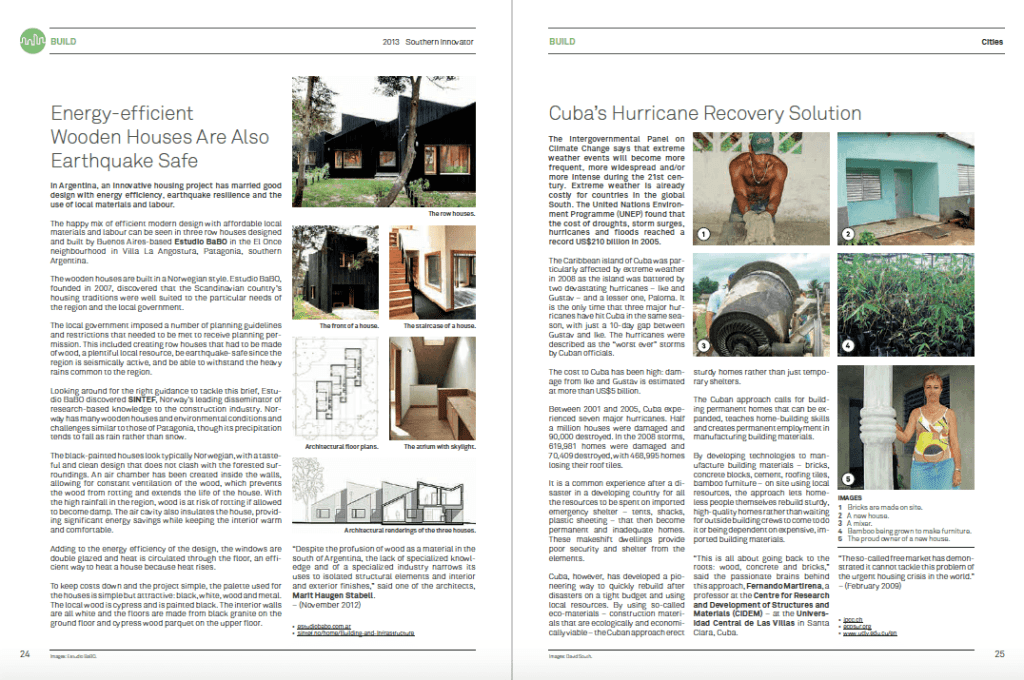
https://davidsouthconsulting.org/2021/02/04/cubas-hurricane-recovery-solution/

https://davidsouthconsulting.org/2021/02/04/new-cuban-film-seeks-to-revive-sector/

https://davidsouthconsulting.org/2022/11/11/urban-farming-to-tackle-global-food-crisis/

https://davidsouthconsulting.org/2021/03/05/southern-innovator-issue-3/


This work is licensed under a Creative Commons Attribution 4.0 International License.

ORCID iD: https://orcid.org/0000-0001-5311-1052.

© David South Consulting 2023