Categories
Archive Development Challenges, South-South Solutions Newsletters

Chinese Trade in Angola Helps Recovery

By David SouthDevelopment Challenges, South-South Solutions

SOUTH-SOUTH CASE STUDY

Two-way trade between Africa and China has been an outstanding success story of the past decade. It has led to significant new investment in the continent and brought many new job opportunities. The Chinese community in Africa comprises a mix of entrepreneurs and workers. In formerly war-torn Angola, Chinese workers and investors have led an economic boom as the country recovers from decades of conflict.

The Chinese are generally young, well-educated, English-speaking, ambitious and hard-working. Estimates put the number of Chinese people in Angola at 100,000, and about 1 million across Africa.

The reason these bright young things need to come to Africa goes back to the essential reality of modern China: despite rapid economic growth, per capita incomes classify it as a poor country. While the outside world sees the glitzy, go-go progress of China’s cities, the country’s rural poor go unseen. Around 400 million of China’s 1.3 billion people have annual per-capita income equivalent to US $8,000, while the remaining 900 million have per-capita incomes as little as one-tenth that amount.

Some 6.3 million people in China will graduate this year from university, and it is still very hard for a well-educated Chinese person to get a good job right away. More than a quarter of these graduates will be unemployed, according to the Education Ministry.

There has also been disquiet in parts of Angola over China’s role, with some calling it “neo-colonialism”. But clearly, both Africa and China have much to gain by increasing cooperation.

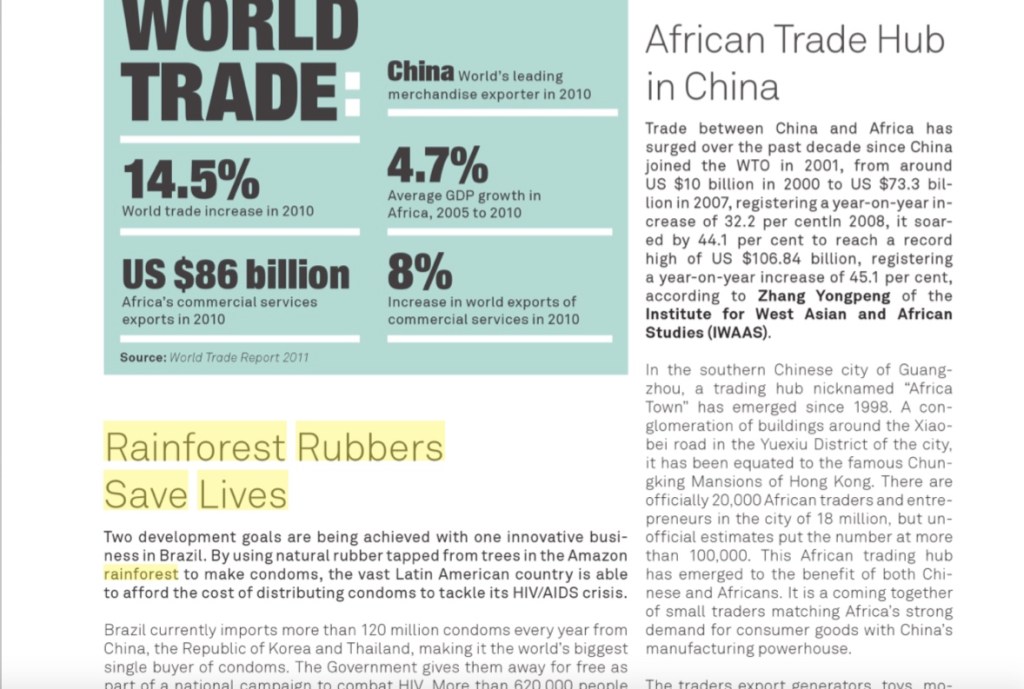
In the southern Chinese city of Guangzhou (http://en.wikipedia.org/wiki/Guangzhou), a trading hub nicknamed “Africa Town” has emerged since 1998. There are officially 20,000 African traders and entrepreneurs in the city of 18 million, but unofficial estimates put the number at more than 100,000. This African trading hub has emerged to the benefit of both the Chinese and Africans. It is a coming together of small traders matching Africa’s strong demand for consumer goods with China’s manufacturing powerhouse.

In Angola, the mix of entrepreneurs and workers is having a big impact on the country’s development.

Betty, a 22-year-old Chinese woman who has various projects in Angola, including the local Chinese language newspaper, is a typical go-getter.

“I am doing much better here than if I had stayed in China,” she told the BBC.

Another beneficiary of the two-way trade is Deng, a construction a worker: “I earn twice as much as I would at home and I have got a better job,” he said.

For most Chinese, foreign travel is still rare and the excitement of going to Africa to work both attracts and repels because of the continent’s reputation.

“At first I found it frightening, “said Wang. “You hear lots of stories of Chinese people being robbed by the locals.” But he found “there are great opportunities here.”

Another, Jet, who runs an air conditioning business, came to Angola five years ago.

“Everything had been destroyed,” he recalled. “There were no roads, railways, shops, nothing. Some Western companies were already here selling their products but I knew I could import things cheaper from China.”

The large infrastructure projects being undertaken by major Chinese companies are also creating new opportunities. Many Chinese labourers are working on building roads, railways, hospitals and vast housing complexes.

One of the more visible symbols of Chinese investment in Angola is the restoration of the Benguela Railway (http://en.wikipedia.org/wiki/Benguela_railway), considered one of the great routes of Africa and built by British contractors. An engineering triumph, its 1,344 kilometres (835 miles) of track stretch up the Angolan coast, right into southern Congo. The railway took almost 30 years to build in the late 19th and early 20th centuries, but little remained. Until very recently all but a tiny stretch of the line was closed. Now Chinese investment is rebuilding the railway and bringing economic improvement in its wake.

“I couldn’t do this before the railway was fixed,” a woman using the train to get to the market to sell her plump red tomatoes told the BBC. “Before, I had to travel by car which was much more expensive.”

And her income has improved along with the refurbished railway. “I am not rich, but a bit richer,” she said.

And unlike the British, who used the railway to export copper without paying for the resource, the Chinese labourers are getting paid and the Angolan government is paying back the Chinese loan for the railway repairs by selling oil overseas for a market rate.

Published: October 2010

Resources

https://davidsouthconsulting.org/2022/06/02/afghanistans-juicy-solution-to-drug-trade/

https://davidsouthconsulting.org/2022/11/02/african-online-supermarket-set-to-boost-trade/

https://davidsouthconsulting.org/2022/10/26/african-trade-hub-in-china-brings-mutual-profits-2/

https://davidsouthconsulting.org/2022/04/12/djibouti-re-shapes-itself-as-african-trade-hub/

https://davidsouthconsulting.org/2021/07/19/global-south-trade-boosted-with-increasing-china-africa-trade-in-2013/

https://davidsouthconsulting.org/2022/10/26/perfume-of-peace-helps-farmers-switch-from-drug-trade/

https://davidsouthconsulting.org/2021/07/19/south-south-trade-helping-countries-during-economic-crisis/

https://davidsouthconsulting.org/2021/03/05/southern-innovator-issue-2/

https://davidsouthconsulting.org/2022/11/01/southern-innovator-magazine-2010-2014/

https://davidsouthconsulting.org/2022/10/20/trade-to-benefit-the-poor-up-in-2006-and-to-grow-in-2007/

https://davidsouthconsulting.org/2022/10/05/women-empowered-by-fair-trade-manufacturer/

https://davidsouthconsulting.org/2022/06/16/women-mastering-trade-rules/

Development Challenges, South-South Solutions was launched as an e-newsletter in 2006 by UNDP’s South-South Cooperation Unit (now the United Nations Office for South-South Cooperation) based in New York, USA. It led on profiling the rise of the global South as an economic powerhouse and was one of the first regular publications to champion the global South’s innovators, entrepreneurs, and pioneers. It tracked the key trends that are now so profoundly reshaping how development is seen and done. This includes the rapid take-up of mobile phones and information technology in the global South (as profiled in the first issue of magazine Southern Innovator), the move to becoming a majority urban world, a growing global innovator culture, and the plethora of solutions being developed in the global South to tackle its problems and improve living conditions and boost human development. The success of the e-newsletter led to the launch of the magazine Southern Innovator.

Creative Commons License

This work is licensed under a
Creative Commons Attribution-Noncommercial-No Derivative Works 3.0 License.

ORCID iD: https://orcid.org/0000-0001-5311-1052.

© David South Consulting 2023

Categories
Archive Development Challenges, South-South Solutions Newsletters

Indian Newspapers Thrive with Economy

By David SouthDevelopment Challenges, South-South Solutions

SOUTH-SOUTH CASE STUDY

The onslaught of digital media in the developed countries of the world regularly brings pronouncements of the death of the traditional newspaper. But this assumption of digital triumph misses out on the reality in countries across the global South.

As incomes rise and literacy levels go up, so does the desire to consume news and information. And while many are jumping straight to online and mobile phone sources, just as many are enjoying more traditional print media offerings like magazines and newspapers.

India boasts both a fast-growing economy and the largest number of paid-for newspapers in the world. The print media industry in India has seen phenomenal growth since 2005, with the number newspaper titles increasing by 40 percent to 2,700 (World Association of Newspapers). The two factors driving this growth in newspapers are rising literacy and a booming economy

The World Association of Newspapers found China leads the world for newspaper subscribers, with 93.5 million readers a day. India is second. It is estimated the Indian newspaper industry will generate US $3.8 billion in revenues in 2010, a 13 percent growth rate over the last five years.

Estimates place growth in the newspaper industry in the next four years at 9 percent a year, to US $5.9 billion (KPMG).

Part of the reason India is defying the decline in newspaper numbers and readership seen in developed countries is poor internet penetration across the country. Because of this, only 7 percent of the population uses the web for information. And the country’s high number of illiterates (just 65 percent of the population can read) means even if many could afford a newspaper, they couldn’t use it.

According to Amar Ambani, head of research at India Infoline Group, “Unlike the West where the internet publishing and advertising has significantly hit the print media, the Internet threat to print media is still in its nascent stage in India, given the low penetration of computers and adequate bandwidth across the country.”

Newspapers are also growing in a highly competitive market exploding with new television channels on cable and satellite and other media distractions like mobile phone applications.

The newspapers (http://www.world-newspapers.com/india.html) are a strong reflection of how much the economy has changed in the past decade. They contain advertisements for property, mobile phones, cars and dating services.

Cost is also a critical element in their success: at only four rupees each (US $0.09 cents), many Indians buy several newspapers at a time for their home. The publications are able to charge so little because of the health of the advertising revenue coming in. Newspaper advertising in India increased by 30 percent between January and Match 2010 alone, the quickest jump in ads for the Asia-Pacific region (Nielsen India).

There is a hierarchy in the newspaper industry: English-language newspapers attract wealthier readers and can charge the most for advertising. But rising literacy rates combined with increasing personal wealth is fuelling growth in regional papers written in local languages. India has 22 official languages and English as an associate language. The country as a whole has about 33 different languages and over 2,000 local dialects. Hindi newspaper circulation rose from 8 million in the early 1990s to over 25 million in 2009.

The Times of India (http://timesofindia.indiatimes.com) is now the world’s largest circulation English-language newspaper, with 4 million readers. It uses this success to charge 10 times what regional papers can for advertising. At present, the regional newspapers’ bread-and-butter is mostly government-paid advertising.

But if trends continue as they are, then the tables will turn on big beasts like the Times of India. Regional papers will grow as people look for an opportunity to read in their own local language.

Flush with cash and confidence, Indian newspapers are also innovating new ways to advertise untried in other countries. Talking ads attached to the actual newspaper’s back pages caused a great stir when they were trialled in India recently (http://www.guardian.co.uk/media/greenslade/2010/sep/28/newspapers-advertising). The talking ads for a car company delivered a sales pitch but also alarmed and annoyed many people because the talking ad wouldn’t stop talking.

Ambani puts the success of the Indian newspaper industry down to five factors: the economic boom in semi-urban and rural India; growing local content; more opportunity to grow the number of readers; rising advertising spending; and rising literacy as a result of rising secondary school enrolment. He believes students aged between 10 and 15 are getting the newspaper habit and they represent huge future growth in newspaper readers.

Published: October 2010

Resources

https://davidsouthconsulting.org/2022/11/17/book-boom-rides-growing-economies-and-cities/

https://davidsouthconsulting.org/2022/09/29/cheap-indian-tablet-seeks-to-bridge-digital-divide/

https://davidsouthconsulting.org/2022/10/20/the-e-reader-battle-reaches-india/

https://davidsouthconsulting.org/2022/10/12/free-magazine-boosts-income-for-rickshaw-drivers/

https://davidsouthconsulting.org/2022/05/26/kenyan-book-company-brings-online-sales-to-east-africa/

https://davidsouthconsulting.org/2022/10/12/rickshaw-drivers-prosper-with-new-services/

Development Challenges, South-South Solutions was launched as an e-newsletter in 2006 by UNDP’s South-South Cooperation Unit (now the United Nations Office for South-South Cooperation) based in New York, USA. It led on profiling the rise of the global South as an economic powerhouse and was one of the first regular publications to champion the global South’s innovators, entrepreneurs, and pioneers. It tracked the key trends that are now so profoundly reshaping how development is seen and done. This includes the rapid take-up of mobile phones and information technology in the global South (as profiled in the first issue of magazine Southern Innovator), the move to becoming a majority urban world, a growing global innovator culture, and the plethora of solutions being developed in the global South to tackle its problems and improve living conditions and boost human development. The success of the e-newsletter led to the launch of the magazine Southern Innovator. 

https://davidsouthconsulting.org/2021/03/05/southern-innovator-issue-1/

Creative Commons License

This work is licensed under a
Creative Commons Attribution-Noncommercial-No Derivative Works 3.0 License.

ORCID iD: https://orcid.org/0000-0001-5311-1052.

© David South Consulting 2024

Categories
Archive Development Challenges, South-South Solutions Newsletters Southern Innovator magazine

South African Wine Industry Uncorks Opportunities

By David SouthDevelopment Challenges, South-South Solutions

SOUTH-SOUTH CASE STUDY

Wine-making is one of South Africa’s oldest industries and plays a key part in the country’s economy. And now both wine making and production are being transformed and creating new economic opportunities. Once seen only as the preserve of the country’s white minority population, wine is slowly becoming a black thing too.

With exports growing from less than 50 million litres in 1994 to more than 400 million litres in 2008 – year-on-year growth of 17 percent – it is an industry that would be remiss if it didn’t share the profits of this success with the 80 percent of the country’s population who are black.

Since the end of the racist Apartheid regime (http://en.wikipedia.org/wiki/South_Africa_under_apartheid) in the mid-1990s, various government and industry initiatives have begun to reverse the iniquities of the country’s wine-making industry – and in turn, introduce more black South Africans to the pleasures of drinking this fine local product.

One product of this shift in sentiment is Zimbabwean Tariro Masayiti. A vintner for the prestigious South African winery Nederburg, he made history by being commissioned to create two of the three selected official wines for the World Cup of football held in South Africa this year. His Sauvignon Blanc and Dry Rose were drunk while fans watched the competition.

He says his introduction to the world of wine-making came about by chance.

“It was by accident really,” he said. “My brother used to work at a farm close to the Mukuyu wineries in Marondera (Zimbabwe). During my days at the university he recommended I do general work at the winery as I needed pocket money and something to help my family with.

“It was here that I got interested in winemaking. I used to see visitors from all over the world and some of them encouraged me to take up winemaking as a career. I applied and was accepted for a place at the University of Stellenbosch where I studied Viticulture and Oenology (winery),’ Masayiti told SW Radio Africa news.

“I was headhunted by Nederburg before I even finished my studies.”

Masayiti’s job involves testing the grapes that go into the winery’s product.

“I smell them and at the same time look for specific characters and flavours,” he said. “You improve on the job with training – you just need to taste a lot of wine. You need to love wine and having a science background is useful, so you understand the technical processes. But one thing that serves me well is I am dedicated and passionate about winemaking.”

Another symbol of these changes is Vernon Henn, general manager of Thandi wines (http://www.thandi.com). He worked his way up to this prestigious role in the white-dominated South African wine industry from being an office cleaner. Thandi is the first wine brand in the world entirely owned and run by a black collective.

Thandi (which means “nurturing love” in the Xhosa language) was started in 1995 and became the world’s first Fair Trade-certified wine in 2003. It sells cabernet sauvignon, merlot, pinot noir, sauvignon blanc, semillon, chardonnay and chenin.

“The whole of the industry has been changing slowly,” Henn told the Guardian newspaper. “We can now up the pace of transformation. There’s still a misconception that anything from black-owned manufacturing has to be inferior. We have always focused on quality and tried to redress misconceptions about black-owned labels.”

Other black-owned labels include M’hudi (http://www.mhudi.com); Ses’fikile (http://www.winedirectory.co.za/index.php/138/sesfikile), led by three former township schoolteachers; and Seven Sisters (http://www.sevensisters.co.za/wmenu.php) – cultivated by seven sisters.

“We are a tiny minority but we are here to stay,” said Vivian Kleynhans of the African Vintners Alliance, comprising eight companies led by black women. “So they will just have to accept us.”

Another success is the Indaba brand (http://twitter.com/IndabaWines) first launched in the US in 1996, just after South Africa became a democratic republic. “Indaba” is the Zulu word for “a meeting of the minds,” or a traditional gathering of tribal leaders for sharing ideas.

The brand was created as a celebration of the democratization process in South Africa, and from its inception the wines have conveyed the spirit of South Africa to the world’s wine drinkers.

The Indaba range of wines consists of the Indaba Sauvignon Blanc, Indaba Chenin Blanc, Indaba Chardonnay, Indaba Merlot and Indaba Shiraz.

There is also the 6th annual Soweto Wine Festival (http://www.sowetowinefestival.co.za/About.htm) held in the Soweto township of Johannesburg. Soweto was home to the resistance against the Apartheid regime, and still has a very poor slum area in its midst. But it is also home to the new and rising black middle class. Many parts of Soweto could now pass for affluent suburbs in any wealthy country. Hatched as an idea in 2004, the wine festival is about “introducing South Africa’s quality wines to the remaining 80 percent of our population,” says Mnikelo Mangciphu, co-founder of the Soweto Wine Festival“Wine is not for white South Africans only to enjoy. It should be a way of life for all South Africans.”

Mangciphu is also the owner and manager of the only wine shop in Soweto – Morara Wine & Spirit Emporium, which he launched after the first Soweto Wine Festival in 2005.

The idea behind the festival is to shift attitudes in South Africa about wine drinking. Soweto has been the home to many trends in the country, from politics to fashion to pop music. And so it seemed the right place to start shifting attitudes towards wine. The number of participants has grown from 3,000 people to 5,520. Five years after it began, the festival showcases wines from 103 wineries.

Mangciphu had spotted a shift in drinking habits away from just beer and so he opened his wine boutique in Soweto to cater to these new tastes. The shop is an elegant place with wooden shelves displaying the bottles of wine.

South Africa’s wine industry now employs around 257,000 people directly and indirectly, including farm labourers and those involved in packaging, retailing and wine tourism.

Wine tourism alone employs over 59 000 people. The Western Cape region, home to much of the wine industry, has seen its economy grow on the back of wine tourism.

By volume, South Africa ranks ninth in the world for wine production.

There is a scholarship fund also available to encourage young people to enter the South African wine industry as a career. Mzokhona Mvemve was one of the first awarded the Indaba Scholarship and became South Africa’s first black wine maker in 2001, working for Cape Classics.

Published: October 2010

Resources

Development Challenges, South-South Solutions was launched as an e-newsletter in 2006 by UNDP’s South-South Cooperation Unit (now the United Nations Office for South-South Cooperation) based in New York, USA. It led on profiling the rise of the global South as an economic powerhouse and was one of the first regular publications to champion the global South’s innovators, entrepreneurs, and pioneers. It tracked the key trends that are now so profoundly reshaping how development is seen and done. This includes the rapid take-up of mobile phones and information technology in the global South (as profiled in the first issue of magazine Southern Innovator), the move to becoming a majority urban world, a growing global innovator culture, and the plethora of solutions being developed in the global South to tackle its problems and improve living conditions and boost human development. The success of the e-newsletter led to the launch of the magazine Southern Innovator. 

Creative Commons License

This work is licensed under a
Creative Commons Attribution-Noncommercial-No Derivative Works 3.0 License.

ORCID iD: https://orcid.org/0000-0001-5311-1052.

© David South Consulting 2023