Categories
Archive Development Challenges, South-South Solutions Newsletters

Ecotourism to Heal the Scars of the Past

By David SouthDevelopment Challenges, South-South Solutions

SOUTH-SOUTH CASE STUDY

The legacy of underdevelopment during the communist era in parts of Eastern Europe is now being seen as an advantage in the global tourism trade. Well off the beaten path for tourists, areas as diverse as Chechnya and Romania are working to turn their rustic rural hinterlands into a strategic advantage in grabbing the market for ecotourists. Ecotourism – tourism that takes people to fragile and beautiful areas – is one of the tourism industry’s fastest growing areas.At stake is the lucrative and ever-growing world tourism market. Global tourist arrivals passed 800 million in 2006, with tourism in the world up by 5.5 per cent (World Tourism Organization), earning US $680 billion globally. In 1993, just seven per cent of travel was nature tourism; that share has now passed 20 per cent.

Romania, now a member of the European Union, boasts rural countryside like Europe of old: all hillsides are common land and there are no walls or fences to impede the view. Life is heavily dominated by agriculture and the rhythms of farm life.

Southern Transylvania is a high plateau of wooded hills and valleys and shielded by the Carpathian Mountains.

“The Carpathians of central and eastern Europe,” said Achim Steiner, head of the UN Environment Programme, “are among the world’s richest regions in terms of biodiversity and pristine landscapes. I have no doubt that the Carpathians, like the Alps, the Himalayas and the Rocky Mountains, will become world famous for walking, hiking, climbing, wildlife watching, photography and similar leisure pursuits.”

In order to preserve this way of life and generate income, various schemes are encouraging low-key tourism. This takes the form of renovating decaying farm buildings for guesthouses. The guesthouses are kept clean and simple and the focus is on typical local food like hearty stews and soups and pork sausages.

Much of this has been paid for by the Mihai Emenescu Trust, a charity seeking to preserve the traditions of the Saxon villages.

Patrick Holden of the Soil Association, a patron of the Mihai Eminescu Trust, thinks the organic agricultural methods of the local farmers could be a model for the rest of Europe.

Romania is also part of the Organization for Black Sea Economic Cooperation (BSEC), which is taking the lead in promoting ecotourism as an economic development option.

Ex-communist nation Bulgaria has also turned to ecotourism, launching its “Ecotourism: Naturally Bulgaria” campaign in September.

Even the once-war-torn Russian republic of Chechnya is trying to radically re-shape people’s perceptions. It is hard to believe, but the former site of a bitter civil war that left the capital Grozny in ruins now wants to be Russia’s Switzerland.

Shatoy region in southern Chechnya, during Soviet times, saw 20,000 visitors every month to ski, ride horses, and hike in the Caucasus Mountains. The new government plans to spend UK £40 million on new hotels, reconstructing old holiday camps, building spas and health centres. The region’s head of government, Mr Khasukha Demilkhanov, is confident that natural beauty can compete with the West: in the Argun Gorge, he pointed out to the Guardian newspaper, the scene is reminiscent of a 19th century woodcutting. Stone towers litter the hills, alpine meadows are full of wild flowers, the mountains are snow-capped and new roads have been built.

The Chechens hope to start with Russian holidaymakers and extreme tourists from the West, before moving more into the mainstream market.

Published: October 2007

Resources

  • Ecotourism.org: The International Ecotourism Society.
  • Ecotourism Kazakhstan: Kazakhstan has put together a dedicated website on ecotourism.
  • Planeta: one of the first ecotourism resources to go online (since 1994) and still offers plenty of information for those wanting to start a business.

https://davidsouthconsulting.org/2022/10/20/african-tourism-leads-the-world-and-brings-new-opportunities/

https://davidsouthconsulting.org/2022/10/20/africas-tourism-sector-can-learn-from-asian-experience/

https://davidsouthconsulting.org/2022/02/07/boosting-tourism-in-india-with-surfing-culture/

https://davidsouthconsulting.org/2022/09/27/caribbean-island-st-kitts-goes-green-for-tourism/

https://davidsouthconsulting.org/2023/02/03/environmental-public-awareness-handbook-case-studies-and-lessons-learned-in-mongolia/

https://davidsouthconsulting.org/2022/11/21/from-warriors-to-tour-guides/

https://davidsouthconsulting.org/2022/11/23/kenyan-safari-begins-minutes-from-airport/

https://davidsouthconsulting.org/2021/08/07/mongolian-green-book/

https://davidsouthconsulting.org/2022/10/10/a-solution-to-stop-garbage-destroying-tourism/

https://davidsouthconsulting.org/2021/03/05/southern-innovator-issue-2/

https://davidsouthconsulting.org/2021/03/05/southern-innovator-issue-5/

https://davidsouthconsulting.org/2023/01/17/war-peace-and-development-may-2018/

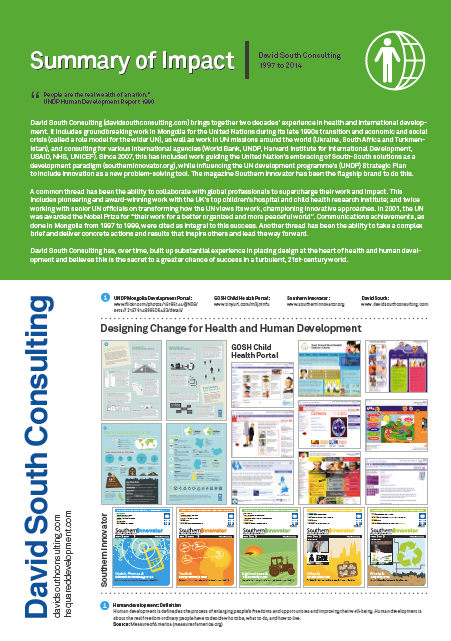
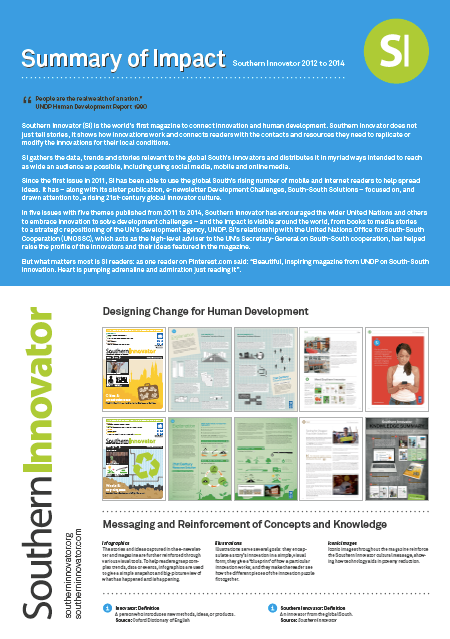
Development Challenges, South-South Solutions was launched as an e-newsletter in 2006 by UNDP’s South-South Cooperation Unit (now the United Nations Office for South-South Cooperation) based in New York, USA. It led on profiling the rise of the global South as an economic powerhouse and was one of the first regular publications to champion the global South’s innovators, entrepreneurs, and pioneers. It tracked the key trends that are now so profoundly reshaping how development is seen and done. This includes the rapid take-up of mobile phones and information technology in the global South (as profiled in the first issue of magazine Southern Innovator), the move to becoming a majority urban world, a growing global innovator culture, and the plethora of solutions being developed in the global South to tackle its problems and improve living conditions and boost human development. The success of the e-newsletter led to the launch of the magazine Southern Innovator.

Environmental Public Awareness Handbook: Case Studies and Lessons Learned in Mongolia by Robert Ferguson.
Creative Commons License

This work is licensed under a
Creative Commons Attribution-Noncommercial-No Derivative Works 3.0 License.

ORCID iD: https://orcid.org/0000-0001-5311-1052.

© David South Consulting 2023

Categories
Archive Development Challenges, South-South Solutions Newsletters Southern Innovator magazine

Next Generation of Innovation for the Grassroots

By David SouthDevelopment Challenges, South-South Solutions

SOUTH-SOUTH CASE STUDY

Taking inspiration from science fiction sagas like the TV show Star Trek, the next generation of innovation is already taking shape in the South. A group of innovative facilities called Fab Labs (short for Fabrication Laboratory) in Ghana, India, Kenya, South Africa and Costa Rica are applying cutting-edge technology to address the everyday needs of people.

Like the futuristic “replicator” in Star Trek, Fab Labs allow people to design and produce what they need there and then. The labs are mushrooming throughout the South as people get the innovation bug.

Originally an idea from the Massachusetts Institute of Technology’s Center for Bits and Atoms, which sponsors nine of the labs, Fab Labs let people use digital technology to build physical objects, from eyeglass frames to toys and computer parts. Fab Labs empower local invention by turning education, problem-solving and job creation into a creative process.

Started by Professor Neil Gershenfeld, Fab Labs use US $20,000 worth of computers, open source design software, laser cutters, milling machines and soldering irons, letting people harness their creativity to build things they need, including tools, replacement parts and essential products unavailable in the local market.

With minimal training, children and adults are designing and making their own toys, jewellery and even computer circuit boards with the machines. It turns people from consumers into inventors.

“Instead of bringing information technology to the masses, the Fab Labs bring information technology development to the masses,” said Gershenfeld.

In Ghana, the Takoradi Technical Institute in the southwest of the country hosts a Fab Lab, allowing a wide variety of people to use the “replicator” – from local street children to tribal chiefs – to make a wide range of products. The Ghana lab has several projects on the go, including antennae and radios for wireless internet networks and solar-powered machinery for cooking, cooling and cutting. The labs have found that the younger the users, the faster the skills are picked up.

John Silvester Boafo, principal at the Takoradi Technical Institute, is proud of what he calls a fu-fu pounder. “In a Ghanaian home, the main dish is fu-fu,” he told the BBC. “Fu-fu is made of plaintain and cassava, which are cooked. After they are cooked, they are put into a mortar and pounded by hand. People go through hard labour just to get a meal to eat. So, we thought we could fabricate this machine to alleviate the hard labour they use in pounding.”

They are also working on portable hand-held chargeable solar panels for televisions and refrigerators.

In Pabal, in the western part of Maharashtra, India, a Fab Lab was established at the Vigyan Ashram in 2002 and is now working on developing agricultural instruments. They are also testing milk for quality and safety, and tuning diesel engines to run more efficiently, especially with bio fuels. Another lab in Bithoor in the state of Uttar Pradesh (operated with the Indian Institute of Technology, Kanpur) is working on 3-D scanning and printing for rural artisans, such as producing wooden blocks used in Chikan embroidery.

In South Africa, officials are in the process of setting up four labs. The first is in the capital Pretoria, home to Africa’s first “science park”. The second is in the township of Shoshanguve, a very poor community with high unemployment.

“We have these very high-tech small start-up companies that are excited by the proximity of the lab,” said Sushil Borde, head of the government agency charged with rolling out the four labs. “The companies say, ‘We have these brilliant ideas, we have these business models, but we don’t know how to get these ideas into tangible products.”

Borde hopes the network of Fab Labs will enable South African entrepreneurs and engineers to test their ideas and “fast track the process of growth and development.”

Seventeen-year-old Kenneth Chauke has been able to build a robot in the Fab Lab in Pretoria, he told the Christian Science Monitor.

IT supervisor Nthabiseng Nkadimeng at the Fab Lab in Shoshanguve, has been encouraging South African youth to dream expansively about new technology. “We want to encourage innovation,” she told the Christian Science Monitor. “A lot of the kids, right now, they’re making toys. That’s okay, it’s a start. But eventually we want them to do things that haven’t been done before.”

“It’s the idea that if you’re somewhere in rural South Africa, and you want something for solar energy, you can go to a Fab Lab and make your own,” said Naas Zaayman, who works for the government on coordinating the Fab Lab strategy.

Published: October 2007

Resources:

  • id21 Insights: A series of articles by the UK ’s Institute of Development Studies on how to make technology and science relevant to the needs of the poor:
  • Biography: Professor Neil Gershenfeld
  • eMachineShop: This remarkable service allows budding inventors to download free design software, design their invention, and then have it made in any quantity they wish and shipped to them: Amazing!

https://davidsouthconsulting.org/2022/02/17/african-digital-laser-breakthrough-promises-future-innovation/

https://davidsouthconsulting.org/2022/10/05/african-innovation-eco-system-taking-shape/

https://davidsouthconsulting.org/2021/05/18/african-innovation-helps-make-banking-transactions-safer/

https://davidsouthconsulting.org/2022/10/10/bringing-the-invention-and-innovation-mindset-to-young-kenyans/

https://davidsouthconsulting.org/2020/04/25/china-looking-to-lead-on-robot-innovation/

https://davidsouthconsulting.org/2022/10/24/flurry-of-anti-poverty-innovations/

https://davidsouthconsulting.org/2021/03/24/frugal-innovation-trend-meets-global-souths-innovation-culture/

https://davidsouthconsulting.org/2022/10/09/grassroots-entrepreneurs-now-have-many-ways-to-fund-their-enterprises/

https://davidsouthconsulting.org/2017/10/18/innovation-agenda-and-timeline-2007-2015/

https://davidsouthconsulting.org/2022/11/11/innovation-cairos-green-technology-pioneers/

https://davidsouthconsulting.org/2020/04/27/innovation-from-the-global-south/

https://davidsouthconsulting.org/2020/12/14/innovation-in-growing-cities-to-prevent-social-exclusion/

https://davidsouthconsulting.org/2022/04/28/innovation-in-the-slums-can-bring-peace-and-prosperity/

https://davidsouthconsulting.org/2021/03/04/innovation-villages-tackling-mdgs/

https://davidsouthconsulting.org/2021/10/22/innovations-in-green-economy-top-three-agenda/

https://davidsouthconsulting.org/2022/10/27/kenyan-mobile-phone-innovations/

https://davidsouthconsulting.org/2021/03/02/new-3d-technology-makes-innovation-breakthrough-and-puts-mind-over-matter/

https://davidsouthconsulting.org/2016/04/14/southern-innovator-and-the-growing-global-innovation-culture-14-april-2016/

https://davidsouthconsulting.org/2022/04/08/technological-innovation-alive-in-brazil/

https://davidsouthconsulting.org/2022/09/26/3d-home-printing-landmark-10-houses-in-a-day/

https://davidsouthconsulting.org/2022/09/26/3d-printing-gives-boy-a-new-arm-in-sudan/

https://davidsouthconsulting.org/2021/01/02/a-undp-success-story-grassroots-environmental-campaign-mobilizes-thousands-in-mongolia-1998/

Development Challenges, South-South Solutions was launched as an e-newsletter in 2006 by UNDP’s South-South Cooperation Unit (now the United Nations Office for South-South Cooperation) based in New York, USA. It led on profiling the rise of the global South as an economic powerhouse and was one of the first regular publications to champion the global South’s innovators, entrepreneurs, and pioneers. It tracked the key trends that are now so profoundly reshaping how development is seen and done. This includes the rapid take-up of mobile phones and information technology in the global South (as profiled in the first issue of magazine Southern Innovator), the move to becoming a majority urban world, a growing global innovator culture, and the plethora of solutions being developed in the global South to tackle its problems and improve living conditions and boost human development. The success of the e-newsletter led to the launch of the magazine Southern Innovator.  

https://davidsouthconsulting.org/2021/03/05/southern-innovator-issue-1/

https://davidsouthconsulting.org/2021/03/05/southern-innovator-issue-2/

Creative Commons License

This work is licensed under a
Creative Commons Attribution-Noncommercial-No Derivative Works 3.0 License.

ORCID iD: https://orcid.org/0000-0001-5311-1052.

© David South Consulting 2023