Tag: Published: November 2012

  • Better by Design in China

    Better by Design in China

    By David SouthDevelopment Challenges, South-South Solutions

    SOUTH-SOUTH CASE STUDY

    In recent decades, China has been known more for its inexpensive manufactured goods than as a producer of high quality products. But this is changing as the country seeks to move up the economic chain.

    China’s long-established design traditions were largely overlooked as the country made its breakneck push to become the world’s manufacturing powerhouse. But now Chinese manufacturers want to be known for high-quality designs and products rather than just for cheap-and-cheerful merchandise.

    China is a critical lesson for the rest of the global South, and offers much inspiration to any country trying to develop, modernize and eradicate poverty.

    The country is the main reason for the dramatic reductions in global extreme poverty rates, and it can be proud of using its average yearly economic growth rate of 10 per cent to lift 440 million Chinese out of poverty – the biggest reduction of poverty in history (The Economist). The strategy of exporting manufactured goods into Western markets at competitive prices has dominated the past 20 years.

    But China faces a dilemma as other nations in the global South are moving into this niche. It needs to quickly become a high-value nation, with unique products and designs generated in the country.

    Luckily, a renaissance in Chinese design in the last five years has been gradually grabbing the attention of the world’s creative community.

    Innovative Chinese designers are creating home furnishings and interiors that are being snapped up by European companies.

    The Italian kitchen utensil design company Alessi turned to eight Chinese architects – including Ma Yansong and Yung Ho Chang – to design a range of trays called (Un) Forbidden City. The architects’ designs were manufactured in Italy – a reversal of the pattern that has dominated for the past 20 years.

    The architects drew on Chinese traditions and 21st century technologies to design the trays. One was made using a 3D scanner which captured images used to make a mould.

    The drive to change and transform China’s global economic role was promoted in 2011’s Beijing International Design Week (http://www.bjdw.org/en/), with its theme of transforming “Made in China to Designed in China.”

    “When you have so much of a manufacturing base in one place, it’s natural that people start thinking about how to climb the value chain,” Philip Tinari, director of Beijing’s Ullens Centre for Contemporary Art (UCCA) (http://ucca.org.cn/) – a champion of new artists and designers – told howtospendit.com.

    “Chinese design has become something to rally around and, unlike art, enjoys great official support because it’s a way of improving China’s long-term economic position, as opposed to expressing thoughts about what’s been going on.”

    Other Chinese designers grabbing attention include Chen Xuan, who makes tables; chair-maker Gui Yang; Li Bowen, a maker of wicker chairs; and Ge Wei, a maker of jewellery boxes.

    Designer Huo Yijin makes contemporary tea trays, using heat-reactive lacquer coating to create dazzling effects.

    “Users can see the wonderful effect of water and temperature reacting on the tea trays when they drink Kungfu tea in the traditional way,” Huo explained.

    Jingdezhen, Jiangxi province – a city that has been making ceramics since the Ming Dynasty (1368–1644) – is now attracting craftspeople from around the world looking to tap into its expertise and skill. One attraction is Mr Yu’s Big Ware Factory. Its unparalleled ability to create giant-size pottery is a design niche with much potential.

    Many foreign creatives are being drawn to China for its can-do attitude and the ability to break with conventions stifling creativity in the West. The next five years could see the world’s design centre of gravity shift eastwards again.

    Published: November 2012

    Resources

    1) Ullens Centre for Contemporary Art (UCCA): The Ullens Center for Contemporary Art (UCCA) is a comprehensive, not-for-profit art center serving a global Beijing public. Website: http://ucca.org.cn/

    2) ChinaShijitanContemporaryArtCenter: A mixed-use art venue with experimental theatre, exhibition space, art gallery and production spaces. Website: http://www.ar-chiasmus.cn/project_6.html

    3) Pearl Lam Galleries: Pearl Lam Galleries lead a stable of International and Chinese artists who are multidisciplinary, refuting the hierarchy of art forms. The galleries do not follow the model of Western galleries; rather, they have evolved from the philosophy of Chinese Literati, which does not segregate between the different art disciplines. Website: http://pearllamgalleries.blogspot.co.uk/p/about.html

    4) School of Design of the China Central Academy of Fine Arts (CAFA): The Central Academy of Fine Arts, located in Beijing, the capital of China, is an academy where culture, history and art are flourishing, which enjoys the best art resources of the world. Website: http://www.cafa.edu.cn/aboutcafa/lan/?c=1101

    5) Beijing’s legendary 798 art district: “798” is located in the Dashanzi area, to the northeast of central Beijing. It is the site of state-owned factories including Factory 798, which originally produced electronics. Beginning in 2002, artists and cultural organizations began to divide, rent out, and re-make the factory spaces, gradually developing them into galleries, art centers, artists’ studios, design companies, restaurants, and bars. Website: http://www.798space.com/subpage_en.asp?classid=17

    https://davidsouthconsulting.org/2021/03/20/accessing-global-markets-via-design-solutions/

    https://davidsouthconsulting.org/2021/03/12/afro-coffee-blending-good-design-and-coffee/

    https://davidsouthconsulting.org/2021/02/20/baker-cookstoves-designing-for-the-african-customer/

    https://davidsouthconsulting.org/2021/08/29/brazilian-design-for-new-urban-middle-class-world/

    https://davidsouthconsulting.org/2022/10/04/the-brck-kenyan-developed-solution-to-boost-internet-access/

    https://davidsouthconsulting.org/2020/12/10/china-sets-sights-on-dominating-global-smartphone-market/

    https://davidsouthconsulting.org/2021/01/26/designed-in-china-to-rival-made-in-china/

    https://davidsouthconsulting.org/2021/06/11/indonesian-wooden-radio-succeeds-with-good-design/

    https://davidsouthconsulting.org/2022/10/04/popular-chinese-social-media-chase-new-markets/

    https://davidsouthconsulting.org/2021/10/04/putting-quality-and-design-at-the-centre-of-chinese-fashion/

    Creative Commons License

    This work is licensed under a
    Creative Commons Attribution-Noncommercial-No Derivative Works 3.0 License.

    ORCID iD: https://orcid.org/0000-0001-5311-1052.

    © David South Consulting 2023
  • Energy-Efficient Wooden Houses are also Earthquake Safe

    Energy-Efficient Wooden Houses are also Earthquake Safe

    By David SouthDevelopment Challenges, South-South Solutions

    SOUTH-SOUTH CASE STUDY

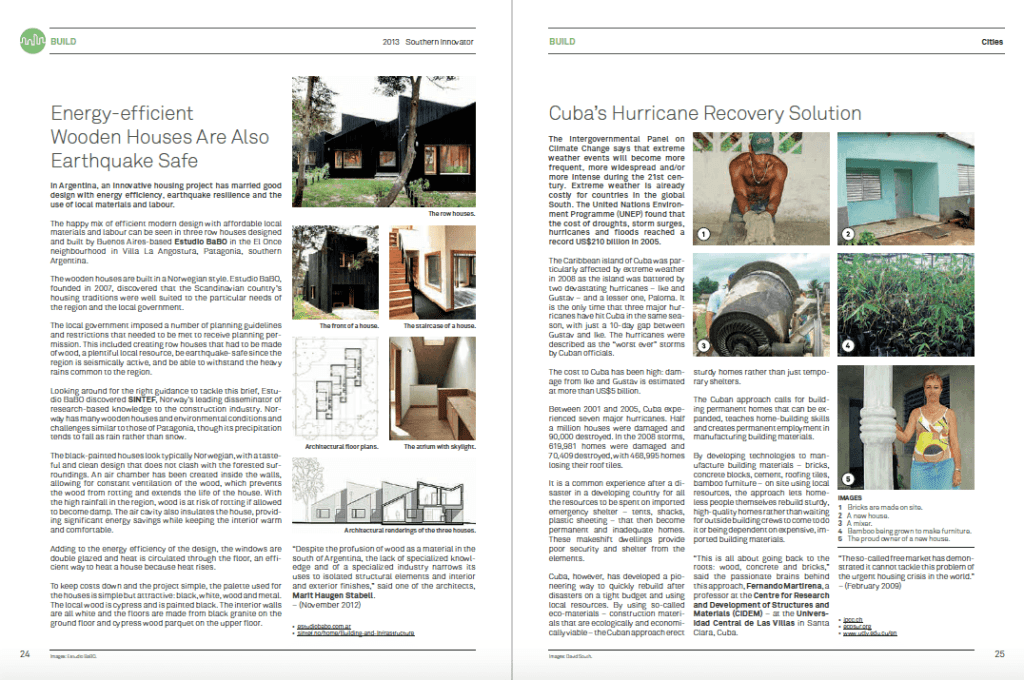
    In Argentina, an innovative housing project has married good design with energy efficiency, earthquake resilience and the use of local materials and labour. As energy resources continue to be stretched around the global South, innovative building designs will be critical to the creation of sustainable housing for the future.

    The happy mix of efficient modern design with affordable local materials and labour can be seen in three row houses designed and built by Buenos Aires-based Estudio BaBO (estudiobabo.com.ar) in the El Once neighbourhood in Villa La Angostura, Patagonia, southern Argentina.

    The wooden houses are built in a Norwegian style. Estudio BaBO, founded in 2007, discovered that the Scandinavian nation’s housing traditions were well suited to the particular needs of the region and the local government.

    The local government imposed a number of planning guidelines and restrictions that needed to be met to receive planning permission. This included creating row houses which must be made of wood – a plentiful local resource. They also had to be earthquake-safe since the region is seismically active and be able to withstand the heavy rains common to the region.

    Looking around for the right guidance to tackle this brief, Estudio BaBO discovered SINTEF – Norway’s leading disseminator of research-based knowledge to the construction industry (http://www.sintef.no/home/Building-and-Infrastructure/). The Nordic nation has many wooden homes and also has similar environmental conditions and challenges to Patagonia – though its precipitation tends to fall as rain, rather than snow.

    The black-painted homes look typically Norwegian, with a tasteful and clean design that does not clash with the forested surroundings. An air chamber has been created inside the homes’ walls allowing for constant ventilation of the wood, which prevents the wood from rotting and extends the life of the house. With the high rainfall of the region, wood is at risk of rotting if allowed to become damp. The air cavity also insulates the house, providing significant energy savings while keeping the interior warm and comfortable.

    Adding to the energy efficiency of the design, the windows are double glazed and heat is also circulated through the floor – an efficient way to heat a home because heat rises.

    To keep costs down and the project simple, the palette used for the homes is simple but attractive: black, white, wood and metal. The local wood is cypress and is painted black. The interior walls are all white and the floors are made from black granite on the ground floor and cypress wood parquet on the upper floor. The rest of the woodwork in the house is also made of cypress.

    Using locally sourced materials also helps to keep costs down.

    The project was initially conceived in 2009 and the houses were built in 2010-2011. While wood is plentiful in Patagonia, traditionally the use of wood in construction was rudimentary and local labour skill levels were low. This meant the design had to be simple and easy to build.

    “Despite the profusion of wood as a material in the south of Argentina, the lack of specialized knowledge and of a specialized industry narrow its uses to isolated structural elements and interior and exterior finishes,” said one of the architects, Marit Haugen Stabell.

    The three units of two-storey row houses each come with a living room, dining room, kitchen, toilet, two bedrooms and a laundry room. Each home also has an outdoor patio. The homes are designed to receive maximum natural light. Deploying this energy efficient design is considered unusual for Argentina and Estudio BaBO has set a new standard for sustainable housing in the country.

    It looks like the CLF Houses could inspire others to look again at wood as a building material.

    Published: November 2012

    Resources

    1) A story on how researchers are perfecting wooden home designs to withstand heavy earthquakes. Website:http://inhabitat.com/wooden-house-can-withstand-severe-earthquakes/

    2) A website packed with photographs of wooden and other houses for inspiration and lesson learning. Website:http://www.trendir.com/house-design/wood_homes/

    3) A step by step slideshow on how a Norwegian wooden house was re-built. Website:http://www.dwell.com/articles/norwegian-wood.html

    4) Inspirational wooden home decorating ideas from across Scandinavia. Website:http://myscandinavianhome.blogspot.cz/

    https://davidsouthconsulting.org/2022/10/19/chinese-building-solution-for-rapidly-urbanizing-global-south/

    https://davidsouthconsulting.org/2021/09/01/disaster-recovery-ten-years-after-the-gujarat-india-experience/

    https://davidsouthconsulting.org/2021/09/01/haiti-earthquake-prompts-tech-aid/

    https://davidsouthconsulting.org/2017/10/27/information-accelerates-crisis-recovery-and-development-1997/

    https://davidsouthconsulting.org/2021/02/12/rebuilding-after-chinese-earthquake-beautiful-bamboo-homes/

    https://davidsouthconsulting.org/2021/02/23/southern-innovator-in-southasiadisasters-net/

    https://davidsouthconsulting.org/2022/09/26/3d-home-printing-landmark-10-houses-in-a-day/

    https://davidsouthconsulting.org/2021/03/05/southern-innovator-issue-4/

    Development Challenges, South-South Solutions was launched as an e-newsletter in 2006 by UNDP’s South-South Cooperation Unit (now the United Nations Office for South-South Cooperation) based in New York, USA. It led on profiling the rise of the global South as an economic powerhouse and was one of the first regular publications to champion the global South’s innovators, entrepreneurs, and pioneers. It tracked the key trends that are now so profoundly reshaping how development is seen and done. This includes the rapid take-up of mobile phones and information technology in the global South (as profiled in the first issue of magazine Southern Innovator), the move to becoming a majority urban world, a growing global innovator culture, and the plethora of solutions being developed in the global South to tackle its problems and improve living conditions and boost human development. The success of the e-newsletter led to the launch of the magazine Southern Innovator.

    Creative Commons License

    This work is licensed under a
    Creative Commons Attribution-Noncommercial-No Derivative Works 3.0 License.

    ORCID iD: https://orcid.org/0000-0001-5311-1052.

    © David South Consulting 2023
  • All-in-One Solar Kiosk Business Solution for Africa

    All-in-One Solar Kiosk Business Solution for Africa

    By David SouthDevelopment Challenges, South-South Solutions

    SOUTH-SOUTH CASE STUDY

    Kiosks are ubiquitous throughout commercial areas in the global South. These highly efficient little business outlets enable small-scale entrepreneurs to sell necessary products without the expense of renting and running a shop.

    While they are a great solution for entrepreneurs and customers alike, they often lack connection to municipal services such as electricity and water. That means kiosk owners need to use batteries or a generator if they need a refrigerator to cool food and drink – an expensive proposition.

    A new product launched this year in Addis Ababa, Ethiopia offers a solution.

    Created by a team of German architects, the Solarkiosk (solarkiosk.eu) is an autonomous business unit designed for remote, off-grid areas. With solar panels across the top of the kiosk, it generates its own electricity and is basically a mini solar power plant. Inside, it is just like a conventional kiosk, with display shelves for products and a counter in the front with a flap – which can feature advertising and messages – that can be opened up for business and locked shut when the kiosk is closed.

    The kiosk captures solar energy and the electricity generated can be used to run a computer, lights or a refrigerator. That makes the Solarkiosk capable of offering a wide range of services needing electricity, from Internet access to car-battery charging and mobile phone recharging – a now essential service as mobile phone use explodes across Africa.

    The first kiosk was prototyped in November 2011 and the makers incorporated their first subsidiary, Solarkiosk Solutions PLC, in Addis Ababa, Ethiopia in March 2012.

    According to Solarkiosk 1.5 billion people worldwide have no regular supply of electricity – 800 million of them in Africa. The makers of Solarkiosk consider this a huge market and hope to make the most of it.

    The kiosk comes in a kit form ready for assembly. The kit is designed to be easy to transport and is light enough and compact enough to be transported on the back of a donkey, its makers claim.

    Solarkiosk operators receive training in running and managing a kiosk. They learn about solar technology and how to maintain the kiosks and run a sustainable business. Once the operators are trained and up and running, they typically hire others to help with running the kiosk and offer the services at convenient times for the customers. The Solarkiosk then, potentially, becomes an income and employment generator for the local community.

    The kiosk is designed to be durable, secure and difficult to tamper with from the outside. The kiosks have been designed to suit many environments and requirements. There is a basic platform that can be added to or expanded depending on local needs and a series of models depending on the customer’s needs. Cleverly, the largest kiosk model is powerful enough to provide electricity to telecom towers. This has proven attractive to mobile telephone companies who can power a telecom tower and make money from running the kiosk as well.

    The Solarkiosk is especially useful for countries near the equator where nights are long (12 hours) and the kiosk can help people get light to read, study and work.

    Solarkiosk is targeting off-grid customers who are using up to 40 per cent of their household income on electricity substitutes. According to Solarkiosk, people in off-grid households collectively spend more every year (US $30 billion) lighting their homes – using candles for example – than do all the people living in electricity grid connected countries (US $20 billion).

    Solar technology is becoming more affordable at the same time as demand in developing countries for electricity and the products powered by electricity is on the rise. Mobile phones are now essential tools for doing business and staying connected – and all of them need to be kept charged up.

    Solarkiosk believes it can save the average off-grid household US $10 per month, while each kiosk could supply solar electricity services to between 200 and 5,000 households.

    For now, Solarkiosk is available in Ethiopia. It is based in Berlin, Germany and receives money from the German government. The kiosks themselves were designed and built by Graft Architects (http://www.graftlab.com).

    Published: November 2012

    Resources

    1) How to maintain a solar panel. Website: http://www.ehow.com/how_2005490_maintain-solar-panel.html

    2) How to start a kiosk business. Website: http://www.entrepreneur.com/article/63012

    3) Kiosk Innova: A Turkish pioneer of hi-tech kiosks for retail services. Website: http://www.kioskinnova.com/english

    Southern Innovator was designed and laid out in Iceland using 100% renewable energy, much of which is from geothermal sources. 
    Creative Commons License

    This work is licensed under a
    Creative Commons Attribution-Noncommercial-No Derivative Works 3.0 License.

    ORCID iD: https://orcid.org/0000-0001-5311-1052.

    © David South Consulting 2023