Tag: Published: March 2013

  • Bangladesh Coffin-Maker Offers an Ethical Ending

    Bangladesh Coffin-Maker Offers an Ethical Ending

    By David SouthDevelopment Challenges, South-South Solutions

    SOUTH-SOUTH CASE STUDY

    Few people want to think about death, and many are ill-prepared when it happens to a loved one or friend. But it will happen to us all – and growing ethical and environmental concerns are reshaping the way many deal with the inevitable event. More and more people are seeking a lower-cost option for being disposed of that also does not harm the environment.

    There are many ideas out there, but one that is getting attention is using sustainably sourced and fairly traded coffins as a way of reducing carbon emissions resulting from a person’s death.

    Bangladeshi pioneers Oasis Coffins (oasiscoffins.com) are crafting ecologically sound, Fair Trade coffins and generating jobs and income for an impoverished region of the country. The coffins are made from locally grown bamboo, seagrass and willow and are a clever piece of design.

    Bamboo is as strong as steel and yet flexible, and the coffins made from it look like typical burial boxes – but can be folded back into their footprint to be stored flat. This is a great space-saving innovation and makes it easier to store the coffins and also to ship them to overseas markets. This clever design is reducing the amount of energy used.

    Oasis has a manufacturing workshop employing 70 people in the Nilphamari district of Bangladesh (http://en.wikipedia.org/wiki/Nilphamari_District), about 400 kilometres north from the capital, Dhaka. The region is poor, but large quantities of bamboo grow in the area.

    It is a region where employment is seasonal and erratic, making family life chaotic as parents constantly search for stable work.
    Oasis Coffins is located in the Uttara Export Processing Zone (http://www.epzbangladesh.org.bd/bepza.php?id=EPZ-U), run under the authority of the Bangladesh Export Processing Zones Authority (BEPZA), a government agency that aims to “promote, attract and facilitate foreign investment in the Export Processing Zones.”  Its sales office is based in Birmingham in the United Kingdom.

    The company began in 2006 with the idea of creating high-quality products using local materials while creating good quality jobs to achieve a double impact: changed lives and a protected environment. The hope is to create a business model that can be replicated elsewhere.

    The company is structured to include both its product development and manufacturing in rural Bangladesh. It took its time conducting market research and product development to make sure it had a product people were willing to buy.

    “We make beautiful, high quality products in an environment that gives people reliable employment and good working conditions,” said managing director David How on the company’s website. “Our products are in demand from people who are becoming increasingly conscious of their impact on the environment and others.

    “It is encouraging to know that in bereavement, we can give life into people and a community in Bangladesh. We want people to know where their products are coming from, and to know that what they buy can benefit people elsewhere.”

    According to its website, Oasis Coffins abides by the standards prescribed by the World Fair Trade Organization (wfto.com) and the European Fair Trade Association (http://www.european-fair-trade-association.org/) and is also a member of ECOTA (ecotaftf.org). The ECOTA Fair Trade Forum started in 1990 and is a networking and coordinating body for small and medium sized Fair Trade Enterprises of Bangladesh.

    Employees are divided equally between women and men, and many have never been to school. They are paid 30 per cent more than the recommended rate for garment workers in Bangladesh.

    Oasis Coffins know by name the farmers who provide the bamboo and all of it is harvested within 20 kilometres of the manufacturing workshop. Oasis Coffins also takes pride in the construction of the workshop, which features plenty of natural light, good ventilation and easy access in and out. A comfortable workshop is important for the health and happiness of manufacturing workers.

    Employees receive a pension scheme, paid holidays, sick leave and a lump-sum payment if they leave. There is also a doctor available during working hours for free medical advice.

    To help upgrade the skills of the workers, there are lunchtime literacy classes, and employees are also taught how to manufacture products to a high global standard.

    The Oasis coffins are benefiting from the growing marketplace for green funerals in Europe and North America.

    In Britain, ecological funerals are on the rise as people seek an affordable and environmentally sound way to be dispatched.
    The UK’s Co-operative Funeral Care, part of the Co-operative Group, is selling the Bangladeshi coffins at more than 900 of its funeral homes in the United Kingdom as part of its ethical strategy.

    Providing funeral services can be an effective income generator. In Ghana, craftsmen have developed a global reputation for their quirky coffin designs celebrating the lives of the deceased. Ghana is also pioneering the selling of funeral insurance through mobile phones. Bereavement services are among the many basic needs of all communities, no matter where they are located. Just as people will always be born and get sick, they will also eventually die. Providing services that offer dignity to the families and the deceased can be a boost to local economies.

    Published: March 2013

    Resources

    1) Ghana coffin pioneer: Paa Joe’s sculpted coffins blur the line between art and craft. Each work is carefully constructed to reflect the ambition or the trade of the person for whom it was made. Website:http://www.jackbellgallery.com/artists/35-Paa-Joe/overview/

    2) African funeral insurance providers: “Stanbic Bank launches FuneralPlan insurance product”. Website:http://www.modernghana.com/news/427917/1/stanbic-bank-launches-funeralplan-insurance-produc.html

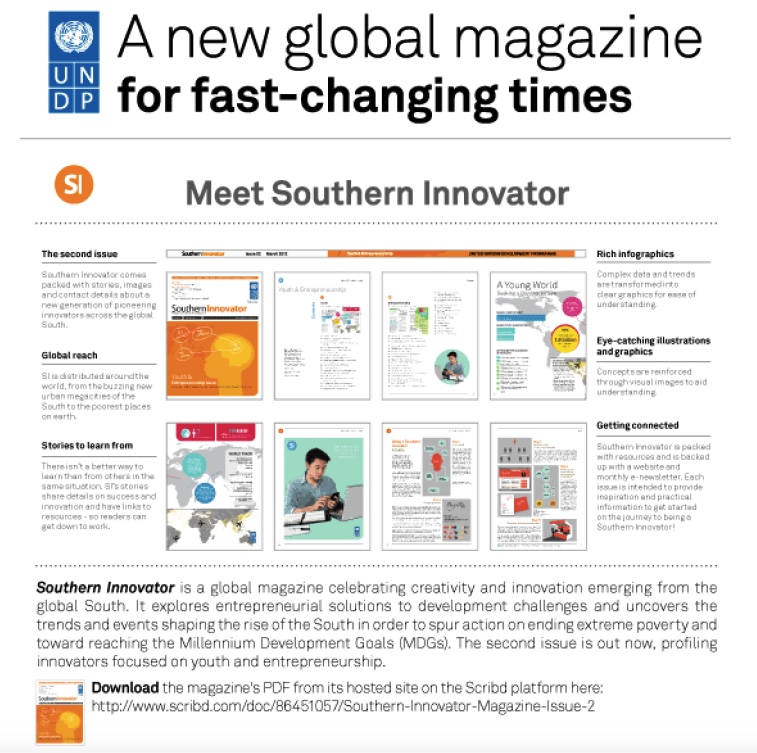
    3) Southern Innovator Magazine Issue 2: Youth and Entrepreneurship. Website:http://www.scribd.com/doc/106055335/Southern-Innovator-Magazine-Issue-2-Youth-and-Entrepreneurship

    Ghanaian Coffins Prove Design and Craftsmanship Boost Incomes

    Southern Innovator logo

    London Edit

    31 July 2013

    Development Challenges, South-South Solutions was launched as an e-newsletter in 2006 by UNDP’s South-South Cooperation Unit (now the United Nations Office for South-South Cooperation) based in New York, USA. It led on profiling the rise of the global South as an economic powerhouse and was one of the first regular publications to champion the global South’s innovators, entrepreneurs, and pioneers. It tracked the key trends that are now so profoundly reshaping how development is seen and done. This includes the rapid take-up of mobile phones and information technology in the global South (as profiled in the first issue of magazine Southern Innovator), the move to becoming a majority urban world, a growing global innovator culture, and the plethora of solutions being developed in the global South to tackle its problems and improve living conditions and boost human development. The success of the e-newsletter led to the launch of the magazine Southern Innovator. 
    Creative Commons License

    This work is licensed under a
    Creative Commons Attribution-Noncommercial-No Derivative Works 3.0 License.

    ORCID iD: https://orcid.org/0000-0001-5311-1052.

    © David South Consulting 2023

  • African Innovation Helps Make Banking Transactions Safer

    African Innovation Helps Make Banking Transactions Safer

    By David SouthDevelopment Challenges, South-South Solutions

    SOUTH-SOUTH CASE STUDY

    As economies grow in Africa, more and more people are conducting their financial transactions electronically. This can be either through mobile phones and digital devices, or through the hole-in-the-wall of the automatic teller machine, or ATM.

    These short cuts mean many people no longer have to endure long line-ups at banks to conduct day-to-day financial transactions. This convenience is revolutionizing banking for many millions of people, but there is a risk: fraud and theft. Both are rising, and are costing customers and banks, both in cash and in damage to the reputation of electronic banking.

    Criminal gangs and lone individuals alike are behind this crime. Most notorious are the “carding” and “skimming” gangs, who plant devices on ATMs to read plastic bank cards and steal victims’ money. Mobile devices can also be “hacked” by sophisticated criminal gangs and the data stolen and used to plunder bank accounts. Lone thieves also take people hostage and force them to use their card to withdraw money. A crime victim is usually forced to give over his or her Personal Identification Number (PIN), which the thief then uses to withdraw cash from the ATM.

    But just as thieves have become cleverer about the new opportunities created by digital financial transactions, enterprising start-ups are developing innovations to improve financial security.

    One Kenyan start-up is hoping to be a pioneer in innovative financial safety software for mobile devices and ATMs.
    Usalama Innovative Systems, LTD. (http://usalama.biz/), co-owned by graduate student and lead programmer Denis Karema (deniskarema.com), has already been singled out for a CIO magazine’s CIO100 Award in Enterprise Innovation in 2011 (http://www.cio.com/cio-awards/cio100).

    Karema has been working in information technology since 2008 and has a background in computer science. He has built his experience while working on various information technology projects in East Africa.

    The ambitious company says it wants to be “the leading provider of innovative solutions to financial entities in Africa by 2015.”
    Usalama has developed various systems pending patents and copyrights and has built up experience in deploying enterprise information technology.

    Usalama is seeking additional funding from investors for multiple innovations to protect customer financial transactions. One of them is an ATM solution, which the company claims can reduce theft by over 90 per cent. Speaking with the Business Daily Africa website, Karema explained the anti-fraud application, dubbed Safety Pin.

    “When someone approaches you or when you are involved in a carjacking, or one of those unfortunate incidences, you give them your card or PIN as they ask for it, but when they get to the machine it does not treat them the same way as it does you,” Karema said.

    The thief is presented with what looks like the victim’s bank account but actually only has 10 per cent of their cash on display. The thief will then withdraw this cash and think they have cleaned out the victim’s bank account.

    It is a clever solution which doesn’t entirely block the thief from receiving money from the ATM, but just gives them a small portion of the amount in the account. The idea is to fulfil the psychological need of the thief to get some cash in the robbery attempt, so they will then release the hostage and go away.

    “We are working on reducing the amounts that can be lost by up to 90 per cent, so it means if I have 100,000 shillings in my account, only 10,000 shillings can be lost through fraud,” Karema said.

    The amount that is stolen can be covered by bank insurance policies so that the customer does not suffer a serious financial loss.

    “(The) good thing about this application, first of all, is this hasn’t been done before,” Karema said. “People have come close to creating ATM anti-fraud measures, like asking you to put your PIN in reverse. But they don’t seem to work. For each of them, you are ending up having your money stolen and then following up with the fraudster. So our application prevents the money from being stolen in the first place. So our preventative measure is better than a curative one when money is involved. And also the application is applicable globally.

    “We intend to have this implemented in each and every commercial bank, not only in Africa, but the rest of the world.

    “A bank can recoup investment in our application within the first year [by avoiding the loss of clients and funds from fraud]. Aside from that, the bank is also able to receive complete and detailed reports each and every time a fraud occurs and so it makes it easier for the bank to monitor trends and also to know which of their outlets are having more and more fraud-related cases.”

    Other innovations Usalama has been developing include Usalama Pin, which helps commercial banks monitor fraud in real time; Usalama Spy, which gives more detailed fraud reports and analyzes the information; Home Bank, a way to offer 24/7 banking to customers so they can deposit the money directly into savings accounts without delay; and Usalama Mobile, a mobile banking and money service solution.

    Usalama believes the suite of solutions will help banks to retain current customers and make their financial transactions safer, attracting so-called “high net worth” clients. Usalama believes this will help banks in Africa grow their number of customers and cash reserves.

    “We are always thinking about innovation because we feel that innovation is the key thing to developing sustainable enterprises,” Karema believes.

    Published: March 2013

    Resources

    1) Sinapis: Sinapis’ mission is to empower aspiring entrepreneurs in the developing world with innovative, scalable business ideas by providing them with a rigorous business education, world-class consulting and mentoring services and access to seed capital. Website:http://www.sinapisgroup.org/entrepreneurs.php

    2) DarkMarket: How Hackers Became the New Mafia: We live our lives online – banking, shopping, working, dating – but have we become complacent? Website:http://www.randomhouse.co.uk/editions/darkmarket-how-hackers-became-the-new-mafia/9780099546559

    3) Usalama is seeking investors via the Venture Capital for Africa platform. Website:http://vc4africa.biz/members/254innovative/

    4) University Student Launches Startup Kenya, A Crowdmap Of All Startups In Kenya. Website:http://techmoran.com/2013/01/22/university-student-launches-startup-kenya-a-crowdmap-of-all-startups-in-kenya/

    5) Southern Innovator Magazine Issue 1: Mobile Phones and Information Technology. Website:http://www.scribd.com/doc/95410448/Southern-Innovator-Magazine-Issue-1-Mobile-Phones-and-Information-Technology

    Southern Innovator logo

    London Edit

    31 July 2013

    Creative Commons License

    This work is licensed under a
    Creative Commons Attribution-Noncommercial-No Derivative Works 3.0 License.

    ORCID iD: https://orcid.org/0000-0001-5311-1052.

    © David South Consulting 2023