

By David South, Development Challenges, South-South Solutions

Increasing prosperity in India is reshaping the country’s relationship to its food. A number of trends are coming together that point to significant improvements to India’s long-running problems with food supply and distribution. This matters because India, despite its two-decade economic boom – and increasing middle-class population – is still home to about 25 per cent of the world’s hungry poor, according to the World Food Programme (WFP).
According to Indian government figures, around 43 per cent of children under five are malnourished and more than half of pregnant women between 15 and 49 suffer from anaemia (http://en.wikipedia.org/wiki/Anemia), a consequence of poor diets (WFP).
Many Indians go hungry despite the fact that the country grows enough food for its entire population. The problem isn’t lack of food but a wasteful system that fails to distribute affordable food efficiently and to make participating in the food system a viable income source. Farming employs as much as 70 per cent of Indians. But many work small plots of land, are heavily in debt and earn a meagre income.
However, a number of developments are improving the efficiency of India’s food system and modernizing the way it works.
There are signs that big changes lie ahead: New restaurants exploring foreign cuisines; modern supermarkets; online food shopping services; food academies teaching new skills; food gurus proselytising for new approaches; and a thriving publishing and media sector.
They are creating new jobs, increasing price competition and encouraging more modern delivery, marketing and distribution systems.
In 2011 the introduction of global supermarkets into the Indian marketplace became a hot debate. The Indian government announced it would open the marketplace to global competition and foreign direct investment (FDI), but put the move on hold in December after an outcry by political parties and protests by small- and medium-sized retailers fearful it would harm livelihoods. The Indian supermarket sector is a market estimated to be worth US $475 (The Guardian).
One retailer that is already bringing international methods to Indian retailing is the Best Price chain of wholesale stores. Best Price is a joint venture between U.S.-based Walmart and Bharti Enterprises, one of India’s largest business groups. In 2007, Walmart India made a deal with Bharti Enterprises to set up a cash and carry business called Best Price Modern Wholesale. The first store opened in 2009, and by 2012 there were 15 outlets.
By teaming up with Walmart, Bharti Enterprises gets to learn from one of the world’s leading retailers and a pioneer in efficiencies, logistics, supply chain management and sourcing.
The stores have all the hallmarks of modern food selling – warehouses, sophisticated inventory control, hygienic conditions and connection to new information technologies (http://www.indiaretailing.com/bharti-walmart-II.asp).
Best Price Modern Wholesale employs 3,710 people, and the stores sell more than 6,000 items, a mix of food and non-food products. It claims 90 per cent of the goods and services are sourced locally.
Food is a highly volatile and politicized issue in India. High food inflation – which reached 12.21 per cent in November 2011, according to India’s Finance Minister Pranab Mukherjee – has led to political tensions. Inflation has driven up the price of staple foods, essential commodities and imported products.
At the same time, India’s commerce ministry has forecast that 10 million jobs will be created if foreign supermarkets are allowed to set up in India. Many of these jobs will be in logistics as more efficient, modern methods shake up India’s food industry. Poor logistics in the Indian food sector means that as much as 40 per cent of produced food does not reach consumers. This waste comes at a high cost in a country with 50 million malnourished children.
New jobs are already being created in the country’s restaurant industry.
While there have always been high-end restaurants in India’s cities, the gastronomic scene has received a recent boost from expatriate Indian restaurateurs returning from the competitive London, Tokyo and New York scenes, bringing skills and experience from some of the most demanding kitchens in the world.
One example is Megu, a restaurant in New Delhi’s Leela hotel(theleela.com/new-delhi-megu.html) that sells Japanese-influenced food.
Such cuisine is being called “elite Indian international gastronomy”, according to The Guardian newspaper.
“We are aiming at the affluent traveller or the ultra-rich local,” Aishwarya Nair, a senior executive at the Leela, told The Guardian. “The idea is to give people a taste of globalization. In our restaurant you don’t know you are in India. You could be in New York, Japan, anywhere.”
That appeals to many newly affluent Indians, food critic Vir Sanghvi told the newspaper.
“The food (at somewhere like Megu) doesn’t matter so much as the experience and the glamour,” Sanghvi said. “There is a lot of money outside the traditional elite now and these people are looking for ways to spend it on something that seems sophisticated.”
The new food fascination is also leading families who once would have employed a cook to watch 24-hour TV channels about food. This programming changes habits and encourages buying new foods and exploring new flavours.
Market analysts believe these trends are likely to continue. A middle class with spending power has been growing in India for almost two decades, and forecasts see the number of middle class Indians reaching 250 million by 2016.
“With bigger and better restaurants and international food brands coming in to the country, it’s only a matter of time before fine dining finds its place among a growing cosmopolitan population,” said Siddharth Mathur, manager of the independent Smoke House Room restaurant (facebook.com/SmokeHouseRoom).
Online food shopping in India is also thriving. Research by Juxt found that 65 million people use the web in India, four-fifths of whom shop online. Murali Krishnan, head of eBay India, told the BBC that the country could become one of the top 10 e-commerce hubs in the world by 2015.
Online grocery services include MyGrahak.com, which calls itself “India’s Largest Food Store” and offers home delivery of food, toiletries and pet supplies. Another is Greenytails.com, which brings together multiple food retailers into one online shopping website and is based in Bangalore and Hyderabad.
As an example of the spin-offs that can be created from rising interest in food culture, there is the story of Nita Mehta. Considered one of India’s most celebrated cookbook authors, Mehta (nitamehta.com) not only publishes recipes but also runs a chain of cooking academies.
As she tells it, her interest in cooking was always there and she started experimenting at home with new recipes for her friends and family. The response was encouraging and she started teaching people how to make ice cream in her home. Curious students flocked to her classes to learn how to make flavours like mint, chocolate chip and mocha.
Following on this success, she started teaching classes in baking, Chinese cooking and what she calls “multicuisine”.
The lessons soon turned into a cookbook, which she wrote after doing her household chores. But her battles had only begun: publishers were not interested so she self-published. She called her publishing company Snab Publishers and released her first book, “Vegetarian Wonders”. It was modestly successful but it was with her second book, “Paneer All the Way”, that things got cooking. Her publishing company has now produced 400 cook books and sold 5 million copies. She has won international awards, does TV cooking programmes, has established several cooking institutes in New Delhi and teaches classes in the U.S., Canada, Britain and other countries.
With successes like Nita Mehta, the Indian food revolution is well underway.
Published: March 2012
Resources
1) India Retailing.com: Calling itself “a path-breaking retail information interface portal. Addressed and directed towards the retailing community across the world, the portal provides a wide-angle view and analysis of the business of retail in India”. Website: indiaretailing.com
2) Retailers Association of India (RAI): RAI is the unified voice of Indian retailers. RAI works with all the stakeholders for creating the right environment for the growth of the modern retail industry in India. Website: rai.net.in/
3) The Wal-Mart Effect: A book on how highly competitive retail supermarkets can drive down food prices and inflation. Website: http://www.amazon.co.uk/Wal-Mart-Effect-Out—town-Superstore/dp/0141019794/ref=sr_1_1?s=books&ie=UTF8&qid=1322570100&sr=1-1
4) More on India’s food situation from the World Food Programme. Website: http://www.wfp.org/countries/india
5) Report on the State of Food Insecurity in Urban India: A report from Networked Ideas. The Report reveals an alarming situation of a permanent food and nutrition emergency in urban India. Website: http://www.networkideas.org/focus/feb2012/fo28_M_S_Swaminathan.htm

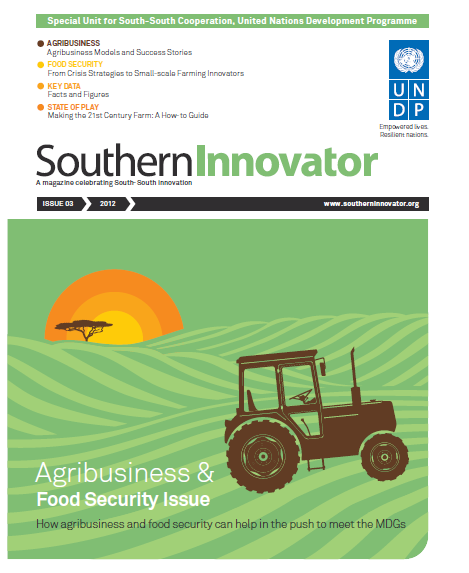
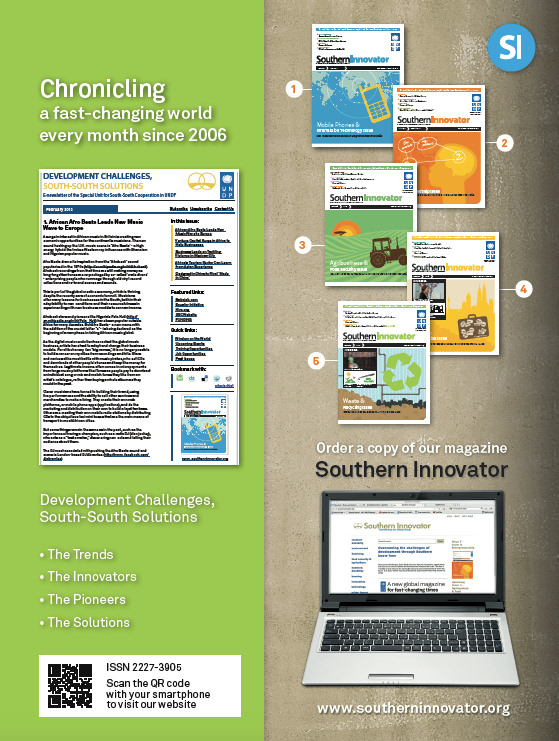
Development Challenges, South-South Solutions was launched as an e-newsletter in 2006 by UNDP’s South-South Cooperation Unit (now the United Nations Office for South-South Cooperation) based in New York, USA. It led on profiling the rise of the global South as an economic powerhouse and was one of the first regular publications to champion the global South’s innovators, entrepreneurs, and pioneers. It tracked the key trends that are now so profoundly reshaping how development is seen and done. This includes the rapid take-up of mobile phones and information technology in the global South (as profiled in the first issue of magazine Southern Innovator), the move to becoming a majority urban world, a growing global innovator culture, and the plethora of solutions being developed in the global South to tackle its problems and improve living conditions and boost human development. The success of the e-newsletter led to the launch of the magazine Southern Innovator.


This work is licensed under a
Creative Commons Attribution-Noncommercial-No Derivative Works 3.0 License.
ORCID iD: https://orcid.org/0000-0001-5311-1052.
© David South Consulting 2023


 David South Consulting
You must be logged in to post a comment.