Categories
Archive Blogroll Development Challenges, South-South Solutions Newsletters

China Consumer Market: Asian Perspective Helps

By David SouthDevelopment Challenges, South-South Solutions

SOUTH-SOUTH CASE STUDY

The rise of China since 1989 has been the most remarkable development story of our times. The number of people lifted out of poverty is historically unprecedented: 65 percent of Chinese people lived below the poverty line in 1981; in 2007 it was 4 percent (World Bank).

Many commentators have focused on China’s astonishing work ethic, vast labour resources and ability to export great quantities of products. But while China has been busy meeting the needs of the world economy, domestic Chinese consumption has received less attention.

Yet, with the Chinese firmly established as keen savers and very ambitious to improve their living standards, a vast new opportunity has emerged: the Chinese consumer market. But it will be a tricky market to tap. Chinese consumers are notorious bargain hunters and prefer to save and invest rather than consume. Poor rural families earning less than US $200 per person a year still are able to save 18 percent of their income.

This makes a lot of sense: social supports have been stripped away as China’s economy embraced the market system. If you do not save and invest, then you will not have the resources to meet the costs of education and health care, for example. China has also seen a dramatic move to urban areas, with over 43 percent of the population now urban.

China, despite all the hype, is still a marketplace that is difficult to easily enter for Western brands and businesses. And this makes for an opportunity for local brands to raise their game.

In order to compete in the consumer market, businesses need to do more than compete on price: they need to also offer something more and that usually involves building a strong brand.

The Chinese urban consumer market could grow from around US $570 billion in 2005 to around US $4.7 trillion by 2025 (PWC) (http://www.pwc.co.uk). Fast growth will be seen in discretionary spending, things other than food, clothing and utilities.

While Chinese businesses have focused on export markets and meeting the needs of the global marketplace – a focus which has been very successful and led to remarkable wealth gains – the Chinese consumer has come lower down the list of priorities.

Growing the domestic consumer market offers a substantial wealth-creating opportunity. Since the global economic crisis erupted in 2008, it has become apparent that the old model of exporting vast quantities of products to Western consumers alone will not be enough to keep living standards rising. Western economies are highly indebted and will take many years to recover from the mistakes and debts from the boom years and the economic crisis.

This is an opportunity for South-South trade, which made up 20 percent of global exports by 2010. Foreign direct investment to developing economies rose by 10 percent in 2010 due to a rapid economic recovery and increasing South-South flows.

One company successfully targeting this market is the Singapore-based Banyan Tree Hotels and Resorts brand (www.banyantree.com), which bills itself as specializing in luxury sanctuaries to rejuvenate the body, mind and soul. It is notable for deliberately not competing on price but on its brand reputation and for tailoring its offering explicitly to Asian tastes. The company claims its resorts are “naturally-luxurious, ecologically sensitive, culture-aware experiences for the discerning, responsible traveller.”

The first Banyan Tree resort was built in Phuket, Thailand in 1987. It now employs 8,200 people from 50 nationalities in 26 resorts. Founder and executive chairman Ho Kwon Ping focused from the start on the business’s brand as critical to driving the growth of the company.

He told INSEAD Knowledge: “The difference between us and some others is that, for many other companies having a strong brand is a reward for being successful in many things that you do but it’s sort of coincidental. It comes afterward; it’s a reward for success in other areas. For us, we’ve always said from the very beginning – having a strong brand is imperative for our survival.”

Banyan Tree has also eschewed quick-growth models, instead trying to do as little environmental damage as possible and to include community development and environmental projects at each resort.

Its Banyan Tree Ringha resort in China’s Yunnan province tries to bring the atmosphere of the fictional earthly paradise of Shangri-La to China. Ringha Valley sits near the Temple of the Five Wisdom Buddhas, 3,600 meters above sea level. The resort has 15 one-bedroom suites, 11 two-bedroom lodges, and six spa suites, decorated in a Tibetan style. The area is home to the Naxi people who trace their origins to nearby Tibet (http://en.wikipedia.org/wiki/Naxi_people).

The accommodation is rustic and the resort is located in the middle of a village. Visitors can see farmers at work right from the resort. Overlooked by Tibetan mountains and settled in a lush, fertile valley the sight was picked for its tranquillity and isolation. The appeal of the area to tourists is clear: mountain peaks, deep canyons, rivers, valleys, streams and tranquil lakes. And in polluted urban China, it is an area free from pollution.

The resort is built from transplanted Tibetan farm houses and offers hikes, mountain lakes, hot springs, gorges, forests. There are Asian touches like a welcome at the resort of Tibetan horns, songs and a tea ceremony.

Tourism is transforming the area. Towns and villages have been renovated to showcase traditional architecture.

The hotel and resort chain gets its name from the tradition of ancient merchants gathering under the branches of the banyan tree to conduct business in the cool shade.

“The 21st century is really going to be the age of Asia – both India and China,” said Ho Kwon Ping. “The huge consumer markets are going to be Asian … Now there’s a real opportunity for people of Asian origin, who have an instinctive cultural feel for where their consumers are moving towards, to come out and create a brand which can be primarily rooted in their own Asian context, but have a global relevance.”

Published: March 2011

Resources

1) How big will the Chinese consumer market get by 2025? A report by PriceWaterhouseCoopers. Website: http://tinyurl.com/5upqew8

2) An interactive map of Africa’s new wealth and where to find it. Website: http://online.wsj.com/article/SB10001424052748704720804576009672053184168.html#project%3DAFRICAMAP0111%26articleTabs%3Dinteractive

3) A video on the rising African consumer market. Website: http://annansi.com/blog/2010/12/growth-and-spending-of-african-consumer-video/

4) Environmental Public Awareness Handbook: Case Studies and Lessons Learned in Mongolia: Tested approaches to community development and environmental protection in Asia. Website: http://www.scribd.com/doc/28633063/Environmental-Public-Awareness-Handbook-Case-Studies-and-Lessons-Learned-in-Mongolia-Part-One?in_collection=2521442
https://davidsouthconsulting.org/2022/10/26/african-trade-hub-in-china-brings-mutual-profits-2/

https://davidsouthconsulting.org/2022/10/26/africas-consumer-market-in-spotlight-for-2011/

https://davidsouthconsulting.org/2020/12/10/china-sets-sights-on-dominating-global-smartphone-market/

https://davidsouthconsulting.org/2022/11/21/chinese-trade-in-angola-helps-recovery/

https://davidsouthconsulting.org/2021/03/20/computer-gold-farming-turning-virtual-reality-into-real-profits/

https://davidsouthconsulting.org/2021/01/26/designed-in-china-to-rival-made-in-china/

https://davidsouthconsulting.org/2022/11/15/indonesian-middle-class-recycle-wealth-back-into-domestic-economy/

https://davidsouthconsulting.org/2022/10/04/popular-chinese-social-media-chase-new-markets/

https://davidsouthconsulting.org/2022/11/17/pulque-aztec-drink-ferments-new-economy/

https://davidsouthconsulting.org/2022/10/26/shopping-and-flying-in-africas-boom-towns/

https://davidsouthconsulting.org/2020/04/17/virtual-supermarket-shopping-takes-off-in-china/

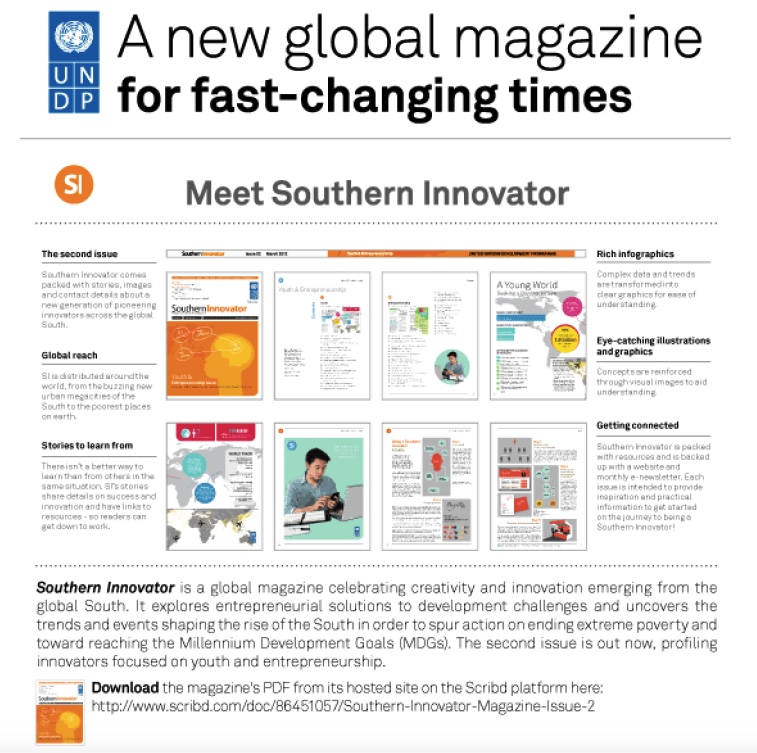
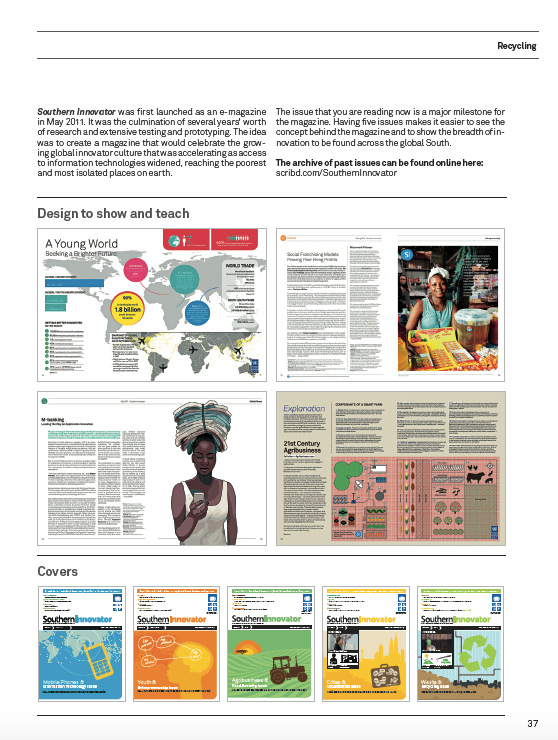
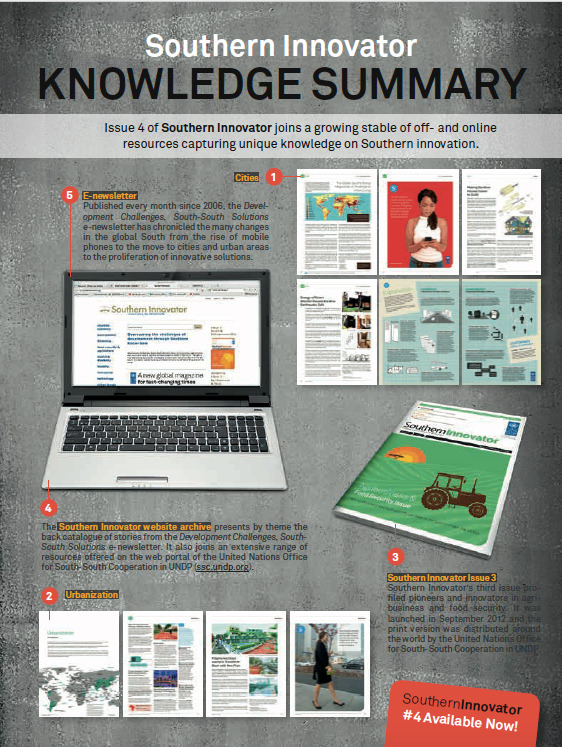
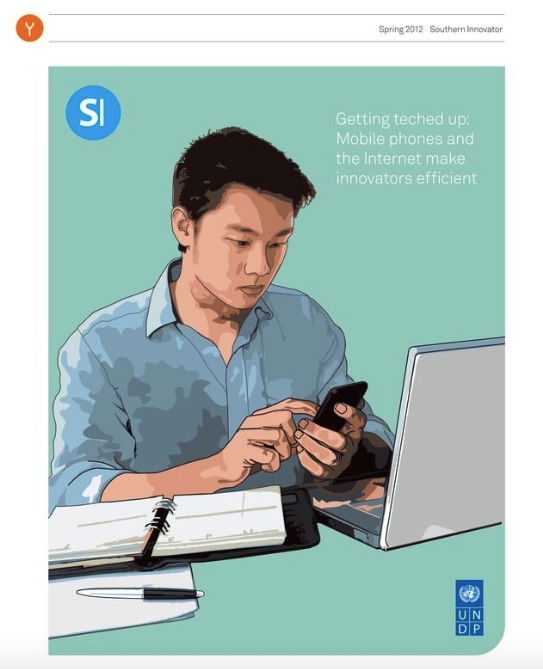
Development Challenges, South-South Solutions was launched as an e-newsletter in 2006 by UNDP’s South-South Cooperation Unit (now the United Nations Office for South-South Cooperation) based in New York, USA. It led on profiling the rise of the global South as an economic powerhouse and was one of the first regular publications to champion the global South’s innovators, entrepreneurs, and pioneers. It tracked the key trends that are now so profoundly reshaping how development is seen and done. This includes the rapid take-up of mobile phones and information technology in the global South (as profiled in the first issue of magazine Southern Innovator), the move to becoming a majority urban world, a growing global innovator culture, and the plethora of solutions being developed in the global South to tackle its problems and improve living conditions and boost human development. The success of the e-newsletter led to the launch of the magazine Southern Innovator. 

https://davidsouthconsulting.org/2021/03/05/southern-innovator-issue-1/

https://davidsouthconsulting.org/2021/03/05/southern-innovator-issue-2/

Creative Commons License

This work is licensed under a
Creative Commons Attribution-Noncommercial-No Derivative Works 3.0 License.

ORCID iD: https://orcid.org/0000-0001-5311-1052.

© David South Consulting 2023

Categories
Archive

Bolivian Film School’s Film Scene Paying Off

By David SouthDevelopment Challenges, South-South Solutions

SOUTH-SOUTH CASE STUDY

A film school in Bolivia shows how a creative hub can become the start of something much bigger. The school is inspiring a new generation of young people to get into filmmaking. And one of its lecturers is already experiencing global success acting in an award-winning new Spanish film.

Bolivia’s economy has grown over the last decade, and the country is beginning to shed its long-standing reputation for grinding poverty and political instability. Public spending has risen, and more money has been put into programmes to reduce poverty. More students are entering higher education and the country recognizes an urgent need for greater awareness and understanding of modern technology.

Film and media production have been targeted as an important way to advance Bolivia’s social and economic development.

Veteran Bolivian filmmaker Jorge Sanjines (http://en.wikipedia.org/wiki/Jorge_Sanjin%C3%A9s) has been one of the most passionate exponents of using film to spread the stories and wisdom of Bolivia’s indigenous people. He believes their stories understand the need to balance the demands of humanity with preservation of the environment. Film, to him, is a way to liberate Bolivian society and address its pervasive problems of poverty, hunger and marginalization.

This chimes with rising global awareness of the importance of the creative economy in future development. No longer seen as a frippery, the creative economy is the “interface between creativity, culture, economics and technology in a contemporary world dominated by images, sounds, texts and symbols” (UNCTAD). It is seen as a way for emerging economies to leapfrog into high-growth areas in the world economy.

It’s a formula that has worked well in many other places. A successful art gallery fosters a scene and draws in audiences, buyers and new businesses. Soon, a creative economy comes alive and that means serious money. Both New York and London have shown how this can work. By 2005, New York City’s creative economy employed over 230,899 people in 24,481 businesses (Americans for the Arts).

Creative economies tend to create excitement and pride in the country; creative businesses like advertising and design make it much easier to sell products and connect with customers. It is hard to imagine the Apple computer brand (http://www.apple.com/) being as successful as it is without intelligent and engaging design.

Regeneration – of poor neighbourhoods, districts, even whole countries – is both a challenge and a key to transforming lives. There is a strong track record of turning to artists and creative people to re-imagine neighbourhoods or a country’s culture, restoring pride and vitality to places beaten down by life’s hardships.

In the Bolivian city of El Alto (http://en.wikipedia.org/wiki/El_Alto,_La_Paz), the Cine Alto film school at the Municipal Arts School of El Alto (http://cinealto.blogspot.com/2009/01/nueva-carrera-de-artes-cinematogrficas.html), offers students a free education in filmmaking. Lecturer and actor Juan Carlos Aduviri is one of the high-profile successes to come from the school since it opened in 2006.

A graduate of the school and a lecturer on screenwriting, he got a big career boost by acting in a major new, award-winning film and is nominated as Best Newcomer by Spain’s top film awards, the Goyas (http://www.academiadecine.com/home/index.php). The nomination is for his role in the Spanish film Even the Rain (http://www.tambienlalluvia.com/) – set in the Bolivian city of Cochabamba, where protests a decade ago broke out over privatisation of water services. It stars well-known Mexican actor Gael Garcia Bernal, who plays a filmmaker set on making a movie about the Spanish conquest of the Americas. While making the film, the so-called “water wars” break out and the actor played by Aduviri must balance his film role with being a protest leader.

The protests against water privatisation in Cochabamba led to the election of Evo Morales (http://en.wikipedia.org/wiki/Evo_Morales) as Bolivia’s president in December 2005.

Cine Alto is one of four film schools in Bolivia but the only one that does not charge students tuition. Cash is tight for the school, which is a simple place and runs on thin resources. The classrooms have bare walls and broken windows, but the school is serious about transforming the lives of young people. The curriculum emphasises a strong theoretical foundation in combination with technical and practical training.

“Conditions in Bolivia to make a film are challenging and in El Alto, it’s even more difficult,” Aduviri told the BBC.

“Life is hard here in El Alto, and this film school is trying to rescue this talent, and support these young people.”

A member of Bolivia’s indigenous people, the Aymara (http://en.wikipedia.org/wiki/Aymara_people), Aduviri grew up in El Alto, a city known for its strong pride and resilience. It is home to almost a million people, most of whom are Aymara.

He studied screenwriting and turned to teaching at the school after graduating. He is passionate about filmmaking as an alternative to negative influences in the community: he wanted the film school “to give a voice to all the talent that we’re losing to alcohol, drugs, prostitution, homelessness and gangs.”

One student, Edson Chambiborque, told the BBC: “”He has taught us to value the little that we have in this school, and never drop our heads despite all the difficulties we may have.”

Aduviri comes from a poor family but now makes a good salary by Bolivian standards: US $200 a month. (The average monthly wage in Bolivia is around US $90). He still lives with his mother in a poor neighbourhood. His father, a miner, died of lung disease.

He wants to become a director and screenwriter and dreams of his film career taking him to the Cannes Film Festival in France (http://www.festival-cannes.com/).

He will continue acting to raise the money to be able to finance his own films. With the money he has made from appearing in the Spanish film, he has bought a computer with film editing software and a television. He has a goal to watch two movies a day on his new television and keep learning.

Appearing in the film has catapulted his career to the next level: the phone is always ringing and the world’s media keep asking for interviews. It has come with trips to Europe to promote the film and receive awards. He also won the best actor award from the Festival de Cinema Europeen des Arcs (http://www.lesarcs-filmfest.com/2010/programme/). An impressive journey for somebody from a poor family.

When he saw his first movie he was inspired by the magic of filmmaking. He told the BBC: “It was showing Rambo. And that day I realised what I wanted to do. When I left the cinema, I said: I want to make films.”

Bolivian film has had to fight for attention with other Central and South American countries. Brazil, Argentina and Chile all have experienced global success. The country has a rich – but little-known – film history, with significant Bolivian filmmakers including Pedro Sambarino, Jorge Ruiz, Oscar Soria, Jorge Sanjines, Antonio Eguino, Paolo Agazzi, Rodrigo Bellott, Juan Carlos Valdivia, Adriana Montenegro, Marcos Loayza.

Bolivia is looking to the digital age to rectify its relative anonymity, and Cine Alto may be ground zero for a Bolivian film new wave.

Published: March 2011

Resources

1) European film festival in Bolivia, with screenings across the country. Website: http://www.cineeuropeobolivia.org/

2) Cine Alto on Facebook: Website: http://es-la.facebook.com/cine.alto

3) Global Creative Economy Convergence Summit 2009: The summit is about the successful and emerging creative technologies and initiatives that are driving economic growth locally, nationally and internationally. Website: http://www.gcecs2009.com/

4) AltoTV: A non-profit television documentary-making project that has made small films on El Alto. Website:http://www.altotvgerman.blogspot.com/

5) The Public University of El Alto: Website:http://www.enlaupea.com/

6) Creative Economy Report 2008. An economic and statistical assessment of creative industries world-wide as well as an overview of how developing countries can benefit from trade in creative products and services, produced by UNCTAD and the Special Unit for South-South Cooperation in UNDP. Website: http://www.unctad.org/en/docs/ditc20082cer_en.pdf

7) A course on Bolivian filmmaking taught by award-winning filmmaker Ismael Saavedera. Website:http://www.sit.edu/studyabroad/sss_blv.cfm

Creative Commons License

This work is licensed under a
Creative Commons Attribution-Noncommercial-No Derivative Works 3.0 License.

ORCID iD: https://orcid.org/0000-0001-5311-1052.

© David South Consulting 2022