Categories
Archive Development Challenges, South-South Solutions Newsletters Southern Innovator magazine

A New Mobile Phone Aimed at the Poor

By David SouthDevelopment Challenges, South-South Solutions

SOUTH-SOUTH CASE STUDY

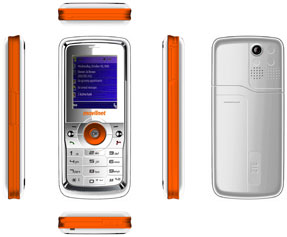
A low-cost Venezuelan mobile phone aimed at the South’s poor is proving that South-South technological cooperation works. Packed with features and costing no more than US $15 – making it one of the cheapest mobile handsets in the world – the phone is aimed at the fast-growing mobile market across the global South.

The South is a dynamic market and has seen quick acceptance of mobile phones. The number of mobile phone users in the world passed 4 billion in 2008, and the fastest growth was in the South (ITU). The development of inexpensive handsets means the phones will be able to reach even more poor people. And packing these phones with the latest in multimedia capability means the poor will be able to make a technological leap.

The Venezuelan phone is being championed as the world’s cheapest mobile phone. It is a bold effort to create an affordable mobile phone packed with features: a camera, WAP internet access (wireless application protocol), FM radio, and MP3 and MP4 players for music and videos.

The phone uses inexpensive parts from China and is assembled in Venezuela. A quarter of the cost of manufacturing the phone is subsidized by the government. Venezuela often uses the profits from its oil industry to subsidize social goals.

The phone was launched on Mother’s Day by Venezuela’s president Hugo Chavez with a call to his mother. Chavez boasted to the Guardian newspaper: “This telephone will be the biggest seller not only in Venezuela but the world.”

With his usual bravado, he said that “whoever doesn’t have Vergatario is nothing” – a statement that has become the marketing slogan for the phone on its website.

The phone already has a waiting list of 10,000 people. The phones are assembled in western Venezuela by Vetelca, a joint state (85 percent) and Chinese (15 percent) company. Vetelca hope to make 600,000 phones in 2009, and to sell more than 2 million in 2011. Exports will first target the Caribbean and then the world.

The desire to spark technological innovation at home is also alive in the Southern African country of Mozambique, which is making the bold move to start manufacturing computers for schools in the country. Like other African countries, Mozambique is connecting schools with computers and the internet. By manufacturing the laptop computers within the country, Mozambiquans are increasing the program’s economic benefit to the country, and building advanced technical skills.

Most Southern African countries rely on importing computers, and Rwanda, South Africa and Ethiopia are getting their school computers from the OLPC (One Laptop Per Child) (www.laptop.org) initiative from the United States.

The Mozambique laptops are call Magalhael (www.portatilmagalhaes.com) and are made in partnership with the Mozambican Ministry of Science and Technology (www.mct.gov.mz/portal/page?_pageid=615,1&_dad=portal&_schema=PORTAL) and Portugal Telecom (www.telecom.pt/InternetResource/PTSite/PT). They come with a 60 gigabyte (GB) hard drive and 2 GB of RAM (memory) and are entirely built in Mozambique.

Read these stories on ICT4D from Development Challenges, South-South Solutions:

Published: June 2009

Resources

  • Google Android: Android is a software for mobile phones that allows people to create useful applications (apps) for the phones. Website: http://code.google.com/android/and www.android.com
  • Kabissa: Space for Change in Africa: An online African web community promoting and supporting the transition to Web 2.0 services in Africa. Offers lots of opportunities to meet people throughout Africa and learn more.Website: www.kabissa.org
  • Business Fights Poverty: Business Fights Poverty is the free-to-join, fast-growing, international network for professionals passionate about fighting world poverty through good business.Website:http://businessfightspoverty.ning.com/
  • BOP Source is a platform for companies and individuals at the BOP to directly communicate, ultimately fostering close working relationships, and for NGOs and companies to dialogue and form mutually valuable public-private partnerships that serve the BOP. Website:http://bopsource.ning.com/
  • Venezuelan Phone. Website: www.vergatorio.com

Like this story? Please check out our first issue of Southern Innovator on mobile phones and information technology.
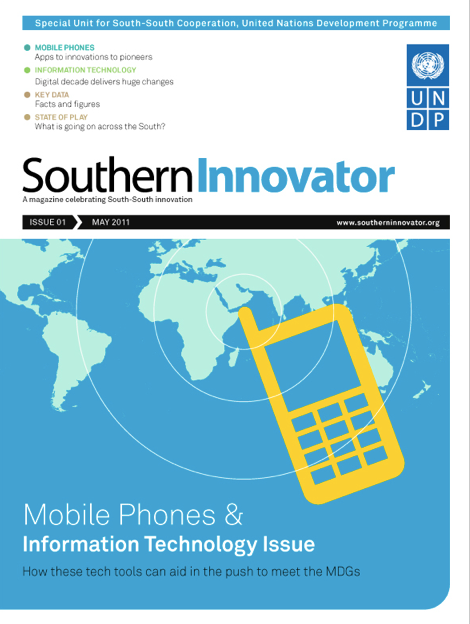
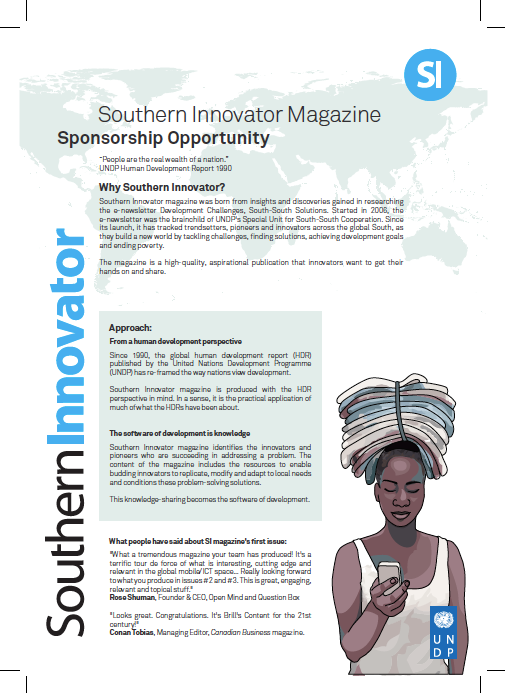
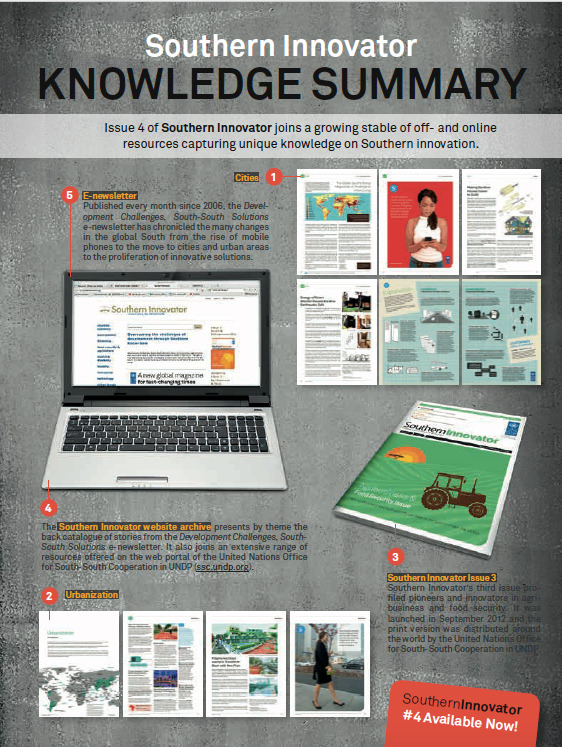
Development Challenges, South-South Solutions was launched as an e-newsletter in 2006 by UNDP’s South-South Cooperation Unit (now the United Nations Office for South-South Cooperation) based in New York, USA. It led on profiling the rise of the global South as an economic powerhouse and was one of the first regular publications to champion the global South’s innovators, entrepreneurs, and pioneers. It tracked the key trends that are now so profoundly reshaping how development is seen and done. This includes the rapid take-up of mobile phones and information technology in the global South (as profiled in the first issue of magazine Southern Innovator), the move to becoming a majority urban world, a growing global innovator culture, and the plethora of solutions being developed in the global South to tackle its problems and improve living conditions and boost human development. The success of the e-newsletter led to the launch of the magazine Southern Innovator.  

Creative Commons License

This work is licensed under a
Creative Commons Attribution-Noncommercial-No Derivative Works 3.0 License.

ORCID iD: https://orcid.org/0000-0001-5311-1052.

© David South Consulting 2023
Categories
Archive Development Challenges, South-South Solutions Newsletters Southern Innovator magazine

Kenyan Eco-Village Being Built by Slum-Dwellers

By David SouthDevelopment Challenges, South-South Solutions

SOUTH-SOUTH CASE STUDY

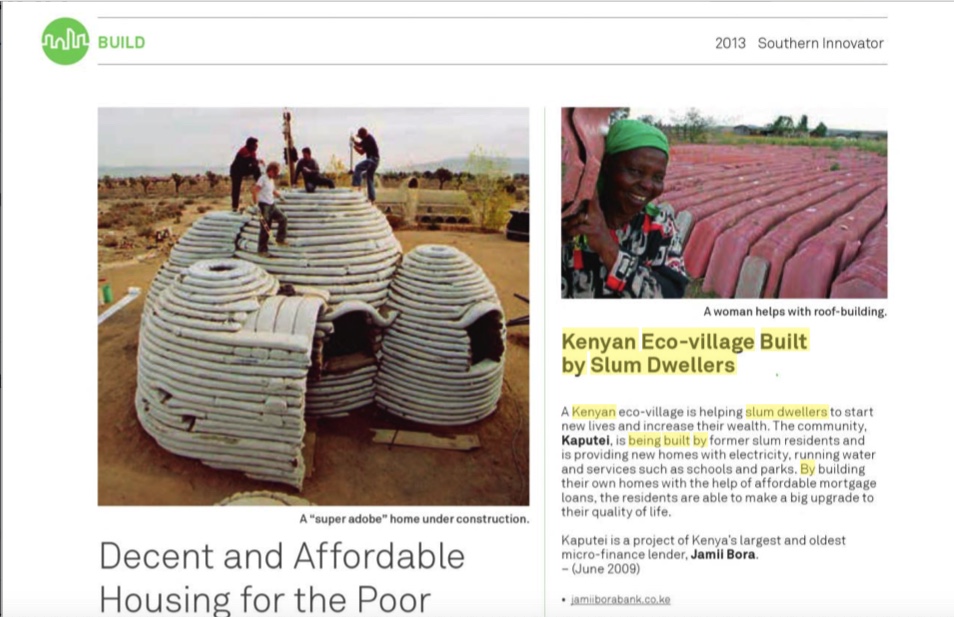
A Kenyan eco-village is helping slum dwellers to start new lives and increase their wealth. The community, Kaputei, is being built by former slum residents – some of whom used to beg to survive – and is providing new homes with electricity, running water and services like schools and parks. By building their own homes, with the help of affordable mortgage loans, the residents are able to make a big upgrade to their quality of life while acquiring real wealth.

More than 900 million people – almost a sixth of the world’s population – now live in urban slums (UN). This number will double by 2030 as a result of rapid urbanization in developing countries. Already in developing countries 43 per cent of urban dwellers live in slums, and the figure leaps to 78 per cent in the least-developed countries. The UN estimates it will take US $18 billion a year to improve living conditions for these people – and most of it will have to come from the residents themselves.

Kaputei is a project of Kenya’s largest and oldest micro-finance lender, Jamii Bora (www.jamiibora.org). Having enjoyed significant success in making loans to over 225,000 people – after starting out in 1999 with loans to just 50 beggars – it realized something on a larger scale was necessary to permanently transform the lives of poor Kenyans.

Jamii Bora’s founder, Ingrid Munro, saw the whole atmosphere of the slums as the biggest impediment to long-term life changes. “As long as you are living in the slums, you will never climb out of poverty,” she told The Independent newspaper. “Families of course need economic opportunities to rise out of poverty, but what good are they if you are still living in hell?”

Jamii Bora came up with the idea of building an entire community from scratch, and doing it in way that was affordable, ecological and sustainable, while building the wealth of the residents. Since 2007, the project has provided homes for 50 families; the target is to have homes for 2,000.

One former beggar who has built her own home is Clarice Adhiambo. An early client of Jamii Bora, she started to learn how to save, reaching her first goal of saving 1,000 Kenyan shillings (US $12.81). With Jamii Bora’s encouragement, she plowed this money back into buying some fish and selling it in the markets. Over time, she was able to grow her efforts until she was a regular market trader, and was borrowing as much as US $1,900 to fund various slum businesses.

Then came the Kaputei project. It has helped Adhiambo move from a 3 meter by 3 meter tin shack in the Nairobi slum of Soweto to her own home with running water: “So much water,” she told The Independent.

The new home is 50 square metres with two bedrooms, a sitting room and a bathroom.

Adhiambo pays US $36 a month for her mortgage — more than most people, because she wants to pay it off quickly. That compares to about US $20 a month in rent paid by many slum dwellers to live in squalor with poor services and quality of life.

Kaputei is a clever community project. Unlike attempts to build housing for the poor in isolation, Kaputei is based on neighbourhoods of 250 families each, with common community centres, playgrounds, parks and church halls. There is a town centre, and zones for commercial and industrial enterprises. The project was approved by the Kenyan government in 2004 and has planning permission for 119 hectares. Trees are being planted to provide protection from wind, add beauty, and, in time, to be a source of income or firewood. A wetland is being used to recycle waste water and is being run in partnership with Kenyan universities.

Each house costs US $1,875 to build. The homes are so cheap because the building materials are assembled in a factory on site, and the families help with the building.

Three house models are available and the families – from the Kamba, Kikuyu, Luo and Maasai peoples – choose the one they like by viewing show homes on site. Each home has access to roads, water and sewage.

It’s estimated the entire community of 2,000 families will cost US $3,750,000 for the homes, and another US $3,750,000 for infrastructure. Mortgages are offered at between 8.5 percent and 10 percent interest and are estimated to take 10 to 15 years to repay. The average mortgage is about US $32 a month.

Published: June 2009

Resources

Builders Without Borders: Is an international network of ecological builders who advocate the use of straw, earth and other local, affordable materials in construction. Website: www.builderswithoutborders.org/

World Hands Project: An NGO specialising in simple building techniques for the poor. Website:www.worldhandsproject.org

CIDEM and Ecosur specialize in building low-cost community housing using eco-materials. They have projects around the world and are based in Cuba. Website: www.ecosur.org

The Building and Social Housing Foundation: An independent research organization promoting sustainable development and innovation in housing through collaborative research and knowledge transfer. Website: www.bshf.org

Slum TV: Based deep inside Nairobi’s largest slum, Mathare, they have been seeking out the stories of hope where international media only see violence and gloom. Website: www.slum-tv.org

https://davidsouthconsulting.org/2022/10/06/africas-fast-growing-cities-a-new-frontier-of-opportunities/

https://davidsouthconsulting.org/2022/05/23/debt-free-homes-for-the-poor/

https://davidsouthconsulting.org/2022/02/17/digital-mapping-to-put-slums-on-the-map/

https://davidsouthconsulting.org/2022/04/28/envisioning-better-slums/

https://davidsouthconsulting.org/2022/11/16/favela-fashion-brings-women-work/

https://davidsouthconsulting.org/2021/11/04/filipino-architect-wants-to-transform-slum-with-new-plan/

https://davidsouthconsulting.org/2022/11/16/housing-innovation-in-souths-urban-areas/

https://davidsouthconsulting.org/2022/10/25/indian-city-slum-areas-become-newly-desirable-places-to-live/

https://davidsouthconsulting.org/2022/04/28/innovation-in-the-slums-can-bring-peace-and-prosperity/

https://davidsouthconsulting.org/2022/10/31/mapping-beirut-brings-city-to-light/

https://davidsouthconsulting.org/2021/10/03/a-new-house-kit-for-slum-dwellers-that-is-safe-and-easy-to-build/

https://davidsouthconsulting.org/2022/11/19/securing-land-rights-for-the-poor-now-reaping-rewards/

https://davidsouthconsulting.org/2022/11/17/tiny-homes-to-meet-global-housing-crisis/

https://davidsouthconsulting.org/2022/11/18/toilet-malls-make-going-better/

https://davidsouthconsulting.org/2022/10/17/the-water-free-south-african-bathing-solution/

https://davidsouthconsulting.org/2021/03/05/southern-innovator-issue-4/

Creative Commons License

This work is licensed under a
Creative Commons Attribution-Noncommercial-No Derivative Works 3.0 License.

2009: Development Challenges, South-South Solutions

ORCID iD: https://orcid.org/0000-0001-5311-1052.

© David South Consulting 2023