Categories
Archive Development Challenges, South-South Solutions Newsletters Southern Innovator magazine

Urban Farming to Tackle Global Food Crisis

By David SouthDevelopment Challenges, South-South Solutions

SOUTH-SOUTH CASE STUDY

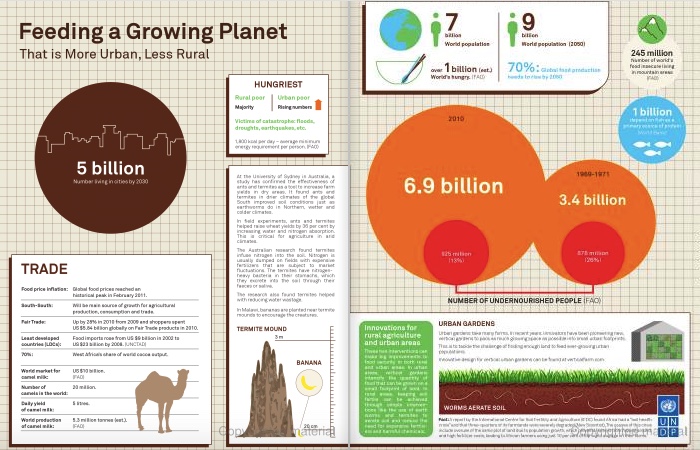
The world’s population is becoming more urban by the day. By 2030, some five billion people around the world will live in cities. This year is the tipping point: urban dwellers (3.3 billion people) now outnumber rural residents for the first time (UNFPA’s State of the World Population 2007 Report). 

But with rising food prices across the globe, many city-dwellers are experiencing hunger and real hardship. On international commodity markets, food prices have gone up 54 percent over the last year, with cereal prices soaring 92 percent (FAO – World Food Situation). While living in an urban environment means living cheek-by-jowl with other people, it doesn’t mean there aren’t ways to grow food and supplement urban dwellers’ tight budgets and boost diets.

U.N. Secretary General Ban Ki-moon has called for food production to increase 50 percent by 2030 just to meet rising demand – and right now there are 862 million people undernourished (FAO). But one solution, urban farming, can make a huge difference, as the Caribbean island of Cuba has shown.

Today, Cuba imports about 50 percent of its minimum fuel and food requirements – a cost that reached US $1.6 billion last year for food. (Reuters). The island has been buffeted by one food crisis after another in the past two decades, first by the collapse of its aid from the Soviet Union, and then by a fuel crisis. But now, urban farming in Cuba provides most of the country’s vegetables, thanks to urban gardens that have sprung up on abandoned land in the country’s cities and towns. And the food is pesticide-free: 70 percent of the vegetables and herbs on the island are organic (http://www.soilassociation.org/web/sa/saweb.nsf/Living/ whatisorganic.html).

These urban farms mean fresh food is just a short walk away from the people who eat it. And in a world of rising fuel prices, Cuba has reduced the use of fossil fuels in the production and transportation of food.

The urban farms have created 350,000 jobs that pay better than most government jobs. It has also improved Cuban’s health: many have moved from diets dominated by rice and beans and imported canned goods from Eastern Europe, to fresh vegetables and fruits.

While Cubans receive at least a basic state ration of rice, beans and cooking oil, the rations do not include fresh fruit and vegetables. After the withdrawal of Soviet subsidies, the average Cuban’s daily calorie intake fell sharply. Between 1989 and 1993, daily calorie intake dropped from 3,004 to 2,323 (UN). But with the growth of urban farms, this has moved up to 3,547 calories a day – even higher than the amount recommended for Americans by the US government.

The secret to this success has been the rise of entrepreneurs like Miladis Bouza, a 48-year-old former research biologist who had to abandon a comfortable middle class life after the collapse of the Soviet Union. Her government salary dropped to US $3 a month. Unable to make ends meet and provide food for her family, she quit her job.

The Cuban government allowed people to turn unused urban land into mini farms. The cities have many vacant lots because the state owns most land and there isn’t competition from private developers, as in many other countries. Unusually for communist Cuba, 80 percent of the profits are kept by the farmers. This can be an average wage of US $71 per month.

“Those salaries are higher than doctors, than lawyers,” Roberto Perez, an agronomist who runs the country’s first urban farm, told The Associated Press. “The more they produce, the more they make. That’s fundamental to get high productivity.”

Miladis grabbed this opportunity to farm a half-acre plot near her home in Havana. Along with her husband, she grows tomatoes, sweet potatoes and spinach, and sells the vegetables at a stall on nearby busy street. This has enabled her monthly income to rise to between US $100 per month and US $250 per month, far more than the average government salary of US $19 per month.

Cuba was inspired by greenbelt farms in Shanghai (http://en.shac.gov.cn/hjgl/jqgk/t20030805_82028.htm): but Cuba has gone even further to make urban farming a key part of the national food supply.

All this urban farming is also all-natural farming. Farms have had to turn to natural compost as fertilizer, and natural pesticides like strong-smelling celery to ward off insects.

So-called organoponicos (http://academicos.cualtos.udg.mx/Pecuarios/ PagWebEP/Lecturas/ORGANOPONICOS.htm ) gather together a wide variety of vegetables, fruits and herbs, as well as ornamental plants. Customers are offered mangos, plantains, basil, parsley, lettuce, garlic, celery, scallions, collard greens, black beans, watermelon, tomatoes, malanga, spinach and sweet potatoes.

“Nobody used to eat vegetables,” said David Leon, 50, buying two pounds of Swiss chard at a Havana organoponico. “People’s nutrition has improved a lot. It’s a lot healthier. And it tastes good.”

Published: June 2008

Resources

https://davidsouthconsulting.org/2020/12/14/african-farming-wisdom-now-scientifically-proven/

https://davidsouthconsulting.org/2022/10/10/cheap-farming-kit-hopes-to-help-more-become-farmers/

https://davidsouthconsulting.org/2023/01/16/hip-driven-pump-brings-water-to-parched-fields/

https://davidsouthconsulting.org/2022/11/23/kenyan-farmer-uses-internet-to-boost-potato-farm/

https://davidsouthconsulting.org/2022/10/31/new-kenyan-services-to-innovate-mobile-health-and-farming/

https://davidsouthconsulting.org/2021/11/09/pocket-friendly-solution-to-help-farmers-go-organic/

https://davidsouthconsulting.org/2021/09/16/small-fish-farming-opportunity-can-wipe-out-malnutrition/

https://davidsouthconsulting.org/2022/10/18/woman-wants-african-farming-to-be-cool/

Development Challenges, South-South Solutions was launched as an e-newsletter in 2006 by UNDP’s South-South Cooperation Unit (now the United Nations Office for South-South Cooperation) based in New York, USA. It led on profiling the rise of the global South as an economic powerhouse and was one of the first regular publications to champion the global South’s innovators, entrepreneurs, and pioneers. It tracked the key trends that are now so profoundly reshaping how development is seen and done. This includes the rapid take-up of mobile phones and information technology in the global South (as profiled in the first issue of magazine Southern Innovator), the move to becoming a majority urban world, a growing global innovator culture, and the plethora of solutions being developed in the global South to tackle its problems and improve living conditions and boost human development. The success of the e-newsletter led to the launch of the magazine Southern Innovator. 
https://davidsouthconsulting.org/2021/03/05/southern-innovator-issue-3/

Creative Commons License

This work is licensed under a
Creative Commons Attribution-Noncommercial-No Derivative Works 3.0 License.

ORCID iD: https://orcid.org/0000-0001-5311-1052.

© David South Consulting 2023

Categories
Archive Development Challenges, South-South Solutions Newsletters

Connoisseur Chocolate from the South Gets a Higher Price

By David SouthDevelopment Challenges, South-South Solutions

SOUTH-SOUTH CASE STUDY

Like coffee beans, cocoa beans are grown around the world and are a major commodity, highly prized in wealthy countries. West Africa accounts for 70 percent of the world’s output, with the rest grown either in Indonesia and Brazil (20 percent), or on a smaller scale in countries across the South, from Belize to Madagascar.

Global sales of cocoa beans have grown by an average of 3.7 percent a year since 2001, and the World Cocoa Foundation estimates 40-50 million people depend on cocoa for their livelihood.

But harvesting cocoa comes at a price to the farmers and those who work on the farms. It is estimated that 284,000 children in West Africa work under abusive conditions to harvest the beans. Cocoa farmers usually only benefit from the price of cocoa in the harvest season between October and February. In Ghana, the second largest producer of beans, child slavery allegations have plagued the cocoa plantations, along with too-low prices paid to farmers. Fluctuating global market prices constantly put small-scale farmers at risk of losing everything they have worked for.

But consumers are developing ever-more sophisticated tastes for chocolate, paying more attention to the quality and origin of the beans. Savvy cocoa producers are using this greater awareness to increase prices for farmers and improve conditions for those who work on the farms.

Maturing consumers’ palates are now picking chocolate and other food products from the South in much the same way as connoisseurs pick wines. In the United Kingdom alone, sales of Fairtrade-branded goods (www.fairtrade.org.uk)- a scheme that offers guaranteed prices and better trading conditions to farmers – have reached £560 million (US$1.1 billion) a year. A survey of consumers in six countries found awareness of fairly traded chocolate was highest in the UK, with 43 percent of people having tried it (http://www.barry-callebaut.com).

British consumers willing to pay more for ethical products are at the forefront of a global surge in fair trade. Hans Vriens, chief innovation officer with Belgian chocolate makers Barry Callebaut, told The Independent newspaper: “Nowadays, chocolate consumption is coming to resemble the way we enjoy wine: we sample and compare different tastes.”

The world’s appetite for chocolate is voracious: For example by 2007, volume sales of chocolate confectionery increased from 1998 by 30 percent in Eastern Europe, and by 40 percent in the Asia Pacific region. Europeans devour 35 percent of the world’s cocoa.

In order to be classed as Fair Trade, a producer must meet a strict set of criteria governing how people and the environment are treated. The Fair Trade scheme pays farmers a higher price for cocoa beans, calculated on the basis of world market prices, plus fair trade premiums. The Fair Trade premium for standard quality cocoa is US$150 per tonne. The minimum price for Fair Trade standard quality cocoa, including the premium, is US$1,750 per tonne. Fair Trade ensures a minimum price of 80 US cents a pound under long-term contracts, with access to credit, and prohibits abusive child labour and forced labour.

At the Chuao Plantation in Venezuela, the local Chuao Empresa Campesina cooperative, representing 100 farmers, is reaping the benefits of developing an exclusive relationship with an Italian chocolate company. Chocolatier Alessio Tessieri was willing to pay a lot more for the beans if high standards were maintained. His sister Cecilia was struck by the aroma of the rare Criollo bean grown by the farmers: it is the least productive in terms of output, but prized for its flavour.

“We found an aroma that was greatly reminiscent of ripe red fruit and plum preserves, with an extremely delicate aftertaste,” she said. “A highly complex and sophisticated aroma lacking any trace of acidity.”

Located in Parque Nacional Henri Pittier, a road and sea trip from the capital Caracas, the town of Chuao, population 1,500, has ideal growing conditions because of its high humidity. In the village, the women take care of the drying process. Throughout the town the cocoa beans lay out in the open on verandas. In the warehouses the enormous “masorche” – the fruit of the cocoa trees, looking like big red melons – are split in half and the pulp is removed, revealing the super-sweet white-coated beans inside.

Alessio struck a good deal with the farmers in recognition of the exclusivity of the beans. He pays US$4 per kilogram against the US$1.30 per kilo paid by the local merchants. He also took on the farmers’ debts with the merchants. But most importantly, he ensured that one of his agronomists would stay behind and supervise the plantation and increase its production, from the current level of 120-130 kilos per hectare to a projected 250-300 kilos.

The Toledo Hills Cacao Cooperative in Belize, South America has developed a relationship with one of the UK’s pioneers in fair trade chocolate, Green & Blacks. The Mayan Indians who farm the cocoa live a traditional life more or less as they have done for centuries. They also live in one of the poorest areas of Belize. The profits made are ploughed back into buying machetes, or rubber boots to protect against snake bites. The cocoa harvest helps supplement their traditional way of life.

Green & Blacks has been buying organic cocoa from the farmers’ co-operative since 1994 and paying a guaranteed price above the world cocoa price. In 2003, they extended their activities with the cocoa farmers and started the Belize Programme to provide even more support. With an investment of £225,000 (US$443,350) over three years, the investment was used to help improve management and farming practices, rehabilitate hurricane-damaged crops, plant more cocoa trees, and train farmers in better growing methods. Green & Blacks continues to provide technical advice and support to the farmers. The business relationship with Green & Blacks has been so successful that other farmers in Belize are now interested in cocoa farming.

The pattern is being repeated elsewhere in Latin America. In San Martin, Peru, rice farmers have moved into cocoa to reap the rewards of the higher prices. Alvis Valles Sajami and Alberto Inou Amasifuen are both graduates of the Peru Farmer Field School. Sajami uses a plant nursery as an extra source of income by selling cocoa plants to other farmers. “I already have 4,000 plants, he said. “This (the nursery) will be so important to increase my cocoa area. I can sell planting material to other farmers in order to have a new source of income for my family.”

Amasifuen has already increased his own cocoa production from two hectares to five, and has also established a nursery to produce cocoa and timber tree seedlings to sell to area farmers.

“We have an increase in demand for cocoa plants in San Martín,” he said. “We expect to provide seedlings not only to our farm, but also to other farmers in expanding their production area.”

Learn more about cocoa trading and Africa’s role here (content provided by commodity.com): Cocoa’s Future as Commodity: What If Africa Can’t Keep Up the Supply? – Where’s Cocoa From and How Much Does It Contribute to the World’s Economy?

Published: June 2008

Resources

  • International Cocoa Organization, a good source of current data on the trade.
    Website: http://www.icco.org/about/chocolate.aspx
  • The Fairtrade Labelling Organization sets the standards for fair-trade and is the place to go to receive official certification.
    Website: www.fairtrade.org.uk
  • The Max Havelaar Foundation offers a similar service and is popular in continental Europe.
    Website: http://www.maxhavelaar.nl/pages/default.asp?rID=4
  • The International Federation of Organic Agriculture Movements (IFOAM) represents the organic farmers’ movement.
    Website: www.ifoam.org
  • World Cocoa Federation was formed in 2000 to play a leading role in helping cocoa farming families by developing and managing effective, on-the-ground programs, raising funds and acting as a forum for broad discussion of the cocoa farming sector’s needs.
    Website: http://www.worldcocoafoundation.org/about/default.asp

More on chocolate here: West African Chocolate Success Story

https://davidsouthconsulting.org/2022/11/21/agribusiness-food-security/

https://davidsouthconsulting.org/2021/10/03/civet-cat-coffee-brews-filipino-opportunity/

https://davidsouthconsulting.org/2022/10/14/indias-modernizing-food-economy-unleashing-new-opportunities/

https://davidsouthconsulting.org/2022/10/21/new-beer-helping-to-protect-elephants/

https://davidsouthconsulting.org/2022/10/31/rainforest-gum-gets-global-market/

https://davidsouthconsulting.org/2021/03/05/southern-innovator-issue-2/

https://davidsouthconsulting.org/2021/03/05/southern-innovator-issue-3/

https://davidsouthconsulting.org/2022/10/20/trade-to-benefit-the-poor-up-in-2006-and-to-grow-in-2007/

https://davidsouthconsulting.org/2022/10/17/west-african-chocolate-success-story/

https://davidsouthconsulting.org/2022/10/18/woman-wants-african-farming-to-be-cool/

Development Challenges, South-South Solutions was launched as an e-newsletter in 2006 by UNDP’s South-South Cooperation Unit (now the United Nations Office for South-South Cooperation) based in New York, USA. It led on profiling the rise of the global South as an economic powerhouse and was one of the first regular publications to champion the global South’s innovators, entrepreneurs, and pioneers. It tracked the key trends that are now so profoundly reshaping how development is seen and done. This includes the rapid take-up of mobile phones and information technology in the global South (as profiled in the first issue of magazine Southern Innovator), the move to becoming a majority urban world, a growing global innovator culture, and the plethora of solutions being developed in the global South to tackle its problems and improve living conditions and boost human development. The success of the e-newsletter led to the launch of the magazine Southern Innovator. 

Creative Commons License

This work is licensed under a
Creative Commons Attribution-Noncommercial-No Derivative Works 3.0 License.

ORCID iD: https://orcid.org/0000-0001-5311-1052.

© David South Consulting 2023