Categories
Archive Development Challenges, South-South Solutions Newsletters Southern Innovator magazine

Staple Foods Are Becoming More Secure in the South

By David SouthDevelopment Challenges, South-South Solutions

SOUTH-SOUTH CASE STUDY

Finding ways to ensure food security in countries experiencing profound economic and social change and stress is critical to achievement of development goals.

Food security is crucial to ensuring economic development is sustainable, and it is vital to long-term human health. Just one bout of famine can damage a generation of youth, stunting brain development and leaving bodies smaller and weaker than they should be.

Thankfully, many innovators are working on this problem and are making significant progress. A report from the Asian Development Bank, The Quiet Revolution in Staple Food Value Chains (http://www.adb.org/publications/quiet-revolution-staple-food-value-chains), found improvements to security of rice and potatoes – common staple foods in many countries. It said the so-called value chains – the various activities a company does to deliver a product or service to the marketplace (http://en.wikipedia.org/wiki/Value_chain) – for potatoes and rice have seen significant improvements in Bangladesh, China and India.

This is important because improvements in access to staple foods will mean better food security and less threat of extreme hunger events. This matters because it just takes one extreme hunger event and a generation is scarred for life.

The human brain is a heavy user of energy: it uses between 20 and 30 per cent of a person’s energy intake. Failure to consume enough calories means brain functioning begins to  be altered (brain-guide.org).

Hunger and starvation slow a person’s mental responsiveness. Low energy intake from minimal diets leads to apathy, sadness and depression. Fetuses and infants are especially sensitive to brain damage caused by malnutrition. A malnourished child can suffer life-long low intelligence and cognitive defects.

More than 70 per cent of the world’s 146 million underweight children aged five and under live in just 10 countries, with more than 50 per cent located in South Asia alone (UNICEF). A quarter of all children – roughly 146 million – in developing countries are underweight, and it is estimated that 684,000 child deaths worldwide could be prevented by increasing access to vitamin A and zinc (WFP).

Undernutrition contributes to 53 per cent of the 9.7 million deaths of children under five each year in developing countries (UNICEF).

Food insecurity also shows on the faces of people who experience it. This extreme stress scars people and harms their prospects in the labour market and their ability to improve their incomes.

Why is access to staple foods improving? It seems, according to the report, to result from innovations such as rapid modernization, with the increasing roll out of supermarkets, the use of cold storage facilities and large rice mills. It also cites the impact of small farmers taking on modern technologies, such as mechanized farming, and making the most of soil by using fertilizers and efficient techniques.

Supermarkets by their nature encourage highly sophisticated supply lines to ensure a steady stream of fresh produce coming in from farms to urban areas. Because of the variety and vast range of produce on offer, they require finely-tuned organizing models and information technologies. In short, they radically alter the way people buy their food, and what people will expect from food providers.

By negotiating deals with farmers, supermarkets create stability, as well as low and competitive prices. They allow for better traceability for food and give consumers more confidence in what they are purchasing. They use cold storage, which means food lasts longer and there is less waste than if food is left to spoil in a marketplace without refrigeration – a revolutionary change in hot countries.

The downside with supermarkets, as has been the case in some countries, is they can quickly dominate the marketplace and push out all other competitors with their economies of scale. When this happens, farmers can also find themselves with little bargaining power again and be hostage to the price the supermarket tells them to sell their product at.

Another critical improvement is the rapid spread of mobile phones. Armed with a mobile phone, small-scale farmers are able to access critical knowledge and information. This means they can make better decisions and quickly adjust what they are doing when mistakes are made.

The survey found that India is a country where the food-supply game has changed dramatically. In the past, traders would advance cash to farmers in the form of loans. But since the use of mobile phones has increased, the balance of power has shifted: farmers now have many other options to finance their operations than turning to middlemen and traders. This means they are no longer as easily manipulated by the traders and can negotiate better prices. Also, better roads, combined with greater competition to provide services to farmers, are improving farming of staple foods in general.

Among potato farmers in rural areas, 73 to 97 per cent have mobile phones and use them to organize deals with traders or receive market information. The take-up of mobile phones was also a recent development for the farmers: most had acquired a mobile phone in the last four years.

It is clear this quiet revolution in food security for staples is a result of greater use of innovative technology and taking on of new techniques.

Published: July 2013

Resources

1) How to start a supermarket in Lagos, Nigeria: A supermarket is one of the most lucrative businesses that can thrive anywhere in the world. Website: http://www.ackcity.net/supermarket-startup-in-lagos

2) Write a supermarket business plan: Templates for writing professional business plans. Website: http://planmagic.com/business_plan/supermarket_business_plan.html

3) How to get your product into a supermarket: Use this mindmap to remind you what you should be doing at every stage of the process. Website: http://www.smarta.com/advice/suppliers-and-trade/logistics-management/mindmap-how-to-get-your-product-into-a-supermarket/

4) The hidden tricks behind making a successful supermarket: Website: http://www.independent.co.uk/news/business/news/the-secrets-of-our-supermarkets-8228864.html

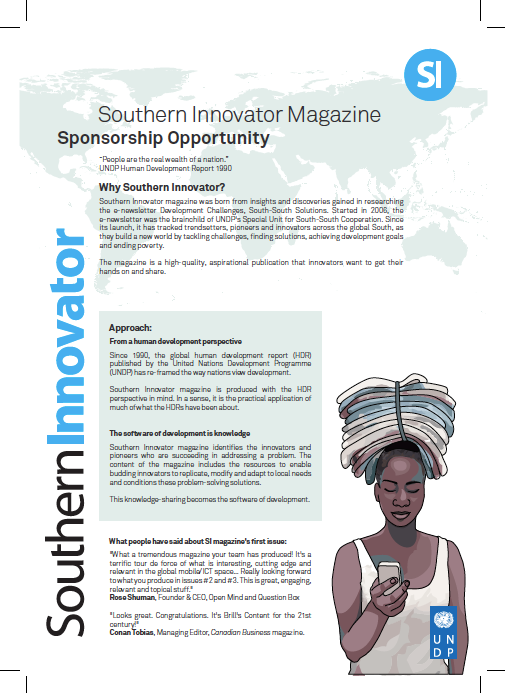
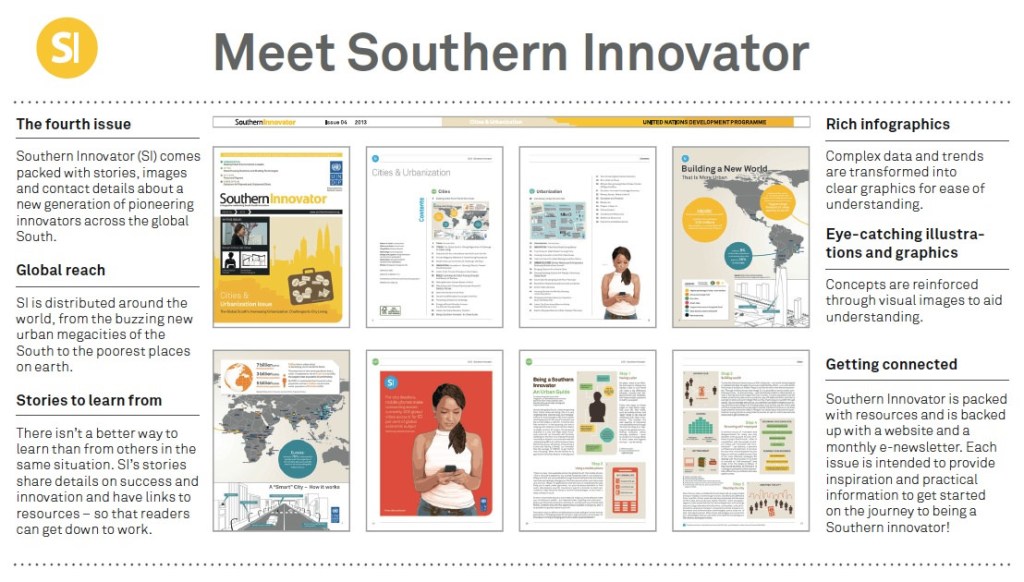
Development Challenges, South-South Solutions was launched as an e-newsletter in 2006 by UNDP’s South-South Cooperation Unit (now the United Nations Office for South-South Cooperation) based in New York, USA. It led on profiling the rise of the global South as an economic powerhouse and was one of the first regular publications to champion the global South’s innovators, entrepreneurs, and pioneers. It tracked the key trends that are now so profoundly reshaping how development is seen and done. This includes the rapid take-up of mobile phones and information technology in the global South (as profiled in the first issue of magazine Southern Innovator), the move to becoming a majority urban world, a growing global innovator culture, and the plethora of solutions being developed in the global South to tackle its problems and improve living conditions and boost human development. The success of the e-newsletter led to the launch of the magazine Southern Innovator. 

Creative Commons License

This work is licensed under a
Creative Commons Attribution-Noncommercial-No Derivative Works 3.0 License.

ORCID iD: https://orcid.org/0000-0001-5311-1052.

© David South Consulting 2023

Categories
Archive Development Challenges, South-South Solutions Newsletters

African Infrastructure Dreams Back on Agenda

By David SouthDevelopment Challenges, South-South Solutions

SOUTH-SOUTH CASE STUDY

Africa’s patchy infrastructure is not keeping pace with the continent’s economic growth.

Satellite photos of Africa at night show a place where light is concentrated overwhelmingly in the South – primarily South Africa – and in the North, with a sprinkling of lights on the west and east coasts (http://geology.com/articles/satellite-photo-earth-at-night.shtml).

This is just one visually arresting way to view the much larger problem of the continent lacking 21st-century infrastructure – from roads to airports to sewage and water services to harbors and rail connections. All are in desperate need of an upgrade.

The World Bank says only one in four people has access to electricity in sub-Saharan Africa. According to the International Energy Agency (IEA), the region will require more than US $300 billion in investment to achieve universal electricity access by 2030.

This lack of modern infrastructure is clashing with Africa’s impressive economic growth in recent years. The continent will be home to seven of the 10 fastest growing economies in the world by 2015, according to the IMF. Yet still too much of this is a reflection of a booming resource economy, which sounds impressive in numbers, but still leaves much of the continent’s population living in a day-to-day world of underdevelopment and poverty.

Africa desperately needs further investment in infrastructure. The good news is that a mix of positive developments is coming together to breathe life into efforts to upgrade the continent.

One is a new campaign to mobilize Africa’s wealthiest to stump up the necessary funds to conduct feasibility studies to lay the groundwork for a big boost to infrastructure spending in the coming years. Another is a flurry of new pledges from the United States to spend more in Africa to increase access to energy – a necessary precondition to improvements to living standards. China, too, is to continue to grow its already substantial investments in Africa.

For innovators, better infrastructure across Africa will make it easier to export products, connect with markets and customers and gain access to new technologies and products available to others around the world.

The Made in Africa Foundation (madeinafricafoundation.co.uk) hopes to turn to Africa’s wealthy global community to help with funding the feasibility studies required to unleash a new wave of infrastructure spending and building across the continent.

Africa takes up 30 million square kilometers (UNEP), is home to approximately 15 per cent of the world’s population and has 60 per cent of the world’s potential agricultural land. Yet, just 34 per cent of Africa can be reached by road and only 30 per cent has access to electricity. One estimate has placed the cost of meeting Africa’s power and transport needs at US $28 trillion by 2050.

That is a vast amount of money, and nobody will commit those sums unless they know that work has gone into planning for this infrastructure and that people are thinking long-term. This is where the Made in Africa Foundation wants to make a difference: it is hoping to get Africa’s wealthy to contribute US $400 million to fund feasibility studies which in turn will kick-off a US $68 billion first phase in investment into roads, railways, ports and energy.

“In 2009, there was (US) $150bn (billion) available to spend, but no bankable infrastructure projects in Africa,” that these funds could be directed towards, said the Foundation’s George Brennan. “These figures should make us angry – the problem is not the availability of funding but the fact that projects are not in a condition to be funded.”

Just as a global diaspora of Indians and Chinese have been instrumental in economic growth and development in India and China in the past two decades, so it is hoped the same formula can be applied to the equally substantial, successful and wealthy African diaspora.

“African Americans spend (US) $1 trillion every year in their economy, but what do they spend on Africa? About 0.01 percent,” said Chris Cleverly, Director of the Made in Africa Foundation. “They have the wherewithal to make profound differences – personally, and by lobbying their pension funds, investment advisers and government to invest in Africa on the basis that it provides good returns.

“It was China and India’s diasporas that developed them – it is the same with Africa’s now.”

Ozwald Boateng (http://ozwaldboateng.co.uk), the dynamic Ghanaian-descended London tailor who built his reputation on a quirky and modern take on traditional British bespoke suits, took the lead along with the Ugandan Prince Hassan Kimbugwe (http://www.cdrex.com/prince-hassan-kimbugwe/1251509.html) and former British barrister Chris Cleverly.

Boateng’s reputation and fame rose along side the buzzing British capital throughout the 2000s. But now he is reaching back to Africa to lead a campaign to substantially raise the level of investment in the continent’s creaking, antiquated or non-existent infrastructure.

He is trying to rally Africa’s wealthiest business leaders to contribute to creating a 21st-century African infrastructure of roads, railways, ports and power supplies. Made in Africa is tackling the fact many big global investors are willing to invest in Africa but find it difficult to do so. Much has to be done before an investor can come along and start, for example, building a new road network or airport. Local governments need to do the initial site survey and environmental impact studies and develop a larger vision for where they would like their country to go and how its cities are to develop.

The campaign got underway with a star-studded gala event earlier this year in Marrakech, Morocco, at the African Banker Awards (http://www.ic-events.net/awards/african_banker_awards_2013/). It also comes with a film, Our Future, Made in Africa, to help explain the campaign and the company.

Some of the people who attended included Nigerian philanthropist Tony Elumelu, Angola’s richest woman Isabel dos Santos and Sudanese telecoms mogul Mo Ibrahim.

“This is the start of fully understanding what Africa can do for itself,” said Boateng. “The Chinese managed to build a railway across China; the Japanese have the bullet train – we need to get past thinking about why it’s difficult to create the roads and railways that Africa needs and just get on with it.”

The Foundation is being supported by the African Development Bank (http://www.afdb.org/en/), a long-time supporter of African infrastructure investment through loans and technical assistance.

An additional boost to African development comes from a recent U.S. government pledge to spend US $7 billion over the next five years in Africa to improve access to energy. Energy is the needed fuel for any significant improvements to human development over the long-term.

U.S. President Barack Obama announced “Power Africa” (http://www.whitehouse.gov/the-press-office/2013/06/30/fact-sheet-power-africa) while he was in Cape Town, South Africa on his recent African tour. At the heart of Power Africa is the pledge to double access to power in Africa. According to medical journal The Lancet, 3.5 million Africans die every year due to indoor air pollution – a figure larger than those who die every year from malaria and HIV/AIDS combined. The pollution results from the fumes caused by burning fuel for cooking, warmth and light.

President Obama promised the funding to help governments in Ethiopia, Ghana, Kenya, Liberia, Nigeria and Tanzania. The funds will be used to boost access to electricity for 20 million households. Funds will also be used to help Angola and Mozambique modernize their energy export sectors.

Power Africa will act as a go-between to encourage links and deals between American energy companies and African partners.

On top of this, Power Africa is being supplemented by an additional US $10 billion in private sector contributions, including a commitment from the General Electric Company to bring 5,000 megawatts of affordable energy to Tanzania and Ghana.

In total, the US estimates it will take US $300 billion in additional funds to bring full power to sub-Saharan Africa.

For the past decade, the biggest change in Africa’s infrastructure story has come from the growing role played by China. China has become Africa’s largest single trading partner, with bilateral trade reaching US $166 billion in 2011 – a jump of 33 per cent from 2010. The total volume was valued at $198.5 billion in 2012 and is expected to surpass $380 billion by 2015.

And much, much more has been promised to come: China’s President Xi Jinping (http://en.wikipedia.org/wiki/Xi_Jinping) renewed a pledge to offer US $20 billion in loans to Africa in March 2013 (Reuters). Much of this is going to electricity-generation projects.

Published: July 2013

Resources

1) China in Africa: The Real Story is a blog tracking the relationship and digging up the real numbers on what is happening. Website: http://www.chinaafricarealstory.com/

2) The China-Africa Development Fund (CADFund) will invest US $2.4 billion in African projects, according to its President Chi Jianxin. Website: http://www.cadfund.com/en/

3) Map of Africa’s major infrastructure: The image shows how infrastructure in Africa is growing rapidly, but is still largely concentrated in coastal regions and those with large mineral deposits. This means that rural and isolated populations often do not have access to modern energy and the benefits that it can bring. Website: http://www.one.org/us/2011/05/10/map-of-africas-major-infrastructure/

4) Dead Aid by Dambisa Moyo. In the past 50 years, more than US $1 trillion in development-related aid has been transferred from rich countries to Africa. Website: http://www.dambisamoyo.com/books-and-publications/book/dead-aid

Find more in Southern Innovator Issue 4: Cities and Urbanization

https://g.co/kgs/y2K5Hy

Development Challenges, South-South Solutions was launched as an e-newsletter in 2006 by UNDP’s South-South Cooperation Unit (now the United Nations Office for South-South Cooperation) based in New York, USA. It led on profiling the rise of the global South as an economic powerhouse and was one of the first regular publications to champion the global South’s innovators, entrepreneurs, and pioneers. It tracked the key trends that are now so profoundly reshaping how development is seen and done. This includes the rapid take-up of mobile phones and information technology in the global South (as profiled in the first issue of magazine Southern Innovator), the move to becoming a majority urban world, a growing global innovator culture, and the plethora of solutions being developed in the global South to tackle its problems and improve living conditions and boost human development. The success of the e-newsletter led to the launch of the magazine Southern Innovator.  

Creative Commons License

This work is licensed under a
Creative Commons Attribution-Noncommercial-No Derivative Works 3.0 License.

ORCID iD: https://orcid.org/0000-0001-5311-1052.

© David South Consulting 2023