The damaging affects of crime and violence can ruin a city. They act as a drag on efforts to increase wealth and improve living conditions, and a city that gets a bad reputation, especially in the age of the Internet, will lose investment opportunities.
The North American nation of Mexico has been struggling against drug and gang-related violence that has left an estimated 47,000 people dead over the past five years. It is a casualty rate worthy of a war.
In Monterrey, the capital of Nuevo Leon state (http://en.wikipedia.org/wiki/Nuevo_Le%C3%B3n), an innovative initiative has brought together local businesses to tackle the root causes of violence and crime. The initiative – called Red SumaRSE, which means ‘joining a network’ – was born from anger and disgust at the situation in the city. And it was ignited by a prominent member of the business community expressing this frustration on the social media outlet Twitter (twitter.com).
The chief executive of the Cemex cement company had had enough one day. Lorenzo Zambrano tweeted a blunt message to other companies in the city: “He who leaves Monterrey is a coward.” It was to be a rallying cry for the campaign to take back the city from the violent gangs.
Monterrey is embroiled in violent drug-related gang crime. Just one incident shows how bad the situation had become. In August 2011 members of the Zetas drug gang torched a casino over a dispute over non-payment of extortion money, killing 52 people.
Law enforcement measures can often only go so far to curb violence in a community. Little impact can be made without addressing the underlying economic causes of much of the violence – poor employment opportunities, drug turf wars between rival gangs, economic instability and more.
“Violence is an expression of social inequality,” Zambrano told The New York Times.
Tragedies like the casino fire provoked the city’s business community to take action. Private companies in the city have stepped up to design and fund a recruitment campaign for the police force and are paying part of the cost for government-backed community redevelopment plans.
Corporate philanthropy in Mexico has a history of being very limited. Apart from distribution of gifts at holiday time,there was little else. But this is changing, with Red SumaRSE showing the way.
“In the last five or 10 years there has been progress both in terms of the quantity of the money and the quality,” Michael Layton, director of the Philanthropy and Civil Society Project at the Autonomous Technological Institute of Mexico, told The New York Times. “But I don’t think Mexico has caught up to Brazil and other countries where the business sector has taken corporate philanthropy to heart.”
The Red SumaRSE alliance of Monterrey’s companies is directing support to non-governmental organizations working on community development. Examples include telephone company Axtel and the tortilla maker Gruma (gruma.com/vEsp) taking charge of 20 other companies to invest in schools, building up infrastructure and reversing drop-out rates.
The Oxxo company (oxxo.com/index.php), Mexico and Latin America’s largest chain store, has started to work at improving conditions in the neighbourhood immediately behind its headquarters. The company is working on building parks, increasing job opportunities and finding ways to prevent teenagers from joining gangs in the first place.
Cemex has also opened a new community centre in a violent neighbourhood where shootings were a regular occurrence. It was based on some Latin American knowledge sharing: inspired by the case of the Colombian city of Medellin, where libraries were strategically located in violent slum areas.
And there is more good work in the pipeline. The business community has drawn up a list of 70 neighbourhoods in the city needing re-development.
Red SumaRSE has not been without its critics. They have attacked the focus on security, education and victims while ignoring corruption, which many believe is the source of many of the city’s problems.
Published: February 2012
Resources
1) Medellin: Walking between slums and dreamworlds of neoliberalism: More on the complexities of the situation in this Colombian city.Website: http://www.a0n.com/medellin/dreamworlds.htm
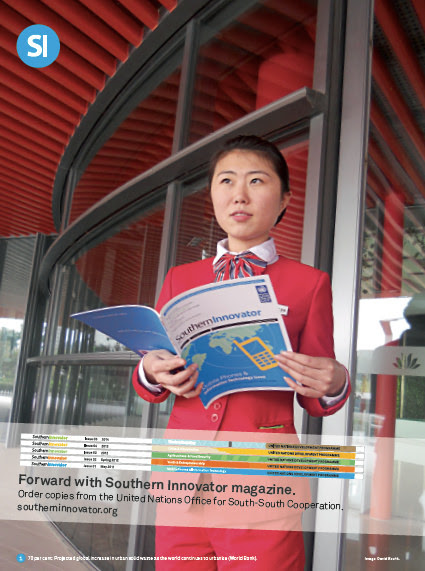
Development Challenges, South-South Solutions was launched as an e-newsletter in 2006 by UNDP’s South-South Cooperation Unit (now the United Nations Office for South-South Cooperation) based in New York, USA. It led on profiling the rise of the global South as an economic powerhouse and was one of the first regular publications to champion the global South’s innovators, entrepreneurs, and pioneers. It tracked the key trends that are now so profoundly reshaping how development is seen and done. This includes the rapid take-up of mobile phones and information technology in the global South (as profiled in the first issue of magazine Southern Innovator), the move to becoming a majority urban world, a growing global innovator culture, and the plethora of solutions being developed in the global South to tackle its problems and improve living conditions and boost human development. The success of the e-newsletter led to the launch of the magazine Southern Innovator.
A surge in interest in African music in Britain is creating new economic opportunities for the continent’s musicians. The new sound heating up the U.K. music scene is “Afro Beats” – a high energy hybrid that mixes Western rap influences with Ghanaian and Nigerian popular music.
Afro Beats draws its inspiration from the “Afrobeat” sound popularized in the 1970s (http://en.wikipedia.org/wiki/Afrobeat).Afrobeat recordings from that time are still making money as long-forgotten tunes are re-packaged by so-called ‘crate divers’ – enterprising people who rummage through old vinyl record collections and re-brand scenes and sounds.
This is part of the global creative economy, which is thriving despite the recent years of economic turmoil. Musicians offer many lessons for businesses in the South, both in their adaptability to new conditions and their resourcefulness in experimenting with new business models to earn an income.
Afrobeat stars and pioneers like Nigeria’s Fela Kuti (http://en.wikipedia.org/wiki/Fela_Kuti) have been popular outside Africa for many decades. But Afro Beats – a new name with the addition of the crucial letter “s” – is being declared as the beginning of a new phase in taking African music global.
As the digital music revolution has rocked the global music business, artists have had to adapt and change their business models. For all but a very few “big names,” it is no longer possible to build a career on royalties from recordings and hits. Stars and novices alike must battle with music pirates, who sell CDs and downloads of other people’s tunes and keep the money for themselves. Legitimate income often comes in micropayments from large music platforms like iTunes as people pay to download an individual song or mix and match tunes they like from an artist’s catalogue, rather than buying a whole album as they would in the past.
Clever musicians have turned to building their brand, using live performances and the ability to sell other services and merchandise to make a living. They create their own web platforms, or mobile phone apps (applications), and do the marketing and distribution on their own to build a loyal fan base. Others are creating their own mobile radio stations by distributing CDs to the ubiquitous taxi mini buses that are the main means of transport in most African cities.
But some things remain the same as in the past, such as the importance of having a champion, such as a radio DJ (disc jockey), who acts as a “taste maker,” discovering new acts and telling their audience about them.
“I’ve been playing this music to three or four thousand people at African events in the U.K. for years,” DJ Abrantee told The Guardian. “For years we’ve had amazing hiplife, highlife, Nigerbeats, juju music, and I thought: you know what, let’s put it all back together as one thing again, and call it Afro Beats, as an umbrella term. Afrobeat, the 60s music, was more instrumental – this Afro Beats sound is different, it’s inter-twined with things like hip-hop and funky house, and there’s more of a young feel to it.”
Abrantee (abrantee.com) promotes Afro Beats in the United Kingdom in myriad ways: he broadcasts six days a week on a radio station, including an Afro Beats-themed show on Saturdays. He travels around to DJ and takes Ghanaian and Nigerian tunes with him. He says Africa is so musically vibrant, he can’t keep up with it all.
“This is specifically the western African sound: there are a lot of shared ideas between these two neighbouring countries,” he explained to The Guardian. “I see Afro Beats as music which makes the heart beat. And it’s funky, and hyped, and energetic and young.”
Afro Beats has also been able to reach a young audience. “It’s striking how young they are – when I do these Afro Beats events there’s thousands of people, and they’re all youngsters, really.”
One of the Afro Beats stars is D’Banj (mohitsrecords.com/d-banj) – a Nigerian rap star – who has been receiving attention for his song Oliver Twist.
The Afro Beats sound is also provoking a new interest in all things African amongst youth with African parents. This is a big change from when American “cool” set the trends. As DJ Abrantee notes, “the parents are really pleased, and proud, that their kids are all of a sudden embracing their culture. It didn’t used to be cool, but now they’re going through their parents’ record collections going, ‘Have you got this old song by Daddy Lumba?’.”
Some of the Afro Beats leaders include Sarkodie’s ‘U Go Kill Me’, Ice Prince’s ‘Oleku’, Atumpan’s ‘The Thing’, Castro ftAsamoah Gyan’s ‘African Girls’.
Afro Beat’s popularity in Britain has led to African artists collaborating with musicians in the UK. Afro Beats musician Sarkodie has collaborated with London-based artists Donaeo and Sway. DJ Abrantee sees this trend continuing and expanding. “You’re going to see more U.K. artists doing Afro Beats collaborations now,” he said.
Other Nigerian artists who have benefited from the increasing awareness are Wiz Kid, 2Face Idibia and P-Square (mypsquare.com).
Abrantee believes Ghana and Nigeria are having a big impact on the global music scene.
“The floodgates have opened. Music is always evolving, and everyone’s always looking for the next drug. Funky house has died out, grime is still there but it’s gone back underground, electro-pop’s got U.K. urban music in the charts, but that’ll die out, it’s got a short shelf-life. … and people are finally noticing I’m getting 3,000 people coming out to dance to Afro Beats.”
British-Ghanaian hip-hop performer Sway sees connections between Afrobeat and Afro Beats.
“Fela Kuti is obviously a massive legend in the game, and what he was doing is not too different to what D’Banj is doing now – taking western influences and adding them to African culture, and coming up with something new, that appeals to everyone,” he said.
And technology is seen as the binding element that is connecting African music and musicians to other scenes.
“African music in Africa is evolving in relation to what’s going on abroad too,” said Sway. “Via the Internet they’re picking up certain trends much quicker: so for example you have Auto-Tune and western styles of singing cropping up on all these Afro Beats tracks.”
And Sway believes the quality of production of African music has improved: “There’s been a serious change in the music coming out of Africa lately.
“The sound is heavier and clearer, the videos are better, there’s been a positive growth in the African music scene. It was just a matter of time before people paid attention.
“When you’ve got African swag and African traditions combined with up-to-date western styles, and singing in English, well – you’ve got a winning formula on your hands.”
Development Challenges, South-South Solutions was launched as an e-newsletter in 2006 by UNDP’s South-South Cooperation Unit (now the United Nations Office for South-South Cooperation) based in New York, USA. It led on profiling the rise of the global South as an economic powerhouse and was one of the first regular publications to champion the global South’s innovators, entrepreneurs, and pioneers. It tracked the key trends that are now so profoundly reshaping how development is seen and done. This includes the rapid take-up of mobile phones and information technology in the global South (as profiled in the first issue of magazine Southern Innovator), the move to becoming a majority urban world, a growing global innovator culture, and the plethora of solutions being developed in the global South to tackle its problems and improve living conditions and boost human development. The success of the e-newsletter led to the launch of the magazine Southern Innovator.
Harnessing the power of design to improve products and the way they are manufactured is a critical component of successful economic development. And the high export value of designing and making “computer equipment, office equipment, telecommunication equipment, electric circuit equipment, and valves and transistors” was flagged up as a priority for developing nations back in 2005 at a meeting looking for “New and Dynamic Sectors of World Trade” (UNCTAD).
One country taking up this challenge is China. It now boasts twice as many Internet users as the United States, and is the main global maker of computers and consumer electronics, from toys to games consoles to digital everything.
China is also on course to become the world’s largest market for Internet commerce and computing.
The centre of gravity is very much moving China’s way: One study of 769 firms investing in 2,203 Chinese companies by Stanford University in California, found “the same firms that were successful in Silicon Valley … have transplanted their expertise to China,” according to Marguerite Gong Hancock in The New York Times.
But the country wants to move from ‘Made in China’ to ‘Designed in China’. This is critical because the majority of the profits to be made are actually in the designing, patenting and marketing of products. Manufacturing, as has been shown in the recent media controversy over the products made by Apple (apple.com), is not the main profit centre.
Apple employs 43,000 people in the United States and 20,000 overseas. But through its network of sub-contractors, the number employed overseas in Asia, Europe and elsewhere is around 700,000 (The New York Times). This includes around 200,000 assembly jobs in China. These workers can make US $17 a day or less.
Apple makes hundreds of dollars in profit for each of its iPhones. Apple can do this because it is the designer of the phones and holds the copyright, and it is the branded company that has built up its reputation and developed a highly sophisticated marketing and distribution network around the world. Through clever use of design, Apple created products that look distinctive in the marketplace. And those are the factors that determine the ability to make this profit. As has been noted, it isn’t just cheap wages that keep Apple’s profits high.
Getting consumers to desire and buy your products is a challenge for any company. Design plays a major part in understanding the unique demands of countries and markets, and what people find appealing or repellent.
A product that has both a successful design and is produced efficiently will generate a good profit.
The classic example from the past is Japan. Devastated during World War II, Japan set about re-building its manufacturing prowess from scratch. It brought in American innovators to introduce new concepts in manufacturing.
Japan’s openness to the new ways enabled it to re-fashion its manufacturing industries to exporting to the developed Western nations, in particular the United States. At first, quality control was an issue and Japan was mocked for making cheap quality trinkets, toys, automobiles and motorcycles. But it quickly changed from this to a reputation for making quality, affordable products and moving quickly into the burgeoning micro-electronics and consumer products markets. It also was a pioneer in computer gaming and entertainment.
The recent achievements in supercomputing in China are pointing to where things can go. China has developed the Sunway Bluelight MPP supercomputer (http://en.wikipedia.org/wiki/ShenWei). It is able to do a quadrillion calculations per second: making the Sunway Bluelight one of the 20 fastest supercomputers in the world. It was built with a Chinese-made microprocessor, and importantly, uses lower amounts of power than other supercomputers.
The clever bit is the ratio of computing power to wattage used. Energy-efficient computing is critical if computers are to make the jump to the next level in processing power.
All these trends coming together hint at big changes in the coming years.
In the past two decades, the electronics sector has enabled a number of developing countries to improve trade performance, in particular East and Southeast Asian nations.
Improving education is critical to the growth strategy. Improving education, like encouraging the pursuit of engineering as a profession, as China has done – it now has more than half a million estimated graduates, the most in the world – means new skills and ideas are coming to the industry (engineeringinchina.net).
But this is not enough. New ideas are essentially a creative process and this needs connections to business and the ability to experiment and play with ideas. Start-up incubators have proven a successful way to do this.
Thailand is a good example: Around US $4.5 billion was invested in the country’s electronics industry between 1986 and 2001. This created 300,000 jobs. The sector became so important it made up a third of the country’s exports.
Realizing that much of the work was assembly manufacturing, the government set up the Thailand IC Design Incubator (http://www.nectec.or.th/rd/electronics/be204-45/be204-45.php) to work on hard disk drive development and move up the value chain.
“In 1978, I saw workers stringing together computer memories with sewing needles,” Patrick J. McGovern explained to The New York Times. McGovern is the founder of the International Data Group, which invests in Chinese enterprises.
“Now innovation is accelerating, and in the future, patents on smartphones and tablets will be originated by the Chinese people.”
In the past, China was not able to make significant progress on this development for two main reasons. The first is copyright piracy and theft of intellectual property rights. During China’s economic rise, this theft was rampant and the country developed a reputation for being home to a vast marketplace of knock-offs of major Western brands. And the second reason was the heavy hand of the government, which scared off many entrepreneurs.
But China is re-structuring its industries to focus on innovation. In 2011, China surpassed South Korea and Europe in total patents and was in a neck and neck race with Japan and the United States. As fuel for the innovation rocket,venture capital is critical. And China is now the world’s second largest venture capital market, with the total jumping from US $2.2 billion in 2005 to US $7.6 billion in 2011.
It is this journey up the manufacturing ‘value chain’ that many countries look to with admiration and jealousy. And the secret to being able to move up this value chain is design – savvy product design combined with savvy design of manufacturing methods to continually drive down costs and drive up quality. How long until China has its own Apple and not just an Apple knock-off (http://www.bbc.co.uk/news/technology-14503724)?
Published: February 2012
Resources
1) Red Dot: The red dot logo stands for belonging to the best in design and business. The red dot is an internationally recognised quality label for excellent design that is aimed at all those who would like to improve their business activities with the help of design.Website: http://www.red-dot.de
2) Dutch Design in Development: DDiD is the agency for eco design, sustainable production and fair trade. They work with Dutch importers and designers and connect them to local producers in developing countries and emerging markets. Together products are made that are both profitable and socially and environmentally sustainable. Website: http://www.ddid.nl/english/index.html
3) C3: C3 offers product design and product engineering services in Shanghai, China. Their strong point is managing innovative design processes from scratch (market research) until production: a one shop service: Website: chinacreativecompany.com
4) Dahua: Zhejiang Dahua Technology Co., Ltd. is a partially state-owned publicly traded company based in Hangzhou which sells video surveillance products and services. Leading video surveillance product and solution provider in IP camera, NVR, HD cctv camera, Analog, PTZ and other vertical solutions. Website: https://www.dahuasecurity.com/uk
Development Challenges, South-South Solutions was launched as an e-newsletter in 2006 by UNDP’s South-South Cooperation Unit (now the United Nations Office for South-South Cooperation) based in New York, USA. It led on profiling the rise of the global South as an economic powerhouse and was one of the first regular publications to champion the global South’s innovators, entrepreneurs, and pioneers. It tracked the key trends that are now so profoundly reshaping how development is seen and done. This includes the rapid take-up of mobile phones and information technology in the global South (as profiled in the first issue of magazine Southern Innovator), the move to becoming a majority urban world, a growing global innovator culture, and the plethora of solutions being developed in the global South to tackle its problems and improve living conditions and boost human development. The success of the e-newsletter led to the launch of the magazine Southern Innovator.






 David South Consulting
You must be logged in to post a comment.