Tag: Published: December 2010

  • Ghanaian Coffins Prove Design and Craftsmanship Boost Incomes

    Ghanaian Coffins Prove Design and Craftsmanship Boost Incomes

    By David SouthDevelopment Challenges, South-South Solutions

    SOUTH-SOUTH CASE STUDY

    In many parts of the world, indigenous ingenuity and craft skills are finally getting the recognition they deserve. The quirky but very inventive gadgets and solutions featured on the Afrigadget blog (http://www.afrigadget.com) never fail to inspire and amaze. The Democratic Republic of the Congo’s (DRC) fashionable gentlemen (http://www.henryherbert.com/gentlemen-of-bacongo/) grabbed the attention of – and inspired – European fashion designers with their creativity and flair. And then there are the Africa Maker Faires, gatherings of clever and innovative thinkers and inventors who get down to work generating solutions to today’s problems.

    Beyond the grim stories of development failures and human tragedies, there is another Africa full of creativity and can-do attitude.

    Amongst the Ga people (http://en.wikipedia.org/wiki/Ga_people) of Teshi, Ghana there is a tradition with a twist: custom-designed coffins. A Ghanaian pioneer has been transforming the way people deal with that most sombre and respectful of rituals, the funeral. Coffin-artist Paa Joe is drawing on a modern-day tradition in Ghana dating back to the 1950s. Coffins – which are normally made from wood and follow the standard template of a narrow, body-length box – are transformed into grand and lively statements about the deceased person’s life.

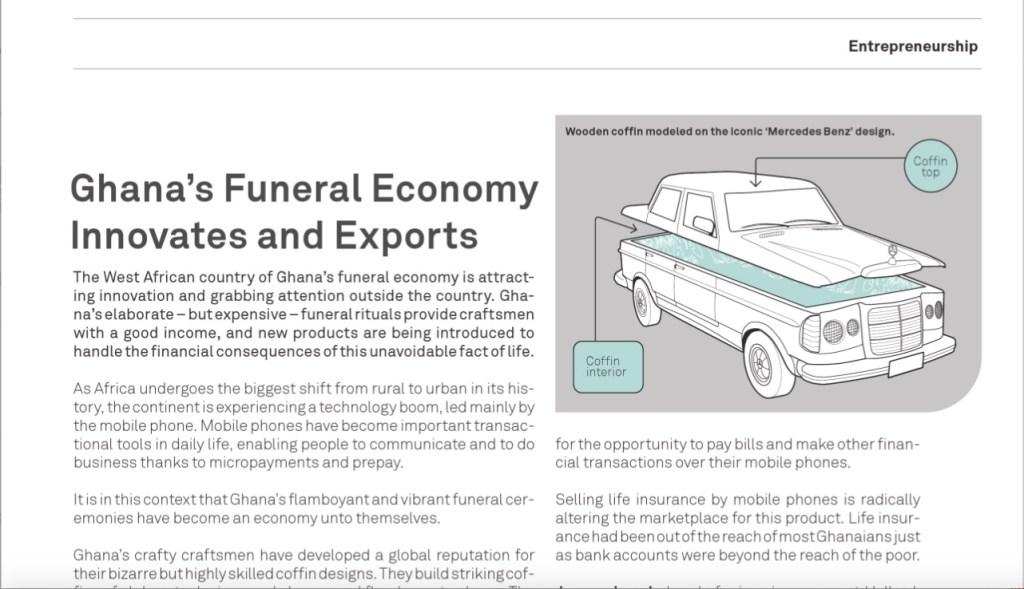
    Designs have included a giant pink fish, a Ghana Airways plane, a souped-up Mercedes Benz and an African eagle.

    “The Ga people (http://www.ghanaweb.com/GhanaHomePage/tribes/ga.php), from the south-east coast of Ghana, revere their ancestors and give great importance to funeral celebrations,” Jack Bell, a London gallery owner exhibiting the coffins, told The Observer newspaper. “Their tradition of creating beautifully carved figurative coffins originated in the 1950s.”

    Paa Joe was born in the Akwapim hills north-east of Accra in 1945. He is considered the top sculpted coffin maker of his generation. He apprenticed with the pioneer of the craft, Kane Kwei (http://www.culturebase.net/artist.php?153) – the man who began this unique vocation in the 1950s. The skill and artistry involved is now recognized in museums around the world, including London’s British Museum.

    The community had a history of highly skilled woodwork and elaborate carvings were regularly created for village chiefs – giant eagles or even the surreal spectacle of a giant cocoa pod.

    The bespoke coffins are an example of how long-standing skills were applied to a new product. The idea of making custom-sculpted coffins begun by Kane Kwei evolved from being a livelihood for Kwei to an apprenticed craft passed down to younger craftsmen. When Kane Kwei’s grandmother died in 1951, without fulfilling her lifelong wish to fly on a plane, Kane made a plane-shaped coffin for her. This coffin was admired by others and Kane got the idea of setting up a workshop and making custom-designed coffins symbolizing the
    deceased’s status and achievements in life.

    “Families commission the coffins – sometimes to a brief designed by the deceased – to represent the aspirations or achievements of a deceased relative, or to characterize their personality: a car for a businessman, a cocoa pod for a farmer, a bible, or even a camera,” Bell said.

    For people with modest means, there are simpler designs of boats, canoes and books. Prices are negotiated with the coffin maker.

    Where there were none, now there are multiple workshops providing custom coffins for funerals. Traditional Ghanaian funerals are lively, colourful events, but the coffin sculptures of Teshi are a modern phenomenon and proof that innovation and good design can transform the most sombre of items into something special.

    Published: December 2010

    Resources

    • Maker Faire Africa: Flickr photo gallery: A clickable archive of the Maker Faire inventors and their inventions. Website:http://www.flickr.com/groups/makerfaireafrica/pool/
    • Afrigadget: Afrigadget: ‘Solving everyday problems with African ingenuity’: This blog never ceases to amaze and fascinate. Website: http://www.afrigadget.com/
    • E-machine Shop: eMachineShop: This remarkable service allows budding inventors to download free design software, design their invention, and then have it made in any quantity they wish and shipped to them: Amazing! Website: http://www.emachineshop.com/ 4) Maker Faire Africa 2010: Catch up on the last Maker Faire Africa. Website: (http://makerfaireafrica.com)
    • Afrigadget: ‘Solving everyday problems with African ingenuity’: This blog never ceases to amaze and fascinate. Website: http://www.afrigadget.com/
    • International Development Design Summit: The Summit is an intense, hands-on design experience that brings together people from all over the world and all walks of life to create technologies and enterprises that improve the lives of people living in poverty. Website:http://iddsummit.org/

    https://davidsouthconsulting.org/2022/10/20/bangladesh-coffin-maker-offers-an-ethical-ending/

    https://davidsouthconsulting.org/2022/10/20/ghanas-funeral-economy-innovates-and-exports/

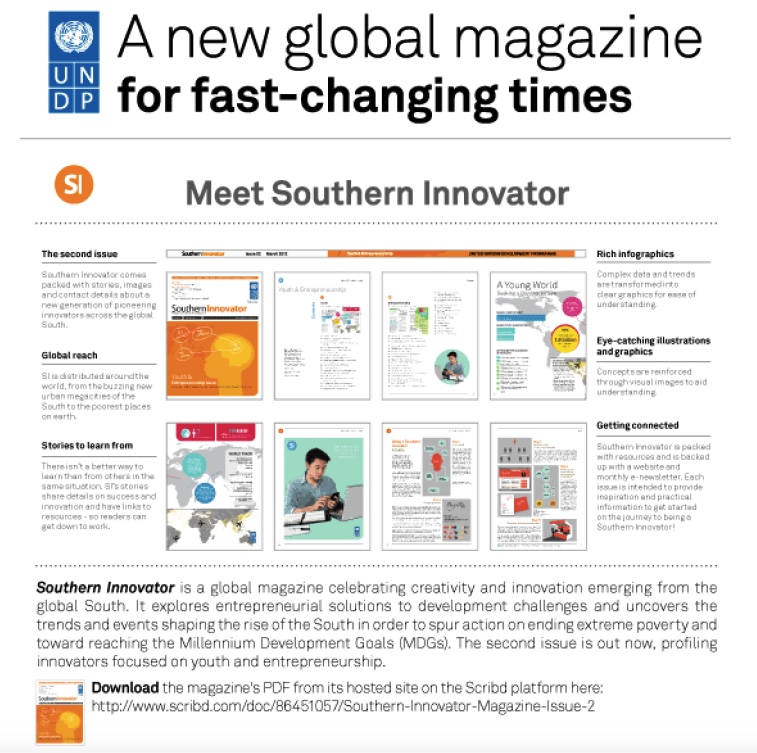
    Development Challenges, South-South Solutions was launched as an e-newsletter in 2006 by UNDP’s South-South Cooperation Unit (now the United Nations Office for South-South Cooperation) based in New York, USA. It led on profiling the rise of the global South as an economic powerhouse and was one of the first regular publications to champion the global South’s innovators, entrepreneurs, and pioneers. It tracked the key trends that are now so profoundly reshaping how development is seen and done. This includes the rapid take-up of mobile phones and information technology in the global South (as profiled in the first issue of magazine Southern Innovator), the move to becoming a majority urban world, a growing global innovator culture, and the plethora of solutions being developed in the global South to tackle its problems and improve living conditions and boost human development. The success of the e-newsletter led to the launch of the magazine Southern Innovator. 
    https://davidsouthconsulting.org/2021/03/05/southern-innovator-issue-2/

    Creative Commons License

    This work is licensed under a
    Creative Commons Attribution-Noncommercial-No Derivative Works 3.0 License.

    ORCID iD: https://orcid.org/0000-0001-5311-1052.

    © David South Consulting 2023
  • Food Diplomacy Next Front for South’s Nations

    Food Diplomacy Next Front for South’s Nations

    By David SouthDevelopment Challenges, South-South Solutions

    SOUTH-SOUTH CASE STUDY

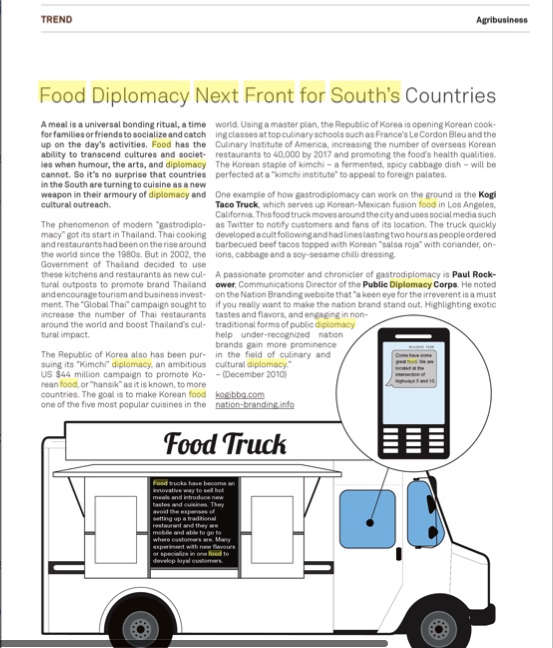
    The meal is a universal bonding ritual, a time for families or friends to socialize and catch up on the day’s activities. Food has the ability to transcend cultures and societies when humour, the arts, and diplomacy cannot. A person may know nothing about a particular country or culture, but they know what their appetite and palate likes. So it’s no surprise that countries in the South are turning to cuisine as a new weapon in their armoury of diplomacy and cultural outreach.

    The phenomenon of ‘gastrodiplomacy’ got its start in Thailand. Thai cooking and restaurants had been on the rise around the world since the 1980s. But in 2002 the Thai government decided to use these kitchens and restaurants as new cultural outposts to promote brand Thailand and encourage tourism and business investment. The “Global Thai” campaign sought to increase the number of Thai restaurants around the world and boost Thailand’s cultural impact.

    As The Economist reported at the time, more restaurants “will not only introduce delicious spicy Thai food to thousands of new tummies and persuade more people to visit Thailand, but it could subtly help deepen relations with other countries.”

    Thailand’s 2002 campaign boosted the number of Thai restaurants around the world and made popular dishes like pad Thai and tom yum soup (http://www.bbc.co.uk/food/recipes/tomyumsoup_85069) familiar to many more people. They are now signature dishes, as synonymous with Thailand as hamburgers are with the United States.

    Malaysia, whose varied and delicious cuisine is less known globally than that if its neighbour Thailand, has been running an aggressive campaign in Britain to promote its food. This included setting up a street market in the famous Trafalgar Square in central London: a high foot-traffic spot guaranteed to get the city’s attention.

    South Korea also has been pursuing its “Kimchi” diplomacy, an ambitious US $44 million campaign to promote Korean food, or hansik (http://www.visitkorea.or.kr/enu/CU/CU_EN_8_1_5.jsp) as it is known, to more nations. They aim to make Korean food one of the top five most popular cuisines in the world. Using a master plan, South Korea is opening Korean cooking classes at top culinary schools like France’s Le Cordon Bleu and the Culinary Institute of America, increasing the number of overseas Korean restaurants to 40,000 by 2017, and promoting the food’s health qualities. The Korean staple of kimchi – a fermented, spicy cabbage dish – will be perfected at a “kimchi institute” to appeal to foreign palates (http://www.korea.net/detail.do?guid=45469).

    Neighbouring North Korea has also turned to gastrodiplomacy with its chain of “Pyongyang Restaurants” (http://www.pyongyangrestaurant.com) around Asia and Europe. These eateries first appeared in China, near the border with North Korea, but have expanded widely during the last decade. Pyongyang Restaurants can be found in Vientiane, Laos; Siem Reap and Phnom Penh, Cambodia; and Bangkok and Pattaya, Thailand. In Europe, a restaurant has opened in the Dutch city of Amsterdam. The restaurants’ formula offers staff in traditional clothing, authentic North Korean interiors, North Korean art, cooking lessons, cultural performances, and singing. The food includes traditional Korean dishes like kimchi (fermented spicy cabbage), Pyongyang “cold noodle” and barbecued cuttlefish (squid).

    One example of how gastrodiplomacy can work on the ground is the Kogi Taco Truck (http://kogibbq.com/), which serves up Korean-Mexican fusion food  in Los Angeles, California. This food truck moves around the city and uses social media like Twitter (www.twitter.com) to notify customers and fans of its location. The truck quickly developed a cult following and had lines lasting two hours as people ordered barbecued beef tacos topped in Korean “salsa roja” with coriander, onions, cabbage and a soy-sesame chilli dressing. The truck has been praised for bringing the appreciation of Korean food and culture to parts of the city that knew little about Korea.

    A passionate promoter and chronicler of gastrodiplomacy is Paul Rockower, Communications Director of the Public Diplomacy Corps (http://publicdiplomacycorps.org), an organization dedicated to bringing
    diplomacy to the public. He noted on the Nation Branding (www.nation-branding.info) website that “a keen eye for the irreverent is a must if you really want to make the nation brand stand out. Highlighting exotic tastes and flavors, and engaging in nontraditional forms of public diplomacy help under-recognized nation brands gain more prominence in the field of culinary and cultural diplomacy.”

    For Taiwan, which has tense relations with China, which does not recognize it as a nation, gastrodiplomacy is a way to get the island’s message across. Taiwan is spending US $31 million on its food diplomacy campaign around the world.

    “Taiwan has figured out it can do better outreach work through the kitchen table,” Rockower told The Guardian newspaper. “When someone tries a sea-salt latte (a Taiwanese drink) it creates awareness about Taiwanese culture. The Koreans embarked on Kimchi diplomacy partly because their brands weren’t being recognized as Korean – Samsung was being recognized as a Japanese brand.”

    Published: December 2010

    Resources

    • Unrepresented Nations and Peoples Organization: Is an international, nonviolent, and democratic membership organization. Its members are indigenous peoples, minorities, and unrecognized or occupied territories who have joined together to protect and promote their human and cultural rights, to preserve their environments, and to find nonviolent solutions to conflicts which affect them. Website:http://www.unpo.org/
    Creative Commons License

    This work is licensed under a
    Creative Commons Attribution-Noncommercial-No Derivative Works 3.0 License.

    Citations

    Launched in 2011, Southern Innovator’s first issue on mobile phones and information technology proved highly influential, profiling the work of a new generation of innovators. It has been cited in books, papers and strategic plans.  The third issue focused on agribusiness and food security, including the phenomenon of ‘gastrodiplomacy’. In 2017, the story Food Diplomacy Next Front for South’s Nations was cited in a paper on its potential for Uzbekistan. By 2019, Uzbekistan had launched its gastrodiplomacy strategy: Uzbekistan Embassy in Jakarta Launches its Gastrodiplomacy Project to Promote Tourism.

    Abduazimov, M. (2017) “Gastrodiplomacy: foreign experience and potential of the republic of Uzbekistan,” International Relations: Politics, Economics, Law: Vol. 2017 : Iss. 2 , Article 2. 
    Available at: https://uzjournals.edu.uz/intrel/vol2017/iss2/2.
    Gastrodiplomacy: foreign experience and potential of the republic of Uzbekistan by M. Abduazimov, International Relations: Politics, Economics, Law, 2017. 
    Anugrahningtyas, Wilda and Meganingratna, Andi (2023) “Analisis Gastrodiplomasi Melalui Samyang Challenge Terhadap Diplomasi Korea Selatan Di INDONESIA Tahun 2015-2017,” Jurnal Ilmiah Hubungan Internasional Fajar.

    This work is licensed under a Creative Commons Attribution 4.0 International License.

    ORCID iD: https://orcid.org/0000-0001-5311-1052.

    © David South Consulting 2025