Categories
Archive Development Challenges, South-South Solutions Newsletters

South Africa Innovates Healthcare with Prepay Phone Vouchers

By David SouthDevelopment Challenges, South-South Solutions

SOUTH-SOUTH CASE STUDY

Pioneers in Africa are experimenting with new ways to fund the delivery of healthcare that is affordable and sustainable and not dependent on foreign aid and donations. A South African company is prototyping the selling of pre-payment healthcare services through mobile phones with a range of vouchers that can be bought and downloaded at the tap of a keypad. They are priced at between US $12 and US $49 and cover medical and dental check-ups, tests, treatments, chronic care and medicines. They are flexible and can also be sent to friends and family who need help.

In South Africa, poverty is still widespread. The majority black population has a median income of US $2,000 a year (New Internationalist) and many still live in crowded townships and poor rural communities. Poverty has also increased for many white Afrikaner South Africans (http://en.wikipedia.org/wiki/Afrikaner). A study by the Standard Bank of South Africa found the number of whites earning less than US $80 a month grew from 2000 to 2004 by more than 50 per cent. In the government capital of Pretoria, 50 Afrikaner squatter camps have emerged in recent years. For many, affordable healthcare is a critical issue.

The story of healthcare in Africa is not a linear one of constant progress. The continent as whole achieved its lowest child mortality rates in the 1970s. But after that, the quality of healthcare declined as a result of various factors including economic crises and the HIV/AIDS crisis – both of which overwhelmed public systems. In sub-Saharan Africa, health systems reached rock bottom in the late 1990s.

“Few people could afford annual check-ups, medicines or user fees at hospitals,” wrote Dr. Ebrahim Malick Samba in the paper “African health care systems: what went wrong?” for News Medical (www.news-medical.net). “One result was the resurgence of infectious diseases such as malaria, tuberculosis and cholera.

“Prior to the 1980s, the district hospitals, community health centres and other outreach health posts provided medical services and essential drugs free of charge. With reforms, user fees and cost recovery were introduced, and the sale of drugs was liberalized.

“Many governments discontinued budget support to the health sector which paralysed the public health system. There was no money for medical equipment and maintenance; salaries and working conditions declined.”

Things have been steadily improving from this low base through the 2000s, the result of increased aid funding for public health systems and greater national investments in staff, facilities and equipment. There is still a long way to go, but Africa is becoming a world leader in developing and deploying mobile phone applications for health and healthcare.

Despite dramatic improvements to the quality of hospitals and the number of qualified doctors, the continent’s healthcare services are still a patchwork, with rural and slum dwellers poorly served and the stresses of treating patients with contagious diseases like HIV/AIDS and malaria pushing resources to the limit.

Research has shown it is better and fairer to develop pre-payment mechanisms for healthcare than to just hit patients with fees when they are ill. With pre-payment, a person can buy care services when they are financially able to and bank up care for when they become ill and not able to work and save.

This is a crucial issue for people with low incomes who can quickly be devastated by their illness or that of loved one or family member.

The World Health Organization (WHO) has taken a firm stand against so-called out-of-pocket payments and encourages the growth in pre-payment methods. The World Health Report 2000 found that “Fairness of financial risk protection requires the highest possible degree of separation between contributions and utilization.”

South Africa’s Yarona Care (www.yaronacare.co.za/prepaid.html) – a health insurance provider network – is rolling out prepaid mobile phone vouchers, allowing patients to see doctors or dentists and even traditional healers for treatment. When a patient visits, the healthcare worker redeems the mobile phone voucher to get paid. One product, Impilo Go, allows people to pay for one visit to a doctor and seven days of medicine for R230 (US $34). For people on a tighter budget, there is Impilo Care for R80 (US$12). A patient can visit a nurse practitioner for a medical check-up and receive tests.

Impilo One offers medicines alone for R100, while Impilo Plus for R195 (US $29) is aimed at people with chronic conditions. They can get a prescription from the doctor and then go to a pharmacy participating in the scheme to receive medicines.

Dental work is also covered by the vouchers.

An online demonstration shows how the mobile phone process works (www.yaronacare.co.za/cellphonedemo.html).

The service is marketed at a mix of customers, from individuals to corporate clients looking to cover large numbers of people to government and NGOs. They can purchase services by voucher, payroll schemes or mobile phones.

Prepaid by mobile phone as a concept is already well established across Africa. It is a simple way to make payments and sell services. In the case of Yarona’s offering, the customer or patient uses their mobile phone to dial a code to pay for a service. When at the doctor or dentist’s office, he or she spends the voucher for the service by giving a unique code to the healthcare professional. Once this is done, Yarona Care pays the healthcare provider for the service.

The voucher approach allows customers to buy health services for family members for a defined period of time. Vouchers can also be sent to family members for emergencies.

Published: April 2011

Resources

1) South Africa’s Afridoctor mobile phone application claims to be Africa’s first personal mobile health clinic. It lets patients use its “SnapDiagnosis” system to submit photos of their ailments and in turn receive advice from a panel of medical professionals, or use the mapping feature to find doctors, clinics and health industry-related services nearby. Website: http://twitter.com/afridoctor

2) Ghana’s mPedigree uses cell phones to build networks to tackle and identify counterfeit drugs. Website: http://mpedigree.net

Development Challenges, South-South Solutions was launched as an e-newsletter in 2006 by UNDP’s South-South Cooperation Unit (now the United Nations Office for South-South Cooperation) based in New York, USA. It led on profiling the rise of the global South as an economic powerhouse and was one of the first regular publications to champion the global South’s innovators, entrepreneurs, and pioneers. It tracked the key trends that are now so profoundly reshaping how development is seen and done. This includes the rapid take-up of mobile phones and information technology in the global South (as profiled in the first issue of magazine Southern Innovator), the move to becoming a majority urban world, a growing global innovator culture, and the plethora of solutions being developed in the global South to tackle its problems and improve living conditions and boost human development. The success of the e-newsletter led to the launch of the magazine Southern Innovator. 

Creative Commons License

This work is licensed under a
Creative Commons Attribution-Noncommercial-No Derivative Works 3.0 License.

ORCID iD: https://orcid.org/0000-0001-5311-1052.

© David South Consulting 2023

Categories
Archive Blogroll data Development Challenges, South-South Solutions Newsletters digital ID

Indian ID Project is Foundation for Future Economic Progress

By David SouthDevelopment Challenges, South-South Solutions

SOUTH-SOUTH CASE STUDY

India is in the midst of the biggest national identification project in the country’s history. The aim is for every Indian to receive a voluntary electronic identification card containing his or her details and a unique number. Called an Aadhaar, it is a 12-digit unique number registered with the Unique Identification Authority of India (http://uidai.gov.in) (UIDAI). The project joins a growing trend across the global South to map populations in order to better achieve development goals.

About one-third of the world’s urban dwellers live in slums, and the United Nations estimates that number will double by 2030 as a result of rapid urbanization in developing countries. How to improve slum-dwellers’ living conditions and raise their standard of living is the big challenge of the 21st century.

With just four years to go until the 2015 deadline to meet the Millennium Development Goals (http://www.undp.org/mdg), and the current economic downturn reversing some gains, any tool that can make development decisions more precise has to be a benefit.

Innovators are turning to the opportunities afforded by digital technologies to reach slums and poor areas. The approaches vary, from India’s national identification system to new ways of using mobile phones and Internet mapping technologies. With mobile phones now available across much of the global South, and plans underway to expand access to broadband internet even in poorly served Africa, it is becoming possible to develop a digital picture of a slum and poor areas and map population needs.

Put to the right use, this powerful development tool can fast-track the delivery of aid and better connect people to markets and government services. In a country of severe regional disparities and caste (http://en.wikipedia.org/wiki/Caste) divisions, the national identification number has the advantage of not documenting people in a way that would bring prejudice.

India’s Aadhaar is intended to serve a number of goals, from increasing national security to managing citizen identities, facilitating e-governance initiatives and tackling illegal immigration. While critics of ID schemes complain about the civil liberties implications of national identity card projects (www.bigbrotherwatch.org.uk), it is a fact that countries that want to increase the social benefits available to their citizens need to understand who those citizens are, where they live and what their social needs are. India’s problem to date has been a lack of knowledge of its citizens: many millions exist in a limbo world of not being known to local authorities.

The unique number is stored in a database and contains details on the person’s demographics (name, age, etc.) and biometrics (http://en.wikipedia.org/wiki/Biometrics) – a photograph, 10 fingerprints and an iris scan. Residents in an area find out about the Aadhaar through various sources, from local media to local government agencies. An ‘Enrolment Camp’ is established in the area where people go to register, bringing anything they have that can prove their identity. The biometric scanning takes place here. ID cards are issued between 20 and 30 days later.

On January 13, 2011 the project declared it had registered its millionth person, a 15-year-old named Sukrity from North Tripura. The goal is to register 600 million people in the next four years.

One of the immediate advantages to many poor people is gaining access to banking services for the first time, because an Aadhaar number is accepted as sufficient ID to open a bank account. The identification authority says the scheme will be “pivotal in bringing financial services to the millions of unbanked people in the country, who have been excluded so far because of their lack of identification.”

The Times of India reported in 2010 that Khaiver Hussain, a homeless man in an addiction treatment programme, was able to get a bank account after receiving the identification number. He was able to open an account with the Corporation Bank along with 27 other homeless people. Having a bank account has removed the fear he had of being robbed of his meagre savings while he slept.

Another homeless day labourer, Tufail Ahmed from Uttar Pradesh, said “This passbook and the UID card have given people like me a new identity. It has empowered us.” He has been able to use the saved money to rent a room with four other day labourers.

In countries where no national ID card schemes exist, people are turning to other methods to register and map populations in order to improve their living conditions.

In Kenya and Brazil, digital mapping projects are underway using mobile phones to paint a picture of the population living in slum areas and shanty towns. An NGO called Map Kibera (www.mapkibera.org) began work on an ambitious project to digitally map Africa’s largest slum, Kibera in Nairobi, Kenya. The Map Kibera project uses an open-source software programme, OpenStreetMap (www.openstreetmap.org), to allow users to edit and add information as it is gathered.

An NGO called Rede Jovem (www.redejovem.org.br) is deploying youths armed with GPS (global positioning system)-equipped (http://en.wikipedia.org/wiki/Global_Positioning_System)mobile phones to map the favelas of Rio de Janerio.

Powerful tools now exist to aid digital mapping. Google Maps (www.maps.google.com) is one example.

While the project is impressively ambitious – and it remains to be seen if it is completed as planned – the economic and development implications of this vast data collection and national identification are enormous. It will enable very accurate identification of markets and needs and also of development challenges and needs. This should lead to many business innovations in the country in coming years and also draw in more business from outside the country.

Published: April 2011

Resources

1) Ushahidi is a website that was developed to map reports of violence in Kenya after the post-election fallout at the beginning of 2008. The new Ushahidi Engine has been created to use the lessons learned from Kenya to create a platform that allows anyone around the world to set up their own way to gather reports by mobile phone, email and the web – and map them. It is being built so that it can grow with the changing environment of the web, and to work with other websites and online tools. Website:http://blog.ushahidi.com/

2) Google Android: Get inventing! This software enables anyone to start making applications for mobile phones. And it offers a platform for developers to then sell their applications (apps). Website: www.android.com

https://davidsouthconsulting.org/2022/10/09/a-new-mobile-phone-aimed-at-the-poor/

https://davidsouthconsulting.org/2022/09/29/cheap-indian-tablet-seeks-to-bridge-digital-divide/

https://davidsouthconsulting.org/2022/02/17/digital-mapping-to-put-slums-on-the-map/

https://davidsouthconsulting.org/2022/10/09/entrepreneurs-use-mobiles-and-it-to-tackle-indian-traffic-gridlock/

https://davidsouthconsulting.org/2020/12/11/false-data-makes-border-screening-corruptible/

https://davidsouthconsulting.org/2022/09/27/india-2-0-can-the-country-make-the-move-to-the-next-level/

https://davidsouthconsulting.org/2022/11/01/indian-newspapers-thrive-with-economy/

https://davidsouthconsulting.org/2022/10/18/indians-fighting-inflation-with-technology/

https://davidsouthconsulting.org/2020/12/12/mobile-phone-shopping-to-create-efficient-markets-across-borders/

“Unique Identity for All”: Biometric identity is being rolled out across the planet. HSB is one of the many players in this fast-growing data collection sector.

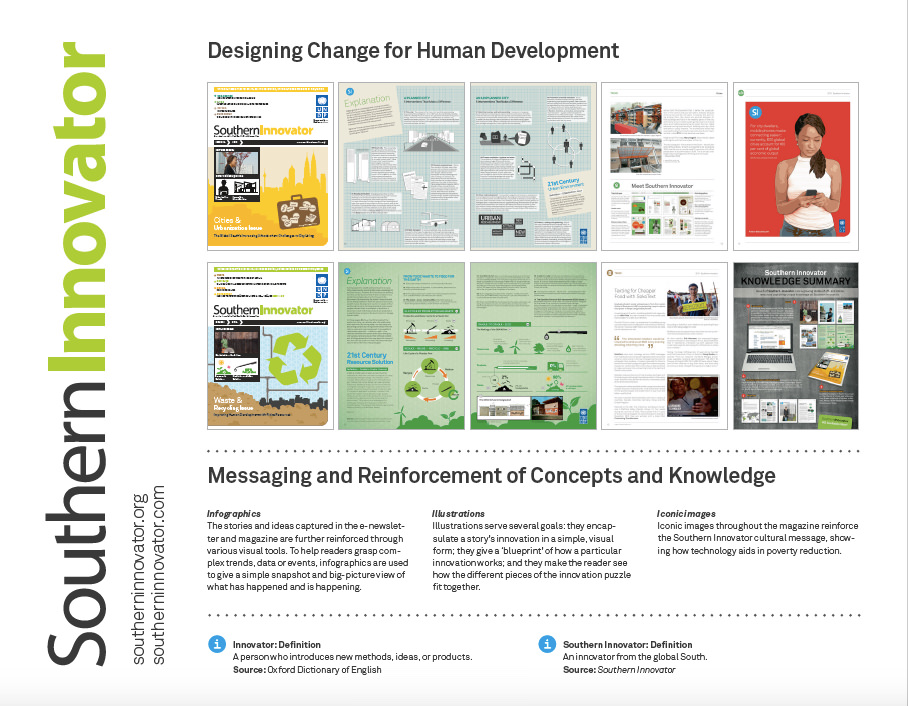
Development Challenges, South-South Solutions was launched as an e-newsletter in 2006 by UNDP’s South-South Cooperation Unit (now the United Nations Office for South-South Cooperation) based in New York, USA. It led on profiling the rise of the global South as an economic powerhouse and was one of the first regular publications to champion the global South’s innovators, entrepreneurs, and pioneers. It tracked the key trends that are now so profoundly reshaping how development is seen and done. This includes the rapid take-up of mobile phones and information technology in the global South (as profiled in the first issue of magazine Southern Innovator), the move to becoming a majority urban world, a growing global innovator culture, and the plethora of solutions being developed in the global South to tackle its problems and improve living conditions and boost human development. The success of the e-newsletter led to the launch of the magazine Southern Innovator.

By 2014, Southern Innovator had published five issues and become a recognised global innovation brand.

https://davidsouthconsulting.org/2021/03/05/southern-innovator-issue-1/

Creative Commons License

This work is licensed under a
Creative Commons Attribution-Noncommercial-No Derivative Works 3.0 License.

ORCID iD: https://orcid.org/0000-0001-5311-1052.

© David South Consulting 2023