Categories
Archive

Tapping the Power of Child Play

By David SouthDevelopment Challenges, South-South Solutions

SOUTH-SOUTH CASE STUDY

Children are an amazing source of energy. Each generation fizzes with the restlessness and optimism of youth. But all that energy is expended in the playground, leaving behind nothing but the sound of laughter. What if that energy could actually be harnessed and turned into electricity? And electricity to power the cash-strapped school the children need to attend to get a good head start in life?

Meeting the Millennium Development Goal of achieving universal primary education would be significantly helped if schools had electricity and in turn the ability to use computers and the Internet. As well, school buildings can be used to their maximum if they have lights for night schools, and expand to secondary and adult education. It is typical practice in Africa to use schools in the evenings for older students. But usually they only have kerosene lamps to turn to for light.

The need is urgent for electricity for schools in Africa: even sub-Saharan Africa’s richest nation, South Africa, has 5,131 schools without electricity. And in the battle for energy, schools have to compete with businesses and cities, as increasing demand makes power outages more common.

Child-power is currently used to run Playpumps’ merry-go-rounds, drawing water from wells. But a children’s see-saw hopes to use the same principle to bring light to power-starved African schools. Children in Uganda are involved in a pilot test of a see-saw that generates electricity with the simple up-and-down motion of the playground ride. The electricity generated is sent to a storage battery via an underground cable. Just five to 10 minutes on the see-saw can generate enough electricity to light a classroom for an evening.

The see-saw is being tested in the Ugandan city of Jinja, made from locally sourced parts, and has been designed by 23-year-old British design student Daniel Sheridan. He was inspired after volunteering on a school trip to the island of Wasimi, south of Mombasa, Kenya, while building a school and teaching.

“The number of children we saw there that loved to play, and their vibrancy, I thought it would be great if I could somehow make use of this,” he told the BBC. “They don’t have Gameboys and all the rest. They are just so genuine and keen to help – they would grab the wheelbarrows we were working with given the chance.”

Sheridan won £5,500 (US $10,930) to further develop the idea at various university student enterprise award schemes. The money is being used for prototype development.

“The current need for electricity in sub-Saharan Africa is staggering. Without power, development is extremely difficult. The potential for this product is huge and the design could be of benefit to numerous communities in Africa and beyond.”

After the prototype testing in Uganda he hopes to either start a business or charity to manufacture the see-saws. His dream?

“Ultimately I would love to design a whole playground of different pieces of equipment that could generate enough electricity to power a whole village.”

Published: April 2008

Resources

  • Playpumps International: More child-powered ways to make a difference: these water pumps draw water from a well while children spin on the merry-go-round. Website: www.playpumps.org
  • OUiP! Or Optimized Universal Interface Platform: This white plastic handheld electronic bar uses the child’s play motion to power it, while it makes noises and displays images. Website: www.thinkthing.net
  • Sprig Toys: Electro-mechanical toys made from wood and recycled plastic that are run on child-power only. Website: www.sprigtoys.com

Development Challenges, South-South Solutions was launched as an e-newsletter in 2006 by UNDP’s South-South Cooperation Unit (now the United Nations Office for South-South Cooperation) based in New York, USA. It led on profiling the rise of the global South as an economic powerhouse and was one of the first regular publications to champion the global South’s innovators, entrepreneurs, and pioneers. It tracked the key trends that are now so profoundly reshaping how development is seen and done. This includes the rapid take-up of mobile phones and information technology in the global South (as profiled in the first issue of magazine Southern Innovator), the move to becoming a majority urban world, a growing global innovator culture, and the plethora of solutions being developed in the global South to tackle its problems and improve living conditions and boost human development. The success of the e-newsletter led to the launch of the magazine Southern Innovator. 

Creative Commons License

This work is licensed under a
Creative Commons Attribution-Noncommercial-No Derivative Works 3.0 License.

ORCID iD: https://orcid.org/0000-0001-5311-1052.

© David South Consulting 2023

Categories
Archive Development Challenges, South-South Solutions Newsletters

The South has a Good Story to Tell

By David SouthDevelopment Challenges, South-South Solutions

SOUTH-SOUTH CASE STUDY

The fast-changing modern world is raising the living standards of billions in the South – China alone has lifted 400 million people out of poverty since the 1980s – but it is also risking the loss of many rich cultural traditions. One of them is storytelling.

Oral storytelling is a critical tool for passing on history, while teaching morals and ethics, especially in societies with low rates of literacy and little formal education. But with the rise of modern media and advertising, few traditional storytellers – many of whom are old – stand a chance. Populations are on the move like never before. As more and more people end up in sprawling cities, many are becoming disconnected from their roots.

Yet across the South, people are finding ways to re-invent story telling — and also to make money, preserve cultural pride and feed the appetite for novelty in hungry, modern media and business.

In 1997, storytelling was acknowledged by UNESCO, which pledged to back humanity’s oral and immaterial heritage, and to protect a vast number of oral and musical traditions, crafts and knowledge – plus the “living human treasures” who possess them. It backed this up in 2003 with the Convention for the Safeguarding of Intangible Cultural Heritage. It supports storytelling through its International Programme for the Development of Communication.

But what about the young – the most important generation for storytelling to have a future? In Bogota, Colombia, students have started a movement of urban storytellers. Aged between 17 and 35, they draw on the things they have learned in university. They eschew linear narration and instead adopt the popular language of films and advertising. Inspired by one television commercial, a story revolves around a drop of tomato sauce falling from a high-rise building, sparking a gun battle. The staccato narrative takes inspiration from post-modern authors like Italo Calvino. It is also the perfect narrative to capture modern, urban audiences who live in a world saturated with media.

By blending together ancestral and post-modern tales, these student storytellers are luring Latin Americans back to listening to stories. Live storytelling, when done well, has an ability to connect with other people like no other medium. This new generation also is helping make Colombia a gathering place for storytellers in Latin America, expressed in events like the Hay Festival Cartegena, a literary event that draws authors from around the world.

But is there any money in storytelling? Tale-spinners like Argentinian Juan Moreno say yes. Moreno quit teaching 17 years ago to tell stories for money in theatres, bars, universities and libraries, tapping into a contemporary marketplace for storytelling.

In fact, it is better paid than acting in the theatre, he claims, and if you are good, it comes with lots of travel. There is a global round of congresses, festivals and seminars to keep storytellers connected, inspired – and paid.

Moreno now makes money teaching many professions how to use stories to be more powerful communicators. He told the UNESCO Courier, “the value of the spoken word, words that heal and restore, that can give life but also take it away,” are key to many fields, like law and social work.

The world centres of storytelling are very much focused on the South. The International Congress of Oral Storytelling, part of the Buenos Aires Book Fair, has been running every year since 1995. At the Congress, tips are exchanged over the subtle tricks of timing and voice, gestures and facial expressions. Other Southern cities with storytelling events, include Bucaramanga, Colombia, Monterrey, Mexico and Agüimes, in the Canary Islands.

While young people are breathing new life into storytelling, Morocco’s legendary storytellers have been facing a common dilemma seen across the developing and developed world: how can they compete with flashier and more distracting pastimes like computer games and TV?

Illiteracy in Morocco affects 40 per cent of the population, so telling stories is an excellent way to reach this non-reading group. Stories and parables have long been seen as a great way to convey ideas, values and philosophies.

But Morocco’s storytelling sages, or halakis, are using their heads and turning to computers to get their stories told, and prevent their thousand-year tradition from dying out. With the help of UNESCO, the halakis have created a digital archive of their stories in audio and video.

Based in Marrakesh’s famous main square, Jemaa al-Fna, they compete in a hury burly of street entertainers and aromatic foods; it is a place where men with monkeys vie with snake charmers for your attention. Morocco’s storytellers would set up in the public squares of the cities of Fes, Meknes and Marrakesh to entertain crowds and educate about morality. These would include the ethical values of kindness, honour and chivalry. But Marrakesh is now the only place where a half dozen old men (there used to be 20 in Marrakesh) still practice this ancient art form.

UNESCO declared the square in 2001 part of the world’s “Oral and Intangible Heritage of Humanity.” Video recorders have been documenting the storytellers and chronicling them on the internet.

Spanish writer Juan Goytisolo, who spends part of his year in Marrakesh, has championed the halakis in his book, Marrakesh Tales, and in bringing UNESCO in to help them. He has defended their corner against the plans of city planners and developers.

Seventy-one-year-old Moulay Mohammed is blunt about the current state of storytelling: “Young Moroccans would rather watch TV soap operas than listen to a storyteller, much less become one themselves,” he told the BBC. Mohammed’s stock-in-trade is the Old Testament and all of A Thousand and One Nights: both tales of sultans, thieves, wise men and fools, mystics, genies, viziers and belly dancers. And he has been telling these tales for 45 years.

In South Africa, digital technology is also breathing new life into storytelling – and infusing the stories with urgent, contemporary issues like HIV, and domestic and sexual violence. South African women are using digital technology to preserve traditional storytelling: A collection of 15 digital stories – called “I Have Listened, I Have Heard” – made in 2006 are being distributed along with books. They assembled the stories using audio recorders and made movies of the readings with digital cameras. It was funded by the Foundation for Human Rights and made at the Women’s Net Computer Training Centre in Johannesburg.

The storytellers worked together on each script, taking a day. They would tell the group a story focusing on particular experiences or meaningful moments in their lives. The group would comment and draw out the best bits of the story. The whole process helps the story teller to flesh out the story with metaphors, narrative techniques and milestones.

Published: April 2008

Resources

  • The basics of story telling are answered in this webpage: www.timsheppard.co.uk
  • Singapore International Story Telling Festival 2008: This year’s festival also includes a new addition: Asian Digital Storytelling Festival
  • International Congress of Oral Storytelling: Held from 2-4 May 2008 in Buenos Aires, Argentina. Website: www.el-libro.org.ar
  • Folk Tales: Online project where Pakistani students and their teachers share folklore and fables with students around the world. Website: www.edutopia.org
  • Thirsty-Fish: Story and Strategy: A consultancy that helps businesses build their brands based on age-old practices of storytelling. Website: www.thirsty-fish.com

“I think you [David South] and the designer [Solveig Rolfsdottir] do great work and I enjoy Southern Innovator very much!” Ines Tofalo, Programme Specialist, United Nations Office for South-South Cooperation

Creative Commons License

This work is licensed under a
Creative Commons Attribution-Noncommercial-No Derivative Works 3.0 License.

ORCID iD: https://orcid.org/0000-0001-5311-1052.

© David South Consulting 2023

Categories
Archive Development Challenges, South-South Solutions Newsletters Southern Innovator magazine

Insects Can Help in Food Crisis

By David SouthDevelopment Challenges, South-South Solutions

SOUTH-SOUTH CASE STUDY

For many years it was a given that the world’s problem was not a lack of food, but that it was unfairly shared. But as the switch to biofuels gathers pace, farmland is being diverted away from growing food for people, to food for fuel. On top of this, growing prosperity in many countries in the South has boosted demand for better quality food, including grain-devouring meat diets – it takes 10 kilograms of grain to get one kilogram of meat from a cow. The crisis has deeply alarmed the UN’s World Food Programme and the World Bank. In the economic battle for food, the poor are the most vulnerable.

So-called agflation (agricultural inflation) has seen spiraling food prices, which in turn are causing food shortages, hunger and malnutrition around the world. For example, rice in Thailand has jumped from US $400 per 100 kilograms in January, to US $760. World grain stocks are at their lowest level in four decades.

But where can new sources of food be found? And what would be a more efficient use of the world’s resources to feed the growing population? One answer, surprisingly, is insects.

In February this year the UN’s Food and Agriculture Organization held a conference in Chiang Mai, Thailand to devour the dietary value of insects as food and discuss how to harvest more of them. The working group of three dozen scientists from 15 countries probed the role of edible forest insects in food security. They explored insect protein as a contributor to better nutrition, the economics of collecting edible forest insects, methods of harvesting, processing and marketing edible forest insects, and ways of promoting insect eating with snacks, dishes, condiments — even recipes.

The range of insects that can be tapped for food is huge: beetles, ants, bees, crickets, silk worms, moths, termites, larvae, spiders, tarantulas and scorpions. More than 1,400 insect species are eaten in 90 countries in the South. Known as entomophagy, insect eating is a growing industry. Entrepreneurs in the South are making insects both palatable and marketable – and in turn profitable. These innovations are adding another income source for farmers and the poor, and supplying another weapon to the battle for global food security.

Insects have one big advantage as a food source: they are efficient converters of food into protein. Based on the weight of the food required to feed them, crickets are twice as efficient as pigs and broiler chicks, four times more efficient than sheep and six times more efficient than cows. They breed at a far faster rate, and they contain essential amino acids. They are seen as an ecologically friendly alternative to traditional animal rearing.

There are downsides to insects, however. In areas where there is heavy pesticide spraying on crops, insects can retain the pesticides in their bodies. Another key issue is sustainability: insect harvesting in some places has driven species to extinction. Then there is revulsion for some: in Western diets, there is an aversion to entomophagy, although most Westerners are happy to eat honey.

Revulsion at eating of insects is misguided. Most grains and preserved food products contain large quantities of insects or insect fragments mixed in. For example, rice usually contains rice weevil larvae – and they can be an important source of vitamins.

In Africa, 250 edible insects are eaten, from termites to grasshoppers, and have helped people through many food emergencies on the continent.

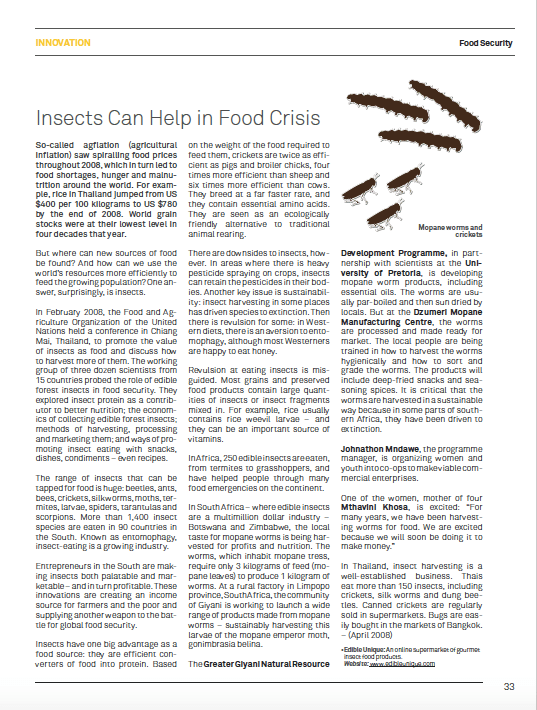
In South Africa — where edible insects are a multimillion dollar industry — Botswana and Zimbabwe, the local taste for mopane worms is being harvested for profits and nutrition. The worms, which inhabit mopane tress, require only three kilograms of feed (mopane leaves) to produce one kilogram of worms. At a rural factory in Limpopo province, South Africa, the community of Giyani is working to launch a wide range of products made from mopane worms – sustainably harvesting this larvae of the mopane emperor moth, gonimbrasia belina.

The Greater Giyani Natural Resources Development Programme in partnership with scientists at the University of Pretoria, is developing mopane worm products, including essential oils. The worms are usually par-boiled and then sun dried by locals. But at the Dzumeri Mopane Manufacturing Centre, the worms are processed and made ready for market. The local people are being trained in how to harvest the worms hygienically, and how to sort and grade the worms. The products will include deep-fried snacks and seasoning spices. It is critical the worms are harvested in a sustainable way, because in some parts of southern Africa, they have been driven to extinction.

Johnathon Mndawe, the programme manager, is organizing women and youth into co-ops to make viable commercial enterprises. “We expect the product to hit supermarket shelves in 2009,” said Morewane Mampuru, coordinator for the Centre for Scientific and Industrial Research, another partner.

One of the women, mother of four Mthavini Khosa, is excited: “For many years, we have been harvesting worms for food. We are excited because we will soon be doing it to make money.”

In Thailand, insect harvesting is a well-established business. Thais eat more than 150 insects, including crickets, silk worms and dung beetles. Canned crickets are regularly sold in supermarkets. Bugs are easily bought in the markets of Bangkok.

Online vendor Thailand Unique, based in Udon Thani, sells and markets a wide range of edible insects. They include edible scorpions, preserved giant water bugs, roasted grasshoppers, edible big crickets, bamboo worms, crushed giant bug paste, and introducing this year, Bug Snackz and Scorpion Thai Green Curry. There is even a ‘Bug Sample Pack’, containing a mix of seven edible insects and arachnids, all slow roasted for easy snacking.

Another important centre for insect harvesting is Latin America. In Venezuala, the Pemon Indians eat fire ants during the rainy season.

In Colombia, so-called “fatass ant” or “hormiga culona” is eaten like popcorn in movie theatres. Some believe it is a defence against cancer, or a natural aphrodisiac. Eating the ants or culona, has been happening right back to the ancient Guane Indians.

In Santander province, farmers are exporting the ants for sale, some being dipped in Belgian chocolate and sold as a luxury food in London’s Harrods and Fortnum and Mason department stores. The abundant ant population brings in US $11 a pound (kilogram conversion) for the farmers, a doubling in price since 2000.

Farmers in the artist colony of Barichara harvest the ants – though concerns have been raised that they have been over-harvesting the population. Restaurants in the area offer ant-based spreads for bread and an ant-flavored lamb sauce.

“It’s an age-old dilemma for the farmer — should I kill it or eat it?” said Andres Santamaria to CBS News, who was given a $40,000 grant from Santander’s government to develop an environmentally sustainable, export-oriented programme for breeding the ants.

In Tijuana, Mexico, ancient Aztec, pre-Colombian insect meals are on offer at this restaurant, joining a global trend. Cien Anios (“100 Years”), specialises in pre-Colombian, Aztec insect recipes. It is proof there is money in preparing insects for food. Typical dishes include garlicky ant eggs and cactus worms in butter.

Published: April 2008

Resources

  • A network for insect collectors: Website: www.insect.net
  • Sunrise Land Shrimp: A do-it-yourself guide to raising and harvesting insects for food, with important information on health and hygiene: Website: www.slshrimp.com
  • Edible Unique: An online supermarket of gourmet insect food products. Website: www.edibleunique.com

https://davidsouthconsulting.org/2022/11/18/farmers-weather-fertilizer-crisis-by-going-organic/

https://davidsouthconsulting.org/2022/11/11/urban-farming-to-tackle-global-food-crisis/

Tijuana‘s Cien Años was the original inspiration for this story. As one of the first stories to draw attention to the insects-for-food market, it contributed to a growing awareness of this exciting food source. I had a delicious all-insect meal there in 2002.

https://davidsouthconsulting.org/2021/03/05/southern-innovator-issue-3/

Creative Commons License

This work is licensed under a
Creative Commons Attribution-Noncommercial-No Derivative Works 3.0 License.

ORCID iD: https://orcid.org/0000-0001-5311-1052.

© David South Consulting 2022