
By David South, Development Challenges, South-South Solutions

The economic devastation of the conflict between Israel and the Palestinians (http://en.wikipedia.org/wiki/Palestine) has brought much hardship to the Palestinian people. The United Nations under the UNRWA mission has been working to lesson the hardship for over 60 years (http://www.unrwa.org). But there is only so much it can do.
However, several business initiatives are creating strong Palestinian food brands to improve the reputation and awareness of Palestine around the world. In particular, Palestinian olive oil has led the way and enjoyed strong sales in countries like the United Kingdom.
Since 2004, the Palestine Fair Trade Association (PFTA) (http://www.palestinefairtrade.org) has been leading the movement of fair trade producers in Palestine, linking small Palestinian farms in fair trade collectives and cooperatives across the country.
Zatoun (http://www.zatoun.com) – or Zaytoun (http://www.zaytoun.org) as its known in the UK – are olive oil and soap brands using the Arabic word for olive. Olive oil (http://en.wikipedia.org/wiki/Olive_oil) is a popular cooking and seasoning oil and is sought after for its health benefits. Most of it is cultivated in the Mediterranean region, with Spain the largest single producer. Like wine, the quality of the olive oil varies greatly and the bouquet and viscosity of the oil play a big role in how consumers select a brand. The trend in the past 10 years has been for consumers to be more selective about the olive oil they buy and to be more informed about the choices available. This increasingly sophisticated consumer choice is what is helping the Palestinian oil succeed.
Another factor is the growing global popularity of the traditional Mediterranean diet. Research has linked it to the prevention of cancers, obesity and cardiovascular diseases, and an aid to food digestion. Olive oil and olives make up one of the six key groups of foods that are part of the Mediterranean Diet. The other elements are grains, fruits and vegetables, legumes and nuts, dairy products and fish.
The Zatoun brand of olive oil uses its profits to help olive tree farmers and their families in Palestine.
The brand is also hoping to alter public perceptions of Palestine. As its website states, “Zatoun helps to create a context based in ordinary everyday life to view and discuss the situation in Palestine-Israel. No longer is it an abstract geopolitical issue involving power elites and undefined national interest.”
The Zatoun brand is led in Canada by Robert Massoud, winner of the 2004 YMCA Peace Medallion. Zatoun is sold in Canada through peace groups and social justice and faith groups and is “intended as a tool to help promote their work and bring home the message that the struggle of Palestinians is ultimately one of human rights and social justice.”
The olive oil is certified fair trade under the Institute for Marketecology (IMO) (http://www.imo.ch/index.php?seite=imo_index_en) in Switzerland. The brand is operated as a not-for-profit with volunteer labour and the entire cost of the product goes to the farmers, customs and shipping costs, and promotion and administration. Each 750mL bottle sells from between CAD $15 (US $14) and CAD $17.50 (US $17.22) and each bar of soap is CAD $5.00 (US $4.90).
In the U.K., the Zaytoun brand was started by British women Heather Masoud and Cathi Pawson, also in 2004. The Palestinian olive oil has benefited from sales promotion during the United Kingdom’s annual Fair Trade Fortnight: a highly publicized promotion over two weeks that has consistently raised the profile of all Fair Trade products. Palestinian products were profiled during the 2009 event.
The Zaytoun brand is certified with the World Fair Trade Organization (www.wfto.com) and has been able to break through to sales in British supermarkets as a result. Having this certification is key to being accepted for display on the supermarket shelves. By being certified, the farmers are able to get guaranteed above market prices for their olives. This makes it easier to plan and invest in the farm and the community and avoid the wild fluctuations of market prices. It is common around the world for farmers to be bankrupted and impoverished when market prices crash and fall below the cost of growing and harvesting the product.
“We have been working for the Fair Trade certificate for four years,” Nasser Abufarha, chairman of the Palestinian Fair Trade Association told the Guardian newspaper. “Fair Trade will increase our sales, and bring us new markets and widen our reach.
“We have given farmers hope,” he said. “An economic exchange that recognises Palestinian farmers’ rights and respects the value of their connection to their land, after marginalization under Israeli occupation, is a major accomplishment.”
Olives are Palestine’s biggest crop, and critical to the local economy. The industry employs more than 100,000 people and its economic health affects many more. But the ongoing conflict has harmed the olive industry in many ways, from the bulldozing of orchards to make way for the Israeli security fence – over 1,100 hectares olive orchards were cut off by the fence in the West Bank village of Anin alone – to clearing fields for the building of new settlements.
For some of the farms, fair trade has meant access to outside markets they haven’t had for 40 years.
The Palestinian olive oil is in a market with fierce competition. In the UK, the oil can retail for £14.49 (US $23) a litre, while some Italian olive oils can be had for just US $9. But the Palestinian olive oil has a number of advantages in the marketplace: consumers have shown a willingness to pay the premium to support the farmers and Palestine, and most importantly in the competitive world of food sales, food connoisseurs rave about it. Food and wine writer Malcom Gluck called Zaytoun olive oil “one of the aggressive yet pungently attractive olive oils I have tasted”. He believes it easily ranks alongside the best Sicilian, Cretan and northern Spanish oils.
Another Palestinian company having success with the olive products is the Anabtawi Group (http://www.anabtawigroup.com/index.php?a=1&lid=3&lid1=24). Based in Nablus in the West Bank, it started in 2008 the Al-Ard Palestinian Agri-Products Company and sells Al-Ard extra virgin olive oil, virgin olive oil and an olive oil soap. Operating on a large scale, the group has the largest olive oil storage facility in Palestine and provides training and support to the farmers. It also undertakes marketing of the products in new markets including Latin America.
Ziad Anabtawi, the company’s president and CEO, told the Brazil-Arab News Agency “Palestinian olive oil is known worldwide for its high quality and its very striking aroma. It is ‘premium’ and organic by nature. Farmers grow the product the traditional way. They do not irrigate the olive trees, [irrigation] comes from rainwater and we do not use any chemicals.”
The Palestinian experience shows it is possible to create new economic opportunities for farmers under even the most arduous political and security conditions.
Published: October 2010
Resources
- Palestine Fair Trade Association: Website:http://www.palestinefairtrade.org/
- International Olive Oil Council (IOOC): The global body to help market and promote olive oil products. Website:http://www.internationaloliveoil.org/

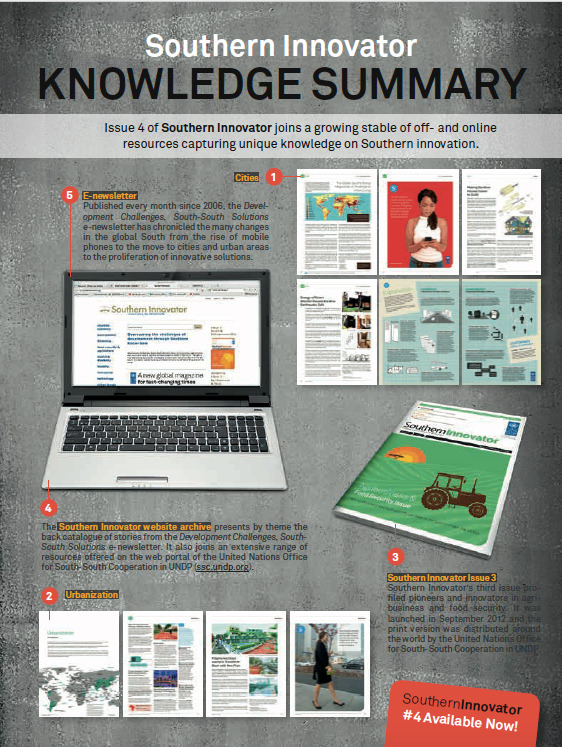
Development Challenges, South-South Solutions was launched as an e-newsletter in 2006 by UNDP’s South-South Cooperation Unit (now the United Nations Office for South-South Cooperation) based in New York, USA. It led on profiling the rise of the global South as an economic powerhouse and was one of the first regular publications to champion the global South’s innovators, entrepreneurs, and pioneers. It tracked the key trends that are now so profoundly reshaping how development is seen and done. This includes the rapid take-up of mobile phones and information technology in the global South (as profiled in the first issue of magazine Southern Innovator), the move to becoming a majority urban world, a growing global innovator culture, and the plethora of solutions being developed in the global South to tackle its problems and improve living conditions and boost human development. The success of the e-newsletter led to the launch of the magazine Southern Innovator.


https://davidsouthconsulting.org/2021/03/05/southern-innovator-issue-3/

This work is licensed under a
Creative Commons Attribution-Noncommercial-No Derivative Works 3.0 License.
ORCID iD: https://orcid.org/0000-0001-5311-1052.
© David South Consulting 2022




 David South Consulting
You must be logged in to post a comment.