Categories
Archive Development Challenges, South-South Solutions Newsletters

Farmers Weather Fertilizer Crisis by Going Organic

By David SouthDevelopment Challenges, South-South Solutions

SOUTH-SOUTH CASE STUDY

Around the world, large-scale agriculture relies on the use of chemical fertilizers. But increasing expense and decreasing supply of fertilizer is driving up the cost of food, and in turn contributing to the overall food crisis.

According to a soon-to-be-released UN report, prices have shot up and will stay high for at least three years. Prices have almost doubled and in some cases risen by 500 percent over 15 months.

The fertilizer crisis is caused by several factors. Anhydrous ammonia, which is the source of nearly all nitrogen fertilizer, needs natural gas, and the price of gas has risen sharply. Other fertilizer ingredients like phosphorous, potassium and potash are also increasingly expensive. Fertilizer needs to be transported long distances to get to farmers, so costs have risen with the soaring price of oil. And finally, the rise in demand for food has put the price of fertilizer up, as countries hoard supplies for themselves.

The 1960s ‘Green Revolution’ in agriculture made developing-world farmers dependent on supplies of fertilizers, pesticides and artificial irrigation. Monoculture cash crops became the norm. Yields were doubled, but at the expense of using three times as much water by accessing groundwater using electric pumps. This and fertilizer pollution has caused widespread damage to soil and water. In India, for example, 57 per cent of the land is degraded, according to Tata Energy Research.

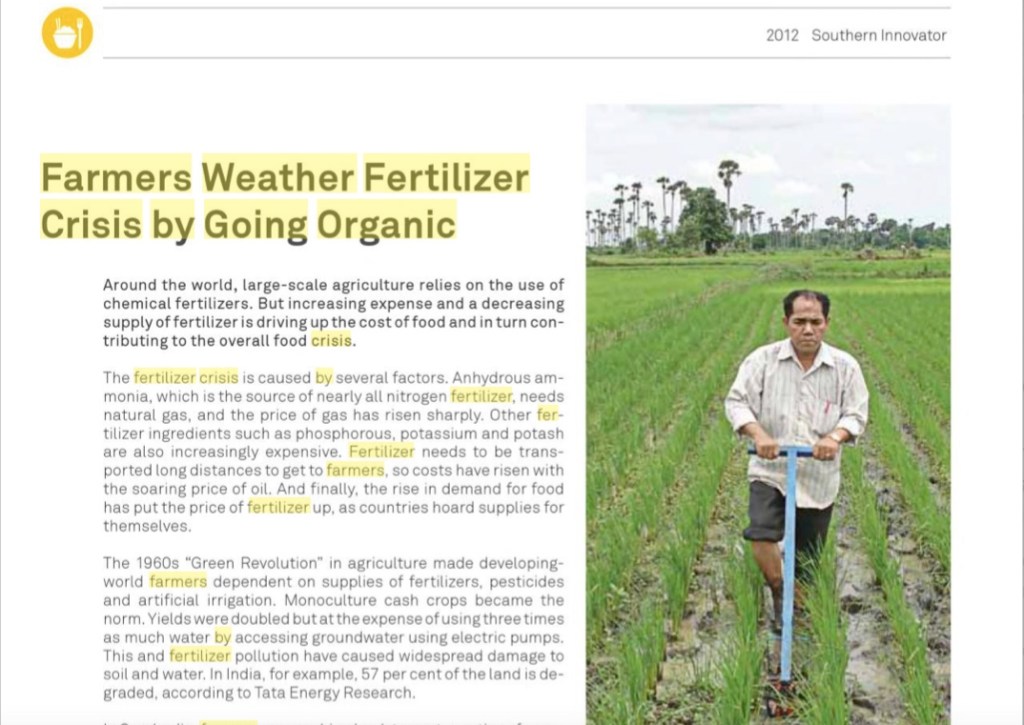
In Cambodia, farmers are reaching back to past practices for answers to the fertilizer crisis. One is to go organic. Taking this approach has many health and environmental advantages – and, best of all for farmers, it keeps costs down.

Khim Siphay, a Cambodian farmer, has found he gets bigger crops of rice and vegetables while paying a lot less for fertilizers.

“Using pesticide or fertilizers kills important insects, and causes the soil to become polluted,” he told Reuters. “I use compost and it helps keep the soil good from one year to another. All of my family members help make the compost.”

The push to organic methods for Cambodia’s 13 million people relying on agriculture for a living comes from a non-governmental organization, the Cambodian Center for Study and Development in Agriculture (CEDAC). It has successfully moved to organic methods, starting from just a handful of 28 farmers in 2000, to the current 60,000 – and received an endorsement from the Cambodian Ministry of Agriculture.

CEDAC says farms using the organic methods have been able to increase rice yields per hectare, while the seeds needed have fallen by 70 to 80 percent. By using a “System of Rice Intensification”, the mostly small-scale farmers are able to get more out of the land, with less labour. Add to that the fact that organic rice gets a premium price on world markets, and the result for the farmers has been a rise in income from US $58 to US $172 per hectare.

“The important point of organic farming is that farmers don’t need to spend money on fertilizers and pesticide so they spend less money on farming,” said CEDAC official Yang Saing Koma.

“They can sell the produce for a higher price. Also they can avoid being infected by pesticides and they will be healthier. It is also good for the environment,” he said.

Rice and other produce can be used to feed chickens to produce organic poultry and eggs – another bonus for farmers looking to raise the value of their produce.

“I started doing organic farming outside my rice paddy, but then I noticed production was double, so in the next season, I decided to grow organically on all of my land,” said farmer Ros Meo. “I spend less money now and I can grow more and I am not sick as I was before, my health is now good.”

Going organic in Cambodia is something that is becoming more attractive to the country’s growing middle class, and the government hopes the country will gain a reputation as an organic producer.

Another approach to cheap fertilizer comes from Caracas, Venezuala. Marjetica Potrc, an artist and architect who works closely with impoverished communities, has come up with a “dry toilet” which collects human waste and converts it to fertilizer.

Developed after spending six months in the barrios of Caracas, the dry, ecologically safe toilet was built on the upper part of La Vega barrio, a district in the city without access to the municipal water grid. It is a place where about half the population receives water from municipal authorities no more than two days a week.

Published: March 2014

Resources

  • South African company Eat Your Garden: It provides urban dwellers and food businesses with their own food gardens bursting with juicy and tasty foods whilst at the same time reducing carbon footprints, and creating employment and provide training, helping poverty alleviation.
    Website: http://www.eatyourgarden.co.za/
  • Soil Association: The organization that establishes the standards necessary for food to be called organically grown.
    Website: http://www.soilassociation.org/
  • Patrick Kamzitu, a farmer in Malawi, on the impact of fertilizer prices:
    Website: www.guardian.co.uk/environment

https://davidsouthconsulting.org/2022/11/21/agribusiness-food-security/

https://davidsouthconsulting.org/2022/11/11/building-an-interactive-radio-network-for-farmers-in-nigeria/

https://davidsouthconsulting.org/2022/05/30/carbon-credits-can-benefit-african-farmers-thanks-to-new-system/

https://davidsouthconsulting.org/2022/10/10/cheap-farming-kit-hopes-to-help-more-become-farmers/

https://davidsouthconsulting.org/2022/11/01/indonesian-food-company-helps-itself-by-making-farmers-more-efficient/

https://davidsouthconsulting.org/2022/11/23/kenyan-farmer-uses-internet-to-boost-potato-farm/

https://davidsouthconsulting.org/2022/10/21/a-new-african-beer-helps-smallholder-farmers/

https://davidsouthconsulting.org/2021/11/09/pocket-friendly-solution-to-help-farmers-go-organic/

https://davidsouthconsulting.org/2022/10/26/perfume-of-peace-helps-farmers-switch-from-drug-trade/

https://davidsouthconsulting.org/2022/11/23/putting-worms-to-work/

https://davidsouthconsulting.org/2022/10/17/small-scale-farmers-can-fight-malaria-battle/

https://davidsouthconsulting.org/2021/03/05/southern-innovator-issue-3/

https://davidsouthconsulting.org/2021/03/05/southern-innovator-issue-5/

https://davidsouthconsulting.org/2022/02/10/urban-farmers-gain-from-waste-water/

Development Challenges, South-South Solutions was launched as an e-newsletter in 2006 by UNDP’s South-South Cooperation Unit (now the United Nations Office for South-South Cooperation) based in New York, USA. It led on profiling the rise of the global South as an economic powerhouse and was one of the first regular publications to champion the global South’s innovators, entrepreneurs, and pioneers. It tracked the key trends that are now so profoundly reshaping how development is seen and done. This includes the rapid take-up of mobile phones and information technology in the global South (as profiled in the first issue of magazine Southern Innovator), the move to becoming a majority urban world, a growing global innovator culture, and the plethora of solutions being developed in the global South to tackle its problems and improve living conditions and boost human development. The success of the e-newsletter led to the launch of the magazine Southern Innovator.

Creative Commons License

This work is licensed under a
Creative Commons Attribution-Noncommercial-No Derivative Works 3.0 License.

ORCID iD: https://orcid.org/0000-0001-5311-1052.

© David South Consulting 2023

Categories
Archive Development Challenges, South-South Solutions Newsletters Southern Innovator magazine

Computer ‘Gold Farming’ Turning Virtual Reality Into Real Profits

ByDavid South,Development Challenges, South-South Solutions

SOUTH-SOUTH CASE STUDY

The rapid spread of the internet around the global South is bringing with it new forms of work. One of these trends is so-called “gold farming”: making money in the virtual world of computer gaming by trading in virtual money, prizes and goods for busy gamers who don’t have time to do it themselves. This work now employs 400,000 people – mostly men and mostly in China, but also elsewhere in the South, according to new report.

Working out of internet centres where they can get access to high-speed or broadband internet connections, “gold farmers” use the global trade in virtual goods for online computer games in the same way stockbrokers trade shares on the world’s stock exchanges. The trade operates similarly to the stock market, with prices fluctuating based on demand and changing by the minute.

And as the report discovered, this trade is acting as a gateway into the world of information technology employment, where computer-literate young men are able to earn an income they could not have done otherwise.

It is a trade that can provide gold farmers with US $145 a month in income. They are often given free food and accommodation to do it, and many have few other economic choices.

“You can probably think of two models,” said the report’s author, Professor Richard Heeks of Manchester University’s Development Informatics Group. “They could play as an individual at a local cybercafe doing their own in-game farming and then selling to one of the trading sites (that buy from farmers at one price, then sell on to player-buyers at a higher price). Or they could be organized into a small/medium enterprise by an owner, all working together in a room full of computers.”

There is a dark side to gold farming too: there have been reports of youths forced to gold farm by gangs who make them work 12 hour days. Crime gangs sometimes become involved and scams proliferate.

Heeks says the downside is the result of governmental ignorance. “The main problem is a lack of understanding about ICT and ICT enterprise generally in some governments in developing countries and in particular a relative lack of understanding about the spread and implications of computer games.”

Supporters see gold farming as a flourishing Southern economy that is worth hundreds of millions of dollars, and exposes participants both to information technology skills and the wide horizons of the virtual computing world. Its defenders say it shows that those who dismiss the expansion of IT infrastructure as a waste of time are missing the emerging economic opportunities it is creating.

Heeks said we still know too little about this fast-evolving sector, but that “gold farming does seem to be providing income/livelihood for young men who would otherwise be unemployed. There are claims that it has helped mop up youths who had otherwise been involved in crime, but we don’t yet know how generalized such claims are.”

The number of players engaged in online gaming has grown by 80 percent per year, and Heeks sees the rise in gold farming as linked to a bigger trend: “in both North and South, we will spend increasing amounts of work and leisure time in cyberspace. Couple that with the growing penetration of ICTs into developing countries, including into poor communities, and there will be growing opportunities for this kind of ‘virtual outsourcing.’”

Currently, more than 300 million people worldwide have access to the internet through fast broadband connections (mostly in developed countries, although this is changing quickly), and more than 1.1 billion of the world’s estimated 6.6 billion people are online.

China is working hard to capture the economic power of the internet. The country’s economic boom has helped create an affluent urban middle class clamouring for the social aspects of internet access like chat rooms, while the government has been driving the roll-out of internet access in rural areas.

The country’s largest Cyber Park is under construction inWujin New and High-tech Development Zone of Changzhou. It will be a technology incubator, a research and development centre, and a place for small and medium-sized enterprises to innovate.

China’s most ambitious digital media industry development is the Beijing Cyber Recreation District (CRD), a collection of digital media academies and company incubators spread over 100 square kilometres, creating the world’s largest virtual world development. It is already home to more than 200 game and multimedia content producers in western Beijing.

And even in Africa, where broadband penetration rates are very poor, countries are now looking to the mobile phone companies to provide their populations with access to the internet, as they struggle to find a place at the digital table.

Mauritius, an island in the Indian Ocean strategically close to Africa and better known for tourism and luxury hotels, wants to become the world’s “cyber island”, and Africa’s e-gateway. Armed with the first 3G network in Africa (the third generation of mobile phone technology – offering high-speed internet access and video telephony), Mauritius is moving fast to make good on this advantage. And it is even moving to the next level of mobile-phone speed, High-speed Download Packet Access (HSDPA) – allowing even greater quantities of information to be exchanged.

Mauritius joins a select few countries, including Japan and South Korea, at the forefront of access to 3G. Wireless – or wi-fi – computer access is available in three-quarters of the island.

Published: September 2008

https://davidsouthconsulting.org/2022/11/21/asia/

https://davidsouthconsulting.org/2022/10/20/china-consumer-market-asian-perspective-helps/

https://davidsouthconsulting.org/2020/12/10/china-sets-sights-on-dominating-global-smartphone-market/

https://davidsouthconsulting.org/2020/12/11/cyber-cities-an-oasis-of-prosperity-in-the-south/

https://davidsouthconsulting.org/2021/01/26/designed-in-china-to-rival-made-in-china/

https://davidsouthconsulting.org/2022/10/04/popular-chinese-social-media-chase-new-markets/

https://davidsouthconsulting.org/2020/04/17/virtual-supermarket-shopping-takes-off-in-china/

Development Challenges, South-South Solutionswas launched as an e-newsletter in 2006 by UNDP’s South-South Cooperation Unit (now the United Nations Office for South-South Cooperation) based in New York, USA. It led on profiling the rise of the global South as an economic powerhouse and was one of the first regular publications to champion the global South’s innovators, entrepreneurs, and pioneers. It tracked the key trends that are now so profoundly reshaping how development is seen and done. This includes the rapid take-up of mobile phones and information technology in the global South (as profiled in the first issue of magazine Southern Innovator), the move to becoming a majority urban world, a growing global innovator culture, and the plethora of solutions being developed in the global South to tackle its problems and improve living conditions and boost human development. The success of the e-newsletter led to the launch of the magazine Southern Innovator.

Follow@SouthSouth1

Archive.org:https://archive.org/details/Httpwww.slideshare.netDavidSouth1development-challengessouthsouthsolutionsseptember2008issue

Slideshare:http://www.slideshare.net/DavidSouth1/development-challengessouthsouthsolutionsseptember2008issue

Southern Innovator Issue 1:https://books.google.co.uk/books?id=Q1O54YSE2BgC&dq=southern+innovator&source=gbs_navlinks_s

Southern InnovatorIssue 2: https://books.google.co.uk/books?id=Ty0N969dcssC&dq=southern+innovator&source=gbs_navlinks_s

Southern Innovator Issue 3:https://books.google.co.uk/books?id=AQNt4YmhZagC&dq=southern+innovator&source=gbs_navlinks_s

Southern Innovator Issue 4:https://books.google.co.uk/books?id=9T_n2tA7l4EC&dq=southern+innovator&source=gbs_navlinks_s

Southern Innovator Issue 5:https://books.google.co.uk/books?id=6ILdAgAAQBAJ&dq=southern+innovator&source=gbs_navlinks_s

Creative Commons License
This work is licensed under a
Creative Commons Attribution-Noncommercial-No Derivative Works 3.0 License.

ORCID iD:https://orcid.org/0000-0001-5311-1052.

© David South Consulting 2025