Categories
Archive Development Challenges, South-South Solutions Newsletters

Ghana’s Funeral Economy Innovates and Exports

By David SouthDevelopment Challenges, South-South Solutions

SOUTH-SOUTH CASE STUDY

The West African nation of Ghana’s funeral economy is attracting innovation and grabbing attention outside the country. The nation’s elaborate – but expensive – funeral rituals provide craftsmen with a good income. And new products are being introduced to handle the financial consequences of this unavoidable fact of life.

As Africa undergoes the biggest shift from rural to urban in its history, the continent is experiencing a technology boom, mainly led by the mobile phone. Mobile phones have become important transactional tools in daily life, enabling people to communicate and to do business, thanks to micropayments and prepay. Interwoven in these twin phenomena of greater urbanization and the mobile phone economy is a rising and growing middle class population with spare cash to spend on more than just the basics of survival. And all of this is throwing up new economies and new products to sell to these middle class customers.

It is in this context that Ghana’s flamboyant and vibrant funeral ceremonies have become an economy unto themselves.

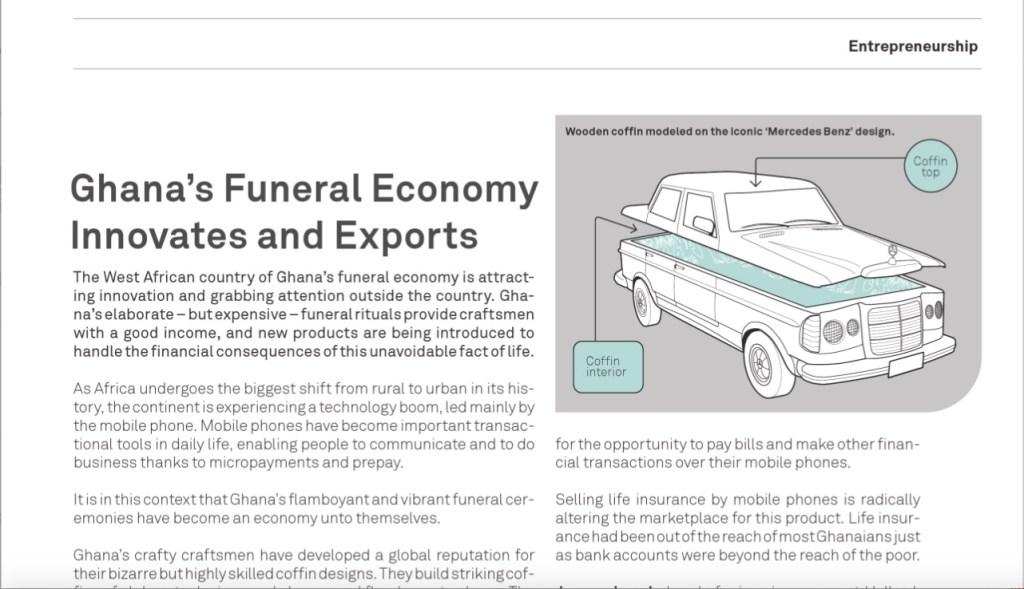
Ghana’s crafty craftsmen have developed a global reputation for their bizarre but highly skilled coffin designs. They build striking coffins of elaborate designs and shapes and flamboyant colours. The coffins usually take on the shape of an aspect of the deceased’s former profession or vocation. For example, a pilot gets buried in a mock-up of the plane they flew, or a farmer is buried in his main crop, like a giant corn cob.

It is proof the creative economy works and adds value to existing products and services. What were just simple coffins for a utilitarian task (burying the dead) becomes an elaborate work of art and transforms burial into a grander experience.

One of the most popular designs is the now-ubiquitous and much-coveted mobile phone: Africa’s great electronic connector. And it is the mobile phone that is allowing people to buy life insurance to be able to pay for the coffins and elaborate funerals.

Mobile money is a dynamic and fast-growing industry that is firmly established in the global South. Some are forecasting the market in mobile payments will reach US $60 billion by 2015.

A range of companies are now offering life insurance policies that can be paid for in small “micropayments” by mobile phone. This is an important service for people who may not have a formal bank account and who can be devastated by the costs of a family member’s funeral.

The two companies pioneering this “micro-insurance” service are Hollard Insurance (http://www.hollard.co.za) and Mobile Financial Services Africa (http://mfsafrica.com). Both are offering funeral insurance by mobile phones. Working with MTN – Africa’s largest mobile phone group (www.mtn.com.gh) – they are launching the mi-Life insurance product, sold for between US 0.80 cents and US $4 for a month’s coverage.

MTN pioneered its Mobile Money service in 2009. Out of 9 million MTN mobile phone subscribers in Ghana, 1.8 million have signed up for the opportunity to pay bills and make other financial transactions over their mobile phones.

Selling life insurance by mobile phones is radically altering the marketplace for this product. Life insurance had been out of the scope of most Ghanaians just as bank accounts were beyond the reach of the poor.

Jeremy Leach, head of micro-insurance at Hollard, told AllWestAfrica (allwestafrica.com), that 55 percent of Ghanaians say they can’t afford life insurance. “In terms of affordability, we’ve tried to address that.”

MTN Mobile Money Ghana’s general manager, Bruno Akpaka, told the Financial Times mi-Life is 50 to 70 per cent cheaper than comparable policies.

Subscribers sign up by using their mobile PIN (personal identification number) at a local kiosk, or send a short message service (SMS) on their handset. Once signed up, a monthly premium is taken from their account. When it runs out, they top it up at the kiosk again.

It currently offers basic funeral cover: a lump sum to the family when the main income earner dies. This money is used towards the costs of expensive funerals. Other products in the pipeline include insurance for school fees.

For the coffin craftsmen, the fast-growing economy of African online shopping is helping with sales. The elaborate craft coffins can be bought online from various platforms including eShopAfrica.com, which promises to sell “fair trade direct from Africa.” Its dedicated Ghana coffin pages (www.eshopafrica.com/acatalog/Ga_Coffins.html) advertise small coffins that take a month to make, and larger ones can take up to three months to build. Prices advertised on the eShop site range from US $1,500 for a full-sized, six-foot coffin, to US $175 for a “desk top chest.”

Designs range from a mobile phone to a Ferrari race car to a computer mouse. But it is not just the resting places for the deceased that are on sale. The cabinet- and coffin-making skills are also turned to making a wide range of storage cabinets in bright colours and imaginative shapes, from a football to a red pepper and a beer-bottle shaped drinks cabinet.

The global attention for the craftsman has been impressive. They are lauded by fine art collectors around the world and have been shown in galleries such as London’s Jack Bell Gallery (www.jackbellgallery.com/paajo.html). The legendary coffin artist Paa Joe is one of the most featured in gallery shows.

Published: April 2011

Resources

1) Shop Africa 53: An online shopping website allowing independent traders to vend their products to the rest of Africa and the world. Website: www.shopafrica53.com

3) Going into Darkness: Fantastic Coffins from Africa by Thierry Secretan, details the culture and the craftsmen, behind the iconic coffins. Website:www.amazon.com/exec/obidos/ASIN/0500278393/cordelinetwebstu%22

4) Creative Economy Programme: The creative economy is an emerging concept dealing with the interface between creativity, culture, economics and technology in a contemporary world dominated by images, sounds, texts and symbols. Website:www.unctad.org/Templates/StartPage.asp?intItemID=4577&lang=1

Bangladesh Coffin-Maker Offers an Ethical Ending

https://davidsouthconsulting.org/2022/10/20/bangladesh-coffin-maker-offers-an-ethical-ending/

https://davidsouthconsulting.org/2022/10/20/ghanaian-coffins-prove-design-and-craftsmanship-boost-incomes/

Development Challenges, South-South Solutions was launched as an e-newsletter in 2006 by UNDP’s South-South Cooperation Unit (now the United Nations Office for South-South Cooperation) based in New York, USA. It led on profiling the rise of the global South as an economic powerhouse and was one of the first regular publications to champion the global South’s innovators, entrepreneurs, and pioneers. It tracked the key trends that are now so profoundly reshaping how development is seen and done. This includes the rapid take-up of mobile phones and information technology in the global South (as profiled in the first issue of magazine Southern Innovator), the move to becoming a majority urban world, a growing global innovator culture, and the plethora of solutions being developed in the global South to tackle its problems and improve living conditions and boost human development. The success of the e-newsletter led to the launch of the magazine Southern Innovator. 
Creative Commons License

This work is licensed under a
Creative Commons Attribution-Noncommercial-No Derivative Works 3.0 License.

ORCID iD: https://orcid.org/0000-0001-5311-1052.

© David South Consulting 2023

Categories
Archive Development Challenges, South-South Solutions Newsletters

South Africa Innovates Healthcare with Prepay Phone Vouchers

By David SouthDevelopment Challenges, South-South Solutions

SOUTH-SOUTH CASE STUDY

Pioneers in Africa are experimenting with new ways to fund the delivery of healthcare that is affordable and sustainable and not dependent on foreign aid and donations. A South African company is prototyping the selling of pre-payment healthcare services through mobile phones with a range of vouchers that can be bought and downloaded at the tap of a keypad. They are priced at between US $12 and US $49 and cover medical and dental check-ups, tests, treatments, chronic care and medicines. They are flexible and can also be sent to friends and family who need help.

In South Africa, poverty is still widespread. The majority black population has a median income of US $2,000 a year (New Internationalist) and many still live in crowded townships and poor rural communities. Poverty has also increased for many white Afrikaner South Africans (http://en.wikipedia.org/wiki/Afrikaner). A study by the Standard Bank of South Africa found the number of whites earning less than US $80 a month grew from 2000 to 2004 by more than 50 per cent. In the government capital of Pretoria, 50 Afrikaner squatter camps have emerged in recent years. For many, affordable healthcare is a critical issue.

The story of healthcare in Africa is not a linear one of constant progress. The continent as whole achieved its lowest child mortality rates in the 1970s. But after that, the quality of healthcare declined as a result of various factors including economic crises and the HIV/AIDS crisis – both of which overwhelmed public systems. In sub-Saharan Africa, health systems reached rock bottom in the late 1990s.

“Few people could afford annual check-ups, medicines or user fees at hospitals,” wrote Dr. Ebrahim Malick Samba in the paper “African health care systems: what went wrong?” for News Medical (www.news-medical.net). “One result was the resurgence of infectious diseases such as malaria, tuberculosis and cholera.

“Prior to the 1980s, the district hospitals, community health centres and other outreach health posts provided medical services and essential drugs free of charge. With reforms, user fees and cost recovery were introduced, and the sale of drugs was liberalized.

“Many governments discontinued budget support to the health sector which paralysed the public health system. There was no money for medical equipment and maintenance; salaries and working conditions declined.”

Things have been steadily improving from this low base through the 2000s, the result of increased aid funding for public health systems and greater national investments in staff, facilities and equipment. There is still a long way to go, but Africa is becoming a world leader in developing and deploying mobile phone applications for health and healthcare.

Despite dramatic improvements to the quality of hospitals and the number of qualified doctors, the continent’s healthcare services are still a patchwork, with rural and slum dwellers poorly served and the stresses of treating patients with contagious diseases like HIV/AIDS and malaria pushing resources to the limit.

Research has shown it is better and fairer to develop pre-payment mechanisms for healthcare than to just hit patients with fees when they are ill. With pre-payment, a person can buy care services when they are financially able to and bank up care for when they become ill and not able to work and save.

This is a crucial issue for people with low incomes who can quickly be devastated by their illness or that of loved one or family member.

The World Health Organization (WHO) has taken a firm stand against so-called out-of-pocket payments and encourages the growth in pre-payment methods. The World Health Report 2000 found that “Fairness of financial risk protection requires the highest possible degree of separation between contributions and utilization.”

South Africa’s Yarona Care (www.yaronacare.co.za/prepaid.html) – a health insurance provider network – is rolling out prepaid mobile phone vouchers, allowing patients to see doctors or dentists and even traditional healers for treatment. When a patient visits, the healthcare worker redeems the mobile phone voucher to get paid. One product, Impilo Go, allows people to pay for one visit to a doctor and seven days of medicine for R230 (US $34). For people on a tighter budget, there is Impilo Care for R80 (US$12). A patient can visit a nurse practitioner for a medical check-up and receive tests.

Impilo One offers medicines alone for R100, while Impilo Plus for R195 (US $29) is aimed at people with chronic conditions. They can get a prescription from the doctor and then go to a pharmacy participating in the scheme to receive medicines.

Dental work is also covered by the vouchers.

An online demonstration shows how the mobile phone process works (www.yaronacare.co.za/cellphonedemo.html).

The service is marketed at a mix of customers, from individuals to corporate clients looking to cover large numbers of people to government and NGOs. They can purchase services by voucher, payroll schemes or mobile phones.

Prepaid by mobile phone as a concept is already well established across Africa. It is a simple way to make payments and sell services. In the case of Yarona’s offering, the customer or patient uses their mobile phone to dial a code to pay for a service. When at the doctor or dentist’s office, he or she spends the voucher for the service by giving a unique code to the healthcare professional. Once this is done, Yarona Care pays the healthcare provider for the service.

The voucher approach allows customers to buy health services for family members for a defined period of time. Vouchers can also be sent to family members for emergencies.

Published: April 2011

Resources

1) South Africa’s Afridoctor mobile phone application claims to be Africa’s first personal mobile health clinic. It lets patients use its “SnapDiagnosis” system to submit photos of their ailments and in turn receive advice from a panel of medical professionals, or use the mapping feature to find doctors, clinics and health industry-related services nearby. Website: http://twitter.com/afridoctor

2) Ghana’s mPedigree uses cell phones to build networks to tackle and identify counterfeit drugs. Website: http://mpedigree.net

Development Challenges, South-South Solutions was launched as an e-newsletter in 2006 by UNDP’s South-South Cooperation Unit (now the United Nations Office for South-South Cooperation) based in New York, USA. It led on profiling the rise of the global South as an economic powerhouse and was one of the first regular publications to champion the global South’s innovators, entrepreneurs, and pioneers. It tracked the key trends that are now so profoundly reshaping how development is seen and done. This includes the rapid take-up of mobile phones and information technology in the global South (as profiled in the first issue of magazine Southern Innovator), the move to becoming a majority urban world, a growing global innovator culture, and the plethora of solutions being developed in the global South to tackle its problems and improve living conditions and boost human development. The success of the e-newsletter led to the launch of the magazine Southern Innovator. 

Creative Commons License

This work is licensed under a
Creative Commons Attribution-Noncommercial-No Derivative Works 3.0 License.

ORCID iD: https://orcid.org/0000-0001-5311-1052.

© David South Consulting 2023