Tag: poverty

  • Model Indian Villages to Keep Rural Relevant

    Model Indian Villages to Keep Rural Relevant

    By David SouthDevelopment Challenges, South-South Solutions

    (Havana, Cuba), November 2008

    SOUTH-SOUTH CASE STUDY

    The world’s rush to urban centres is the great challenge of the 21st century. In 2007, the world became a majority urban place. The consequences of this shift can be seen in the blight of urban poverty, with its slums and squalor, environmental degradation, and rising social tensions. But there are people working on keeping rural areas relevant and pleasant places to live. These rural advocates see a vibrant countryside as part of the solution to the world’s plethora of crises.

    In India, a pioneering initiative is reviving impoverished rural villages. Drawing on self-organizing methods used in India since 1200 BC, the Model Village India (www.modelvillageindia.org.in) is based around India’s democratic system of Panchayats: a village assembly of people stemming back to pre-colonial times.

    “Decentralizing is necessary if development is to reach the grassroots,” said the concept’s founder, Rangeswamy Elango, a head of the village of Kuthampakkam, 20 kilometres (12 miles) from the bustling city of Chennai, and one of the 12,600 Panchayats in the Indian state of Tamil Nadu.

    While all villages have the ability to use the Panchayat system to improve their lives, few are making the most of this system. The model villages are about showing other villages the true power they have at their disposal. And that with a plan and determination, they can increase their income and improve their quality of life, attracting more money from government and other sources to do so.

    The concept has now expanded to 30 model villages. At its core it is about being positive, eschewing griping about problems and instead getting down to work to solve them.

    “We demonstrate the basic infrastructure, sustainable housing, food security,” said Elango. “If the government is not bothering, maybe through the local people’s efforts, we can try to demonstrate a variety of development models.”

    As India’s economy has boomed, its small towns and villages have withered. Home to the majority of the country’s population, they are in crisis, with declining populations and high suicide rates. India’s urban slums are where people are going – they are growing 250 percent faster than the country’s population. India is a country in danger of neither having a viable rural economy, nor viable cities, but just vast tracts of slums.

    Originally left out of the first draft of India’s constitution, Panchayats became legitimized in 1992. They are now elected in every one of the 260,000 villages in India. If they use them, the local Panchayats have extensive powers to transform the destiny of a village, with control of budgets, and decision-making power on how services are to be delivered. This ranges from the provision of clean water, to burying the dead and building roads. The trick is in getting people to realize the power they wield over their destiny and how it can transform their economic situation.

    “The village-level local governments are constitutionally important bodies,” said Elango, “but the way it is implemented is not good. The system is unable to deliver the goods to the people.”

    The model village approach has revived once-declining villages plagued with high unemployment, chronic alcohol abuse, and domestic violence. The residents are involved in the building of new and healthier homes, providing clean drinking water, waste facilities, education services – including an academy dedicated to teaching the skills and lessons leaned by the villagers to other villages – and even trying to break down the barriers between people because of India’s caste social hierarchy.

    “Instead of having a big college, this is a practical people’s model,” Elango said. “It is not done by an academic but by a layman. The learning is spontaneous and emotional.”

    Elango is driven by making his village a model that works, and in turn, becoming a magnet for others wishing to improve their lives and their villages.

    Elango’s village was not able to support itself with its two crop harvests a year and the villagers resorted to illegal alcohol production instead to make a living. Despite being well connected by highway with nearby Chennai, the village was socially and economically dying.

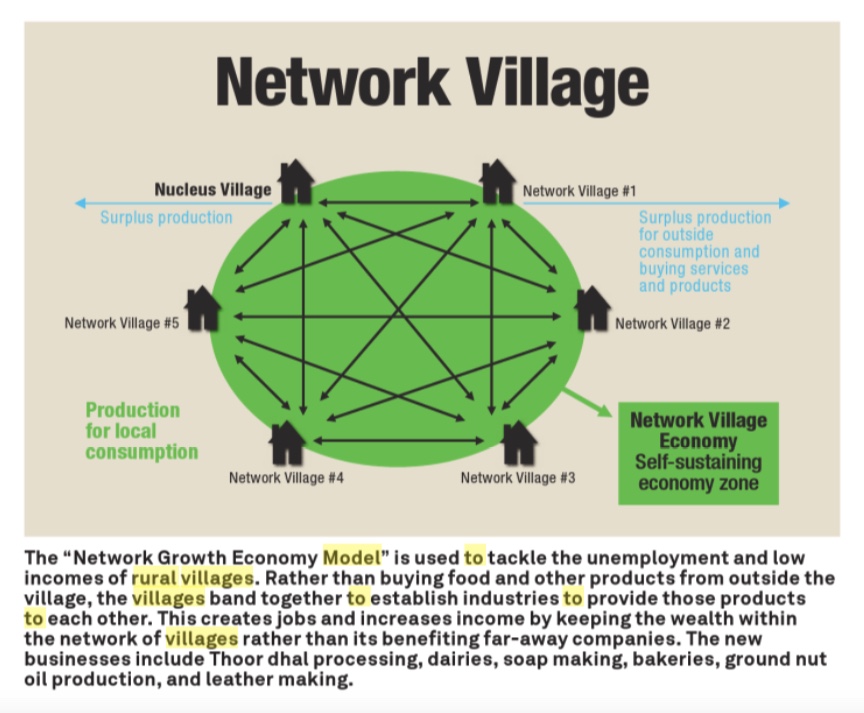
    Like a spreading ink spot, the concept is to create a network of like-minded villages that act as self-reinforcing positive role models, spreading the prosperity and stability outwards. The “Network Growth Economy Model” is a direct challenge to the “special economic zones that benefit only capitalist owners,” said Elango.

    Ambitious, Elango is hoping to draw in 2,000 villages over the next 10 years, until a tipping point is reached, and the model explodes across India.

    A native of the village, Elango became saddened by the community’s decline, including widespread domestic violence against women. The booming city of Chennai’s prosperity had not rippled out to the village, and it was still lacking good infrastructure and sanitation. A trained chemical engineer, he was elected the President of the Kuthambakkam Panchayat in 1996, and set about using his engineer’s perspective to draft the village’s five-year plan from 1996 to 2001.

    But the budget was tight. And he had to turn to innovative solutions: recycling building materials, conserving water and reducing electricity consumption. But the resourcefulness paid off, and the state of Tamil Nadu provided the money to upgrade roads, drains, build a community centre, child care facilities, 200 low cost toilets, and work sheds for the village’s industries. By the end of 2001, most basic needs were being met. He then turned to providing good quality housing for the villagers still living in thatch huts.

    He has used the “Network Growth Economy Model” to tackle the unemployment and low incomes. It works like this: rather than buying food and other products from outside the village, the villages band together to establish industries to provide those products to each other. This creates jobs and increases income by keeping the wealth within the network of villages, rather than it benefiting far-away companies. The new businesses include Thoor dhal processing, dairies, soap making, bakeries, ground nut oil production, and leather making.

    “India was strong when this model was in place – we had strong villages,” said Elango. “Globalization’s trickle down is not working for India.”
    Published: November 2008

    Resources

    • Unleashing India’s Innovation: Toward Sustainable and Inclusive Growth, a report by the World Bank. Website: http://web.worldbank.org/WBSITE/EXTERNAL/COUNTRIES/SOUTHASIAEXT/0,,contentMDK:21490203~pagePK:146736~piPK:146830~theSitePK:223547,00.html
    • NextBillion.net: Hosted by the World Resources Institute, it identifies sustainable business models that address the needs of the world’s poorest citizens. Website:http://www.wri.org
    • CIDEM and Ecosur specialise in building low-cost community housing using eco-materials. They have projects around the world and are based in Cuba. Website: http://www.ecosur.org

    Sponsored by BSHF. BSHF is now called World Habitat and it aims to seek out and share the best solutions to housing problems from around the world.

    https://davidsouthconsulting.org/2022/11/22/bio-ethanol-from-sturdy-and-once-unwanted-indian-plant/

    https://davidsouthconsulting.org/2022/09/29/cheap-indian-tablet-seeks-to-bridge-digital-divide/

    https://davidsouthconsulting.org/2022/10/09/entrepreneurs-use-mobiles-and-it-to-tackle-indian-traffic-gridlock/

    https://davidsouthconsulting.org/2021/08/29/indian-business-model-makes-green-energy-affordable/

    https://davidsouthconsulting.org/2022/10/25/indian-city-slum-areas-become-newly-desirable-places-to-live/

    https://davidsouthconsulting.org/2021/08/28/indian-entrepreneur-brings-dignity-to-poor-women/

    https://davidsouthconsulting.org/2021/03/04/indian-id-project-is-foundation-for-future-economic-progress/

    https://davidsouthconsulting.org/2022/10/18/indian-initiatives-to-make-travel-safer-for-women/

    https://davidsouthconsulting.org/2022/06/15/indian-mobile-phone-application-innovators-empower-citizens/

    https://davidsouthconsulting.org/2022/11/01/indian-newspapers-thrive-with-economy/

    https://davidsouthconsulting.org/2022/10/06/indian-solar-economy-brings-new-vocation-for-women/

    https://davidsouthconsulting.org/2022/10/06/indian-solar-power-pack-powers-villages/

    https://davidsouthconsulting.org/2022/10/25/indian-toilet-pioneer-champions-good-ideas/

    https://davidsouthconsulting.org/2022/10/18/indians-fighting-inflation-with-technology/

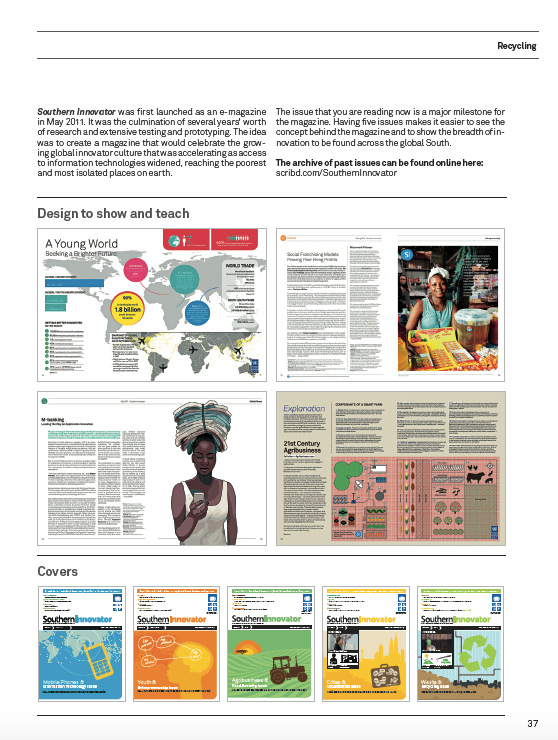
    Development Challenges, South-South Solutions was launched as an e-newsletter in 2006 by UNDP’s South-South Cooperation Unit (now the United Nations Office for South-South Cooperation) based in New York, USA. It led on profiling the rise of the global South as an economic powerhouse and was one of the first regular publications to champion the global South’s innovators, entrepreneurs, and pioneers. It tracked the key trends that are now so profoundly reshaping how development is seen and done. This includes the rapid take-up of mobile phones and information technology in the global South (as profiled in the first issue of magazine Southern Innovator), the move to becoming a majority urban world, a growing global innovator culture, and the plethora of solutions being developed in the global South to tackle its problems and improve living conditions and boost human development. The success of the e-newsletter led to the launch of the magazine Southern Innovator.

    https://davidsouthconsulting.org/2021/03/05/southern-innovator-issue-3/

    Creative Commons License

    This work is licensed under a
    Creative Commons Attribution-Noncommercial-No Derivative Works 3.0 License.

    ORCID iD: https://orcid.org/0000-0001-5311-1052.

    © David South Consulting 2023

  • A Partnership For Progress: UNDP In Mongolia 1997 | 19 January 2016

    A Partnership For Progress: UNDP In Mongolia 1997 | 19 January 2016

    A Partnership for Progress: The United Nations Development Programme in Mongolia

    Editor: David South

    Publisher: UNDP Mongolia Communications Office

    Published: 1997

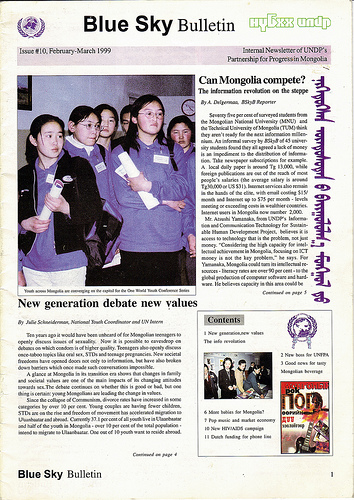
    Background: The Partnership for Progress brochure raised the curtain on UNDP’s programme in Mongolia and my work heading UNDP Mongolia’s Communications Office. I led the Office from 1997 to 1999, garnering awards and praise for the quality of the offline and online resources.

    A Partnership for Progress

    “For years we were under the domination of foreign countries. So really, Mongolia is a new nation.” With these words, Prime Minister M. Enkhsaikhan described the enormity of the task ahead for Mongolians. While Mongolia has been an independent nation for most of this century, this has not been the case with its economy. Just as a new democratic nation was born in the 1990s, so Mongolia’s economy lost the large subsidies and trading arrangements it had in the past with the Soviet Union. The time to learn about free markets and the global economy had arrived.

    Under socialism, Mongolia was dependent on the Soviet Union. Prior to the socialist revolution in 1921, the country experienced hundreds of years under the influence of the Chinese. It is only since 1990 that Mongolia has had an opportunity to build the foundations of an independent economy and political culture. But it takes money and know-how to make the transition work. This is the kind of nation-building support the United Nations Development Programme (UNDP) specializes in. UNDP’s fifth country plan for Mongolia has come to an end, and in cooperation with the Mongolian Government the sixth – the Partnership for Progress – has begun.

    Meeting the challenges of transition

    The international community rapidly responded to Mongolia’s needs in the early 1990s. Along with the large international donors, the UN system is playing a pivotal role with UNICEF, UNFPA, WHO and UNDP to assist in the country’s social reconstruction. Other agencies now operating in Mongolia include UNESCO, UNV, UNHCHR, World Bank and the IMF. The UN’s capacity to coordinate, not only within the UN family of organizations, but also with donors and the international NGO community has proved extremely useful in mobilizing the technical assistance needed at this critical time. The goal is capacity building, or the transformation of both the human and economic resource base to fit the economic and social demands of transition.

    UNDP’s Partnership for Progress with the Government of Mongolia serves as the framework for assisting the Government to combat the worst effects of poverty and social disintegration brought on by economic transition. The programmes and projects mounted with UNDP assistance not only tackle the lack of material resources, but also the dearth of practical experience in the strategies and methodologies required to nurture open government and encourage democratic procedures, protect human rights, preserve the environment and promote the private sector.

    Mongolia is a large country with poor infrastructure. This means it is not only difficult to transport food or make a phone call, but also to develop and deliver programmes that reach the entire country. It is through the expertise of the UNDP, drawing experience from around the world, that these obstacles to a market economy and an open democracy can be overcome.

    UNDP has had a country office in Mongolia since the 1970s. UNDP’s resource mobilization target for the five year programme from 1997 to 2001 is US $27.5 million, with 45 percent to be directed to poverty alleviation, 30 percent to governance and 15 percent to environmental protection. With this material input and the goodwill it generates, the Mongolian Government can design appropriate social and political structures to support their efforts in seeking lasting solutions to the problems brought on by transition. Mongolia can then become an equal player in the global community of the 21st Century.

    UNDP in Mongolia

    The UNDP’s programmes in Mongolia follow the global principle of helping people to help themselves. Through a close working relationship with the Mongolian Government (the Partnership for Progress), UNDP personnel work with many thousands of Mongolian counterparts in government, academia and NGOs all over the country. In addition, UNDP has a large contingent of United Nations Volunteers (UNVs) deployed in Mongolia. There are over 27 international UNVs working in all UNDP programme areas and further 26 national UNVs working as community activists to foster participation in the poverty alleviation programme. Another six national UNVs are involved in the UNESCO/UNDP decentralization project.

    A peaceful transition

    The transition in the 1990s from socialism to democracy and free markets has profoundly transformed the country’s political and economic character. Mongolia is a young democracy that is also a model for bloodless political revolution. Today, this participatory democracy boasts scores of newspapers, dozens of political parties and a vigorous parliamentary system. On the economic front, a command-based economy has been replaced by free markets. But there has been a high price to pay in social disintegration and dysfunction, as the former social supports disappear and their replacements fail to “catch” everyone. As with all social upheaval, vulnerable groups – the elderly, the young, the weak – bear the brunt of the social and economic shocks as the old gives way to the new.

    The bubble bursts

    Before the 1990s, the Mongolian economy was totally dependent on subsidies from the Soviet Union. The state owned all means of production and private enterprise was foresworn. Farmers and herders were organized into cooperatives. Factories had more workers than they needed. Wages were low but no one starved. The state provided for the basics of life – health care, education, jobs and pensions. Free fuel was provided to get through the severely cold winters, and during blizzards lives were saved in stranded communities with food and medicine drops by Russian helicopters.

    The bubble burst in 1991 when the Soviet Union disintegrated and the subsidies came to an end. Prior to this, communist countries accounted for 99 percent of Mongolia’s imports and 94 percent of its exports. Mongolia’s economy suddenly lost its buttress and immediately collapsed.

    A sense of freedom

    Although the economic picture was bleak, politically Mongolians rejoiced and embraced the principles of Western parliamentary democracy. A new sense of political and personal freedom took hold. Freedom of religion ensured a revival of Buddhism. Monasteries sacked and razed under the Communists were restored and religious observance once again became part of daily life.

    Collectivization began to give way to free markets and privatization. A voucher system was used to redistribute the assets of many state-owned entities. Each citizen was issued with vouchers to the value of 10,000 tugrigs (at the time worth US $100). They could be bought and sold like shares of stock.

    Livestock was privatized and previous limitations regarding ownership of animals were lifted. As a result, the composition of herds changed and the numbers of animals soared to the highest levels in 50 years. While the collapse of the state sector has led to severe hardship, many nomadic herders who astutely manage their herds are self-sufficient in meat and milk. Many continue the old energy saving ways, including collecting dung for fuel and using their animals for transport. Some find it possible to live almost completely outside the cash economy.

    Transition shock

    The spectre of the worst aspects of market economies soon loomed for many who had known only a poor but predictable life under a command economy. Suddenly unemployment, inflation and reduced services became the norm. Previously reliable export markets in the newly constituted Commonwealth of Independent States disappeared entirely, leaving a ballooning trade deficit and a plummeting tugrig. The fall in global prices for cashmere and copper have only exacerbated an already critical situation.

    Poverty strikes

    Poverty and starvation hit with a vengeance. According to Food and Agriculture Organization (FAO) figures, a third of the population now lives at starvation levels. The demise of collectivized farming has contributed to both a shortage of food and reduction in food self-sufficiency. Thousands of homeless children work, beg or steal in the streets of the capital, Ulaan Baatar. Many descend into the sewers for warmth to escape the subzero temperatures that prevail for most of the year, while others seek refuge in the few children’s shelters in the city.

    Unemployment is high. Women are particularly vulnerable, with more than 100,000 summarily removed from the pension rolls at the beginning of 1997. The retired, whose pensions have decreased dramatically in value are also in severe distress, with almost all relying on their families, friends and neighbours. Those without such support are left to live a precarious existence.

    Poverty alleviation

    To reverse a rapidly deteriorating situation, the Government instituted a six-year National Poverty Alleviation Programme (NPAP) with the primary objective of reducing poverty by 10 percent by the year 2000. Designed with assistance from UNDP, donors and Mongolian NGOs, the NPAP is founded on new principles unseen before in Mongolia. Responsibility is decentralized, with each of the 21 aimags (provinces) having a local Poverty Alleviation Council with responsibility for identification, formulation and appraisal and approval of projects. Thus the people of the area can respond to local needs – identify them, propose solutions to problems and act to determine their own futures.

    The Mongolian National Poverty Alleviation Programme addresses a wide range of social issues, including income poverty and the crisis in the health and education sectors. Solutions to such urgent social welfare problems are a high priority for the Mongolian Government – and international assistance is critical. The introduction of fees for health and education services that were previously free has placed an unbearable financial strain on some families. School drop-out rates and truancy are problems in both urban and rural areas. The costs associated with general maintenance and heating of public buildings adds another financial burden in the transition period.

    Emphasis on women

    A US $10 million soft loan from the World Bank for the period 1996 to 1999 supports Mongolia’s efforts to follow up on the commitments of the World Summit for Social Development, the Fourth World Conference for Women and other recent global initiatives.

    The NPAP institutional framework focuses on explicit measures to alleviate poverty by attending to sustainable livelihoods, employment creation, gender equality, grassroots development and human resource capacity building. Mongolia’s historically high levels of literacy, health care and education auger well for the future of this approach, in spite of the many obstacles facing the people.

    In addition, the Women’s Development Fund and the Social Assistance Fund have mobilized national NGOs and international donors for both income generation schemes and distress relief for the vulnerable. The success of women in actively implementing projects with the help of the various funds is a testament to the strength and resilience of ordinary Mongolians.

    Working with the National Poverty Alleviation Programme initiatives, the UN System Action Plan and Strategy provides technical assistance and capacity training to realize the objectives of the national programme.

    In all, eight new projects are on the agenda for 1997, including credit provision, skills and vocational training, water and sanitation provision, urban renewal, pre-school education and one capacity building project at the institutional level.

    Freedom of information

    Under the Partnership for Progress, UNDP is working with donors and international NGOs to promote and foster a participatory democracy. A key component of good government and democracy is the free flow of information. That is why UNDP has placed a significant portion of its resources into ensuring government, NGOs and citizens have access to the state-of-the-art computer communications technology, especially the Internet and e-mail. The Governance and Economic Transition Programme will have nine new projects by the end of 1997: seven to support national reforms in government and the civil service, two to support journalists as they come to grips with their new responsibilities in a democratic society, and one in the tertiary education sector, following a series of faculty-strengthening education projects that have been ongoing since the early 1990s.

    The Consolidation of Democracy through Strengthening of Journalism project offers direct support to working journalists.

    Six journalism centres throughout the country offer hands-on training courses and access to news and information from international and Mongolian sources.

    At the aimag level, Citizen Information Service Centres will be custom tailored to the information needs of each aimag’s residents. These centres will increase the free flow of information from the capital, which is currently hampered by poor communications infrastructure.

    Decentralization, governance and economic transition

    The Government has wisely foreseen the need to engage in a fundamental shift in how Mongolia is governed. Not only should it provide institutions that can address the social and economic shocks of the 1990s, but it also must provide a stable and efficient policy to ensure a prosperous and secure future for Mongolia.

    Decentralization in government administration is a cornerstone of the Government’s policy to make managers of public services more responsive to local people’s needs. In an ambitious programme to decentralize and consolidate democracy in Mongolia, the Government has promised to devolve decision-making more and more to the local level. The UNDP plays a key role in ensuring this process continues and that local politicians acquire the skills necessary to handle these new responsibilities.

    A respect for nature

    Mongolia’s flora, fauna and unspoiled landscapes are at a watershed. Mongolians have traditionally had a respect for the natural environment as a source of food and shelter from the harsh climate. These close ties have meant that environmental preservation and respect for nature form an integral part of cultural traditions. As far back as the reign of Chingis Khan in the 13th century, Mongolia has had nature reserves. The new social and economic imperatives have put a strain both on these traditions and the environment, with a corresponding stress on Mongolians.

    Semi-nomadic herding still forms the backbone of the country, and the pressures of the 90s have only re-enforced this. Many Mongolians have turned to herding as the only guarantee of a steady supply of food and economic well-being.

    The environment is regularly challenged by natural disasters. In 1996, a rash of forest fires destroyed large swathes of land and caused extensive economic and environmental damage. Floods, heavy snowfall, extremely low temperatures, strong winds, dust storms, and earthquakes are all natural hazards for Mongolia.

    Keeping Mongolia green

    UNDP’s mandate in environmental protection and preservation is reflected in its support to the Government. As Mongolia addresses the challenge of up-holding international conventions to which it is signatory, it must sustain and preserve a decent and dignified lifestyle for all its citizens.

    In the area of disaster management, the Government is emphasizing preventative measures as much as relief. UNDP support is focused on an extensive campaign for preparedness, technical support and capacity building to deal with both natural and man-made disasters.

    The flagship programme for the environment is the Government’s Mongolia Agenda for the 21st Century (MAP 21). The Government’s continuing biodiversity programme, under the auspices of the Global Environment Fund (GEF), has already shown results, with the on-going mapping of the country’s biodiversity for future generations.

    Two new projects were initiated in 1997: the Sustainable Development Electronic Information Network reaches out to people in remote and isolated locations. The Energy Efficient Social Service Provision Project has introduced straw-bale construction, an environmentally-friendly, energy-efficient and pollution-reducing building technology. This technology uses straw for insulation within the walls of buildings. Schools and health clinics will be built with straw insulation by work crews trained by the project.

    The environmental challenges Mongolia faces are acknowledged by the world community as both requiring a global and a national commitment. UNDP acts as conduit for a number of globally-supported programmes focused on local action. The axiom “think globally, act locally” is the principle guiding the UNDP/Mongolian Partnership for Progress’ environmental activities.

    “A Partnership for Progress: The United Nations Development Programme in Mongolia”: UNDP Mongolia Communications Office, 1997

    Note: Mongolia was experiencing ‘shock therapy’ during the 1990s, as well as austerity, in response to the collapse in subsidies and state supports when trade relationships with the Soviet Union ended.

    Find in a library:

    Worldcat.org: A partnership for progress : the United Nations Development Programme in Mongolia, UNDP Mongolia Communications Office, 1997

    OCLC Number / Unique Identifier: 1248070177

    Creative Commons License
    This work is licensed under a
    Creative Commons Attribution-Noncommercial-No Derivative Works 3.0 License.

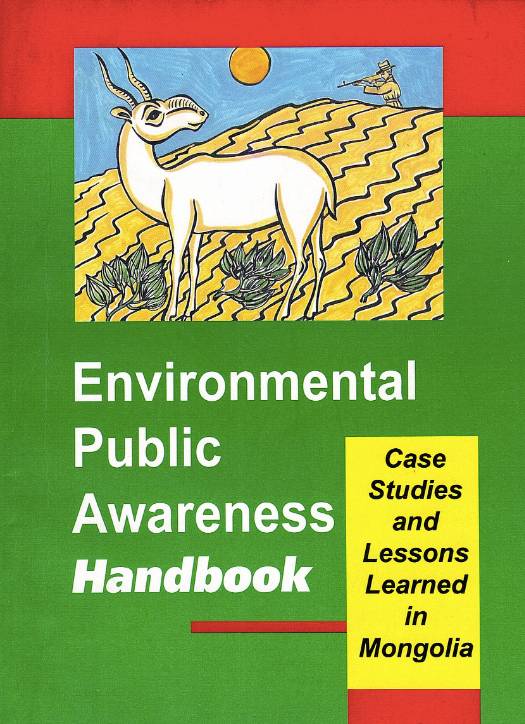
    Publications produced by the Partnership for Progress (1997-1999):

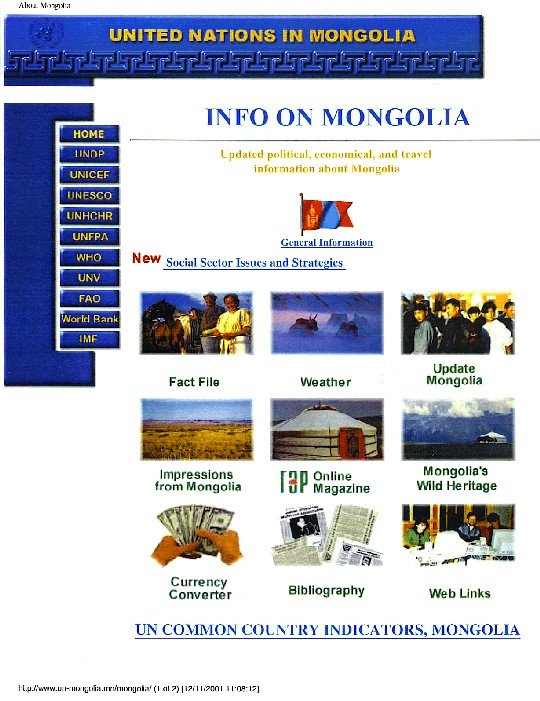
    Online media produced by the Partnership for Progress (1997-1999):

    Works citing Partnership for Progress (1997-1999):

    ORCID iD: https://orcid.org/0000-0001-5311-1052.

    © David South Consulting 2021

  • Crowdsourcing Mobile Phones To Make The Poor Money

    Crowdsourcing Mobile Phones To Make The Poor Money

    By David SouthDevelopment Challenges, South-South Solutions

    SOUTH-SOUTH CASE STUDY

    The proliferation of mobile phones across the global South, reaching even the poorest places on the planet, has given birth to whole new ways of making money. A phenomenon called ‘crowdsourcing’ – in which the power of individuals is harvested to achieve a goal – is now being used to create networks of people earning extra income.

    One technology called Txteagle (http://txteagle.com/index.html), works like this: somebody performs small tasks with their mobile phone, such as translating a document into a local language, and in return receives credits or cash, so-called ‘micro-payments.’ By having many people perform these tasks in their spare time or down time at work, a large project can be completed and people can top-up their income. The secret is that the task must be able to be broken up into bite size chunks: the elephant must be eaten with a small fork.

    For the poor, or people who are just getting by in a poor country, this can be a much-needed survival top-up in hard economic times. It is also an opportunity for people normally frozen out of formal employment opportunities or living in slum conditions.

    Txteagle is being pioneered in Kenya using text messages or a low bandwidth, interactive protocol known as USSD (http://en.wikipedia.org/wiki/USSD) (usually used to check prepaid phone balances).

    The rapid growth in take-up has made mobile phones the big success story of the 21st century. With such reach, finding new applications for mobile phones that are relevant to the world’s poor and to developing countries is a huge growth area. It is estimated that by 2015, the global mobile phone content market could be worth over US $1 trillion: relegating basic voice phone calls to just 10 percent of the way people use mobile phones.

    The technological success story of mobile phones is impressive: China is home to the same number of mobile-phone users (surpassing 650 million in 2009) as the whole of Europe. According to India’s telecoms regulator (http://www.trai.gov.in/Default.asp), half of all urban dwellers now have mobile – or fixed – telephone subscriptions and the number is growing by eight million a month. In Tanzania, mobile phone use grew by 1,600 percent between 2002 and 2008.

    Txteagle is the brainchild of Nathan Eagle of EPROM (Entrepreneurial Programming and Research on Mobiles) (http://eprom.mit.edu/ ). He works on developing new mobile phone applications with computer science departments in 10 Sub-Saharan African countries including: the University of Nairobi (http://www.uonbi.ac.ke/) (Kenya), Makerere University (http://mak.ac.ug/makerere/) (Uganda), GSTIT (http://www.gstit.edu.et/) (Ethiopia), Ashesi University (http://www.ashesi.org/) (Ghana), and the Kigali Institute of Science and Technology (http://www.kist.ac.rw/) (Rwanda).

    Eagle has pioneered Txteagle in Nairobi, Kenya with students at the University of Nairobi. Drawing on his experience in East Africa, where he has lived since 2006, Eagle has a powerful message about mobile phones in the South. “This is their technology. The mobile phone is theirs,” he told a conference in March of this year. “It has had a far greater impact on their lives than it has on ours.”

    Eagle says typical Txteagle users are “literate people in Nairobi who have significant idle time, like taxi drivers, security guards” or high school students. Like many Southern countries, Kenya has a plethora of languages: 62 in all. It can be laborious and costly to translate into all these languages. But by using crowd-sourcing on mobile phones, mobile phone company Nokia’s (www.nokia.com) phone menus have been translated into 15 local languages.

    Already there are more people wanting to earn money this way than there are tasks to do. Eagle has had to cap payments at US $1.50 a day. The service needs to grow, and it is looking to offer people in the United States the opportunity to have easily broken-up tasks done in Kenya. Eagle believes his algorithms (http://en.wikipedia.org/wiki/Algorithm) ensure a 95-percent accuracy rate. One possible market is the US $15 billion medical transcription industry.

    Kenya, a nation of 32 million, relies on its small business sector for most employment. In 2005, the government’s Economic Survey (www.cbs.go.ke/) found the small business sector created 437,900 jobs – mostly because of the boom in mobile phones. According to the Massachusetts Institute of Technology (MIT), adding an additional 10 mobile phones per 100 people boosts a typical developing country’s GDP growth by 0.6 percent. The boost comes from the innovative use of mobile phone technology by local entrepreneurs.

    Kenya is making significant headway on innovating with mobile phones. Already, 30 percent of Kenyans pay for their electricity with their mobile phones instead of waiting in line.

    “We have transformed the majority of phones in East Africa into a platform that people can use to make money,” Eagle told the conference. “There are 15 million Africans ready to start working on their mobile phones.”

    By David South, Development Challenges, South-South Solutions

    Published: July 2009

    Development Challenges, South-South Solutions was launched as an e-newsletter in 2006 by UNDP’s South-South Cooperation Unit (now the United Nations Office for South-South Cooperation) based in New York, USA. It led on profiling the rise of the global South as an economic powerhouse and was one of the first regular publications to champion the global South’s innovators, entrepreneurs, and pioneers. It tracked the key trends that are now so profoundly reshaping how development is seen and done. This includes the rapid take-up of mobile phones and information technology in the global South (as profiled in the first issue of magazine Southern Innovator), the move to becoming a majority urban world, a growing global innovator culture, and the plethora of solutions being developed in the global South to tackle its problems and improve living conditions and boost human development. The success of the e-newsletter led to the launch of the magazine Southern Innovator.  

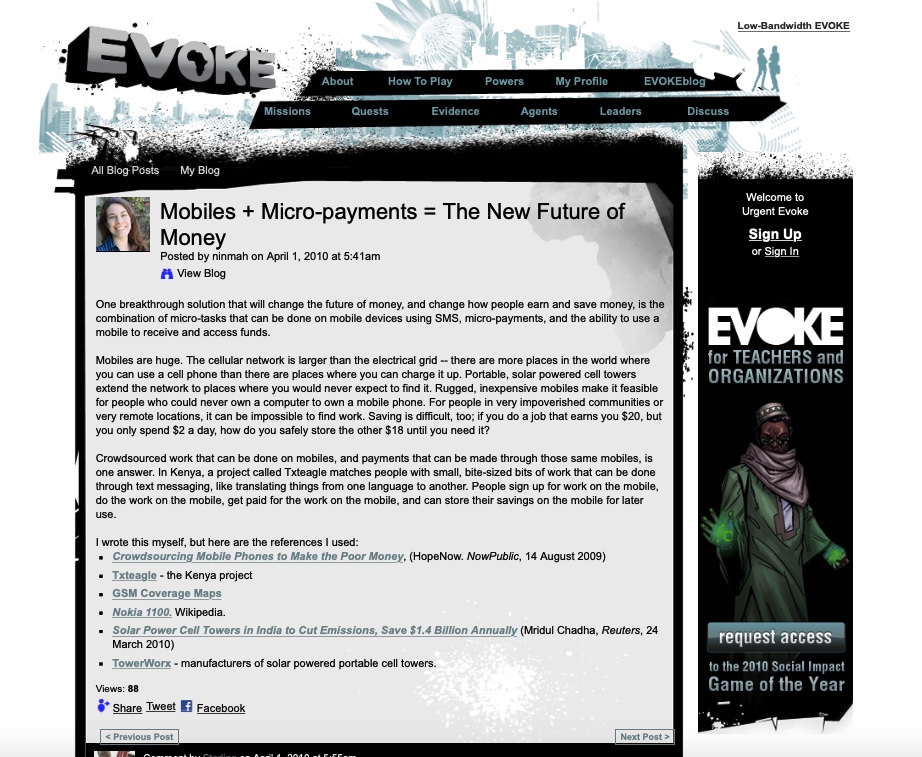
    In 2010 the story was cited in Evoke’s Mobiles + Micro-payments = The New Future of Money (April 1, 2010).

    Follow @SouthSouth1

    Google Books: https://books.google.co.uk/books?id=_bgpEldq9JsC&dq=development+challenges+july+2009&source=gbs_navlinks_s

    Slideshare: http://www.slideshare.net/DavidSouth1/development-challengessouthsouthsolutionsjuly2009issue

    Southern Innovator Issue 1: https://books.google.co.uk/books?id=Q1O54YSE2BgC&dq=southern+innovator&source=gbs_navlinks_s

    Southern Innovator Issue 2: https://books.google.co.uk/books?id=Ty0N969dcssC&dq=southern+innovator&source=gbs_navlinks_s

    Southern Innovator Issue 3: https://books.google.co.uk/books?id=AQNt4YmhZagC&dq=southern+innovator&source=gbs_navlinks_s

    Southern Innovator Issue 4: https://books.google.co.uk/books?id=9T_n2tA7l4EC&dq=southern+innovator&source=gbs_navlinks_s

    Southern Innovator Issue 5: https://books.google.co.uk/books?id=6ILdAgAAQBAJ&dq=southern+innovator&source=gbs_navlinks_s

    Creative Commons License
    This work is licensed under a
    Creative Commons Attribution-Noncommercial-No Derivative Works 3.0 License.

    ORCID iD: https://orcid.org/0000-0001-5311-1052.

    © David South Consulting 2023

  • Creative Use of Wi-Fi to Reach the Poor

    Creative Use of Wi-Fi to Reach the Poor

    By David SouthDevelopment Challenges, South-South Solutions

    SOUTH-SOUTH CASE STUDY 

    In 2003 former UN Secretary-General Kofi Annan called for greater access to wi-fi, or wireless internet networks, as a mechanism to help poorer regions catch up with the pace of technological change in developed countries. Wireless networks remove the need to lay costly wires and can quickly bring fast and convenient internet access to large populations currently denied access. By removing the need to lay lots of cables to get communities online, wireless could help poorer nations narrow the digital divide and catch up with countries where the technology has already taken hold. Social entrepreneurs are stepping in to fill the gap between the promise of wi-fi and the reality.

    A contemporary take on the mobile library, where a bus travels to remote or under serviced areas to lend books, is being used to bring wi-fi and web content to remote villages in India, Rwanda, Cambodia and Paraguay lacking internet access. United Villages and its subsidiary First Mile Solutions cleverly targets only the content the villagers really want and then provides it to them for a fee. Using a fleet of buses and motorcycles, they upload in the city before going to the countryside popular pages and pages previously requested. “There’s only 0.003 percent of the web that rural Indians care about,” founder Amir Hassan told the BBC. “They want to know the cricket scores, they want to see the new Aishwarya Rai photos, and they want to hear a sample of the latest Bollywood tunes.”

    Once in the countryside, a small box with an antenna onboard the buses or a motorcycle communicates with the rural computers, sometimes up to six times a day. Special content requests can be made for a few rupees, and emails are collected and delivered. Not only do the buses deliver web content, they also act as a courier service, picking up and delivering products ordered via the web for the villagers. “We-re bringing e-commerce to rural India,” said Hassan.

    “My objective is to show to the village youth that having a PC with connectivity is a viable business, so that more and more unemployed youth can take up this as a self-employment opportunity,” remarks villager Raj Kishor Swain, who helps with United Villages.

    Green WiFi, based in San Francisco, has a simple aim: to provide children in developing countries with access to the internet. But the difference is that they have developed a solution to the biggest problem in most remote regions: reliable electricity supply. Their invention is intended to partner with the US $100 laptop computers being rolled out in the developing countries by the One Laptop Per Child Project. Green WiFi has developed a low cost, solar-powered, standardized wi-fi access solution that runs out-of-the-box with no systems integration or power requirements. All that is required is a single source of broadband access and light.

    In a further boost to internet access in Africa, the World Bank is also funding US $164.5 million in high-speed internet access for Kenya, Burundi and Madagascar to boost regional competitiveness. Eastern and much of Southern Africa is the only region in the world not connected to the global broadband infrastructure.

    Resources

    • The Wireless Internet Institute was launched in 2001 as an international think tank where stakeholders explore wireless Internet technologies, best practices and sustainable implementation models. W2i is a World Times, Inc. initiative addressing the regulatory, business and integration complexities associated with the deployment of wireless Internet technologies.
    • The World Dialogue on Regulation for Network Economies is concerned with regulation and governance for network economies. They conduct research, facilitate online dialogue and discussion among experts, and publish and distribute papers, reports and other relevant information.
    • I-Genius: I-genius is a world community of social entrepreneurs and seeks to inspire a new generation of social innovators. They hope to encourage partnerships across geographical and cultural boundaries, by building partnerships between social businesses and wider stake holders, governments, corporations, NGOs, investors and the media.
    • A blog linking technology and social entrepreneurs: Click here
    • Social Edge: a web portal for social entrepreneurs by social entrepreneurs
    Creative Commons License

    This work is licensed under a
    Creative Commons Attribution-Noncommercial-No Derivative Works 3.0 License.