Categories
Archive Development Challenges, South-South Solutions Newsletters Southern Innovator magazine

Innovative Stoves to Help the Poor

By David SouthDevelopment Challenges, South-South Solutions

SOUTH-SOUTH CASE STUDY

Half of the world’s population cook with a fuel-burning stove, and this figure rises to 80 per cent of households in rural areas in developing countries. Typical fuels burned include wood, coal, crop leftovers and animal dung. The indoor pollution from smoke and carbon monoxide is a top health hazard in the developing world, ranking just behind dirty water, poor sanitation and malnutrition. The World Health Organization (WHO) estimates that 1.6 million people die each year as a result of toxic indoor air.

A landmark five-year study comparing Guatemalans cooking on open fires, to those using improved stoves, has brought more evidence forward of the damage done by indoor air pollution: “It’s been shown that children living in houses using open fires with solid fuels will have more pneumonia than children living in houses that are using cleaner fuels,” said Dr. Kirk R. Smith, an environmental health scientist at the University of California, Berkeley.

The research, combined with studies in Asia, suggests additional health problems from indoor air pollution, including higher frequency of cataracts, partial blindness, tuberculosis, low birth weights and high blood pressure. The researchers found that cleaner stoves had larger effects than reducing salt in the diet or lowering blood pressure in women, with the results published last July in Environmental Health Perspectives.

But Southern innovators are finding practical ways to curb pollution from indoor cooking and the burning of trash in slums.

In Yunnan Province, China, entrepreneur Hao Zheng Yi’s Yunnan Zhenghong Environmental Protection Co. has been selling clean-burning stoves to rural farmers. One fifth of rural China has no electricity (UN), and 80 per cent rural dwellers burn wood or straw in ovens for heating and cooking. This creates heavy indoor air pollution, damaging health.

The so-called Efficient Gasification Burning system combines traditional fuel and natural gas: a hybrid that helps low-income households to affordably use the stove and not pollute their indoor air.

The stoves are sold for a profit in Yunnan Province, and so far 50,000 have been sold. Because the ovens are sold for a profit, Zhenghong had to consult extensively with the farmers in the design phase to make sure the ovens meet their needs.

The result has been that Zhenghong ovens run for five to eight years using the same amount of wood and hay a conventional oven burns in one year.

Another source of air pollution is burning trash in slums. The lack of formal trash removal services in slums has two bad consequences: one is the pollution and poison from rotting rubbish leaching into the soil and water table; the other is ad-hoc burning of the trash to get rid of it, which pollutes the air with a toxic, acrid stench. In Nairobi’s Kibera slum – the second biggest in Africa – over 60 per cent of the city’s residents live in the slum, and are bypassed by garage collection services. Garbage is piled up along the muddy roads and paths, or hangs in the trees.

The Kenyan NGO Umande Trust, which specialises in water and sanitation projects, has developed a home-grown method to burn trash and avoid having to turn to very expensive and complicated incinerators from Europe. The sheer quantity of trash that needs to be burned in the slum means smaller solutions will not be able to handle the problem.

Its “community cooker” re-uses garbage from the community as fuel for a boiler and oven attached to it. The heat generated by burning the rubbish provides hot water and cooking facilities – and also jobs for unemployed youths who collect the rubbish and stock the incinerator. It was developed by a Kenyan architect, and it is hoped the “community cooker” will be taken up across Africa.

The community cooker’s inventor, Kenyan architect Jim Archer, took eight years to design and build it: “My thinking was how do we get rid of the rubbish and …how can we induce people to pick it up. Then I thought, well if we can convert it to heat on which people can cook…” he told Australia’s ABC News.

Similar industrial scale trash incinerators can cost between US $50 million to US $280 million (World Bank) – “…when applying waste incineration, the economic risk of project failure is high…”. The community cooker on the other hand, will sell for US $10,000.

The idea was to create an incinerator that was simple to use and repair: something that the commercially available, computer-controlled incinerators were not able to do. As the cooker gets up to speed, it will be able to burn 60 per cent of the slum’s trash.

Local youth go house-to-house collecting trash. They get money from the slum residents for this. Rubbish is then exchanged for cooking time or hot water for washing.

“The trash has started to help us a bit after the cooker came. There are fewer diseases like diarrhea and the environment has improved. … I think burning the rubbish will bring good health to this community,” said Patricia Ndunge, as she fried onions on the cooker.

And it looks like the community cooker has a future: Kenya’s largest supermarket, Nakumatt, has pledged to pay for 20 more slum cookers.

Published: March 2008

Resources

  • Envirofit: A Shell Foundation supported project to produce 300,000 clean, wood-burning stoves for the developing world (starting with India, Brazil, Kenya and Uganda). Envirofit will offer a variety of sleek ceramic stoves from single to multipot, with and without chimneys, and with colors like apple red, baby blue and gold. The cost is to start at $10 to $20 and run to $150 to $200.
    Website: http://www.envirofit.org/

Follow @SouthSouth1

Slideshare: http://www.slideshare.net/DavidSouth1/development-challengessouthsouthsolutionsnovember2010issue

Southern Innovator Issue 1: https://books.google.co.uk/books?id=Q1O54YSE2BgC&dq=southern+innovator&source=gbs_navlinks_s

Southern Innovator Issue 2: https://books.google.co.uk/books?id=Ty0N969dcssC&dq=southern+innovator&source=gbs_navlinks_s

Southern Innovator Issue 3: https://books.google.co.uk/books?id=AQNt4YmhZagC&dq=southern+innovator&source=gbs_navlinks_s

Southern Innovator Issue 4: https://books.google.co.uk/books?id=9T_n2tA7l4EC&dq=southern+innovator&source=gbs_navlinks_s

Southern Innovator Issue 5: https://books.google.co.uk/books?id=6ILdAgAAQBAJ&dq=southern+innovator&source=gbs_navlinks_s

Creative Commons License

This work is licensed under a
Creative Commons Attribution-Noncommercial-No Derivative Works 3.0 License.

ORCID iD: https://orcid.org/0000-0001-5311-1052.

© David South Consulting 2023

Categories
Archive Development Challenges, South-South Solutions Newsletters Southern Innovator magazine

African Megacity Makeovers Tackle Rising Populations

By David SouthDevelopment Challenges, South-South Solutions

SOUTH-SOUTH CASE STUDY

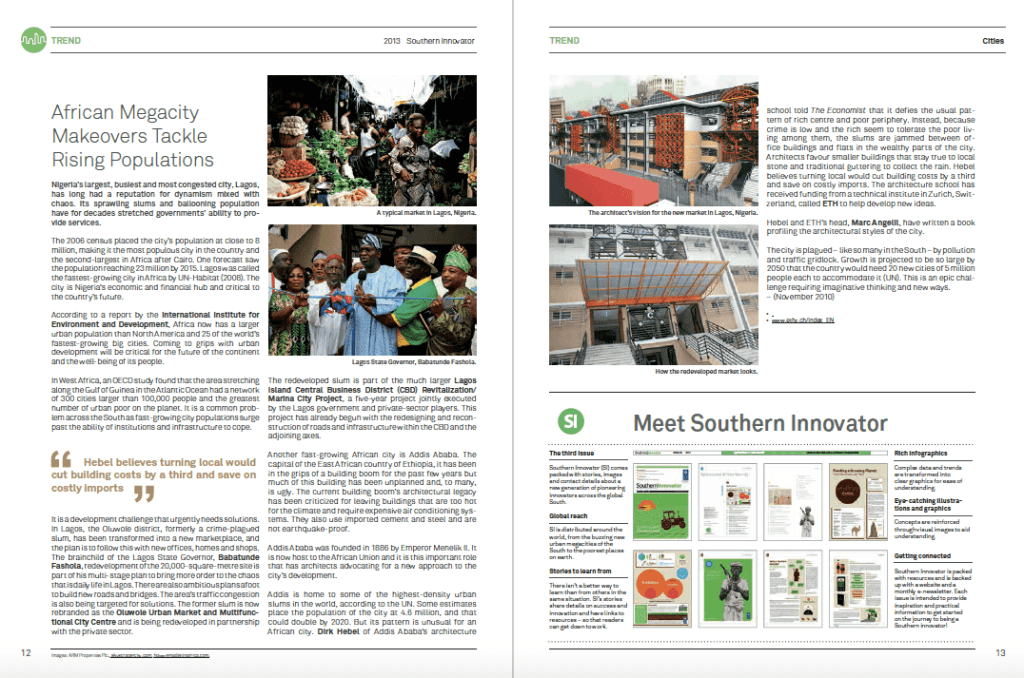
Nigeria’s largest, busiest and most congested city, Lagos, has long had a reputation for dynamism mixed with chaos. Its sprawling slums and ballooning population have for decades stretched governments’ ability to provide services.

The 2006 census placed the city’s population at close to 8 million, making it the most populous city in the country and the second largest in Africa after Cairo. One forecast saw the population reaching 23 million by 2015. It was called the fastest growing city in Africa by UNHABITAT (2008). The city is Nigeria’s economic and financial hub and critical to the country’s future.

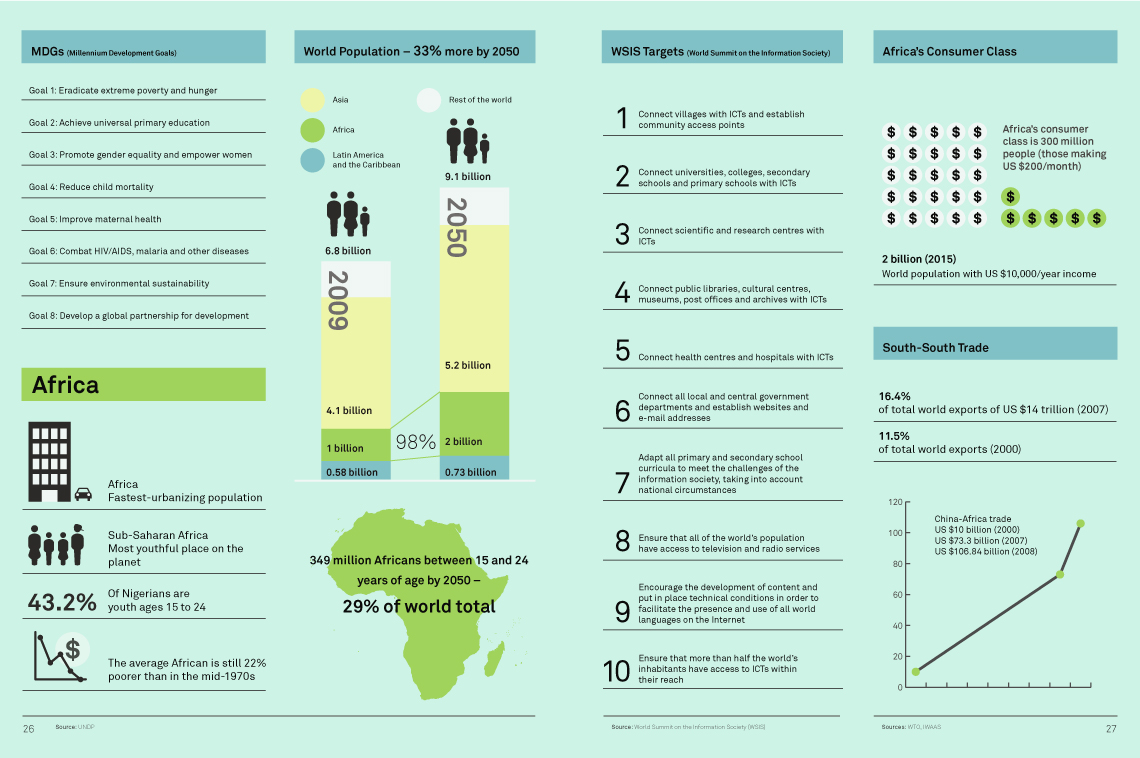
According to a report by the International Institute for Environment and Development, Africa now has a larger urban population than North America and 25 of the world’s fastest growing big cities. Getting to grips with urban development will be critical for the future of the continent and the wellbeing of its people.

In West Africa, an OECD study found the area stretching along the Gulf of Guinea in the Atlantic Ocean had a network of 300 cities larger than 100,000 people and the biggest collection of urban poverty on the planet.

It is a common problem across the South as fast-growing city populations surge past the ability of institutions and infrastructure to cope.

By 2025, Asia could have 10 or more cities with populations larger than 20 million (Far Eastern Economic Review).

It is a development challenge that urgently needs solutions.

In Lagos, the Oluwole district – formerly a crime-plagued slum – has been transformed into a new marketplace, and the plan is to follow this with new offices, homes and shops. The brainchild of the Lagos state governor Babatunde Fashola (http://en.wikipedia.org/wiki/Babatunde_Fashola), redevelopment of the 20,000 square metre site is part of his multi-stage plan to bring more order to the chaos that is daily life in Lagos. There are also ambitious plans afoot to build new roads and bridges. The area’s traffic congestion is also being targeted for solutions. The former slum is now re-branded as the Oluwole Urban Market and Multifunctional City Centre (http://tinyurl.com/2wmrscq) and is being re-developed in partnership with the private sector.

The re-developed slum is part of the much-larger Lagos Island Central Business District (CBD) Revitalisation/Marina City Project, a five-year project, jointly executed by the Lagos government and private sector players. This project has already begun with the redesigning and reconstruction of roads and infrastructure within the CBD and the adjoining axes.

Another fast-growing African city is Addis Ababa. The capital of the East African nation of Ethiopia, it has been in the grip of a building boom for the past few years. But much of this building has been unplanned and, to many, is ugly. The current building boom’s architectural legacy has been criticized for leaving buildings that are too hot for the climate and require expensive air conditioning systems. They also use imported cement and steel and are not earthquake-proof.

Addis Ababa (http://en.wikipedia.org/wiki/Addis_Ababa) was founded in 1886 by Emperor Menelik II. It is now host to the African Union (http://www.africa-union.org/) and it is this important role that has architects advocating for a new approach to the city’s development.

Addis is home to some of the highest density urban slums in the world, according to the UN. Some estimates place the population at of the city at 4.6 million people and that it could double by 2020. But its pattern is unusual for an African city. Dirk Hebel of Addis Ababa’s architecture school  (http://www.eiabc.edu.et/managing-board/scientific-director.html) told The Economist it defies the usual pattern of rich centre and poor periphery. Instead, because crime is low and the rich seem to tolerate the poor living among them, the slums are jammed between office buildings and flats in the wealthy parts of the city.

Architects favour smaller buildings that stay true to local stone and traditional guttering to collect the rain. Hebel believes turning local would cut building costs by a third and save on costly imports.

The architecture school has received funding from a technical institute in Zurich, Switzerland called ETH (http://www.ethz.ch/index_EN) to help develop new ideas.

Hebel and ETH’s head, Marc Angelil, have written a book profiling the architectural styles of the city. The city has gone through various phases: during its Marxist period (1974-1991) government buildings mimicked the Soviet Union. During the Italian fascist occupation (1935-1941) they followed the styles favoured by Italian dictator Benito Mussolini. Political problems aside, the architects believe the Italians brought good planning, allowing streets to radiate out from landmark buildings.

The city is plagued – like so many in the South – by pollution and traffic gridlock. Growth is on projection to be so large by 2050, the country would need 20 new cities of 5 million people each to accommodate it (UN). This is an epic challenge requiring imaginative thinking and new ways.

Published: November 2010

https://davidsouthconsulting.org/2022/10/17/ambitious-schemes-hope-to-advance-economic-development/

https://davidsouthconsulting.org/2020/04/22/artists-fear-indifference-from-megacity/

https://davidsouthconsulting.org/2020/12/04/big-data-can-transform-the-global-souths-growing-cities/

https://davidsouthconsulting.org/2022/10/19/chinese-building-solution-for-rapidly-urbanizing-global-south/

https://davidsouthconsulting.org/2021/10/21/cities-for-all-shows-how-the-worlds-poor-are-building-ties-across-the-global-south/

https://davidsouthconsulting.org/2020/12/11/cyber-cities-an-oasis-of-prosperity-in-the-south/

https://davidsouthconsulting.org/2021/11/04/filipino-architect-wants-to-transform-slum-with-new-plan/

https://davidsouthconsulting.org/2022/03/20/global-south-eco-cities-show-how-the-future-can-be/

https://davidsouthconsulting.org/2021/11/12/global-souths-rising-megacities-challenge-idea-of-urban-living/

https://davidsouthconsulting.org/2022/09/28/model-cities-across-the-south-challenge-old-ways/

https://davidsouthconsulting.org/2022/10/10/more-futuristic-african-cities-in-the-works/

https://davidsouthconsulting.org/2021/11/12/new-cities-offering-solutions-for-growing-urban-populations/

https://davidsouthconsulting.org/2017/11/08/smart-cities-up-close-2013/

https://davidsouthconsulting.org/2021/10/22/south-south-cooperation-for-cities-in-asia/

https://davidsouthconsulting.org/2020/04/22/will-the-megacity-mean-mega-privatization/

Development Challenges, South-South Solutions was launched as an e-newsletter in 2006 by UNDP’s South-South Cooperation Unit (now the United Nations Office for South-South Cooperation) based in New York, USA. It led on profiling the rise of the global South as an economic powerhouse and was one of the first regular publications to champion the global South’s innovators, entrepreneurs, and pioneers. It tracked the key trends that are now so profoundly reshaping how development is seen and done. This includes the rapid take-up of mobile phones and information technology in the global South (as profiled in the first issue of magazine Southern Innovator), the move to becoming a majority urban world, a growing global innovator culture, and the plethora of solutions being developed in the global South to tackle its problems and improve living conditions and boost human development. The success of the e-newsletter led to the launch of the magazine Southern Innovator.  

Follow @SouthSouth1

Slideshare: http://www.slideshare.net/DavidSouth1/development-challengessouthsouthsolutionsnovember2010issue

Southern Innovator Issue 1: https://books.google.co.uk/books?id=Q1O54YSE2BgC&dq=southern+innovator&source=gbs_navlinks_s

Southern Innovator Issue 2: https://books.google.co.uk/books?id=Ty0N969dcssC&dq=southern+innovator&source=gbs_navlinks_s

Southern Innovator Issue 3: https://books.google.co.uk/books?id=AQNt4YmhZagC&dq=southern+innovator&source=gbs_navlinks_s

Southern Innovator Issue 4: https://books.google.co.uk/books?id=9T_n2tA7l4EC&dq=southern+innovator&source=gbs_navlinks_s

Southern Innovator Issue 5: https://books.google.co.uk/books?id=6ILdAgAAQBAJ&dq=southern+innovator&source=gbs_navlinks_s
https://davidsouthconsulting.org/2021/03/05/southern-innovator-issue-4/

Creative Commons License
This work is licensed under a
Creative Commons Attribution-Noncommercial-No Derivative Works 3.0 License.

ORCID iD: https://orcid.org/0000-0001-5311-1052.

© David South Consulting 2022

Categories
Archive Blogroll Development Challenges, South-South Solutions Newsletters Southern Innovator magazine

Rammed-Earth Houses: China Shows how to Improve and Respect Traditional Homes

By David SouthDevelopment Challenges, South-South Solutions

(Havana, Cuba), November 2008

SOUTH-SOUTH CASE STUDY

The pace of change across the South has been blistering. Over the past decade, the overall population has moved from being primarily rural to majority urban. In the process, rural communities have suffered, as they have seen their young and ambitious leave in droves seeking a better life in cities.

More than 200 million Chinese farmers have moved to cities in recent years. It’s easy to see why. Chinese farms are tiny, with the average rural household farming just 0.6 hectares. And incomes are low compared to the cost of living: average annual income was just US$606 in 2007, a third of city salaries.

But it is possible to improve the quality of life in rural areas and in turn boost economic fortunes.

In China, projects that upgrade homes to modern standards while respecting traditional designs and architecture are breathing new life into rural communities. A return to the age-old technique of using earth as the principal building material is saving energy and keeping house costs low.

The tradition of packing earth to build a wall dates back to some of the earliest stretches of the Great Wall of China in 220 BC.

Currently it is estimated that half the world’s population-approximately 3 billion people on six continents – lives or works in buildings constructed of earth.

This traditional building technique is being used in the reconstruction effort to build new homes after the May 12, 2008 earthquake in Sichuan Province. The earthquake left millions of people homeless in the country’s worst natural disaster in 30 years, and has made low-cost but efficient house building critical.

In western China, villages have been entirely rebuilt from scratch. The application of research and science to the traditional designs – roofs in the pagoda style, with buildings arranged around courtyards – enabled the development of homes that are energy efficient to run, and are more hygienic and earthquake safe. In Yongren County of Yunnan Province, over 7,000 mountain dwellers were moved to better farming land and over 2,000 homes were built in the new village of BaLaWu. Over 30 of the homes were built using rammed earth by the Xi-an team. 

“The original homes had very low living quality,” said team member Hu Rong Rong of the Green Building Research Centre of Xi’an University of Architecture and Technology (http://www.xauat.edu.cn/jdeg/about.html), which oversees building of the new homes. “The architecture layout of the indoor space and courtyard was not reasonable. In the courtyard the areas for living, raising livestock, storing and processing crops were mixed up. The indoor environment was not comfortable. It was cold in the houses during winter and hot during summer. Most of the rooms lacked natural lighting and were dark in the daytime.

“In the poor areas, many people still live in earth houses because of the low cost. However, most of the earth houses have low living quality.

“After we finished the project, through our design, the living quality was improved very much. The dwellers were satisfied with their new houses.”

Land reform in China has brought more hope to the country’s 750 million rural poor, many of whom live on less than US$1 a day. It is hoped that giving the rural poor more control over their lives will bring an improvement in agricultural production, food security and economic prosperity. Reforms also mean the poor have more secure land rights.

Hu said gaining the trust and buy-in of the villagers was critical to the success of the project.

“We built the first home as a demonstration. After we finished, the villagers could experience the advantages of the new home. Most of them decided to use our design and they could choose the one they liked from several proposals.”

Poverty is a big problem in the villages. Incomes are very low, at 2000 RMB per year (US $290). Hu said “families were given a house-building allowance of 8000 RMB (US $1,160) to meet the cost of building materials – and the land was free for them to use.”

“The villagers built the houses by self-help. We helped them to design and build the houses for free,” Hu said.

The houses are pioneering in using natural sources to provide light, heat, waste disposal and gas for cooking and heating.

“We used natural material like earth as a main building material to get good thermal mass and also to reduce CO2 emission,” Hu said.

“We designed a simple family sewage-purge-pool and marsh-gas-well system to reduce pollution and get energy from wastes.”

Using rammed earth has a long history in China. Across Western China, there are many buildings constructed with rammed earth. And using earth has many advantages when resources are scarce or expensive: “Earth buildings avoid deforestation and pollution, and can achieve low energy costs throughout their lifetime,” said Hu.

“With living standards increasing, more and more people would like to use burned bricks and concrete to build new houses, which will consume more energy and bring pollution,” said Hu.

But like any technology, the application of modern science and environmental knowledge to the traditional designs, can reap huge improvements in the quality of the homes and comfort levels. And win people back to the benefits of rammed earth dwellings.

“Building with earth materials can be a way of helping with sustainable management of the earth’s resources,” said Hu.

And Hu is adamant the new, environmentally designed homes respect the wisdom of traditional design.

“The new earth house design should consider the local culture. It should be proved that both the house style and the construction technique can be accepted by the users.”

Published: December 2008

Resources

  • The Rural Development Institute focuses on land rights for the poor and has a series of articles on China’s land reforms. Website: www.rdiland.org
  • Rural DeveIopment Institute has recently been given an award from the World Bank’s Development Marketplace competition to create Legal Aid and Education Centres in China’s countryside. Website:www.rdiland.org/PDF/092808_WorldBankComp.pdf
  • A blog gives more details on the Chinese rammed earth project. 
    Website:www.51xuewen.com
  • Earth Architecture, a book and blog on the practice of building with earth, including contemporary designs and projects. 
    Website: www.eartharchitecture.org

https://davidsouthconsulting.org/2022/05/23/debt-free-homes-for-the-poor/

https://davidsouthconsulting.org/2021/11/12/energy-efficient-wooden-houses-are-also-earthquake-safe/

https://davidsouthconsulting.org/2022/10/26/making-bamboo-houses-easier-to-build/

https://davidsouthconsulting.org/2021/02/12/rebuilding-after-chinese-earthquake-beautiful-bamboo-homes/

https://davidsouthconsulting.org/2022/05/23/solar-bottle-bulbs-light-up-dark-homes/

https://davidsouthconsulting.org/2022/09/26/3d-home-printing-landmark-10-houses-in-a-day/

https://davidsouthconsulting.org/2022/11/17/tiny-homes-to-meet-global-housing-crisis/

Sponsored by BSHF. BSHF is now called World Habitat and it aims to seek out and share the best solutions to housing problems from around the world.

https://davidsouthconsulting.org/2021/03/05/southern-innovator-issue-4/

Creative Commons License

This work is licensed under a
Creative Commons Attribution-Noncommercial-No Derivative Works 3.0 License.

ORCID iD: https://orcid.org/0000-0001-5311-1052.

© David South Consulting 2023

Categories
Archive Blogroll Development Challenges, South-South Solutions Newsletters Southern Innovator magazine

Creating Green Fashion in China

By David SouthDevelopment Challenges, South-South Solutions

SOUTH-SOUTH CASE STUDY

China is the world’s largest manufacturer (Euromonitor) and the largest clothing maker, producing a quarter of all textiles and clothing. It is a global fashion production hub, and many major global clothing brands have their products made there – whether they admit it or not.

Although most people probably do not give it a second thought, the fashion and clothing industries can be highly polluting and exploitive. The use of toxic fertilizers to boost cotton yields leaves behind a legacy of contaminated soil and water tables. Dyes used to colour clothing also can be toxic and pollute water. For people working in this industry – many of whom are women – conditions can vary widely and include low pay and high stress.

According to the Ethical Fashion Forum, “it is difficult for companies sourcing from China to be sure of fair working practices. There have been many reports of low wages, long hours, and unfair working conditions in factories in China.”

But one innovative fashion brand is out to transform the way the garment business works in China and to develop a template that could be used in other places such as Africa.

The design duo of Hans Martin Galliker and Amihan Zemp has set up their clothing brand’s studio in one of Beijing’s historic hutong (alley) neighbourhoods – narrow streets of low-rise buildings that were the traditional urban dwelling environments for generations of Chinese people. The NEEMIC (neemic.com) brand, founded in 2011, makes sustainable fashions and champions green production methods in China.

The business’s belief is that the world has enough fabric already to meet the clothing needs of the population. In response, NEEMIC makes its clothing from a mix of recycled natural materials and new organic materials. According to its website, NEEMIC collaborates “with young designers from London to Tokyo to create a particular metropolitan aesthetic.”

“We use the finest natural fabrics for a perfectly comfortable feel,” Galliker said. “We pick the finest natural materials from leftovers of the industry, recycle used clothes, and strive to order new fabrics only from certified organic producers.”

Hans Martin Galliker began as a farming apprentice in his native Switzerland, and brings a practical bent to his approach to fashion. He draws on his knowledge of farming and agriculture to create a unique eco-conscious fashion product in China.

Galliker got his start in fashion working for a brand in Shenzhen, southern China. He worked with the organic farms there, and this inspired him to explore sustainability in fashion design and ways of introducing the principles of fair trade to the fashion and textile industries in China.

Galliker is passionate about taking a different attitude to fashion: “There are many fashion brands and many of them are … meaningless,” he told the China Daily newspaper. “They do fashion which looks more or less … the same, which has no creativity and does a lot of harm to the environment.

“Growing cotton is highly chemicals and labour-intensive, which degrades the soil and pays people very low salaries. And the dyeing and colouring processes pollute rivers and people receive low salaries but have to work long hours. The whole textile industry is really bad for the environment.”

NEEMIC has completed three collections of clothing since it was founded in 2011.

“We started selling some of our designs at a boutique in Beijing that focuses on upcycling fashion. People like it and want to buy more,” said Galliker.

Upcycling is the process of converting waste material into new products (http://en.wikipedia.org/wiki/Upcycling).

And to counter any negative perceptions that organic cotton clothing can only ever be unfashionable, Galliker is out to prove it is possible to create stylish organic clothing.

On top of building the brand, Galliker also works to educate the industry and change ways. He is also setting up a branch in China of the Hong Kong Organic Textile Association (http://neemic.asia/organic), which encourages fashion designers to jointly buy organic materials. He also publishes a website on sustainable agricultural practices in China, with details on current policies on organic farming.

“It is very normal for Chinese farmers to use many fertilizers, but the environment is going bad and consumers do not like this kind of farming,” Galliker points out. “For farmers, it’s not meaningful to produce only to make money to live a decent life. It should be more than that.”

The NEEMIC operation is lean: the Beijing studio does all the designing of the clothes, programming of the multilingual websites and runs the online shopping and payment sites.

For now, the goal is to not only increase the use of organically grown materials but also to introduce the fair trade concept into China.

“In two years we want to do fair trade production,” Galliker said.

And he has Africa in his sights with his green fashion template.

“In the long term we will have many successful projects here or non-profit companies … a lot of creative force and investment so that we can help rural regions in Africa to do sustainable agriculture projects.”

Published: December 2012

Resources

1) Ethical Fashion Forum: The Ethical Fashion Forum is the industry body dedicated to a sustainable future for fashion. A not for profit organisation, EFF aims to make it easy for fashion professionals to integrate sustainability at the heart of what they do. Website: http://www.ethicalfashionforum.com/

2) Hong Kong Organic Textile Association: Its mission is to promote organic textiles in Hong Kong Website: http://www.facebook.com/HKOrganicTextileAssociation

3) Tips on how to upcycle. Website: http://www.independent.co.uk/property/interiors/the-insider–how-to-upcycle-without-much-effort-2343100.html

4) How to create a Lookbook for a fashion brand. Website: http://noisetteacademy.com/2011/05/creating-a-lookbook/

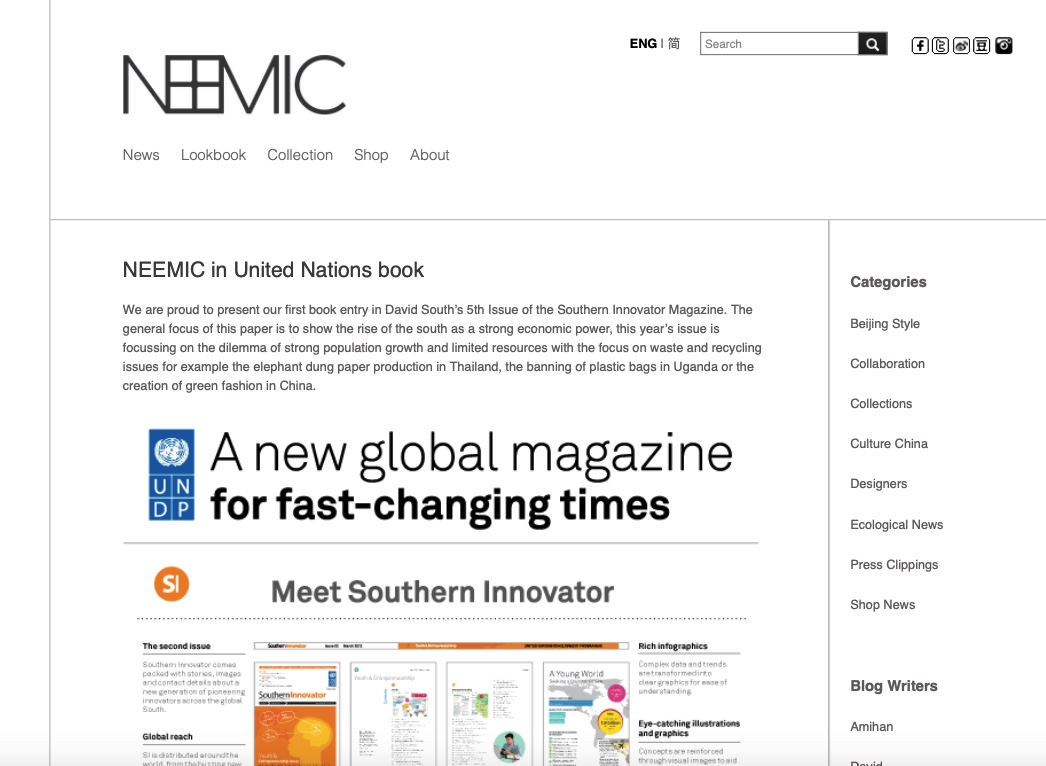
“We are proud to present our first book entry in David South’s 5th Issue of the Southern Innovator Magazine. The general focus of this paper is to show the rise of the south as a strong economic power, this year’s issue is focussing on the dilemma of strong population growth and limited resources with the focus on waste and recycling issues for example the elephant dung paper production in Thailand, the banning of plastic bags in Uganda or the creation of green fashion in China.” https://neemic.asia/ecological-news/neemic-southern-innovator-book

https://davidsouthconsulting.org/2021/02/09/african-fashions-growing-global-marketplace-profile/

https://davidsouthconsulting.org/2021/01/05/afropolitan-african-fashion-scene-bursting-with-energy/

https://davidsouthconsulting.org/2022/10/09/fashion-closes-gap-between-catwalk-and-crafts/

https://davidsouthconsulting.org/2022/11/17/fashion-recycling-how-southern-designers-are-re-using-and-making-money/

https://davidsouthconsulting.org/2022/11/16/favela-fashion-brings-women-work/

https://davidsouthconsulting.org/2020/04/30/local-fashions-pay-off-for-southern-designers/

https://davidsouthconsulting.org/2022/10/24/made-in-africa-fashion-brand-pioneers-aim-for-global-success/

https://davidsouthconsulting.org/2021/10/04/putting-quality-and-design-at-the-centre-of-chinese-fashion/

https://davidsouthconsulting.org/2021/03/05/southern-innovator-issue-5/

Development Challenges, South-South Solutions was launched as an e-newsletter in 2006 by UNDP’s South-South Cooperation Unit (now the United Nations Office for South-South Cooperation) based in New York, USA. It led on profiling the rise of the global South as an economic powerhouse and was one of the first regular publications to champion the global South’s innovators, entrepreneurs, and pioneers. It tracked the key trends that are now so profoundly reshaping how development is seen and done. This includes the rapid take-up of mobile phones and information technology in the global South (as profiled in the first issue of magazine Southern Innovator), the move to becoming a majority urban world, a growing global innovator culture, and the plethora of solutions being developed in the global South to tackle its problems and improve living conditions and boost human development. The success of the e-newsletter led to the launch of the magazine Southern Innovator.  

Follow @SouthSouth1

Google Books: https://books.google.co.uk/books?id=q1KeBgAAQBAJ&dq=development+challenges+december+2012&source=gbs_navlinks_s

Slideshare: http://www.slideshare.net/DavidSouth1/development-challengessouthsouthsolutionsdecember2012issue

Southern Innovator Issue 1: https://books.google.co.uk/books?id=Q1O54YSE2BgC&dq=southern+innovator&source=gbs_navlinks_s

Southern Innovator Issue 2: https://books.google.co.uk/books?id=Ty0N969dcssC&dq=southern+innovator&source=gbs_navlinks_s

Southern Innovator Issue 3: https://books.google.co.uk/books?id=AQNt4YmhZagC&dq=southern+innovator&source=gbs_navlinks_s

Southern Innovator Issue 4: https://books.google.co.uk/books?id=9T_n2tA7l4EC&dq=southern+innovator&source=gbs_navlinks_s

Southern Innovator Issue 5: https://books.google.co.uk/books?id=6ILdAgAAQBAJ&dq=southern+innovator&source=gbs_navlinks_s

Creative Commons License

This work is licensed under a
Creative Commons Attribution-Noncommercial-No Derivative Works 3.0 License.

ORCID iD: https://orcid.org/0000-0001-5311-1052.

© David South Consulting 2023