
Publisher: UNDP Mongolia Communications Office
Published: April 1997
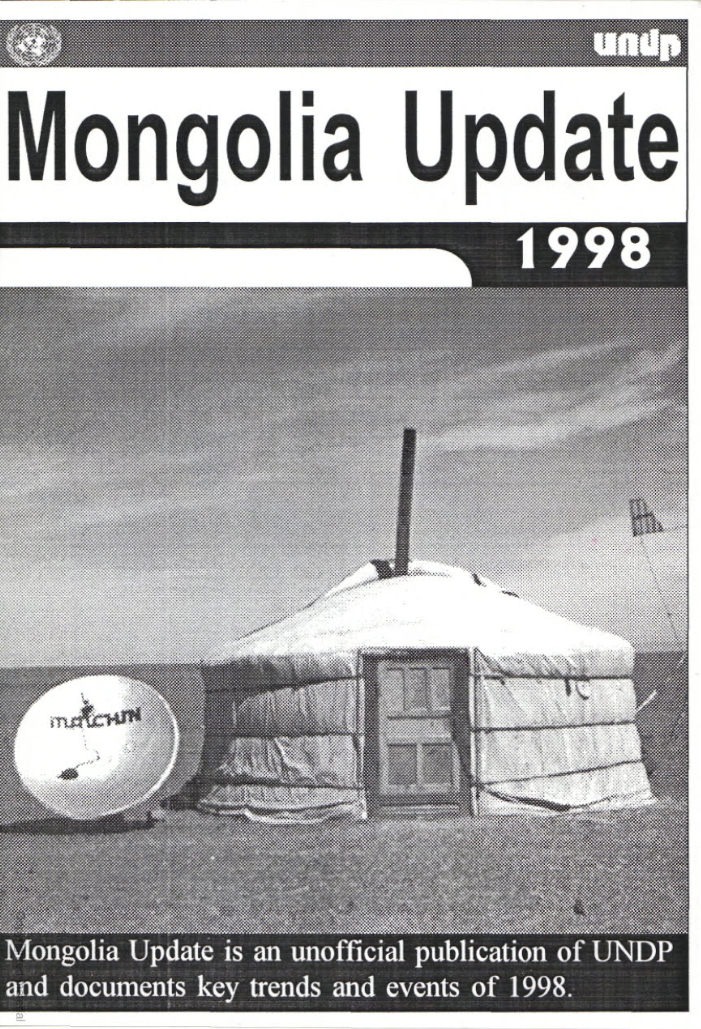
This is an unofficial publication of UNDP. Views presented in this document do not necessarily reflect those of UNDP. Mongolia Update is provided as service to those who are interested in the rapid changes taking place in today’s Mongolia.
Partnership for Progress Update
I.General Update
Presidential Elections
This is the third time during a twelve month period that Mongols are going to cast their vote. This May 18 they will make a decision on who will be the second president of the country. There are currently 1.2 million citizens of Mongolia eligible to vote to elect the new president. 30 regional election committees have been set up in the 21 aimags and nine districts of the city of Ulaanbaatar. Three presidential nominees were officially recognized by the general election committee and have received their certificates. The three include the incumbent president P. Ochirbat who promises to concentrate on implementing demands of the society and population, J. Gombojav prioritizing restoration of discipline and order, poverty alleviation and unemployment, and N. Bagabandi stressing the issue of social justice.
Spring Session of the Parliament
The spring session of the Parliament commenced on April 5. Out of more than 90 bills awaiting parliamentary approval, 27 draft laws have been included in the session agenda. These include such important legislation as the package of laws on taxation, amendments to the law on the constitutional court (Tsets) and among others a number of laws related to social issues, on land privatization, media, foreign military presence and transit.
During the four months of the Fall session, the Parliament approved 18 laws, introduced amendments to 34 laws and issued 47 resolutions. Among the laws passed were packages on housing privatization, social protection and the law on NGOs.
Spring Fires
The 386 spring fires of last year took the lives of 25 people and injured 61 others, affected 10.2 million hectares of land, 175 dwellings and 7,690 livestock. The total damage was estimated at MNT1,129.4 billion, including MNT1,128.4 billion in ecological and economic damage, MNT589 million in damage to the private and public property, and MNT372.1 million in direct expenditures for fire fighting.
As for this year, to date in April , a total of 51 forest fires have been registered in the country. Currently only three fires in Huvsgul, Hentii and Bulgan provinces are still being fought. The commission issued an instruction to strengthen monitoring of contained fires that still are going underneath the earth’s surface and can break out at any time. The commission regularly receives photos from a US satellite and this helps spot fires at a stage early enough to alert and mobilize local communities.
II.Economic and Social Update
Inflation Developments
Mongolia seems to be different from its Asian neighbors in that while in those countries the Lunar New Year means a shopping rush and sales, in Mongolia it is quite the opposite. In Mongolia small traders dictate the prices in a country highly dependent on imports of basic necessities. It is not surprising that traders who supply almost 60-70 per cent of imported foodstuffs want to squeeze as much money as possible out of thier customers. The state customs tax inspection reported that the volume of imports grew three fold over the weeks preceding the Lunar New Year.
The consumer index grew up by 8.1% since last December, and 2.3% as of March. Prices on meat, milk, milk products, home utilities, clothing and footwear have increased. Economists attribute the price hike to the soaring exchange rate of the Togrog vis-a-vis the US Dollar. Since the beginning of the year, the average inflation rate was up 2.7%.
In accordance with the March report of the State Statistical Office, average household income in the country in February was MNT60.8 thousand. On average, compared to the same period in 1995, household income increased by 14.1%. The average monthly monetary expenditures per household was MNT60.8 thousand. The composition of household expenditure in the capital city includes food expenses up to 55% compared to the same period in 1996. In rural areas expenses for food stuffs comprise 47.4% as compared to the same period in 1996. Food expenditure was mostly for purchasing flour, flour products, meat and meat products. In Ulaanbaatar the change in consumption is due to a small shift towards payments for services such as public transport. As for the rural areas, this shift can be attributed to non- food expenses such as investment in private production, services and purchases of clothing and fabrics.
Exchange Rate Developments
16 per cent devaluation of the national currency during two weeks of March, following the Lunar New Year celebrations, was possibly due to the distrust people have towards the banks and a desire to convert their savings into hard currency. The parallel market rate reached MNT960 vis-a-vis the US Dollar. The Bank of Mongolia did not intervene in the process attributing the situation to a surge in demand for hard currency following the long winter months of slow trading. Every spring there is a short period, when the exchange rate surges but not as high as this year. This year, during the first three weeks of March, the rate went up by 8 percent compared to 6% in 1994, 7% in 1995 and 2% in 1997. Last year the central bank spent $ 73 million to maintain the exchange rate at MNT 640.
As of the end of March, official statistics showed a 19.7% increase in the exchange rate of the Togrog vis-a-vis the US Dollar against the beginning of 1997 and some 69.7% increase when compared to the same period last year.
Monetary and Banking Developments
The Debt Collection Service, established last September, is working on returning to the banks coffers MNT28 billion in debts considered bad and resulting from the issue of MNT17.4 billion in credits in cities and MNT8.2 billion in credits in rural areas over the last few years, without proper examination of the lenders’ financial credibility.
The Service collected more than MNT700 million within four months of 1996 and plans to bring back another MNT10 billion this year. Recently the department started applying indirect pressure by publishing the names of individuals and companies heavily indebted to banks. Eventually, the plans are to sell the debt papers on the securities market.
The Bank of Mongolia reported that at the end of February, total money supply reached MNT114.5 billion, that is 10.8% less than that reported at the beginning of the year and about 12% more than during the same period in 1996.
In March savings increased by 6.4%. This was connected with a 19.4% or MNT4.7 billion increase in foreign currency savings. Individual savings dropped by 1.5% against February but the account balances of economic entities increased by 4%.
Fiscal Developments
For 1997, state budget revenues are projected at MNT158 billion and expenditure at MNT184 billion, with a deficit standing at MNT26 billion. It is planned that the deficit be maintained at 3.9% of the GDP with further curbing by MNT6 billion from the MNT30 billion deficit registered in 1996. The parliament added MNT16.4 billion to the banking sector reform and endorsed the government to issue MNT15 billion in government bonds to cover the state budget deficit. The finance minister announced that much attention will be given for promotion of small producers and promised, that foreign investment will be given more favorable conditions.
At the end of February, state budget revenues reached MNT28.8 billion, expenditures MNT29 billion with the budget deficit standing at MNT0.2 billion.
Projections for state budget revenues for the first two months of the year have been exceeded by MNT1.4 billion, or 6.2%. This resulted from actions taken by the Government during the last half of 1996 to ameliorate debt and tax collection, reforms in public administration and reduction of subsidies to economic entities to improve the structure of budget expenditures and stronger monitoring of state budget revenues and expenditures.
Projections for state budget expenditure for the first two months of the year have not been reached with a shortfall of MNT4.7 billion, or 16.5%. This is explained, in part, by the shortfall in privatization earnings of MNT1.4 billion.
The new package of nine laws on taxation was submitted for consideration in the Spring session of the Parliament. The Prime Minister emphasized the significance of the new tax reforms that would have a mid and long term positive impact on economic recovery and a healthy business environment providing assistance to manufacturers and consumers.
Amendments were made to the income tax law of economic entities and organizations. The reason for making the amendment, according to the National Taxation Board, was that there are currently 30 thousand economic entities operating in the country out of which only 8 thousand actually pay income taxes. The income tax law on economic entities stipulates for a 15% tax on income up to MNT100 million and 40% for those with an income above MNT100 million. Medium-sized companies will receive better incentives under the new taxation system now being discussed by Parliament. In general, taxes will be reduced through expanding the taxpayers base. The present system of corporate taxation results in some companies underreporting their profits and evading taxes. The study revealed that only 71 large companies contribute 85 percent of the tax revenue.
Excise taxes on alcohol, alcoholic beverages, and tobacco have been increased two-fold. This would have the long term effect of promotion of indigenous industries and reducing low quality imports. Excise tax law changes include excise on petrol, diesel fuel and imported cars. It is estimated that by imposing excise tax on imported vehicles more than MNT1100 million will be generated for the state budget.
Regarding customs duties, all except duties on spirits, alcohol, tobacco, oil products will be eliminated effective May 1. There is currently MNT17,475 in revenue to the state budget from this source. The issue of offsetting the revenue lost as a result of the elimination of customs duties requires addressing through a nearly 30% saving of expenditures of the state budget.
The Parliament set a 10% tax on annual incomes of between MNT0-576,000, a 20% income tax for incomes between MNT576,001-1.152 million, 40% tax for those with an annual income of more than MNT1,152,001. The percentage of income tax in rural areas, especially among herders with private livestock, will vary depending on the amount of income and the market price of the animal products. People with less than 150 head of livestock, old age pensioners and low- income families will be exempt from income tax.
Nationwide Inventory of State Assets
In mid- February, the State Property Committee launched a nationwide inventory of state assets. All state- owned assets across the country were registered anew and assessed. The main purpose of this exercise was to come up with a clear picture of state property thus facilitating the Government ‘s decision as to what is to be passed to local Government jurisdiction. A total of MNT 110 million was initially planned to be used for the inventory. For the first time a comprehensive computer database will be set up with all property and assets categorized under type, location and value.
Industrial and Real Sector Activities
Construction Sector
The rise in construction activities of about 31.4% compared to the same period last year during the first three months of 1997, can be attributed to construction work done by joint Mongolian and foreign units. The number of incomplete buildings, most of them public, reached 321 due to a shortage of state budget investment in the sector. In 1993, the government had to halt construction and conserve 114 building and offer another 186 for sale. This did not bring the desired results. Now the government bears the burden of MNT30 million every year in maintenance costs of these incomplete structures. Since the MNT30 billion funding necessary to complete the construction is unavailable, they are slotted for sale to the private sector.
Gross industrial production
In the first three months of the year, industrial output declined by 4.8% and totaled MNT44.1 billion. A survey revealed that shortage of cash poses a major problem for about 60% of enterprises while 27.1% named high interest rates on bank credits. Another 13% of enterprises have problems with procuring raw materials and supplies.
Production levels in the mining sector, including coal, metal ore and quarrying of stone. And in the manufacturing of beverages, wood and wood products, metal products and power increased. However, decreases in the production of such industrial products as forestry products, meat and meat products, and tanning and dressing of leather, were evident.
The private sector accounted for 46% of the total industrial output.
Agriculture
The Ministry of Agriculture is concerned about the potential shortage of seeds for grain farming in 1997. Though the country’s capacity to store seed reserves is 50 thousand tons, for the last few years only 5 to 8 thousand tons of seed were kept because of a shortage of money to finance reserve stocks . This year only 5 thousand tons of seed were reserved, but, according to preliminary estimates, for the 1997 sowing season the requirement will be 70 thousand tons of grain seeds to cultivate an area of 350 thousand hectares.
Although the Ministry of Agriculture and Industry planned to cultivate more than 320,000 hectares of land this year, only 270,000 will be sown. The problem of grain seeds was solved to a degree with 6,800 tons of seeds coming from the state special reserve. A shortage of funds did not allow the agriculture companies to procure spare parts and only 70% of machinery is ready for spring work. Out of MNT 3.3 billion necessary for the sowing season, the agricultural farms plan to invest MNT 1 billion on their own, with another one billion coming from the flour mills as credits. The government refrained from issuing credits as before, and limited tax reduction on revenues by 50 percent. Despite the government appeal, commercial banks came up with only about MNT 300 million in credits.
Responding to the Government’s request for assistance in emergency seed supply for the 1997 growing season, through its Emergency Production of High Quality Elite Seed and New Variety Testing project UNDP will assist Mongolia’s private sector farmers by i) re-starting the multiplication of high quality wheat seed by private enterprises on a pilot scale, and ii) testing new high quality wheat varieties under Mongolian’s agro-ecological conditions. This project will be a critical lead-in to future interventions by donor agencies and the private sector. The Special Relief Operations Service (TCOR), FAO, have fielded a seed specialist and a procurement officer to Kazakhstan to check and procure 200 tons of elite wheat seed. At the same time, new high yield wheat varieties are being procured in countries with overlapping agro-ecological conditions. Six new varieties of wheat seed are being shipped from Mexico and others from Canada.
Foreign Trade Developments
The total reported trade volume in the first three months of 1996 reached US$ 149.7 million showing a decrease of 21.7% over the same period in 1996. Exports totaled US$79 million and imports US$70.7 million. Exports were down by 20.9%, and imports down by 22.7%.
The decrease in exports was caused by the fact that overall volume and prices for exported goods fell. Both price and volume changes affected such main export commodities as copper concentrate, fluorite spar concentrate, scoured goat down and hides. In the first quarter of 1997, the average border price of these commodities, which represent 71.3 % of export goods, was down by 14.5 % against the same period last year. This has led to a loss of US$11.6 million in export earnings in the first quarter, or US$12.2 as compared to the same period in 1996.
The decrease in imports can be attributed to the fall in imports of main commodities such as fuel, oil and metal products.
Exports to other countries, except the neighboring, increased. Imports from developed countries increased by 9.1 points against the same period last year, while imports from other countries decreased.
Some 47.3 % of exports went to Switzerland, one of the top export destinations in 1996, 19.2 % to China, 10.9 % to Russia, 5.1 % to UK, 4.9 % to Italy. 39.7 % of imports were from Russia, the bulk of this volume being petroleum products, 8.3 % from the United States, 6.8 % from China, 5.1 % from Denmark and 4.1 % from Japan.
Privatization
The third attempt to privatize the 35-year old State Department Store (SDS) at the opening price of MNT3.4 billion is at standstill due to lack of bidders.
The law on housing privatization was passed in mid-October 1996 and seeks to privatize more than two million square meters or MNT256 billion worth of state-owned apartments and was supposed to go into effect from January 1, 1997. However, it was vetoed by the President who considered that the law needed a further review due to contradictions with the Housing and other laws. The Law was finally passed in February this year. Under the Law, MNT260 billion worth 4,300,000 square meters of state-owned housing will be transferred into private ownership free of charge. Presently about 2.3 million people live in state-owned apartments. The above Law has provisions for exemption from privatization charges for female pensioners over 55 and male pensioners over 60, the rightful children-owners and orphans, individuals receiving allowances for disabilities, families having over 4 children aged 16 and below, low income single mothers with over 4 children aged 16 and below. The basic cost for a square meter was determined by the Parliament to be MNT150,000 (equivalent of approx. $190). Privatization of housing will start as soon as the government approves about 10 procedures prepared by the Ministry of Infrastructure Development. Most of privatized housing is concentrated in the capital city, and the condition and market value of about 60,000 flats will be assessed by experts.
More residents of the capital city prefer to live in their own houses. Last year alone, 1,800 families out of 2,400, who moved into new houses, have become the owners of private cottages with 56,000 square meters of total living space. In 1996, more than 20,000 applications for a land patch permit were sent to the city council and twice more are expected this year. Presently, nearly 60% of the city’s 580,000 population live in ghers, a traditional felt-walled dwelling.
In the course of privatization in 1991 – 1992, about 270 state owned farms and cooperatives were split into 2,000 smaller private units short of funds and equipment necessary to maintain cultivation at 450,000 hectares of arable land. Last week the government approved the auction of seven major agriculture companies and the trade the state owned shares of another 45 shareholding companies. Given the persisting decline of agriculture production and the deep crisis in the sector, the government faces the necessity to undertake resolute steps to solve the problems.
Social Issues
Unemployment
Official statistics quote 57.5 thousand unemployed people registered at labor exchanges as of the end February. This figure is 11.1 thousand more than that in the same period of 1996.
Poverty
Official statistics show that the number of poor in the country is 446 thousand comprising some 103.5 thousand households. The poverty level is thus 19.4% of the population. The statistics are based on calculations of average monthly income per member of the household and vary from the 1995 survey conducted with the IBRD during which the calculations were made on the basis of average monthly consumption per member of household. Out of the total poor, nationwide there are 61,8 thousand people who are neither employed nor in school.
The minimum subsistence level has been revised nine times since 1991. The last revision was made in February this year and included stipulations for regions of Mongolia. The poverty line now stands at MNT10,400 for Ulaanbaatar, MNT10,380 for Orkhon-Uul and Darkhan-Uul, MNT9,720 for the Western region, MNT 9,420 for the Middle region, MNT9,340 for the Gobi region, and MNT9,250 for the Eastern region. Another revision of the minimum subsistence level and minimum hourly wage is pending discussion at the Spring session of the Parliament to reflect correctly the inflation rate.
The provisional committee against poverty representing about a dozen NGOs started a hunger strike on April 1 demanding to address the problem of aggravating poverty. On April 10, the Prime Minister met with the protesters and explained that the government inherited the problem of more than 103,000 pensioners and 87,000 unemployed and has not been able to address their problem within the few months in office. He instructed the Minister ofHealth and Welfare, as well as the City Mayor to see how to help them. The mayor promised the strikers jobs, bank loans and land to grow vegetables. As a result of this, the hunger strike was called off.
Health
The salaries of 32,000 health sector employees will be raised in the next three months irrespective of the civil servants’ fixed salary system. This decision follows the nationwide, 18,000 strong warning strike of the health sector employees held on February 28. Figures are quoted that presently 80% of doctors and nurses live in poverty.
The newly amended law on health insurance became effective on April 1 evoking different reactions from patients, who are now to be charged for medical treatment. Payment for several categories of medical services, including MNT 1,100 for an ambulance call, MNT 3,000 for a blood test, and about MNT 10,000 for comprehensive medical examinations, as well as MNT 2,500 for each day in hospital for those without health insurance, were introduced.
Since the adoption of the new law, the number of patients undergoing medical treatment decreased and vulnerable groups were most affected by this change. Upon popular demand, the Ministry of Health and Social Welfare is amending two attachments to the law on health insurance which state the costs of medical services.
Work time reduction
The 340,000 strong army of civil servants may switch into five working days a week schedule, if the parliament agrees with it at its spring session. The government had approved in principle the respective draft law and submitted it to the Ikh Hural. Under the bill, work time should not exceed 40 hours a week and annual holidays will be curtailed from 24 to 15 days. The government plans to introduce the shift without additional expenses from the state budget.
III. Partnership for Progress Update – UNDP Activities in Mongolia
The United Nations Development Programme has been a supporter of Mongolia’s development efforts since the 1970s. A new five year cycle entitled the Partnership for Progress which covers the period from 1997 to 2001 has began. The UNDP activities support the Mongolian Government’s Programme of Action (November, 1996), with its priority on economic growth under difficult transition conditions.
The impact of Mongolia’s dramatic transition process in the 1990s makes economic growth a precondition for solving problems, especially those related to poverty. The successful implementation of the different parts of the Government’s Programme of Action is expected to generate growth. There are favorable conditions for Mongolia’s economic growth, including considerable natural resources, a literate human resource base, and growth oriented Government policies. However, significant obstacles exist including a limited infrastructure, growing poverty, a weak banking system, harsh climatic conditions and a vast territory.
UNDP’s contribution to growth with equity will be three-fold. First, UNDP interventions will fully support the Government’s Programme to stimulate equitable economic growth. Second, UNDP, through its partnership role in the national poverty programme and natural resource management, will help the Government deal with various issues of people centered sustainable development. Third, UNDP will contribute significantly to the national capacity to formulate policy and to implement programmes which support sustainable human development by concentrating on strengthening governance capacities of the national government, local authorities and civil society.
The UNDP supported activities attempt to bring together a multitude of partners in support of sustainable human development: Government authorities at the national and local level, civil society and NGOs, UNDP and the UN System, academia and the private sector, and bilateral and multilateral donors. The design of the Partnership for Progress combines global thinking with local actions to achieve and improve the well- being of the Mongolian people.
In March, the Country Cooperation Framework 1997- 2001 for Mongolia was approved by UNDP Headquarters.
Poverty Alleviation
The composition of the National Poverty Alleviation Committee (NPAC) was revised to include the Prime Minister as the Chair of the NPAC, the Minister of Health and Social Protection as the Deputy Chair of the NPAC, and the Minister of Education, State Secretaries of the Ministries of Finance, Agriculture and Industry, Infrastructure Development, and Department heads of two Departments of the Ministry of Health and Social Protection, as members of the NPAC.
The Targeted Assistance Fund (TAF) under the National Poverty Alleviation Programme is designed to provide in-kind assistance to the poorest members of society to help them meet their basic needs. TAF financial resources of $128,000 were distributed through Aimag Poverty Alleviation Councils (APACs)/District Poverty Alleviation Councils (DPACs). Since January 1997, a total of 523 projects were funded from the Local Development Fund which and Women’s Development Fund focused on health, education, vulnerable group income generation, and public works.
Provision of Energy Efficient Social Services
UNDP is giving importance to introducing and expanding renewable energy in the social infrastructure sector as relevant to the National Poverty Alleviation Programme and other social development activities. A project titled Provision of Energy Efficient Social Services was signed by the Government and UNDP in April. Within the framework of this project, 100 community centers will be constructed or refurbished, using the straw-bale technique, during the next 3 years. The project will have a direct impact on the health and education of a large number of children, women, new borns and clinic users in general. The demonstration concepts to be used can have large scale replication, reducing the energy needs and improving the living conditions of the poorest segments of the Mongolian population as well as providing unemployed people with skills for improved income.
Poverty Newsletter
The first issue of the Cheerful Poor, the latest arrival to the print media, has hit the news stand in April. The bi-weekly newspaper is being published by the National Poverty Alleviation Programme. The newspaper will inform the general public of the progress of the NPAP, statistics, job vacancies and other information for unemployed.
Environment
The new edition of the Mongolia Red Data Book on endangered and threatened species of Mongolia is being prepared with the direct involvement of the Mongolia Biodiversity Project. The Red Data Book will include globally and/or nationally endangered threatened plants and animals with maps and pictures showing their distribution. The National Fund for Endangered species and the British Government are contributing US$ 4,500 and £ 10,000 respectively for the printing of the book.
A new grant from UNDP to the Environmental Public Awareness Programme will support public awareness projects proposed by national NGOs. It will allow the Programme to run more training workshops for project personnel and to travel throughout the country to monitor communities and NGOs, rural projects. The UNDP grant supplements the initial allocation from the Government of the Netherlands.
Governance and Economic Transition
Following the recommendations of the evaluation mission that took place in October 1996 the Government of Mongolia has by Prime Minister’s decree decentralized projects under the programme to Ministries.
UNDP is presently in the process of designing the next three years projects that will support the government’s policies on good governance and successful economic transition. Among the many new proposals are the following: 1) project in support of Democracy and Local Self Governance, which will play an important role in consolidating UNDP’s support to aimag, soum and bagh communities; 2) project on support to Journalism, which through the Mongolian Press Institute will support a lively and professional national public debate; 3) second phase of the project on creation of a Public Management Information system, which will result in expansion by July 1997 of the established network between Prime Minister’s Office, Parliament Secretariat, President’s Office, Ministry of Finance, State Statistical Office and Tuv Aimag Center; 4) “Think Tank” project design, which will provide the highest political level with a financial support to quick national and international advice and research on relevant political responses to the complex economic and political transition process Mongolia is undertaking.
HIV/AIDS/STD
While Mongolia has been fortunate enough to have remained relatively free from HIV/AIDS in the past, changing economic conditions and associated lifestyles make Mongolia increasingly vulnerable to the ever growing worldwide HIV/AIDS pandemic.
The United Nations system in Mongolia, at the request of the Government, has recently completed a two week assessment of the STDs and HIV/AIDS situation in the country, making recommendations and suggestions for national programmes and future international support and technical assistance. The challenge, as spelled out in their report “Working Together for a Safer World” is to develop an expanded national response involving all sectors of society, building upon the lessons learned during nearly two decades of working with the AIDS epidemic. The UNAIDS team, composed of representatives of UNICEF, UNDP, WHO and public health officials from Thailand and Vietnam, recommended four strategic activities for Mongolia:
- establish effective national HIV/AIDS/STD policies and programme structures,
- including strategic planning and coordination;
- develop population targeted and pre-tested HIV/AIDS and STD information, education, and communication activities which facilitate safer behavior;
- ensure the availability and promote the use of high quality condoms and
- improve the quality of STD prevention and care.
Aid Coordination
The Government of Mongolia addressed the issue of aid coordination through the establishment of an Aid Coordination Unit (ACU) under the Prime Minister’s Office in September 1996. The Government’s Programme of Action stipulates that foreign grants and loans should be acquired from as many sources as possible with the aim of providing for the national and economic security of Mongolia and reducing the burden on the state budget.
A draft law on amendments to the law on government was submitted for the consideration of the Spring session of the Parliament. The draft envisages the transfer of the coordination function of foreign aid, currently under the Ministry of External Relations, to the Ministry of Finance. Thus, the Ministry of Finance will have under its wing, issues pertaining to both loans and aid.
A mission of an expert in external cooperation coordination is in town. The expert is working on a project proposal for assisting capacity building in aid coordination which will include the formulation of a resource mobilization strategy and technical assistance strategy.
IV. New Initiatives
Regional Economic Development
The current territorial and administrative structure hinders steady development nationwide. To redressthis situation, the government has elaborated a new project on territorial zones of the country that envisages five major regions across Mongolia to facilitate adequate conditions for sustainable development of these areas. The project, already submitted to the Parliament, proposes to make Hovd, Uliastai, Arvaiheer, Ulaanbaatar and Choibalsan the centers of these zones taking into account the history of the nation’s development, specifics of demography, land, livestock, pastures, farming, mineral resources and other criteria. It also suggests having 18 aimags instead of the present 21, 91 groups of urban settlements and 334 soums. According to its classifications, cities should have a population of no less than 250 thousand, big towns some 50-250 thousand people, while settlements with a population of 30-50 thousand will be named small towns. The rest will be considered as urban and rural villages. The forecast for 2010 is that there will be one city, four big towns, 16 small towns, 43 urban and 312 rural villages in Mongolia.
Foreign Direct Investment Forum, June 4-5
During the Foreign Direct Investment Forum, co- sponsored by the Government and the World Bank, domestic and foreign businessmen and investors discussed joint exploration for oil, gold and zinc resources of the country.
A trade fair will be sponsored by the Government and the World Bank to promote foreign investment and is expected to attract over 100 foreign firms and manufacturers.
The government Foreign Investment Board expects MNT 160 billion investment this year. Last year, 180 companies and business entities from 28 countries applied to set up joint ventures in this country pledging a total of $39 million, in investment. Presently 20,000 Mongolians are employed in about 400 joint ventures.
During the FDI Round Table meeting in October 1996, the government committed itself to following up on its recommendations and introducing changes to the Foreign Investment law adopted in 1993.
Micro Credit Development
Priority number one of the new Government, which came into power after the June elections 1996, is to increase employment and opportunities in order to develop sustainable economic growth. One of the potential opportunities for achieving this is the creation of micro credit facilities which in a country like Mongolia, with a small population and vast territory, could be later replicated at nationwide level. However, the current situation in the commercial banking sector does not allow for the development of such new credit facilities. The deep crisis situation that has occurred in the sphere of banking has made the resolution of the banking sector problem one of the burning issues of the economy. A number of commercial banks have fallen into deep financial crisis and effectively stopped playing the role of financial mediators in the economy.
The Micro Credit Summit, held this February in Washington D.C., was attended by five participants from Mongolia. The purpose of the Summit was to launch a global movement to reach 100 million of the world’s poorest families, especially the women of those families, with credit for self- employment and other financial and business services, by the year 2005. Mongolia was included in the list of recipients of $ 21 billion to be allocated for 100 million impoverished people in developing countries. Heads and high level officials from 112 countries attended the Summit to discuss the future of microfinancing schemes in addressing development and poverty issues.
Mongolia’s participants to the Summit are unanimous in their desire to convene a National Micro Credit Summit/ Workshop in late June to discuss and make policy recommendations for the development of micro credit in the country.
The Ministry of Finance approved 120 small projects to be financed from the Soum Development Fund set up last year by the government. Up to MNT 5 million will be allocated from the fund to boost local economies in the country’s 334 soums (principalities). So far, 72 soums submitted 288 projects ranging from a shoe repair shop to a flour mill.
Others
UNICEF approved an $ 8.25 million budget for its operations in Mongolia. Under the Master Plan of Operations for 1997 – 2001, mother and child health protection, vaccination of children and the promotion of local community initiatives will be emphasized. UNICEF started its operations in Mongolia in 1984 and is an active promoter of child health protection issues.
The World Bank announced a $35 million open tender for the modernization of the Baganuur coal mine. Caterpillar of USA, Comatsu of Japan and Volvo of Sweden are bidding for the right to supply bulldozers and heavy trucks. Japan recently allocated $48 million for the Shivee Ovoo coal mine modernization as well. When both projects are completed by the year 2005, the two mines will double their production to 10 million tons of coal a year.
The Asian Development Bank signed an agreement with the Mongolian government on $60 million credits for 1997. About $40 million will be spent on modernization of the capital city heating and energy network and $15 million for the health sector reform. The remaining $5 million will be for the development of public service facilities in the Western provinces. Over the last years, AsDB has provided Mongolia with a total of 314 million in credits and another $ 31 million in technical assistance.
The UNESCO Mass Communication Development Commission approved a $27,000 grant to the Press Institute of Mongolia to purchase a broadcasting studio. Set up a year ago with $1.2 million grant from the Danish government, the Mongolian Press Institute has received over last few months $30,000 from the UNDP to start an independent news agency based on Internet resources and another grant from the Soros Foundation to open a journalism school. As well as organizing seminars and courses, the Institute has opened a press conference center for Mongolian journalists. Another UNDP project focussing on training journalists in strategies to address their changing role will begin in mid 1997.
The European Union plans to spend total of $19.5 million in technical assistance for Mongolia in the next three years. An additional $183,000 aid from the EU will be provided to alleviate the consequences of multiple fires last spring.
A US$ 18 million road construction project to be financed under an agreement between the Ministry of Infrastructure Development and Arab Development Foundation of Kuwait is to be launched soon. A contractor to build an 180 km road between the second and third largest cities, Darhan and Erdenet, will be chosen from among the international companies short listed to bid.
The first step towards unifying the efforts of more than 600 non-government organizations was made in April. About 20 NGOs including the Women’s Federation, Red Cross, Center for Children and Center Against Domestic Violence, agreed to set up a club named “Crossroads”, which will coordinate the activities of the member organizations, supply information and organize training. This center will serve as a focal point of joint actions. The club is a non-partisan body and will help influence the decision makers. Over the last few years, NGOs have flourished in this country with more than 600 of them registered at the Ministry of Justice. Last fall, Parliament approved the law on NGOs, which provides more incentives for public organizations.
Solar Eclipse
As astronomers had predicted, at 8.45, Sunday morning of March 9, one third of Mongolia sank into darkness as the sun disk went black for two minutes. Only the sounds of dogs barking and the banging of pots could be heard as people tried to scare away the Rahu Monster which, according to legends, swallows the sun. Long expected and speculated this natural phenomena did not stir much public attention and the capital city residents took it very quietly. More than 2,000 visitors were expected to view the solar eclipse from the Mongolian steppes. However, the number of foreign observers was a little over 1,000.

This work is licensed under a
Creative Commons Attribution-Noncommercial-No Derivative Works 3.0 License.
ORCID iD:https://orcid.org/0000-0001-5311-1052.
© David South Consulting 2026


You must be logged in to post a comment.