Categories
Archive Blogroll Now Magazine

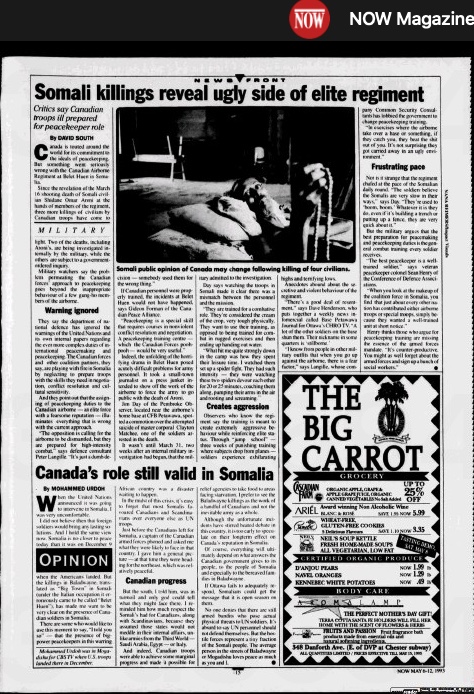
Somali Killings Reveal Ugly Side Of Elite Regiment

By David South

Now Magazine (Toronto, Canada), May 6-12, 1993

Canada is touted around the world for its commitment to the ideals of peacekeeping. But something went seriously wrong with the Canadian Airborne Regiment at Belet Huen in Somalia.

Since the revelation of the March 16 shooting death of Somali civilian Shidane Omar Aroni at the hands of members of the regiment, three more killings of civilians by Canadian troops have come to light. Two of the deaths, including Aroni’s, are being investigated internally by the military, while others are subject to a government-ordered inquiry.

Military watchers say the problem permeating the Canadian Armed Forces’ approach to peacekeeping goes beyond the inappropriate behaviour of a few gung-ho members of the airborne.

Warning ignored

They say the department of national defence has ignored the warnings of the United Nations and its own internal papers regarding the ever more complex duties of international peacemaking and peacekeeping. The Canadian forces and other coaltion partners, they say, are playing with fire in Somalia by neglecting to prepare troops with the skills they need in negotiation, conflict resolution and cultural sensitivity.

And they point out that the assigning of peacekeeping duties to the Canadian airborne – an elite force with a fearsome reputation – illuminates everything that is wrong with the current approach.

“The opposition is calling for the airborne to be dismantled, but they are prepared for high-intensity combat,” says defence consultant Peter Langille. “It’s just a dumb decision – somebody used them for the wrong thing.”

“The opposition is calling for the airborne to be dismantled, but they are prepared for high-intensity combat,” says defence consultant Peter Langille. “It’s just a dumb decision – somebody used them for the wrong thing.”

If Canadian personnel were properly trained, the incidents at Belet Huen would not have happened, says Gideon Forman of the Canadian Peace Alliance.

“Peacekeeping is a special skill that requires courses in non-violent conflict resolution and negotiation. A peacekeeping training centre – which the Canadian Forces pooh-pooh – would be very useful.”

Indeed, the unfolding of the horrifying drama in Belet Huen posed acutely difficult problems for army personnel. It took a small-town journalist on a press junket intended to show off the work of the airborne to force the army to go public with the death of Aroni.

Jim Day of the Pembroke Observer, located near the airborne’s home base at CFB Petawawa, spotted a commotion over the attempted suicide of master corporal Clayton Matchee, one of the soldiers arrested in the death.

It wasn’t until March 31, two weeks after an internal military investigation had begun, that the military admitted to the investigation.

Day says watching the troops in Somalia made it clear there was a mismatch between the personnel and the mission.

“They are trained for a combative role. They’re considered the cream of the crop, very tough physically. They want to use their training, as opposed to being trained for combat in rugged exercises and then ending up handing out water.

“What hit me quite strongly down in the camp was how they spent their leisure time. I watched them set up a spider fight. They had such intensity – they were watching these two spiders devour each other for 20 or 25 minutes, coaching them along, pumping their arms in the air and rooting and screaming.”

Creates aggression

Observers who know the regiment say the training is meant to create extremely aggressive behaviour while reinforcing elite status. Through “jump school” – three weeks of punishing training where subjects drop from planes – soldiers experience exhilarating highs and terrifying lows.

Anecdotes abound about the secretive and violent behaviour of the regiment.

“There’s a good deal of resentment,” says Dave Henderson, who puts together a weekly news infomercial called Base Petawawa Journal for Ottawa’s CHRO TV. “A lot of the other soldiers on the base shun them. Their nickname in some quarters is ‘stillborne.’

“I know from people in other military outfits that when you go up against the airborne, there is a fear factor,” says Langille, whose company Common Security Consultants, has lobbied the government to change peacekeeping training.

“In exercises where the airborne take over a base or something, if they catch you, they bet the shit out of you. It’s not surprising they got carried away in an ugly environment.”

Frustrating pace

Nor is it strange that the regiment chafed at the pace of the Somalian daily round. “The soldiers believe the Somalis are very slow in their ways,” says Day. “They’re used to ‘boom, boom.’ Whatever it is they do, even if it’s building a trench or putting up a fence, they are very quick about it.”

But the military argues that the best preparation for peacemaking and peacekeeping duties is the general combat training every soldier receives.

“The best peacekeeper is a well-trained soldier,” says veteran peacekeeper colonel Sean Henry of the Conference of Defence Associations.

“When you look at the make-up of the coalition force in Somalia, you find that just about every other nation has contributed either airborne troops or special troops, simply because they wanted a well-trained unit at short notice.”

“When you look at the make-up of the coalition force in Somalia, you find that just about every other nation has contributed either airborne troops or special troops, simply because they wanted a well-trained unit at short notice.”

Henry thinks those who argue for peacekeeping training are missing the essence of the armed forces’ mandate. “It’s counter-productive. You might as well forget about the armed forces and sign up a bunch of social workers.”

Does the UN know what it’s doing?

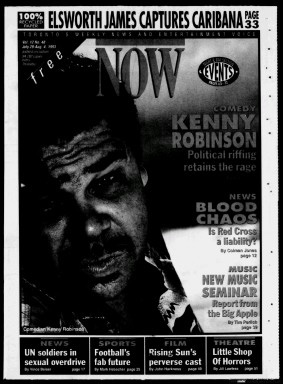
Now Magazine (Toronto, Canada), July 22-28, 1993. This incident was the basis of the 2001 film Black Hawk Down. 

By David South

Now Magazine (Toronto, Canada), July 22-28, 1993

The United Nations’ bloody hunt for elusive Mogadishu warlord general Mohamed Farah Aideed has many observers wondering whether the world body is making up the rules as it goes along.

Some critics, such as George Cram of the Canadian Council for International Cooperation, an influential umbrella group for Canadian non-governmental organizations of NGOs, question if the obsession with Aideed isn’t just burying the UN in a deeper image problem with the Third World.

Critics point to the fallout of growing resentment from the July 12 attack on Aideed’s compound – killing more than 70 civilians – boding ill for a peaceful reconstruction of Somali society.

The fact that among those killed within the compound were clan elders who were negotiating a peace has upset Somalis even more, says Cram, a Horn of Africa researcher.

“The UN has lost its credibility, its moral authority, lost its blue-beret neutrality,” says Cram bluntly.

The degree to which Aideed should be the main focus of current UN actions has some relief agencies scratching their heads. Aideed has become Somalian bogey man number one with UNOSOM’s (United Nations Operations in Somalia) head, US Admiral Johnathon Howe. He has placed a $25,000 price on Aideed for an arrest.

“I don’t recall the UN ever going out and actually attempting to arrest individuals – they certainly haven’t done it in other conflict zones,” says reverend David Hardy of Saskatoon-based Lutheran Relief, who has organized relief flights into Somalia.

Cambodian example

He cites the example of Cambodia, where the UN brokered a controversial peace with those purveyors of the genocidal killing fields, the Khmer Rouge, in order to secure free elections.

David Isenverg of the Center for Defense Information, a liberal Washington-based think tank, worries that doggedly going after Aideed while ignoring the other factions will paint the UN as siding with one faction over another.

“The protracted effect is to turn the US and UN into partisans to the conflict.”

Hardy believes Aideed, who is adept at seeing which way the wind blows, has inflated his stature as an opponent of the UN as foreign invader.

Then there are other criticisms. Some observers wonder whether the UN is too proud or too blind, or simple oblivious when it comes to seeking advice from the locals it went in to protect.

Even Canada, while supporting the UN’s military effort since Aideed “is obstructing relief supplies,” believes that national reconciliation should be a main focus, says external affairs spokesperson Rodney Moore.

He says Canada continues to urge the UN to move quickly on national reconciliation, bringing together women’s groups, clan elders and other non-warlord groups.

“One of the areas where the UN operation went wrong is the tendency to deal with the ‘superpowers’ of Somalia while ignoring groups like women’s collectives,” says World Visions’ Philip Maher, who has just returned from Somalia.

“Part of the problem is misunderstanding,” Maher says. “The UN hasn’t done a great job of telling Somalis what they are doing.”

Many point to the peaceful north, where the as yet internationally unrecognized Somaliland offers a successful model, combining women’s groups and elders to wrest control.

Update: War crimes: former minister reveals why Canada disbanded its special airborne force after scandal: The drastic step was judged the best way to fix systemic problems after an affair similar to allegations against Australian forces in Afghanistan (Wed 2 Dec 2020)

Further reading: 

Canada evolves from peacekeeper to war-fighter by A. Walter Dorn, The Toronto Star, Dec. 21, 2013

IS CANADA A NATION OF WARRIORS OR PEACEKEEPERS? HOW TO REFOCUS ON UNITED NATIONS PEACE OPERATIONS by Maj M.C.C. Lafortune, Canadian Forces College, 2016-2017

Law in Times of Crisis: Emergency Powers in Theory and Practice by Oren Gross and Fionnuala Ní Aoláin  (2006)

Manitoba Law Journal: The New Emergencies Act: Four Times the War Measures Act, 1991 CanLIIDocs 129

Doug Ford declared a state of emergency. Should Justin Trudeau do the same? 

October 1970 by Louis Hamelin (Publisher: House of Anansi, 2013). “October 1970 is a thrilling fictional account of the events that shaped one of the most volatile moments in recent history.”

Trudeau’s Darkest Hour: War Measures in Time of Peace, October 1970 Editors: Guy Bouthillier, Édouard Cloutier (2010)

Warrior Nation: Rebranding Canada in an Age of Anxiety by Ian McKayJamie Swift (2012)

Warriors Or Peacekeepers? Building Military Cultural Competence, Editors: Kjetil EnstadPaula Holmes-Eber (2020)

Canadian Peacekeeping Is Under the Gun by Craig Turner, Los Angeles Times, Aug. 1, 1996

My journalism:

1992

Top Reporters Offer Military Media Handling Tips

1993

Continental Drift And Military Complexities

Somali Killings Reveal Ugly Side Of Elite Regiment

Does the UN know what it’s doing?

Peaceniks Questioning Air-Raid Strategy In Bosnia

1996

State Of Decay: Haiti Turns To Free-Market Economics And The UN To Save Itself

U.S. Elections Update: Clinton is using Canada to keep control of Haiti

Creative Commons License

This work is licensed under a
Creative Commons Attribution-Noncommercial-No Derivative Works 3.0 License.

ORCID iD: https://orcid.org/0000-0001-5311-1052.

© David South Consulting 2023

Categories
Archive Blogroll UNDP Mongolia 1997-1999

A Partnership For Progress: UNDP In Mongolia 1997 | 19 January 2016

A Partnership for Progress: The United Nations Development Programme in Mongolia

Editor: David South

Publisher: UNDP Mongolia Communications Office

Published: 1997

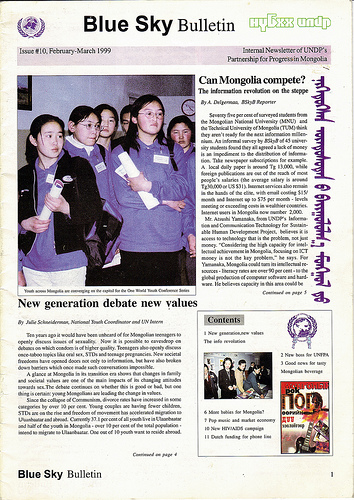
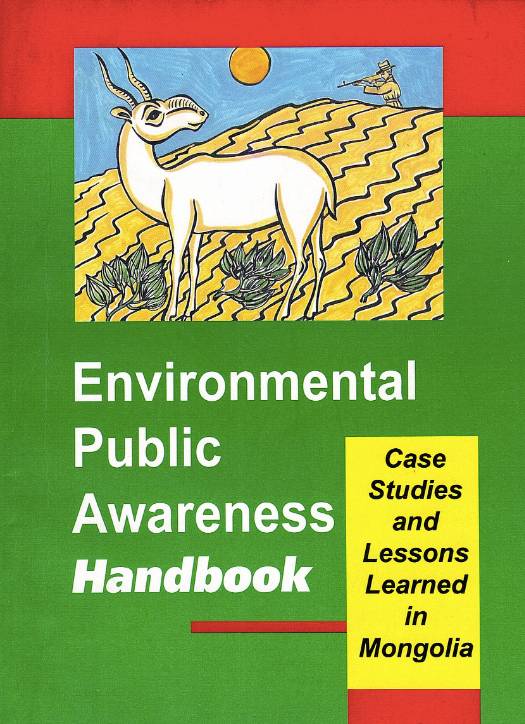
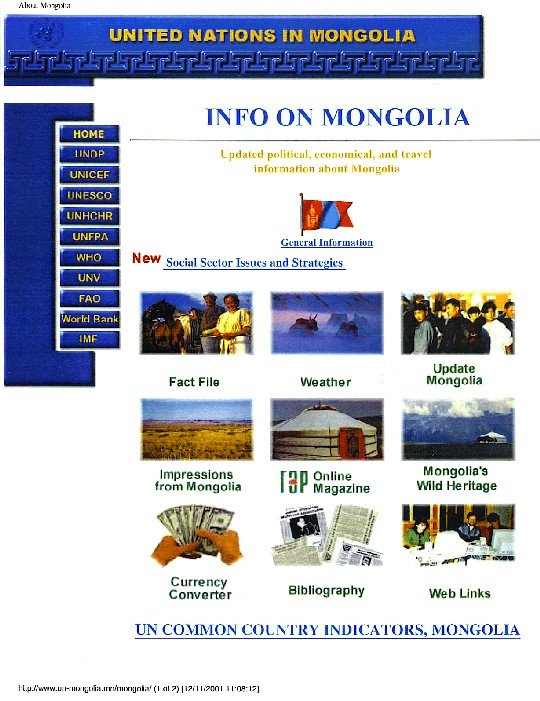
Background: The Partnership for Progress brochure raised the curtain on UNDP’s programme in Mongolia and my work heading UNDP Mongolia’s Communications Office. I led the Office from 1997 to 1999, garnering awards and praise for the quality of the offline and online resources.

A Partnership for Progress

“For years we were under the domination of foreign countries. So really, Mongolia is a new nation.” With these words, Prime Minister M. Enkhsaikhan described the enormity of the task ahead for Mongolians. While Mongolia has been an independent nation for most of this century, this has not been the case with its economy. Just as a new democratic nation was born in the 1990s, so Mongolia’s economy lost the large subsidies and trading arrangements it had in the past with the Soviet Union. The time to learn about free markets and the global economy had arrived.

Under socialism, Mongolia was dependent on the Soviet Union. Prior to the socialist revolution in 1921, the country experienced hundreds of years under the influence of the Chinese. It is only since 1990 that Mongolia has had an opportunity to build the foundations of an independent economy and political culture. But it takes money and know-how to make the transition work. This is the kind of nation-building support the United Nations Development Programme (UNDP) specializes in. UNDP’s fifth country plan for Mongolia has come to an end, and in cooperation with the Mongolian Government the sixth – the Partnership for Progress – has begun.

Meeting the challenges of transition

The international community rapidly responded to Mongolia’s needs in the early 1990s. Along with the large international donors, the UN system is playing a pivotal role with UNICEF, UNFPA, WHO and UNDP to assist in the country’s social reconstruction. Other agencies now operating in Mongolia include UNESCO, UNV, UNHCHR, World Bank and the IMF. The UN’s capacity to coordinate, not only within the UN family of organizations, but also with donors and the international NGO community has proved extremely useful in mobilizing the technical assistance needed at this critical time. The goal is capacity building, or the transformation of both the human and economic resource base to fit the economic and social demands of transition.

UNDP’s Partnership for Progress with the Government of Mongolia serves as the framework for assisting the Government to combat the worst effects of poverty and social disintegration brought on by economic transition. The programmes and projects mounted with UNDP assistance not only tackle the lack of material resources, but also the dearth of practical experience in the strategies and methodologies required to nurture open government and encourage democratic procedures, protect human rights, preserve the environment and promote the private sector.

Mongolia is a large country with poor infrastructure. This means it is not only difficult to transport food or make a phone call, but also to develop and deliver programmes that reach the entire country. It is through the expertise of the UNDP, drawing experience from around the world, that these obstacles to a market economy and an open democracy can be overcome.

UNDP has had a country office in Mongolia since the 1970s. UNDP’s resource mobilization target for the five year programme from 1997 to 2001 is US $27.5 million, with 45 percent to be directed to poverty alleviation, 30 percent to governance and 15 percent to environmental protection. With this material input and the goodwill it generates, the Mongolian Government can design appropriate social and political structures to support their efforts in seeking lasting solutions to the problems brought on by transition. Mongolia can then become an equal player in the global community of the 21st Century.

UNDP in Mongolia

The UNDP’s programmes in Mongolia follow the global principle of helping people to help themselves. Through a close working relationship with the Mongolian Government (the Partnership for Progress), UNDP personnel work with many thousands of Mongolian counterparts in government, academia and NGOs all over the country. In addition, UNDP has a large contingent of United Nations Volunteers (UNVs) deployed in Mongolia. There are over 27 international UNVs working in all UNDP programme areas and further 26 national UNVs working as community activists to foster participation in the poverty alleviation programme. Another six national UNVs are involved in the UNESCO/UNDP decentralization project.

A peaceful transition

The transition in the 1990s from socialism to democracy and free markets has profoundly transformed the country’s political and economic character. Mongolia is a young democracy that is also a model for bloodless political revolution. Today, this participatory democracy boasts scores of newspapers, dozens of political parties and a vigorous parliamentary system. On the economic front, a command-based economy has been replaced by free markets. But there has been a high price to pay in social disintegration and dysfunction, as the former social supports disappear and their replacements fail to “catch” everyone. As with all social upheaval, vulnerable groups – the elderly, the young, the weak – bear the brunt of the social and economic shocks as the old gives way to the new.

The bubble bursts

Before the 1990s, the Mongolian economy was totally dependent on subsidies from the Soviet Union. The state owned all means of production and private enterprise was foresworn. Farmers and herders were organized into cooperatives. Factories had more workers than they needed. Wages were low but no one starved. The state provided for the basics of life – health care, education, jobs and pensions. Free fuel was provided to get through the severely cold winters, and during blizzards lives were saved in stranded communities with food and medicine drops by Russian helicopters.

The bubble burst in 1991 when the Soviet Union disintegrated and the subsidies came to an end. Prior to this, communist countries accounted for 99 percent of Mongolia’s imports and 94 percent of its exports. Mongolia’s economy suddenly lost its buttress and immediately collapsed.

A sense of freedom

Although the economic picture was bleak, politically Mongolians rejoiced and embraced the principles of Western parliamentary democracy. A new sense of political and personal freedom took hold. Freedom of religion ensured a revival of Buddhism. Monasteries sacked and razed under the Communists were restored and religious observance once again became part of daily life.

Collectivization began to give way to free markets and privatization. A voucher system was used to redistribute the assets of many state-owned entities. Each citizen was issued with vouchers to the value of 10,000 tugrigs (at the time worth US $100). They could be bought and sold like shares of stock.

Livestock was privatized and previous limitations regarding ownership of animals were lifted. As a result, the composition of herds changed and the numbers of animals soared to the highest levels in 50 years. While the collapse of the state sector has led to severe hardship, many nomadic herders who astutely manage their herds are self-sufficient in meat and milk. Many continue the old energy saving ways, including collecting dung for fuel and using their animals for transport. Some find it possible to live almost completely outside the cash economy.

Transition shock

The spectre of the worst aspects of market economies soon loomed for many who had known only a poor but predictable life under a command economy. Suddenly unemployment, inflation and reduced services became the norm. Previously reliable export markets in the newly constituted Commonwealth of Independent States disappeared entirely, leaving a ballooning trade deficit and a plummeting tugrig. The fall in global prices for cashmere and copper have only exacerbated an already critical situation.

Poverty strikes

Poverty and starvation hit with a vengeance. According to Food and Agriculture Organization (FAO) figures, a third of the population now lives at starvation levels. The demise of collectivized farming has contributed to both a shortage of food and reduction in food self-sufficiency. Thousands of homeless children work, beg or steal in the streets of the capital, Ulaan Baatar. Many descend into the sewers for warmth to escape the subzero temperatures that prevail for most of the year, while others seek refuge in the few children’s shelters in the city.

Unemployment is high. Women are particularly vulnerable, with more than 100,000 summarily removed from the pension rolls at the beginning of 1997. The retired, whose pensions have decreased dramatically in value are also in severe distress, with almost all relying on their families, friends and neighbours. Those without such support are left to live a precarious existence.

Poverty alleviation

To reverse a rapidly deteriorating situation, the Government instituted a six-year National Poverty Alleviation Programme (NPAP) with the primary objective of reducing poverty by 10 percent by the year 2000. Designed with assistance from UNDP, donors and Mongolian NGOs, the NPAP is founded on new principles unseen before in Mongolia. Responsibility is decentralized, with each of the 21 aimags (provinces) having a local Poverty Alleviation Council with responsibility for identification, formulation and appraisal and approval of projects. Thus the people of the area can respond to local needs – identify them, propose solutions to problems and act to determine their own futures.

The Mongolian National Poverty Alleviation Programme addresses a wide range of social issues, including income poverty and the crisis in the health and education sectors. Solutions to such urgent social welfare problems are a high priority for the Mongolian Government – and international assistance is critical. The introduction of fees for health and education services that were previously free has placed an unbearable financial strain on some families. School drop-out rates and truancy are problems in both urban and rural areas. The costs associated with general maintenance and heating of public buildings adds another financial burden in the transition period.

Emphasis on women

A US $10 million soft loan from the World Bank for the period 1996 to 1999 supports Mongolia’s efforts to follow up on the commitments of the World Summit for Social Development, the Fourth World Conference for Women and other recent global initiatives.

The NPAP institutional framework focuses on explicit measures to alleviate poverty by attending to sustainable livelihoods, employment creation, gender equality, grassroots development and human resource capacity building. Mongolia’s historically high levels of literacy, health care and education auger well for the future of this approach, in spite of the many obstacles facing the people.

In addition, the Women’s Development Fund and the Social Assistance Fund have mobilized national NGOs and international donors for both income generation schemes and distress relief for the vulnerable. The success of women in actively implementing projects with the help of the various funds is a testament to the strength and resilience of ordinary Mongolians.

Working with the National Poverty Alleviation Programme initiatives, the UN System Action Plan and Strategy provides technical assistance and capacity training to realize the objectives of the national programme.

In all, eight new projects are on the agenda for 1997, including credit provision, skills and vocational training, water and sanitation provision, urban renewal, pre-school education and one capacity building project at the institutional level.

Freedom of information

Under the Partnership for Progress, UNDP is working with donors and international NGOs to promote and foster a participatory democracy. A key component of good government and democracy is the free flow of information. That is why UNDP has placed a significant portion of its resources into ensuring government, NGOs and citizens have access to the state-of-the-art computer communications technology, especially the Internet and e-mail. The Governance and Economic Transition Programme will have nine new projects by the end of 1997: seven to support national reforms in government and the civil service, two to support journalists as they come to grips with their new responsibilities in a democratic society, and one in the tertiary education sector, following a series of faculty-strengthening education projects that have been ongoing since the early 1990s.

The Consolidation of Democracy through Strengthening of Journalism project offers direct support to working journalists.

Six journalism centres throughout the country offer hands-on training courses and access to news and information from international and Mongolian sources.

At the aimag level, Citizen Information Service Centres will be custom tailored to the information needs of each aimag’s residents. These centres will increase the free flow of information from the capital, which is currently hampered by poor communications infrastructure.

Decentralization, governance and economic transition

The Government has wisely foreseen the need to engage in a fundamental shift in how Mongolia is governed. Not only should it provide institutions that can address the social and economic shocks of the 1990s, but it also must provide a stable and efficient policy to ensure a prosperous and secure future for Mongolia.

Decentralization in government administration is a cornerstone of the Government’s policy to make managers of public services more responsive to local people’s needs. In an ambitious programme to decentralize and consolidate democracy in Mongolia, the Government has promised to devolve decision-making more and more to the local level. The UNDP plays a key role in ensuring this process continues and that local politicians acquire the skills necessary to handle these new responsibilities.

A respect for nature

Mongolia’s flora, fauna and unspoiled landscapes are at a watershed. Mongolians have traditionally had a respect for the natural environment as a source of food and shelter from the harsh climate. These close ties have meant that environmental preservation and respect for nature form an integral part of cultural traditions. As far back as the reign of Chingis Khan in the 13th century, Mongolia has had nature reserves. The new social and economic imperatives have put a strain both on these traditions and the environment, with a corresponding stress on Mongolians.

Semi-nomadic herding still forms the backbone of the country, and the pressures of the 90s have only re-enforced this. Many Mongolians have turned to herding as the only guarantee of a steady supply of food and economic well-being.

The environment is regularly challenged by natural disasters. In 1996, a rash of forest fires destroyed large swathes of land and caused extensive economic and environmental damage. Floods, heavy snowfall, extremely low temperatures, strong winds, dust storms, and earthquakes are all natural hazards for Mongolia.

Keeping Mongolia green

UNDP’s mandate in environmental protection and preservation is reflected in its support to the Government. As Mongolia addresses the challenge of up-holding international conventions to which it is signatory, it must sustain and preserve a decent and dignified lifestyle for all its citizens.

In the area of disaster management, the Government is emphasizing preventative measures as much as relief. UNDP support is focused on an extensive campaign for preparedness, technical support and capacity building to deal with both natural and man-made disasters.

The flagship programme for the environment is the Government’s Mongolia Agenda for the 21st Century (MAP 21). The Government’s continuing biodiversity programme, under the auspices of the Global Environment Fund (GEF), has already shown results, with the on-going mapping of the country’s biodiversity for future generations.

Two new projects were initiated in 1997: the Sustainable Development Electronic Information Network reaches out to people in remote and isolated locations. The Energy Efficient Social Service Provision Project has introduced straw-bale construction, an environmentally-friendly, energy-efficient and pollution-reducing building technology. This technology uses straw for insulation within the walls of buildings. Schools and health clinics will be built with straw insulation by work crews trained by the project.

The environmental challenges Mongolia faces are acknowledged by the world community as both requiring a global and a national commitment. UNDP acts as conduit for a number of globally-supported programmes focused on local action. The axiom “think globally, act locally” is the principle guiding the UNDP/Mongolian Partnership for Progress’ environmental activities.

“A Partnership for Progress: The United Nations Development Programme in Mongolia”: UNDP Mongolia Communications Office, 1997

Note: Mongolia was experiencing ‘shock therapy’ during the 1990s, as well as austerity, in response to the collapse in subsidies and state supports when trade relationships with the Soviet Union ended.

Find in a library:

Worldcat.org: A partnership for progress : the United Nations Development Programme in Mongolia, UNDP Mongolia Communications Office, 1997

OCLC Number / Unique Identifier: 1248070177

Creative Commons License
This work is licensed under a
Creative Commons Attribution-Noncommercial-No Derivative Works 3.0 License.

Publications produced by the Partnership for Progress (1997-1999):

Online media produced by the Partnership for Progress (1997-1999):

Works citing Partnership for Progress (1997-1999):

ORCID iD: https://orcid.org/0000-0001-5311-1052.

© David South Consulting 2021

Categories
Archive Blogroll id magazine

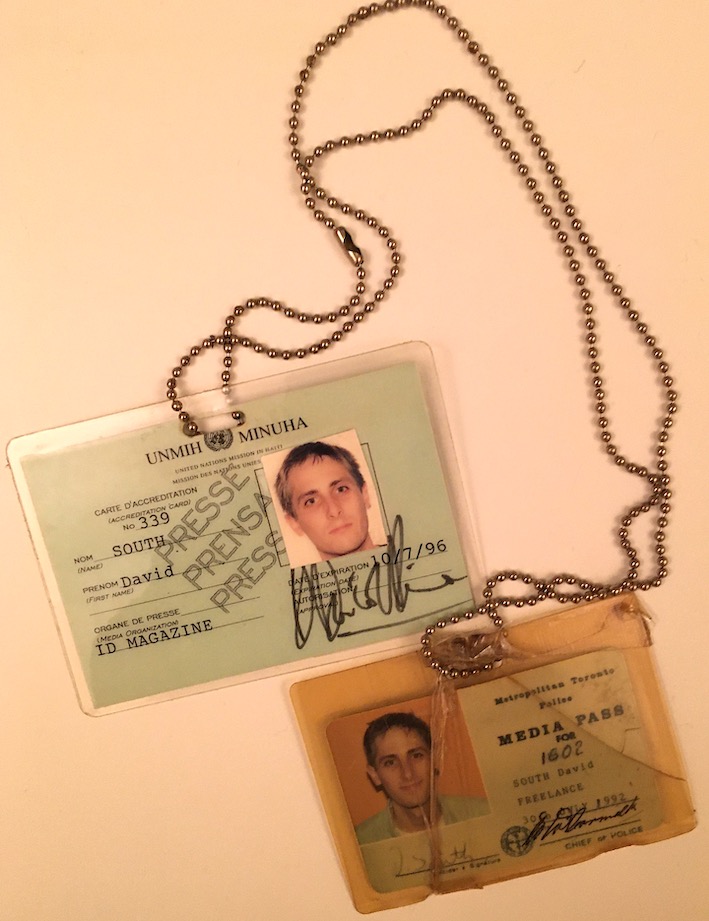
State Of Decay: Haiti Turns To Free-Market Economics And The UN To Save Itself

By David South

Id Magazine (Canada), July 11-25, 1996

Port-au-Prince – Brand-new four-by-four jeeps in various shapes and sizes bounce over the moon-like craters of Port-au-Prince’s roads. The presence of so many expensive vehicles in a country unable to feed all its citizens is hard to take, but it is not one of the worst paradoxes of Haiti.

The appalling state of the roads – more like occassional stretches of asphalt to break up the monotony of potholes – is an apt symbol of Haiti, a reminder with every jar of the tailbone of the public squalor of the many and the private wealth of the few. The shiny new jeeps are not a sign of recent good times, but reveal who has all the money in this nation of almost seven million: the tiny Haitian elite, thieves, the United Nations and the multitude of non-governmental aid agencies.

When democratically-elected president Jean-Bertrand Artistide, deposed in a 1991 coup, returned to complete his term in office in 1994, many Haitians hoped that this country would at last begin to shake off centuries of exploitation at the hands of a selfish elite backed by American corporate masters and begin to build a democratic future.

The United Nations mission in Haiti, which includes 700 Canadian troops, is intended to support the country’s fledgling democracy. But Haiti’s future remains uncertain – as does the role the UN will play in shaping it.

Despite negotiating a peaceful and democratic transition last February 7 from Aristide – a firebrand former priest and passionate advocate of Haiti’s poor – to successor Rene Garcia Preval, Haiti hasn’t stopped its economic freefall. Economists predict the country won’t match 1991 earning levels until the next century. Political unrest resulting from opposition to the government’s privatization plans could also spell trouble ahead.

The United Nations presence, due to end June 30, has been extended another five months at the request of the Haitian government. The newly-minted UN Support Mission in Haiti, a military force of 600 UN troops supported by 700 soldiers paid through voluntary contributions, is being assembled. It will replace the current force of 1900.

Lousy loans

Meanwhile, the government of Rene Preval is negotiating with the International Monetary Fund (IMF), the World Bank and the United States to get much-needed loans to help balance the budget. Critics say the world’s banks are trying to lock the poorest country in the Western hemisphere further into crippling debt. The Haitian budget is US $750 million, 60 per cent of which the government hopes to raise from loans.

But there is a condition. Haiti must embark on a structural adjustment programme: widespread firings of the public service, privatization of most of the public sector, loosening of controls over foreign capital, adherance to the ethos of global trading blocks espoused by the North American Free Trade Agreement (NAFTA). Some call this neo-liberalism, others neo-conservatism. Either way, it forces this impoverished country to limit how it can address rebuilding a crumbling infrastructure.

The government’s hands are tied, though, as the conditions were part of the deal to return Aristide to power.

A Canadian public relations company, Gervais-Gagnon-Covington Associates, has been paid US $800,000 by the American government to sell the idea of privatization of Haiti’s handful of idle and near-bankrupt state enterprises.

In order to plunge deep into this Haitian quagmire, I pitch up at the legendary Hotel Oloffson – made famous by novelist Graham Greene in The Comedians – and begin interviewing in the languid atmosphere by the pool.

“Aristide has put Haitians in a giant trap with the IMF plan,” says Jane Regan, who runs an independent news service based in Port-au-Prince. “The US $1 billion in loans will double the national debt.

“Haiti used to be self-sufficient in rice – last year they bought US $56 billion in US rice. The roads are worse now than a year ago. Right now the UN mission is of questionable worth and Canadians are getting taken advantage of.  They have been sent to clean up after the Americans. These are the same neo-liberal economic policies that hurt Canadian workers – just imagine what Haitians are feeling!”

Regan thinks that, so far, the only people to make any money out of this arrangement are businesses and the more than 800 NGOs operating in Haiti. And on that note, the feisty Regan disrobes and plunges into the Hotel’s pool.

According to Kim Ives, a reporter with the Haitian newspaper Haiti Progres, there are a few cracks in the solidarity between Preval and Aristide: “Aristide is hitting out against privatizations. In a two-hour TV interview, he drew a line between himself and Preval.”

One of the few visible signs of change in Haiti is the dusty Octobre 15 road leading from the airport past former president Aristide’s palatial home on its way to the wealthy suburb of Petionville. It is bordered on one side by Camp Maple Leaf, and on the other by dilapidated shanty towns and desperate street vendors.

Cynics point out the road conveniently serves the interests of the elite once again. It offers a direct and more or less pothole-free route from the secluded mansions of Petionville to the airport – a crucial escape route in a politically volatile developing country. In fact, a development of monster homes that would make a Canadian suburbanite blush is going up near the airport to capitalise on this.

Canadian troops

Caught between the Haitian government and its people is the United Nations, including Canada’s troops. Canadian troops form the first line of defence – along with Preval’s personal secuity guards – to defend the National Palace. They accompany the president wherever he goes, 24 hours a day.

Some fear growing resentment among Haitians for government policies will pitch the population against the soldiers.

At Camp Maple Leaf, the home base of Canada’s military contingent in Haiti, the troops are scrambling to adjust to a new mission sanctioned by the United Nations. As of June 30, they must take a back seat to the troubled Haitian police force as it tries to prove that the intensive training provided by police from around the world has paid off.

In the first week of July, the Canadian soldiers of the Royal 22nd Regiment – the famous Vandoos  – receive confusing news about a change in their firing orders or Rules of Engagement. ROEs dictate the tone and behaviour of peacekeepers on a UN mission and, as the experience of Somalia demonstrates, they can be the difference between success and disaster.

As the new mandate starts, the Canadians are first told they will be only able to use deadly force to defend themselves and not Haitians. If a member of the government is assassinated, they must stand by. If a Haitian is clubbed to death before their eyes, they must stand back. It is a qualitative change from their ROEs prior to June 30.

Ottawa military spokesman Captain Conrad Bellehumour says the change is indicative of an evolving mandate. But a military spokesman in Haiti says the old ROEs are now back in force, and Canadians can intervene to save a Haitian’s life.

“Maybe somebody’s been listening to Jean-Luc Picard too much,” quips retired Brigadier-General Jim Hanson, in a reference to TV show Star Trek’s prime directive of non-interference in a culture.

Preval’s police

A large banner hangs over a Port-au-Prince street: “Police + Population = Securite + Paix”. The UN has placed its greatest emphasis on reforming Haiti’s policing and justice system. The Police Nationale d’Haiti (PNH) was formed, and the RCMP and the American Federal Bureau of Investigation (FBI) were asked to provide training. The idea is to break from the past – when the military used policing as an opportunity to terrorize the population – and establish a police force to serve and protect.

But the efforts of the Haitians and their international police advisers have had a mixed success. According to Canadian soldiers, the Haitian police need to be coaxed into conducting routine patrols and have not given up patrolling in large numbers in the back of a pick up truck with rifles at the ready. To be fair, seven police officers have been killed since January, in what many believe is an organized campaign of terror orchestrated by sympathizers of the old dictatorship and drug gangs.

According to Sergeant Serge Martin of the Vandoos, “The PNH use 15 police officers to patrol and don’t talk to anybody.”

“You don’t depend on police to protect you,” claims Regan. “The Haitian government has no control over them. You don’t know if there is going to be a coup tomorrow.”

Jean-Yves Urfie, editor of the pro-democracy Libete newspaper in Port-au-Prince, believes the campaign to kill police goes back to the United States. “I am convinced the coup d’etat was financed by the Republican administration. I believe the Republicans want to destroy things here to show (President) Clinton wasted his time bringing Aristide back.

“The government was forced to incorporate former members of the military into the police force. And it would be terrible if the population develops the impression all cops are bad.”

“They are 10 years away from a viable police force,” concludes Hanson.

A stop at the fourth precinct police station shows just how far things still need to go. At the counter is a lone police officer, sharply turned out in his beige shirt and yellow-striped navy pants, courtesy of the Royal Canadian Mounted Police. But this proves to be a veneer of change. Canadian soldiers ask if everything is alright. They then ask to see tonight’s prisoners. The officer sheepishly leads the troops down a narrow corridor to 9 ‘ by 12 ‘ foot cell stuffed with nine prisoners. It is very hot and the stench from an open drain overflowing with sewage is nauseating.

Outside the Penitencier National in downtown Port-au-Prince, a yellow concrete structure with peeling pain, Haitians lined up to feed the inmates, talk about their frustrations with a justice system that has collapsed. Many complain that only the rich, who can hire lawyers, can enjoy the fruits of democracy. While state-directed beatings and killings have been dramatically reduced, most prisoners rot on remand until they are charged with a crime. Heiner Rosentdahl, the UN representative in Haiti in charge of prison reform, tries to be upbeat. “There have been no changes in conditions in Haiti’s prisons. Treatment of the prisoners is better, though there have been some abuses. We have developed a nation-wide register book of prisoners to help keep track of who is in prison.”

Another mixed blessing, according to Rosendahl, is the new requirement that all prisoners be fed two meal a day. The food is so poor, prisoners have been getting sick.

He is frustrated with the pace of penal reform. “The Haitian prison system hasn’t had a budget since October 1995, because of battles within the parliament,” he says. “The Haitian government didn’t ask for a plan to change this situation despite the minister of justice visiting the prison for the first time.”

According to Rosendahl, it is not the routine killing of thieves by mobs that worries the elite. Nor is it the assassination of police officers, or the untold thousands dying of disease and hunger. The only thing that is beginning to rock their world is a new phenomenon for Haiti: kidnapping and extortion.

Voodoo economics

For such a seriously depressed economy, there is an astonishingly large number of lottery booths – or Borlettes – on Haitian streets. They are so plentiful, they join gas stations as the main landmarks of the streets.

The industrial park which is now home to the remaining American troops stationed in Port-au-Prince, is a good monument to Haiti’s economic problems. Dilapidated and only barely functioning, this facility once supported, directly and indirectly, a large portion of the city’s population. As crummy as the sweatshop jobs were, they provided valuable income for the capital’s poor.

The Haitian economy under Francois Duvalier and his son, Jean-Claude, before the chaos of the late 1980s and 1990s, was based on assembling manufactured goods for the US market. Haiti was the world’s largest producer of baseballs, and ranked as “top three in the assembly of such diverse products as stuffed toys, dolls and apparel, especially brassieres. All told, the impact of international subcontracting was considerable,” according to author Paul Farmer in his book, The Uses of Haiti.

Today, Pierre Joseph, a Haitian-American from New York City, has a new job: he screens the ID cards of Haitian workers as they enter the park. He says there were once over 50 factories operating here; now there are 30.

Evidence of Haiti’s economic collapse is everywhere. On the walls outside the National Palace is scrawled Aba Preval Granhanje – Preval is a liar. Across the wide boulevard in a square are around 75 homeless children. They joke with the Canadian soldiers, especially boyish 2nd Lt. Marc Verret, who looks like a baby in soldiers clothes. The kids beg him for water and money.

In the market area, the piles of garbage, rotting meat and excrement make a muddy devil’s stew. Homeless children sleep on top of the abandoned crates. One small child is curled up in an American flag, asleep.

Desecrating dead

The dead also suffer the indignities of economic ruin. Outside the gates of the Hopital Generale, a man lies dead on a broken trolley in the yard. Others still alive, with limbs missing, are sprawled out on the ground. Chickens and goats roam the grounds. In the back is the main morgue for Port-au-Prince. The odour just 25 feet from the entrance to the morgue is normal for this city strewn with rotting garbage and stewed by a hot sun.

Inside, an overpowering odour like rotten chicken meat is the product of 450 human cadavers. Like rag dolls laid out in a ghoulish toy store, row upon row of children dead from starvation and disease – Haiti’s infant mortality rate is 127 per 1,000 babies born – are stacked almost to the ceiling. There are also adults. Old women, young men badly mutilated for stealing, are strewn out on the dirty concrete floor and on shelves.

There is no refrigeration, and according to military doctor Major Tim Cook, “something really nasty is going to come out of there if they don’t do something.”

Proving peacekeeping

More is at stake in Haiti than the re-building of a politically and economically devastated nation. For Canada’s armed forces, shaken and little stirred by the Somalia scandal, it is an opportunity to make amends. This time around, the peacekeepers are keeping the needs of the local population foremost in their gun sights. When the Vandoos head out on another one of their 24-hour patrols, the atmosphere is friendly and filled with gentle ribbing with the locals. They have the advantage of being able to speak French, a language understood to varying degrees by most of the population.

The approach of the individual soldiers varies widely. On a routine patrol, Alpha Company engaged in good-natured kidding around, with splashing the locals the worst offence. But a day out with Charlie Company, led by Sergeant Serge Martin, proved another story. The two privates assigned to accompany a group of journalists were a couple of operators. The day included a visit to a perfume shop, a trip through the wharf area looking for prostitutes and constant propositioning of the local women.

One Canadian corporal with the Vandoos, Eric Charbonneau, has been trying to make a small difference to the lives of the 400 people living in the community of Cazeau, a shanty town near the international airport. He has started literacy and hygiene lessons and raised money to help the residents build concrete houses to replace the mud dwellings they currently inhabit.

“I was walking along the fence and started to build a relationship with the kids,” he explains. “Some guy approached me and needed some help. It took three weeks to build a relationship. They are too used to white people giving away things for doing nothing. They were surprised when they had to work for it.”

At the gates to Camp Maple Leaf is a spray-painted sign. In Creole, French and English beside a Canadian flag, it says “No More Jobs.” While it could look at home back in Canada, it illustrates how important the presence of soldiers, the United Nations and charities are right now to the economy.

Some observers see the UN presence as part of a slide back into dependency on foreign money, restricting Haiti’s ability to assert itself. But others believe the turn to the international community is Haiti’s last hope of breaking with a past littered with dictatorships and poverty.

According to Captain Roberto Blizzard – an erudite and wise observer of the situation – the base has been stampeded with desperate Haitians looking for work. Blizzard has tried to find work for as many Haitians as he can, even helping them to form a laundry co-operative he hopes will survive long past the Canadians’ stay.

“There is a danger of the Haitian people turning into full-time beggars,” he says with sadness.

Further reading:

Failed States and Institutional Decay: Understanding Instability and Poverty in the Developing World by Natasha M. Ezrow and Erica Frantz, Bloomsbury Academic, 18 July 2013.

Towards a taxonomy of failed states in the New World Order: decaying Somalia, Liberia, Rwanda and Haiti by Jean-Germain Gros, Third World Quarterly, Vol. 17 No. 3 September 1996 Section 5 Page 455

https://davidsouthconsulting.org/2021/10/28/ending-gang-violence-while-cleaning-the-streets-in-haiti/

https://davidsouthconsulting.org/2021/09/01/haiti-earthquake-prompts-tech-aid/

https://davidsouthconsulting.org/2021/01/08/haitian-coffee-becoming-a-hit-with-american-connoisseurs/

https://davidsouthconsulting.org/2021/10/28/milk-co-operatives-help-hungry-haiti/

https://davidsouthconsulting.org/2022/09/23/opinion-canada-is-allowing-u-s-to-dictate-haitis-renewal-more-news-and-opinion-on-what-the-un-soldiers-call-the-haitian-vacation/

https://davidsouthconsulting.org/2021/01/26/u-s-elections-update-clinton-is-using-canada-to-keep-control-of-haiti/

Creative Commons License

This work is licensed under a
Creative Commons Attribution-Noncommercial-No Derivative Works 3.0 License.

ORCID iD: https://orcid.org/0000-0001-5311-1052.

© David South Consulting 2025