Categories
Archive Development Challenges, South-South Solutions Newsletters Southern Innovator magazine

Info Ladies and Question Boxes: Reaching Out to the Poor

By David SouthDevelopment Challenges, South-South Solutions

SOUTH-SOUTH CASE STUDY

Quick access to accurate and useful information is crucial for development. With the remarkable spread of information around the world via the Internet – one of the greatest achievements of the 21st century – more than 1.5 billion people now use the Web to boost their incomes and opportunities (Internet World Stats).

For those lucky enough to be able to afford regular access to the Internet – as well as a computer and electricity – this new technology is a powerful tool for economic and social advancement. But what about people who are overlooked by technology companies because they are too poor, or too remote, or who are illiterate?

Two initiatives are bringing the benefits of information and communication technologies (ICTs) to the poor and the illiterate in ingenious ways.

Bangladesh’s (http://www.virtualbangladesh.com) ‘Info Lady’ scheme is the brainchild of D.Net (Development Research Network) (http://www.dnet-bangladesh.org/), a non-profit organization formed in 2001 to use information and communication technology (ICT) for economic development.

Info Ladies typically come equipped with a mobile phone, laptop computer, Internet modem, headphone, webcam, digital camera, and photo printer. They roam around remote villages on bicycles and are a one-stop access point for the rural poor for information, telephone calls and digital services like photography. And Info Ladies can also be Info Men, though this seems to be a problem because women have an easier time being invited into people’s homes.

One Info Lady is Luich Akhter Porag. She travels the countryside on her bicycle, equipped with a laptop computer, modem and a mobile phone, and can provide a commercial phone service, photography, livelihood information, knowledge services, international and local voice calls, video and animation and Internet resources.

When farmer Dula Miah had two of his cows bitten by a rabid dog, he was puzzled as to what to do. According to Bangladesh’s Daily Star newspaper, Info Lady Luich Akhter Porag came by to help. By using a software programme called ‘Jeeon’ (http://www.dnet.org.bd/MultimediaSoftware.php?BookType=8) – software designed to provide nine essential services to rural people –  Porag was able to identify the solution: a vaccine and a trip to the Sundarganj Veterinary Hospital.

Around 24 Info Ladies are now working in various villages in the districts of Gaibandha, Noakhali and Satkhira. The concept is effective: after receiving training in how to use the laptop computer and resources, they are dispatched on bicycles to remote villages to connect the poor and uneducated with crucial information.

D.Net started with something they called ‘Mobile Lady’ which used just mobile phones, but became frustrated with the limits of the service and decided to combine the phones with a laptop computer, effectively turning the women into mobile ‘telecentres’ (http://en.wikipedia.org/wiki/Telecentre).

Dr Ananya Raihan, executive director of D.Net, told The Daily Star that each Info Lady now earns between Tk 2,500 (US $36) and Tk 20,000 (US $290) per month. It has proven to be a good business for rural women, he said. And things are set to grow: “We are planning to increase the number of info ladies to 1,000 by year-end (2009).”

While traditional technology companies have stayed away from rural villages because it isn’t worth it for them to go there, the Info Ladies are simultaneously making money in the villages and connecting people to the outside world.

Porag says she has provided services to around 6,000 villagers.

“Now I earn more than Tk 2,500 (US $36) to Tk 3,500 (US $50) per month after becoming an info lady,” said Porag who started working as an Info Lady in June 2007.

Another initiative that is filling the gap between the needs of the poor and powerful information technologies is the Question Box (www.questionbox.org).

Pioneered in India – home to the largest number of illiterate people in the world: 304.11 million (Human Development Report) – the idea is brilliantly simple. An intercom-like white tin box with a phone inside is placed in a village’s public areas. Using the existing phone networks, the user just has to hit a simple button to get an operator at the other end. The operator sits in front of an Internet-enabled computer. The user just asks their question, and the operator turns these questions into search queries. When the computer’s search engine gives back answers, the operator selects the best one and then replies in the user’s native language and in layman’s terms.

The Open Mind Program’s Question Box Project opened its first Box in September 2007 and now operates in Pune, Maharashtra.

It has also expanded to Uganda, where the Question Box and Grameen Foundation (http://www.grameenfoundation.org/) have partnered to bring what they call AppLab Question Box (AQB) to rural Uganda. AQB is a live, local-language telephone hotline service that brings the Internet to the fields and market stalls in Uganda where there are no computers.

The Question Box is based on an idea from Rose Shuman, a business and international development consultant. Shuman had become frustrated that with all the clever people and vast sums of money going into information technology, few were developing low-cost ways to take the power of computers to the people.

Following the constant improvement approach favoured in information technology, the Box is now in its third iteration. One of the adjustments made has been the switch to solar power for the boxes because the electricity grid was too unreliable, according to Shuman.

Published: September 2009

Resources

1) The Question Box project in photos. Website:http://www.flickr.com/photos/73495762@N00/ and Website: http://www.questionbox.org/ and blog: Website:http://questionblog.posterous.com/
2) Info Dev (www.infodev.org) has a quick guide to low-cost computing devices and initiatives for the developing world. Website: http://www.infodev.org/en/Publication.107.html

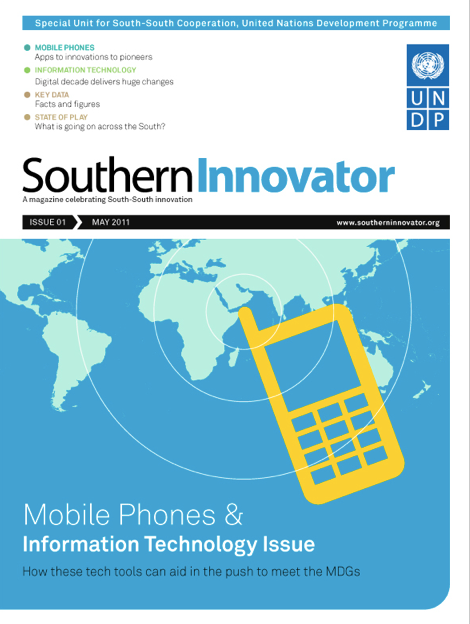
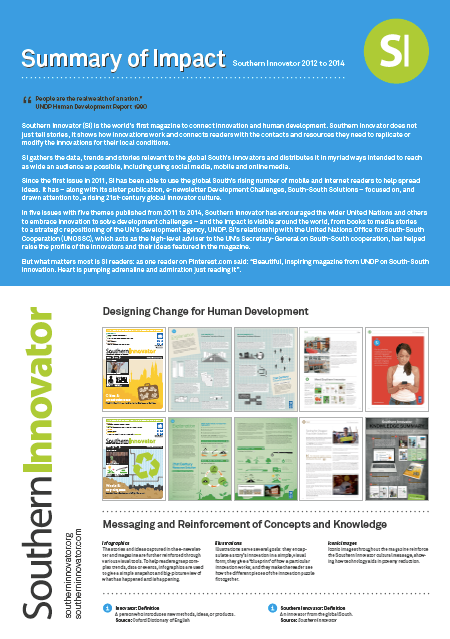
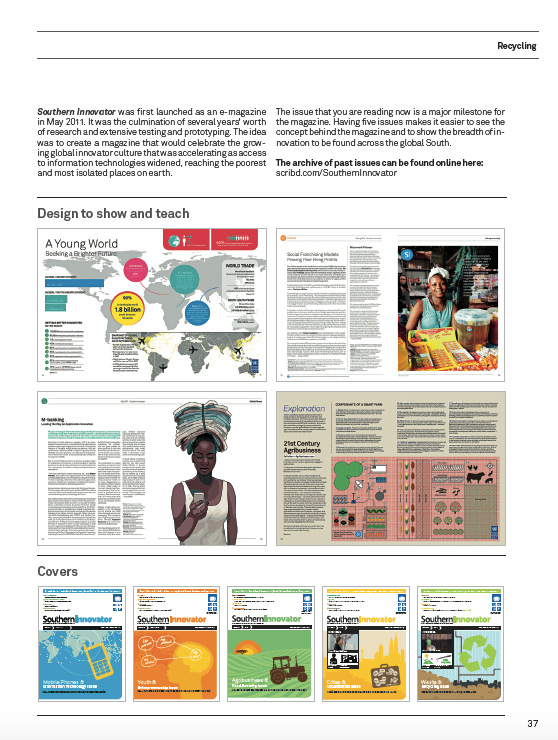
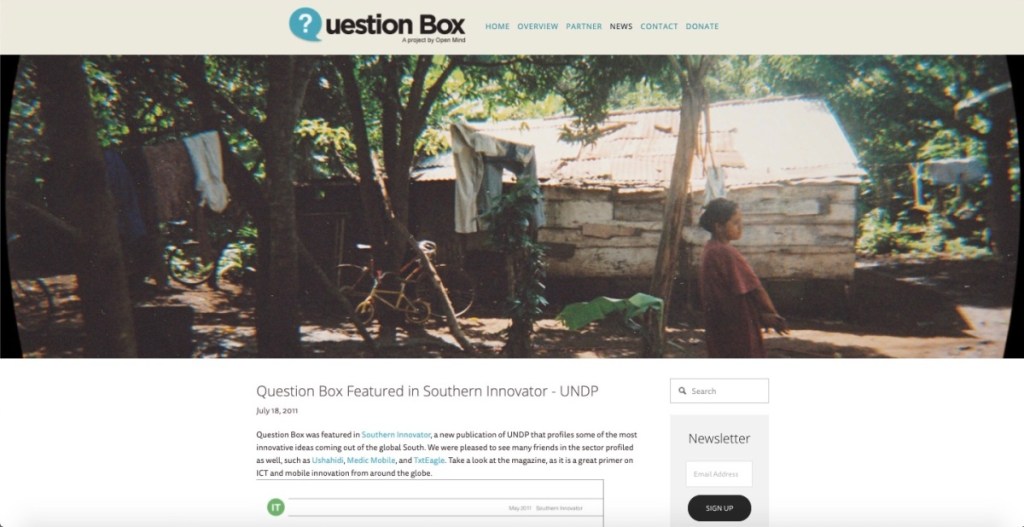
Question Box in Southern Innovator Magazine.

https://davidsouthconsulting.org/2022/11/19/cooking-up-a-recipe-to-end-poverty/

https://davidsouthconsulting.org/2021/09/23/david-south-consulting-books-1997-2014/

https://davidsouthconsulting.org/2022/10/24/flurry-of-anti-poverty-innovations/

https://davidsouthconsulting.org/2021/04/06/gobi-desert-wine-to-tackle-poverty-and-boost-incomes/

https://davidsouthconsulting.org/2022/11/22/happy-nigeria-west-african-nation-has-good-attitude/

https://davidsouthconsulting.org/2022/06/10/illiterate-get-internet-at-touch-of-a-button/

https://davidsouthconsulting.org/2022/11/20/kiva-new-gateway-of-loans-for-the-poor/

https://davidsouthconsulting.org/2022/10/21/local-animation-a-way-out-of-poverty/

https://davidsouthconsulting.org/2022/11/20/old-adage-gets-new-life/

https://davidsouthconsulting.org/2022/10/21/social-networking-websites-a-way-out-of-poverty/

https://davidsouthconsulting.org/2021/03/05/southern-innovator-issue-1/

https://davidsouthconsulting.org/2021/01/23/a-steppe-back-economic-liberalisation-and-poverty-reduction-in-mongolia/

https://davidsouthconsulting.org/2021/01/23/the-sweet-smell-of-failure-the-world-bank-and-the-persistence-of-poverty/

https://davidsouthconsulting.org/2022/11/20/venezuelas-currencies-promote-cooperation-not-competition/

https://davidsouthconsulting.org/2022/11/18/web-2-0-networking-to-eradicate-poverty/

Creative Commons License

This work is licensed under a
Creative Commons Attribution-Noncommercial-No Derivative Works 3.0 License.

ORCID iD: https://orcid.org/0000-0001-5311-1052.

© David South Consulting 2023

Categories
Archive Development Challenges, South-South Solutions Newsletters Southern Innovator magazine

Illiterate Get Internet at Touch of a Button

By David SouthDevelopment Challenges, South-South Solutions

SOUTH-SOUTH CASE STUDY

Quick access to information is crucial for development. The remarkable spread of information around the world via the internet has been one of the greatest achievements of the 21st century. The astounding take-up of mobile phones is another. For those who can afford it or get access to a computer and electricity, the new technology is a powerful tool for economic and social advancement. But what about people who are caught in the technology gap, or who are illiterate?

What about those who have a mobile phone, but are too poor to own a computer – or live in a village without electricity? Or those who can’t read or write? In India, there are 42 million Internet users, 3.7 per cent of the population. But the country is also home to the largest number of illiterate people in the world: 304.11 million (Human Development Report).

A unique solution in rural India is developing a way to connect the illiterate to the internet. The Open Mind Programme’s Question Box Project, opened its first Box in the village of Phoolpur in September 2007.

The idea is brilliantly simple. An intercom-like white tin box with a phone inside is placed in a village’s public areas. Using the existing phone networks, the user just has to hit a simple button to get an operator at the other end. The operator sits in front of an internet-enabled computer. The user just asks their question, and the operator turns these questions into search queries. When the computer’s search engine gives back answers, the operator selects the best one and then replies in the user’s native language and in layman’s terms.

The operator’s role goes beyond simply typing questions into Google – the operators use intelligent software that aggregates frequently asked questions (FAQs) to speed up time. FAQs include: school scores, job opportunities, football/cricket scores, and definitions and terms. Operators will also send emails for the users.

The service also has a role to play for the literate who lack Internet access. Students once had to travel to get their exam results, but now they can just ask the Question Box.

The Question Box operates in normal business hours for now. A second Question Box was put into operation at the beginning of 2008 in the village of Ethida, several hours’ drive from New Delhi, and there are plans to expand the Question Box to 30 units connected to 20 operators.

At present, organizers are looking into raising revenue for the service by advertising and sponsorship. Operators are typically homeworkers and well-educated. Mostly female, their parents are happy to have them work from home.

During this first phase, the project team analyzed the results and refined the structure of the service. They are also exploring viable business models to be able to take the service across India and keep it sustainable.

Professor of Psychology Ritu Dangwal from the NIIT Institute, is in charge of working with the villagers to monitor the project. She is also involved in a start-up called Hole in the Wall, which provides internet kiosks to rural villagers. Dangwal’s research has starkly correlated the relationship between distance from a big city and decreasing quality of education, a graphic example of the damage done by being cut off from good information resources.

The Question Box is based on an idea from Rose Shuman, a business and international development consultant. Shuman had become frustrated that with all the clever people and vast sums of money going into information technology, few were developing low-cost ways to take the power of computers to the people.

“The best thing about this project is that it’s very tangible,” she told the Daily Telegraph newspaper. “It’s not a big infrastructure. You have a box you can see and touch, and a call log of every question.”

Published: April 2008

Resources

  • Photographs of the project launch and the Question Box: www.flickr.com
Question Box in Southern Innovator Magazine.
Creative Commons License

This work is licensed under a
Creative Commons Attribution-Noncommercial-No Derivative Works 3.0 License.

ORCID iD: https://orcid.org/0000-0001-5311-1052.

© David South Consulting 2022

Categories
Archive data Development Challenges, South-South Solutions Newsletters Southern Innovator magazine

Radical Drone Solution To Woeful Infrastructure In Poor Countries

By David SouthDevelopment Challenges, South-South Solutions

SOUTH-SOUTH CASE STUDY

Drones – unpiloted aircraft, formally called Unmanned Aerial Vehicles (UAV) or Unmanned Aircraft Systems (UAS) – have long been used for military purposes. The U.S. military claims to have 7,500 drones – a massive growth from just 50 a decade ago – and has used them for surveillance and combat in conflicts from Afghanistan to Iraq.

Drones can cost anywhere between a few thousand and millions of dollars depending on their size and sophistication. Some weigh as little as half a kilogram, and the largest can reach 18,000 kilograms (19 tons).

It is estimated 40 countries around the world are working on drones in one capacity or another.

Military drones come with ominous-sounding names such as Predator, Fire Scout, Global Hawk and Hunter. But many pioneers and innovators are setting out to prove drones can be a technology of peace and development and not just of fear and war.

YouTube provides many examples of drones being tested out as a delivery method. SF Express (http://www.sf-express.com/cn/en/product_service/product_intro/airline_delivery.html), a courier service in Dongguang, China has tried delivering parcels by drone. It is using a drone with eight rotor blades, called an octocopter (http://www.steadidrone.eu/octocopter-ei8ht/).

In Shanghai, the InCake bakery has used drones to deliver cakes (http://www.youtube.com/watch?v=fXwgwSkujOY). The service was brought to a halt after complaints from citizens, worried the drone would crash into someone.

The American pizza chain Domino’s has been testing drones for delivering pizza in the United Kingdom (http://www.youtube.com/watch?v=ZDXuGQRpvs4). A British company has used drones to deliver sushi to restaurant tables in London (http://www.youtube.com/watch?v=WV0yQYXLU34).

These may prove to be novelty experiments – or the early days of a revolution. Time will tell.

But serious thinking about drones is taking place in the area of development.

One pioneering company thinks it has a solution for two big problems common to many developing countries: the chaos, congestion and crowding that clog urban areas; and the poor or non-existent infrastructure in rural areas. Both problems make it expensive and time-consuming to move goods around.

A billion people in the world do not have access to all-weather roads, says the World Bank. Some roads are being upgraded in parts of sub-Saharan Africa but many are in worse shape than they were decades ago. Modern infrastructure is expensive to build, and the funds to do it often must be borrowed.

A startup called Matternet thinks it has the solution to getting around this problem in Africa, and in rapidly growing cities of the global South. It believes drones can come to the rescue where infrastructure is poor or non-existent, and save valuable wealth that can be diverted to real improvements in human development, or used to reduce congestion in crowded urban areas.

The Matternet (http://matternet.us/) is billed as “the next paradigm for transportation.” Matternet is offering a system and a concept for deploying drones as a scalable solution to overcome the problem of poor transportation networks in developing countries.

The artist’s vision on Matternet’s website shows drones buzzing their way through an urban high-rise landscape as they go about their business.

The Matternet drone design has two wings with three fans in each wing to allow it to take off and land vertically as well as flying in a straight line. There is a 10 litre space for packages and a rechargeable battery at the bottom of the drone. The drones can fly at 40 kilometres an hour, at an altitude of up to 121 metres and are guided by GPS (Global Positioning System) (http://en.wikipedia.org/wiki/Global_Positioning_System).

The drone moves in and out of a ground-station landing pod, where it is recharged, picks up new packages to deliver, and connects electronically to receive instructions. An entry and exit slot sits on top of the pod while there is a place at ground level for people to pop in packages for delivery.

Each vehicle costs US $1,000 and can last 10 years, the makers claim. Matternet believes the drones could transport 2 kilograms over 10 kilometres for just 24 US cents a trip.

Matternet’s Andreas Raptopoulos (https://www.solveforx.com/moonshots/physical-transport) hopes to push Africa away from simply upgrading its infrastructure along the lines of what is already in existence in developed countries. It is estimated it will take Africa another 50 years to have an infrastructure equal to North America. But why wait so long? Why not, he argues, just use drones or UAVs to knit a transport infrastructure criss-crossing the continent delivering goods and services to people?

Radical drone advocates like Matternet are very ambitious. They believe drones are to infrastructure what mobile phones have been to telecommunications: an advanced, 21st-century technology that enables countries to leapfrog ahead of old-school 20th century infrastructure and connect people up for much less cost and effort.

Imagine a city in the global South 15 years from now: canyons of high-rise buildings stretch from the central business district out to the suburbs where apartment towers replace office buildings. And whooshing through these canyons will be the drones carrying everything from takeaway food to medical supplies to the latest fashion items.

Anywhere in Africa can currently contact Matternet to arrange a trial of the technology (http://matternet.us/get-matternet/). The concept had field trials in the Dominican Republic and Haiti in the Caribbean. A large field test trial is being arranged for Lesotho, where the drones will help with delivering supplies to clinics serving patients with HIV/AIDS. The 47 clinics are spread out over a 138 square kilometre area and will be served by 50 ground stations and 150 drones at a cost of US $900,000. In comparison, building 2 kilometres of a single lane road would cost US $1 million.

Matternet is based in Palo Alto, California and founded by partners Andreas Raptopoulos, Paola Santana, Dimitar Pachlov and Darlene Damm.

It was conceived at the Singularity University (http://singularityu.org/) whose mission is to educate, inspire and empower leaders to apply exponential technologies to address humanity’s grand challenges.

By David South, Development Challenges, South-South Solutions

Published: October 2013

Development Challenges, South-South Solutions was launched as an e-newsletter in 2006 by UNDP’s South-South Cooperation Unit (now the United Nations Office for South-South Cooperation) based in New York, USA. It led on profiling the rise of the global South as an economic powerhouse and was one of the first regular publications to champion the global South’s innovators, entrepreneurs, and pioneers. It tracked the key trends that are now so profoundly reshaping how development is seen and done. This includes the rapid take-up of mobile phones and information technology in the global South (as profiled in the first issue of magazine Southern Innovator), the move to becoming a majority urban world, a growing global innovator culture, and the plethora of solutions being developed in the global South to tackle its problems and improve living conditions and boost human development. The success of the e-newsletter led to the launch of the magazine Southern Innovator.  

Other stories from Development Challenges, South-South Solutions:

African Digital Laser Breakthrough Promises Future Innovation

China Looking to Lead on Robot Innovation

Digital Mapping to put Slums on the Map

New Weapon Against Crime in the South

Follow @SouthSouth1

Google Books: https://books.google.co.uk/books?id=I_hcAwAAQBAJ&dq=development+challenges+october+2013&source=gbs_navlinks_s

Slideshare: http://www.slideshare.net/DavidSouth1/development-challenges-october-2013-issue

Southern Innovator Issue 1: https://books.google.co.uk/books?id=Q1O54YSE2BgC&dq=southern+innovator&source=gbs_navlinks_s

Southern Innovator Issue 2: https://books.google.co.uk/books?id=Ty0N969dcssC&dq=southern+innovator&source=gbs_navlinks_s

Southern Innovator Issue 3: https://books.google.co.uk/books?id=AQNt4YmhZagC&dq=southern+innovator&source=gbs_navlinks_s

Southern Innovator Issue 4: https://books.google.co.uk/books?id=9T_n2tA7l4EC&dq=southern+innovator&source=gbs_navlinks_s

Southern Innovator Issue 5: https://books.google.co.uk/books?id=6ILdAgAAQBAJ&dq=southern+innovator&source=gbs_navlinks_s

Creative Commons License
This work is licensed under a
Creative Commons Attribution-Noncommercial-No Derivative Works 3.0 License.

ORCID iD: https://orcid.org/0000-0001-5311-1052.

© David South Consulting 2023