Categories
Archive Development Challenges, South-South Solutions Newsletters Southern Innovator magazine

Africa’s Fast-Growing Cities: A New Frontier of Opportunities

By David SouthDevelopment Challenges, South-South Solutions

SOUTH-SOUTH CASE STUDY

According to a new report by the International Institute for Environment and Development, Africa now has a larger urban population than North America and 25 of the world’s fastest growing big cities. Europe’s share of the world’s 100 largest cities has fallen to under 10 percent in the past century.

Counter to common misperceptions about what is luring people to big cities, the report’s author, David Satterthwaite, said it isn’t because governments and aid are attracting them: government “policies leave much to be desired as they tend to neglect the urban poor, leading to high levels of urban poverty, overcrowding in slums and serious health problems. Governments should see urbanisation as an important part of a stronger economy and their expanding urban population as an asset, not as a problem.”

But global perceptions of Africa are changing. The Mo Ibrahim Foundation has listed the most efficiently run African economies, with a strong correlation between good governance and higher growth rates (Mauritius, Seychelles, Botswana, South Africa, Namibia, Ghana and Senegal).

In most of urban French West Africa, extensive interviews with micro-entrepreneurs and micro-finance practitioners found that most operating micro-enterprises in the informal economy are entrepreneurs by necessity, and that their most basic needs drove their business activities and behaviours. Success was held back by lack of capital, poor training, and a general aversion to risk (Faculty of Management, Dalhousie University).

While access to capital has been identified as the key factor in opportunity, entrepreneurs aren’t even waiting for microfinance institutions to help them. “I started this business of selling chips (French fries) two years ago using money we raised as a group of 30 women,” said Mary Mwihaki, 27, who lives in the Mathare slum area outside Nairobi.

Each member of her group of women contributes about US 30 cents a day and the resulting US $9 is given to a different member of the group on a rotating basis, she told IRIN news agency. Mwihaki waited three months to raise the US $27 she needed. She joins many other women across the country taking the same approach to raising capital.

For some entrepreneurs, it is just the proximity to a buzzing urban atmosphere that is a spur to action. One clothes seller told the African Executive he has been able to make enough money to get a house built just selling second hand clothing. Twenty-three-year-old Henry Mutunga in Nairobi, Kenya takes advantage of the high turnover of the city’s Machakos Country bus terminal to sell second hand clothes.

“After months of searching for a job, I asked myself, ‘Why am I wasting the business studies knowledge I acquired in school?’ I was not comfortable being left in the house every morning, with nothing to do, while my uncle went to work in order to feed me and pay the house rent. I got hooked to the urban mentality and tried my hand at selling trousers.”

Now with two employees, he is able to rent his own house, and is able to use extra money to have his own house built. He urges other youth to become employers, not employees.

At the technological end of entrepreneurship, in Nairobi, Kenya, Mumbi’s Dial-a-Cab company is joining 20 fleet firms in the country to adopt a new mobile phone-based vehicle-tracking technology developed by two young African IT entrepreneurs, Waweru Kimani and Paul Mahiaini. The technology allows management to know how low fuel is, which car has gone where, when a car has been hijacked, what car doors are open, how long it has been stopped, and where it is located. Impressively, it also allows management to stop the car at the touch of a button if it has been stolen. It costs US $570 to install, and costs US $40/month to use.

Other entrepreneurs are piggy backing their success on the booming housing markets in Angola, Ivory Coast, Liberia, Nigeria, Congo, Mali, Morocco, Tunisia, Botswana, Ghana, Mozambique, Rwanda, Kenya, Mauritius, Uganda, Algeria, Egypt, Senegal: all creating enormous opportunities for entrepreneurs providing other services, like furniture, appliances, insurance, landscaping, security, architecture etc.

And the giant US internet search engine Google is now setting up operations in West Africa, based in Dakar – a sure sign that they see this as a new boom market. And Indian investment in Africa has also dramatically shot up this year, according to mergers and acquisitions magazine, The Deal. In 2005, US $81 million was invested in Africa. In 2006, US $340 million; and in 2007, US $294 million.

Published: November 2007

Resources

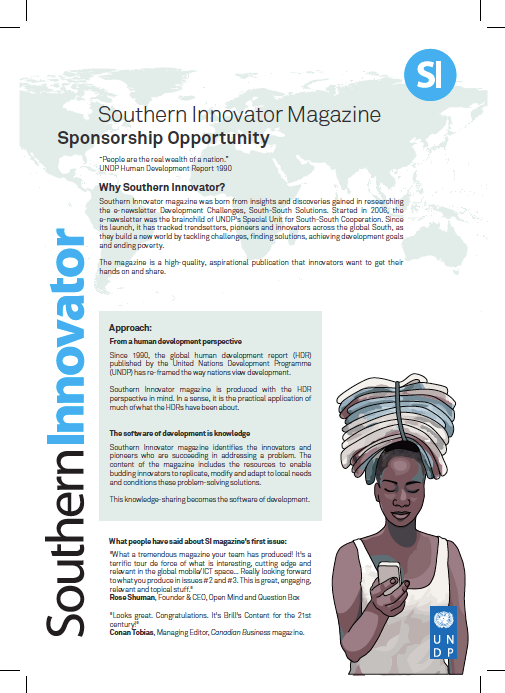
Development Challenges, South-South Solutions was launched as an e-newsletter in 2006 by UNDP’s South-South Cooperation Unit (now the United Nations Office for South-South Cooperation) based in New York, USA. It led on profiling the rise of the global South as an economic powerhouse and was one of the first regular publications to champion the global South’s innovators, entrepreneurs, and pioneers. It tracked the key trends that are now so profoundly reshaping how development is seen and done. This includes the rapid take-up of mobile phones and information technology in the global South (as profiled in the first issue of magazine Southern Innovator), the move to becoming a majority urban world, a growing global innovator culture, and the plethora of solutions being developed in the global South to tackle its problems and improve living conditions and boost human development. The success of the e-newsletter led to the launch of the magazine Southern Innovator.  
Creative Commons License

This work is licensed under a
Creative Commons Attribution-Noncommercial-No Derivative Works 3.0 License.

ORCID iD: https://orcid.org/0000-0001-5311-1052.

© David South Consulting 2023

Categories
Archive

Powerful Solar Light Spurring Income-Making Opportunities

By David SouthDevelopment Challenges, South-South Solutions

SOUTH-SOUTH CASE STUDY

A clever innovator from India has built a highly durable solar lantern that also doubles as a mobile phone charger.

The Sunlite lantern – the JS 30 MOB Sunlite – made by Sunlite Solar (sunlite-solar.com) is an LED (http://en.wikipedia.org/wiki/Light-emitting_diode) light packed with clever innovations. It is completely self-contained and does not require any extra parts, cables or separate solar panel to charge it. The clever design includes a pop-up, fold-down handle, a powerful solar PV (photovoltaic) panel on its top that – with a day out in the sun – charges the lantern’s battery enough to provide around 8 hours of 360-degree light when the sun goes down. It is also highly durable and moisture and heat resistant and can withstand a drop on a hard floor.

The manufacturer of the Sunlite lantern is India Impex, which focuses on making and exporting high quality off-grid solar lighting products and sees itself as a “socially driven company.” Founded in 2009, it has built up its reputation as a global vendor to humanitarian and relief agencies.

To date, the Sunlite lantern has been distributed to people following Japan’s 2011 earthquake and tsunami, after Thailand’s 2011 floods and to refugees caught up in the ongoing crisis in Syria.

“For the size of the lamp, for the number of hours, for the features we give, including the mobile (phone) charging – we are 100 per cent portable – it is all integrated,” said Sunlite representative Divyesh Thakkar, while demonstrating the lantern at the 2012 Global South-South Development Expo, held recently in Vienna, Austria (southsouthexpo.org).

The mobile phone charging capability has been seized as a great way to turn the lantern into an income-generating opportunity. Already, people are forming co-ops and charging rent time on the lantern for recharging mobile phones. And there are a few clever tweaks to the lantern to help control this.

“I don’t want this to be abused – I want it to be smart,” said Thakkar. “When someone comes in and charges the mobile phone and forgets, it is going to cut off after 20 minutes.”

Sunlite lanterns have many uses, according to the product’s maker. One aspect the manufacturer is emphasizing is the importance of light to the security of women and children. There is overwhelming evidence that better lighting makes for a more secure environment, and allows people to do more things safely at night. Children can look out for environmental threats such as poisonous snakes and spiders, and women and girls can feel safe doing things like going to the toilet without worrying that somebody might attack them in the dark.

Solar power is being seen as a way to get electricity to people in areas bypassed by conventional electricity grid networks. It also helps move people away from expensive, polluting and dangerous alternatives such as diesel generators, paraffin lamps, gas stoves and coal or dung fires.

“We compare our solar lantern to the kerosene lantern,” Sunlite representative Sagar Mehta explained. “On a payback basis, you use an approximate of 30 to 40 cents of a US dollar of kerosene every day for a four-hour light. First of all, it is very harmful – smoke inhalation, illnesses, burns, all sorts of things, security issues.

“That will cost a family one third or half of its income on a daily basis. If we can change this around where if we can make a solar lantern, where the sun is free, that can pay back in three months and you start earning rather than paying, (they are) making a living.”

Solar-powered devices have many advantages. They can power up their batteries during the day while sitting in the sunshine and then be a source of light and electricity at night. This free energy source reduces the cost of running lights at night and means people can do a wide range of activities, from reading and studying to running a business or socializing. Some have even used Sunlite lanterns as landing lights for aircraft runways in Africa.

Sunlite lanterns are currently being distributed to people in disaster situations and also in refugee camps and displaced persons communities.

“The lamp was developed as a basic light for refugees who don’t have anything and have been displaced from homes,” said Mehta. “We supply in excess of 50,000 lamps every year to aid agencies, in particular the (UN’s) refugee agency.”

In order to keep tight control on quality and be able to have an inventory of lanterns ready to go on a moment’s notice, the company has invested in and set up its own in-house manufacturing facilities in India.

Sunlite Solar sees itself as a social enterprise. It is not focused on quick profits, and developing the lantern has taken time.

“It requires a huge amount of investment and time,” said Thakkar. “We spent two years without selling a single piece. What we did was our R&D and went out in the field, some of the most dangerous places – Rwanda, Uganda – actually training people to use it and getting the awareness.

“When you work with the UN, when you work through other government channels, it is just a long process which you have to be willing to go through.”

Published: December 2012

LINKS:

1) More information on how renewable solar technologies work. Website:http://www.energysavingtrust.org.uk/Generating-energy/Choosing-a-renewable-technology/Solar-panels-PV 


2) Solar Sister: Solar Sister eradicates energy poverty by empowering women with economic opportunity. Website:http://www.solarsister.org/

3) D.Light Design: D.light is a for-profit social enterprise whose purpose is to create new freedoms for customers without access to reliable power so they can enjoy a brighter future. Website: http://www.dlightdesign.com/

Development Challenges, South-South Solutions was launched as an e-newsletter in 2006 by UNDP’s South-South Cooperation Unit (now the United Nations Office for South-South Cooperation) based in New York, USA. It led on profiling the rise of the global South as an economic powerhouse and was one of the first regular publications to champion the global South’s innovators, entrepreneurs, and pioneers. It tracked the key trends that are now so profoundly reshaping how development is seen and done. This includes the rapid take-up of mobile phones and information technology in the global South (as profiled in the first issue of magazine Southern Innovator), the move to becoming a majority urban world, a growing global innovator culture, and the plethora of solutions being developed in the global South to tackle its problems and improve living conditions and boost human development. The success of the e-newsletter led to the launch of the magazine Southern Innovator.  
Creative Commons License

This work is licensed under a
Creative Commons Attribution-Noncommercial-No Derivative Works 3.0 License.

ORCID iD: https://orcid.org/0000-0001-5311-1052.

© David South Consulting 2022

Categories
Archive Blogroll Development Challenges, South-South Solutions Newsletters

Nollywood: Booming Nigerian Film Industry

By David SouthDevelopment Challenges, South-South Solutions

SOUTH-SOUTH CASE STUDY

The digital revolution in filmmaking over the last decade has given birth to an African success story: Nollywood – Nigeria’s answer to Hollywood, uses low-cost digital filmmaking and editing to tell local stories — in the process making money and creating thousands of jobs.

This do-it-yourself (DIY), straight-to-DVD and video market has in just 13 years ballooned into a US $250 million-a-year industry employing thousands of people. In terms of the number of films produced each year, Nollywood is now in third place behind India’s Bollywood and America’s Hollywood. Despite rampant pirating of DVDs and poor copyright controls, directors, producers, actors, stars, vendors and technicians are all making a living in this fast-growing industry.

The power of creative industries to create jobs and wealth has been a focus of UNESCO, through its Global Alliance for Cultural Diversity. UNESCO has been in the forefront in helping African countries re-shape their policies to take cultural industries into consideration. The promotion of cultural industries also has been incorporated into the New Partnership for Africa’s Development (NEPAD).

What is particularly attractive about Nollywood to the poor in the South is its rough-and-ready approach to filmmaking: combining low-cost digital cameras and film editing software on personal computers, with small budgets and fast turn-around times. Films are made on location using local people. These factors make getting into filmmaking accessible and within reach of more people.

Nollywood grew out of frustration, necessity and crisis: in the late 1980s and early 1990s, Nigerian cities became crime hotbeds. People were terrified to go out on the streets, and this led to the closing down of many movie theatres. Desperate for entertainment at home – and unsatisfied with foreign imports from India and the West – Nigerians turned to telling their own stories to stave off the boredom of staying in.

The film credited with sparking off the industry is 1992’s Living in Bondage – a huge financial hit credited with raising the level of professionalism and production values in Nigerian cinema.

Now, between 500 and 1,000 feature-length movies are made each year, selling well across the continent of Africa. Average productions take 10 days and cost around US $15,000 (www.thisisnollywood.com). Nollywood stars are famous throughout Africa – and Nigeria culturally dominates West Africa just as the US does the world. It is estimated there are 300 producers and that 30 titles go to shops and market stalls every week. On average, a film sells 50,000 copies: a hit will sell several hundred thousand. With each DVD costing around US $2, it is affordable to most Nigerians and very profitable for the producers.

“These are stories about Africa, not someone else’s,” well-known actor Joke Silva told the Christian Science Monitor.

Focused on Africa, the films’ themes revolve around AIDS, corruption, women’s rights, the occult, crooked cops and prostitution. They do so well because they speak directly to the lives of slum-dwellers and rural villagers.

“We are telling our own stories in our way, our Nigerian way, African way,” said director Bond Emeruwa. “I cannot tell the white man’s story. I don’t know what his story is all about. He tells his story in his movies. I want him to see my stories too.”

The big brands – Sony, Panasonic, JVC and Canon – all produce cameras capable of high-definition digital filmmaking and these have become the staple tools of this filmmaking revolution.

More and more, the films are capitalising on the large African diaspora around the world, on top of Africa’s large internal market. And this is offering a step-up into the global marketplace for Nigerian directors and producers.

The Nollywood phenomemon has been documented in the documentary This is Nollywood, directed by Franco Sacchi, a teacher from the Center of Digital Imaging Arts at Boston University.

The prospects for the industry are only looking up: the Nigeria in the Movies project has been launched to help grow the industry, establish standards, improve distribution and broaden its international appeal and awareness. It also offers filmmaking grants for neophyte filmmakers.

Of course, filmmaking can be a tricky business: authorities in largely Muslim northern Nigeria have imposed 32 restrictions on the local film industry — nicknamed “Kannywood” after the city of Kano. A six-month ban lost the industry US $29 million and put thousands out of work: a sign of the economic importance of this DIY filmmaking business. The message is clear: filmmakers need to be sensitive to the cultural norms of the communities in which they work.

Kannywood, started in 1992, has 268 production companies and 40 editing studios, employing over 14,000 people.

Adim Williams is one Nigerian director who is getting an international audience. He spends about US $40,000 on films that take two weeks to shoot. He has already secured an American release of a comedy, Joshua. Another director, Tunde Kelani, is regularly featured at international film festivals, where Nollywood screenings are more common.

And some, like young director Jeta Amata, believe Nollywood’s cheap, fast-production, DIY approach has a lot to teach Hollywood, with its expensive filmmaking and ponderous production cycles.

Published: March 2008

Resources

  • This is Nollywood: A documentary about Nigeria’s booming movie industry.
    Website: http://www.thisisnollywood.com
    There is also an inspiring trailer to the film here.
    Website: http://www.thisisnollywood.com
  • The global charity Camfed (dedicated to eradicating poverty in Africa through the education of girls and empowerment of women) has projects to teach women filmmaking skills.
    Website: http://uk.camfed.org
  • Festival Panafricain du Cinema et de la Television de Ouagadoogou 2009: Africa’s biggest film festival.
    Website: http://www.fespaco.bf/
  • Naijarules: Billing itself as the “largest online community of lovers and critics of Nollywood”, an excellent way to connect with all the players in the business.
    Website: http://www.naijarules.com/vb/index.php
  • Nollywood Foundation: Based in the US, aims to bring Nigerian films and culture to an international audience and to promote new films and new media.
    Website:http://www.nollywoodfoundation.org/home.php

https://davidsouthconsulting.org/2022/03/30/angolan-film-grabs-attention-at-film-festival/

https://davidsouthconsulting.org/2022/04/01/bolivian-film-schools-film-scene-paying-off/

https://davidsouthconsulting.org/2022/04/01/new-african-film-proving-power-of-creative-economy/

https://davidsouthconsulting.org/2021/02/04/new-cuban-film-seeks-to-revive-sector/

https://davidsouthconsulting.org/2022/03/30/riverwood-kenyan-super-fast-super-cheap-filmmaking/

Development Challenges, South-South Solutions was launched as an e-newsletter in 2006 by UNDP’s South-South Cooperation Unit (now the United Nations Office for South-South Cooperation) based in New York, USA. It led on profiling the rise of the global South as an economic powerhouse and was one of the first regular publications to champion the global South’s innovators, entrepreneurs, and pioneers. It tracked the key trends that are now so profoundly reshaping how development is seen and done. This includes the rapid take-up of mobile phones and information technology in the global South (as profiled in the first issue of magazine Southern Innovator), the move to becoming a majority urban world, a growing global innovator culture, and the plethora of solutions being developed in the global South to tackle its problems and improve living conditions and boost human development. The success of the e-newsletter led to the launch of the magazine Southern Innovator.  

Follow @SouthSouth1

Google Books: https://books.google.co.uk/books?id=DqmXBgAAQBAJ&dq=development+challenges+march+2008&source=gbs_navlinks_s

Slideshare: http://www.slideshare.net/DavidSouth1/development-challengessouthsouthsolutionsmarch2008issue-44443163

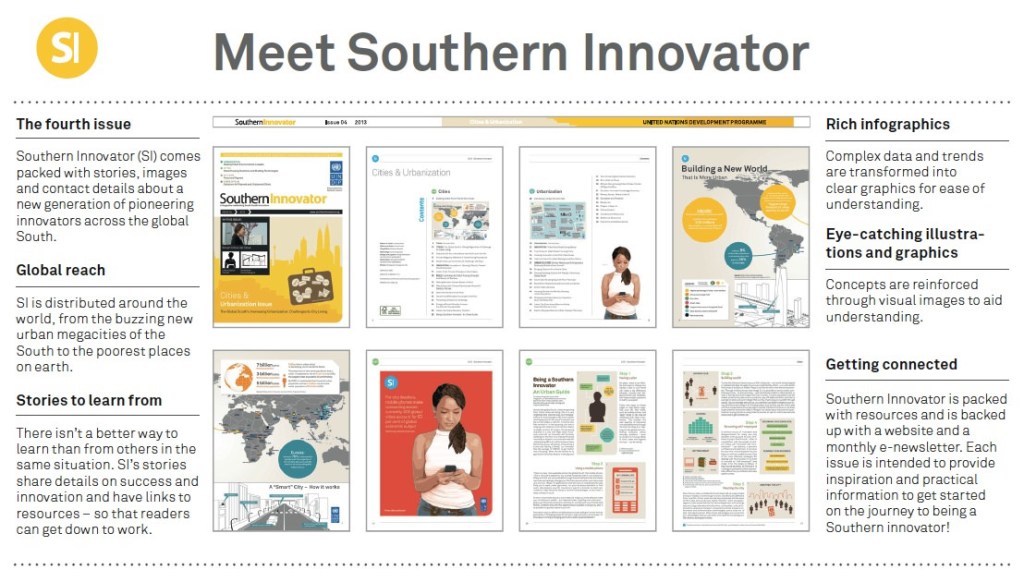
Southern Innovator Issue 1: https://books.google.co.uk/books?id=Q1O54YSE2BgC&dq=southern+innovator&source=gbs_navlinks_s

Southern Innovator Issue 2:https://books.google.co.uk/books?id=Ty0N969dcssC&dq=southern+innovator&source=gbs_navlinks_s

Southern Innovator Issue 3:https://books.google.co.uk/books?id=AQNt4YmhZagC&dq=southern+innovator&source=gbs_navlinks_s

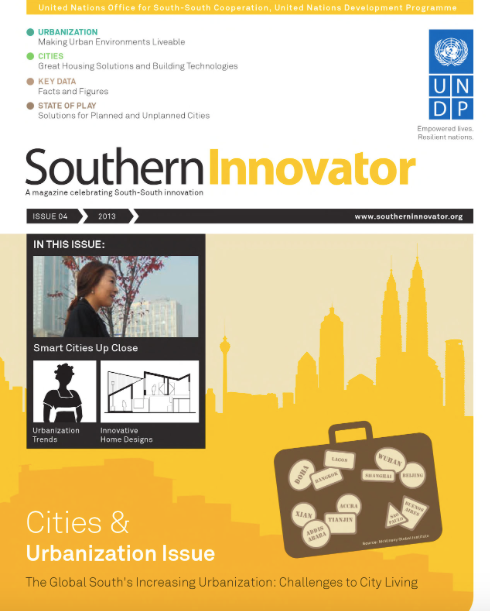
Southern Innovator Issue 4: https://books.google.co.uk/books?id=9T_n2tA7l4EC&dq=southern+innovator&source=gbs_navlinks_s

Southern Innovator Issue 5:https://books.google.co.uk/books?id=6ILdAgAAQBAJ&dq=southern+innovator&source=gbs_navlinks_s

One of the many stories we covered on Africa’s fast-growing cities from 2007. It was witnessing first-hand Africa’s innovators and their adaptive use of mobile and information technologies that inspired us to give birth to Southern Innovator’s first issue.

Citations

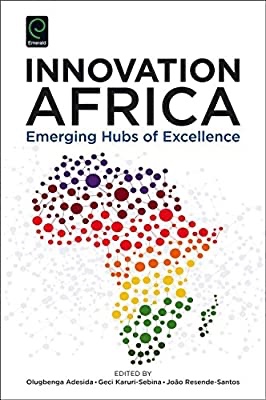
Cited in Innovation Africa: Emerging Hubs of Excellence edited by Olugbenga Adesida, Geci Karuri-Sebina, Joao Resende-Santos (Emerald Group Publishing, 2016).

https://davidsouthconsulting.org/2021/03/05/southern-innovator-issue-2/

Creative Commons License

This work is licensed under a
Creative Commons Attribution-Noncommercial-No Derivative Works 3.0 License.

ORCID iD: https://orcid.org/0000-0001-5311-1052.

© David South Consulting 2023