Tag: Ontario

  • New Student Group Seeks 30 Percent Tuition Hike

    New Student Group Seeks 30 Percent Tuition Hike

    Coalition hoping to be the “responsible” campus alternative

    By David South

    Now Magazine (Toronto, Canada), December 17-23, 1992

    While the provincial government’s decision to eliminate most student grants has many students worrying about meeting the increasing costs of higher education, a new student group is lobbying the province to hike tuition.

    The Ontario Undergraduate Student Alliance (OUSA) is a coalition of executives from student councils at the University of Toronto – the biggest in Canada – as well as Queen’s, Brock, the University of Waterloo and Wilfred Laurier.

    Those councils used to be members of the Ontario Federation of Students (OFS), the province’s major student organization, representing more than 200,000 students at 31 colleges and universities.

    But there have been disagreements within the OFS over its policy that tuition fees be abolished. The five dissident student councils got together last month and launched OUSA to address what they say is “the worst underfunding crisis in recent memory.”

    The group calls for a 30-per-cent increase in tuition over the next three years, an about-face from the stance of most mainstream student organizations, which call for, at the very least, a tuition freeze. Both the OFS and the Canadian Federation of Students have a zero-tuition policy.

    “Until now, student groups have been whining, but our approach is reasonable,” says Farrah Jinha, president of U of T’s Students’ Administrative Council, which left OFS a decade ago. “OUSA is setting a limit on how much tuition can increase and with very specific conditions.”

    OUSA’s plan calls for the provincial government to match, dollar-for-dollar, any increase in student fees. In conjunction with a 5-per-cent increase in private sector contributions, this would infuse an expected $360 million into higher education, says OUSA.

    Political lobbyist Titch Dharamsi – a former vice-president of SAC and high-profile organizer for the Liberal party – has carried over his lobbying duties to OUSA.

    Gimme gimme

    Dharamsi says OUSA isn’t out to rival OFA and is just being “realistic.” “The public likes our ideas. They are real, workable solutions. We recognize the province’s fiscal problems. It’s not just ‘gimme, gimme’ anymore.”

    Jinha says the policy positions of the OFS don’t have much in common with everyday student concerns.

    “People felt it wasn’t worth the money,” she says. “Many students across the province were frustrated with OFS taking stands on non-student issues like abortion, decriminalizing marijuana or the Gulf war. We wanted a group which would focus more on issues like teaching quality and accessibility to funding.”

    OUSA claims to represent 85,000 students. Staff have been hired and equipment purchased for the group’s unmarked office in the suites of a University Avenue law firm. “We are in this for the long haul,” Dharamsi says.

    OUSA has caught the eye of colleges and universities minister Richard Allen, whose party shares a zero-tuition policy with the OFS. But now that the NDP finds itself governing during a recession, Allen’s views sound more like OUSA’s.

    “The party policy on tuition is symbolic,” he says. “It says we want to address barriers to post-secondary education.”

    Student quits

    One student representative on U of T’s Students’ Administrative Council, Jason Zeidenberg, resigned when SAC decided to join OUSA.

    “The process hasn’t involved students,” says Zeidenberg. “It is a policy for student politicians, not students. OUSA has no constitution, no financial structure, no mechanism for individual students to bring questions forward. It is an undemocratic, fly-by-night institution.

    “Until they justify their expenditures, they are under suspicion of being a front group to legitimize policies like raising tuition.”

    OUSA isn’t legally obliged to incorporate itself or provide a constitution or accountable executive. The group operates much like a club, with member council executives making decisions collectively, and funds coming out of member unions’ budgets.

    Joining OFS requires a student referendum, but because of OUSA’s quasi-ad-hoc status, no such vote is needed to join the new group.

    Dharamsi says this approach is cost-effective and flexible. He says OUSA has spent around $10,000 to date, but can’t offer a fixed budget.

    Zeidenberg hs organized several college and faculty student unions at U of T to demand that SAC hold a referendum about membership in OUSA.

    Craft doesn’t feel that OUSA is a threat. “I’m not losing sleep over it,” he says. “We’re considered the representatives of students in Ontario.”

    Recently, however, the University of Western Ontario pulled out of OFS and is currently negotiating with OUSA about joining. Western’s departure takes another 20,000 students and precious dollars with them, and funding cuts have led OFS to lay off staff.

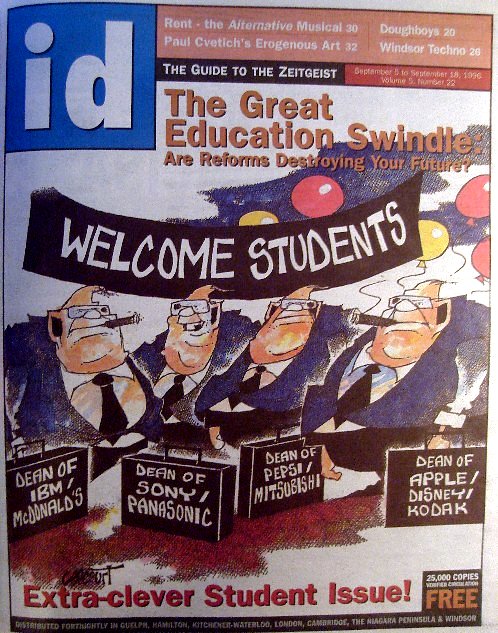
    This cover is by great Canadian political cartoonist and illustrator Jack Lefcourt. Always funny, Jack captures well the corporate take-over of the country’s universities and the introduction of the catastrophic debt culture that leaves so many students in a financial pickle. It was also Id’s first student issue. Id Magazine: Student Issue, “The guide to the zeitgeist”, Ontario, 1996, Features Editor: David South.

    https://davidsouthconsulting.org/2021/01/26/aid-organization-gives-overseas-hungry-diet-food-diet-giant-slim-fast-gets-tax-write-off-for-donating-products/

    https://davidsouthconsulting.org/2022/11/16/canadian-magazines-newspapers-1990s/

    https://davidsouthconsulting.org/2021/06/01/case-study-2-watch-magazine-1994-and-1996-2/

    https://davidsouthconsulting.org/2021/07/20/case-study-3-id-magazine-1996-1997-2/

    https://davidsouthconsulting.org/2020/12/18/counter-accusations-split-bathurst-quay-complex-issues-of-sexual-assault-racism-at-centre-of-local-dispute/

    https://davidsouthconsulting.org/2020/12/11/false-data-makes-border-screening-corruptible/

    https://davidsouthconsulting.org/2020/12/10/one-world-youth-conferences-mongolia-1998-1999/

    https://davidsouthconsulting.org/2022/11/11/online-free-knowledge-sharing/

    https://davidsouthconsulting.org/2020/12/18/peaceniks-questioning-air-raid-strategy-in-bosnia/

    https://davidsouthconsulting.org/2020/12/12/somali-killings-reveal-ugly-side-of-elite-regiment/

    https://davidsouthconsulting.org/2021/02/05/study-says-jetliner-air-quality-poses-health-risks-cupe-takes-on-airline-industry-with-findings-of-survey/

    https://davidsouthconsulting.org/2020/12/11/top-reporters-offer-military-media-handling-tips/

    Creative Commons License

    This work is licensed under a
    Creative Commons Attribution-Noncommercial-No Derivative Works 3.0 License.

    ORCID iD: https://orcid.org/0000-0001-5311-1052.

    © David South Consulting 2023
  • Peaceniks Questioning Air-Raid Strategy In Bosnia

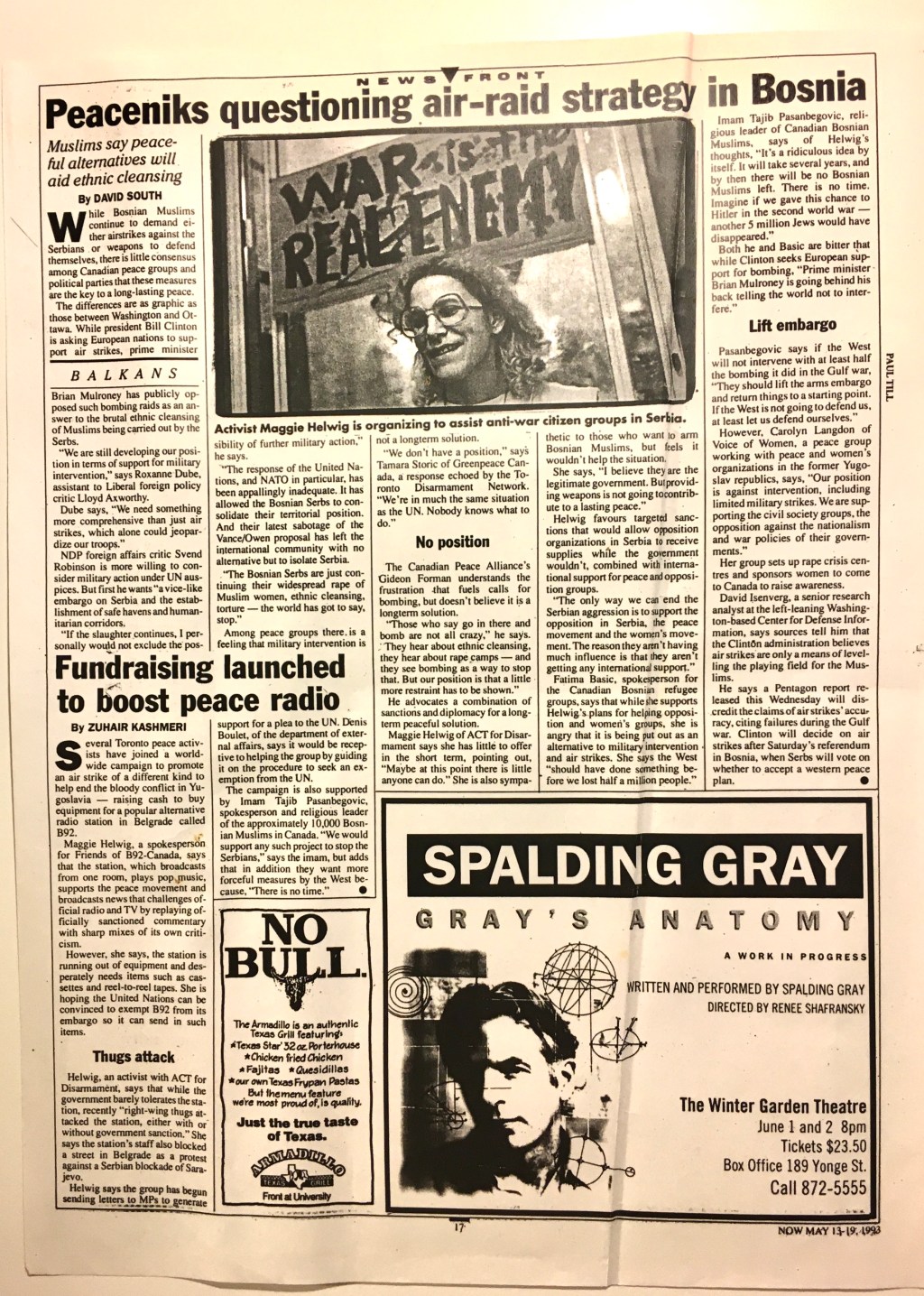
    Peaceniks Questioning Air-Raid Strategy In Bosnia

    Muslims say peaceful alternatives will aid cleansing

    By David South

    Now Magazine (Toronto, Canada), May 13-19, 1993

    While Bosnian Muslims continue to demand either airstrikes against the Serbians or weapons to defend themselves, there is little consensus among Canadian peace groups and political parties that these measures are the key to a long-lasting peace.

    The differences are as graphic as those between Washington and Ottawa. While president Bill Clinton is asking European nations to support air strikes, prime minister Brian Mulroney has publicly opposed such bombing raids as an answer to the brutal ethnic cleansing of Muslims being carried out by the Serbs.

    “We are still developing our position in terms of support for military intervention,” says Roxanne Dube, assistant to Liberal foreign policy critic Lloyd Axworthy.

    Dube says, “We need something more comprehensive than just airstrikes, which alone could jeopardize our troops.”

    NDP foreign affairs critic Svend Robinson is more willing to consider military action under UN auspices. But first he wants “a vice-like embargo on Serbia and the establishment of safe havens and humanitarian corridors.

    “If the slaughter continues, I personally would not exclude the posibility of further military action,” he says.

    “The response of the United Nations, and NATO in particular, has been appallingly inadequate. It has allowed the Bosnian Serbs to consolidate their territorial position. And their latest sabotage of the Vance/Owen proposal has left the international community with no alternative but to isolate Serbia.

    “The Bosnian Serbs are just continuing their widespread rape of Muslim women, ethnic cleansing, torture – the world has got to say, stop.”

    Among peace groups there is a feeling that military intervention is not a longterm solution.

    “We don’t have a position,” says Tamara Storic of Greenpeace Canada, a response echoed by the Toronto Disarmament Network. “We’re in much the same situation as the UN. Nobody knows what to do.”

    No position

    The Canadian Peace Alliance’s Gideon Forman understands the frustration that fuels calls for bombing, but doesn’t believe it is a longterm solution.

    “Those who say go in there and bomb are not all crazy,” he says. “They hear about ethnic cleansing, they hear about rape camps – and they see bombing as a way to stop that. But our position is that a little more restraint has to be shown.”

    He advocates a combination of sanctions and diplomacy for a longterm peaceful solution.

    Maggie Helwig of ACT for Disarmament says she has little to offer in the short term, pointing out, “Maybe at this point there is little anyone can do.” She is also sympathetic to those who want to arm Bosnian Muslims, but feels it wouldn’t help the situation.

    She says, “I believe they are the legitimate government. But providing weapons is not going to contribute to a lasting peace.”

    Helwig favours targeted sanctions that would allow opposition organizations in Serbia to receive supplies while the government wouldn’t, combined with international support for peace and opposition groups.

    “The only way we can end the Serbian aggression to to support the opposition in Serbia, the peace movement and the women’s movement. The reason they aren’t having much influence is that they aren’t getting any international support.”

    Fatima Basic, spokesperson for the Canadian Bosnian refugee groups, says that while she supports Helwig’s plans for helping opposition and women’s groups, she is angry that it is being put out as an alternative to military intervention and air strikes. She says the West “should have done something before we lost half a million people.”

    Imam Tajib Pasanbegovic, religious leader of Canadian Bosnian Muslims, says of Helwig’s thoughts, “It’s a ridiculous idea by itself. It will take several years, and by then there will be no Bosnian Muslims left. There is not time. Imagine if we gave this chance to Hitler in the second world war – another 5 million Jews would have disappeared.”

    Both he and Basic are bitter that while Clinton seeks European support for bombing, “Prime minister Brian Mulroney is going behind his back telling the world not to interfere.”

    Life embargo

    Pasanbegovic says if the West will not intervene with at least half the bombing if did in the Gulf War, “They should life the arms embargo and return things to a starting point. If the West is not going to defend us, at least let us defend ourselves.”

    However, Carolyn Langdon of Voice of Women, a peace group working with peace and women’s organizations in the former Yugoslav republics, says, “Our position is against intervention, including limited military strikes. We are supporting the civil society groups, the opposition against the nationalism and war policies of their governments.”

    Her group sets up rape crisis centres and sponsors women to come to Canada to raise awareness.

    David Isenverg, a senior research analyst at the left-leaning Washington-based Center for Defense Information, says sources tell him that the Clinton administration believes air strikes are only a means of levelling the playing field for the Muslims.

    He says a Pentagon report released this Wednesday will discredit the claims of air strikes’ accuracy, citing failures during the Gulf War. Clinton will decide on air strikes after Saturday’s referendum in Bosnia, when Serbs will vote on whether to accept a Western peace plan.

    Now Magazine (Toronto, Canada), May 13-19, 1993.
    Creative Commons License

    This work is licensed under a
    Creative Commons Attribution-Noncommercial-No Derivative Works 3.0 License.

    ORCID iD: https://orcid.org/0000-0001-5311-1052.

    © David South Consulting 2021

  • Feds Call For AIDS, Blood System Inquiry: Some Seniors Infected

    Feds Call For AIDS, Blood System Inquiry: Some Seniors Infected

    By David South

    Today’s Seniors (Canada), July 1993

    HIV-tainted blood transfusions given in the early 1980s have left some seniors with AIDS, but it is feared many are unaware of their HIV-positive status. 

    Between 1979 and 1985 – before testing of blood products for HIV became mandatory – 266 transfusion recipients and over 677 hemophiliacs are known to have been infected in Canada, according to the Centre for AIDS Statistics. 

    But the final numbers are unkown – estimates range from 400 to 1,000 cases of HIV transmission among the 1.5 million Canadians given blood products during this time. 

    This uncertainty is fueling public concern. With such a serious public health danger, many are shocked by the confusing messages being sent by governments, the Canadian Red Cross Society and hospitals. 

    But it took the report of an all-party Parliamentary subcommittee on health, released at the end of May, to shock the federal government into calling for a public inquiry into the blood system. The report is highly critical of the decision-making process involved in blood collection and distribution. 

    “We have members of our group who are seniors,” says Jerry Freise, spokesperson for advocacy organization HIV-BT (Blood Transfusion) Group, whose wife was infected with HIV due to a blood transfusion. “And many of them went for years being misdiagnosed and treated for something other than HIV. Others have gotten sick, and one died without knowing it because nobody told him. 

    “A classic case is Kenneth Pittman who was infected in 1984. The Red Cross found out in 1985 and they allegedly took two years to tell The Toronto Hospital. The hospital took two years to tell his doctor, and his doctor decided not to tell anybody. 

    Infected

    “Another couple, a lady of 59 and a man of 64, called us April 1. She found she was infected, and the reason she took a test is because her husband turned out to be HIV-positive three weeks before a transfusion in 1983. He had gone for years without a diagnosis from doctors.” 

    This runs counter to the Red Cross’s story. 

    “Whenever a blood donor tests positive for HIV antibodies, we go back and trace the prior donations,” says spokesperson Angela Prokoptak at the Society’s national office. “The Red Cross supplies blood to hospitals, so we know which units went to which hospital. But the hospital must go through their records to find who they transfused. 

    “After identifying the recipient, the hospital contacts the recipient’s physician, and then they have them tested. There are of course limitations.

    “Since 1987, the Red Cross has been advising people who may be concerned to consult their physician for counselling and advice.”

    But subcommitte member Chris Axworthy, an NDP MP, found that hospitals and the Red Cross hesitated to notify former patients for fear of lawsuits. He says the federal government should show some leadership and stop passing the buck to other agencies and departments. 

    Only two hospitals in Ontario – Toronto’s Hospital for Sick Children and Princess Margaret Hospital – have tried systematically to contact former patients. 

    Ontario health ministry spokesperson Layne Verbeek says it is a laborious and costly task for hospitals to notify former patients. “We’ve always informed people if they are thought to be at risk, but many hospitals aren’t in the position to trace. If people are at risk or have doubts, they should be tested.”

    Verbeek says recent media coverage has caused an increase in the number of people seeking HIV blood tests – requests for the test doubled after the Sick Kids hospital went public. The provincial government’s lab went from 700 tests per day to 1,300, but Verbeek says that has started to taper off. 

    The ministry of health is happy with the number of people coming forward to be tested, says Verbeek. 

    But Friese says the different players are more concerned about lawsuits than informing the public. He is especially upset at the Red Cross for not taking a leadership role in disseminating information. 

    “The Red Cross and the medical system have failed miserably to contact people. Even today they are reticent to tell people they were part of a risk group and should get treated.” Friese feels the various governments and the Red Cross are leaving the job of informing the public to his group and the Canadian Hemophiliacs Society. 

    Beat the drums

    “It’s my job to beat the drums for the media while I’m dealing with my wife being infected? That’s my job, when these are the ministers of health?”, Friese says with anger.

    The effect of AIDS on seniors isn’t new to US-based National Institute on Aging researcher Marcia Ory. She and colleagues helped sound the alarm back in 1989 with the book “AIDS In An Aging Society: What We Need To Know.” In the US, over 10 per cent of AIDS cases have occurred in people over 50. 

    “Surprisingly, people have ignored older people and the AIDS issue,” says Ory. “You had older people in hospitals who might have complained about fatigue which was thought to be age-related. Older people aren’t as likely to be diagnosed as early because of the assumption that they are not at risk from AIDS.

    “We don’t want older people in general to be overly fearful, but we want them to acknowledge the possibility, and to engage in good preventative practices if they are at risk.” 

    Ron deBurger, director of AIDS prevention for the Canadian Public Health Association, would like assurances that the security of the blood supply has improved. 

    “The subcommittee came to the right conclusion asking for a public inquiry,” says deBurger. “I would hope the terms of reference are broad enough to take a look at the whole issue of the safety of the blood supply, not only in terms of what happened in the past, but, more importantly, what’s happening today.”

    Other than hemophiliacs, who require large quantities of blood, deBurger believes anybody who received one transfusion has a small risk. “If you had blood once, I think the odds are pretty long that you are going to end up with tainted blood. But AIDS does take eight to 10 years to manifest itself, and we might still be picking up pieces for the next four to five years that we don’t know about yet.” 

    Friese recommends that anybody who received blood or blood products between 1979 and 1985 get an HIV test. If their doctor says it isn’t necessary, they should call the AIDS Hotline about anonymous testing. 

    Anybody who has tested positive for HIV and would like support and counselling can call Robert St-Pierre of the Canadian Hemophilia Society at 1-800-668-2686.

    For information on anonymous testing call the Ontario government’s AIDS Hotline in Toronto at 416-392-2437. For support write HIV-BT Group, 257 Eglinton Avenue W., Suite 206, Toronto, Ont., M4R 1B1. 

    Read more of David South’s 1990s health and medical journalism here: 

    https://davidsouthconsulting.org/2022/06/24/can-we-talk-hannah-promotes-communication-between-medical-schools/

    https://davidsouthconsulting.org/2021/02/05/changing-health-care-careers-a-sign-of-the-times/

    https://davidsouthconsulting.org/2017/10/18/hannah-institute-for-the-history-of-medicine-1992-1994/

    https://davidsouthconsulting.org/2022/04/28/health-care-in-danger/

    https://davidsouthconsulting.org/2020/12/17/lamas-against-aids/

    https://davidsouthconsulting.org/2017/08/15/mongolian-aids-bulletin/

    https://davidsouthconsulting.org/2020/12/17/philippine-conference-tackles-asias-aids-crisis/

    https://davidsouthconsulting.org/2022/06/24/professor-puts-chronic-fatigue-into-historical-perspective/

    https://davidsouthconsulting.org/2021/02/05/study-says-jetliner-air-quality-poses-health-risks-cupe-takes-on-airline-industry-with-findings-of-survey/

    https://davidsouthconsulting.org/2020/04/20/take-two-big-doses-of-humanity-and-call-me-in-the-morning/

    Taking Medicine To The People: Four Innovators In Community Health

    https://davidsouthconsulting.org/2021/02/05/us-health-care-businesses-chasing-profits-into-canada/

    More from Canada’s Today’s Seniors

    https://davidsouthconsulting.org/2021/02/05/critics-blast-government-long-term-care-reforms/

    https://davidsouthconsulting.org/2022/10/08/dodging-the-health-insurance-minefield/

    https://davidsouthconsulting.org/2020/06/14/government-urged-to-limit-free-drugs-for-seniors/

    Health Care On The Cutting Block: Ministry Hopes For Efficiency With Search And Destroy Tactics

    https://davidsouthconsulting.org/2021/02/05/health-care-on-the-cutting-block-ministry-hopes-for-efficiency-with-search-and-destroy-tactics/

    New Seniors’ Group Boosts ‘Grey Power’: Grey Panthers Chapter Opens With A Canadian Touch

    https://davidsouthconsulting.org/2021/02/20/private-firms-thrive-as-ndp-reinvents-medicare/

    https://davidsouthconsulting.org/2020/06/14/psychiatric-care-lacking-for-institutionalised-seniors/

    Seniors Falling Through The Health Care Cost Cracks

    https://davidsouthconsulting.org/2020/06/14/specialists-want-cancer-treatments-universally-available/

    ORCID iD: https://orcid.org/0000-0001-5311-1052.

    © David South Consulting 2023

  • Top Reporters Offer Military Media Handling Tips

    Top Reporters Offer Military Media Handling Tips

    Ryerson’s course on handling media has raised eyebrows

    By David South

    Now Magazine (Toronto, Canada), November 12-18, 1992

    The whimsical Certificate of Military Achievement hanging in the offices of the Ryersonian newspaper at Ryerson journalism school is testament to the warm relationship between the armed forces and one of Canada’s top journalism schools.

    But a two-month crash course in journalism for military public affairs officers hosted by Ryerson this summer has left a bad taste in the mouths of some participants and critics.

    The course, which involved 18 soldiers, included two weeks of classes in each of print, radio and TV journalism, wrapping up with two weeks of “crisis management” training. The 60 instructures included such prominent journalists as Ann Medina and Pamela Wallin.

    According to an administration newsletter, the course netted Ryerson more than $350,000. Organizers say the course was merely an exercise in familiarizing soldiers with the needs of working journalists. But given the often conflicting roles of the military and the media, some fear journalistic ethics may have taken some collateral damage.

    “The course had nothing to do with national defence or the armed forces,” says course teacher and organizer Shelley Robertson. “They just wanted to understand the roles of journalists from the other side. The military didn’t ask us to teach what we teach our students.”

    Robertson says the course also benefited the participating journalists by giving them contacts in the military.

    But according to media critic Barrie Zwicker, the exercise blurs what should be the distinctly different interests of journalists and the military. “It’s similar to press and politicians. By getting close to the politician, journalists can get information they couldn’t normally obtain. The negative side is that the media can get sucked in and lose a larger perspective. The same tensions exist with covering the military.

    Managing media

    “It’s up to the media to break the rules and try and get the story. The military always wants to hide its victims. If a Ryerson journalist strikes up a friendship with a public affairs officer, will the reporter be true to their journalistic tradition?”

    Colloquially known as spin doctors, hype-meisters and flak catchers, public affairs officers perform much the same tasks in the military as their civilian counterparts in industry and government – including managing information that gets to the public or media.

    In the past, Canadian soldiers had to go to the US for special training at the Defense Information School at Fort Benjamin Harrison. But, according to Robertson, the armed forces were looking for a Canadian spin.

    With 4,600 Canadian peacekeepers now stationed around the world, including a contingent in the dangerous and volatile former Yugoslav republics, the chances for conflict – and casualties – have increased.

    Lieutenant-commander Glen Chamberlain, who helped coordinate the course, says the military’s increased profile means that the forces have to become more adept at media relations. “There is a great desire among Canadians to know what troops on peacekeeping duties are up to. We have a wonderful story to tell.”

    Chamberlain says he works on journalists’ behalf with stubborn military commanders. “The armed forces are finding there is a real benefit to having specialized PA officers. We want to help journalists to tell our story well.”

    The crisis management section of the course offered participants a hands-on approach to managing journalists. The officers were presented with two scenarios – a murder at Moss Park armoury and a highway helicopter crash – and then practised handling a group of journalists investigating the events.

    Course lecturer Kevin Donovan, who covered the Gulf war for the Toronto Star, remembers the effectiveness and sophistication of PA officers in the field.

    “When I was in Riyadh, Saudi Arabia, I walked into a hotel and on the wall were pool reports – news briefs written by US military public affairs officers – that journalists were encouraged to use for stories. There were some journalists going out into the field to cover stories, but a huge number just sat in this beautiful hotel.”

    “Canadian journalists are ignorant of the military and could do with getting closer. You almost never find a full-time journalist in Canada who knows anything about them. The more you know about the military, the less you will be manipulated.”

    Stop information

    Donovan feels uncomfortable about teaching on the course.

    “I was asked by Ryerson to give a talk on my experiences in Saudi Arabia, Kuwait and Iraq,” he says. “My initial reaction was no. I hate the existance of public affairs people with a passion. Their job is to stop information.

    “I’m uncomfortable with Ryerson being hired by the department of national defence. One officer in the course got very upset when I told them to make contacts with the media and leak stories.”

    Course organizer Clive Vanderburgh admits organizers had concerns about conflicts between the role of journalists and military officers. “There was a lot of discussion concerning the potential for conflict – especially that the people hired to teach might think they were there to help the department of national defence to avoid the media

    “But we were trying to give a general understanding of the media’s needs. We didn’t sell the country down the drain.”

    Another teacher was Robert Fulford, the well-known writer and lecturer on journalistic ethics. “I don’t have a problem with Ryerson teaching the military,” says Fulford. “It’s a way of spreading journalistic technique to people in the DND. It seems to be a natural extension of the work of Ryerson.

    “Canadian journalists are ignorant of the military and could do with getting closer. You almost never find a full-time journalist in Canada who knows anything about them. The more you know about the military, the less you will be manipulated.”

    But Gideon Forman, coordinator of the Canadian Peace Alliance, fears Ryerson may be helping the military mislead the public.

    “Why do these guys practise handling the media so much of there’s nothing to hide? This is just better packaging for the military so they can get what they want from the public.

    “I have problems with public money being spent teaching the military to be more effective with the media, while other organizations have their budgets cut or eliminated.

    “Is there a similar program for food banks or women’s shelters?”

    Note on story context: This story was researched and written after two key events involving Canada’s military: the first Gulf War from 1990-1991; and the Oka Crisis in 1990, where the Canadian Armed Forces confronted an armed group of Mohawk “Warriors” in Oka, Quebec.

    More investigative journalism here: 

    Peaceniks Questioning Air-Raid Strategy In Bosnia

    Somali Killings Reveal Ugly Side Of Elite Regiment

    Study Says Jetliner Air Quality Poses Health Risks: CUPE Takes On Airline Industry With Findings Of Survey

    Creative Commons License

    This work is licensed under a
    Creative Commons Attribution-Noncommercial-No Derivative Works 3.0 License.

    ORCID iD: https://orcid.org/0000-0001-5311-1052.

    © David South Consulting 2023