Tag: Ontario

  • US Health Care Businesses Chasing Profits Into Canada

    US Health Care Businesses Chasing Profits Into Canada

    Some fear corporate health care will kill equality of treatment

    By David South

    Now Magazine (Toronto, Canada), April 8-14, 1993

    American-style private health care is slipping across the Canadian border under the noses of three provincial NDP governments, say researchers representing an association of health care workers.

    Jackie Henwood and Colleen Fuller of the 7,500-member Health Sciences Association of British Columbia charge in a recent report that a combination of free trade and tightfisted government spending is undermining the universality of medicare and ushering in the beginnings of a two-tier system.

    While the health care industry created more jobs than any other sector of the economy between 1984 and 1991, they point out, things have changed dramatically since the Canada-US free trade agreement came into effect in 1989. Now much of this growth is clustering in the private sector.

    And they expect that this trend will continue under the forthcoming North American free trade agreement.

    “NAFTA will accelerate trends towards a privatized, nonunion and corporate dominated system of health care in Canada,” says the report.

    Binding provisions

    Chapter 14 of the Canada-US free trade agreement opened competition for health-care facilities management services to US companies. Certain NAFTA provisions will bind all levels of government to consider for-profit health care companies on equal footing with public providers when bidding for services, and entitles them to compensation if they can prove to an arbitration board that they’ve been wronged.

    “That represents a substantial encroachment on the democratic right of local, provincial and federal governments to make decisions,” says Cathleen Connors, who chairs the Canadian Health Coalition, which includes labour activists, nurses, doctors and other health-care workers.

    This, in combination with health care cutbacks – both federal and provincial – is resulting in service and job cuts, bed closures, increased drug costs and an increase in privatization, the report says.

    In the area of home care, for example – visiting nurses, physiotherapists, homemakers and other services – private firms now take in close to half of all OHIP billings. Many of their clients pay out of their own pockets for services.

    The Ontario ministry of health doesn’t keep statistics on the private home health care sector in the province, but the Ontario Home Health Care Providers’ Association, a trade group, estimates that private firms in the industry now employ 20,000 people.

    The industry is dominated by a small number of large firms, including Paramed, Comcare and Med+Care.

    “It’s a market situation,” says Henwood. “If the services aren’t available to people within the public sector, they will go outside of it.

    “We’ve seen this in other countries like England, where they had a public system and now have a parallel private system. If you erode a system enough that people get pissed off, they are going to start to look for alternatives, and the people with the greatest liberty are those with money.”

    Connors says that because the Canada Health Act only covers the provision of hospital and physician services, the prinicples of universality and comprehensiveness don’t extend down to community-based services like home care.

    The study also found that giant US private health insurers are positioning themselves to reap profits in the fertile Canadian market.

    Last week, Wisconsin-based American Medical Security Inc. announced it will begin offering American hospital insurance to Ontario residents this month, citing a demand in Canada to bypass lengthening waiting lists for medical treatment.

    Giant US west-coast insurer Kaiser Permanente declared in the March 1992 issue of Fortune magazine that they have targeted Canada as the next growth market. And American Express membership now offers the privilege of health insurance.

    With private health care services sprouting up like spring weeds, says Henwood, provinces are placing yearly limits on the number of private services covered under provincial health plans, thus preventing people shopping around for services, no matter what their income.

    Sheila Corriveau, corporate relations coordinator at Toronto-based Dynacare, Canada’s largest full-range private health care company – which operates labs, retirement homes, homecare services and consulting services – is enthusiastic about expansion plans, and says that removing patients from hospitals into their homes has been a boon for private health-care services.

    “I think the health system will benefit, because what you are really doing is off-loading the cost from the public sector and from the treasury to private enterprise,” says Harry Shapiro of Dynacare. “Private enterprise depends on its own ingenuity for survival and its own levels of efficiency.”

    But advocates of the public system say the free-market option now looming is being ushered in by the very parties that Canadians have come to rely on to defend medicare.

    Medicare stance

    Ontario’s new health minister, Ruth Grier, however, denies her government is jeopardizing medicare.

    “I want to disagree with that as profoundly as I can,” she says, fidgeting with an ashtray during a recent interview. “Our government has reaffirmed its commitment to medicare. Over the last decade, under conservative and liberal governments, health care costs have increased in double-digit figures. The system would have collapsed at that rate of growth.

    “I guess I haven’t found a way of blaming free trade for failures of the health care system at this point,” she says.

    But critics say in the last year alone, Ontario’s ministry of health has capped health coverage for travellers abroad, removed coverage for physical exams requested by employers, chopped hospital beds and cut back the number of drugs covered on the provincial drug plan.

    Grier says that the government’s vision relies on a new view of medical care seekers as consumers who are going to take more responsibility for their own health care

    “Government can’t do it all,” she says.

    Now Magazine (Toronto, Canada), April 8-14, 1993.

    More investigative journalism by David South for Toronto’s Now Magazine:

    Now Magazine (Toronto, Canada), November 12-18, 1992.

    More healthcare reporting by David South from Canada’s Today’s Seniors

    Feds Call For AIDS, Blood System Inquiry: Some Seniors Infected

    Government Urged To Limit Free Drugs For Seniors

    Health Care On The Cutting Block: Ministry Hopes For Efficiency With Search And Destroy Tactics

    New Seniors’ Group Boosts ‘Grey Power’: Grey Panthers Chapter Opens With A Canadian Touch

    Seniors Falling Through The Health Care Cost Cracks

    ORCID iD: https://orcid.org/0000-0001-5311-1052.

    © David South Consulting 2021

    Like our content? Help contribute to the costs of keeping it online.

    Scan code with your phone and help us out.
    Creative Commons License

    This work is licensed under a
    Creative Commons Attribution-Noncommercial-No Derivative Works 3.0 License.

    ORCID iD: https://orcid.org/0000-0001-5311-1052.

    © David South Consulting 2022
  • Cut Services To Elderly, Says Doctors’ Survey… But Leave Our Salaries Alone!

    Cut Services To Elderly, Says Doctors’ Survey… But Leave Our Salaries Alone!

    “With a guaranteed income and job security, I don’t know one doctor who has suffered in the recession…”

    By David South

    Today’s Seniors (Canada), January 1993

    If the results of a nation-wide survey of doctors are right, Canadian physicians love medicare but abhor government attempts to make them accountable for its costs. It also suggests that doctors are more willing to talk about cutting services to seniors and people with “unhealthy lifestyles” than to discuss cutting their own wages to save money. 

    However, according to some doctors, physicians’s anger with the provincial government is founded on ignorance and poor analysis of the larger forces affecting health care. 

    The survey, Breaking the Wall of Silence: Doctors’ Voices Heard at Last, was commissioned by The Medical Post, a national newspaper for doctors. It sent questionnaires to 12,000 doctors, receiving 3,087 responses. The Post also conducted in-person interviews to better gauge the mood of doctors. 

    The survey’s title is somewhat misleading, considering that doctors have been making noise over a number of issues this year; targets included proposed right-to-treatment legislation, cuts to the Drug Benefit Plan, capping of yearly billings at $450,000, and inquiries into charges of sexual abuse by doctors. And most significantly, the last conference of the Canadian Medical Association passed a resolution calling for a two-tier health system in which those with money can hop the queue. 

    Post editor Diana Swift says the poll shows fairly strong support for limiting services to the elderly, although the survey question is short on details: “I feel it is reasonable that access to high-cost services such as transplants should be rationed according to such parameters as the patient’s age and/or unhealthy habits.”

    Yet just under 70 per cent of doctors opposed any capping of their salaries, despite 56 per cent of the public supporting this measure according to a 1991 Globe and Mail-CBC poll. 

    When questioned, Health Minister Francis Lankin expressed surprise that doctors felt so strongly, and denied the government is considering rationing services to seniors. Lankin feels the volatile mood of doctors is a reaction to the rapid changes taking place in health care. 

    Dr. Michael Rachlis, health care critic and author of the book Second Opinion, says the survey’s low response rate means that the answers reflect “redneck physicians, who are more likely to respond.” Swift admits to a high response rate from young male physicians, who since the 1986 doctors’s strike in Ontario, have been considered the profession’s most militant. 

    One response which some may find alarming was towards the “Oregon model.” In that American state, medical procedures are rationed to seniors and individuals covered by medicare. Anybody needing uncovered emegency treatment has to pay for it themselves. A disturbing 65 per cent of survey respondents supported such a move. 

    Dr. Gerry Gold, associate registrar at the College of Physicians and Surgeons of Ontario, feels that some doctors lack perspective. “The complaints are a reflection of frustration with increasing involvement of government. But if physicians understood the role of the government in the U.S., they would realize they, along with insurance companies, intervene far more.”

    Gold says doctors have had the same complaints ever since the beginnings of medicare. “Many front-line doctors lack the information to make informed comment,” he says. “They aren’t being consulted or informed by the government.”

    Rachlis says many doctors fail to realize how privileged they are. “Canadian physicians don’t realize medicare has protected their autonomy more than in the U.S.,” he says. “Doctors are always angry because they have large chips on their shoulders from being brutalized in their training. They don’t realize the government has given them a privileged monopoly over health services. With a guaranteed income with job security, I don’t know one doctor who has suffered in this recession.”

    Gold doesn’t foresee strikes or job actions by doctors, but predicts further government cuts, and more services being de-insured by OHIP. A recent example involved removing coverage for third-party medical exams such as those requested by employers or insurance companies. As medical procedures end up outside of OHIP, Gold foresees physicians charging whatever they like. 

    A perennial idea is the user fee. This is one of the few ideas that gathers support from a majority of doctors and the general population alike. But Rachlis feels these measures are meanspirited and avoid the real problems plaguing health care. “When Saskatchewan introduced user fees for physician and hospital care in 1968,” he says, “health costs remained the same and it discouraged the elderly, the poor and people with large families from seeking service. 

    “When providers are allowed to charge users for care, as in the United States, where more than 20 per cent of health care costs are paid our of pocket, overall costs go up.” 

    More from Canada’s Today’s Seniors

    Feds Call For AIDS, Blood System Inquiry: Some Seniors Infected

    Government Urged To Limit Free Drugs For Seniors

    Health Care On The Cutting Block: Ministry Hopes For Efficiency With Search And Destroy Tactics

    New Seniors’ Group Boosts ‘Grey Power’: Grey Panthers Chapter Opens With A Canadian Touch

    Seniors Falling Through The Health Care Cost Cracks

    ORCID iD: https://orcid.org/0000-0001-5311-1052.

    © David South Consulting 2021

  • Critics Blast Government Long-Term Care Reforms

    Critics Blast Government Long-Term Care Reforms

    “They cut hospital beds and lay off staff without having community health care services ready…”

    “When the elderly… decide that facility-based care is the best option, they can’t get it…”

    By David South

    Today’s Seniors (Canada), October 1992

    Seniors should keep a close eye on the Ontario government’s proposed long-term care reforms. According to critics, the plan has more than a few bugs. 

    The term long-term care encompasses an often confusing web of services, from home-provided community services like meals on wheels to institutional care including homes for the aged, seniors’ apartments and chronic care hospitals. 

    Like other provincial governments, the Rae government is trying to rein in escalating health care costs – and long-term care services aren’t immune. They hope that emphasizing prevention and healthy lifestyles, plus providing more services in the home and community, will reduce reliance and expensive health care services like high-cost drugs, surgery and high-tech equipment. According to health minister Frances Lankin, this will preserve medicare in the age of fiscal restraint. 

    The government has outlined seven goals for its long-term care reforms: prepare for the coming surge in the over-65 population; cater services to better reflect the cultural, racial and linguistic make-up of Ontario; eliminate confusion over what services are available; involve the community in planning so that services reflect community needs; lessen reliance on institutions; provide support to family caregivers; tighten regulations governing government-run and private facilities; and improve working conditions for the largely female caregiving workforce. 

    But many people are wary of the proposed reforms and worry that if they aren’t managed properly, some seniors will fall through the cracks. 

    A report released in July by the Senior Citizens’ Consumer Alliance for Long-Term Care Reform blasts the government for being simplistic in its plans. The report compares the present reforms to the failed attempt in the 1970s to move psychiatric care out of the institutions and into communities by closing 1,000 beds. The tragic result in that case was homelessness for many psychiatric patients who found community services unable to help, or, more often than not, non-existent. The Alliance fears seniors – the biggest users of health services – could fall victim to reforms in a similar way. 

    Emily Phillips, president of the Registered Nurses’ Association of Ontario, is blunt: “The NDP’s plans sound good on paper, but they can’t give a budget or direct plan on how they hope to carry out reforms. They are going about things backwards. They cut hospital beds and lay off staff without having community health care services ready.”

    The Ontario Association of Non-Profit Homes and Services for Seniors (OANHSS) – which operates charitable and municipal homes for the aged, non-profit seniors’ apartments. chronic care hospitals and community services serving over 100,000 seniors – says 4,300 seniors are on waiting lists for their member facilities right now, and things won’t improve if the government continues to reduce the number of long-term care beds. 

    But Lankin insists that beds are available in homes and hospitals and it is funding formulas that prevent them from being filled. 

    To help carry out its reforms, the NDP will reallocate $647 million by 1996-97. In bureaucratese, this funding is said to be “back-end loaded”, or mostly spent close to 1996-97. 

    The problem with this, according to the Alliance, is that the government has already embarked on a radical “downsizing” of hospitals, closing beds and laying off health care workers. Lankin claims the worst case scenario for layoffs this year won’t exceed 2,000, but the Ontario Hospital Association claims 14,000 jobs are in jeopardy. Because of this, the Alliance wants money to be spent earlier to avoid gaps in services. 

    Phillips believes it will be hard to pin down the extent of job losses. “For every full-time job cut many part-time and relief positions go with it,” she says. 

    Dr. Rosana Pellizzari, a member of the Medical Reform Group and chair of the Ontario Association of Health Centres, wants better community accountability for hospitals before they lay off staff and cut services. “Sometimes it makes sense to bring people to hospitals,” she says. “Planning must be at the community level, open and democractic. Health care workers, who are mostly women, should not be scapegoated for financial problems. Doctors and management should go first. Physicians experience very little unemployment.” 

    Many nursing and charitable homes for the aged are facing financial crisis. According to OANHSS, six charitable homes for the aged have closed since 1987 due to deficits. In 30 homes, the total annual deficit has increased 125 per cent since 1987. The Ministry of Health recently allocated special funds of $8.1 million to ensure these facilities survive until January, when a new, needs-based funding formula will be introduced. It is intended to better match the actual care requirements of the 59,000 consumers living in long-term care facilities. 

    Michael Klejman, executive director of OANHSS, agrees with helping seniors to stay in their homes. “But when the elderly and their care-givers in Ontario decide that facility-based care is the best option, they simply can’t get it,” he notes. “We know from experience that many of them remain in acute care hospital beds with a cost to the province of about four times what it would cost them to fund a long-term care bed. And many, unfortunately, remain in their own flats or apartments at considerable risk to themselves, isolated and dependent on a patchwork of services.” 

    Beatrix Robinow, who worked on the Alliance’s report, was not impressed with the government’s initial plans, especially the proposed creation of 40 service coordination agencies whose mandate would be to control the delivery of home care services to seniors. Robinow thinks this would add to the confusion and just be another layer of bureaucracy. Many people who appeared at the Alliance’s public hearings expressed confusion over how the long-term care system worked. 

    Robinow says that the government could save money by trimming the bureaucracy and using present organizations like the little-known District Health Councils. 

    “District Health Councils have nothing to do with social services,” says Robinow. “But we want them to be expanded to include long-term care and general supervision of community services. We are waiting to hear if they are interested. I would urge the government to make sure that services are in place before pushing people out of institutions.” 

    The health minister is cautious about the government’s next steps. “The Alliance’s report has been very helpful,” she says. “We are in the process of developing options. Two other ministers are involved and we also need to take this through Cabinet.

    “Ontario is much larger and more complex (than other provinces). The range of services is more developed. We also have a mess in jurisdictions between municipalities and the province. And in Ontario there isn’t a concensus that this is the way to go. 

    “We have been doing a lot of rationalization and streamlining for longer than other provinces. Most thinking people looking at the situation agree that doing nothing would hurt the system. It is not sustainable at present. You hear a lot of things about user fees. That would be the slippery slope for medicare. That would make people think they could buy better services.”

    Ironically, user fees were recently endorsed by the Canadian Medical Association, suggesting the minister will have a fight on her hands with angry doctors. 

    Amidst all the confusion, Dr. Perry Kendall was appointed on Aug. 24 as the provincial government’s special advisor on long-term care and population health. This veteran of both the City of Toronto as Medical Officer of Health – and the groundbreaking Victoria Health Project in British Columbia (often seen as the model for community services to seniors) seems well qualified. “One problem in the past has been the creation of smaller and smaller organizations every time somebody felt the system was not responsive to their needs,” he says. “This created organizational chaos. The challenge  now is to get all the organizations back together to share their expertise.”

    Lankin says she hopes to have a conference on the reforms in the fall. 

    ORCID iD: https://orcid.org/0000-0001-5311-1052.

    © David South Consulting 2021

  • U.S. Elections Update: Clinton is using Canada to keep control of Haiti

    U.S. Elections Update: Clinton is using Canada to keep control of Haiti

    By David South

    Id Magazine (Canada), October 31 to November 13, 1996

    Canadian troops are not only on the frontline of peacekeeping in Haiti but also the frontline of U.S. foreign policy – a policy that is unravelling during the run-up to the November 5 presidential election. While the living standards of Haitians in the poorest country in the Western Hemisphere continue to decline despite free elections, Canadian troops are charged with keeping the island nation peaceful. It’s a task that is proving more and more difficult as Haiti suffers a crime wave and violent political unrest. 

    While American president Bill Clinton tries to snatch another victory from a grumpy U.S. electorate, his advisors are desperately trying to keep the lid on his foreign policy “victories” in Bosnia and Haiti. 

    Things are so bad, Clinton sent his secretary of state, Strobe Talbott, and his national security advisor, Anthony Lake, to Haiti on August 30 in response to high-profile assassinations of right-wing leaders. 

    “The administration are hoping, with fingers crossed, nothing will happen before November 5,” says Larry Birn of the Washington-based Centre for Hemispheric Affairs. “What the United States would like to do is cryogenically freeze all its foreign policy engagements so they don’t produce any problems. But we are losing very valuable time in Haiti because of Washington’s paralysis over negative developments occurring there. 

    “Washington didn’t realize an economic success story had to be bred there in a couple of years. The USAID programme is a scandal waiting for an investigation.”

    There is also another election-year factor: Republicans are not fond of anything that whiffs of a humanitarian approach to Haiti. Since they dominate Congress, this is also Clinton’s problem. 

    Given the history of American support for dictatorships in Haiti, the Clinton administration has chosen a low-key approach. After the 1994 invasion, the Americans pulled out the vast majority of their troops within a year, handing over responsibility for internal security to a UN peacekeeping force. But the U.S. never fully cut itself off from interfering in Haiti, keeping a military base operating in the country’s only industrial park in Port-au-Prince. 

    And Canada is key to U.S. plans because of that sour legacy. Canadians are seen as free from the burden of colonialism, and as a plus, our 700 mostly French-speaking troops can communicate better with the local population. 

    This policy has gone as far as hiring a Canadian public relations company to promote structural adjustment programmes that are conditional upon Haiti receiving any foreign aid from the International Monetary Fund and the World Bank, both based in Washington. 

    Gilles Morin is co-ordinating manager for Montreal firm Gervais-Gagnon-Covington Associates, who won the contract. Morin says, while his company did win the contract, like many other things to do with Haiti, they have heard nothing since Fall 1995 because of disorganization.  

    “On a personal basis there was a strong anti-American feeling among the population because of the past,” says Morin. “A lot of the financial institutions are based in Washington and they needed international support because banks in Washington are seen as American.”

    But there is a risk that a switch in U.S. priorities during the heat of an election will endanger Canadian troops.

    “If the president feels he has political risk in Haiti, he’s not going to take Canadian concerns into consideration,” warns Birns. “The UN mission gets caught up in the wake of U.S. efforts and it’s not able to define an independent course. Right now, the problem really is the USAID mission in Haiti is a total failure. The international donor function, you couldn’t exaggerate how disappointing it’s been in terms of almost no relief. The unemployment rate of 80 per cent is exactly what the unemployment rate was when the UN arrived.”

    On August 28, American troops from the 82nd Airborne plopped down on the streets of Port-au-Prince to spend a week patrolling. Many observers questioned the motives for this intervention. Was it to say to Haitians the UN isn’t the real deal, and if they get out of line, the Americans will kick their butts? Why doesn’t Canada protest the U.S. undermining the credibility of our peacekeeping mission?

    To Birn, sending in the 82nd was the foreign-policy equivalent of fast-food. “Sending in the 82nd Airborne merely aimed at getting a one-day headline,” he says. “The administration’s position has been staked on the fact there has been a number of foreign policy wins. But each of these victories is held together by corn starch and could unravel at any moment.”

    Birn sees an escalation in political violence just around the corner. He fears the current economic crisis will help the formation of a violent left-wing guerrilla movement to rival existing right-wing paramilitaries. 

    “Without former president Jean Bertrand Aristide,” he explains, “there is growing apprehension that president Rene Preval will not be able to project a sufficient leadership to keep the average Haitian, who is sacrificing with no expectation of an improved standard of living, happy.”

    While it has been almost two years since Haiti was the media’s darling, observers point out the cycle of violence has returned to the country’s streets despite the presence of UN peacekeepers and American troops. 

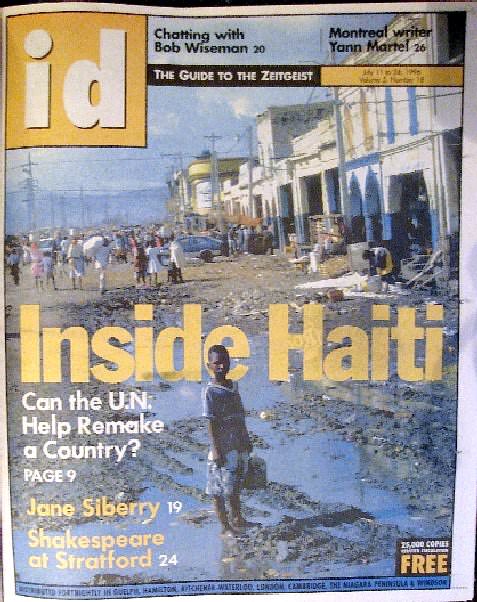
    When id reported from the Haitian capital of Port-au-Prince in July (id July 11 to 24, Number 18), it was obvious no progress had been made to improve the standard of living or rebuild the country’s crumbling infrastructure. 

    In an ironic twist, attempts to step up deportations of Haitian-Americans convicted of crimes in the U.S. has led to an increase in killings in Haiti according to the October 22 issue of New York weekly, The Village Voice

    More and more, the UN troops are propping up an increasingly unpopular government. A government that is seen by many Haitians to be getting its orders from Washington, not Port-au-Prince. Canadian troops lead the UN mission in Haiti and make up 700 of the 1500 soldiers stationed there (the rest are from Pakistan and Bangladesh).

    There is a serious danger Canadian troops will be caught in the crossfire of any uprising or coup attempt, since Canadian troops shadow president Rene Preval 24 hours a day and also guard the National Palace, which was attacked August 20, killing two Haitians.

    “U.S. Elections Update: Clinton is using Canada to control Haiti”.

    Read a 1996 report on the UN mission in Haiti here: State Of Decay: Haiti Turns To Free-Market Economics And The UN To Save Itself 

    ORCID iD: https://orcid.org/0000-0001-5311-1052.

    © David South Consulting 2021