Tag: Ontario

  • Private Firms Thrive As NDP ‘Reinvents’ Medicare

    Private Firms Thrive As NDP ‘Reinvents’ Medicare

    By David South

    Today’s Seniors (Canada), August 1993

    Many of today’s seniors fought for Canada’s internationally-admired public health system. But more and more people are becoming worried that the combination of health care reform, funding cutbacks and free trade is fuelling the growth of a second tier of private medical services serving the well off. 

    The provincial government sees things differently, arguing Ontarians no longer expect government to pay for everything and rather than eroding medicare, the NDP is reinventing it. 

    Whichever way one looks at it, private insurance companies, homecare providers, labs and other services designed to make money are becoming more and more involved in the health care business. 

    Operating in the territory outside the guidelines of the 1984 Canada Health Act – which sets out the principles of medicare for the federal government to enforce – the private sector has room to expand, at the same time as OHIP coverage is scaled back from more and more services. 

    Janet Maher, whose Ontario Health Coaltion (OHC) represents doctors, nurses and other health care workers, worries for the future of medicare. 

    “A number of things like accommodation services – laundry, food services – are in the grey area of the Canada Health Act,” says Maher. “So with all these fees that are being introduced, by the strict letter of the law, there is no way to stop them. But as far as we are concerned the spirit of the Act isn’t being observed.”

    In its current reforms, the government of Ontario is emphasizing paramedical professions like midwives who fall outside the CHA and aren’t covered by OHIP. The turn to community-based services means that people have to rely more on services and providers that aren’t covered under the CHA. 

    Maher says privatizing accommodation services is a recent phenomenon, the result of hospitals finding creative ways to trim their budgets. 

    “It’s a new area that hospitals are taking bids on,” she says. “The other thing around the accommodation services is that because they are not categorized, strictly speaking, as health care services, none of this is exempted in the Free Trade Agreement from U.S. competition.”

    A recent report by two British Columbia researchers tries to put together this complex puzzle. Jackie Henwood and Colleen Fuller of the 7,500-member Health Sciences Association of British Columbia recently charged that a combination of free trade and budget-slashing governments is eroding the universality of medicare and ushering in a two-tier system. 

    Fuller and Henwood identify the Free Trade Agreement as the culprit. While the health care industry created more jobs than any other sector of the Canadian economy between 1984 and 1991, they point out the job growth has been concentrated in the private sector since free trade was implemented in 1989. And they expect worse under the proposed North American Free Trade Agreement (NAFTA). 

    “NAFTA will accelerate trends towards a privatized, non-union and corporate-dominated system of health care in Canada.”

    One provision of the Free Trade Agreement has also made it possible for U.S. companies to compete against Canadian firms in health care. Chapter 14, “health-care facilities management services”, allows wide-open competition. 

    Under NAFTA, provisions will bind all levels of government to consider for-profit health care companies on both sides of the border on equal footing with public providers when bidding for services, and entitles them to compensation if they can prove to an arbitration board they’ve been wronged. 

    “That represents a substantial encroachment on the democratic right of local, provincial and federal governments to make decisions,” says Cathleen Connors, who chairs the national wing of OHC, the Canadian Health Coalition. 

    It’s this plus health care cutbacks – federal and provincial – that’s resulting in service and job cuts and bed closures in the public sector and an increase in privatization, say Henwood and Fuller. These opportunities have not gone unnoticed by private companies south of the border. 

    One such company is American Medical Security Inc. (AMS) of Green Bay Wisconsin. After hiring Canadian pollsters Angus Reid to do a survey, AMS saw a profitable market in offering American hospital insurance to frustrated Canadians awaiting surgery. Sixteen per cent of those polled said they wanted this service; that was enough for AMS. 

    “One thing that comes across loud and clear is that Canadians for the most part are happy,” says spokesperson Carrie Galbraith. “They know they are taken care of during an emergency. But they are willing to pay a little extra if they need care.”

    So far, AMS offers its plan to Ontario, B.C. and Manitoba, with Toronto its best market. Galbraith says plans are in the works to expand to all of Canada except the territories. 

    Unfortunately, like most private health plans, AMS cuts its losses by avoiding what Galbraith calls “adverse selection” – anybody with a known serious health problem need not apply. 

    Here in Ontario, private for-profit home care services take in close to half of all OHIP billings. Many clients pay out of their own pockets for additional services. 

    The Ontario health ministry doesn’t keep statistics on the extent of the private home health care sector, says spokesperson Layne Verbeek. But the Ontario Home Health Care Providers’ Association, a trade group, estimates private homecare companies now employ 20,000 and serve more than 100,000. 

    “It’s a market situation,” says Henwood. “If the services aren’t available to people within the public sector, they will go outside of it. We’ve seen this in other countries like England, where they had a public system and now have a parallel private system. If you erode a system enough that people get angry, they are going to start to look for alternatives, and the people with the greatest liberty are those with money.”

    But in a recent interview, health minister Ruth Grier was adamant this scenario wouldn’t be allowed to take place in Ontario. She strongly disagreed that medicare is being weakened due to recent changes, and said the government has actually “reaffirmed its commitment to medicare.”  

    More from Canada’s Today’s Seniors

    Feds Call For AIDS, Blood System Inquiry: Some Seniors Infected

    Government Urged To Limit Free Drugs For Seniors

    Health Care On The Cutting Block: Ministry Hopes For Efficiency With Search And Destroy Tactics

    New Seniors’ Group Boosts ‘Grey Power’: Grey Panthers Chapter Opens With A Canadian Touch

    Seniors Falling Through The Health Care Cost Cracks

    My background: 

    CASE STUDY 7: UNOSSC + UNDP | 2007 – 2016

    CASE STUDY 5: GOSH/ICH Child Health Portal | 2001 – 2003

    CASE STUDY 4: UN + UNDP Mongolia | 1997 – 1999

    Hannah Institute For The History Of Medicine | 1992 – 1994

    Taking Medicine To The People: Four Innovators In Community Health

    Take Two Big Doses Of Humanity And Call Me In The Morning

    Like our content? Help contribute to the costs of keeping it online.

    Scan code with your phone and help us out.

    ORCID iD: https://orcid.org/0000-0001-5311-1052.

    © David South Consulting 2021

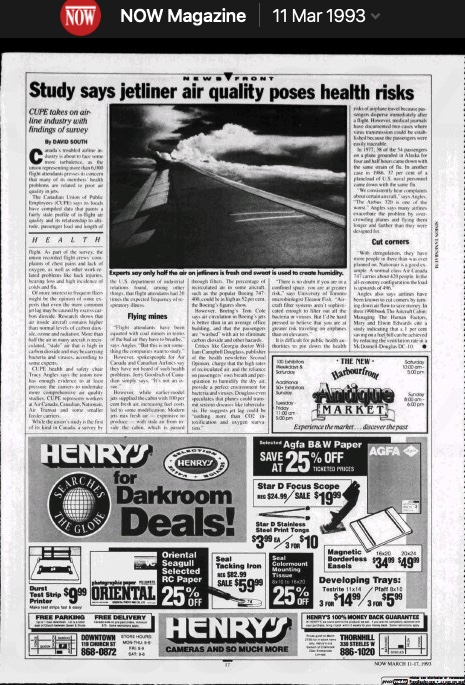
  • Study Says Jetliner Air Quality Poses Health Risks: CUPE Takes On Airline Industry With Findings Of Survey

    Study Says Jetliner Air Quality Poses Health Risks: CUPE Takes On Airline Industry With Findings Of Survey

    By David South

    Now Magazine (Toronto, Canada), March 11-17, 1993

    Canada’s troubled airline industry is about to face some more turbulence, as the union representing more than 6,000 flight attendents presses its concern that many of its members’ health problems are related to poor air quality in jets.

    The Canadian Union of Public Employees (CUPE) says its locals have compiled data that paints a fairly stale profile of in-flight air quality and its relationship to altitude, passenger load and length of flight. As part of the survey, the union recorded flight crews’ complaints of chest pains and lack of oxygen, as well as other work-related problems like back injuries, hearing loss and high incidence of colds and flu.

    Of more interest to frequent fliers might be the opinion of some experts that even the more common jet lag may be caused by excess carbon dioxide, ozone and radiation. More than half the air in many aircraft is recirculated, “stale” air that is high in carbon dioxide and may be carrying bacteria and viruses, according to some experts.

    CUPE health and safety chair Tracy Angles says the union now has enough evidence to at least pressure the carriers to undertake more comprehensive air quality studies. CUPE represents workers at Air Canada, Canadian, Nationair, Air Transat and some smaller feeder carriers.

    While the union’s study is the first of its kind in Canada, a survey by the US department of industrial relations found, among other things, that flight attendents had 20 times the expected frequency of respiratory illness.

    Flying mines

    “Flight attendants have been equated with coal miners in terms of the bad air they have to breathe,” says Angles. “But this is not something the companies want to study.”

    However, spokespeople for Air Canada and Canadian Airlines say they have not heard of such health problems. Jerry Goodrich of Canadian simply says, “It’s not an issue.”

    However, while earlier-model jets supplied the cabin with 100 per cent fresh air, increasing fuel costs led to some modification. Modern jets mix fresh air – expensive to produce – with stale air from inside the cabin, which is passed through filters. The percentage of recirculated air in some aircraft, such as the popular Boeing 747-400, could be as high as 52 per cent, Boeing’s figures show.

    Boeing’s Tom Cole says air circulation in Boeing’s jets is better than in an average office building, and that the passengers are “washed” with air to eliminate carbon dioxide and other hazards.

    Critics like Georgia doctor William Campbell Douglass, publisher of the health newsletter Second Opinion, charge that the high rates of recirculated air, and the reliance on passengers’ own breath and perspiration to humidify the dry air, provide a perfect environment for bacteria and viruses. Douglass even speculates that planes could transmit serious diseases like tuberculosis. He suggests jet leg could be “nothing more than CO2 intoxification and oxygen starvation.”

    “There is no doubt if you are in a confined space, you are at greater risk,” says University of Toronto microbiologist Eleanor Fish. “Aircraft filter systems aren’t sophisticated enough to filter out all the bacteria and viruses. But I’d be hard pressed to believe that you are at greater risk traveling on airplanes than on elevators.”

    It is difficult for public health authorities to pin down the health risks of airplane travel because passengers disperse immediately after a flight. However, medical journals have documented two cases where virus transmission could be established because the passengers were easily traceable.

    In 1977, 38 of the 54 passengers on a plane grounded in Alaska for a four and a half hours came down with the same strain of flu.

    “We consistently hear complaints about certain aircraft,” says Angles. “The Airbus 320 is one of the worst.”

    Angles says many airlines exacerbate the problem by over-crowding planes and flying them longer and farther than they were designed for.

    Cut corners

    “With deregulation, they have more people in there than was ever planned on. Nationair is a good example. A normal class Air Canada 747 carries about 420 people. In the all-economy configuration the load is upwards of 496.”

    Angles also says airlines have been known to cut corners by turning down air flow to save money. In their 1990 book The Aircraft Cabin: Managing the Human Factors, Mary and Elwin Edwards cite a study indicating a 1 per cent saving on a fuel bill can be achieved by reducing the ventilation rate in a McDonnel-Douglas DC-10.

    More resources: 

    April 2021

    Airqualitynews.com Terror at 20,000 feet

    A new global campaign and film asks whether the air we breathe on commercial flights is as safe as we think it is.

    Another issue, which frequently gets overlooked, is the quality of the air passengers breathe onboard

    In February, a global campaign was launched by the Global Cabin Air QualityExecutive (GCAQE), which called for the mandatory introduction of effective filtration and warning systems, to be installed on all commercial passenger jet aircraft.

    According to the GCAQE, there have been 50 recommendations and findings made by 12 air accident departments globally over the last 20 years, directly related to contaminated air exposures on passenger jet aircraft.

    However, commercial aircraft continue to fly, with no contaminated air warning systems to inform passengers and crews when the air they are breathing is contaminated.”

    Jetliner Cabins Are Quickly Cleared of Virus, Pentagon Says

    “Particles the size of the new coronavirus are quickly purged from a commercial aircraft cabin, according to a U.S. Defense Department study touted by United Airlines Holdings Inc. in its effort to reassure wary travelers.

    Filtration systems and rapid air-exchange rates mean that only about 0.003% of infected particles entered a masked passenger’s breathing zone, said the report, released Thursday.”

    Aircraft Air Quality – Protecting Against Contaminants, Association of Flight Attendants

    “On October 5, 2018, a 5-year FAA bill became law. Included in the bill is a study on technologies to combat contaminated bleed air. This is significant progress!”

    ‘Contaminated air’ on planes linked to health problems, 21 June 2017

    AEROTOXIC SYNDROME: A NEW OCCUPATIONAL DISEASE?, Public Health Panorama, Volume 3, Issue 2, June 2017

    Influenza Air Transmission, Influenza A (H1N1) Blog, September 28, 2009

    “What does this tell us? Aerosols, very small particles of saliva containing the virus we exhale when we sneeze or even when we breathe if we have the flu, probably have an important role in the transmission of influenza. In addition to that we have public transportation, with a great number of people circulating in a place that may be closed and badly ventilated at times and we may have a notion of the importance of public campaigns that promote education and awareness of contaminated people to avoid leaving their homes when they have the flu and that they cover their mouth and nose with a disposable tissue when they sneeze and discard it right after that.”

    2006

    Tuberculosis and Air Travel: Guidelines for Prevention and Control

    “The revised International Health Regulations, adopted in 2005, provide a legal framework for a more effective coordinated international response to emergencies caused by outbreaks of infectious diseases. A number of provisions are relevant to the detection and control of TB during air travel, strengthening the authority of WHO and of national public health authorities in this domain. Because of these important developments since the original guidelines were issued in 1998, WHO has prepared this revised version to take account of current public health risks that may arise during air travel and new approaches to international collaboration in dealing with them. The guidelines were developed with the collaboration of international experts in air travel medicine and other authorities. Implementing the recommendations will help to reduce the spread of dangerous pathogens across the globe and decrease the risk of infection among individual travellers.

    An outbreak of influenza aboard a commercial airliner, American Journal of Epidemiology, Volume 110, Issue 1, July 1979

    “A Jet airliner with 54 persons aboard was delayed on the ground for three hours because of engine failure during a takeoff attempt. Most passengers stayed on the airplane during the delay. Within 72 hours, 72 per cent of the passengers became III with symptoms of cough, fever, fatigue, headache, sore throat and myalgia. One passenger, the apparent Index case, was III on the airplane, and the clinical attack rate among the others varied with the amount of time spent aboard. Virus antigenlcally similar to A/Texas/1/ (H3N2) was Isolated from 8 of 31 passengers cultured, and 20 of 22 ill persons tested had serologic evidence of infection with this virus. The airplane ventilation system was inoperative during the delay and this may account for the high attack rate.”

    The Airliner Cabin Environment and the Health of Passengers and Crew.

    “At the end of its review of health data in the 1986 report The Airliner Cabin Environment: Air Quality and Safety, the National Research Council (NRC) committee concluded that “available information on the health of crews and passengers stems largely from ad hoc epidemiologic studies or case reports of specific health outcomes [and] conclusions that can be drawn from the available data are limited to a great extent by self-selection…and lack of exposure information” (NRC 1986). This chapter reviews data on possible health effects of exposure to aircraft cabin air that have emerged since the 1986 report and the emergence of data resources (e.g., surveillance systems) and studies that have particular relevance for the evaluation of potential health effects related to aircraft cabin air quality. Selected earlier sources are also reviewed. The decision to ban tobacco-smoking on domestic airline flights in 1987 and on flights into and out of the United States in 1999 reduces the relevance of some studies of exposures and reported signs and symptoms that clearly could have been related to the products of tobacco smoke.” 

    ORCID iD: https://orcid.org/0000-0001-5311-1052.

    © David South Consulting 2021

  • Health Care On The Cutting Block: Ministry Hopes For Efficiency With Search And Destroy Tactics

    Health Care On The Cutting Block: Ministry Hopes For Efficiency With Search And Destroy Tactics

    By David South

    Today’s Seniors (Canada), August 1993

    It’s search and destroy time at Ontario’s ministry of health: search out savings and destroy inefficiency and waste. But many remain apprehensive that not all the cuts are going to be logical and fear the province’s health and well-being will be affected. 

    As part of the social contract deal, the Ontario Medical Association must find $20 million in cuts from the list of services covered by OHIP. The OMA and the provincial government are currently haggling over which procedures and examinations will be cut. 

    “We look at services that aren’t medically necessary,” says health ministry spokesperson Layne Verbeek. “Because we were wealthier in the past, we were able to cover some services. We aren’t in that position now. But I don’t see how eliminating medically unnecessary treatments will affect the population.”

    The fallout of the Rae government’s attempts to reign in costs and recover lost revenues may take years to unfold, but it is already apparent that Ontarians will be paying more. 

    “Access to necessary treatment should not depend on a person’s ability to pay,” says health policy critic Carol Kushner. “What disturbs me about any delisting program is that virtually every medical service could be termed medially necessary. There are very few services that are an out-and-out waste of time.

    “We often point to the fact that Ontario spends $200 million a year treating the common cold. Well, most of that is a waste of time. But delisting even that kind of service would be a detriment to the public’s health, because a small group of patients really do need to see a doctor when they have a cold.”

    OMA spokesperson Jean Chow says it’s too early to pin down the exact cuts that will be made. “It’s a little premature to try and speculate what the final list will be.”

    The newly-created Non-Tax Revenue Group is hard at work finding fees, fines and penalities the government can add or hike to boost revenue from this source from $5 billion to $10 billion a year. 

    The spring budget saw the first hit, with the addition of $240 million in non-tax revenue. 

    A radical reshaping of medicare is taking place. Private sector services – for which consumers pay directly or through insurance companies – now make up 34 per cent of Ontario’s health care funding, compared to 42 per cent in the United States, according to a recent study by the Canadian Medical Association. 

    Health minister Ruth Grier has also floated the idea of widespread hospital closures. Both the Toronto and Windsor district health councils (DHCs) are carrying out feasibility studies on “reconfiguration.” The ministry is remaining tight-lipped about which hospitals will get the chop. 

    “One suspects there’s room for efficiency – there are a lot of empty beds in a number of different places,” says ministry spokesperson Verbeek. 

    “All hospitals are being reviewed, with a view to closing one or two hospitals,” says health planner Lisa Paolatto, who is working on a feasibility study on “reconfiguration” for the Essex County District Health Council, along with Toronto’s DHC. 

    Closing hospitals could present a serious political hot potato for the government. In Britain, the Conservative government is still recovering from the bad feelings surrounding proposals to close world-renowned hospitals in the London area. The public feels great loyalty to local hospitals, a feeling that has been further fostered by hospital charities that raise millions a year from the communities’ good will. 

    “This is going to open up new discussions of money between doctors and patients,” says Kushner. “Seniors are a unique group in Canada because they remember what it was like before medicare – what it was like not to be able to pay for the doctor, to forgo treatment that they thought was necessary. They understand the financial hardship that could occur if they were unlucky enough to have a family member who needs expensive medical treatment.” 

    All Posts

    More from Canada’s Today’s Seniors

    Feds Call For AIDS, Blood System Inquiry: Some Seniors Infected

    Government Urged To Limit Free Drugs For Seniors

    Health Care On The Cutting Block: Ministry Hopes For Efficiency With Search And Destroy Tactics

    New Seniors’ Group Boosts ‘Grey Power’: Grey Panthers Chapter Opens With A Canadian Touch

    Seniors Falling Through The Health Care Cost Cracks

    ORCID iD: https://orcid.org/0000-0001-5311-1052.

    © David South Consulting 2021
  • Changing Health Care Careers A Sign Of The Times

    Changing Health Care Careers A Sign Of The Times

    By David South

    Hospital News (Canada), June 1992

    Ontario’s health care system is in the midst of a big change. But where are the new jobs going to be and how can health care workers prepare for the coming crunch?

    “Anybody who thought they could progress through the health care system until retirement is in for a shock,” said Ruth Robinson, a national health care consultant for Peat Marwick Stevenson and Kellogg management consultants. 

    Radical changes are taking place in the health care system and it looks like traditionally safe occupations are in for a shake-up. 

    “Hospitals are being pressured to change fundamentally,” said Ms. Robinson. “The net effect is fewer jobs. A lot of people will have to think about new careers.”

    In the Ministry of Health working document entitled Goals and Strategic Priorities, released in January, the fundamental shift from treatment to disease prevention and health promotion is laid out in generalities. 

    The goals range from health equity for aboriginals, women, children and AIDS patients to better management of costs to development of a stronger health care industry that will jump start the economy. And they range from the reorganization of professional responsibilities to promotion of services outside institutions with the goal of keeping people out of hospitals. 

    One thing is clear, the talk is about big changes. But talk is cheap to laid-off health care workers looking for new jobs. 

    The provincial government’s recently passed, but yet to be proclaimed, Regulated Health Professions Act will have serious repercusions for all health care providers. 

    “Traditionally, doctors have an exclusive domain over a wide area,” said Charlie Bigenwald, executive director of health human resources planning at the Ministry of Health. “Even though other people could do things, they had to be delegated by a doctor. With the legislation, we have pushed back what doctors can do. This means there will be more opportunity for a wider variety of health care workers to get into those areas.”

    Midwifery is one of the benefactors of changes in regulations. The Ministry of Health is looking into having a university-based program for midwives. 

    Ms. Robinson predicted nurses and middle management will suffer the most in the change to community-based health care. 

    “Nurses will need to get a bachelor degree if they hope to compete for jobs,” she said. 

    As for middle managers, who often have clinical skills, they will have to reconsider staying in health care, she said. “They will disappear significantly. They can advance themselves by getting back to clinical skills or consider management positions in non-health care areas.

    “There is nothing to be ashamed of about career changes these days,” she added. 

    In the shift towards community-based care, opportunities will arise for health care workers who can offer creative solutions to improve service delivery. 

    “For nurses, we currently have something called the Nursing Innovation Fund where individuals can apply for a wide variety of developmental things like attending workshops, conferences and training programs. We process 2,500 applications a year,” said Mr. Bigenwald. 

    The Ministry of Health hopes the future sees a health care system that adds to the province’s economy rather than drains it. 

    “We spend $17 billion a year on health care. We never looked at the health care system as an economic motor in the past. The question we are asking right now is ‘why can’t an Ontario firm make the carpets, beds, sutures etc?’, said Mr. Bigenwald. 

    Ms. Robinson said “Governments are running out of money and can’t increase funding. They will be looking for more partnerships in the private sector. In this climate, creative solutions to health care delivery have a great opportunity.” 

    Creative Commons License

    This work is licensed under a
    Creative Commons Attribution-Noncommercial-No Derivative Works 3.0 License.

    ORCID iD: https://orcid.org/0000-0001-5311-1052.

    © David South Consulting 2023