Television programmers are under attack once again. Thanks to Guelph activist Patricia Herdman’s Coalition for Responsible Televsion (CORT), two violent television shows – Poltergeist (CTV) and Millennium (Fox/Global) – have lost several advertisers in recent weeks due to pressure from CORT. It’s just another wave in a new assault on the immorality of television.
Positive Entertainment Alternatives for Children Everywhere (PEACE), a Montreal group founded after the murder of 14 young women in that city in 1989, staged a press conference last week, complete with sweet-faced children, to announce its “Toxic TV” list. Who is toxic? Old favourites like Bugs Bunny, Batman and Robin and The Simpsons. PEACE also produced a list of “Positive” TV shows. It included a wrist-slashing selection of insipid programming, such as Barney and Friends, Fresh Prince of Bel-Air and Kratt’s Creature.
But critics of television overlook the strong and often simplistic moral messages that infuse most programming. Some even argue the mostly Judeo-Christian morality comes at the expense of atheistic and agnostic perspectives.
University of Guelph philosophy professor Jay Newman argues that religious moralists are making television the scapegoat for all of society’s ills.
He argues television, rather than being a moral vacuum, is heavily influenced by Judeo-Christain values – often in shows many people don’t suspect.
Newman sharply criticizes religious moralists, who he says, neglect to observe the same contradictions in their own beliefs that they see in television.
In Newman’s view, religion shares many sins with television. Religion promotes passivity (“The meek shall inherit the earth”), disrupts family life (who needs to talk to that “immoral” gay brother/sister?), does a questionable job of moral education, invents celebrities (the saints), sacrifices spiritual wisdom for meaningless ritual and entertainment (the Mass), and promotes violent behaviour (who can forget the Crusades or the Spanish Inquisition?).
Leaning back in his chair at his University of Guelph office, the irascible New York-born Newman enthusiastically defends television.
“When we assess TV as bad,” he says, “I’m not convinced religion is the only moral teacher, and it has not been the best moral teacher. Religion has been a very important force of hatred, whereas Star Trek teaches us to respect other cultures.
“TV has been of great value in promoting pluralism and an increase in tolerance.”
Newman isn’t talking about gore-soaked TV like Poltergeist and Millennium, shows he says speak more about their producers than about the medium of television. “Wanton slaughter can’t be blamed on TV. But I do agree with psychologists that some television inures us to violence.”
He sees Star Trek as a moral force for both pluralism and tolerance, strong values that are essential to democracies with many ethnic, cultural and racial groups. “This show promotes tolerance towards people who appear different. It shows aliens have aspirations and desires just like us.”
Newman does take offence to one race of aliens on the popular series: the Ferengi. While the Ferengi are supposed to be the equivalent of used car dealers in Star Trek’s universe, they draw criticism from Newman for their anti-semitic undertones. But even here, says Newman, TV can’t beat the pantheon of Christain anti-semites.
As for the bumbling antics of Bart Simpson and his dad Homer, Newman says The Simpsons also contain positive morals. “The Simpsons teaches us to accept the foibles of others and empathize. It does it in a gentle way without passing a very austere judgement.”
Newman even sees hope in the dreamy world of daytime soap operas. They teach people to develop empathy. They also use negative role models to show that hatred and contempt backfire on people; that promiscuity and adultry don’t come without a cost.”
As for Seinfeld, a sitcom about a group of friends who seem to never do anything, Newman says, “I’m a New Yorker and I can’t sit through it.”
Newman, an expert on religious fanaticism and hypocrisy, has responded to religious critics of television in his new book, appropriately titled Religion vs. Television. Newman sees religious critics of television as at best hypocrites, at worst specious claimants to higher moral ground.
“[Religious leaders] make judgements to show the usefulness of their institutions in an attempt to restore the lustre of religious authority.”
Newman believes the debate surrounding violence on TV is misguided. He believes the root causes of violence should be dealt with first.
“Television is a convenient scapegoat. Its criticism parallels religious bigotry. They don’t focus on the individual, just the medium. And this is accepted by people who call themselves liberal!”
TV immoral?
But critics of TV say any decent moral messages that slip through are undermined by television’s subservience to a higher God: consumerism. For Rose Anne Dyson of Canadians Concerned About Violence in Television (C-CAVE), this corrupted morality can’t be ignored. “There is only one over-riding religion today: consumerism. Its main purveyor is TV.
“Television is a major socializer today. Parents and teachers are key to modifying that influence. But most of television is very bad and just teaches consumer-driven values. There isn’t a single children’s programme that isn’t infused with commercial values.”
Dyson believes the negative effects aren’t just psychological. “Watching too much TV is bad – it causes obesity and hyperactivity.”
Dyson’s claims were recently backed up by a new study showing unhealthy minds may lead to unhealthy bodies. A study conducted by Columbia University claimed the more that children watched TV, the fatter they got. Researcher Dr Barbara Dennison found children who watched 14 hours of television a week had diets with 35 per cent of their calories from fat. The study blamed the high representation of junk food in television ads and the fact they promoted couch potato dining. Canadian children on average watch 18 hours a week of television.
Dyson does agree with Newman’s criticism of organized religions’ spurious claims to higher ground. “Judeo-Christian religions have gotten us into a lot of trouble!”
To control this morally wayward TV, Dyson looks forward to more entertainment conglomerates self-regulating their programming. “The cornerstone of democracy is to obey rules.
“A lot of cultural studies people tend to underestimate the impact of TV – there is too much of a value-free approach.”
Id was published in Guelph, Ontario, Canada in the 1990s.
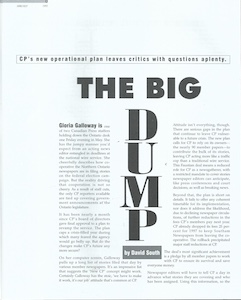
Gloria Galloway is one of two Canadian Press staffers holding down the Ontario desk one Friday evening in May. She has the jumpy manner you’d expect from an acting news editor entangled in deadlines at the national wire service. She cheerfully describes how cooperative the Northern Ontario newspapers are in filing stories on the federal election campaign. But the reality driving that cooperation is not so cheery. As a result of staff cuts, the only CP reporters available are tied up covering government announcements at the Ontario legislature.
It has been nearly a month since CP’s board of directors gave final approval to a plan to revamp the service. The plan caps a crisis-filled year during which many feared the agency would go belly up. But do the changes make CP’s future any more secure?
On her computer screen, Galloway pulls up a long list of stories filed that day by various member newspapers. It’s an impressive list that suggests the ‘New CP’ concept might work. Certainly Galloway has the stoic, ‘we have to make it work, it’s our job’ attitude that’s common at CP.
Attitude isn’t everything, though. There are serious gaps in the plan that continue to leave CP vulnerable to a future crisis. The new plan calls for CP to rely on its owners – the nearly 90 member papers – to contribute the bulk of its stories, leaving CP acting more like a traffic cop than a traditional wire service. This Faustian deal means a reduced role for CP as a newsgatherer, with a restricted mandate to cover stories newspaper editors can anticipate, like press conferences and court decisions, as well as breaking news.
Beyond that, the plan is short on details. It fails to offer any coherant timetable for its implementation, nor does it address the likelihood, due to declining newspaper circulations, of further reductions in the fees CP’s members pay next year. CP already dropped its fees 25 percent for 1997 to keep Southam Newspapers from leaving the cooperative. The rollback precipitated major staff reductions at CP.
The deal’s most significant achievement is a pledge by all member papers to work with CP to ensure its survival and save everyone money.
Newspaper editors will have to tell CP a day in advance what stories they are covering and who has been assigned. Using this information, so the theory goes, it will be possible to avoid assigning several reporters from competing papers to cover a story when one will do. A reporter will not only be working for his or her own paper that day, but for every CP paper, and will be expected to file updates throughout the day to a CP editor, who in turn will write the story that is then ‘wired’ to all the members. That way, it is hoped, no superfluous stories will be going out on the wire. Member papers will still file analytical and feature stories to CP but, as is the case now, they are under no obligation to give away their prized family jewels – exclusive stories – to other CP papers.
In practical terms, the new approach has been creeping into CP’s way of doing things by stealth rather than command. CP has been increasing its reliance on member papers to pick up the slack when CP reporters aren’t available. The most recent example was the federal election campaign: only one CP reporter was assigned full-time to cover the whole campaign. The rest of the coverage was handled by a combination of CP bureau staff and member paper reporters.
While many smaller papers are dependent on CP for their provincial, national and international stories, the bigger papers, who are the main sources of these stories, can afford to be blase’. Their willingness to co-operate will decide the success or failure of the member-exchange component of CP.
Southam’s vice-president of editorial, Gordon Fisher, maintains his papers will support the plan because it will save his company approximately $2.5 million a year. “We pay a significant amount of money towards this cooperative,” he maintains. “A member exchange is one of the more efficient ways we can find to deliver news without incurring a huge amount of expense.”
“What is CP needs a story earlier than a reporter normally files?” asks managing editor Jane Perves of Halifax’s Chronicle-Herald and Mail-Star. “Theoretically, they should be spending all their time doing the story for our paper.”
Jane Purves is an enthusiastic supporter of CP. Nonetheless she wonders if CP editors will be caught in a contest of wills with editors at member papers. She would like to see a reporter’s CP obligations involve simply calling in a quote or raw data. She would have a problem if a reporter working on a major story for her paper was distracted by CP’s needs.
The Globe and Mail is conidering hiring a full-time co-ordinator to handle the heavy volume of stories that paper generates for CP. Newspaper managers elsewhere are split on the question of whether the plan will increase workloads. The extent that it does so will be a crucial test of their commitment.
Not only will editors need to regularly ‘loan’ reporters to CP, they will have to change how they do things on a daily basis if the plan is to work. Editors will have to file an assignment list one day in advance to CP, a task that could get easily overlooked when papers get hit with multiple big stories.
“It’s pretty minor stuff,” says Perry Beverley, the co-publisher of Brockville’s Recorder and Times. Although the Recorder and Times is an afternoon paper where copy is edited in the morning, Beverley has no plans to switch an editor to an evening shift to fit CP’s deadlines.
Deadlines are a particularly thorny question in a country that spans six time zones. Newspapers on the East coast can file stories at the end of the day and still meet CP deadlines that are pegged at Toronto time. The problem is with newspapers west of Ontario; they will have to file stories well before the end of the day. In the case of B.C., filing will have to be done in the morning so that stories picked up by CP will be ready in time for East coast papers.
The copy will have to go out to CP unedited.
At the Edmonton Sun, editor-in-chief Paul Stanway isn’t sanguine about sending out unedited copy. Stanway had editorial deadlines pushed back to 6 p.m. 18 months ago as part of a re-organization at the paper, but they still mean copy would be sent straight from reporters to CP, where copy needs to be in between 4 p.m. and 9 p.m. Toronto time. Stanway is concerned the CP staff will not have the time to fact-check stories to weed out mistakes, which would reflect poorly on his paper.
The anticipated deadline crunch has been nicknamed “the big dump” in CP circles: a tidal wave of material hitting the wire service’s desks all at once, leaving editors scrambling to do re-writes before newspapers are put to bed.
CP general manager Jim Poling, who vacates he job in June, believes this problem will be solved by the restructuring, not exacerbated by it. “The volume of copy has already dropped significantly,” he says. “We are hoping for a wider spectrum of deadlines. Hopefully you are going to get your copy spread out over a longer period, instead of over the course of a couple of hours. You might not need a massive shift of people to a certain time.”
Poling claims the resolution is in better planning which will result in fewer unwanted stories. Fewer stories, so Poling maintains, means more time for editors to re-write.
At CP’s Winnipeg bureau, Canadian Media Guild vice-president Scott Edmonds is sceptical. He isn’t convinced the slimmed down CP will have the staff to handle what he sees as an increasing workload.
“It sounds like the meatgrinder approach to journalism,”says Edmonds. “There is no way these desks are going to be able to cope with any degree of thoughtfulness with this copy. The pressure is going to be too great.”
Edmonds also sees a bigger problem in staff moral. “The majority of people working for Canadian Press don’t want their career to end up as a re-writer… It will require a lot more attention on the desk for this material, so we will be taking resources away from reporting. In other words, taking somebody away from doing the story to redoing the story.”
CP’s raison d’etre is its ability to turn out stories written in a homogenous national voice that can be tailored for a specific paper’s readers. Another important asset is the agency’s ability to quickly add knowledge and background to stories, drawing on the experience of its reporters and editors. According to Martin O’Hanlon at CP’s Ontario Desk, cut-backs have compromised this ability. Three business reporters have been poached by the Financial Post, including Ian Jack and Sandy Rubin. Over 40 talented reporters and editors took buyouts in the fall of 1996.
This means CP isn’t as well equipped as it once was to turn raw copy from reporters into high-quality journalism that can draw the respect and admiration of its subjects.
“Our reporters are not trained to write for a national audience,” emphasizes Jane Purves in Halifax.
Scott Edmonds doesn’t believe member contributors are a substitute for CP staff. “I’m very concerned about attempting to replace quality staf-written material that caters to a national audience and is written to uniform standards, with material picked up from newspapers that in some cases may be very good, but in some cases may not be of the same quality.”
There is a great deal of confusion over when the plan is supposed to kick in. One camp, which includes Jim Poling, sees it more as a gradual, evolutionary change that will take several years to fine tune. There are others who want to see trial runs. Still others believe there will be a date set for a total national switch-over.
Perry Beverley favours test sites and single switch-over date.
“Once that D-Day time is chosen for the switch-over into the restructured CP,” she says, “there will be an appointed person in the newsroom responsible for sending the schedule to CP.”
Purves favours a gradual switch. “A shot-gun approach might backfire. I’d rather have a gradual approach providing we had a starting date and an aim.”
“We don’t have to have a roll-out day,” says Poling. “But if all the managers and staff rise up and say ‘shit, we need test sites,’ then I will listen. Anybody who is waiting for a date will be disappointed. All of this started a long time ago and is a continuing process that will take a couple of years to get everything in place.”
Seven regional news committees will co-ordinate and oversee this new approach, each one staffed by representatives from member papers and CP. According to the plan, these regional news committees will act as enforcers for the new regime. They will work out the logistics of member exchange and use fines to penalize papers that miss deadlines or obstruct exchange.
How such an approach would work in practice is still up in the air. “At some point everybody is going to act against the interests of the co-op,” maintains Purves. “They will be wondering, ‘will I be fined for this?’”
Nobody contacted by SCAN could tell us what these fines would be, how violations would be investigated or what constituted offences. Purves wondered what deterrence value the fines would have if a paper thought it had acted in its best interests. If paper X decided to hold back a juicy scoop that was supposed to be that day’s CP story, a fine of $2,000 might be worth incurring if it sells more newspapers. It was generally agreed none of these committees would meet until after the federal election at the earliest.
For now, Poling is generally optimistic (though he won’t around past June and a replacement has yet to be found). He is talking about raising salaries for the first time in five years, about hiring new staff, about stabilizing life at CP.
The lower fees have lured back one newspaper group, British Columbia’s Sterling. A trial use of CP stories started at the beginning of May. It remains to be seen whether New Brunswick’s Telegraph Journal/Times Globe papers will return, after pulling out of CP in 1993 and hiring more of its own reporters with the money saved. Publisher Jamie Milne remains coy as to his interest in returning to CP, but Poling thinks a deal will be worked out by the fall.
And what about the mood of the man charged with overseeing CP’s transition? Jim Poling, as some CP staffers like to mention, is losing that cautious reserve managers usually have for talking to the media. He isn’t happy with the state of the print media in Canada.
“There has been a lot of cutting in this industry,” says an audibly frustrated Poling. “The fact of the matter is this: cutting isn’t the only answer to having an efficient operation. There has to be some money available to allow journalists to walk around a bit. People who walk around and poke at things and stare at things write good stories.”
With phones ringing all around us, Galloway begins to think out loud about possible wrinkles in the new CP plan: how newspaper reporters at trials will have to keep leaving the courtroom to file updates for CP, how stories written for local papers will translate for national readers, how hard it can be for local, non-CP reporters to cover elections when they don’t know what questions have been asked elsewhere on the campaign trail.
But Galloway has to get back to work. She has to push the Toronto Star to file a story early so the Hamilton Spectator can pick it up.
Scan magazine was published for media professionals in Toronto, Canada in the 1990s.“The Big Dump”Breaking the news to CP staff.
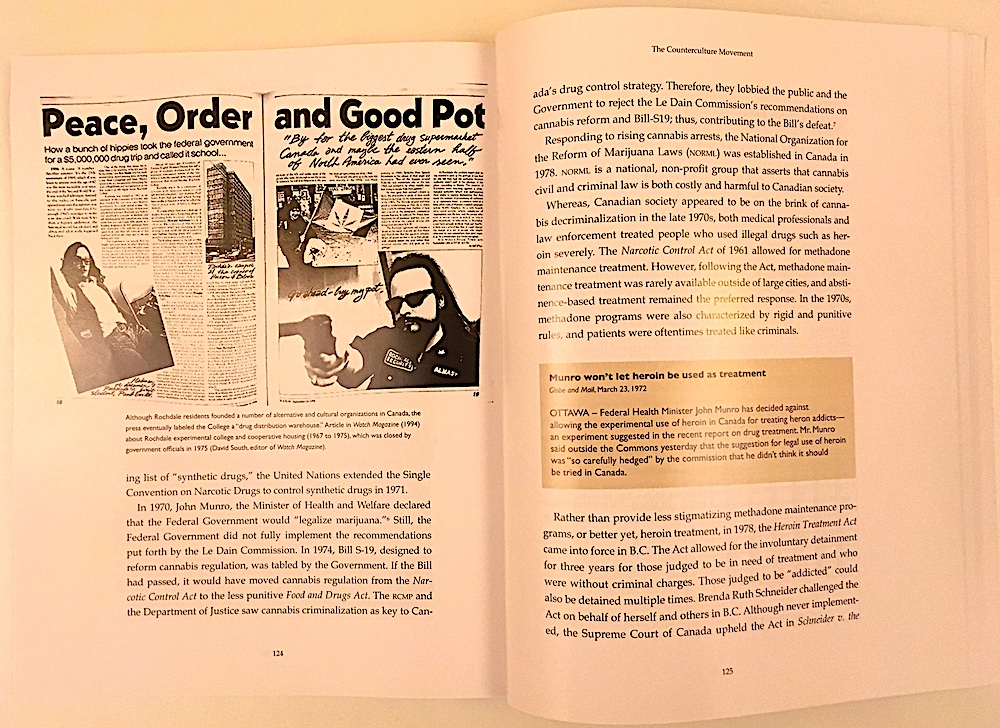
Upon my return from a United Nations workshop in Dhaka, Bangladesh, I was delighted to receive a copy of the new book Busted: An Illustrated History of Drug Prohibition in Canada (Fernwood Publishing, 2017, ISBN 978-1-55266-976-1) by Professor Susan Boyd from the Faculty of Human and Social Development at the University of Victoria in British Columbia, Canada.
Busted: An Illustrated History of Drug Prohibition in Canada by Susan Boyd (Fernwood Publishing).
It is a beautifully illustrated book and an excellent introduction to Canada’s unique history surrounding drug use and drug prohibition. As the country embarks on a new phase in its relationship to some drugs, the book gives the bigger picture that many Canadians are probably unaware of. Canada had a period of extensive social experimentation in the late 1960s and early 1970s, defying perceptions the country is ‘boring’ and where excitement doesn’t happen.
A feature we did for Toronto’s Watch Magazine in 1994 (in which I was Editor-in-Chief) is on page 124 in the chapter on The Counterculture Movement: The 1960s and 1970s.
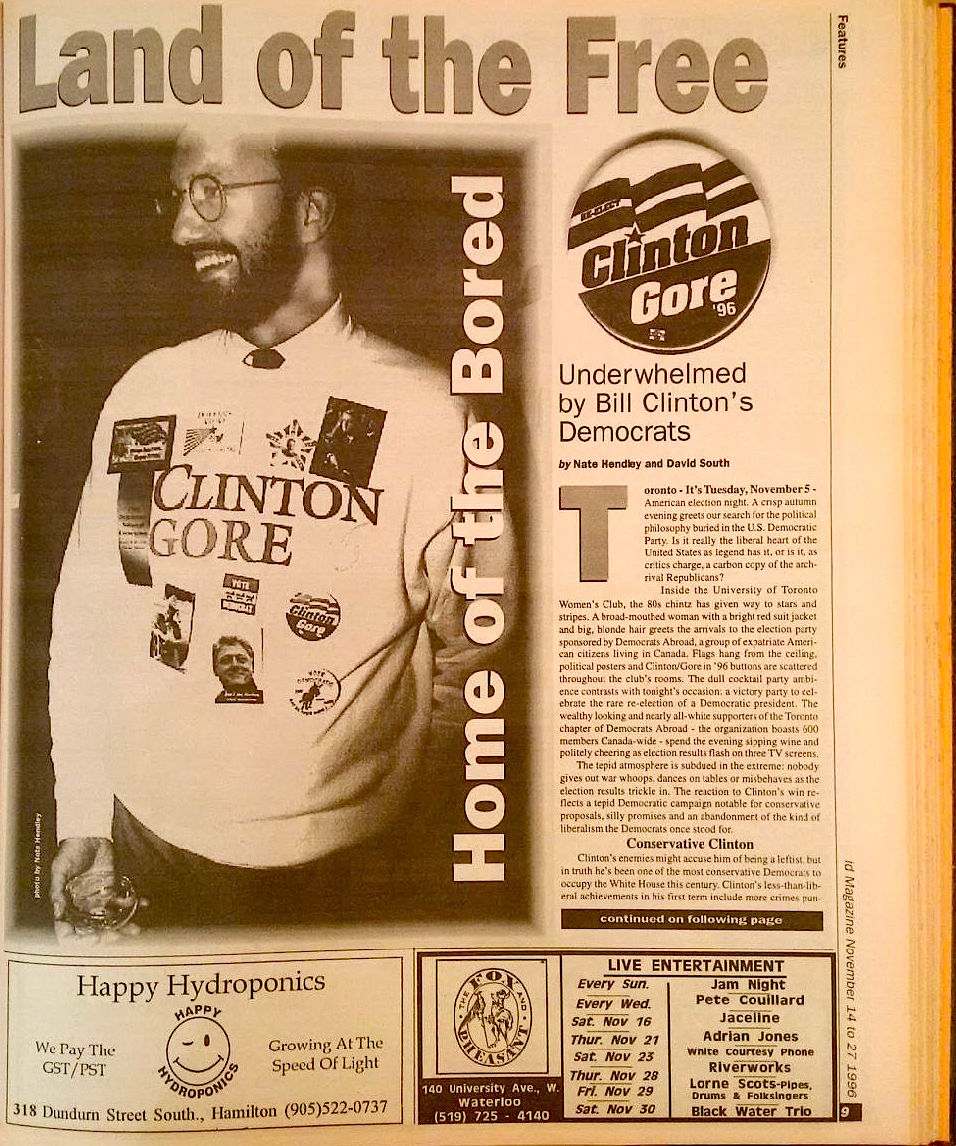
Toronto – It’s Tuesday, November 5 – American election night. A crisp autumn evening greets our search for the political philosophy buried in the US Democratic Party. Is it really the liberal heart of the United States as legend has it, or is it, as critics charge, a carbon copy of the arch-rival Republicans?
Inside the University of Toronto Women’s Club, the 80s chintz has given way to stars and stripes. A broad-mouthed woman with a bright red suit jacket and big, blonde hair greets the arrivals to the election party sponsored by Democrats Abroad, a group of expatriate American citizens living in Canada. Flags hang from the ceiling, political posters and Clinton/Gore in ’96 buttons are scattered throughout the club’s rooms. The dull cocktail party ambience contrasts with tonight’s occasion: a victory party to celebrate the rare re-election of a Democratic president. The wealthy looking and nearly all-white supporters of the Toronto chapter of Democrats Abroad – the organization boasts 600 members Canada-wide – spend the evening sipping wine and politely cheering as election results flash on three TV screens.
The tepid atmosphere is subdued in the extreme: nobody gives out war whoops, dances on tables or misbehaves as the election results trickle in. The reaction to Clinton’s win reflects a tepid Democratic campaign notable for conservative proposals, silly promises and an abandonment of the kind of liberalism the Democrats once stood for.
Conservative Clinton
Clinton’s enemies might accuse him of being a leftist, but in truth he’s been one of the most conservative Democrats to occupy the White House this century. Clinton’s less-than-liberal achievements in his first term include more crimes punishable by the death penalty, a promised additional 100,000 police on the streets, “V-Chip” technology in television sets, an intensification of the war on drugs and an abandonment of federal responsibility for welfare. Clinton’s re-election campaign featured promises to encourage school kids to wear uniforms, a vow to get even tougher on drug use by such measures as forcing teenagers to pass urine tests before issuing them driver’s licenses, and a recommitment to eliminating the US federal deficit.
The mostly monied professionals at the party are well aware of Clinton’s rightward turn since taking office in 1992, but put the president’s conservative leanings down to pragmatic politics.
“Am I disappointed in Clinton?” asks Bill Cronau, the past chair of Democrats Abroad and self-professed liberal. “Sure, but I’m not surprised that Clinton became more conservative. He is a Southerner after all.”
Arkansas-born Clinton used law and order issues “to chop GOP off,” adds Cronau, an insurance manager for Manulife, on the president’s theft of the Republican’s thunder.
The closest thing at the party to an actual living American politician is Tom Ward. Ward, with a detached air and the glow of a politician, soon attracted an audience when he entered the room. Ward twice ran unsuccessfully to become a Democratic congressman for Indiana, and agrees that overall Clinton has been “a disappointment as a liberal.”
He also agrees the president has moved far more to the right than previous Democratic presidents such as Jimmy Carter or Lyndon Johnson. Still, Ward, who has lived in East York since 1989, gives Clinton liberal kudos for his attempted passage of health care reforms. Yet Clinton’s proposed health care plan fell apart in 1994 following intense debate and criticism from the Republicans. Ward says he would try to introduce Canadian political ideas such as universal health care and stricter gun control were he to return to Indiana for a third run at Congress.
Canada or Clinton?
Joan Sumner, a psychologist originally from New York City, says she was initially impressed by Canada’s health care system, and by Clinton’s attempt at passing similar legislation in the US. But now she’s having second thoughts.
The Republicans, under Ronald Reagan and George Bush “decimated the health care system in the United States,” she says. “To run a medical practice became like running a business. It became difficult to collect from the insurance companies, who were reluctant to pay for psychiatric care.”
Sumner, who works with people who have “closed-head injuries,” has lived in Canada for 11 years. At the time she arrived, she found Canada’s health care system in good shape. “Now it’s a disaster and going from bad to worse. Truth be told, I am thinking of looking back across the border, especially with Clinton’s second term. The federal Liberals and the provincial government have no commitment to the people of Ontario.”
She complains about the extent of America’s influence on the Canadian political system.
Mike Harris, she fears, is borrowing his ideas from conservative Republican governor Christine Todd Williams in New Jersey. She would prefer Harris to look to liberals like former New York governor Mario Cuomo for inspiration. Unfortunately, Cuomo’s version of liberalism is out of fashion in both Canada and the United States these days.
While nearly everyone at the party expresses displeasure with Clinton’s turn to the right, few can explain why they supported him over his Republican challenger, Bob Dole.
In one corner is a bearded man in a white sweatshirt littered with Clinton/Gore campaign buttons. This super-supporter is Tim Wilkins, a Toronto social worker originally from Florida. When asked what policies attracted him to support the Democrats, Wilkins becomes flustered and unable to give any specifics.
“Been with the Democrats since 1988,” says Wilkins. “I could not identify with the Republicans at all. I think Bush was a very poor selection, and when he selected Dan Quale as his running mate, I thought ‘my Lord, you’ve just blown that ticket.’ The Republicans are just too right-wing, completely out of touch with Americans. And that’s an example of what’s happening tonight. Bob Dole and (running mate) Jack Kemp are completely out of touch. They have no agenda, no economic plan.”
Clinton and Chretien
Byron Toben, a Montreal Democrat, thinks a Clinton win will cement the close personal relationship between Clinton and prime minister Jean Chretien.
“Clinton and Chretien have something of a mutual admiration society going,” says Toben, who does immigration work, helping US citizens to move to Canada. “Clinton and Chretien are both on the same wavelength.”
Anne Kerr, the Canadian-born wife of Tom Ward, also agrees. She says Clinton’s victory is important to Canada because Liberals have more in common with the Democrats than the Republicans.
True enough, both Chretien and Clinton represent parties traditionally viewed as left-of-centre. Both men ran on vaguely liberal platforms for election, and both turned sharply conservative after deciding that deficit-reduction was more important than social spending or government activism. The federal Liberals in Canada and the Democrats in the United States now support conservative agendas that aren’t too much different than the platforms of their right-wing rivals. The biggest difference between the two nations, as Ward points out, is that the United States now lacks any major left-wing party such as the New Democrats. The Greens, running as a left-wing alternative to the Democrats, with consumer crusader Ralph Nader as their candidate, pulled in slightly more than a half-million votes on November 5. That is more than other minor parties such as the Libertarians or US Taxpayers Party, but hardly enough to convince Clinton to turn sharply leftwards in his second term.
Disappointment with Clinton’s first term aside, the Democrats Abroad party briefly jolts awake towards the end of the evening when Clinton’s re-election is confirmed. Champagne corks are popped by the club’s wait staff, but nobody is in a hurry to grab a glass. The mood becomes slightly effervescent as tipsy Democrats grow more animated, only to be hit with some mind-numbing post-victory speeches by the group’s executive. After a few toasts, the moment passes and a steady stream of Democrats slips out, thankful their man had won over Bob Dole, becoming the first Democratic president to win a second consecutive term in office since Franklin Roosevelt in 1936.
Id Magazine was published in Guelph, Canada in the 1990s.










 David South Consulting
You must be logged in to post a comment.