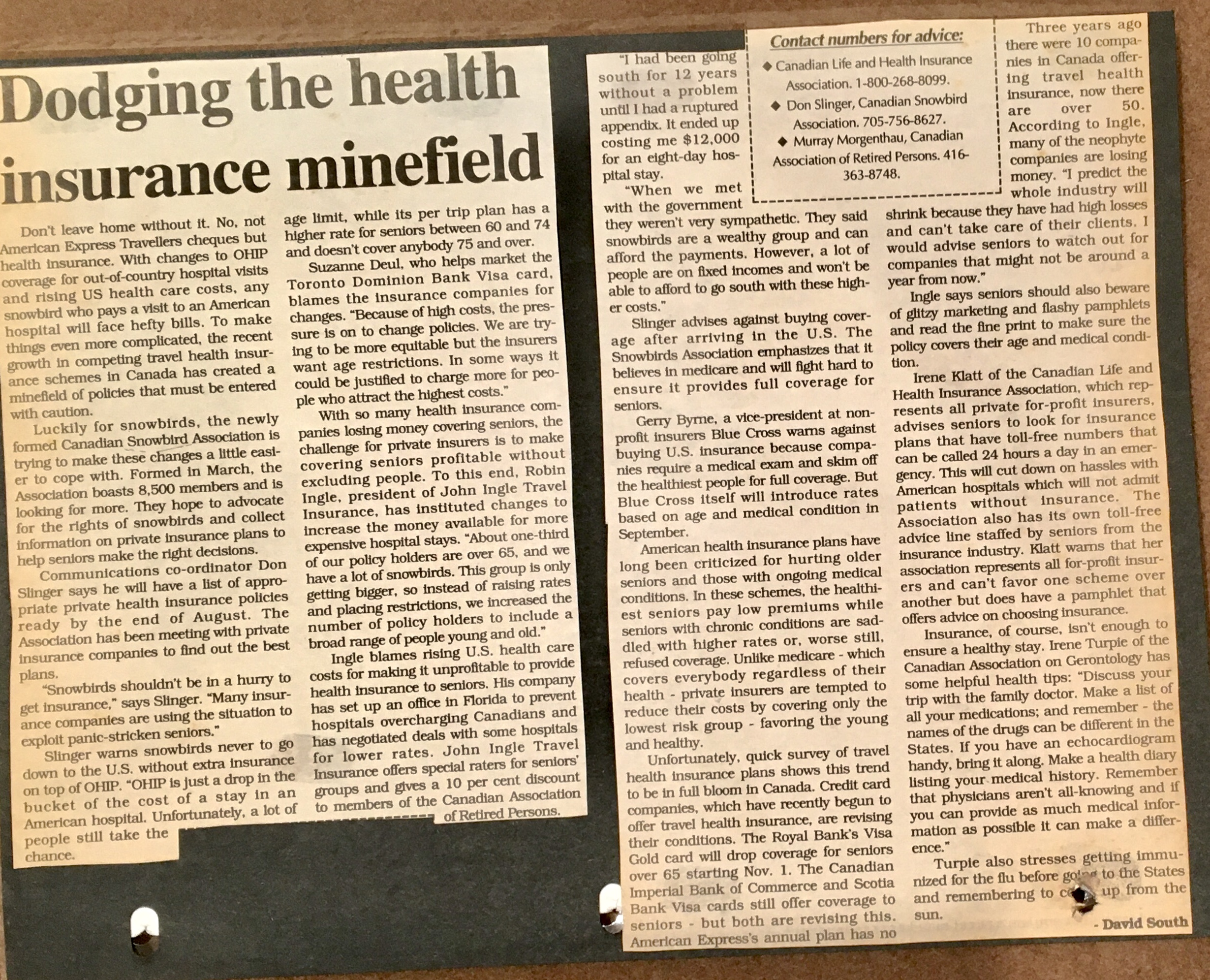
Don’t leave home without it. No, not American Express Travellers cheques but health insurance. With changes to OHIP coverage for out-of-country hospital visits and rising U.S. health care costs, any snowbird who pays a visit to an American hospital will face hefty bills. To make things even more complicated, the recent growth in competing travel health insurance schemes in Canada has created a minefield of policies that must be entered with caution.
Luckily for snowbirds, the newly formed Canadian Snowbird Association is trying to make these changes a little easier to cope with. Formed in March, the Association boasts 8,500 members and is looking for more. They hope to advocate for the rights of snowbirds and collect information on private insurance plans to help seniors make the right decisions.
Communications co-ordinator Don Slinger says he will have a list of appropriate private health insurance policies ready by the end of August. The Association has been meeting with private insurance companies to find out the best plans.
“Snowbirds shouldn’t be in a hurry to get insurance,” says Slinger. “Many insurance companies are using the situation to exploit panic-stricken seniors.”
Slinger warns snowbirds never to go down to the U.S. without extra insurance on top of OHIP. “OHIP is just a drop in the bucket of the cost of a stay in an American hospital. Unfortunately, a lot of people still take the chance.
“I had been going south for 12 years without a problem until a ruptured appendix. It ended up costing me $12,000 for an eight-day hospital stay.
“When we met with the government they weren’t sympathetic. They said snowbirds are a wealthy group and can afford the payments. However, a lot of people are on fixed incomes and won’t be able to afford to go south with these higher costs.”
Slinger advises against buying coverage after arriving in the U.S. The Snowbirds Association emphasizes that it believes in medicare and will fight hard to ensure it provides full coverage for seniors.
Gerry Byrne, a vice-president at non-profit insurers Blue Cross warns against buying U.S. insurance because companies require a medical exam and skim off the healthiest people for full coverage. But Blue Cross itself will introduce rates based on age and medical conditions in September.
American health insurance plans have long been criticized for hurting older seniors and those with ongoing medical conditions. In these schemes, the healthiest seniors pay low premiums while seniors with chronic conditions are saddled with higher rates or, worse still, refused coverage. Unlike medicare – which covers everybody regardless of their health – private insurers are tempted to reduce their costs by covering only the lowest risk group – favouring the young and healthy.
Unfortunately, a quick survey of travel health insurance plans shows this trend to be in full bloom in Canada. Credit card companies, which have recently begun to offer travel health insurance, are revising their conditions. The Royal Bank’s Visa Gold card will drop coverage for seniors over 65 starting Nov. 1. The Canadian Imperial Bank of Commerce and Scotia Bank Visa cards still offer coverage to seniors – but both are revising this. American Express’s annual plan has no age limit, while its per trip plan has a higher rate for seniors between 60 and 74 and doesn’t cover anybody 75 and over.
Suzanne Deul, who helps market the Toronto Dominion Bank Visa card, blames the insurance companies for changes. “Because of high costs, the pressure is on to change policies. We are trying to be more equitable but the insurers want age restrictions. In some ways it could be justified to charge more for people who attract higher costs.”
With so many health insurance companies losing money covering seniors, the challenge for private insurers is to make covering seniors profitable without excluding people. To this end, Robin Ingle, president of John Ingle Travel Insurance, has instituted changes to increase the money available for more expensive hospital stays.
“About one-third of our policy holders are over 65, and we have a lot of snowbirds. This group is only getting bigger, so instead of raising rates and placing restrictions, we increased the number of policy holders to include a broad range of people young and old.”
Ingle blames rising U.S. health care costs for making it unprofitable to provide health insurance to seniors. His company has set up an office in Florida to prevent hospitals overcharging Canadians and has negotiated deals with some hospitals for lower rates. John Ingle Travel Insurance offers special rates for seniors’ groups and gives a 10 per cent discount to members of the Canadian Association of Retired Persons.
Three years ago there were 10 companies in Canada offering travel insurance; now there are over 50.
According to Ingle, many of the neophyte companies are losing money. “I predict the whole industry will shrink because they have had high losses and can’t take care of their clients. I would advise seniors to watch out for companies that might not be around a year from now.”
Ingle says seniors should also beware of glitzy marketing and flashy pamphlets and read the fine print to make sure the policy covers their age and medical condition.
Irene Klatt of the Canadian Life and Health Insurance Association, which represents all private for-profit insurers, advises seniors to look for insurance plans that have toll-free numbers that can be called 24 hours a day in an emergency. This will cut down on hassles with American hospitals which will not admit patients without insurance. The Association also has its own toll-free advice line staffed by seniors from the insurance industry. Klatt warns that her association represents all for-profit insurers and can’t favor one scheme over another but does have a pamphlet that offers advice on choosing insurance.
Insurance, of course, isn’t enough to ensure a healthy stay. Irene Turple of the Canadian Association on Gerontology has some helpful health tips: “Discuss your trip with the family doctor. Make a list of all your medications; and remember – the names of the drugs can be different in the States. If you have an echocardiogram handy, bring it along. Make a health diary listing your medical history. Remember that physicians aren’t all-knowing and if you can provide as much medical information as possible it can make a difference.”
Turple also stresses getting immunized for the flu before going to the States and remembering to cover up from the sun.
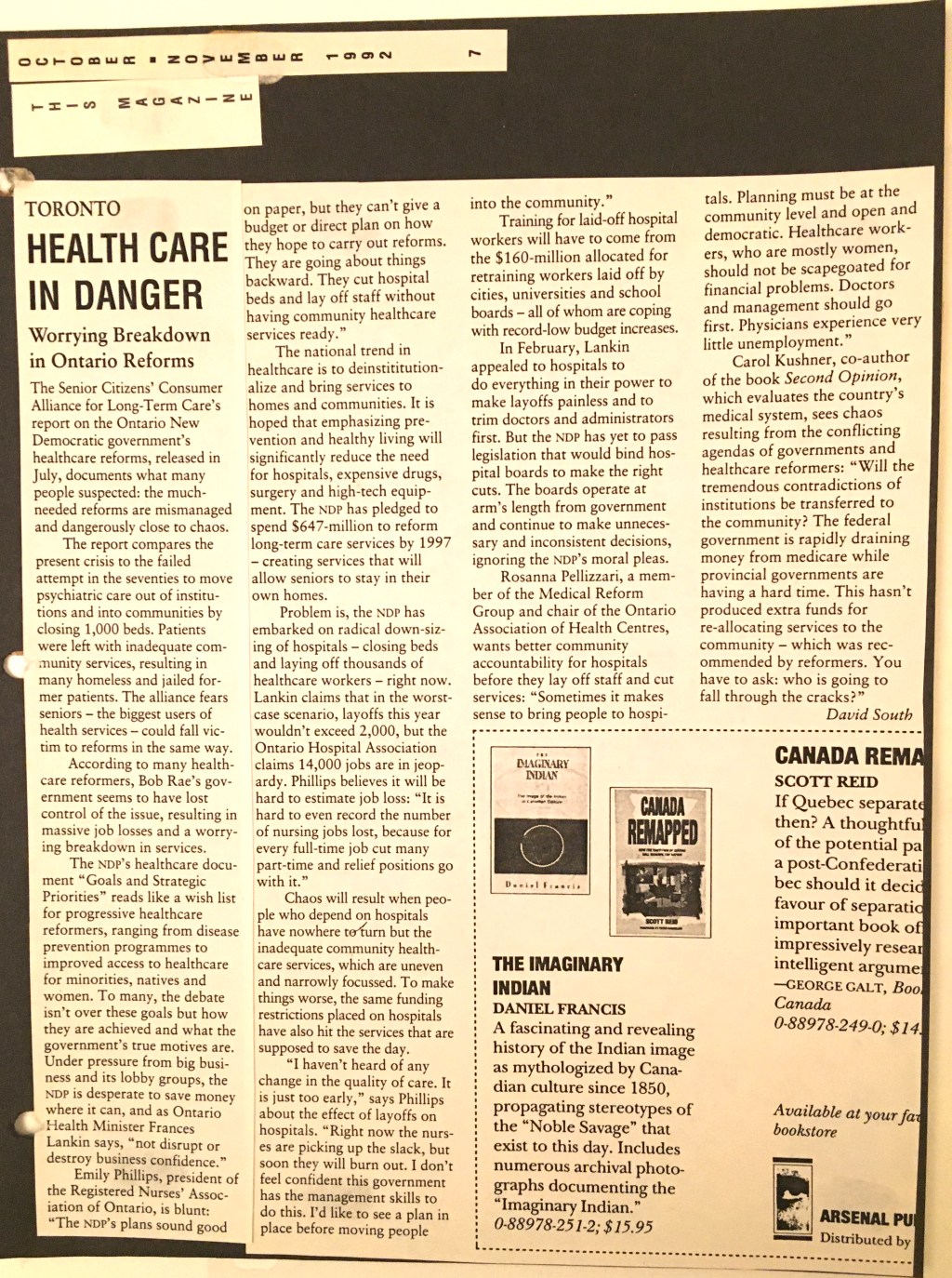
The Senior Citizens’ Consumer Alliance for Long-Term Care’s report on the Ontario New Democratic government’s health care reforms, released in July, documents what many people suspected: the much-needed reforms are mismanaged and dangerously close to chaos.
The report compares the present crisis to the failed attempt in the seventies to move psychiatric care out of institutions and into communities by closing 1,000 beds. Patients were left with inadequate community services, resulting in many homeless and jailed former patients. The alliance fears seniors – the biggest users of health services – could fall victim to reforms in the same way.
According to many health care reformers, Bob Rae’s government seems to have lost control of the issue, resulting in massive job losses and a worrying breakdown in services.
The NDP’s health care document “Goals and Strategic Priorities” reads like a wish list for progressive health care reformers, ranging from disease prevention programmes to improved access to health care for minorities, natives and women. To many, the debate isn’t over these goals but how they are achieved and what the government’s true motives are. Under pressure from big business and its lobby groups, the NDP is desperate to save money where it can, and as Ontario Health Minister Francis Lankin says, “not disrupt or destroy business confidence.”
Emily Phillips, president of the Registered Nurses’ Association of Ontario, is blunt: “The NDP’s plans sound good on paper, but they can’t give a budget or direct plan on how they hope to carry out reforms. They are going about things backward. They cut hospital beds and lay off staff without having community health care services ready.”
The national trend in health care is to deinstitutionalize and bring services to homes and communities. It is hoped that emphasizing prevention and healthy living will significantly reduce the need for hospitals, expensive drugs, surgery and high-tech equipment. The NDP has pledged to spend $647 million to reform long-term care services by 1997 – creating services that will allow seniors to stay in their own homes.
Problem is, the NDP has embarked on radical down-sizing of hospitals – closing beds and laying off thousands of health care workers – right now. Lankin claims that in the worst-case scenario, layoffs this year wouldn’t exceed 2,000, but the Ontario Hospital Association claims 14,000 jobs are in jeopardy. Phillips believes it will be hard to estimate job loss: “It is hard to even record the number of nursing jobs lost, because for every full-time job cut many part-time and relief positions go with it.”
Chaos will result when people who depend on hospitals have nowhere to turn but the inadequate community health care services, which are uneven and narrowly focussed. To make things worse, the same funding restrictions placed on hospitals have also hit the services that are supposed to save the day.
“I haven’t heard of any change in the quality of care. It is just too early,” says Phillips about the effect of layoffs on hospitals. “Right now the nurses are picking up the slack, but soon they will burn out. I don’t feel confident this government has the management skills to do this. I’d like to see a plan in place before moving people into the community.”
Training for laid-off hospital workers will have to come from the $160-million allocated for retraining workers laid off by cities, universities and school boards – all of whom are coping with record-low budget increases.
In February, Lankin appealed to hospitals to do everything in their power to make layoffs painless and to trim doctors and administrators first. But the NDP has yet to pass legislation that would bind hospital boards to make the right cuts. The boards operate at arm’s length from government and continue to make unnecessary decisions, ignoring the NDP’s moral pleas.
Rosana Pellizzari, a member of the Medical Reform Group and chair of the Ontario Association of Health Centres, wants better community accountability for hospitals before they lay off staff and cut services: “Sometimes it makes sense to bring people to hospitals. Planning must be at the community level and open and democratic. Health care workers, who are mostly women, should not be scapegoated for financial problems. Doctors and management should go first. Physicians experience very little unemployment.”
Carol Kushner, co-author of the book Second Opinion, which evaluates the country’s medical system, sees chaos resulting from the conflicting agendas of governments and health care reformers: “Will the tremendous contradictions of institutions be transferred to the community? The federal government is rapidly draining money from medicare while provincial governments are having a hard time. This hasn’t produced extra funds for re-allocating services to the community – which was recommended by reformers. You have to ask: who is going to fall through the cracks?”
Expertise: Investigative journalism, editing, start-ups, content and magazine design, digital content, digital strategy.
Locations: Toronto and Guelph, Ontario, Canada and London, UK 1991 to 1997
Investigative Journalist, Editor, Reporter, Writer:David South
Abstract
I worked as a journalist for magazines and newspapers from 1991 to 1997 in Canada and the United Kingdom and as a radio host for a weekly spoken word interview programme, Word of Mouth (CKLN-FM).
CKLN-FM’s “Word of Mouth 6 pm-6:55 pm Hosts: David South, Jill Lawless This show goes well behind the headlines for the real story behind the events.”
This included working as an investigative journalist for Now Magazine, “Toronto’s alternative news and entertainment source”, as a Medical and Health Correspondent for Today’s Seniors, and as an investigative journalist and reporter for two Financial Times newsletters, New Media Markets and Screen Finance.
Could it be possible to do high-quality investigative journalism in the context of a shrinking economy undergoing austerity, and where the media sector is contracting and consolidating around a small number of media companies? Is it possible to launch new media products in the face of a contracting economy and reach new audiences and create new markets?
In Canada, the early to mid 1990s were the years of government austerity and economic crisis. After the crash of 1989/1990*, institutions came under great stress. Health care, for example, was pitched into a period of turmoil and change. Drawing on my experience working in the health sector (Princess Margaret Hospital/Ontario Cancer Institute), I covered this crisis in many stories for various publications, in particular Today’s Seniors.
The Canadian economy severely contracted and unemployment was at 11.4 per cent by 1993 (Statistics Canada), and as Statistics Canada says, “Because employment recovered at a snail’s pace after the recession of the early 1990s, the decline in the unemployment rate was delayed until 1994”.
The media in general could not avoid the wider economic crisis. According to the book The Missing News: Filters and Blind Spots in Canada’s Press (Robert A. Hackett and Richard S. Garneau, Canadian Centre for Policy Alternatives, University of Toronto Press 2000), Canada’s media was also in a crisis throughout the 1990s, as declining resources, staff layoffs and media closures reduced the breadth and depth of news coverage. Canadian media as a whole also has a “great dependence on advertising, which accounts for more than 70% of daily newspaper revenues, about 64% of magazine revenues,” which means there is enormous pressure to only publish stories that do not upset advertisers. And monopolies exert great control over news content in Canada: “In the United States, ten companies control 43.7% of total daily newspaper circulation. By contrast, in Canada since 1996, one single company controls a comparable share of the media pie.”
The impact of this crisis was summed up by Jeffrey Simpson in the book The Missing News, where he said newspapers are “shrinking in size, personnel, ambition and, as a consequence, in their curiosity,” …. “I believe the result has been a diminution in quality.” (p64)
This is the context in which, ironically, it was possible to flourish as a much-sought-after investigative journalist who could get the story and get the quotes and as an editor. And it was also a time for opportunity, in particular as new media rose in importance, from cable and satellite television, to the rise of the Internet.
I broke original stories for Now Magazine as a member of their investigative reporting team, for Today’s Seniors as its Medical and Health Correspondent, and as a reporter for two Financial Times newsletters in London, UK. I also broke original stories as a freelancer for many other magazines and newspapers, including Hospital News, The Toronto Star, This Magazine, The Annex Gleaner, Flare, The Financial Post Magazine, Canadian Living, and others. I drew on strong contacts in health care, media, politics, international relations and the military.
I was an editor for magazines, newspapers and newsletters as well, gaining invaluable experience and contacts. This included as Editor-in-Chief for start-up youth publication, Watch Magazine (see Case Study 2), and as Features Editor for Id Magazine (see Case Study 3).
Themes covered included the uses – and abuses – of data, the impact of military engagements to uphold international law, how to re-structure health care when budgets are tight, with populations ageing, and technology and scientific advances quickly expanding options, the emerging new media world of cable and satellite television and the Internet, the sexual revolution 2.0, urbanization and how it re-shapes politics and community, international development, and youth culture.
Story highlights include covering data concerns over Canada’s border screening measures, questions about the air quality of aircraft cabins, the debate over airstrikes in Bosnia, scandals involving peacekeepers in Somalia and reporting on the UN peacekeeping mission in Haiti, reforms to medical education in Canada, innovators in health care, the tug of war over health care spending during austerity measures, London, UK designers, the growing role of Nordic countries in cable and satellite television, the film financing scene in Europe and the UK, the new sexual revolution and its impact on cable and satellite television and the rising Internet, changes to Canada’s media industry, and Toronto’s embracing of the megacity concept and the political battles it sparked.
I edited newsletters and newspapers aimed at specific communities, from Canada’s medical history community to part-time students. And had the privilege of helming a start-up youth magazine as its Editor-in-Chief to its commercial success (see Case Study 2).
* “The last two recessions in Canada occurred in 1982 and 1990. … The most recent Canadian recession began in the second quarter of 1990 and over the next 12 months GDP fell by 3.2%. … The recovery from this recession was unusually slow; there was almost no growth between mid-1991 and mid-1992. This slow recovery was export driven.” (The Canadian Encyclopedia)
“In early 1994, Canada’s economic situation was not that favourable—our economy was facing some rather serious problems.
“… the recession here was more severe than in the United States.
“Working their way out of these difficulties was disruptive and painful for Canadian businesses. Defaults, restructurings, and downsizings became the order of the day. With all this, unemployment took a long time to recover from the 1990–91 recession and, in many instances, wages and salaries were frozen or reduced (Bank of Canada: Canada’s Economic Future: What Have We Learned from the 1990s?)
A small sample of published stories with links is below:
1991: Begin career as investigative journalist and editor.
1992: Work as a Medical and Health Reporter for Today’s Seniors and as an Investigative Journalist for Now Magazine. Work as Editor and Writer for the Hannah Institute for the History of Medicine’s newsletter.
1993: Published in many publications, including The Toronto Star, Canadian Living and This Magazine.
1994: Work on re-launch of Watch Magazine 2.0 and its expansion (see Case Study 2).
1995: Work as reporter for two Financial Times newsletters in London, UK.
1996: Work on re-launch of Watch Magazine 3.0 and its expansion. Begin work at Id Magazine as its Features Editor (see Case Study 3).
1997: Begin two-year assignment with the United Nations mission in Mongolia (see Case Study 4).
Testimonials
“David South … proved himself to be a penetrating, thorough and hard-working journalist. He produced a lot of very good stories …” Neil McCartney, Editor, Screen Finance, Telecom Markets and Mobile Communications, London, UK









 David South Consulting
You must be logged in to post a comment.