Categories
Archive Development Challenges, South-South Solutions Newsletters

Bio-ethanol From Sturdy and Once-Unwanted Indian Plant

By David SouthDevelopment Challenges, South-South Solutions

SOUTH-SOUTH CASE STUDY

With awareness of global warming at an all-time high – and governments seeking real-world solutions to solve this enormous problem – bioethanol fuel has risen up the agenda as a replacement for conventional fuel sources. At present, most bioethanol fuel is produced from either corn or sugar but a less known plant jatropha could be the real solution. Brazil has been a pioneer in producing bioethanol fuel from sugar, while the United States has focused on its substantial corn crop as a source, and both contribute more than half the world’s supply. Brazil alone made US $5.4 billion from biofuels (ethanol and biodiesel combined) in 2005, while global production is estimated at 48 billion litres (Biofuel Market Worldwide (2007-2010) www.canbiotech.com).

Global prices for crude oil, under pressure from a number of sources, are volatile and far above 1990s levels. This hurts the poorest countries most (Human Development Report 2005). Expensive fuel means the world’s poor are denied affordable access to machinery and appliances that can make life more comfortable. Poorer nations are often more dependent on oil imports than richer countries. As well, most of their industries are energy intensive, and their cars and homes are less energy efficient. This means low-income countries spend twice as much of their national income on imported oil than do developed countries (World Bank). A US $10 per barrel increase in the cost of crude oil shaves half a percentage point from economic growth in the West; in the poorest countries, it is nearly three times higher.

The two common sources of bioethanol fuel – corn and cane sugar – have a major drawback: they are diverting food sources into fuel for vehicles. Already, the massive US diversion of corn into the bioethanol fuel market has sent the price of corn skyrocketing, making this hardy food staple in countries like Mexico more expensive for the poor. Some estimates claim ethanol plants will burn up to half of the United States’ domestic corn supplies within a few years (Foreign Affairs). To fill the fuel tank of a sports utility vehicle (SUV) with pure ethanol requires 450 pounds of corn – enough calories to feed one person for a year.

And this is why many are now advocating a non-edible Indian fruit bush called jatropha as a better solution. It is like a grapefruit, with each fruit containing three plum-sized seeds. Each seed contains 35 percent oil which can be converted into biodiesel. A shrub from the family euphorbiaceae, jatropha’s lifespan is 50 years. It bears fruit several times a year, and each bunch is five to eight fruits. Being unedible, the oil is mostly used for soap and varnishes.

Cultivation of the jatropha was prioritised a year ago by the Indian Railway Minister, Lalu Prasad Yadav. Disused railways lands were to be put aside for growing the crop. Brazil’s biodiesel company, Biomasa, plans to plant two million hectares with jatropha this year, and it is believed jatropha will surpass sugar cane as the principal source for bioethanol in Brazil.

The advantages of jatropha include its hardy nature: it does not require pesticide, manure, or irrigation to grow and it is drought resistant. A single jatropha plant will yield one litre of biodiesel per year for 40 years, and it yields 1,300 kg of seeds per hectare per year. Its advocates hope to see jatropha bushes planted alongside existing crops, with an acre producing 100 litres of fuel per year.

The downsides of cultivating jatropha as a fuel source would need to be overcome. At present, jatropha’s high acidity means its seeds degrade quickly in humid environments (much of the global South) when exposed to air. Steel tanks used for storage require a nitrogen blanket to prevent water absorption. During the processing stage (something called transesterification), the large quantities of glycerine are produced as a byproduct. Demand is low for this byproduct and disposal is a problem. A cake is also produced that has no real value or use. To make it economically worthwhile to grow in India for example, farmers would need to receive four rupees per kg of seed. This would produce a biofuel costing 50 rupees per litre – considered too expensive at present. Jatropha advocates are urging government subsidies to kick-start production and make the price competitive.

In Ghana, smallholder farmers have already rebelled against growing jatropha. They say that since the oil is inedible, and growing the crop leaves them at the mercy of price-setting by the refineries, they do not want to run the risk.

“What may encourage farmers to venture into jatropha,” said Wisdom Yao Adjah-Cudjoe, a cereal farmers’ representative, “would be a guaranteed price arrangement, as is the case with cocoa.”

In Africa, research by the South African Biodiversity Institute has estimated that 50 percent of the landmass of the continent is suitable for jatropha cultivation (a total of 1,080 million hectares). It could be a huge opportunity for African farmers and a big cost saving for poor countries, but if farmers are to be encouraged to grow jatropha, they will need the right price incentives and guarantees.

Published: June 2007

Resources

  • Jain Irrigation Systems Ltd: An Indian company specialising in helping farmers to begin growing jatropha plants.
  • Centre for Jatropha Promotion: Based in Charu, Rajasthan, India, it researches all aspects of jatropha cultivation and acts as a seed bank.
  • Kick Start Oil Press: Developed in 1993, the Kick Start Oil Press was designed for use in Africa by farmers. It is manufactured in Kenya and sold as a complete kit for entrepreneurs to get started pressing seed for oil. The Kick Start NGO designs technologies for private entrepreneurs of small-scale enterprises, and has offices in Kenya, Tanzania and Mali.
  • Haiti Innovation: Established by former Peace Corps volunteers, and links Haitian NGOs with aid donors. It encourages projects to post on the web and contributors to donate directly to them. It is currently promoting the growing of jatropha in Haiti.
  • Agricultural Biotechnology Network in Africa (ABNETA): This is an excellent source for real-time news and information sources on the biofuel market in Africa.

Development Challenges, South-South Solutions was launched as an e-newsletter in 2006 by UNDP’s South-South Cooperation Unit (now the United Nations Office for South-South Cooperation) based in New York, USA. It led on profiling the rise of the global South as an economic powerhouse and was one of the first regular publications to champion the global South’s innovators, entrepreneurs, and pioneers. It tracked the key trends that are now so profoundly reshaping how development is seen and done. This includes the rapid take-up of mobile phones and information technology in the global South (as profiled in the first issue of magazine Southern Innovator), the move to becoming a majority urban world, a growing global innovator culture, and the plethora of solutions being developed in the global South to tackle its problems and improve living conditions and boost human development. The success of the e-newsletter led to the launch of the magazine Southern Innovator.

Creative Commons License

This work is licensed under a
Creative Commons Attribution-Noncommercial-No Derivative Works 3.0 License.

ORCID iD: https://orcid.org/0000-0001-5311-1052.

© David South Consulting 2022

Categories
Archive Development Challenges, South-South Solutions Newsletters

Chinese Trade in Angola Helps Recovery

By David SouthDevelopment Challenges, South-South Solutions

SOUTH-SOUTH CASE STUDY

Two-way trade between Africa and China has been an outstanding success story of the past decade. It has led to significant new investment in the continent and brought many new job opportunities. The Chinese community in Africa comprises a mix of entrepreneurs and workers. In formerly war-torn Angola, Chinese workers and investors have led an economic boom as the country recovers from decades of conflict.

The Chinese are generally young, well-educated, English-speaking, ambitious and hard-working. Estimates put the number of Chinese people in Angola at 100,000, and about 1 million across Africa.

The reason these bright young things need to come to Africa goes back to the essential reality of modern China: despite rapid economic growth, per capita incomes classify it as a poor country. While the outside world sees the glitzy, go-go progress of China’s cities, the country’s rural poor go unseen. Around 400 million of China’s 1.3 billion people have annual per-capita income equivalent to US $8,000, while the remaining 900 million have per-capita incomes as little as one-tenth that amount.

Some 6.3 million people in China will graduate this year from university, and it is still very hard for a well-educated Chinese person to get a good job right away. More than a quarter of these graduates will be unemployed, according to the Education Ministry.

There has also been disquiet in parts of Angola over China’s role, with some calling it “neo-colonialism”. But clearly, both Africa and China have much to gain by increasing cooperation.

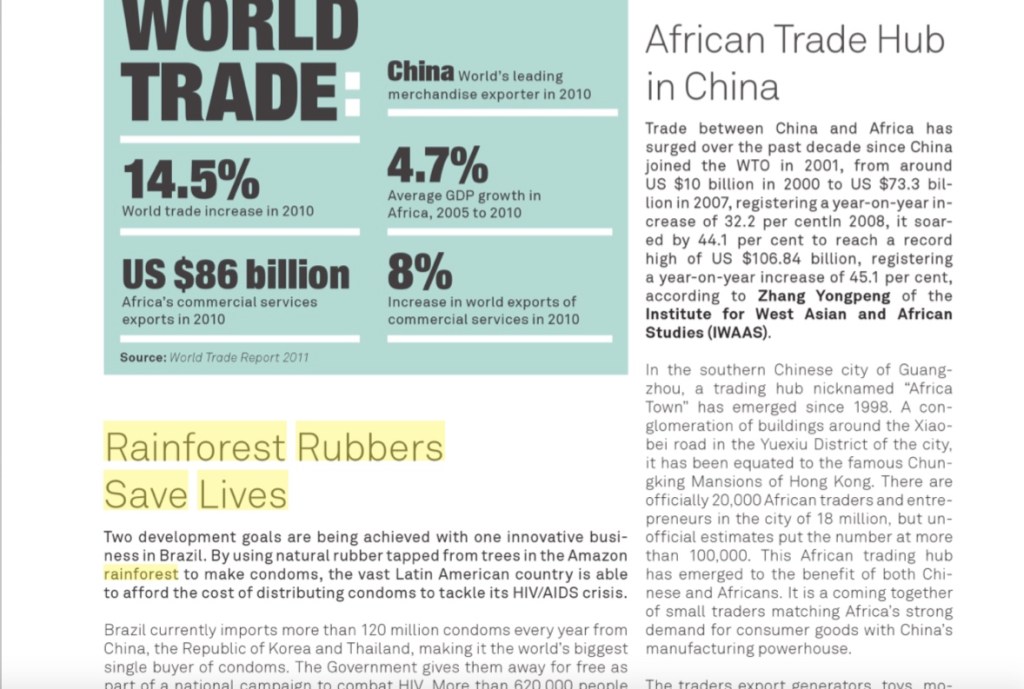
In the southern Chinese city of Guangzhou (http://en.wikipedia.org/wiki/Guangzhou), a trading hub nicknamed “Africa Town” has emerged since 1998. There are officially 20,000 African traders and entrepreneurs in the city of 18 million, but unofficial estimates put the number at more than 100,000. This African trading hub has emerged to the benefit of both the Chinese and Africans. It is a coming together of small traders matching Africa’s strong demand for consumer goods with China’s manufacturing powerhouse.

In Angola, the mix of entrepreneurs and workers is having a big impact on the country’s development.

Betty, a 22-year-old Chinese woman who has various projects in Angola, including the local Chinese language newspaper, is a typical go-getter.

“I am doing much better here than if I had stayed in China,” she told the BBC.

Another beneficiary of the two-way trade is Deng, a construction a worker: “I earn twice as much as I would at home and I have got a better job,” he said.

For most Chinese, foreign travel is still rare and the excitement of going to Africa to work both attracts and repels because of the continent’s reputation.

“At first I found it frightening, “said Wang. “You hear lots of stories of Chinese people being robbed by the locals.” But he found “there are great opportunities here.”

Another, Jet, who runs an air conditioning business, came to Angola five years ago.

“Everything had been destroyed,” he recalled. “There were no roads, railways, shops, nothing. Some Western companies were already here selling their products but I knew I could import things cheaper from China.”

The large infrastructure projects being undertaken by major Chinese companies are also creating new opportunities. Many Chinese labourers are working on building roads, railways, hospitals and vast housing complexes.

One of the more visible symbols of Chinese investment in Angola is the restoration of the Benguela Railway (http://en.wikipedia.org/wiki/Benguela_railway), considered one of the great routes of Africa and built by British contractors. An engineering triumph, its 1,344 kilometres (835 miles) of track stretch up the Angolan coast, right into southern Congo. The railway took almost 30 years to build in the late 19th and early 20th centuries, but little remained. Until very recently all but a tiny stretch of the line was closed. Now Chinese investment is rebuilding the railway and bringing economic improvement in its wake.

“I couldn’t do this before the railway was fixed,” a woman using the train to get to the market to sell her plump red tomatoes told the BBC. “Before, I had to travel by car which was much more expensive.”

And her income has improved along with the refurbished railway. “I am not rich, but a bit richer,” she said.

And unlike the British, who used the railway to export copper without paying for the resource, the Chinese labourers are getting paid and the Angolan government is paying back the Chinese loan for the railway repairs by selling oil overseas for a market rate.

Published: October 2010

Resources

https://davidsouthconsulting.org/2022/06/02/afghanistans-juicy-solution-to-drug-trade/

https://davidsouthconsulting.org/2022/11/02/african-online-supermarket-set-to-boost-trade/

https://davidsouthconsulting.org/2022/10/26/african-trade-hub-in-china-brings-mutual-profits-2/

https://davidsouthconsulting.org/2022/04/12/djibouti-re-shapes-itself-as-african-trade-hub/

https://davidsouthconsulting.org/2021/07/19/global-south-trade-boosted-with-increasing-china-africa-trade-in-2013/

https://davidsouthconsulting.org/2022/10/26/perfume-of-peace-helps-farmers-switch-from-drug-trade/

https://davidsouthconsulting.org/2021/07/19/south-south-trade-helping-countries-during-economic-crisis/

https://davidsouthconsulting.org/2021/03/05/southern-innovator-issue-2/

https://davidsouthconsulting.org/2022/11/01/southern-innovator-magazine-2010-2014/

https://davidsouthconsulting.org/2022/10/20/trade-to-benefit-the-poor-up-in-2006-and-to-grow-in-2007/

https://davidsouthconsulting.org/2022/10/05/women-empowered-by-fair-trade-manufacturer/

https://davidsouthconsulting.org/2022/06/16/women-mastering-trade-rules/

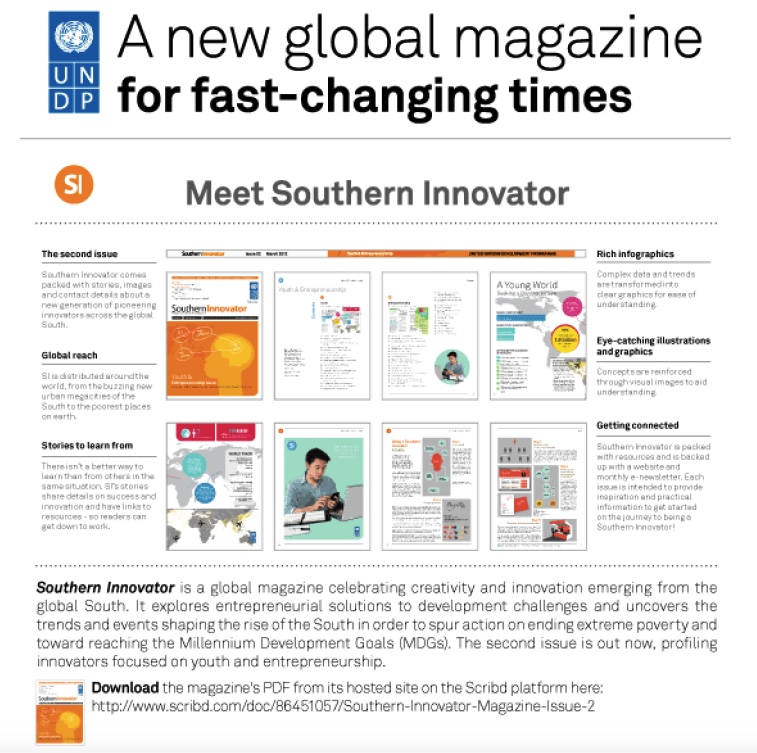
Development Challenges, South-South Solutions was launched as an e-newsletter in 2006 by UNDP’s South-South Cooperation Unit (now the United Nations Office for South-South Cooperation) based in New York, USA. It led on profiling the rise of the global South as an economic powerhouse and was one of the first regular publications to champion the global South’s innovators, entrepreneurs, and pioneers. It tracked the key trends that are now so profoundly reshaping how development is seen and done. This includes the rapid take-up of mobile phones and information technology in the global South (as profiled in the first issue of magazine Southern Innovator), the move to becoming a majority urban world, a growing global innovator culture, and the plethora of solutions being developed in the global South to tackle its problems and improve living conditions and boost human development. The success of the e-newsletter led to the launch of the magazine Southern Innovator.

Creative Commons License

This work is licensed under a
Creative Commons Attribution-Noncommercial-No Derivative Works 3.0 License.

ORCID iD: https://orcid.org/0000-0001-5311-1052.

© David South Consulting 2023

Categories
Archive Development Challenges, South-South Solutions Newsletters

Ghana: Oil-rich City Sparks Entrepreneurs and Debate

By David SouthDevelopment Challenges, South-South Solutions

SOUTH-SOUTH CASE STUDY

Commodity booms can seem like the answer to a poor nation’s prayers, a way to fulfil all their development dreams and goals. The reality, however, is far more complex. More often than not, the discovery of resources sparks a mad scramble for profits and patronage, as politicians and politically connected elites carve out their slice of the new resource boom before anyone else.

The twin cities of Sekondi-Takoradi (http://en.wikipedia.org/wiki/Sekondi-Takoradi) in the Western Region of Ghana are now experiencing an oil boom. Ghana’s oil production went online in December 2010 and the government is hoping it will double the country’s growth rate.

Large supplies of oil were found off the coast in 2007, transforming Takoradi from a sleepy, rundown port city into the hub for the oil boom.

Local man Peter Abitty told the BBC he was renting out an eight-bedroom house for US $5,000 a month. The house overlooks the sea and comes with banana and coconut trees.

“Tenants that come here can take the coconuts for free! We don’t charge anything,” Abitty said.

He put the strong interest in the house down to a simple fact: “It’s out there: oil, oil, oil.”

People’s hopes are being raised in Ghana’s case because it has built a reputation as a better-governed country than other African petro states like Nigeria and Angola.

But others argue that price increases caused by the boom are destroying local businesses. A report on the Ghana Oil news website found popular local businesses suffering. One example it gave was the Unicorn Internet Café, an employer of local youth, which shut down in 2010 because of high rents.

It found businesses have shut down in the following sectors: timber, sawmilling, super markets, mobile phone shops, boutiques and trading shops. But it also found many new businesses opening up, including banks, insurance companies and hotels.

The challenge facing Ghana is to ensure oil brings a long-term change to a higher value business environment and economy, rather than just an unequal and temporary boom.

Another challenge is to connect the many youth leaving education in the city with the jobs and opportunities being created by the oil industry. The twin cities are a regional educational centre with a lot of technical colleges and secondary schools.

To counter these concerns, a Regional Coordinating Council is promising to place the growth of small and medium enterprises at the centre of regional development.

The dreams and promises for Takoradi are very ambitious. “In five years time, I see Takoradi becoming one of the modern cities of the world,”  Alfred Fafali Adagbedu, the owner of Seaweld Engineering (www.seaweldghana.com), a new local company set up to service the oil sector, told the BBC.

“I can imagine skyscrapers, six-lane highways and malls.”

“The transport industry is going to improve, because workers on the rig are going to need to be transported. Agriculture is going to see a boom because all those people on the rig will need to be fed.

“Even market women are going to see more business, because a lot of workers are going to have very fat paychecks. Everyone in this city is going to gain in business.”

How far Takoradi has to travel to come close to meeting these dreams and expectations can be seen in its current state. The railway station has a train with laundry hanging from it because it hasn’t moved in years, reported the BBC. People are living in the sleeping car of the train.

But the typical signs of a boom are all visible: traffic jams, booked hotels, rising rents and prices, and it is already hurting people on fixed salaries.

Local authorities have plans to demolish rundown parts of the city and rebuild with modern office environments for the new businesses resulting from the oil economy.

An estimated US $1 billion a year in revenue will go to the Ghanaian government and local authorities want 10 percent of this to be ring-fenced for regional development.

“Many resources are coming from the western region. From years back, gold is here, timber is here, diamonds are here,” said Nana Kofi Abuna V, one of the few female chiefs in the area.

“But when they share the cake up there, they leave out the western region. This time, if there is oil and gas in the region we should benefit more than everybody else.”

But Adagbedu at Seaweld Ghana believes Ghana will see real improvements.

“I’m very sure we will avoid the mistakes,” he said. “Ghana is a democracy, everyone is watching, so there is going to be a lot of improvement here.”

And to help in keeping these promises, the BBC will continue to return to Sekondi-Takoradi to track its changes and see how things improve.

Published: September 2011

Resources

1) BarCamp Takoradi: BarCamp is an international network of user-generated conferences (or unconferences). They are open, participatory workshop-events, the content of which is provided by participants. Website:http://twitter.com/#!/barcamptakoradi

2) Ghana Ports and Harbours Authority: The Authority overlooks the Takoradi port. Website:http://www.ghanaports.gov.gh/GPHA/takoradi/index.html

3) Friends of the Nation (FON): The NGO serves as a catalyst towards increased action for sustainable natural resource management and health environment in the Takoradi region. Website: http://www.fonghana.20m.com/aboutus1.htm

4) Takoradi City: A website packed with information and photos on the city. Website:http://www.takoradicity.com/pages/sections.php?siteid=takoradicity&mid=39

Development Challenges, South-South Solutions was launched as an e-newsletter in 2006 by UNDP’s South-South Cooperation Unit (now the United Nations Office for South-South Cooperation) based in New York, USA. It led on profiling the rise of the global South as an economic powerhouse and was one of the first regular publications to champion the global South’s innovators, entrepreneurs, and pioneers. It tracked the key trends that are now so profoundly reshaping how development is seen and done. This includes the rapid take-up of mobile phones and information technology in the global South (as profiled in the first issue of magazine Southern Innovator), the move to becoming a majority urban world, a growing global innovator culture, and the plethora of solutions being developed in the global South to tackle its problems and improve living conditions and boost human development. The success of the e-newsletter led to the launch of the magazine Southern Innovator. 

Creative Commons License

This work is licensed under a
Creative Commons Attribution-Noncommercial-No Derivative Works 3.0 License.

ORCID iD: https://orcid.org/0000-0001-5311-1052.

© David South Consulting 2023