Categories
Archive Development Challenges, South-South Solutions Newsletters

Mountain People: Innovative Ways to Help the World’s Most Vulnerable

By David SouthDevelopment Challenges, South-South Solutions

SOUTH-SOUTH CASE STUDY

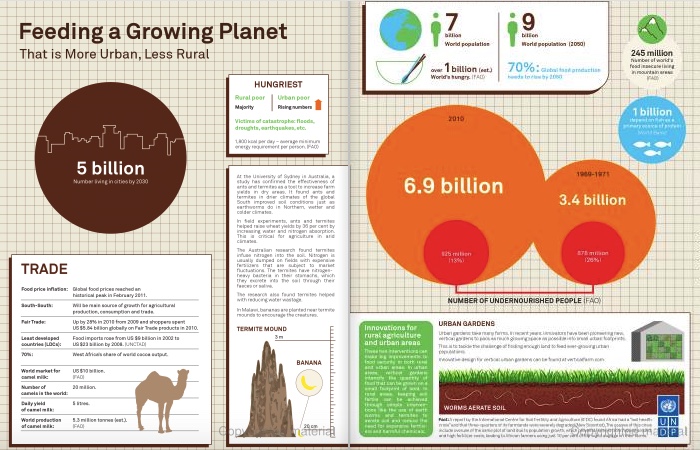
Physically isolated and socially and politically marginalized, mountain dwellers are among the most vulnerable in the world, according to the Food and Agriculture Organization. A disproportionate number of the world’s 840 million chronically undernourished people live in highland areas — about 270 million mountain people lack food security, with 135 million suffering chronic hunger. Large numbers of additional people in lowland areas also depend on mountains.

In October in Rome, more than 60 representatives from mountain countries around the world called for a coherent approach to sustainable agriculture and rural development in the world’s highland areas to address this crisis. First identified as a problem back at the 1992 Earth Summit in Rio, the degradation of mountain eco-systems and the poverty of those living there, has only worsened with increasing conflict and war. Mountain forests are rapidly vanishing across the globe.

Mountains occupy 24 per cent of the earth’s landscape, and are home to 12 per cent of the world’s people; a further 14 per cent live beside mountains. Most are in the Andes, the Hengduan-Himalaya-Hindu Kush system, and a number of African mountains. Many mountain people are from ethnic minorities, and are often frozen out of political or commercial power. Poverty is common: more than 60 per cent of the rural Andean population lives in extreme poverty, and most of the 98 million Chinese considered to be among the world’s “absolute poor”, are ethnic minorities who live in mountains.

Mountains make up a quarter of the world’s landscapes, and mountain watersheds are critical to water supply – up to 80 per cent of the planet’s fresh surface water comes from mountains. Over half of the world’s population depend on mountains for water, food, hydro-electricity, timber and mineral resources (UN University Mountain Programme).

By their way of life, mountain peoples have expertise in small-hold farming, medicinal uses for native plants, and sustainable harvesting of food, fodder and fuel from forests.

In China, the MinYiYuan company has developed a model to help the millions of impoverished Chinese in the countryside who are being left out of the country’s current economic boom. While many are migrating to the cities to work as labourers, mostly women and children are left behind in villages, with few options to support themselves.

Cai Tingfen saw an opportunity to help the ethnic minority population of Liupanshui City in Guizhou Province. Founded in 2005, MinYiYuan bridges the handcraft culture of the region with the bigger national economy. Its model is unique: rather than buying ready-made handicrafts from craftspeople, MinYiYuan sets the design standards for the quality of the raw materials and sources them itself. This avoids problems with inconsistencies and guarantees customers get a reliably high-quality product. The craftspeople use these raw materials to make handcrafts in their homes, and the finished goods are bought back by the company.

The company buys cotton, hemp and Chinese herbs from local farmers, luring them away from livelihoods that cause deforestation. In 2006, the MinYiYuan Folk Art Centre sold 60,000 (batik) wax prints, 8,000 embroideries, and 20,000 ethnic handicrafts. It made 1.13 million yuan (US $149.319). The company is ambitious, and is already looking to building a research and development base to integrate design, manufacturing, packaging and sales.

Another model that is working is in the Philippines. After the Mount Pinatubo volcano eruptions in the early 1990s, the Aetas people of Luzon found their community was buried under ash and stone. Unable to work the land anymore and live off of the fish and wildlife, the Aetas were close to starvation. Many migrated to the cities to look for work: And without many relevant urban skills, most ended up living in squalor.

One by-product of the volcanic explosion was vast quantities of pumice stone, used in the garment industry to produce ‘stone-washed’ denim. Entrepreneurs were soon turning up to gather the stones.

The Asian Institute for Technology helped the Aeta people organize themselves in marketing social enterprises to gather, market and sell the stones to the many garment makers in the Philippines. By forming cooperatives, the Aeta are able to change the power dynamics with the garment companies: where they had to sell very cheaply to middlemen, the cooperatives enable them to charge more and make a liveable income, allowing them to stay in the community and avoid environmentally more harmful ways to make a living.

In Peru, coffee growers in the mountains have banded together as a social enterprise and use market solutions to increase living standards. The Cepicafe brand in the Piura Mountains, promotes its Fair Trade practices to secure higher prices for the growers. It does this by countering the increasing competition in the coffee market and lower world prices for the beans, with better quality coffee grains and bypassing middlemen to access markets directly.

Cepicafe raises the skills of the growers by providing education to increase productivity and quality, while reducing the farms ecological impact. The premium that fair trade is able to get is then used to improve the farmers’ lives with better housing, new clothes, shoes, better diets, and access to medicine.

They have 51 grassroots member organizations, totaling to 4,800 small-scale coffee producers. Over 18 per cent are women. By introducing a business culture and using radio programmes to further spread knowledge, productivity and quality have increased.

Cepicafe’s access to markets in the US and Europe means it can pay between 60 and 80 per cent more than local buyers.

Published: November 2007

Resources

  • Mountain Forum: created in 1995, it is a great resource for sustainable mountain development and conservation.
  • The Mountain Institute: A non-profit organization dedicated to conservation, community development and cultural preservation in the Andean, Appalachian and Himalayan mountain ranges.
  • Adelboden Group: Established in 2002, it exists as a forum to discuss mountain policies, exchange experience and coordinate planning.

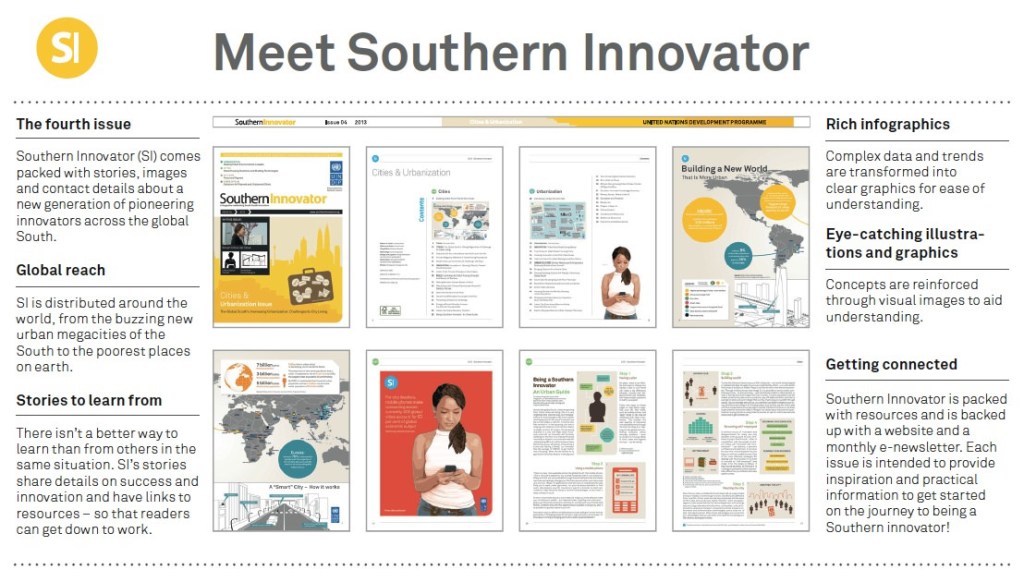
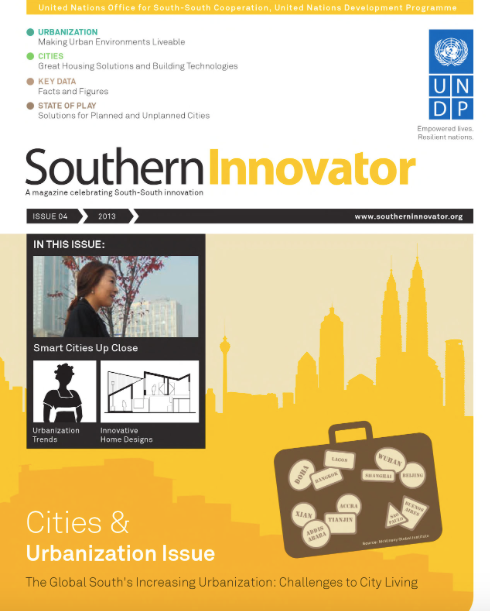
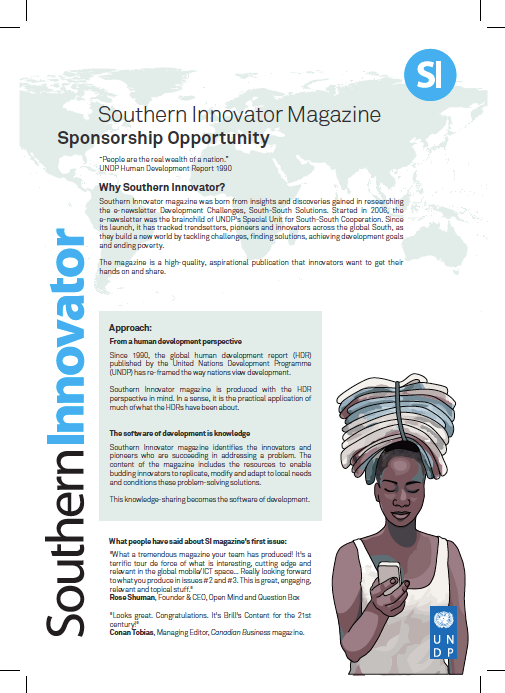
Development Challenges, South-South Solutions was launched as an e-newsletter in 2006 by UNDP’s South-South Cooperation Unit (now the United Nations Office for South-South Cooperation) based in New York, USA. It led on profiling the rise of the global South as an economic powerhouse and was one of the first regular publications to champion the global South’s innovators, entrepreneurs, and pioneers. It tracked the key trends that are now so profoundly reshaping how development is seen and done. This includes the rapid take-up of mobile phones and information technology in the global South (as profiled in the first issue of magazine Southern Innovator), the move to becoming a majority urban world, a growing global innovator culture, and the plethora of solutions being developed in the global South to tackle its problems and improve living conditions and boost human development. The success of the e-newsletter led to the launch of the magazine Southern Innovator.

Creative Commons License

This work is licensed under a
Creative Commons Attribution-Noncommercial-No Derivative Works 3.0 License.

ORCID iD: https://orcid.org/0000-0001-5311-1052.

© David South Consulting 2022

Categories
Archive Development Challenges, South-South Solutions Newsletters

Saving the Amazon Forest While Making a Living

By David SouthDevelopment Challenges, South-South Solutions

SOUTH-SOUTH CASE STUDY

The vast Amazon rainforest straddles Brazil (over half is there), and stretches over many countries, including Peru, Ecuador and Bolivia. It holds more than 2,500 tree species and 30 per cent of all known plant species – 30,000 in all. It contains the world’s largest tropical forest national park, Brazil’s Tumucumaque Mountains National Park(http://www.amazon-rainforest.org/places-of-interest.html). Over 25 per cent of drugs sold in pharmacies contain rainforest ingredients, and the rainforest acts as the Earth’s lungs, absorbing carbon dioxide, and emitting oxygen.

Logging in the forest is widespread and highly wasteful – 356,000 square kilometres of rainforest have been deforested (WWF). In the past 50 years, Ecuadorhas lost over 50 per cent of its tropical rainforest.

More than 26 million people live in the forest, with 11 million on the Brazilian side. While the Amazon’s indigenous people have little ecological impact, it is people drawn in to logging and farming who do most of the damage. Slash and burn techniques are common.

Preserving this critical natural environment while providing jobs for the local inhabitants is a challenge being taken up by a clutch of entrepreneurs. This new wave of entrepreneurs seeks to run businesses that respect the environment and provide a good living to those they employ.

The global garment industry is one of the most lucrative in the world (in 2000 consumers spent over US $1 trillion on buying clothes). Most of the manufacturing takes place in the poorest places on earth, and the garment and fashion industries contribute to vast quantities of pollution in these countries, either by using toxic chemicals and pesticides, by polluting and depleting water supplies, or through inefficient processes, transport and waste.

Brazilian enterprise Treetap (http://www.treetap.com.br/) (formally AmazonLife) is seeking to change the fashion industry by selling sustainable materials to top designers. Their patented rubberized natural latex is sold under the brand name Treetap. It is made from natural rubber native to the region, and it uses a fair trade system to ensure its suppliers receive a living wage. The company itself uses the substance to produce its own handbags and purses.

By promoting the sustainable use of a rainforest resource and focusing on social as well as financial returns, the company is proving the value of a “triple-bottom line” approach to business – where social and environmental concern is just as important as profit.

The company has placed the preservation of the Amazon rainforest at the centre of its business plan. Tribal communities in the Amazon depend on rubber tree tapping for their livelihoods, and Treetap works with the Rubber Tappers Association (http://www.brazilmax.com/news2.cfm/tborigem/pl_amazon/id/10) to save 900,000 hectares of forest from exploitation.

Over 45 families are supported, and they are paid eight times the market rate for their rubber. Its Rio de Janeiro factory supplies several European fashion designers with their faux-leather fabric to make clothes, backpacks, upscale furniture and handbags.

“Europe is our main market,” said Treetap Project Coordinator and designer Maria Beatriz Saldanha, “We are developing relationships in France, Italy, Germany and The Netherlands.”

High profile French fashion house Hermes Sellier has been using this rubber since 1998 for handbags. Italian furniture company Moroso uses it to upholster chairs. “They (fashion designers) love it. The material is shiny and supple and has the fair fashion appeal.”

Treetap has now moved into making bike courier bags for the world’s largest bicycle company, Giant, selling over 10,000 bags.

Saldanha’s partner, Joao Augusto Fortes, first came upon the idea of using natural rubber when the pair opened a store in Rio in the 1990s.

Wild rubber is favoured because it does not kill the trees and provides jobs for the tappers. The increase in synthetic rubber made from oil-based products has driven down the price for natural rubber, and led to people clearing forests to make way for more profitable products like timber and cattle.

After nasty battles in the 1980s to protect the rubber tappers’ way of life, the Brazilian government began to take action. It has now set aside protected forests for the tappers so they can still make a living.

Saldanha hunted around for products for her EcoMercado store. She came across the rubber tappers of the state of Amazonas, who were using the natural rubber to make their traditional rubber sacks.

“We had the idea, so we met with rubber tappers and ordered laminates from them,” said Saldanha. “We then used the rubber to make a small quantity of bags, briefcases and other products.”

Things did not go swimmingly at the beginning. The first run of 500 bags sold out quickly, but “Two months later all of the bags we had just sold melted,” said Saldanha. “We hadn’t figured out that the rubber needed to be vulcanized.”

Back at the drawing board, they adapted the vulcanizing process used by big factories to a small-scale process that the rubber tappers could do. And then they patented it. The company now sells 30,000 sheets of wild rubber a year.

Another Brazilian company, Hering Instruments, is using sustainability as a marketing boost for its musical instruments. When legendary musician and current Brazilian minister of culture, Gilberto Gil, (http://en.wikipedia.org/wiki/Gilberto_Gil) played a guitar made from Hering Instruments’ parts, there was pride: “Yes, that was a good moment for us,” said Alberto Bertolazzi, CEO of Hering Instruments. Gil’s guitar was one of the first to be made of Hering crafted parts, all sourced from high-quality woods from the Amazon forests.

They are now being sold by the world’s largest guitar and bass companies. Certified by the Forest Stewardship Council, the wood is harvested from 1.8 million hectares of managed forest in the state of Acre.

Trees are chosen for harvesting based on their age, location and how many have been cut down.

It is targeting the US $30 billion/year global market for musical instruments. The clever marketing has used celebrity musicians and a series of “Amazonas” guitars decorated by well-known painters like Gustavo Rosa and Antonio Peticov.

At Florestas (www.ikove.com) (www.florestas.com), owner Fernando Lima is producing all-natural Amazonian personal care products sourced from across the Amazon. Florestas has successfully partnered with Brazilian university labs to study indigenous Amazonian therapeutics, like Babacu oil, Acerola fruit, and Acai berries. Rain forest plants are rich in nutrients, vitamins and anti-oxidants – all highly coveted by health consumers around the world.

Certified as organic and ecologically sustainable by the French Ecocert group, all goods are purchased from Amazon cooperatives, thus enabling indigenous people to avoid cutting down forests to make a living. Brazilian nuts are purchased directly from the harvesters, avoiding middlemen and increasing the amount Florestas pays local families.

The company uses a range of methods to sell its products: e-commerce, catalogues, stores, including in Japan, France and the US.

An innovative enterprise with another university connection is Ouro Verde Amazonia. Founded in 2002 by University of Sao Paulo Professor Luiz Fernando Laranja da Fonseca, and his wife, Ana Luisa, when they moved to the southern rural region of the Amazon.

The couple has single handily revitalised the declining Brazil nut industry in Mato Grosso, while protecting the ecosystem and generating income for farmers. Ouro Verde, or green gold, enables farmers to avoid having to work in the logging industry. They make nut-based cooking oils, butters and granulated powders. Rich in omega-3, it is marketed as a healthy alternative to conventional cooking oils for the health conscious consumer. At present it is sold in 100 stores in Brazil, but wants to go global.

Published: November 2007

Resources

  • Amazon Watch is a non-profit organization that works with indigenous and environmental organizations in the Amazon Basin to defend the environment and advance indigenous peoples’ rights in the face of large-scale industrial development.”
  • Design that Matters: Timothy Prestero, CEO (Cambridge, MA): Design that Matters (DtM) was founded to help social enterprises in developing countries scale up enterprises more quickly by providing them access to better products designed specifically for their business needs.
  • World of Good: Priya Haji, Co-founder and CEO (Emeryville, CA): World of Good seeks to lift thousands of women in the developing world out of poverty. It creates opportunities for hundreds of artisan cooperatives around the world by serving as a bridge to the U.S. retail market and providing access to fair wages, safe working conditions and long-term economic sustainability.

Development Challenges, South-South Solutions was launched as an e-newsletter in 2006 by UNDP’s South-South Cooperation Unit (now the United Nations Office for South-South Cooperation) based in New York, USA. It led on profiling the rise of the global South as an economic powerhouse and was one of the first regular publications to champion the global South’s innovators, entrepreneurs, and pioneers. It tracked the key trends that are now so profoundly reshaping how development is seen and done. This includes the rapid take-up of mobile phones and information technology in the global South (as profiled in the first issue of magazine Southern Innovator), the move to becoming a majority urban world, a growing global innovator culture, and the plethora of solutions being developed in the global South to tackle its problems and improve living conditions and boost human development. The success of the e-newsletter led to the launch of the magazine Southern Innovator. 

Creative Commons License

This work is licensed under a
Creative Commons Attribution-Noncommercial-No Derivative Works 3.0 License.

ORCID iD: https://orcid.org/0000-0001-5311-1052.

© David South Consulting 2022

Categories
Archive Development Challenges, South-South Solutions Newsletters Southern Innovator magazine

Africa’s Fast-Growing Cities: A New Frontier of Opportunities

By David SouthDevelopment Challenges, South-South Solutions

SOUTH-SOUTH CASE STUDY

According to a new report by the International Institute for Environment and Development, Africa now has a larger urban population than North America and 25 of the world’s fastest growing big cities. Europe’s share of the world’s 100 largest cities has fallen to under 10 percent in the past century.

Counter to common misperceptions about what is luring people to big cities, the report’s author, David Satterthwaite, said it isn’t because governments and aid are attracting them: government “policies leave much to be desired as they tend to neglect the urban poor, leading to high levels of urban poverty, overcrowding in slums and serious health problems. Governments should see urbanisation as an important part of a stronger economy and their expanding urban population as an asset, not as a problem.”

But global perceptions of Africa are changing. The Mo Ibrahim Foundation has listed the most efficiently run African economies, with a strong correlation between good governance and higher growth rates (Mauritius, Seychelles, Botswana, South Africa, Namibia, Ghana and Senegal).

In most of urban French West Africa, extensive interviews with micro-entrepreneurs and micro-finance practitioners found that most operating micro-enterprises in the informal economy are entrepreneurs by necessity, and that their most basic needs drove their business activities and behaviours. Success was held back by lack of capital, poor training, and a general aversion to risk (Faculty of Management, Dalhousie University).

While access to capital has been identified as the key factor in opportunity, entrepreneurs aren’t even waiting for microfinance institutions to help them. “I started this business of selling chips (French fries) two years ago using money we raised as a group of 30 women,” said Mary Mwihaki, 27, who lives in the Mathare slum area outside Nairobi.

Each member of her group of women contributes about US 30 cents a day and the resulting US $9 is given to a different member of the group on a rotating basis, she told IRIN news agency. Mwihaki waited three months to raise the US $27 she needed. She joins many other women across the country taking the same approach to raising capital.

For some entrepreneurs, it is just the proximity to a buzzing urban atmosphere that is a spur to action. One clothes seller told the African Executive he has been able to make enough money to get a house built just selling second hand clothing. Twenty-three-year-old Henry Mutunga in Nairobi, Kenya takes advantage of the high turnover of the city’s Machakos Country bus terminal to sell second hand clothes.

“After months of searching for a job, I asked myself, ‘Why am I wasting the business studies knowledge I acquired in school?’ I was not comfortable being left in the house every morning, with nothing to do, while my uncle went to work in order to feed me and pay the house rent. I got hooked to the urban mentality and tried my hand at selling trousers.”

Now with two employees, he is able to rent his own house, and is able to use extra money to have his own house built. He urges other youth to become employers, not employees.

At the technological end of entrepreneurship, in Nairobi, Kenya, Mumbi’s Dial-a-Cab company is joining 20 fleet firms in the country to adopt a new mobile phone-based vehicle-tracking technology developed by two young African IT entrepreneurs, Waweru Kimani and Paul Mahiaini. The technology allows management to know how low fuel is, which car has gone where, when a car has been hijacked, what car doors are open, how long it has been stopped, and where it is located. Impressively, it also allows management to stop the car at the touch of a button if it has been stolen. It costs US $570 to install, and costs US $40/month to use.

Other entrepreneurs are piggy backing their success on the booming housing markets in Angola, Ivory Coast, Liberia, Nigeria, Congo, Mali, Morocco, Tunisia, Botswana, Ghana, Mozambique, Rwanda, Kenya, Mauritius, Uganda, Algeria, Egypt, Senegal: all creating enormous opportunities for entrepreneurs providing other services, like furniture, appliances, insurance, landscaping, security, architecture etc.

And the giant US internet search engine Google is now setting up operations in West Africa, based in Dakar – a sure sign that they see this as a new boom market. And Indian investment in Africa has also dramatically shot up this year, according to mergers and acquisitions magazine, The Deal. In 2005, US $81 million was invested in Africa. In 2006, US $340 million; and in 2007, US $294 million.

Published: November 2007

Resources

Development Challenges, South-South Solutions was launched as an e-newsletter in 2006 by UNDP’s South-South Cooperation Unit (now the United Nations Office for South-South Cooperation) based in New York, USA. It led on profiling the rise of the global South as an economic powerhouse and was one of the first regular publications to champion the global South’s innovators, entrepreneurs, and pioneers. It tracked the key trends that are now so profoundly reshaping how development is seen and done. This includes the rapid take-up of mobile phones and information technology in the global South (as profiled in the first issue of magazine Southern Innovator), the move to becoming a majority urban world, a growing global innovator culture, and the plethora of solutions being developed in the global South to tackle its problems and improve living conditions and boost human development. The success of the e-newsletter led to the launch of the magazine Southern Innovator.  

Creative Commons License

This work is licensed under a
Creative Commons Attribution-Noncommercial-No Derivative Works 3.0 License.

ORCID iD: https://orcid.org/0000-0001-5311-1052.

© David South Consulting 2023

Categories
Archive Blogroll Development Challenges, South-South Solutions Newsletters

Turning Street Children into Entrepreneurs

By David SouthDevelopment Challenges, South-South Solutions

SOUTH-SOUTH CASE STUDY

The UN estimates that 500 million people around the world are homeless, and UNICEF estimates India alone has 11 million homeless children on its streets (though it is difficult to pin down the figure). In order to survive another day, these children will work in one way or another. While there are many campaigns to ban children from working, and charities dedicated to getting them off the streets and into shelter, the raw fact remains: many of these children slip through the cracks and remain vulnerable, poor and neglected.

Most street children suffer from malnutrition, hunger, health problems, and abuse. They make ends meet by working various jobs or by stealing. While they have dreams, there is no mechanism for them to save for the future. It is a live-for-now existence that, if they survive to adulthood, means they will probably remain homeless and vulnerable.

Street and working children have money: it is a natural consequence of having to be resourceful to survive. But what they don’t have is access to banking services or trustworthy financial advice that can help them to gain wealth and move out of poverty and into a brighter future.

The Children’s Development Bank in India is one initiative that seeks to turn these neglected children into the next generation of entrepreneurs. The bank works on banking and co-operative principles, where savers are members and joint owners of the bank. Any child can save money with the bank and earn interest, as well as take out loans if they are over 15 years old. It was started in 2001 and was inspired by the Youth Bank in the UK. Interest made by the bank is shared by its members, as with many co-operative banks and credit unions.

The bank is managed jointly by children and adults. The children have a say in how the bank is run and on what conditions it should lend money. They also keep an eye on borrowers to prevent them from running off without repaying loans.

For these vulnerable children, it has many advantages: they can put money aside without fear of it being stolen or lost, save for important things like clothes, or pay for their education.

A key part of the bank’s mandate is helping the children build entrepreneurial skills for business. Mentors help the children choose a business model, select an occupation with minimal risk and more benefits, get training and solve business problems.

The bank has branches in India, Afghanistan, and Sri Lanka.

Ten-year-old Deepak Prahlad, a street child in Delhi, dreams of being a doctor.

“I know what it takes to be a doctor. I need to study hard and need to save a lot of money,” he told the Hindustan Times. For now, he works as a rag picker but has started saving 30 to 40 rupees a day in the Children’s Development Bank. The bank has 1,300 members in the city. It pays 3.5 per cent interest on savings accounts.

“Some of them want to fly very high,” said Rita Panicker, who helped set up the bank in 2001. “We have been working with street children for the past two decades. Some of these children are very talented and have entrepreneur qualities. One of the biggest problems facing these children was that they did not have a safe place to keep their hard-earned money. In fact, it was the children who came up with the idea of the children’s bank. It started with 20 members in 2001 – and now it has 1,300 members in Delhi.”

Sudesh, a 15-year-old manager who looks after the bank’s current accounts, said: “We are extremely careful about whom to offer loans since we do not want to see our members’ savings lost because of bad loans. The skills I have learnt here are going to stand me in good stead in life.” Managers are chosen every six months by the children and they compete for the job.

Published: November 2007

Resources

  • Making Cents International: “It inspires youth, practitioners, policy makers and funders to more effectively share and develop parnerships, programmes and policies that support youth entrepreneurs.”
Southern Innovator Issue 2 focused on youth and entrepreneurship. https://g.co/kgs/6kZAg4

https://davidsouthconsulting.org/2022/12/18/the-disabled-in-the-south-can-make-money-restore-dignity/

https://davidsouthconsulting.org/2021/10/28/ending-gang-violence-while-cleaning-the-streets-in-haiti/

https://davidsouthconsulting.org/2023/01/16/hip-driven-pump-brings-water-to-parched-fields/

https://davidsouthconsulting.org/2022/05/02/landmark-study-finds-simple-toys-key-to-boosting-educational-development-and-meeting-mdgs/

https://davidsouthconsulting.org/2021/03/05/southern-innovator-issue-2/

https://davidsouthconsulting.org/2020/12/09/study-finds-simple-toys-key-to-boosting-educational-development-january-2007/

https://davidsouthconsulting.org/2022/10/27/tapping-the-power-of-child-play/

https://davidsouthconsulting.org/2022/07/19/traffic-signs-bring-safety-to-the-streets/

Development Challenges, South-South Solutions was launched as an e-newsletter in 2006 by UNDP’s South-South Cooperation Unit (now the United Nations Office for South-South Cooperation) based in New York, USA. It led on profiling the rise of the global South as an economic powerhouse and was one of the first regular publications to champion the global South’s innovators, entrepreneurs, and pioneers. It tracked the key trends that are now so profoundly reshaping how development is seen and done. This includes the rapid take-up of mobile phones and information technology in the global South (as profiled in the first issue of magazine Southern Innovator), the move to becoming a majority urban world, a growing global innovator culture, and the plethora of solutions being developed in the global South to tackle its problems and improve living conditions and boost human development. The success of the e-newsletter led to the launch of the magazine Southern Innovator. 

Creative Commons License

This work is licensed under a
Creative Commons Attribution-Noncommercial-No Derivative Works 3.0 License.

ORCID iD: https://orcid.org/0000-0001-5311-1052.

© David South Consulting 2023