Categories
Archive Development Challenges, South-South Solutions Newsletters

Lagos Traffic Crunch Gets a New Solution

By David SouthDevelopment Challenges, South-South Solutions

SOUTH-SOUTH CASE STUDY

Around the world, traffic congestion is often accepted as the price paid for rapid development and a dynamic economy. But as anyone who lives in a large city knows, there comes a tipping point where the congestion begins to harm economic activity by wasting people’s time in lengthy and aggravating commuting, and leaving commuters frazzled and burned out by the whole experience.

According to the World Business Council for Sustainable Development, 95 per cent of congestion growth in the coming years will be in developing countries. Even in developed countries like the United States, in 2000, the average driver experienced 27 hours of delays (up seven hours from 1980) (MIT Press). This balloons to 136 hours in Los Angeles.

Developing countries are seeing vehicle numbers rise by between 10 and 30 per cent per year (World Bank). In economic hotspots, growth is even faster.

Lagos, Nigeria, the throbbing business hub of West Africa’s most populous nation, has a network of over 2,700 km of roads with a vehicle density of 740 vehicles per kilometre (E.I. Bello). All those cars consume over 85 per cent of the petroleum products imported into the country – a costly expense for a country that actually imports oil. All this driving is necessary because the city has no rail or sea mass transit system and all movements of people and goods are by road.

Nigeria suffers from the irony of being a country that makes 95 per cent of its export earnings and 80 per cent of its revenue from oil, yet has to import most of its fuel because its refineries are constantly breaking down.

The overwhelming majority of mega-cities are now located in developing countries, including sprawling conurbations such as São Paulo, Brazil (18.8 million inhabitants in 2007), Delhi, India (15.9 million), and Manila, Philippines (11.1 million). By 2015 Lagos will have 12.8 million inhabitants and by 2025, it is estimated it will have 16.8 million citizens.

That will be a lot of cars and frustrated people trying to get around.

One project trying to alleviate the pain of a daily commute in the city is called Traffic (Traffic.com.ng). The computer application, or ‘app’, has a live feed of traffic on its homepage, collecting information from a wide variety of sources: the web, mobile phones and SMS (short message service) text messages sent in by mobile telephone. The service is also looking to extract information from microblogging site Twitter (twitter.com).

The service says it aims to “reduce stress on Lagos road by providing up-to-the-minute traffic status in the state.”

It uses the powerful concept of ‘crowdsourcing’, in which a large group of people contributes to solve a problem by combining the technological power of mobile phones and the Internet. These two technologies mean it is possible to solve problems in real time and draw on a very large group of people spread out over a wide geographical area.

So, how does it work? A user can go to the homepage and click “View Traffic Report From” and see live data streaming in. If the user wants to see traffic conditions in a particular area, they type in the road and area in a box on the page and click to see the report.

Those who are stuck in a traffic jam and want to alert others can send an SMS message with the keywords to 07026702053.

The Traffic app came under scrutiny by the anonymous blogger Cherchez la Curl, whose blog is about “celebrating African women and natural hair”: “It’s no Einstein-worthy revelation to say that solving Lagos’ traffic problem (and, more generally, improving Nigeria’s poor transportation network) is one of the keys to sustaining growth and economic development in Nigeria,” the blog said.

The blog’s author found the service was still in its early days: “While the idea is a fantastic application of modern technology to developing Africa, the only problem I see is that it seems like no-one is sending through traffic alerts! On a recent visit to the site, the alert stream was empty of alerts save for a few tweets. It’s a shame as this service would be extremely handy as a counterpoint/band-aid whilst government sorts out the root cause of the traffic.”

It sounds like it is still early days for the Traffic app and Lagos residents will be its harshest critics.

Published: January 2012

Resources

1) LagosMet.com: An Internet bulletin board offering rolling updates on Lagos traffic and security reports. Users can also post their reports. Website: http://lagosmet.com

2) eNowNow: A website offering live updates on Lagos traffic congestion. Website: http://traffic.enownow.com

3) SENSEable City: A project at the Massachusetts Institute of Technology’s SENSEable City Laboratory to use the new generation of sensors and hand-held electronics to change how cities are understood and navigated. This includes creating real-time maps of cities that can then be used to help with avoiding traffic congestion and other problems. Website: http://senseable.mit.edu

4) Mobility 2001: World Mobility at the End of the Twentieth Century and its Sustainability published by the World Business Council for Sustainable Development. Website: http://www.wbcsd.org

5) Lagos Traffic Crowdmap: A mix of user-contributed reports on the traffic conditions in Lagos. Website: https://lagostraffic.crowdmap.com/main

6) A study of Urban Traffic Management – A Case Study of Lagos State Traffic Management Authority by E. I, Bello et al., 2009. Website: http://www.scientific.net/AMR.62-64.599

7) Cities for All: An interview on book seeking to find solutions to the congested cities of the South. Website: http://globalurbanist.com/2010/08/24/cities-for-all-shows-how-the-worlds-poor-are-building-tiesacross-the-global-south

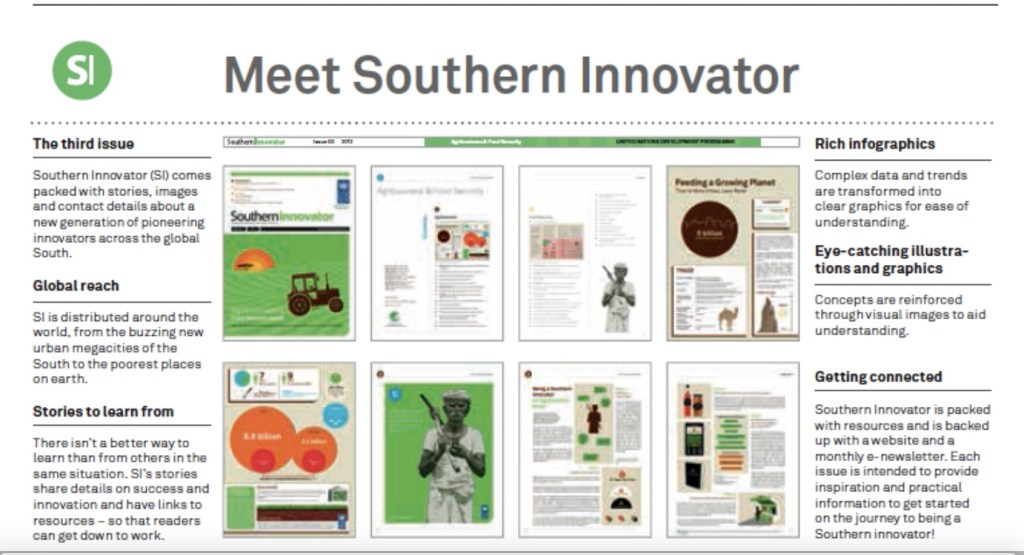
Development Challenges, South-South Solutions was launched as an e-newsletter in 2006 by UNDP’s South-South Cooperation Unit (now the United Nations Office for South-South Cooperation) based in New York, USA. It led on profiling the rise of the global South as an economic powerhouse and was one of the first regular publications to champion the global South’s innovators, entrepreneurs, and pioneers. It tracked the key trends that are now so profoundly reshaping how development is seen and done. This includes the rapid take-up of mobile phones and information technology in the global South (as profiled in the first issue of magazine Southern Innovator), the move to becoming a majority urban world, a growing global innovator culture, and the plethora of solutions being developed in the global South to tackle its problems and improve living conditions and boost human development. The success of the e-newsletter led to the launch of the magazine Southern Innovator. 

Creative Commons License

This work is licensed under a
Creative Commons Attribution-Noncommercial-No Derivative Works 3.0 License.

ORCID iD: https://orcid.org/0000-0001-5311-1052.

© David South Consulting 2023

Categories
Archive data Development Challenges, South-South Solutions Newsletters Southern Innovator magazine

Enormous Potential for Nigerian Software Industry

By David SouthDevelopment Challenges, South-South Solutions

SOUTH-SOUTH CASE STUDY

Nigeria has an unfortunate global reputation as the home of 419 scams (http://en..wikipedia.org/wiki/Advance-fee_fraud). A typical 419 scam involves sending emails to people around the world in order to extort money from them. Online scams may show an unexpected technical sophistication for a country associated with poverty, but are a sign that some of Nigeria’s plentiful talents are being turned to illegal activities rather than building legitimate businesses.

Many argue that Nigeria is missing its potential to become an African legal software powerhouse. The Institute of Software Practitioners of Nigeria said the country’s annual consumption of software reached US $900 million in 2006, making it possibly Africa’s biggest market.

“Nigeria stands a good chance of dominating both the local and West African diaspora in a thriving global software market,” it argues.

Production of computer software is a major income earner for countries like the United States and India.

Many argue that Nigeria has enormous potential, if it can address some common problems: an absence of software quality assurance, poor investment in software development, poor product standards and a lack of proper documentation. In short: if Nigeria’s software industry takes on board global best practice, then it is sitting on a goldmine of legitimate business opportunities.

Chris Uwaje, president of the Institute of Software Practitioners of Nigeria (ISPON), told Business Day that the country’s software technology, if well retooled and strategically positioned for global competitiveness, could earn about US $10 billion annually from foreign software exchange.

He argued that developing the software industry would have many benefits for the population as a whole.

“Software has … become and will remain one of the fastest growing industries with power to enrich, and sustain national economies,” Uwaje said.

Some estimates put the world software industry and associated markets at US $1,300 billion, with 90 percent of the world’s software exports coming from the United States and Europe. Outside the U.S., U.K., Germany and Japan, the new and emerging countries within the software industry are India and China, and to a lesser extent Singapore and Malaysia.

According to market researcher DataMonitor, the worldwide software industry grew by 6.5 percent between 2007 and 2008.

DataMonitor forecasts that in 2013, the global software market alone will have a value of US $ 457 billion, an increase of 50.5 percent since 2008 (Datamonitor’s Software: Global Industry Guide).

Africa has a high proportion of entrepreneurs because people have next to no social supports to fall back on and need to do business to survive. Nigeria’s large youth population – 43.2 percent of the total – could be the driver of this new economy if used right.

Nigeria mostly imports software solutions despite having an extensive capacity in software development. If developed well, software could surpass oil as a revenue generator for the country.

According to A Profile of Nigeria’s Software Industry by H. Abimbola Soriyan and Richard Heeks, “A typical software company (in Nigeria) had between 11 and 50 customers (the average was 36 though a few firms involved with package installation had several thousand). There was a strong concentration among these customers. Almost all were private sector … There was a surprising lack of government/public sector organizations as customers (reflected above in the limited number of firms found in Abuja).”

Jimson Olufuye, president of the Information Technology Association of Nigeria (ITAN), believes that more needs to be done to support the software developers. And while on paper there is strong support for this sector in information technology policy, “In addition, we need to establish more IT parks with appropriate policies on infrastructure, human resources, incentives and business plan.”

Wahab Sarumi, chief executive officer of Wadof Software Consulting, explains the problem: “Indigenous software developers are an endangered species, abandoned by the government, neglected by its own people and bullied by the poachers from India, to whom Nigerian businesses rush to buy software applications to solve local business problems.”

Already, Nigerian software firms are offering existing off-the-shelf software that they custom package with local services. This recognizes software made in advanced countries isn’t entirely right for developing countries: and this is where business opportunities await for software developers.

But the key to success, at the end of the day, is to be the best solution on offer for the right price. James Agada, managing director of ExpertEdge Limited, believes people buy the best software for the task and don’t care where it comes from.

“If you want to sell software, the buyer does not buy the software alone, he buys the software, buys capacity to support the software, buys your capacity to improve on the software, he buys what he assumes is your mastery of the domain the software … the software must be able to compete favourably with its competitors.”

Published: February 2010

Resources

1) West Africa Trade Hub: A great resource for doing business in West Africa . Website:http://www.watradehub.com/index.php?option=com_content&task=view&id=1439

2) Rogue Economics: A website accompanying the book by Loretta Napoleoni on the illegal economic activities unleashed after the fall of communism. Website: http://www.lorettanapoleoni.com/

3) Towards an African E-Index: SMS e-Access and Usage Across 14 African Countries: A report from 2006 showing how small and medium African businesses increase income with ICTs. Website:http://mobileactive.org/research/towards-african-e-index-sms-e-access-and-usage-across-14-african-countries

4) Changing Dynamics of Global Computer Software and Services Industry: Implications for Developing Countries: A report from UNCTAD on how computer software can become the most internationally dispersed high-tech industry. Website:http://www.unctad.org/templates/webflyer.asp?docid=1913&intitemid=2529&lang=1

5) A Profile of Nigeria’s Software Industry by H. Abimbola Soriyan and Richard Heeks, Paper No 21, 2004, Development Informatics: Working Paper Series. Website: http://tinyurl.com/yh25dpa

6) Institute of Software Practitioners of Nigeria: A great contact point for finding legitimate software developers in Nigeria. Website: http://www.ispon.org/

7) Tech Soup: A great place to meet legitimate software developers and learn more. Website:http://home.techsoup.org/pages/default.aspx

https://davidsouthconsulting.org/2022/10/26/africa-to-get-own-internet-domain/

https://davidsouthconsulting.org/2021/03/20/computer-gold-farming-turning-virtual-reality-into-real-profits/

https://davidsouthconsulting.org/2020/12/11/cyber-cities-an-oasis-of-prosperity-in-the-south/

https://davidsouthconsulting.org/2020/12/04/data-surge-across-global-south-promises-to-re-shape-the-internet/

https://davidsouthconsulting.org/2020/12/11/false-data-makes-border-screening-corruptible/

https://davidsouthconsulting.org/2022/06/10/illiterate-get-internet-at-touch-of-a-button/

https://davidsouthconsulting.org/2022/10/04/popular-chinese-social-media-chase-new-markets/

Development Challenges, South-South Solutions was launched as an e-newsletter in 2006 by UNDP’s South-South Cooperation Unit (now the United Nations Office for South-South Cooperation) based in New York, USA. It led on profiling the rise of the global South as an economic powerhouse and was one of the first regular publications to champion the global South’s innovators, entrepreneurs, and pioneers. It tracked the key trends that are now so profoundly reshaping how development is seen and done. This includes the rapid take-up of mobile phones and information technology in the global South (as profiled in the first issue of magazine Southern Innovator), the move to becoming a majority urban world, a growing global innovator culture, and the plethora of solutions being developed in the global South to tackle its problems and improve living conditions and boost human development. The success of the e-newsletter led to the launch of the magazine Southern Innovator.  
Other stories from Development Challenges, South-South Solutions:

African Digital Laser Breakthrough Promises Future Innovation 

China Looking to Lead on Robot Innovation

Digital Mapping to put Slums on the Map

New Weapon Against Crime in the South

Follow @SouthSouth1

Google Books: https://books.google.co.uk/books?id=I_hcAwAAQBAJ&dq=development+challenges+october+2013&source=gbs_navlinks_s

Slideshare: http://www.slideshare.net/DavidSouth1/development-challenges-october-2013-issue

Southern Innovator Issue 1: https://books.google.co.uk/books?id=Q1O54YSE2BgC&dq=southern+innovator&source=gbs_navlinks_s

Southern Innovator Issue 2: https://books.google.co.uk/books?id=Ty0N969dcssC&dq=southern+innovator&source=gbs_navlinks_s

Southern Innovator Issue 3: https://books.google.co.uk/books?id=AQNt4YmhZagC&dq=southern+innovator&source=gbs_navlinks_s

Southern Innovator Issue 4: https://books.google.co.uk/books?id=9T_n2tA7l4EC&dq=southern+innovator&source=gbs_navlinks_s

Southern Innovator Issue 5: https://books.google.co.uk/books?id=6ILdAgAAQBAJ&dq=southern+innovator&source=gbs_navlinks_s

https://davidsouthconsulting.org/2021/03/05/southern-innovator-issue-1/

https://davidsouthconsulting.org/2021/03/05/southern-innovator-issue-2/

Creative Commons License

This work is licensed under a
Creative Commons Attribution-Noncommercial-No Derivative Works 3.0 License.

ORCID iD: https://orcid.org/0000-0001-5311-1052.

© David South Consulting 2023

Categories
Archive Blogroll Development Challenges, South-South Solutions Newsletters Southern Innovator magazine

Growing A Southern Brand To Global Success: The Olam Story

By David SouthDevelopment Challenges, South-South Solutions

SOUTH-SOUTH CASE STUDY

Most people haven’t heard of Olam International, but they know the brands they work for and they more than likely eat their produce. The story of Olam (http://www.olamonline.com) – a global food supply company in ‘agri-products’ that got its start in Nigeria – shows how a Southern brand can grow and go global, and overcome the difficulties of cross-border trade.

Olam supplies well-known global food brands including Cadbury (chocolate), Nestle, Lavazza (coffee), Mars (chocolate), Tchibo and Planters (peanuts).

Olam not only survived its startup in Nigeria, it has thrived, trading around Africa and across the globe, becoming a major supplier to the world’s top food brands.

The quantity of agri-products harvested in the world is 5.2 billion metric tonnes. In that market, Olam is a significant producer of cashews, peanuts, spices, beans, coffee, cocoa, sheanuts, packaged foods, rice, wheat, barley, sugar, cotton, wood, and rubber. It is already the world’s largest supplier of cashew nuts and sesame nuts and in the top three for peanuts. Olam’s cashew business in Africa provides work for 17,000 people, 95 percent of whom are women.

Olam also uses its success to play a critical role in securing the world’s food supply and has specialized in meeting the food needs of the world’s rapidly growing population, especially in China and India. Between 2001 and 2007, annual increases in the global consumption of agricultural commodities were larger than during the 1980s and 1990s. Higher incomes are leading to higher consumption of proteins like meat. And as meat demand rises, so does the demand for grain and protein feeds to produce the meat. It takes two kilograms of grain to produce one kilogram of chicken, four kilograms of produce for one kilogram of pork, and eight kilograms of produce for one kilogram of beef.

Chris Brett, Olam’s senior vice president and head of corporate social responsibility and sustainability, said the company tries to blend business success with wider social goals.

“We are one of the few businesses investing in rural environments and am tackling the problem of urbanization,” said Brett in Olam’s London office – the company’s global headquarters is in Singapore.

In 2008, it won the World Business Development Award for its contribution to achieving the Millennium Development Goals (MDGs) (http://www.un.org/millenniumgoals/).

Olam also has been recognized for its contribution to global food security. By providing farmers with credit to help build their communities, it has also been able to revive declining rural economies and help stem the outflow of farmers to the big cities and urban slums.

“Many countries are afraid to lend to farmers,” Brett said. “We gather the farmers together in groups of 500 and Olam manages the loan while a local bank receives the money. Defaults have been low and farmers are building up a credit rating. In this way, farming becomes a business not just a subsistence existence.”

The dramatic changes taking place in African countries – especially rapid urbanization that has made the continent home to 25 of the world’s fastest growing cities (International Institute for Environment and Development) – means there is an urgent need to increase food production and stabilize rural economies to support farming.

Olam International, started in 1989 in Nigeria by its India-born CEO Sonny George Verghese has many lessons for any Southern entrepreneurs who have their sights set high.

After developing its skills in exporting cashew nuts from Nigeria, Olam moved into cotton, cocoa and sheanuts. From 1993 to 1995, the company explored ways of taking their skills into other countries and different products. It was a period of rapid expansion into other African countries including Benin, Togo, Ghana, Cote d’Ivoire, Burkina Faso and Senegal.

Olam now operates in 26 African countries.

There has been a renaissance in South-South trade in recent years before the current economic crisis, growing by an average of 13 percent per year between 1995 and 2007. By 2007, South-South trade made up 20 percent of world trade.

Olam started with one product, got its supply right, and then started looking around and seeing what other products and services it could offer, applying already-tested expertise and supply skills – what the company calls the ‘Olam DNA’.

Olam claims its success has come from building strong relationships with farmers to guarantee high standards for the food products. The company does this by tightly tracking its stock and its quality. Olam then uses the information to analyze risks to the supply network. The company also keeps both warehouses and field managers close to the farmers. Olam estimates 65 percent of its profit comes from managing the journey from farmer’s field to factory gate.

Its selling point to customers is the ability to guarantee the entire journey from farmer’s field to factory gate, taking on all the risk and stress for ensuring the product is of the right standard and delivered on time.

Its niche is to provide the food products required by some of the world’s top food brands. The company has grown from just one product in Nigeria and two employees in 1989, to directly employing over 10,000 people worldwide and supplying 20 products in 60 countries, according to Brett. He says the company, which had a total 2008 turnover of US $5.75 billion, was “born out of Africa.”

Brett says the company is now “investing heavily in Africa in processing and distribution centres” – proof that a success story feeds back into more success and investment. It has been able to use its profits to go back and buy up failing businesses and former state-run enterprises, and modernize them. Olam now grows the food, processes it, and transports it to market.

Olam actively works with international donors, global NGOs like Technoserve (farmer business development), WWF (environmental impact of supply chain), and the Bill and Melinda Gates Foundation (cocoa and cashew farmers).

Olam, however, has received criticisms for its past practices. The global environmental group Greenpeace attacked its logging in the Democratic Republic of Congo (DRC) (http://www.greenpeace.org.uk/tags/olam), and the International Finance Corporation (IFC) divested its holdings from Olam for it trading illegally cut timber.

Olam and the Gates Foundation project are working with 200,000 cocoa farmers in West Africa to double their incomes. In Ghana, cocoa farming has become synonymous with poverty and perceived as an occupation of last resort. The work force is rapidly aging and the industry will die out if it doesn’t become more profitable and attractive to young people.

“We want the farmers to be profitable, the transporters to be profitable,” Brett said. “We believe a supply chain does not work if one player takes too much.”

And what advice does Olam have for budding food producers and growers? “Catchy, simple brands work. Our Mama Mia pasta caught the wave of the Abba revival.”

“Our Tasty Tom brand became very popular in Africa so we extended the brand into other products than just tomato paste. You reduce the cost of advertising by extending the brand name.”

“We feel SMEs (small, medium enterprises) growth is critical because it would give us more support. If more people invested in SMEs, we would have more people to do business with. We want to be able to make deals: they could be entrepreneurs.

“If you can add extra value it costs nothing but time.”

Brett advises budding SMEs: “It’s all about quality: trust and shared business ethics like formal contracts. When you have those, the bigger brands will give you support.”

Published: October 2009

https://davidsouthconsulting.org/2022/11/21/africa/

https://davidsouthconsulting.org/2020/12/14/african-farming-wisdom-now-scientifically-proven/

https://davidsouthconsulting.org/2022/11/21/agribusiness-food-security/

https://davidsouthconsulting.org/2022/11/16/brazils-agricultural-success-teaches-south-how-to-grow/

https://davidsouthconsulting.org/2022/10/10/cheap-farming-kit-hopes-to-help-more-become-farmers/

https://davidsouthconsulting.org/2022/11/18/farmers-weather-fertilizer-crisis-by-going-organic/

https://davidsouthconsulting.org/2022/11/23/kenyan-farmer-uses-internet-to-boost-potato-farm/

https://davidsouthconsulting.org/2021/09/16/small-fish-farming-opportunity-can-wipe-out-malnutrition/

https://davidsouthconsulting.org/2021/09/16/ugandan-fish-sausages-transform-female-fortunes/

https://davidsouthconsulting.org/2022/11/11/urban-farming-to-tackle-global-food-crisis/

https://davidsouthconsulting.org/2022/10/10/us-1-trillion-opportunity-for-africas-agribusinesses-says-report/

https://davidsouthconsulting.org/2022/10/18/woman-wants-african-farming-to-be-cool/

Development Challenges, South-South Solutions was launched as an e-newsletter in 2006 by UNDP’s South-South Cooperation Unit (now the United Nations Office for South-South Cooperation) based in New York, USA. It led on profiling the rise of the global South as an economic powerhouse and was one of the first regular publications to champion the global South’s innovators, entrepreneurs, and pioneers. It tracked the key trends that are now so profoundly reshaping how development is seen and done. This includes the rapid take-up of mobile phones and information technology in the global South (as profiled in the first issue of magazine Southern Innovator), the move to becoming a majority urban world, a growing global innovator culture, and the plethora of solutions being developed in the global South to tackle its problems and improve living conditions and boost human development. The success of the e-newsletter led to the launch of the magazine Southern Innovator.  
Follow @SouthSouth1

Google Books: https://books.google.co.uk/books?id=tRKYBgAAQBAJ&dq=development+challenges+october+2009&source=gbs_navlinks_s

Slideshare: http://www.slideshare.net/DavidSouth1/development-challengessouthsouthsolutionsoctober2009issue

Southern Innovator Issue 1: https://books.google.co.uk/books?id=Q1O54YSE2BgC&dq=southern+innovator&source=gbs_navlinks_s

Southern Innovator Issue 2: https://books.google.co.uk/books?id=Ty0N969dcssC&dq=southern+innovator&source=gbs_navlinks_s

Southern Innovator Issue 3: https://books.google.co.uk/books?id=AQNt4YmhZagC&dq=southern+innovator&source=gbs_navlinks_s

Southern Innovator Issue 4: https://books.google.co.uk/books?id=9T_n2tA7l4EC&dq=southern+innovator&source=gbs_navlinks_s

Southern Innovator Issue 5: https://books.google.co.uk/books?id=6ILdAgAAQBAJ&dq=southern+innovator&source=gbs_navlinks_s

https://davidsouthconsulting.org/2021/03/05/southern-innovator-issue-3/

https://davidsouthconsulting.org/2021/03/05/southern-innovator-issue-5/

Creative Commons License

This work is licensed under a
Creative Commons Attribution-Noncommercial-No Derivative Works 3.0 License.

ORCID iD: https://orcid.org/0000-0001-5311-1052.

© David South Consulting 2023

Categories
Archive Blogroll Development Challenges, South-South Solutions Newsletters

African Fashion’s Growing Global Marketplace Profile

By David SouthDevelopment Challenges, South-South Solutions

SOUTH-SOUTH CASE STUDY

Tales of African global fashion successes have multiplied in the last few years. African fashion is seeing its profile rise as more and more shows and festivals boost awareness of the continent’s designs, designers and models. In turn, African fashion and design is being taken more seriously as an income and job generator, and as a sector able to weather the ups and downs of the global economy: people always need to wear clothes.

If the global fashion industry were a country, it would rank 7th in global GDP (gross domestic product) (Fashion Performance Network).

In 2011, the apparel retail industry was worth an estimated US $1.1 trillion, and that could grow to US $1.3 trillion by 2016. And the sector is expanding in the global South. It is forecast that India and China combined will be as big a fashion market as the United States by 2015.

One visible aspect of this is the plethora of African fashion weeks that have sprung up.

Launched in 2011, African Fashion Week in London (africafashionweeklondon.com), or AFWL, is a reflection of how far things have come and how much higher the profile of African fashion now is.

The mission behind AFWL is “to promote emerging and established African designers and African-inspired designers from across the globe.” The number of attendees grew from 4,700 in the first year to 20,000 in 2012.

In 2012 it partnered with Côte d’Ivoire Fashion Week (https://www.facebook.com/pages/Cote-dIvoire-Fashion-Week/364950310210789), which will hold its third annual event in December 2013. This partnership has meant fashion designers from Côte d’Ivoire can benefit from the higher international profile of appearing at African Fashion Week in London. The theme in 2012 was “Ivorian Textile Products on the American Market.”

“London is one of the most important fashion capitals around the world,” said Côte d’Ivoire Fashion Week’s founder and CEO, Coulibaly Severin on the AFWL website. “It is a great honour for us and the African continent to have a professional international platform to promote African Fashion industry actors, African heritage, African values, African textiles through Africa Fashion Week London.”

The idea is to use the fashion week as a bridge to access the European market.

With the right support, African fashion businesses have huge potential for growth.

A distinctive “Afropolitan” aesthetic (http://afropolitanaesthetic.tumblr.com/) has grown as a phenomenon since 2005, influencing global urban design trends. It can be characterized as urban, sophisticated, tailored and boldly African in its use of colours and patterns. British designer Paul Smith (http://www.paulsmith.co.uk/uk-en/shop/) has been one of many designers to be inspired by the afropolitan look.

While African fashion trends have always influenced the global fashion business, the challenge has been to create viable global African fashion brands that can compete in the global marketplace and in turn create sustainable jobs in Africa.

Pioneers are showing that it can be done.

Featured at Africa Fashion Week in London in 2011, the Nigerian fashion brand Mmabon (mmabon.com) is now looking to pioneer new ways to buy and sell clothing in Africa. The company, which sells affordable casual and custom apparel, is launching a mobile phone app for all devices and is building its own Internet e-commerce website as well. Mmabon had been engaging with customers through Facebook and the BlackBerry smartphone, but realized it could offer a much better experience for customers through an app and an e-commerce website. This shows the future for fashion in Africa is going mobile and going online.

Founded by Elizabeth Idem-Ido, Mmabon is capitalizing on the fact Internet access is improving in Nigeria and is turning to online advertising to drum up customers. The fashion brand is trying to reach 16 to 34 year olds, of which 8 million are believed to be currently on Facebook in Nigeria, according to Idem-Ido.

There is a cultural change underway in the country: people are increasingly feeling comfortable doing commerce online and on mobile phones.

“Nigerian youths are now more willing to buy products over the Internet, unlike five years ago, with the likes of konga.com and jumia.com revolutionizing the online retail scene in Nigeria,” Idem-Ido, who is also a trained lawyer, told VC4Africa (https://vc4africa.biz/).

Konga (Konga.com) is Nigeria’s largest online mall. Opened in 2012, it offers a wide range of products for order across Nigeria. Jumia.com calls itself the “the biggest online shopping mall in Africa”, operating in Morocco, Egypt, Ivory Coast, Nigeria and Kenya. Another player is Ecwid (ecwid.com), which bills itself as an e-commerce solution for small businesses that “is a revolutionary shopping cart that seamlessly integrates with your existing website. It can also be added to your page on social media networks, such as Facebook or mySpace”.

Idem-Ido’s experience with Mmabon over the past two years shows how online marketing can be an effective – and cost-effective – way to broaden a company’s customer base.

“As a business, we have not physically met with 80 per cent of our current customers,” she said. “Orders have been achieved from referrals, BlackBerry Messenger contacts and our official Facebook page. Online marketing improves our visibility without owning a prime-location store and reminds, assures our already existing customers on why we are their preferred brand.”

Her fashion business began humbly as a part-time t-shirt printing hobby for her friends. Then people started ordering custom-designed t-shirts, and so she began a journey exploring fabrics in local and foreign markets.

Mmabon is now the official merchandiser for the Calabar Festival 2013-2015 (calabarfestival.com), the biggest street carnival in West Africa. Taking place in Calabar, Cross River State, Nigeria, it attracts a million people.

Mmabon is receiving help from Venture Capital for Africa, or VC4Africa (https://vc4africa.biz/), a community of entrepreneurs and investors helping to build companies in Africa, to raise further investment to grow the brand and the business.

Another success benefiting from international exposure is Malian designer Boubacar Doumbia (http://www.ndomo.net/english/index.html), who is currently making fabrics for design-savvy British furniture and home furnishings store Habitat. The prints with African themes have proven a hit with Habitat customers.

Working from a new studio in Burkina Faso’s capital, Ouagadougou, Doumbia (https://www.ashoka.org/fellow/boubacar-doumbia) is a leading advocate of bogolan (http://www.malimali.org/what-is-bogolan/), a Malian traditional textile dyeing process using mud.

He uses locally grown cotton, which is first dyed using plant-based dyes. A chemical reaction occurs when the iron in the mud is applied to the fabric and turns the existing plant dye black after three applications, or grey after two applications. The mud is washed off and the fabrics are placed in the sun to dry. It is a sustainable and chemical-free approach to dyeing fabrics and also creates vibrant patterns that have caught the attention of people in Europe and elsewhere.

Other outlets who have become enamored with African patterns and themes in Britain include Darkroom Boutique, House of Fraser and the V&A Museum, The Guardian newspaper reported.

As an Ashoka fellow (ashoka.org) – Ashoka is the largest network of social entrepreneurs worldwide – Boubacar is using the craft as a way to boost skills and opportunities for youth in Mali. He has “overhauled the traditional model of youth apprenticeship in Mali by putting young people in a central, entrepreneurial role from the outset. Rather than simply train students in the methods of textile production, he teaches professional, people and life skills, and encourages his apprentices to become self-sufficient, creative, and innovative”, according to the Ashoka website.

Elsewhere, African fashion style pioneer Gilles Belinga (https://www.facebook.com/GillesBelinga) has become a fashion phenomenon in China. The former communications engineering student had a deeply personal conversion to fashion and style upon arriving in Beijing; the buzzing and vibrant Chinese capital captured his heart.

“I discovered my talent and passion for fashion in China,” he told China Daily.

“I’ve also been given many opportunities here, so I want to pursue my fashion dream in China.”

The Cameroon native has a distinctly afropolitan take on fashion – elegant, tailored suits, strong colours, and a gentleman’s manner – and this fashionable posture landed him modeling work in fashion shows.

He arrived in China in 2008 after his parents divorced and he went from being in a wealthy family back home to having to do any job he could get to survive. He started out in Tianjin, China – an industrial city with a large high-technology sector – and then moved to Beijing to study.

It was there that he fell in love with the city’s fashion scene and hasn’t looked back.

“I never attended fashion school in Africa, but in Beijing, in this fashionable environment I realized that I like drawing clothes, matching colors and mixing fabrics,” he said.

“There are so many fabrics here, which has given me the chance to try out different things. Sometimes you might have a talent in you, but you might not discover that talent if you’re not in a place where it can come out.”

He now designs clothes and has them made by local tailors.

“When I design clothes for clients, I look at the whole person and what kind of message they want to deliver to people,” he said. “Then I check their skin color and think about style and fabric.”

He defies the elitist take on fashion that can be promulgated by fashion magazines and thinks good fashion is for everyone.

“I believe the way you dress sends a message to people about how you want them to think about you.”

He finds Beijing is full of opportunities and he is regularly stopped in the city’s trendy Sanlitun (http://en.wikipedia.org/wiki/Sanlitun) neighbourhood and asked to be in fashion shows.

“In China, you don’t know who you are going to meet. You could be anywhere and meet someone who can change your life.”

And he plans to perfect his skills and designs in China and then take them back to Cameroon one day.

And maybe, in time, Belinga will be the next big fashion thing.

Published: October 2013

Resources

1) African Fashion Week London: AFWL celebrates London’s unique and diverse cultural heritage, topped with the flamboyant mixing of Western and African culture through fashion at the same time promoting Africa’s rich ethnic culture and interpreting it into contemporary designs. Website: africafashionweeklondon.com

2) Gentlemen of Bacongo by Daniele Tamagni, Paul Smith and Paul Goodwin, Publisher: Trolley. Website: amazon.com

The Afropolitan: A magazine and website from South Africa packed with content from an afropolitan perspective. Website: afropolitan.co.za/

Association of African Designers in Diaspora: The Association of African Designers in the Diaspora is the non-profit social enterprise arm of Africa Fashion Week London that supports emerging designers with the aim to make a positive contribution to society through fashion and creativity. Website: http://africafashionweeklondon.com/africafashionweek/association-of-african-designers-in-diaspora/

The Creative Economy: How People Make Money From Ideas by John Howkins, Publisher: Penguin. Website: creativeeconomy.com/book.htm

Creative Economy Report Website: This annual report offers a snapshot of the state of the global creative economy and its key trends. Website: http://unctad.org/en/Pages/Publications/Creative-Economy-Report-%28Series%29.aspx

7) Copyright + Creativity = Jobs and Economic Growth: WIPO Studies on the Economic Contribution of the Copyright Industries (WIPO 2012). Website: http://www.ip-watch.org/weblog/wp-content/uploads/2012/02/WIPO-Copyright-Economic-Contribution-Analysis-2012-FINAL-230-2.pdf

8) The Afropolitan Shop: The Afropolitan Shop is an online boutique founded by Beverly Lwenya, that desires to tell an African Design Story. It began as a blog in 2007 called The Afropolitan Network, which highlighted stories and images of the African Diaspora. The Afropolitan Shop is now a growing global brand, specializing in handmade and designer accessories such as jewelry, bags and shoes. Website: theafropolitanshop.com/

Creative Commons License

This work is licensed under a
Creative Commons Attribution-Noncommercial-No Derivative Works 3.0 License.

ORCID iD: https://orcid.org/0000-0001-5311-1052.

© David South Consulting 2023