Though many feel a golly-gee-whiz response when medical science leaps another hurdle towards genetic manipulation, research by two recent Royal Society Hannah Medal winners into the history of eugenics sends a chill up the spine.
Both University of Toronto’s professor Pauline Mazumdar, author of Eugenics, Human Genetics and Human Failings: The Eugenics Society, its Sources and its Critics in Britain (Routledge, 1992), and Angus McLaren, University of Victoria professor of history and author of Our Own Master Race: Eugenics in Canada, 1885-1945 (McClelland and Stewart, 1990), disclose how mainstream genetic selection once was – and possibly still remains.
“Ever since the test tube baby breakthrough a decade ago, there’s been a new concern for the spin-offs of this research,” says McLaren. “In Canada there’s a woman who was sterilized in Alberta who is now suing the Alberta government, so that is bringing it back into the consciousness that these things actually did happen.”
“Many quite respectable individuals took it as given that there must be something in eugenics. That was the difficulty in writing the book, determining who was a eugenist and who wasn’t. It was so widely believed that it was very hard to make a serious demarcation.”
Professor McLaren found winning the medal helped raise his profile. And the resulting media interest allowed him to put the issue in historical perspective.
“The problem as ever is people looking for some sort of a quick fix to social problems – hoping that some sort of genetic tampering will allow very complex problems to be surgically dealt with.”
The idiosyncracies of Canada’s medical schools can be both a strength and a drawback. An exchange program sponsored by the Hannah Institute hopes to bring the schools a little closer by opening up the communication lines from coast to coast.
The first exchange took place this April between the University of Western Ontario and the University of Calgary. Medical students met at Western for three days of talks and socializing.
“One of the objectives is to have each student work up a talk of ten minutes to stimulate further research,” says UWO Hannah Professor Paul Potter, who helped coordinate the exchange along with Calgary’s Dr. Peter Cruse.
Topics ranged from diseases among the Cree of Alberta to the old medical art of uroscopy.
Professor Potter says he hopes the exchange will become a regular annual affair, possibly with next year’s exchange matching Calgary with Halifax’s Dalhousie University.
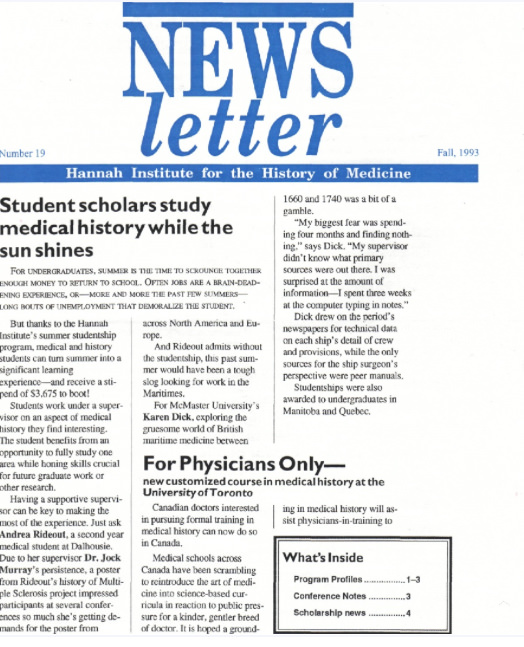
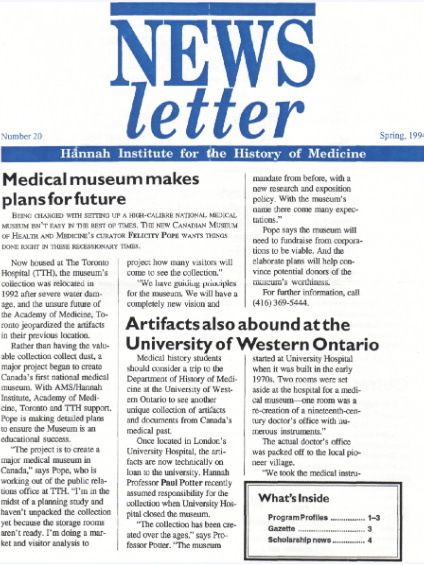
I worked as Editor and Writer for the newsletter of the Hannah Institute for the History of Medicine (under the direction of the Editor-in-Chief and Hannah Executive Director Dr. J.T. H. Connor) in the early 1990s. Located close to the University of Toronto and within a neighbourhood claiming a long association with medical and scientific discovery (Sir Frederick Banting, co-developer of insulin for the treatment of diabetes, lived at 46 Bedford Road,), the goal was to better connect Canada’s medical history community of scholars and raise the profile of the funding resources available to further the study of medical history in Canada.
“… in recent years it has become a pursuit for a growing number of researchers. … Behind much of this growth has been the Hannah Institute for the History of Medicine which has encouraged writing …”.
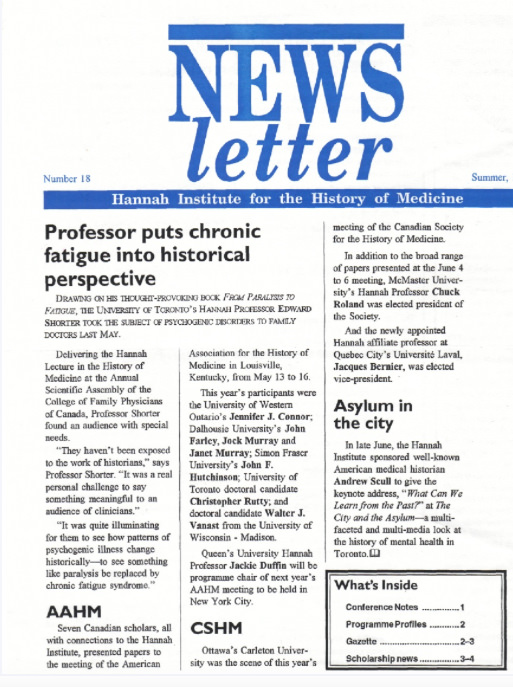
Drawing on his thought-provoking book From Paralysis to Fatigue, the University of Toronto’s Hannah Professor Edward Shorter took the subject of psychogenic disorders to family doctors last May.
Delivering the Hannah Lecture in the History of Medicine at the Annual Scientific Assembly of the College of Family Physicians of Canada, Professor Shorter found an audience with special needs.
“They haven’t been exposed to the work of historians,” says Professor Shorter. “It was a real personal challenge to say something meaningful to an audience of clinicians.
“It was quite illuminating for them to see how patterns of psychogenic illness change historically – to see something like paralysis be replaced by chronic fatigue syndrome.”
I worked as Editor and Writer for the newsletter of the Hannah Institute for the History of Medicine (under the direction of the Editor-in-Chief and Hannah Executive Director Dr. J.T. H. Connor) in the early 1990s. Located close to the University of Toronto and within a neighbourhood claiming a long association with medical and scientific discovery (Sir Frederick Banting, co-developer of insulin for the treatment of diabetes, lived at 46 Bedford Road,), the goal was to better connect Canada’s medical history community of scholars and raise the profile of the funding resources available to further the study of medical history in Canada.
The controversial Nordic Satellite Distribution consortium is in danger of collapsing because of a row between two of its three big shareholders.
The row, between Swedish programmer Kinnevik and Norwegian telephone company Telenor, threatens the chances of the consortium coming up with a restructuring that will win acceptance from European Commission competition officials.
NSD has been trying to turn the 1 degree West orbital position – home to the Thor and TV Sat-2 satellites – into Scandinavia’s “hot bird” position. But Kinnevik also plans to take a substantial slice of capacity on the Swedish Space Corporation’s planned digital satellite Sirius-2, at 5 degrees East. Telenor is furious.
It is demanding that Kinnevik drop the plan and also give up its existing transponders at the 5 degrees East position, on the Tele-X and Sirius-1 satellites. Kinnevik already plans to give up its Astra transponders, to the relief of Telenor.
Kinnevik is buying capacity on the rival system simply as a way of hedging its bets. Sirius-2, with 16 transponders offering a mix of digital and analogue channels for the Scandinavian market, could become a powerful satellite and Kinnevik is worried that a strong rival service might be developed on it. The company is thought to be negotiating for six of the 16 transponders (another 16 transponders are aimed at the rest of Europe).
Per Bendix, chairman of the NSD, said that the group could continue without Kinnevik, although it would be difficult to find another company with such large pockets.
He downplayed the rows between the shareholders: “Of course, there are tensions between Kinnevik and Telenor. You can’t imagine a process like this, a complicated business deal, without some frictions which create some warmth. None of the partners can stop this initiative, it has gained too much momentum.”
TeleDanmark, the third member of NSD, has tried to play a mediating role between Telenor and Kinnevik.
One source close to the consortium said: “Kinnevik is definitely interested in investigating other satellite operators for the digital future. The company is known for doing exactly as it pleases, which clashes with Telenor which is trying to get 1 degree West into shape.”
Kinnevik and Telenor have clashed repeatedly over Kinnevik’s refusal to give up the 5 degrees East position, where it transmits five channels on Sirius. The issue has been exacerbated for Telenor by the fact that the mostly unencrypted Sirius/Tele-X package has achieved a better penetration than the encrypted Thor package.
The two companies have also been at loggerheads over the restructuring of the consortium, forced upon it by the European Commission.
Last July, competition commissioner Karel Van Miert ruled that NSD, which was planned as a vertically-integrated company providing programming, subscriber management and satellite capacity, was anti-competitive.
He ruled that NSD would “create or strengthen a permanent dominant position as a result of which effective competition would be significantly impeded” in the Nordic market for satellite broadcasting. It would dominate the provision of satellite transponders in Scandinavia, cable television in Denmark and direct-to-home pay-television distribution.
Bendix, with the backing of Telenor, has been trying to broaden the shareholder base by bringing in other Scandinavian programmers. But Kinnevik opposes the move because it does not think that it will meet Brussels’ concerns. It also does not want to play second fiddle to other programmers.
The shareholders have looked at other options, including one of splitting NSD into separate companies covering transponder-leasing, subscriber management and programming. The companies could have different ownership. Pele Tornberg, Kinnevik’s deputy managing director, would not say what alternative plan Kinnevik is proposing.
NSD has until next month to present Brussels with a revised shareholding structure.
Helsinki Media, the Finnish broadcaster, has rejected an approach to rejoin NSD, which it left in 1994 in a row over Kinnevik’s influence. President Tabio Kallioja said that the company maintained its view that NSD gave Kinnevik a stranglehold on the allocation of satellite capacity to other programmers. He added that Helsinki Media was interested in the plans for digital satellite television being developed by NetHold and by Telia Media, owned by the Swedish PTT, Telia.





 David South Consulting
You must be logged in to post a comment.