Categories
Archive

Innovative Solutions Celebrated in Ashden Awards

By David SouthDevelopment Challenges, South-South Solutions

SOUTH-SOUTH CASE STUDY

The world’s population is heading towards 9.6 billion by 2050 (UN). Combined with a growing middle class and rising living standards across the global South, that means ever-greater demand on the world’s finite resources. This raises a crucial question: Where will the energy to power rising living standards come from, and how much damage will be done to the planet’s environment by pollution created generating it (https://www.un.org/en/development/desa/news/population/un-report-world-population-projected-to-reach-9-6-billion-by-2050.html)?

The solution advocated by the world’s scientists is to move to sustainable energy creation, which does not rob from the future to create energy for today.

Such an approach requires fresh thinking and engagement from those who are actually involved in the struggle to raise living standards and improve human development.

One way to do this is to use high-profile awards and prizes to lure out fresh thinking and innovators and help them get the funding they need to realize their plans.

The International Ashden Awards (ashden.org) – considered the “leading green energy awards” – is about championing and promoting “practical, local energy solutions that cut carbon, protect the environment, reduce poverty and improve people’s lives”. It recently announced the finalists and winners for 2014.

The international finalists are 10 sustainable energy enterprises drawn from Africa (Burkina Faso, Tanzania), India and Southeast Asia (Cambodia, Myanmar). A handy, clickable and searchable online map (http://www.ashden.org/winners) further explains the winners and finalists for 2014 and previous years.

“With the stark warnings from the IPCC (Intergovernmental Panel on Climate Change) of the impacts of climate change, especially for the most vulnerable, we need to find solutions before it is too late,” said Ashden founder-director Sarah Butler-Sloss.

“Our role at Ashden is to shine a light on those organizations around the world that are helping reduce carbon emissions and finding ways of adapting to the effects of climate change.”

The mix of non-profit organizations and businesses among 2014’s winners and finalists shows there is no shortage of enthusiasm and fresh thinking out there. Proof the global South is alive with innovators with solutions.

Among the five international winners – who will receive between US $8,566 and US $68,531 each – is India’s Greenway Grameen (greenwaygrameen.com). It is tackling the problem of harmful pollution caused by cooking. Despite rapid economic growth and the spread of consumer goods such as televisions and mobile phones, most Indian women still cook with wood or dung. This is not only time-consuming, it also produces health-damaging smoke. Greenway Grameen was founded by two young MBA graduates in 2010 to make and sell affordable, desirable cookstoves that reduce smoke, cook food more quickly and stay cleaner for longer, dramatically improving the quality of life for many women and girls. As of March 2014 more than 120,000 of Greenway’s made-in-India smart stoves had been sold, benefitting around 610,000 people.

Another Indian winner is Infosys (infosys.com). India’s fast-growing economy is making ever-greater demands on its electrical grid. Global IT giant Infosys is leading the way to more sustainable growth by embracing green building measures, decreasing electricity consumption per staff member across its Indian business campuses. Success lies in seizing every opportunity to cut energy consumption in its existing buildings – from reducing the size of chiller plants for air conditioning to painting roofs white to reflect the heat. Cutting-edge design of new buildings also helps keep offices cooler and maximizes natural light. Taking US $80 million off its electricity bills, Infosys has proven the business case for large companies to invest in energy efficiency – not just in India but around the globe.

Among the other winners:

– Tanzania’s Off Grid Electric (offgrid-electric.com) is a leader in solar energy in East Africa, using mobile money to sell solar power as a daily service at an affordable price. Mobile money – where customers pay with their mobile phones – is increasingly used as a method of payment. Off Grid stands out because it understands the importance of customer service, offering an all-day customer care telephone line and ongoing support from a local agent. More than 10,000 households have taken up the service since April 2012. As fast as systems are manufactured they are off to customers – thanks to a sophisticated mobile phone app-based customer registration and product-tracking system.

– Myanmar’s Proximity Designs (proximitydesigns.org) is introducing treadle pumps (http://en.wikipedia.org/wiki/Treadle_pump) and other sustainable agriculture technologies to the country for the first time. Lifting water from wells and carrying it across fields is back-breaking, time-consuming work for rural farmers. Combined with water-saving drip irrigation technology, foot-operated treadle pumps that draw up water from wells can dramatically increase yields and incomes. Farmers are now seeing their lives transformed with some harvests and incomes more than doubling – and the pumps are helping ease the daily drudgery of farming. With over 90,000 households benefiting so far, Proximity Designs continues to adapt and introduce new products like solar pumps, to meet the needs of this rapidly changing country.

– Cambodia’s Sustainable Green Fuel Enterprise (http://www.sgfe-cambodia.com/environment) is turning leftover coconut shells and other waste into clean-burning briquettes for use as cooking fuel in the capital Phnom Penh’s homes and restaurants. While most Cambodians cook on wood charcoal, contributing to the country’s rampant deforestation and air pollution, this pioneering Cambodian business – led by Carlo Figà Talamanca – can scarcely keep up with demand.

The finalists are also an innovative lot too. Kéré Architecture (kerearchitecture.com) in Burkina Faso, Africa, has set a new standard for green school buildings. The school it built has a ventilated roof and other clever design features, providing a much cooler environment for children to study in. Not only that, the school was built by local people, and largely with local materials. Germany-based Francis Kéré, originally from Burkina Faso, designed and built the school in his home village. Kéré Architecture has since designed and built more than 20 innovative, naturally cooled public buildings in Africa.

India’s Sakhi Unique Rural Enterprise (sureindia.co.in), or SURE, is a not-for-profit social enterprise in central Maharashtra that has selected, trained and supported more than 600 female micro-entrepreneurs to sell clean energy products such as solar lanterns and cleaner cookstoves to other women. For the women entrepreneurs, selling energy products boosts income and carries a social cachet, while customers also see their lives improved with time-saving products.

Another Indian innovator, Mera Gao Power (http://meragaopower.com/), is demonstrating the business case for meeting the needs of some of the poorest people in India with unsubsidized commercial micro-electric grids, connecting more than 20,000 Uttar Pradesh families to clean, affordable power. Each system is easy to install and provides seven hours of light and mobile phone-charging for up to 32 houses. And with weekly payments of just US $0.42 cents, the electricity is even cheaper than kerosene.

The Rajasthan Horticulture Development Society (http://horticulture.rajasthan.gov.in/) in India has come up with a novel way to boost green agriculture and boost farming incomes. Farmers in the desert state of Rajasthan are seeing their sons return from cities to work on their farms thanks to a new solar-powered agricultural boom. The Rajasthan Horticulture Development Society (RHDS) has provided more than 10,000 farmers with new solar-powered water pumps, enabling year-round cultivation of high-value crops and the kind of high-tech horticulture that’s never been seen in the region before. With farmers’ incomes more than doubling, the programme has given them the “gift of life”.

And finally, Tanzania’s SimGas (simgas.com) is selling biogas plants that help people turn manure into clean gas for cooking instead of using charcoal, helping reduce deforestation. The plants are factory-produced and made of plastic, so they can be installed much more quickly than conventional plants and reach many more thousands of people. SimGas has just installed the largest plastic injection-moulding machine in East Africa, creating the potential to roll out biogas plants across East Africa.

The Ashden Awards were set up in 2001 to champion trailblazing sustainable energy enterprises and programmes that improve people’s lives and tackle climate change. Ashden says its 150 award winners have improved the lives of 37 million people worldwide, and are now saving over 5 million tonnes of carbon emissions every year.

Published: July 2014

Resources

1) Innovation Prize for Africa: The IPA is an initiative of the African Innovation Foundation (AIF) started in 2011. IPA honours and encourages innovative achievements that contribute toward developing new products, increasing efficiency or saving cost in Africa. Website: http://innovationprizeforafrica.org

2) Champions of the Earth Award: The Champions of the Earth Award recognizes outstanding environmental leaders, whether individuals or organizations, that have exemplified inspiration, vision, innovation, leadership and action for the environment. This international award was established by UNEP in 2004. Website: unep.org/awards/

The SEED Awards: The SEED Award recognizes innovation in local, environmentally-responsible and sustainable entrepreneurship. This international award is the flagship programme of the SEED Initiative, a partnership founded by the United Nations Development Programme (UNDP), UNEP, and the International Union for Conservation of Nature (IUCN). Website: seedinit.org

4) Green Star Awards: The Green Star Awards recognize those who have made remarkable efforts to prevent, prepare for, and respond to environmental disasters around the world. This international award is a joint initiative between UNEP, the UN Office for the Coordination of Humanitarian Affairs and Green Cross International. Website: http://www.gcint.org/green-star-awards3

Creative Commons License

This work is licensed under a
Creative Commons Attribution-Noncommercial-No Derivative Works 3.0 License.

ORCID iD: https://orcid.org/0000-0001-5311-1052.

© David South Consulting 2023

Categories
Archive Development Challenges, South-South Solutions Newsletters Southern Innovator magazine

Avoiding Wasting Food and Human Potential with ICTs

By David SouthDevelopment Challenges, South-South Solutions

SOUTH-SOUTH CASE STUDY

Creative use of information technology in the South is helping to address two very different kinds of waste – of food and of human and community potential.

In Ghana, a mobile phone-driven Internet marketplace is helping to improve efficiencies in farming and selling food. Another initiative is addressing the crisis in India’s villages by drawing on the diaspora of former villagers now living in urban environments around the world.

Finding ways to efficiently trade food is crucial to keeping hunger at bay and meeting the needs of growing populations. In a report earlier this year, the UN’s Environment Programme (UNEP) found that more than half of the world’s food is wasted or discarded.

“There is evidence … that the world could feed the entire projected population growth alone by becoming more efficient,” said Achim Steiner, UNEP Executive Director, at the launch of The Environmental Food Crisis: The Environment’s Role in Averting Future Food Crises.

Ghana is a country that has already gained a reputation as an IT leader in West Africa (www.ghanaictawards.com). Now a clever technology based in the capital, Accra, is using mobile phones to connect farmers and agricultural businesses and associations to the marketplace. By using SMS (http://en.wikipedia.org/wiki/SMS) text messages, information from the field is gathered and collated. This can include tracking what is happening on the farm, how crops are surviving the weather, and the status of food inventories day-by-day. All the data is collected by the TradeNet website and displayed with prices and deadlines for buyers and sellers to get in touch with each other. This reduces the time and cost involved in gathering updates from thousands of people across the country.

Launched in 2007, the service recently won the Information Communication Technology innovations contest by the World Summit Award (WAS) (http://www.wsis-award.org/about/index.wbp) of the United Nations’ World Summit on Information Society (WSIS).

TradeNet is currently collating market data from 13 countries and proclaims itself the largest SMS-based market information service on the continent of Africa. It has more than 12,000 registered users and covers 500 individual markets.

The service’s full name is TradeNet: Market Information on your Mobile (http://www.tradenet.biz/?lang=en), and it tracks products like ground nuts, sesame, tomato, maize and white beans. It offers market information from Afghanistan , Benin , Burkina Faso , Cameroon , Cote d’Ivoire , Ghana , Madagascar , Mali , Mozambique , Nigeria , Sudan and Togo.

Founded by its chief executive officer Mark Davies, TradeNet is run out of the internet start-up incubator Busy Lab (http://www.busylab.com/) in Accra. Busy Lab specializes in building mobile web solutions for companies and projects involved in rural media and computing.

While in India, villages are in crisis: As India’s economy has boomed, its small towns and villages have withered. Home to the majority of the country’s population, they are suffering declining populations and high suicide rates. India’s urban slums are where people are going; they are growing 250 percent faster than the country’s population. Yet so many people share some past connection with the country’s 260,000 ailing villages.

And while the world has become a majority urban place, it is acknowledged the future for the environment and agriculture rests in the health of villages.

The social media website Mana Vuru (www.manavuru.com) seeks to connect people living in cities with the villages they were born in, or where their families came from. It is about restoring the broken connection with the village in order to enhance their future development.

As Mana Vuru declares: “Villages form the backbone of our economy. True progress, growth and prosperity can only be realized when villages become self-sustainable.”

The site points out that “most villages are suffering from crippling infrastructure and some even lack the basic amenities like electricity and fresh water. We believe that every person who migrated to greener pastures and attained success and wealth should feel some sort of moral responsibility and do their bit for their respective villages.”

A project of the Palette School of Multimedia (http://www.palettemultimedia.com/) in Hyderabad – one of India’s technology hubs – the site lets former village dwellers register and start meeting and connecting with fellow members of the diaspora. Together they can network to help the village address its development challenges.

Published: August 2009

Resources

1) A video story by CNN on Tradenet. Website: http://www.youtube.com/watch?v=s6z0ywkHPPQ

2) BOP Source is a platform for companies and individuals at the BOP (bottom of the pyramid) to directly communicate, ultimately fostering close working relationships, and for NGOs and companies to dialogue and form mutually valuable public-private partnerships that serve the BOP.
Website: http://bopsource.ning.com/

3) Afriville is a Web 2.0 service and an African Caribbean social network. Afriville is a community website along the lines of the famous MySpace. Users are free to message and post profiles. The difference is that the user is able to choose how closed or open the networks are. The site features a state of the art music management system which allows African and Caribbean artists to get straight in touch with their fans.
Website: www.afriville.com

4) Business Action for Africa: Business Action for Africa is an international network of businesses and business organisations from Africa and elsewhere, coming together in support of three objectives: to positively influence policies for growth and poverty reduction, to promote a more balanced view of Africa, and to develop and showcase good business practice in Africa
Website: www.businessactionforafrica.org

5) Model Village India: An innovative concept to rejuvenate India’s villages and build economies and self-reliance. Website: http://www.modelvillageindia.org.in/index1.html

Development Challenges, South-South Solutions was launched as an e-newsletter in 2006 by UNDP’s South-South Cooperation Unit (now the United Nations Office for South-South Cooperation) based in New York, USA. It led on profiling the rise of the global South as an economic powerhouse and was one of the first regular publications to champion the global South’s innovators, entrepreneurs, and pioneers. It tracked the key trends that are now so profoundly reshaping how development is seen and done. This includes the rapid take-up of mobile phones and information technology in the global South (as profiled in the first issue of magazine Southern Innovator), the move to becoming a majority urban world, a growing global innovator culture, and the plethora of solutions being developed in the global South to tackle its problems and improve living conditions and boost human development. The success of the e-newsletter led to the launch of the magazine Southern Innovator.  

Creative Commons License

This work is licensed under a
Creative Commons Attribution-Noncommercial-No Derivative Works 3.0 License.

ORCID iD: https://orcid.org/0000-0001-5311-1052.

© David South Consulting 2023

Categories
Archive data Development Challenges, South-South Solutions Newsletters digital ID

India 2.0: Can the Country Make the Move to the Next Level?

By David SouthDevelopment Challenges, South-South Solutions

SOUTH-SOUTH CASE STUDY

With the global economic crisis threatening to cause turmoil in the emerging markets of the global South, it is becoming clear that what worked for the past two decades may not work for the next two.

For India, the legacy issues of poverty still need to be addressed, and the country’s impressive information technology (IT) industry – which has driven so much of India’s growth – will face stiff competition from other countries in the global South. Some argue that if the IT industry hopes to keep growing and contributing to India’s wealth, things will need to change.

Unlike China, where heavy investment in infrastructure and a strong link between government and the private sector has driven the impressive manufacturing boom in the country, in India the government has de-regulated and taken a back seat, leaving the private sector and entrepreneurs to drive the change and do the innovation.

Many believe various areas need urgent attention if India is to continue to enjoy good growth rates in the coming years. Areas in need of attention include infrastructure, healthcare and education (thesmartceo.in), in particular the knowledge to work in the information technology industry of the 21st century.

One of the founders of Indian outsourcing success Infosys (infosys.com), executive co-chairman Senapathy Gopalakrishnan, told Britain’s Telegraph newspaper, “So many people’s lives have been changed by IT in India.

“People from the middle class and lower middle class have become global employees and have the opportunity to work with some of the best companies in the world. But the challenge for India is that this industry can only create so many jobs. IT is not going to solve the unemployment problem in India.”

But the coming next wave of change in information technology is an opportunity to be seized to reduce unemployment if enough people are educated to handle it.

According to Gopalakrishnan: “I strongly believe, and it’s backed up by data, that there is a shortage of computer professionals everywhere in the world, including India. The application of computers is growing dramatically and will continue to grow dramatically over the next 20 to 30 years. We have to train and create the workforce necessary to grow this industry.”

Various media stories have called this next phase India 2.0. If India 1.0 was the highly successful information technology outsourcing industry developed in the late 1980s, through the 1990s and 2000s, then India 2.0 is the next wave of IT innovation being driven by Big Data, automation, robotics, smart technologies and the so-called “Internet of things.”

Big Data is defined as the large amounts of digital data continually generated by the global population. The speed and frequency with which data is produced and collected – by an increasing number of sources – is responsible for today’s data deluge (UN Global Pulse). It is estimated that available digital data will increase by 40 per cent every year. Just think of all those mobile phones people have, constantly gathering data.

Processing this data and finding innovative ways to use it will create many of the new IT jobs of the future.

“We are living in a world which is boundary-less when it comes to information, and where there is nowhere to hide,” continues Gopalakrishnan, “If you have a cellphone, somebody can find out exactly where you are. Through social networks you’re sharing everything about yourself. You are leaving trails every single moment of your life. Theoretically, in the future you’ll only have to walk through the door at Infosys and we’ll know who you are and everything about you.”

Unlike in the late 1980s, when India was the pioneer in IT outsourcing for large multinational companies and governments, competition is fierce across the global South. The mobile-phone revolution and the spread of the Internet have exponentially increased the number of well-educated people in the global South who could potentially work in IT. China, the Philippines, Kenya, Nigeria and Ghana are just some of the countries heavily involved in this area.

If India fails to meet the India 2.0 challenge, it risks seeing its successful companies and entrepreneurs leaving to work their magic elsewhere in Asia and the new frontiers of Africa, just as many of its best and brightest of the recent past became pioneers and innovators in California’s Silicon Valley.

India’s IT sector contributed 1.2 per cent to the country’s gross domestic product (GDP) in 1998; by 2012, this was 7.5 per cent (Telegraph). The IT industry employs 2.5 million people in India, and a further 6.5 million people indirectly. IT makes up 20 per cent of India’s exports and, according to the National Association of Software and Services Companies (nasscom.in), the industry has revenue of US $100 billion.

India is now the IT and outsourcing hub for more than 120 of the Fortune 500 companies in the United States.

Out of India’s 3.5 million graduates every year, 500,000 are in engineering – a large pool of educated potential IT workers. India produces the world’s third largest group of engineers and scientists, and the second largest group of doctors.

IT has become a route that catapults bright Indian youth into 21st-century businesses and science parks and to the corporations of the world.

One visible example of the prosperity brought by IT services in India is the booming technology sector based in the city of Bangalore (also called Bengaluru) (http://en.wikipedia.org/wiki/Bangalore).

Reflective of the contradictions of India, Bangalore has 10 per cent of its workforce now working in IT, but also 20 per cent of its population living in urban slums.

The nearby Electronics City (elcia.in) is considered “India’s own silicon valley and home to some of the best known global companies.”

To date, aspects of India 2.0 are already taking shape.

One company is called Crayon Data (crayondata.com). It uses Big Data and analytics to help companies better understand their customers and increase sales and deliver more personal choices.
Edubridge (http://acumen.org/investment/edubridge/) is helping to bridge the gap for rural youth with varied education backgrounds and long-term jobs. Edubridge trains youth for the real needs of employers to increase the chances they will get a job. This includes jobs in the IT business process outsourcing sector and banking and financial services.

Infosys is working on innovations for the so-called “Internet of things,” in which smart technologies connect everyday items to the grid and allow for intelligent management of resources and energy use. Infosys is developing sophisticated software using something called semantic analytics – which analyses web content (http://en.wikipedia.org/wiki/Semantic_analytics) – to sort through social media and the Internet to track customer responses to products.

Elsewhere, former Infosys Chief Executive Nanden Nilekani is involved in a Big Data innovation to address the problem of social and economic exclusion of India’s poor. Called Aadhaar (http://uidai.gov.in/), the government-run scheme is gathering biometric data on every Indian to build the world’s largest biometric database. After being enrolled and having fingerprints and iris scans taken, each individual is given a 12-digit identification number. So far 340 million people have been registered with the scheme, and it is hoped 600 million will be registered by the end of 2014.

The idea is to use a combination of access to mobile phones and these unique ID numbers to widen access to all sorts of products and services to poor Indians, including bank accounts for the millions who do not have one. Many people, lacking any identity or official acknowledgment they exist, were prevented from engaging with the formal economy and formal institutions. Being able to save money is a crucial first step for getting out of poverty and it is hoped information technology will play an important role in achieving this.

Published: March 2014

Resources

1) India 2.0 by Mick Brown. Website: http://s.telegraph.co.uk/graphics/india2.0/part-one#top

2) Electronic City Bangalore: Regional information portal for Electronic City, an industrial technology hub located in Bangalore South, India. This portal is becoming the most favourite haunt of ECitizens living and/or working in Electronic City. Website: http://www.electronic-city.in/

3) Electronics City Industries Association: Welcome to the Electronics City, India’s own silicon valley and home to some of the best known global companies. Located in Bangalore, the Electronics City was conceived way back in the mid-1970?s as an Industrial Estate exclusively for Electronics Industries. Today the industrial estate boasts is an oasis of large, medium and small industries spanning software services, hardware; high end telecommunications; manufacture of indigenous components; electronic musical instruments, just  to name a few. Website: elcia.in

4) Godrej E-City: Situated in Electronic city and connected through NICE road and the elevated expressway, Godrej E-City brings your workplace and other major conveniences within your immediate reach. Your travel times become shorter and hassle-free. You have more time for your family and yourself. It’s time to move closer to happiness. Website: https://www.godrejproperties.com/godrejecity/overview

5) Infosys: Infosys is a global leader in consulting, technology and outsourcing solutions. As a proven partner focused on building tomorrow’s enterprise, Infosys enables clients in more than 30 countries to outperform the competition and stay ahead of the innovation curve. Website: http://www.infosys.com/pages/index.aspx

6) Tech Hub Bangalore: partnering with the UK India Business Council to establish TechHub in Bangalore.TechHub is a community and workspace for technology entrepreneurs with 1000’s of members, building the most exciting startups in Europe. We have physical community spaces in London, Manchester, Bucharest, Swansea and Riga and have members from over 50 countries.The Bangalore site will be part of a wider scheme in partnership with other British firms such as Rolls Royce, ADS, Bangalore Cambridge Innovation Network, BAe and PA Consulting with the aim of forging stronger links between the UK and India. Website: http://www.techhub.com/blog/techhub-expands-to-bangalore/

https://davidsouthconsulting.org/2022/09/29/cheap-indian-tablet-seeks-to-bridge-digital-divide/

https://davidsouthconsulting.org/2022/02/17/digital-mapping-to-put-slums-on-the-map/

https://davidsouthconsulting.org/2022/10/09/entrepreneurs-use-mobiles-and-it-to-tackle-indian-traffic-gridlock/

https://davidsouthconsulting.org/2022/10/20/the-e-reader-battle-reaches-india/

https://davidsouthconsulting.org/2022/10/25/indian-city-slum-areas-become-newly-desirable-places-to-live/

https://davidsouthconsulting.org/2021/03/04/indian-id-project-is-foundation-for-future-economic-progress/

https://davidsouthconsulting.org/2022/11/01/indian-newspapers-thrive-with-economy/

https://davidsouthconsulting.org/2022/10/18/indians-fighting-inflation-with-technology/

https://davidsouthconsulting.org/2022/10/06/indian-solar-power-pack-powers-villages/

https://davidsouthconsulting.org/2021/03/31/new-weapon-against-crime-in-the-south/

Development Challenges, South-South Solutions was launched as an e-newsletter in 2006 by UNDP’s South-South Cooperation Unit (now the United Nations Office for South-South Cooperation) based in New York, USA. It led on profiling the rise of the global South as an economic powerhouse and was one of the first regular publications to champion the global South’s innovators, entrepreneurs, and pioneers. It tracked the key trends that are now so profoundly reshaping how development is seen and done. This includes the rapid take-up of mobile phones and information technology in the global South (as profiled in the first issue of magazine Southern Innovator), the move to becoming a majority urban world, a growing global innovator culture, and the plethora of solutions being developed in the global South to tackle its problems and improve living conditions and boost human development. The success of the e-newsletter led to the launch of the magazine Southern Innovator.  

https://davidsouthconsulting.org/2021/03/05/southern-innovator-issue-1/

Creative Commons License

This work is licensed under a
Creative Commons Attribution-Noncommercial-No Derivative Works 3.0 License.

ORCID iD: https://orcid.org/0000-0001-5311-1052.

© David South Consulting 2022

Categories
Archive Hannah Institute for the History of Medicine

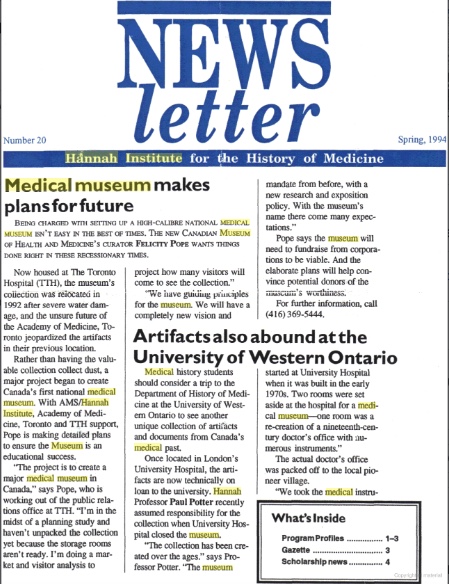
Medical museum makes plans for future

By David South

Hannah Institute for the History of Medicine Newsletter (Toronto, Canada), Number 20, Spring, 1994

Being charged with setting up a high-calibre national medical museum isn’t easy in the best of times. The new Canadian Museum of Health and Medicine’s curator Felicity Pope wants things done right in these recessionary times. 

Now housed at The Toronto Hospital (TTH), the museum’s collection was relocated in 1992 after severe water damage, and the unsure future of the Academy of Medicine, Toronto jeopardized the artifacts in their previous location. 

Rather than having the valuable collection collect dust, a major project began to create Canada’s first national medical museum. With AMS/Hannah Institute, Academy of Medicine, Toronto and TTH support, Pope is making detailed plans to ensure the museum is an educational success. 

“The project is to create a major medical museum in Canada,” says Pope, who is working out of the public relations office at TTH. “I’m in the midst of a planning study and haven’t unpacked the collection yet because the storage rooms aren’t ready. I’m doing a market and visitor analysis to project how many visitors will come to see the collection.”

“We have guiding principles for the museum. We will have a completely new vision and mandate from before, with a new research and exposition policy. With the museum’s name there come many expectations.”

Pope says the museum will need to fundraise from corporations to be viable. And the elaborate plans will help convince potential donors of the museum’s worthiness. 

Artifacts also abound at the University of Western Ontario 

Medical history students should consider a trip to the Department of History of Medicine at the University of Western Ontario to see another unique collection of artifacts  and documents from Canada’s medical past. 

Once located in London’s University Hospital, the artifacts are now technically on loan to the university. Hannah Professor Paul Potter recently assumed responsibility for the collection when University Hospital closed the museum. 

“The collection has been created over the ages,” says Professor Potter. “The museum started at University Hospital when it was built in the early 1970s. Two rooms were set aside at the hospital for a medical museum – one room was a re-creation of a nineteenth-century doctor’s office with numerous instruments.”

The actual doctor’s office was packed off to the local pioneer village. 

“We took the medical instruments and doctors’ ledgers. I took the things that were more interesting from a medical history perspective.”

And what’s there to see? For shock value there are the gruesome instruments of Victorian medicine – bloodletting knives and cups and surgical saws. Also on display is London’s first electro-cardiogram machine and microscopes dating back to the mid-1800s. 

For Professor Potter, the collection livens up medical school lectures and provides a valuable research resource at the university.

Creative Commons License

This work is licensed under a
Creative Commons Attribution-Noncommercial-No Derivative Works 3.0 License.

ORCID iD: https://orcid.org/0000-0001-5311-1052.

© David South Consulting 2022