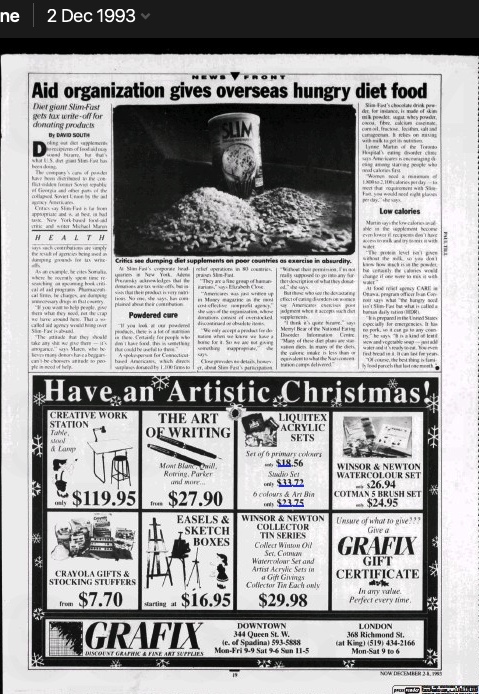
Doling out diet supplements to recipients of food aid may sound bizarre, but that’s what US diet giant Slim-Fast has been doing.
The company’s cans of powder have been distributed to the conflict-ridden former Soviet republic of Georgia and other parts of the collapsed Soviet Union by the aid agency Americares.
Critics say Slim-Fast is far from appropriate and is, at best, in bad taste. New York-based food-aid critic and writer Michael Maren says such contributions are simply the result of agencies being used as dumping grounds for tax write-offs.
As an example, he cites Somalia, where he recenly spent time researching an upcoming book critical of aid programs. Pharmaceutical firms, he charges, are dumping unnecessary drugs in that country.
“If you want to help people, give them what they need, not the crap we have around here. That a so-called aid agency would bring over Slim-Fast is absurd.
“The attitude that they should take any shit we give them – it’s arrogance,” says Maren, who believes many donors have a beggars-can’t-be-choosers attitude to people in need of help.
At Slim-Fast’s corporate headquarters in New York, Adena Pruzansky acknowledges that the donations are tax write-offs, but insists that their product is very nutritious. No one, she says, has complained about their contribution.
Powdered cure
“If you look at our powdered products, there is a lot of nutrition in there. Certainly for people who don’t have food, this is something that could be useful to them.”
A spokesperson for Connecticut-based Americares, which directs surpluses donated by 1,100 firms to relief operations in 80 countries, praises Slim-Fast.
“They are a fine group of humanitarians,” says Elizabeth Close.
“Americares was just written up in Money magazine as the most cost-effective nonprofit agency,” she says of the organization, whose donations consist of overstocked, discontinued or obsolete items.
“We only accept a product for donation when we know we have a home for it. So we are not giving something inappropriate,” she says.
Close provides no details, however, about Slim-Fast’s participation. “Without their permission, I’m not really supposed to go into any further description of what they donated,” she says.
But those who see the devastating effects of eating disorders on women say Americares exercises poor judgement when it accepts such diet supplements.
“I think it’s quite bizarre,” says Merryl Bear of the National Eating Disorder Information Centre. “Many of these diet plans are starvation diets. In many of the diets, the caloric intake is less than or equivalent to what the Nazi concentration camps delivered.”
Slim-Fast’s chocolate drink powder, for instance, is made of skim milk powder, sugar, whey powder, cocoa, fibre, calcium caseinate, corn oil, fructose, lecithin, salt and carrageenan. It relies on mixing with milk to gets its nutrition.
Lynne Martin of the Toronto Hospital’s eating disorder clinic says Americares is encouraging dieting among starving people who need calories first.
“Women need a minimum of 1,800 to 2,100 calories per day – to meet that requirement with Slim-Fast, you would need eight glasses per day,” she says.
Low calories
Martin says the low calories available in the supplement become even lower if recipients don’t have access to milk and try to mix it with water.
“The protein level isn’t given without the milk, so you don’t know how much is in the powder, but certainly the calories would change if one were to mix it with water.”
At food relief agency CARE in Ottawa, program officer Ivan Connoir says what “the hungry need isn’t Slim-Fast but what is called a human daily ration (HDR).
“It is prepared in the United States especially for emergencies. It has no pork, so it can go to any country,” he says. “It is a kind of lentil stew and vegetable soup – just add water and it’s ready to eat. You even find bread in it. It can last for years.
“Of course the best thing is family food parcels that last one month.”
Now Magazine (Toronto, Canada), December 2-8, 1993.
We were able to identify numerous trends that were at the time being overlooked or under-reported; trends that could radically re-shape international development. This included the rapid rise ofmobile phonesin the global South and their powerful impact on economic development, the rush to cities and urban areas that was turning the world into a majority urban place, and the shift to greater South-South trade, investment and contact. Whereas the past involved people always looking North for inspiration, capital and business and trade relationships, this was shifting to South-South arrangements. And there were plenty of inspirational, modern, 21st century examples of economic, social and human development achievements across the global South to report on. By consistently tracking and chronicling a quiet revolution underway in the global South, the e-newsletter was able to draw attention to a rising 21st-century global innovator culture being shaped by the use of mobile phones and information technologies. Few at the time had grasped how much this was going to reshape the international development paradigm.
To start, the e-newsletterDevelopment Challenges, South-South Solutions(begun in 2006), was used to gather together as many stories, data, trends, and contacts as possible and get this message to as wide a group as possible. Luckily, this coincided with the very moment whole swathes of the global South were coming online, either through connecting with mobile phones or through the Internet. Quickly, it became clear there was not a lack of inspiring stories and innovations and solutions to share, but a lack of resources to communicate them. One solution was to utilise a new publishing tool that emerged in 2007: crowd-powered news services. It became a great way to bypass the stranglehold on news and information held by traditional media. Read more on this here:http://www.scribd.com/doc/251968773/Southern-Innovator-Summary-of-Impact-2011-to-2012
In particular, the e-newsletter caught the eye of those looking for inspiration in the wake of the 2007/2008 global economic crisis:
“Great economic and business reporting! Very helpful for us.” Africa Renewal, Africa Section, Strategic Communications Division, United Nations Department of Public Information
“I just went over your June newsletter. It’s very well done and far reaching. Congratulations!” Violette Ruppanner, Director, 3D -> Trade – Human Rights – Equitable Economy, Geneva, Switzerland
“Just to let you know I enjoyed the newsletter a lot – it was interesting to learn about things going on that I would never otherwise find out about, and also the listing of future conferences and events proved very useful.” Ian Sanderson, Deloitte, Geneva, Switzerland
“Congratulations on another great newsletter that’s packed with fascinating information! I really enjoy getting it each month.” Whitney Harrelson, Making Cents, Washington D.C.
2008: Development work begins on the concept for a book on innovation in the global South. Attend an Africa trade-focused meeting in Switzerland just as the global crisis breaks. Witness attendees dash from the event as they get frantic calls from London and New York. Undertake Cuba study tour with the BSHF.
2009: The book concept becomes a magazine. Attend the UN Conference on the Social and Political Dimensions of the Global Crisis: Implications for Developing Countries in Geneva, Switzerland.
2010: Begin working with graphic designer and illustrator Solveig Rolfsdottir and graphic designer Eva Hronn Gudnadottir in Reykjavik, Iceland on the initial concepts for what would become Southern Innovator. The working title for the new magazine is Creative Sparks.
2014: The fifth issue ofSouthern Innovatoris launched at the Global South-South Development Expo (GSSD Expo) in Washington, D.C.. Southern Innovator has always tried to inspire others to take action and this has turned out to be the case.
“Beautiful, inspiring magazine from UNDP on South-South innovation. Heart is pumping adrenaline and admiration just reading it”
Once blazing a lonely trail, there are now many places to find stories on global South innovation (The Guardian, SciDev, Devex, Business Fights Poverty, Zunia etc.). Mainstream media have also woken up to the energy and change sweeping across the global South, disrupting its regular diet of negative news stories focused around war, disasters and failure (unfortunately, still the majority of what most people see on their TV).
“I liked your latest Southern innovator! Always inspiring.”
“Btw, I really enjoyed reading them, impressive work & a great resource. Looking forward to Issue 6. My best wishes to you & your team at SI.”
“The magazine looks fantastic, great content and a beautiful design!”
Most importantly, it is the young who have told us they ‘get’ Southern Innovator. It portrays a world they know – comfortable with new technologies, looking to solve problems, open to doing things in new ways. And it is that audience that excites us the most: the youth of the global South (Africa’s young population will be a huge contributor to the world’s working-age workforce by 2050): they are shaping the new world we live in and seeking a role in it.
On Twitter, comments included: From @CapacityPlus Nice job RT @ActevisCGroup: RT @UNDP: Great looking informative @SouthSouth1 mag on South-South Innovation; @UNDP Great looking informative @SouthSouth1 mag on South-South Innovation; @JeannineLemaire Graphically beautiful & informative @UNDP Southern Innovator mag on South-South Innov.
The phases of this project have been compiled in two e-books and published online here:
2015: In September 2015 (http://www.bbc.co.uk/news/world-asia-china-34372188), China’s President Xi Jinping announced China would spend US $2 billion on South-South cooperation initiatives. This has been called “a ‘game changer’ in international relations”(http://www.ipsnews.net/2015/11/opinion-chinas-new-south-south-funds-a-global-game-changer/).President Xi also said of South-South cooperation, it is: “a great pioneering measure uniting the developing nations together for self-improvement, is featured by equality, mutual trust, mutual benefit, win-win result, solidarity and mutual assistance and can help developing nations pave a new path for development and prosperity.”
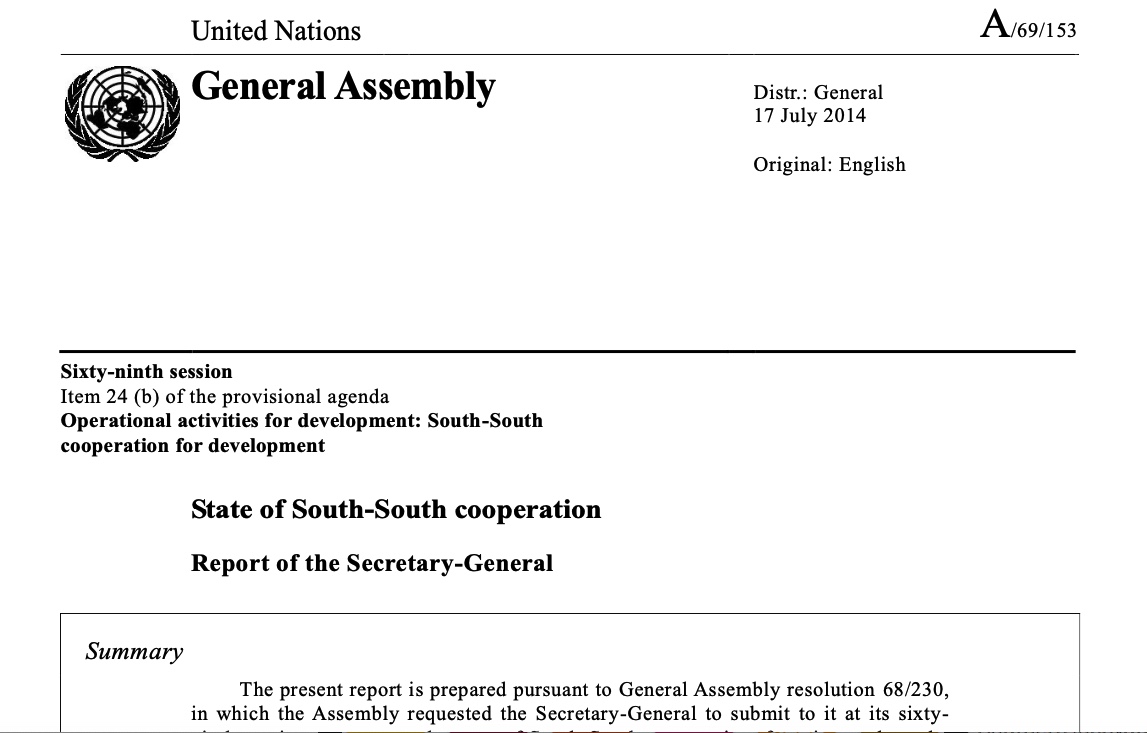
The Southern origins of sustainable development goals: Ideas, actors, aspirations by Sakiko Fukuda-Parr and Bhumika Muchhala (SDG Resource Centre).United Nations General Assembly: Sixty-ninth session, Item 24 (b) of the provisional agenda, Operational activities for development: South-South cooperation for development, 17 July 2014.The research informing Southern Innovator Magazine played a part in the formulation of the UN’s post-2015 development agenda, including the Sustainable Development Goals (SDGs).









You must be logged in to post a comment.