
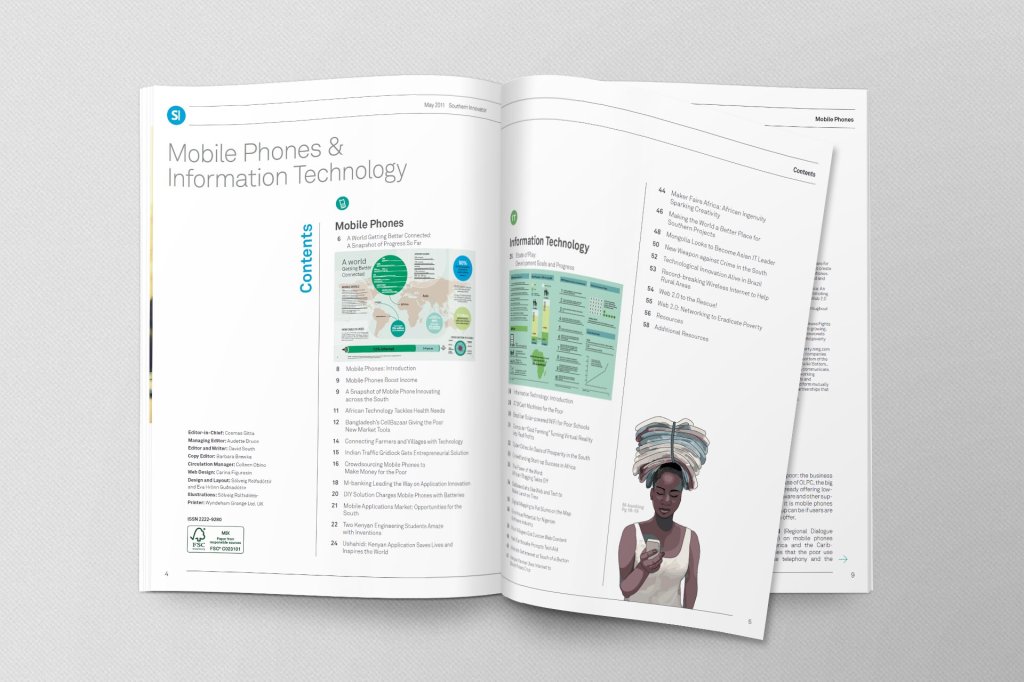
By David South, Development Challenges, South-South Solutions

The pace of change in information technology in the South is impressive, and nowhere has it been more rapid than in the take-up of mobile phones. In the past three years China has become the world’s largest exporter of information and communications technology (ICT), and home to the same number of mobile-phone users (500 million) as the whole of Europe. According to India’s telecoms regulator, half of all urban dwellers now have mobile- or fixed-telephone subscriptions and the number is growing by eight million a month. In Tanzania, mobile phone use grew by 1,600 percent between 2002 and 2008. In Nigeria it grew by almost 7,000 percent over six years, from 5 percent of the population 140 million in 2002, to a predicted 34.3 percent by the first quarter of this year.
But it is the Philippines that has become a global leader in mobile phone commerce. A whole panoply of banking tasks can now be done by mobile phone: transferring funds from one person to another, making small purchases, or paying fees.
“The most significant lesson learned so far,” said Shawn Mendes, lead author on a report titled The Innovative Use of Mobile Applications in the Philippines Lessons for Africa. “Is that m-Banking, rather than more altruistic applications such as m-Health and m-Education, has delivered the greatest benefits to people in developing countries.”
Access to basic banking services is vital for the world’s poor: The Consultative Group to Assist the Poor (CGAP) found that over 3 billion poor people lack access to even the most minimal banking services to manage their lives.
But mobile phones have come to the rescue as the fastest growing consumer product in history. Portio Research estimates that between 2007 and 2012 the number of mobile subscribers will grow by another 1.8 billion, mostly in emerging economies like India and China.
The Philippines is not alone in introducing so-called m-Banking (mobile phone banking) Africa’s leaders include the Democratic Republic of the Congo (CelPay), Kenya (M-PESA), South Africa (MTN MobileBanking and WIZZIT) and Zambia (CelPay).
“Safari-Com’s M-Pesa in Kenya has grown rapidly from start-up in early 2007 to well over 1 million accounts today,” said Mendes, the report author. “In May of this year Vodacom launched M-Pesa in Tanzania for their 4 million subscribers in that country. I expect very rapid growth of this service in Tanzania where less than 10 per cent of the adult population have conventional bank accounts. There are numerous other examples such as CelPay in Zambia and the Congo but I have been watching the success of M-Pesa in East Africa most closely.”
But the Philippines has taken m-Banking the furthest, with two great models for other countries: G-Cash and Smart Money. And the country has shown that it is possible to make these services attractive to the poor, not just the wealthy.
A combination of a good regulatory environment and an atmosphere of innovation brought mobile phone costs down, and made this possible. The mobile phone innovations were also successful because they mimicked existing consumer habits of the poor, piggy-backing on the extensive retail network of small village shops or “sari sari” stores. Poor Filipinos usually buy “tingi” or “sachets” of products like shampoo, fish sauce or soap. And it is in these shops that credit top-up centres were set up and prepaid phone cards sold.
Cleverly, mobile phone operators in the Philippines at first offered free SMS (short message service) text messaging. This was key to how m-Banking took off. As Smart Money’s Napoleon Nazareno said: “there must be an existing SMS habit.”
This should bode well for Africa, where an SMS habit has taken hold because it is so much cheaper than voice calls. Another important habit was prepayment. People learned how to use prepay cards, call numbers and how to enter codes into phones to purchase credits. They learned how to check their credit balance and to electronically load credit on to their phone. This habit made m-Commerce much easier and fuelled its growth.
In South Africa, m-Banking services are revolutionizing daily life. Hair salon owner Andile Mbatha in Soweto used to have to travel for two hours by minibus to a bank to send money to his relatives. But by setting up a bank account with a service called Wizzit, he no longer needs to keep stacks of cash in his salon (and risk robbery), can send money to his sister in Cape Town by phone, and receive payment for hair cuts by phone from his customers. “This has taken out a lot of stress,” said Mr Mbatha.
For Southern entrepreneurs looking to get the most from mobile phones, another recent development will help. Mobile phone companies are following developments with computers and turning away from using only proprietary software, to allowing open source software. Over the next six months, this will mean small-scale entrepreneurs can get in on making applications for mobile phones on a massive scale. Two software companies are now involved: Symbian, which provides the operating system for most of the new generation mobile phones with web access, and Google’s Android open source operating system for mobiles. In Sub-Saharan Africa and East Africa, these applications will help to bypass the lack of internet bandwidth.
In India, poor rural farmers are using mobile phone text messaging to get an advantage over the commodity markets. With so-called “agflation” and “rising prices for food ” it is crucial farmers keep on top of fluctuating commodity prices. Over 250 million Indians rely on farming for survival. But the pressure on farmers is severe and suicide rates are high.
Banana farmer Kapil Jachak is using a text messaging service to get the latest on the weather and daily market prices. The service, Reuters Market Light, costs a dollar a month. It’s a for-profit business venture by the global business news service, but helps farmers make money too. It already has 15,000 customers signed up.
This market knowledge gives the farmers a huge advantage when they compete with the traders in the wholesale markets of the city of Pune. “By getting the weather reports we can see exactly how much water our banana plants need,” said Kapil to the BBC. “I keep my cost down, and get the best crop I can.”
“This has increased my profit. I don’t have to make some headache, and go to any market, any shopkeepers, and wholesalers. I can do my marketing easily and get more and more money.” The service has already armed him with the knowledge to fight off banana stem weevils when they were attacking crops. The text recommended a pesticide.
Published: July 2008
Resources
- Twitter: a way to communicate linking mobile phone communications of up to 140 characters with the web. These free applications help users to set up the service and link with all their other internet applications.
Website: http://twitter.pbwiki.com/Apps - The innovative use of mobile applications in the Philippines Lessons for Africa: A paper from the Swedish International Development Cooperation Agency (Sida) on mobile phone innovation.
Website: http://www.sida.se/sida/jsp/sida.jsp?d=118&a=33306&language=en - Textually.org: a very inspiring website profiling loads of innovations with mobile phones in the developing world.
Website:http://www.textually.org/textually/archives/cat_mobile_phone_projects_third_world.htm - Over 20 tested mobile internet phone applications that are useful and easy to use.
Website: http://mashable.com/2008/01/02/20-mobile-internet-applications/

Development Challenges, South-South Solutions was launched as an e-newsletter in 2006 by UNDP’s South-South Cooperation Unit (now the United Nations Office for South-South Cooperation) based in New York, USA. It led on profiling the rise of the global South as an economic powerhouse and was one of the first regular publications to champion the global South’s innovators, entrepreneurs, and pioneers. It tracked the key trends that are now so profoundly reshaping how development is seen and done. This includes the rapid take-up of mobile phones and information technology in the global South (as profiled in the first issue of magazine Southern Innovator), the move to becoming a majority urban world, a growing global innovator culture, and the plethora of solutions being developed in the global South to tackle its problems and improve living conditions and boost human development. The success of the e-newsletter led to the launch of the magazine Southern Innovator.



This work is licensed under a
Creative Commons Attribution-Noncommercial-No Derivative Works 3.0 License.
ORCID iD: https://orcid.org/0000-0001-5311-1052.
© David South Consulting 2022


 David South Consulting
You must be logged in to post a comment.