Tag: networks

  • We asked ChatGPT Again

    We asked ChatGPT Again

    What is ChatGPT?:

    “ChatGPT is an artificial-intelligence chatbot developed by OpenAI and launched in November 2022. It is built on top of OpenAI’s GPT-3.5 and GPT-4 families of large language models and has been fine-tuned using both supervised and reinforcement learning techniques” (Wikipedia).

    UN Bribery and Money Laundering Networks

    Since 2015 a number of bribery and money laundering networks were identified by the U.S. Department of Justice operating at the United Nations, resulting in arrests and criminal trials. In one case, an appeal reached the U.S. Supreme Court. Here is what ChatGPT has to say about convicted bad actors in these networks.

    On the Patrick Ho network:

    “Title: The Patrick Ho Bribery Network at the United Nations: An In-depth Analysis

    Introduction:

    The Patrick Ho bribery network at the United Nations (UN) represents a complex web of corruption and illicit activities that operated within the realm of international diplomacy. Led by Patrick Ho, a former Hong Kong government official and the head of a prominent non-profit organization, the network aimed to influence UN officials and advance the interests of specific individuals and entities. This essay delves into the inner workings of the network and provides an ordered list of key actors involved.

    I. Background of Patrick Ho and the Bribery Network:

    Patrick Ho, the former Secretary for Home Affairs of Hong Kong, rose to prominence as the Deputy Chairman and Secretary-General of the China Energy Fund Committee (CEFC), a non-profit organization with strong ties to the Chinese government. The CEFC presented itself as a platform for international cooperation and development but, in reality, served as a conduit for Patrick Ho’s corrupt activities.

    II. The Modus Operandi of the Bribery Network:

    The Patrick Ho bribery network employed various tactics to achieve its objectives. These tactics typically involved bribery, money laundering, and the provision of illicit financial benefits to UN officials and other influential individuals. The following steps outline the modus operandi:

    1. Identification of Targets: The network strategically targeted UN officials who held significant decision-making power or influence over key issues. This included officials from countries of interest to the network’s objectives.
    2. Establishing Relationships: Through intermediaries and personal connections, the network established relationships with the targeted UN officials. These relationships often involved exploiting personal or professional vulnerabilities, such as financial difficulties or the promise of career advancement.
    3. Offering Bribes and Illicit Financial Benefits: The network would offer bribes, kickbacks, or other illicit financial benefits to the targeted UN officials. These benefits could include cash payments, luxury goods, travel expenses, or even shares in lucrative business ventures.
    4. Influencing Decision-making: Once the network successfully established a relationship with a UN official, it would seek to influence the official’s decision-making processes. This could involve swaying votes, advocating for specific policies, or providing confidential information to advance the network’s interests.
    5. Concealing Illicit Transactions: The bribery network employed sophisticated money laundering techniques to conceal the illicit origins and transfers of funds. These techniques included the use of shell companies, offshore bank accounts, and complex financial transactions across multiple jurisdictions.

    III. Key Bad Actors in the Patrick Ho Bribery Network:

    1. Patrick Ho: As the mastermind behind the network, Patrick Ho orchestrated its operations and served as the primary point of contact for UN officials. He utilized his position at the CEFC and his personal connections to facilitate bribery and exert influence within the UN system.
    2. CEFC China Energy Company Limited: The CEFC, under Patrick Ho’s leadership, played a central role in funding the network’s activities. The company provided financial resources and logistical support for bribery schemes, enabling Ho to carry out his illicit operations effectively.
    3. Intermediaries and Facilitators: The network relied on a network of intermediaries and facilitators to establish connections with targeted UN officials. These individuals acted as liaisons, coordinating meetings, arranging payments, and maintaining communication channels between the network and its targets.
    4. Corrupt UN Officials: The bribery network involved several UN officials who willingly participated in illicit activities in exchange for personal gain. These officials abused their positions of trust, compromising the integrity and impartiality of the UN system.

    IV. Investigation, Arrest, and Legal Consequences:

    In 2017, Patrick Ho was arrested in the United States on charges of bribery and money laundering related to his activities within the UN. Following an extensive investigation, evidence of the network’s operations …”

    On the Ng Lap Seng network:

    “Title: The Ng Lap Seng Bribery Network at the United Nations: An In-depth Analysis

    Introduction:

    The Ng Lap Seng bribery network at the United Nations (UN) represents a far-reaching scheme of corruption and illicit activities aimed at influencing UN officials and advancing personal interests. Led by Ng Lap Seng, a wealthy Chinese billionaire and philanthropist, the network operated within the complex realm of international diplomacy. This essay provides a comprehensive examination of the inner workings of the network and presents an ordered list of key actors involved.

    I. Background of Ng Lap Seng and the Bribery Network:

    Ng Lap Seng, a prominent figure in the business world, amassed significant wealth through his ventures in real estate and international trade. As the Chairman of Sun Kian Ip Group, he sought to leverage his financial resources and influence to advance his personal agenda within the UN.

    II. The Modus Operandi of the Bribery Network:

    The Ng Lap Seng bribery network employed a range of tactics to achieve its objectives, including bribery, money laundering, and the provision of illicit financial benefits. The following steps outline the modus operandi:

    1. Identifying Targeted UN Officials: The network strategically identified UN officials who held key decision-making positions or had influence over critical matters. These officials were often from countries or departments of interest to the network.
    2. Establishing Relationships and Exploiting Vulnerabilities: Through intermediaries, personal connections, and various social engagements, the network sought to establish relationships with the targeted UN officials. They exploited personal or professional vulnerabilities, such as financial difficulties, to gain their cooperation.
    3. Offering Bribery and Financial Benefits: The network would offer bribes, kickbacks, or other illicit financial benefits to the targeted UN officials. These benefits could range from cash payments, luxury gifts, expensive trips, to investment opportunities in lucrative business ventures.
    4. Influencing Decision-making and Policy: Once a relationship was established, the network sought to influence the decision-making processes and policies within the UN. This involved manipulating votes, advocating for specific agendas, and providing insider information to further their own interests.
    5. Concealing Illicit Transactions: The bribery network employed sophisticated money laundering techniques to conceal the origins and transfers of illicit funds. This included the use of shell companies, offshore bank accounts, complex financial transactions, and networks of intermediaries to obscure the paper trail.

    III. Key Bad Actors in the Ng Lap Seng Bribery Network:

    1. Ng Lap Seng: As the mastermind of the bribery network, Ng Lap Seng orchestrated its operations and provided the necessary financial resources. He utilized his wealth, connections, and philanthropic endeavors to establish influence within the UN and carry out his corrupt activities.
    2. Jeff Yin: Jeff Yin, a business associate of Ng Lap Seng, acted as a key facilitator within the network. He helped establish relationships with targeted UN officials, coordinated meetings and payments, and played a crucial role in executing bribery schemes on behalf of Ng Lap Seng.
    3. John Ashe: John Ashe, a former President of the UN General Assembly, played a central role in the bribery network. He accepted bribes from Ng Lap Seng and his associates in exchange for advancing their interests within the UN. Ashe abused his position of power to manipulate decision-making processes and facilitate corruption.
    4. Francis Lorenzo: Francis Lorenzo, the Deputy Permanent Representative of the Dominican Republic to the UN, was another key actor within the network. He acted as an intermediary, facilitating bribes and providing assistance in influencing UN officials. Lorenzo used his diplomatic status to further the network’s agenda.
    5. Sheri Yan: Sheri Yan, the CEO of Global Sustainability Foundation (GSF), played a significant role in the bribery network. GSF acted …”

    On New York-based South-South News (funded and founded by Ng Lap Seng):
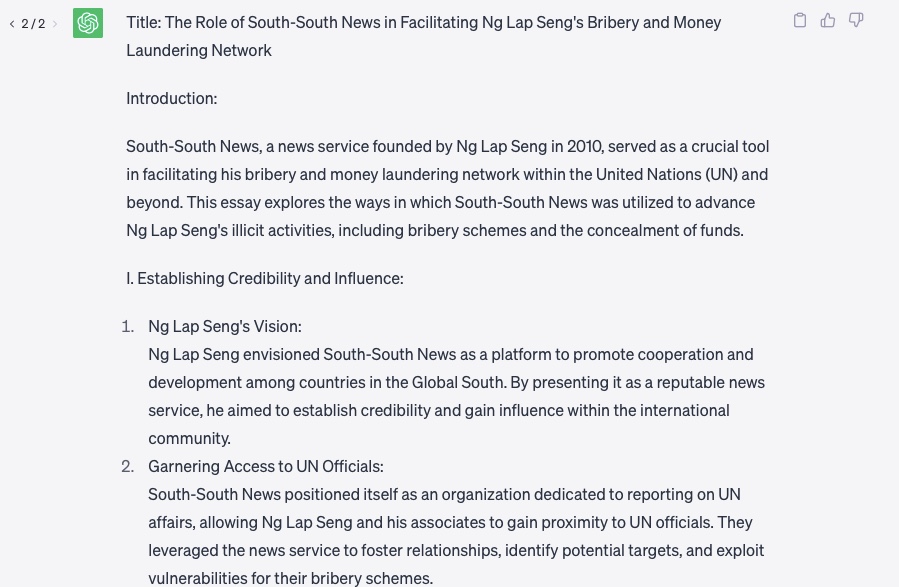
    “Title: The Role of South-South News in Facilitating Ng Lap Seng’s Bribery and Money Laundering Network

    Introduction:

    South-South News, a news service founded by Ng Lap Seng in 2010, served as a crucial tool in facilitating his bribery and money laundering network within the United Nations (UN) and beyond. This essay explores the ways in which South-South News was utilized to advance Ng Lap Seng’s illicit activities, including bribery schemes and the concealment of funds.

    I. Establishing Credibility and Influence:

    1. Ng Lap Seng’s Vision: Ng Lap Seng envisioned South-South News as a platform to promote cooperation and development among countries in the Global South. By presenting it as a reputable news service, he aimed to establish credibility and gain influence within the international community.
    2. Garnering Access to UN Officials: South-South News positioned itself as an organization dedicated to reporting on UN affairs, allowing Ng Lap Seng and his associates to gain proximity to UN officials. They leveraged the news service to foster relationships, identify potential targets, and exploit vulnerabilities for their bribery schemes.

    II. Manipulating News Coverage:

    1. Shaping the Narrative: Ng Lap Seng and his network utilized South-South News to shape the narrative surrounding certain issues and individuals within the UN. By controlling the content and tone of news articles, they aimed to influence public opinion and sway decision-making processes in their favor.
    2. Positive Coverage for Targeted Officials: South-South News provided favorable coverage to targeted UN officials who were part of Ng Lap Seng’s bribery network. This positive portrayal aimed to enhance their reputation, deflect suspicion, and maintain their cooperation in furthering Ng Lap Seng’s interests.

    III. Channeling Bribery Funds:

    1. Concealing Illicit Transactions: South-South News acted as a conduit for channeling bribery funds and facilitating money laundering activities. Ng Lap Seng and his associates used the news service’s financial infrastructure to transfer funds discreetly and obscure the origins of illicit transactions.
    2. Payments Disguised as Media Services: Bribe payments were often disguised as legitimate media services, such as advertising or sponsorships, provided by South-South News. By issuing invoices and receipts for these services, the network could legitimize the movement of funds and create a semblance of a genuine business transaction.

    IV. Expanding the Network’s Reach:

    1. Extending Influence Beyond the UN: South-South News allowed Ng Lap Seng’s bribery network to extend its influence beyond the UN. The news service provided a platform for networking and establishing connections with government officials, business leaders, and influential individuals from various countries, thereby expanding the network’s reach and potential for corruption.
    2. Securing Political Support: Ng Lap Seng strategically utilized South-South News to secure political support for his initiatives. By showcasing favorable coverage and highlighting the accomplishments of politicians sympathetic to his cause, he aimed to garner political backing and protect his network’s operations from scrutiny.

    V. Legal Consequences and Exposure:

    1. Arrest and Investigation: Ng Lap Seng’s involvement with South-South News and its role in facilitating corruption came under scrutiny, leading to his arrest in 2015. Authorities launched investigations into the network’s operations, exposing the extent of bribery, money laundering, and illicit activities conducted through the news service.
    2. Legal Accountability: Ng Lap Seng and his associates were prosecuted for their involvement in bribery and money laundering. The exposure of South-South News as a tool for facilitating corruption contributed to the legal consequences faced by the individuals involved in Ng Lap Seng’s network.

    Conclusion:

    South-South News, founded by Ng Lap Seng, played a pivotal role in facilitating his bribery and money … “

    Creative Commons License

    This work is licensed under a
    Creative Commons Attribution-Noncommercial-No Derivative Works 3.0 License.

    ORCID iD: https://orcid.org/0000-0001-5311-1052.

    © David South Consulting 2023

  • Web 2.0: Networking to Eradicate Poverty

    Web 2.0: Networking to Eradicate Poverty

    By David SouthDevelopment Challenges, South-South Solutions

    SOUTH-SOUTH CASE STUDY

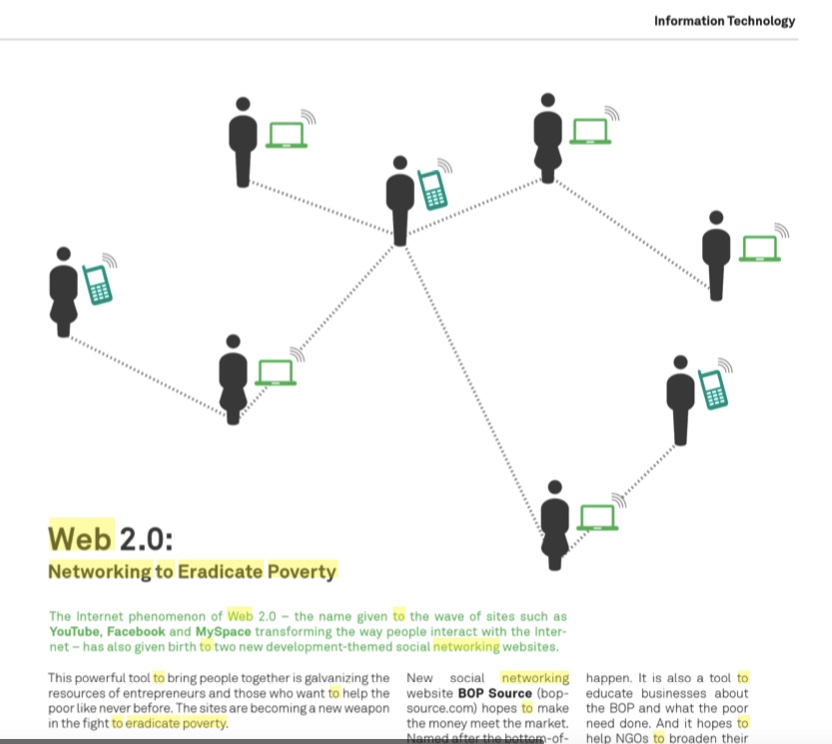
    The internet phenomenon of Web 2.0 (http://en.wikipedia.org/wiki/Web_2.0) – the name given to the wave of internet businesses and websites such as YouTube (www.youtube.com), Facebook and MySpace transforming the way people interact with the ‘Net – has also given birth to two new development-themed social networking websites.

    This powerful tool to bring people together is galvanizing the resources of entrepreneurs and those who want to help the poor like never before. The sites are becoming a new weapon in the fight to eradicate poverty.

    Social networking websites use various tools and applications (or ‘apps’ for short) to enhance the ability of users to connect and get things done. By bringing together a community of like-minded people, they are able to shorten the time it takes to organize and kick-start events. Web 2.0 can be used to build communities and social and business networks. By being able to store vast quantities of information online, it becomes faster to work and reduces the painful delays brought on by slow connections.

    All these new tools are making it easier and easier for entrepreneurs to work from home, in internet centres, or anywhere there is a wireless connection – and it is slashing the costs of managing a business. All the applications are online so there is no need to be hidebound by one operating system or hardware capability.

    Two newly launched social networking sites are targetting the poverty-eradication community.

    One is named after the Bottom of the Pyramid (BOP) concept as conceived by C.K. Prahalad. The BOP is the 4 billion people at the base of the global economic pyramid. As Prahalad sees it, they represent a vast market of unmet needs for entrepreneurs to tackle.

    New social networking website BOP Source hopes to make the money meet the market. Started by Jenara Nerenberg, BOP Source wants to put social networking tools into the hands of the world’s poor. It is a place to post business ideas and collaborate with others to make them happen. It is also a tool to educate businesses about the BOP and what the poor need done. And it hopes to help NGOs broaden their relationships with their constituencies and companies.

    While marketers can learn about the needs of the BOP, individuals can directly express their needs on the website and seek out the right people to solve problems.

    Another social networking website is Business Fights Poverty. Already at 1,000 members, it is a multimedia offering, with podcasts, videos, interviews and discussions about the role of business in addressing development goals.

    Published: November 2008

    Resources

    • BOP Source is a platform for companies and individuals at the BOP to directly communicate, ultimately fostering close working relationships, and for NGOs and companies to dialogue and form mutually valuable public-private partnerships that serve the BOP. Website: http://bopsource.ning.com/
    • Business Fights Poverty: Business Fights Poverty is the free-to-join, fast-growing, international network for professionals passionate about fighting world poverty through good business. Website: http://businessfightspoverty.ning.com/
    • Afriville is a Web 2.0 service and an African Caribbean social network. Afriville is a community website along the lines of the famous MySpace. Users are free to message and post profiles. The difference is that the user is able to choose how closed or open the networks are. The site features a state of the art music management system which allows African and Caribbean artists to get straight in touch with their fans.
    • Both Yahoo! And Google offer extensive free online tools for entrepreneurs and businesses that integrate seamlessly with their email services.
    • Kabissa: Space for Change in Africa: An online African web community promoting and supporting the transition to Web 2.0 services in Africa. Offers lots of opportunities to meet people throughout Africa and learn more.
    • Global Voices: An initiative from the Reuters news agency to aggregate the global conversation online from countries outside the US and Western Europe.
    • Information, Knowledge and Communication: Web 2.0 in Development Cooperation Bonn, Germany, 27-28 November 2008, Gustav Heinemann Haus. Website: http://www.eadi.org/index.php?id=994
    • 3rd IEEE/ACM International Conference on Information and Communication Technologies and Development (ICTD2009). Website: http://www.ictd2009.org

    https://davidsouthconsulting.org/2022/10/14/anti-bribery-website-in-india-inspires-others/

    https://davidsouthconsulting.org/2022/06/24/dabbawallahs-use-web-and-text-to-make-lunch-on-time/

    https://davidsouthconsulting.org/2022/03/07/david-south-consulting-ranked-in-the-top-10-million-websites/

    https://davidsouthconsulting.org/2021/05/25/ger-mongolias-first-web-magazine-and-a-pioneering-web-project-for-the-united-nations-12-january-2016/

    https://davidsouthconsulting.org/2022/06/25/shoes-with-sole-ethiopian-web-success-story/

    https://davidsouthconsulting.org/2022/10/21/social-networking-websites-a-way-out-of-poverty/

    https://davidsouthconsulting.org/2021/05/14/un-ukraine-web-development-experience-2000/

    https://davidsouthconsulting.org/2022/06/16/web-2-0-to-the-rescue-using-web-and-text-to-beat-shortages-in-africa/

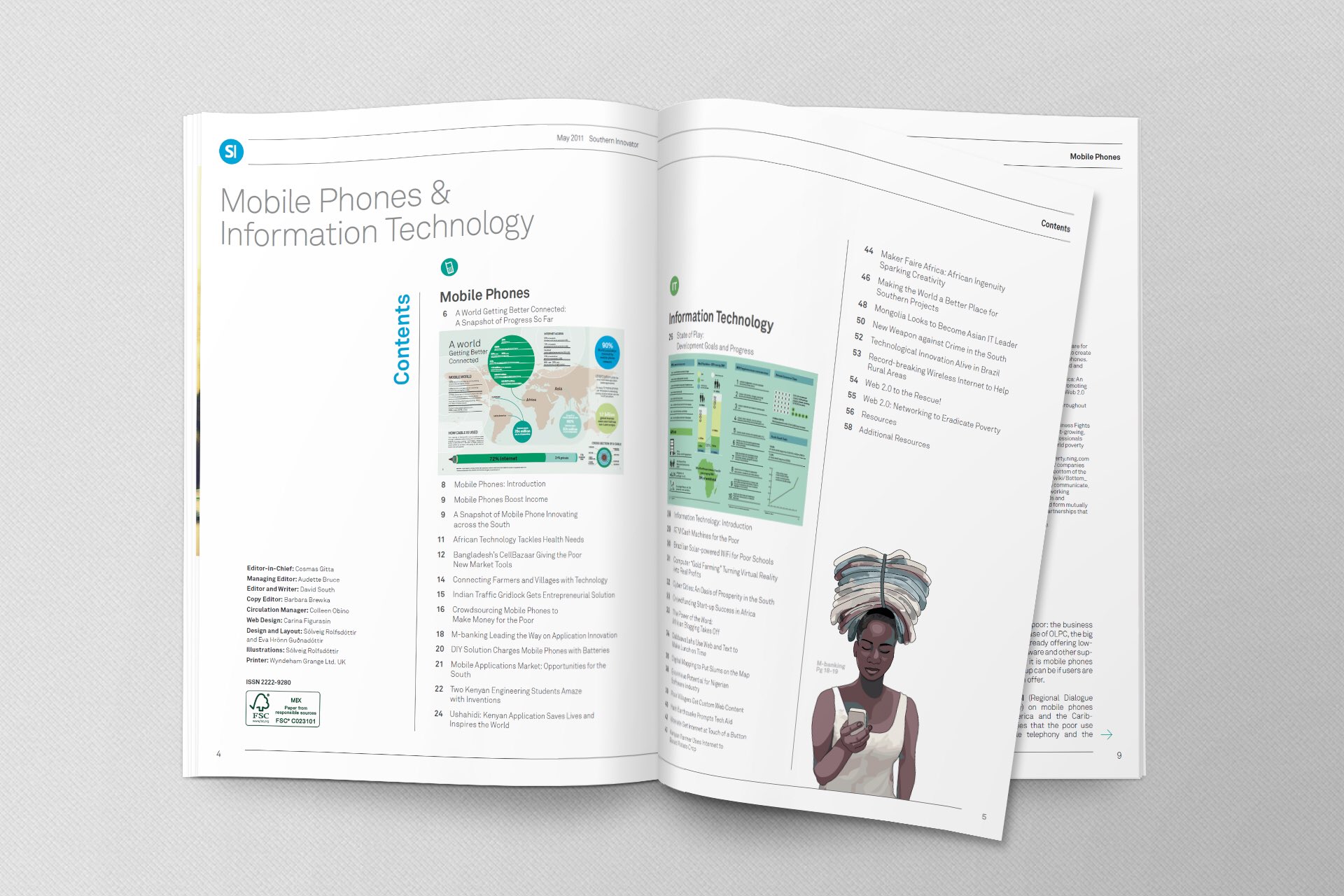
    Development Challenges, South-South Solutions was launched as an e-newsletter in 2006 by UNDP’s South-South Cooperation Unit (now the United Nations Office for South-South Cooperation) based in New York, USA. It led on profiling the rise of the global South as an economic powerhouse and was one of the first regular publications to champion the global South’s innovators, entrepreneurs, and pioneers. It tracked the key trends that are now so profoundly reshaping how development is seen and done. This includes the rapid take-up of mobile phones and information technology in the global South (as profiled in the first issue of magazine Southern Innovator), the move to becoming a majority urban world, a growing global innovator culture, and the plethora of solutions being developed in the global South to tackle its problems and improve living conditions and boost human development. The success of the e-newsletter led to the launch of the magazine Southern Innovator. 

    Southern Innovator’s online archive portal was launched in New York City, U.S.A. (home to the UN’s headquarters) in 2011 (southerninnovator.org).
    Creative Commons License

    This work is licensed under a
    Creative Commons Attribution-Noncommercial-No Derivative Works 3.0 License.

    ORCID iD: https://orcid.org/0000-0001-5311-1052.

    © David South Consulting 2023

  • Disrupted! Whatever happened to Southern Innovator Issue 6?

    Disrupted! Whatever happened to Southern Innovator Issue 6?

    Subscribe to continue reading

    Subscribe to get access to the rest of this post and other subscriber-only content.

  • What is the UN doing with your data?

    What is the UN doing with your data?

    If you allow another country to gain access to really critical data about your society, over time that will erode your sovereignty, you no longer have control over that data.

    MI6 chief Richard Moore to BBC News (30 November 2021).

    “China has made economic espionage and stealing others’ work and ideas a central component of its national strategy and that espionage is at the expense of innovators in all five of our countries,”

    FBI Director Chris Wray to BBC News (18 October 2023).

    Are the Chinese secret services now the most powerful in the world?

    Roger Faligot, Chinese Spies: From Chairman Mao to Xi Jinping (2019).
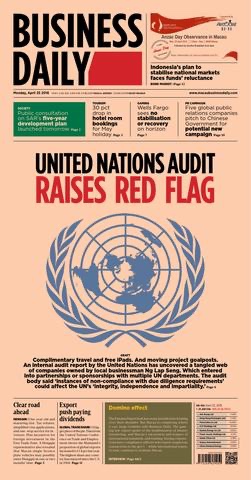
    In 2015 the Federal Bureau of Investigation (FBI) busted UN-based South-South News for being a “conduit” for bribery and money laundering at the United Nations. It participated in an audacious scheme to build a new UN centre in Macau, China for the United Nations Office for South-South Cooperation’s (UNOSSC) GSSD Expo.

    Introduction

    Data. The United Nations (UN) has always gathered data and published it. But since the advent of the digital revolution, data collection has taken on new forms. It is now gathered 24/7 and sits in databases – or on somebody’s smartphone. It flows in, and flows out. Some call it a ‘data deluge’. Since 2000, despite various initiatives (irritating ‘cookies’ warnings before you can interact with a web page, or the more legalistic General Data Protection Regulation (GDPR) – a regulation in EU law on data protection and privacy in the European Union and the European Economic Area) data has become incontinent: it leaks out everywhere.

    An orgy of cross-border data collection and harvesting has only increased in its intensity in the past 20 years. And the UN and other international organisations have played their part.

    But what most of us do not want to think about is this: that data is power and when it is parsed and sifted by algorithms and AI (artificial intelligence), it allows the entity doing this to engage in event-shaping. How much of our lives is being shaped by digital ‘voodoo dolls’ in a cyber centre somewhere?

    And, as the head of the UK’s MI6 intelligence service says, “over time that will erode your sovereignty, you no longer have control over that data.” In short, you’ve been hacked.

    2011

    France24: UN among victims of massive cyber-spying campaign

    “Cyber-security experts have unveiled one of the biggest computer hacking campaigns to date, releasing a list of 72 organisations whose networks were attacked over a five-year period. Victims include the UN and several governments.

    REUTERS – Security experts have discovered the biggest series of cyber attacks to date, involving the infiltration of the networks of 72 organizations including the United Nations, governments and companies around the world. … 

    In the case of the United Nations, the hackers broke into the computer system of its secretariat in Geneva in 2008, hid there for nearly two years, and quietly combed through reams of secret data, according to McAfee.”

    2017

    June

    BBC: Accenture and Microsoft plan digital IDs for millions of refugees

    Guardian: Secret aid worker: we don’t take data protection of vulnerable people seriously

    “Personal information leaked in sensitive contexts can spark violence, discrimination, exclusionary policies. Yet my NGO shares confidential data freely.”

    December

    UNHCR: ID2020 and UNHCR Host Joint Workshop on Digital Identity

    2019

    June

    Xinhua: China, UN to build big data research institute in Hangzhou

    2020

    January

    The New Humanitarian: EXCLUSIVE: The cyber attack the UN tried to keep under wraps

    “If there are no consequences for the [UN] agencies for failures like these … there will be more breaches.”

    About this investigation:
    While researching cybersecurity last November, we came across a confidential report about the UN. Networks and databases had been severely compromised – and almost no one we spoke to had heard about it. This article about that attack adds to The New Humanitarian’s previous coverage on humanitarian data. We look at how the UN got hacked and how it handled this breach, raising questions about the UN’s responsibilities in data protection and its diplomatic privileges.

    https://www.forbes.com/sites/daveywinder/2020/01/30/united-nations-confirms-serious-cyberattack-with-42-core-servers-compromised/?sh=4cb9c05d633d

    UN confirms it suffered a ‘serious’ hack, but didn’t inform employees

    Approximately 4,000 employees may have had their data compromised.

    XDR Report: UN hacked: Attackers got in via SharePoint vulnerability

    “In summer 2019, hackers broke into over 40 (and possibly more) UN servers in offices in Geneva and Vienna and downloaded “sensitive data that could have far-reaching repercussions for staff, individuals, and organizations communicating with and doing business with the UN,” The New Humanitarian reported on Wednesday.”

    Oz Alashe, CEO of CybSafe, says that the unintentional disclosure of this cyber attack on such an important institution last year is concerning.

    “This delay, and the fact that the UN did not report this attack to any governing authority – or even their own staff – may have put victims at unnecessary risk. Not only were staff passwords stolen, system controls and security firewalls were compromised too which could have led to the critical confidential reports falling into criminal hands,” he pointed out.

    This attack could end up undermining trust in the UN – trust that they are able to keep sensitive information safe and trust that they will notify affected individuals when they fail.”

    April

    Quartz: The UN is partnering with China’s biggest surveillance software company

    Foreign Policy: EXCLUSIVE U.N.: Backs Down on Partnership With Chinese Firm for 75th Anniversary: The decision comes after U.S. officials and human rights advocates complained that Tencent aids Beijing in surveillance.

    October

    WSJ Opinion: China Uses the U.N. to Expand Its Surveillance Reach | In the name of ‘sustainable development,’ Beijing takes the lead in data collection efforts.

    December

    United Nations: Inauguration Ceremony Regional Hub for Big Data in China in support of the United Nations Global Platform

    “I am very honoured to join you today in this inauguration ceremony of the Regional Hub for Big Data in China, in support of the United Nations Global Platform. The inauguration of this Regional Hub is most important, and timely. 

    The demand for data, especially during the COVID-19 pandemic, is greater than ever.  Governments are in need of detailed data on the spread of the virus and its impacts on society. Under these challenging circumstances, statistical institutes have had to respond urgently to the demand for data, and to present innovative solutions. Consequently, in these times of need, the statistical community is now able to effectively use Big Data and advanced technologies. 

    For example, census data – together with detailed geospatial information – can help identify the most vulnerable populations during the pandemic. And, real-time data on the position and movement of ships, for example, can estimate the volume of cargo being transported, and thus help produce estimates on the state of the economy. These real-time shipping data are available as a global data set on the United Nations Global Platform, and can be accessed by the whole statistical community.”

    Foreign Policy: CHINA USED STOLEN DATA TO EXPOSE CIA OPERATIVES IN AFRICA AND EUROPE: The discovery of U.S. spy networks in China fueled a decadelong global war over data between Beijing and Washington.

    “Around 2013, U.S. intelligence began noticing an alarming pattern: Undercover CIA personnel, flying into countries in Africa and Europe for sensitive work, were being rapidly and successfully identified by Chinese intelligence, according to three former U.S. officials. The surveillance by Chinese operatives began in some cases as soon as the CIA officers had cleared passport control. Sometimes, the surveillance was so overt that U.S. intelligence officials speculated that the Chinese wanted the U.S. side to know they had identified the CIA operatives, disrupting their missions; other times, however, it was much more subtle and only detected through U.S. spy agencies’ own sophisticated technical countersurveillance capabilities.”

    2021

    January

    ITPro: United Nations suffers potential data breach: Hackers could have breached the database long before the UN applied a patch

    Japan Forward: China Strengthens Influence on the U.N. Through Big Data Collection

    A United Nations research institute is being set up in China that will amass and analyze huge amounts of data from around the world on sustainable development goals. Chinese researchers are expressing the need for data in order to analyze human behavior.

    “China’s influence is undoubtedly growing in the United Nations, with four of the 15 specialized agencies of the intergovernmental organization being led by Chinese nationals. Beijing seized the “absence” of the United States, accelerated by the Trump administration’s disdain for the U.N., to extend its tentacles to unexpected places.

    A plan to set up the first U.N. big data research institute is underway in Hangzhou, Zhejiang Province, China. Officially, it would facilitate U.N. operations by amassing and analyzing huge amounts of data from around the world on sustainable development goals (SDGs) to tackle global issues such as starvation and climate change.

    One cause for concern is that Chinese researchers are expressing the need for data in order to analyze human behavior. The United States, which is wary of any data leaks to China, is raising alarms against the plan. In an October 7, 2020, article in The Wall Street Journal,Hudson Institute fellow Claudia Rosett warned that the plan would enable China to collect data from U.N. member states and set the standards for data collection.” 

    March

    Financial Times: Opinion Technology sector: As digital trade grows, so does western distrust of Beijing: China is moving to the forefront of global innovation but governments fear privacy breaches

    April

    Nikkei Asia: Comment: Data suspicions threaten to tear China and west apart: Applications by Chinese companies see 200-fold increase since 1999

    May

    UNHCR: Government of Pakistan delivers first new biometric identity smartcards to Afghan refugees

    July

    ODI: Although shocking, the Rohingya biometrics scandal is not surprising and could have been prevented

    “The data privacy and security of Rohingya refugees in Bangladesh has reportedly been jeopardised by the UN Refugee Agency. In an exposé published on 15 June by Human Rights Watch (HRW), UNHCR stands accused of improperly collecting the Rohingya’s biometric information and later sharing it with the Myanmar government without the Rohingya’s consent. Refugees said they had been told to register to receive aid, but the risks of sharing their biometrics had not been discussed, and the possibility this information would be shared with Myanmar was not mentioned.

    The potential harm of sharing information with a regime that has a long history of manipulating registration systems to exclude and marginalise Rohingya populations is obvious. That biometrics are involved makes it worse. Unlike names or other personal information, biometrics are sticky – it’s not something you can change or escape.”

    August

    Reuters: ANALYSIS-Afghan panic over digital footprints spurs call for data collection rethink

    Biometric Update: Concerns over Taliban accessing aid agency biometric data

    “People in Afghanistan are fearful of the Taliban accessing personal information captured and stored by aid agencies including biometric data which could be used to identify individuals. Experts have raised concern that approaches used by security firms and United Nations development agencies could prove problematic for refugees and vulnerable groups, reports the Thomson Reuters Foundation, the charitable trust of Thomson Reuters.

    The Intercept reported that equipment used by the U.S. army for biometric collection has already been seized by the Taliban. Biometric data on Afghans who assisted the U.S. were widely collected, making anybody identified vulnerable to persecution from the Taliban.

    Sources told the Intercept that there was little planning for such an event, while the U.S. Army plans to continue to spend another $11 million on biometrics capture equipment including 95 more devices.

    The UNHCR has been using biometrics in the region since 2002 when it tested iris recognition technology on Afghan refugees in the Pakistani city of Peshawar. Aid agencies praise biometric technology’s anti fraud and contactless capabilities.”

    September

    Bloomberg: Cybersecurity

    UN Computer Networks Breached by Hackers Earlier This Year

    “Hackers breached the United Nations’ computer networks earlier this year and made off with a trove of data that could be used to target agencies within the intergovernmental organization. 

    The hackers’ method for gaining access to the UN network appears to be unsophisticated: They likely got in using the stolen username and password of a UN employee purchased off the dark web.”

    “Organizations like the UN are a high-value target for cyber-espionage activity,” Resecurity Chief Executive Officer Gene Yoo said. “The actor conducted the intrusion with the goal of compromising large numbers of users within the UN network for further long-term intelligence gathering.”

    CPO Magazine: United Nations Data Breach: Hackers Obtained Employee Login From Dark Web, Are Executing Ongoing Attacks on UN Agencies

    “A spokesperson for the United Nations has confirmed that the organization was breached by hackers in early 2021, and that attacks tied to that breach on various branches of the UN are ongoing. The data breach appears to stem from an employee login that was sold on the dark web. The attackers used this entry point to move farther into the UN’s networks and conducted reconnaissance between April and August. Information gleaned from this activity appears to have been put to use in further attacks, with attempts made on at least 53 accounts.”

    UN data breach creates long-term havoc for organization

    “The UN has a unique need for cutting-edge cybersecurity given that it is one of the world’s prime targets for hackers, and that it fields regular attacks from advanced operators. Many of these go unrecorded, but the organization has weathered some high-profile attacks in recent years.”

    2022

    January

    The Hub: China’s influence at the UN is growing—how, why, and what it means with Rosemary Foot

    ABC News: Security scanners across Europe tied to China govt, military

    At some of the world’s most sensitive spots, authorities have installed security screening devices made by a single Chinese company with deep ties to China’s military and the highest levels of the ruling Communist Party

    The Diplomat:

    China’s Espionage Plans for the 2022 Winter Olympics: What Athletes Should Expect

    Yes, China is going to spy on the Olympic athletes. Its mandatory app is just the tip of the iceberg.

    Why the US Must Take China’s Disinformation Operations Seriously

    China has barely scratched the surface of its potential to carry out a “people’s war” on global public opinion.

    “China’s propaganda machine also has over 1 million journalists and reporters tasked with the mission to “tell China’s story well.” Armed with AI and bots, China’s huge internet army could hobble global social media platforms with a large-scale flooding attack to win the CCP’s public opinion war.”

    February

    FBI Director Wray says scale of Chinese spying in the U.S. ‘blew me away’

    The FBI opens a new China-related counterintelligence investigation every 12 hours on average, and it now has over 2,000 such cases.

    2024

    April

    UNDP Investigates Cyber-Security Incident

    APRIL 16, 2024

    New York – The United Nations Development Programme (UNDP) recently experienced a cyber-attack, in which local IT infrastructure in UN City, Copenhagen was targeted. 

    On March 27, UNDP received a threat intelligence notification that a data-extortion actor had stolen data which included certain human resources and procurement information.

    Actions were immediately taken to identify a potential source and contain the affected server as well as to determine the specifics of the exposed data and who was impacted. 

    UNDP is currently conducting a thorough assessment of the nature and scope of the cyber-attack, and we have maintained ongoing communication with those affected by the breach so they can take steps to protect their personal information from misuse. Additionally, we are continuing efforts to contact other stakeholders, including informing our partners across the UN system.

    UNDP takes this incident extremely seriously and we reiterate our dedication to data security. We are committed to continue working to detect and minimize the risk of cyber-attacks.

    Foreign states targeting UK universities, MI5 warns

    Foreign states are targeting British universities in order to undermine national security, MI5 has warned.

    Vice-chancellors from 24 leading universities were briefed on the threat by the security services and the government on Thursday.

    They were warned cutting-edge research could be targeted by states to boost their own militaries and economies.

    The deputy prime minister has announced a consultation on measures to protect UK universities.

    There has been no direct reference to any one state, but Parliament’s intelligence and security committee warned last year that China could be gaining undue influence in British academic research.

     
    “Unique Identity for All”: Biometric identity is being rolled out across the planet. HSB is one of the many players in this fast-growing data collection sector. Companies such as HSB collect data on behalf of international organisations.

    Facial recognition AI software triangulates facial features to produce a recognition match.

    This story is from 1992 and is a rare glimpse into Canada’s data sharing agreements with the US and other countries.

    Data integrity and cross-border data sharing have been concerns for a very long time. False Data Makes Border Screening Corruptible

    Further Reading:

    There’s a War Going On But No One Can See It by Huib Modderkolk, Bloomsbury, 02 Sept. 2021

    “Based on the cases he investigated over a period of six years, award-winning Dutch journalist Huib Modderkolk takes the reader on a tour of the corridors and back doors of the globalised digital world. He reconstructs British-American espionage operations and reveals how the power relationships between countries enable intelligence services to share and withhold data from each other.”  

    The Age of Surveillance Capitalism: The Fight for a Human Future at the New Frontier of Power by Shoshana Zuboff, Profile Books, 2019

    “Surveillance Capitalism: A new phase in economic history in which private companies and governments track your every move with the goal of predicting and controlling your behaviour. Under surveillance capitalism you are not the customer or even the product: you are the raw material.”

    BBC News: MI6 boss warns of China ‘debt traps and data traps’

    “In a wide-ranging interview ahead of his first major public speech since taking on the role as head of MI6, Mr Moore:

    • warned China has the capability to “harvest data from around the world” and uses money to “get people on the hook” …

    “Speaking about the threat posed by China, Mr Moore described its use of “debt traps and data traps”.

    He said Beijing is “trying to use influence through its economic policies to try and sometimes, I think, get people on the hook”.

    Explaining the “data trap”, he said: “If you allow another country to gain access to really critical data about your society, over time that will erode your sovereignty, you no longer have control over that data.

    “That’s something which, I think, in the UK we are very alive to and we’ve taken measures to defend against.”

    Creative Commons License

    This work is licensed under a
    Creative Commons Attribution-Noncommercial-No Derivative Works 3.0 License.

    ORCID iD: https://orcid.org/0000-0001-5311-1052.

    © David South Consulting 2024