Tag: NDP

  • US Health Care Businesses Chasing Profits Into Canada

    US Health Care Businesses Chasing Profits Into Canada

    Some fear corporate health care will kill equality of treatment

    By David South

    Now Magazine (Toronto, Canada), April 8-14, 1993

    American-style private health care is slipping across the Canadian border under the noses of three provincial NDP governments, say researchers representing an association of health care workers.

    Jackie Henwood and Colleen Fuller of the 7,500-member Health Sciences Association of British Columbia charge in a recent report that a combination of free trade and tightfisted government spending is undermining the universality of medicare and ushering in the beginnings of a two-tier system.

    While the health care industry created more jobs than any other sector of the economy between 1984 and 1991, they point out, things have changed dramatically since the Canada-US free trade agreement came into effect in 1989. Now much of this growth is clustering in the private sector.

    And they expect that this trend will continue under the forthcoming North American free trade agreement.

    “NAFTA will accelerate trends towards a privatized, nonunion and corporate dominated system of health care in Canada,” says the report.

    Binding provisions

    Chapter 14 of the Canada-US free trade agreement opened competition for health-care facilities management services to US companies. Certain NAFTA provisions will bind all levels of government to consider for-profit health care companies on equal footing with public providers when bidding for services, and entitles them to compensation if they can prove to an arbitration board that they’ve been wronged.

    “That represents a substantial encroachment on the democratic right of local, provincial and federal governments to make decisions,” says Cathleen Connors, who chairs the Canadian Health Coalition, which includes labour activists, nurses, doctors and other health-care workers.

    This, in combination with health care cutbacks – both federal and provincial – is resulting in service and job cuts, bed closures, increased drug costs and an increase in privatization, the report says.

    In the area of home care, for example – visiting nurses, physiotherapists, homemakers and other services – private firms now take in close to half of all OHIP billings. Many of their clients pay out of their own pockets for services.

    The Ontario ministry of health doesn’t keep statistics on the private home health care sector in the province, but the Ontario Home Health Care Providers’ Association, a trade group, estimates that private firms in the industry now employ 20,000 people.

    The industry is dominated by a small number of large firms, including Paramed, Comcare and Med+Care.

    “It’s a market situation,” says Henwood. “If the services aren’t available to people within the public sector, they will go outside of it.

    “We’ve seen this in other countries like England, where they had a public system and now have a parallel private system. If you erode a system enough that people get pissed off, they are going to start to look for alternatives, and the people with the greatest liberty are those with money.”

    Connors says that because the Canada Health Act only covers the provision of hospital and physician services, the prinicples of universality and comprehensiveness don’t extend down to community-based services like home care.

    The study also found that giant US private health insurers are positioning themselves to reap profits in the fertile Canadian market.

    Last week, Wisconsin-based American Medical Security Inc. announced it will begin offering American hospital insurance to Ontario residents this month, citing a demand in Canada to bypass lengthening waiting lists for medical treatment.

    Giant US west-coast insurer Kaiser Permanente declared in the March 1992 issue of Fortune magazine that they have targeted Canada as the next growth market. And American Express membership now offers the privilege of health insurance.

    With private health care services sprouting up like spring weeds, says Henwood, provinces are placing yearly limits on the number of private services covered under provincial health plans, thus preventing people shopping around for services, no matter what their income.

    Sheila Corriveau, corporate relations coordinator at Toronto-based Dynacare, Canada’s largest full-range private health care company – which operates labs, retirement homes, homecare services and consulting services – is enthusiastic about expansion plans, and says that removing patients from hospitals into their homes has been a boon for private health-care services.

    “I think the health system will benefit, because what you are really doing is off-loading the cost from the public sector and from the treasury to private enterprise,” says Harry Shapiro of Dynacare. “Private enterprise depends on its own ingenuity for survival and its own levels of efficiency.”

    But advocates of the public system say the free-market option now looming is being ushered in by the very parties that Canadians have come to rely on to defend medicare.

    Medicare stance

    Ontario’s new health minister, Ruth Grier, however, denies her government is jeopardizing medicare.

    “I want to disagree with that as profoundly as I can,” she says, fidgeting with an ashtray during a recent interview. “Our government has reaffirmed its commitment to medicare. Over the last decade, under conservative and liberal governments, health care costs have increased in double-digit figures. The system would have collapsed at that rate of growth.

    “I guess I haven’t found a way of blaming free trade for failures of the health care system at this point,” she says.

    But critics say in the last year alone, Ontario’s ministry of health has capped health coverage for travellers abroad, removed coverage for physical exams requested by employers, chopped hospital beds and cut back the number of drugs covered on the provincial drug plan.

    Grier says that the government’s vision relies on a new view of medical care seekers as consumers who are going to take more responsibility for their own health care

    “Government can’t do it all,” she says.

    Now Magazine (Toronto, Canada), April 8-14, 1993.

    More investigative journalism by David South for Toronto’s Now Magazine:

    Now Magazine (Toronto, Canada), November 12-18, 1992.

    More healthcare reporting by David South from Canada’s Today’s Seniors

    Feds Call For AIDS, Blood System Inquiry: Some Seniors Infected

    Government Urged To Limit Free Drugs For Seniors

    Health Care On The Cutting Block: Ministry Hopes For Efficiency With Search And Destroy Tactics

    New Seniors’ Group Boosts ‘Grey Power’: Grey Panthers Chapter Opens With A Canadian Touch

    Seniors Falling Through The Health Care Cost Cracks

    ORCID iD: https://orcid.org/0000-0001-5311-1052.

    © David South Consulting 2021

    Like our content? Help contribute to the costs of keeping it online.

    Scan code with your phone and help us out.
    Creative Commons License

    This work is licensed under a
    Creative Commons Attribution-Noncommercial-No Derivative Works 3.0 License.

    ORCID iD: https://orcid.org/0000-0001-5311-1052.

    © David South Consulting 2022

  • Psychiatric Care Lacking For Institutionalised Seniors

    Psychiatric Care Lacking For Institutionalised Seniors

    Don Weitz wears a T-shirt bluntly saying, “Fry rice – not brains.”

    By David South

    Today’s Seniors (Canada), November 1992

    Seniors who live in nursing homes and homes for the aged are receiving an inadequate amount of psychiatric care, according to a study conducted by Toronto’s Baycrest Centre for Geriatric Care. 

    Dr. David Conn, director of psychiatry at Baycrest and an author of the report, says action must be taken to remedy this situation, since at least 80 per cent of elderly long-term care residents suffer from some form of mental disorder. 

    The issue of psychiatric care for seniors is complex. There are many, often strongly-held, opinions about the nature of this care and what measures will genuinely improve the mental well-being of seniors in institutions. 

    According to The Senior Citizens’ Consumer Alliance for Long-Care Reform, Ontario has the highest rate of institutionalisation of seniors in the world, with 7.5 per cent of seniors over the age of 65 and 15 per cent over 75 in institutions. The Alliance demanded in its reforms in Ontario that seniors’ mental health problems be taken more seriously and be included in any assessment for care. 

    Baycrest’s report surveyed 1,148 medical directors and nursing directors in over 500 nursing homes and homes for the aged across Ontario. The 601 who responded reported that 37 per cent of their residents received no psychiatric care, while only 12 per cent received more than five hours per month. The most common psychiatric problems under treatment were depression, agitation, wandering and physical aggression. 

    “Recognition of significant mental disorders in nursing homes is a recent phenomenon because geriatric psychiatry is a relatively new field,” says Dr. Conn. “The usual approach has been to reach for the prescription pad. We know now that antidepressants have been underused and tranquillizers overused.

    “To deliver effective psychiatric care requires more than just psychiatrists – teams of psychiatric nurses can also be involved. Hopefully the staff of these institutions will become better educated as a result of this report.”

    Dr. Kenneth Shulman, head of psychiatry at the Sunnybrook Health Sciences Centre, feels the worst neglect occurs in private rest homes. 

    “There is general lack of accountability when it comes to geriatric psychiatric services.” Schulman advocates a coordinated, comprehensive regional network of services. 

    Dr. Conn is sensitive to reports of sexual, physical and mental abuse of residents in some institutions. He says staff as well as residents of institutions can benefit from psychiatric consultations. “If more psychiatric consultants were available, the staff could also receive help in working out their problems,” he says. “Unfortunately the fee-for-service system doesn’t include paying for visiting staff.

    “Being in an institution is not easy for anyone. It often means being apart from family, living with strangers, loss of freedom and having to live by the institution’s timetable.”

    One of the most controversial of psychiatric treatments is electroconvulsive therapy (ECT). ECT involves placing electrodes on the sedated patient’s head and passing 100 to 175 volts of electricity into one of the lobes of the brain to induce grand mal seizure and coma. 

    Opponents of ECT say the procedure can cause memory loss and confusion, and in some cases proves fatal. A 1985 Ontario government task force report recommended against using ECT in certain cases: “For patients whose work requires a clear and precise memory, ECT is probably contraindicated.”

    But many other sources say that while ECT has been abused in the past and, like many other medical procedures, may not be a pretty sight, it is sometimes effective in combating depression. 

    Dr. Conn confirms that the controversial procedure is still being used on seniors. “ECT is used on very depressed people,” he says. “It is a hospital-based service. The patient is admitted to a psychiatric unit of the hospital. We do it at Baycrest. It is only a last resort and has often been life-saving.”

    Don Weitz, a senior citizen and spokesperson for Resistance Against Psychiatry, doesn’t mince words about what he says is the adverse effects of electroshock therapy and psychiatric practice in general. He wears a T-shirt bluntly saying, “Fry rice – not brains.”

    “We have known about the adverse effects of shock for years,” says Weitz. “Research from the ‘40s and ‘50s was very clear that there was brain damage.

    “What doctors mean by improvement is in fact post-injury euphoria – the brain will overcompensate with giddiness, and this only lasts for two to four weeks. Doctors seldom test people for more than two or three months afterwards.”

    “What we know for sure is that within the institutions, they would rather give drugs or shock than talk to seniors. I think this should be called elder abuse – what else could it be? Is it such a mystery why people are depressed in institutions where they are abused? Psychiatrists have a vested interest in billing OHIP for pushing the button.”

    But Dr. Shulman disagrees with blaming the atmosphere of institutions. “It is simplistic to think that the environment is responsible for aggressiveness or other problems,” he says. “These people are cognitively impaired – it could be medication-related or something else. These are complicated issues.”

    For any nursing home workers who want further advice about psychiatry, Baycrest has produced a “Jargon-free” guide called Practical Psychiatry in the Nursing Home. 

    Read more of David South’s 1990s health and medical journalism here: 

    https://davidsouthconsulting.org/2022/06/24/can-we-talk-hannah-promotes-communication-between-medical-schools/

    https://davidsouthconsulting.org/2021/02/05/changing-health-care-careers-a-sign-of-the-times/

    https://davidsouthconsulting.org/2017/10/18/hannah-institute-for-the-history-of-medicine-1992-1994/

    https://davidsouthconsulting.org/2022/04/28/health-care-in-danger/

    https://davidsouthconsulting.org/2020/12/17/lamas-against-aids/

    https://davidsouthconsulting.org/2017/08/15/mongolian-aids-bulletin/

    https://davidsouthconsulting.org/2020/12/17/philippine-conference-tackles-asias-aids-crisis/

    https://davidsouthconsulting.org/2022/06/24/professor-puts-chronic-fatigue-into-historical-perspective/

    https://davidsouthconsulting.org/2021/02/05/study-says-jetliner-air-quality-poses-health-risks-cupe-takes-on-airline-industry-with-findings-of-survey/

    https://davidsouthconsulting.org/2020/04/20/take-two-big-doses-of-humanity-and-call-me-in-the-morning/

    https://davidsouthconsulting.org/2020/04/17/taking-medicine-to-the-people-four-innovators-in-community-health/

    https://davidsouthconsulting.org/2021/02/05/us-health-care-businesses-chasing-profits-into-canada/

    More from Canada’s Today’s Seniors

    https://davidsouthconsulting.org/2021/02/05/critics-blast-government-long-term-care-reforms/

    https://davidsouthconsulting.org/2022/10/08/dodging-the-health-insurance-minefield/

    Feds Call For AIDS, Blood System Inquiry: Some Seniors Infected

    Government Urged To Limit Free Drugs For Seniors

    https://davidsouthconsulting.org/2020/06/14/government-urged-to-limit-free-drugs-for-seniors/

    Health Care On The Cutting Block: Ministry Hopes For Efficiency With Search And Destroy Tactics

    New Seniors’ Group Boosts ‘Grey Power’: Grey Panthers Chapter Opens With A Canadian Touch

    https://davidsouthconsulting.org/2021/02/20/private-firms-thrive-as-ndp-reinvents-medicare/

    https://davidsouthconsulting.org/2020/06/14/psychiatric-care-lacking-for-institutionalised-seniors/

    Seniors Falling Through The Health Care Cost Cracks

    https://davidsouthconsulting.org/2020/06/14/specialists-want-cancer-treatments-universally-available/

    ORCID iD: https://orcid.org/0000-0001-5311-1052.

    © David South Consulting 2023

  • Government Urged To Limit Free Drugs For Seniors

    Government Urged To Limit Free Drugs For Seniors

    By David South

    Today’s Seniors (Canada), May 1993

    Another blow may be coming to seniors on top of last August’s cuts to the Ontario Drug Benefit Plan (ODBP). Health minister Ruth Grier has been advised to terminate the policy offering free drugs for Ontario residents over 65. 

    Assistant deputy health minister Mary Catherine Lindberg says the 13-page report from the Ontario Drug Reform Secretariat urges the government to replace universal coverage with a system based on income. 

    The government argues that fiscal problems, a desire to make wealthy seniors pay, and a need to extend the program to the working poor has driven them to consider the move, while critics argue it will hurt modest-to-lower-income seniors. They say costs could be better contained by keeping universal coverage and attacking the source of escalating costs: pharmaceutical manufacturers and doctors who over-prescribe or misprescribe. 

    Concession

    If implemented, the cuts will represent a concession by the NDP on the once-sacred principle of universality. Just last year, former health minister Francis Lankin said, “I believe strongly in universality, and we’re not looking at ending it for drug coverage of seniors.”

    The proposed plan calls for single people, regardless of age, who earn over $20,000 a year, and families earning over $40,000, to pay a premium of up to $300 for drug coverage. 

    Those earning less than that amount will have to pay for their own drugs until they reach a limit tied to their income to become eligible for free drugs. 

    The government says this changes qualifying for coverage from age to income-based. 

    In a recent interview, health minister Ruth Grier wouldn’t be specific about what plan she would go for. But she agrees with the report’s authors that the drug plan needs reform. 

    “While the drug plan makes drugs available in an open-ended way to everybody over 65,” says Grier. “In many cases it doesn’t help the low-income family with parents in minimum wage jobs and has a child needing constant drugs. And when we reform the system we aren’t just looking at how we can contain costs, but also how we can make it fairer. The underlying principle of all that we are doing is equity and fairness.”

    The drug benefit plan, which also covers welfare recipients, hit $1.2 billion last year out of an almost $17 billion health budget. That was an increase of 13.8 per cent from 1991, but lower than the 18.1 per cent average for the last 10 years. 

    David Kelly at Toronto’s multi-service agency Senior Link suggests the government go after the drug industry for wasting money promoting drugs and duplicating research projects. 

    According to the industry advocate Pharmaceutical Manufacturers Association of Canada’s own statistics, drug companies spent $186 million on “marketing” in 1990 while $286 million actually went to research and development. 

    The federal government’s own Patent Medicine Prices Review Board, in an internal study leaked to The Globe and Mail, found Canada to have some of the highest drug prices among the seven industrialized nations. 

    Anger

    Seniors organizations and agencies almost overwhelmingly expressed anger over the report, seeing it as another attack on universality of medicare. They feel the government isn’t being creative enough solving fiscal problems. 

    “I strongly disapprove,” says Sara Wayman, chairperson of the Ontario board of Canadian Pensioners Concerned. “The concept of universality when it comes to services is a basic democratic principle we support strongly. People who earn $20,000 a year are still struggling to make ends meet. This would represent a real hardship. 

    “We also feel strongly that the high medical costs that everybody is talking about aren’t really due to universality. They are really due to the high cost of drugs, and because there has been a restraint of generic drugs by our legislature.

    “They are tip toeing around the medical profession. I hope people will speak out.”

    Kelly feels savings could be reaped by taxing back any benefits given to wealthy seniors, while maintaining the universality of programs. 

    “The group they are talking about is very tiny,” says Kelly. “And so the cost savings to the government are going to be really minimal. A whole process will have to be set up to decide who gets free drugs, and what you get is another layer of bureaucracy everyone has to go through. Studies have shown this adds to the net costs of government in the long run.”

    Creative Commons License

    This work is licensed under a
    Creative Commons Attribution-Noncommercial-No Derivative Works 3.0 License.

    ORCID iD: https://orcid.org/0000-0001-5311-1052.

    © David South Consulting 2022

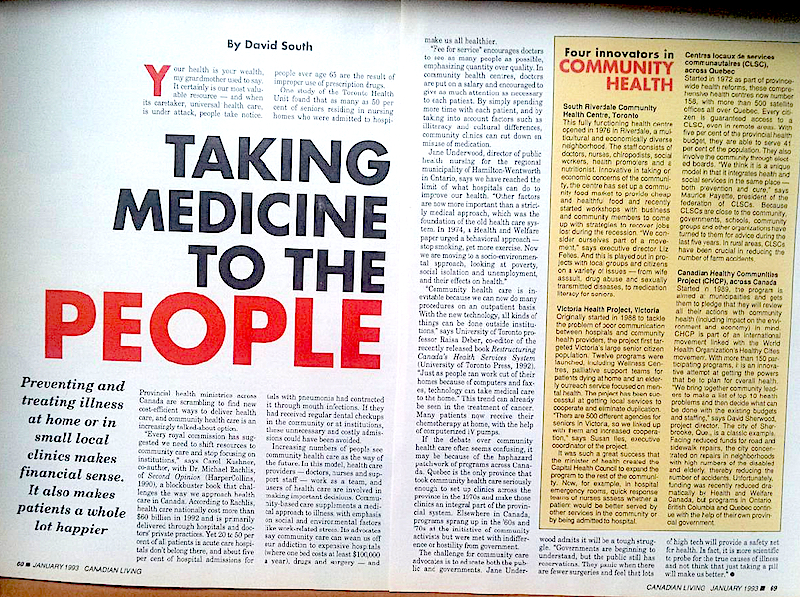
  • Taking Medicine To The People: Four Innovators In Community Health

    Taking Medicine To The People: Four Innovators In Community Health

    Preventing and treating illness at home or in small local clinics makes financial sense. It also makes patients a whole lot happier.

    By David South

    Canadian Living (Canada), January 1993

    Your health is your wealth, my grandmother used to say. It certainly is our most valuable resource – and when its caretaker, universal health care, is under attack, people take notice.

    Provincial health ministries across Canada are scrambling to find new cost-efficient ways to deliver health care, and community health care is an increasingly talked-about option.

    “Every royal commission has suggested we need to shift resources to community care and stop focusing on institutions,” says Carol Kushner, co-author, with Dr. Michael Rachlis, of Second Opinion (HarperCollins, 1990), a blockbuster book that challenges the way we approach health care in Canada. According to Rachlis, health care nationally cost more than $60 billion in 1992 and is primarily delivered through hospitals and doctors’ private practices. Yet 20 per cent of all patients in acute care hospitals don’t belong there, and about five per cent of hospital admissions for people over age 65 are the result of improper use of prescription drugs.

    One study of the Toronto Health Unit found that as many as 50 per cent of seniors residing in nursing homes who were admitted to hospitals with pneumonia had contracted it through mouth infections. If they had received regular dental check-ups in the community or at institutions, these unnecessary and costly admissions could have been avoided.

    Increasing numbers of people see community health care as the way of the future. In this model, health care providers – doctors, nurses and support staff – work as a team, and users of health care are involved in making important decisions. Community-based care supplements a medical approach to illness, with emphasis on social and environmental factors like work-related stress. Its advocates say community care can wean us off our addication to expensive hospitals (where one bed costs at least $100,000 a year), drugs and surgery – and make us all healthier.

    “Fee for service” encourages doctors to see as many people as possible, emphasizing quantity over quality. In community health centres, doctors are put on a salary and encouraged to give as much attention as necessary to each patient. By simply spending more time with each patient, and by taking into account factors such as illiteracy and cultural differences, community clinics can cut down on misuse of medication.

    Jane Underwood, director of public health nursing for the regional municipality of Hamilton-Wentworth in Ontario, says we have reached the limit of what hospitals can do to improve health. “Other factors are now more important than a strictly medical approach, which was the foundation of the old health care system. In 1974, a Health and Welfare paper urged a behavioral approach – stop smoking, get more exercise. Now we are moving to a socio-environmental approach, looking at poverty, social isolation, and unemployment, and their effects on health.”

    “Community health care is inevitable because we can now do many procedures on an outpatient basis. With the new technology, all kinds of things can be done outside institutions,” says University of Toronto professor Raisa Deber, co-editor of the recently released book Restructuring Canada’s Health Services System (University of Toronto Press, 1992).

    “Just as people can work out of their homes because of computers and faxes, technology can take medical care to the home.” This trend can already be seen in the treatment of cancer. Many patients now receive their chemotherapy at home, with the help of computerized IV pumps.”

    If the debate over community health care often seems confusing, it may be because of the haphazard patchwork of programs across Canada. Quebec is the only province that took community health care seriously enough to set up clinics across the province in the 1970s and make those clinics an integral part of the provincial system. Elsewhere in Canada, programs sprang up in the ’60s and ’70s at the initiative of community activists but were met with indifference or hostility from government.

    The challenge for community care advocates is to educate both the public and governments. Jane Underwood admits it will be a tough struggle. “Governments are beginning to understand, but the public still has reservations. They panic when there are fewer surgeries and feel that lots of high tech will provide a safety net for health. In fact, it is more scientific to probe for the true causes of illness and not think that just taking a pill will make us better.”

    Four Innovators in Community Health

    South Riverdale Community Health Centre, Toronto

    This fully functioning health centre opened in 1976 in Riverdale, a multicultural and economically diverse neighborhood. The staff consists of doctors, nurses, chiropodists, social workers, health promoters and a nutritionist. Innovative in taking on economic concerns of the community, the centre has set up a community food market to provide cheap and healthful food and recently started workshops with business and community members to come up with strategies to recover jobs lost during the recession. “We consider ourselves part of a movement,” says executive director Liz Feltes. And this is played out in projects with local groups and citizens on a variety of issues – from wife assault, drug abuse and sexually transmitted diseases, to medication literacy for seniors. 

    Victoria Health Project, Victoria

    Originally started in 1988 to tackle the problem of poor communication between hospitals and community health providers, the project first targeted Victoria’s large senior citizen population. Twelve programs were launched, including Wellness Centres, palliative support teams for patients dying at home and elderly outreach service focused on mental health. The project has been successful at getting local services to cooperate and eliminate duplication. “There are 500 different agencies for seniors in Victoria, so we linked up with them and increased cooperation,” says Susan Lles, excutive coordinator of the project.

    It was such a great success that the minister of health created the Capital Health Council to expand the program to the rest of the community. Now, for example, in hospital emergency rooms, quick response teams of nurses assess whether a patient would be better served by other services in the community or by being admitted to hospital. 

    Centres locaux de services communautaires (CLSC), across Quebec

    Started in 1972 as part of province-wide health reforms, these comprehensive health centres now number 158, with more than 500 satellite offices all over Quebec. Every citizen is guaranteed access to a CLSC, even in remote areas. With five per cent of the provincial health budget, they are able to serve 41 pr cent of the population. They also involve the community through elected boards. “We think it is a unique model in that it integrates health and social services in the same place – both prevention and cure,” says Maurice Payette, president of the federation of CLSCs. Because CLSCs are close to the community, governments, schools, community groups and other organizations have turned to them for advice during the last five years. In rural areas, CLSCs have been crucial in reducing the number of farm accidents. 

    Canadian Healthy Communities Project (CHCP), across Canada

    Started in 1989, the program is aimed at municipalities and gets them to pledge that they will review all their actions with community health (including impact on the environment and economy) in mind. CHCP is part of an international movement linked with the World Health Organization’s Healthy Cities movement. With more than 150 participating programs, it is an innovative attempt at getting the powers that be to plan for overall health. “We bring together community leaders to make a list of top 10 health problems and then decide what can be done with the existing budgets and staffing,” says David Sherwood, project director. The city of Sherbrooke, Que., is a classic example. Facing reduced funds for road and sidewalk repairs, the city concentrated on repairs in neighborhoods with hig numbers of the disabled and elderly, thereby reducing the number of accidents. Unfortunately, funding was recently reduced dramatically by Health and Welfare Canada, but programs in Ontario, British Columbia and Quebec continue with the help of their own provincial government. 

    This work is licensed under a Creative Commons Attribution 4.0 International License.

    “… in recent years it has become a pursuit for a growing number of researchers. … Behind much of this growth has been the Hannah Institute for the History of Medicine …” 

    Read more about Canadian innovation in healthcare and medical education here: Take Two Big Doses Of Humanity And Call Me In The Morning

    Read more on my work promoting Canadian medical history scholarship here: Hannah Institute For The History Of Medicine | 1992 – 1994

    Read more on my work leading on innovation and modernisation in the UK’s NHS here: CASE STUDY 5: GOSH/ICH Child Health Portal | 2001 – 2003

    https://davidsouthconsulting.org/2021/02/05/changing-health-care-careers-a-sign-of-the-times/

    https://davidsouthconsulting.org/2021/02/05/critics-blast-government-long-term-care-reforms/

    https://davidsouthconsulting.org/2022/10/08/dodging-the-health-insurance-minefield/

    https://davidsouthconsulting.org/2020/12/18/feds-call-for-aids-blood-system-inquiry-some-seniors-infected/

    https://davidsouthconsulting.org/2022/04/28/health-care-in-danger/

    https://davidsouthconsulting.org/2021/02/05/health-care-on-the-cutting-block-ministry-hopes-for-efficiency-with-search-and-destroy-tactics/

    https://davidsouthconsulting.org/2021/02/20/new-legislation-will-allow-control-of-medical-treatment/

    https://davidsouthconsulting.org/2021/02/20/private-firms-thrive-as-ndp-reinvents-medicare/

    https://davidsouthconsulting.org/2020/06/14/psychiatric-care-lacking-for-institutionalised-seniors/

    https://davidsouthconsulting.org/2020/06/14/seniors-falling-through-the-health-care-cost-cracks/

    https://davidsouthconsulting.org/2020/06/14/specialists-want-cancer-treatments-universally-available/

    https://davidsouthconsulting.org/2020/04/20/take-two-big-doses-of-humanity-and-call-me-in-the-morning/

    https://davidsouthconsulting.org/2021/02/05/us-health-care-businesses-chasing-profits-into-canada/

    Creative Commons License

    This work is licensed under a
    Creative Commons Attribution-Noncommercial-No Derivative Works 3.0 License.

    ORCID iD: https://orcid.org/0000-0001-5311-1052.

    © David South Consulting 2023