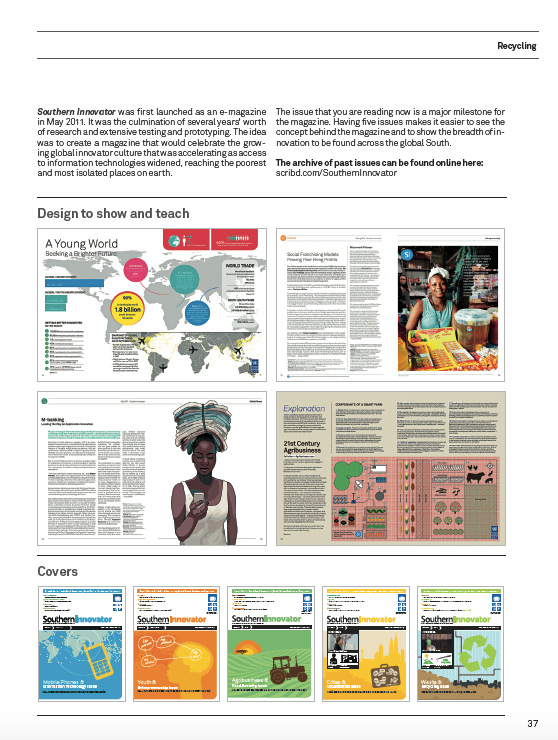
Beginning in 2011 and ending in 2014, each issue of Southern Innovator was launched at the annual Global South-South Development Expo (GSSD Expo) run by the United Nations Office for South-South Cooperation (UNOSSC). The issues (there were five) would connect with that year’s Expo theme and were intended to reinforce the solutions presented at the Expo, as well as those solutions discovered through research for the influential United Nations e-newsletter Development Challenges, South-South Solutions. An Expo was not run in 2015 for the following reason: U.S. Finds Macau Billionaire Guilty in U.N. Bribery Case.
Studies have shown the importance of reading to real change. Not just online, but in paper form. The retention of information and knowledge is greater when a person reads something in a book or a magazine. Another factor is quality design (which makes the published material both attractive and effective). Trashy, gaudy or slap-dash design, while it has its place and context, is not suitable for well-funded, transparent, public organizations seeking to communicate across borders in a professional manner. Southern Innovator was designed following the UN and UNDP design guidelines at the time, while also adhering to the UN Global Compact and the UN Consultants Remuneration Guidelines. The content was also written to follow those guidelines as well as the Plain English Campaign, which seeks to reduce the presence of “gobbledygook, jargon and misleading public information”. On top of this, the magazine benefited from experience: the experience of one of Iceland’s top graphic designers and illustrators, the team based at the UNOSSC in New York who oversaw the editing and proof reading, and the researcher, editor and writer who has led many successful and award-winning publishing ventures, including during “one of the biggest peacetime economic collapses ever”.
“What a tremendous magazine your team has produced! It’s a terrific tour de force of what is interesting, cutting edge and relevant in the global mobile/ICT space… This is great, engaging, relevant and topical stuff.” Rose Shuman, Founder & CEO, Open Mind and Question Box, Santa Monica, CA, U.S.A.
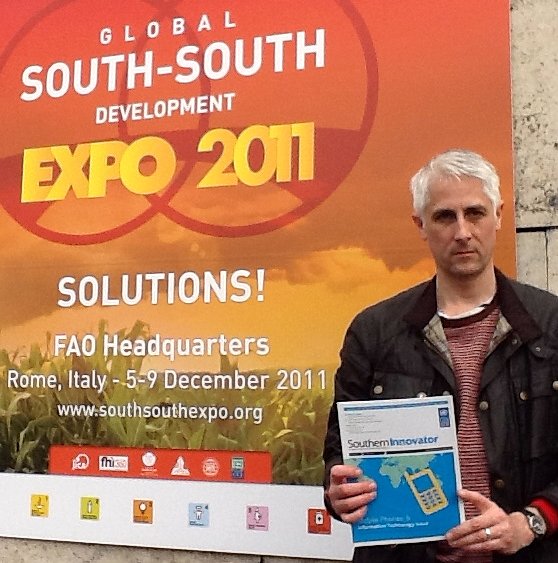
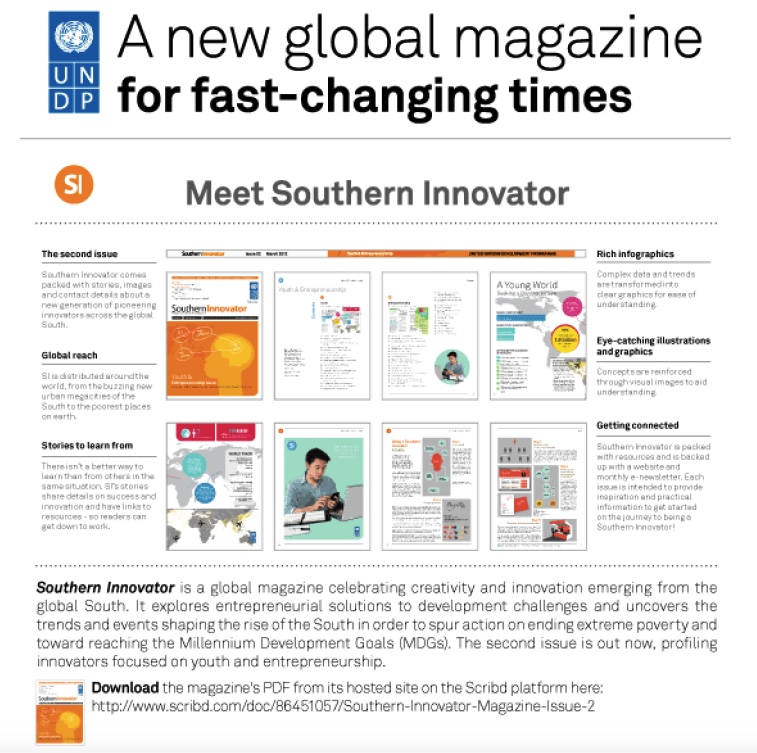
Southern Innovator Issue 1: Mobile Phones and Information Technology was published in 2011 and launched at the Expo in Rome, Italy.
Southern Innovator Issue 2: Youth and Entrepreneurship was published in 2012 and launched at the Expo in Vienna, Austria.Southern Innovator Issue 3: Agribusiness and Food Security was published in 2012 and launched at the Expo in Vienna, Austria.Southern Innovator Issue 4: Cities and Urbanization was published in 2013 and launched at the Expo in Nairobi, Kenya (the first time in Africa).
Issue 6 of Southern Innovator was to be on the theme of science, technology and innovation. Southern Innovator Issue 5: Waste and Recycling was published in 2014 and launched at the Expo in Washington, D.C.
Innovators working in the global green economy could benefit from over US $450 million in investment recently pledged at the UN’s Global South-South Development Expo (GSSD Expo) held in Nairobi, Kenya.
A combination of green investors, businesses, governments and others came together at the UN Environment Programme’s (UNEP) headquarters in the Kenyan capital from 28 October to 1 November 2013 to share solutions and strike deals and partnerships.
The event represented a significant turning point in awareness of the role played by the global South’s innovators in global development and growing economies. The quantity of pledges and investment deals struck at the Expo bodes well for the future of south-south solution sharing.
Organized by the UN’s Office for South-South Cooperation in UNDP (UNOSSC) (southsouthexpo.org) and hosted by UNEP (unep.org) under the theme “Building inclusive green economies”, the Global South-South Development Expo (GSSD Expo) is the world’s biggest event for development solutions created in the South for the South.
“The theme of this year’s Expo is fitting in that Southern countries have both the opportunity and the obligation to pursue a ‘smarter’ development course than their predecessors,” said General Assembly President John Ashe.
Examples of the investment deals struck include helping to build organic fertilizer factories and constructing solar power plants in Kenya, and growing green business ventures for women in Egypt.
South-South cooperation is the exchange of resources, technology and knowledge between developing countries. Today, over US $5 trillion in currency reserves are held by countries of the global South. They also make up 47 per cent of global trade.
Tapping this rich resource is an unparalleled economic development opportunity and could be one of the main engines of growth in the years ahead, the Expo organizers believe.
“As so many stories that we have heard this week demonstrate, South-South Cooperation is playing a vital role in facilitating this global transition,” said UN Under-Secretary-General and UNEP Executive Director Achim Steiner.
“Not only are these local, national and regional efforts producing positive results, but they are overcoming barriers, building new partnerships, creating new finance mechanisms, generating knowledge, sharing information, providing training and capacity building in areas and sectors that are critical for a global transition to a low carbon, resource efficient and inclusive economy,” he added.
As an example of how solutions are shared and deals are struck, more than 40 companies were successfully matched and held business negotiations using the Expo’s South-South Global Assets and Technology Exchange (SS-GATE). An online match-making service bringing together innovative companies with the knowledge and funding they need to grow, the SS-GATE was able to get 148 companies to list their projects on the SS-GATE web-platform during an Expo event.
For the first time in its history, the Expo garnered a strong online presence with the help of volunteers who collaborated remotely around the world on social media. The event was so popular that it trended on Twitter in Kenya, meaning that the message of the value and growing scope of South-South cooperation reached the next generation of development practitioners, entrepreneurs, environmentalists, thinkers and leaders.
Also at the Expo, the fourth issue of Southern Innovator magazine (southerninnovator.org) had its official launch. Southern Innovator Issue 4 visits the new cities being built to tackle the challenges of a rapidly urbanizing 21st-century world. The magazine also highlights some of the solutions being devised to the challenges people face as the world becomes a majority urban place.
Some innovators are building new cities from scratch, applying the latest thinking and hard-wiring in cutting-edge information technologies and innovative environmental measures to create “smart” cities and eco-cities. Architects are designing and refining homes that are beautiful and functional, easy to build, affordable and conserve energy. Social entrepreneurs are innovating ways to create liveable and socially inclusive urban areas, often in places where planning has been scant and where incomes are very low. All the stories featured in the magazine were chosen for their focus on improving human development and for their ingenuity and fresh thinking.
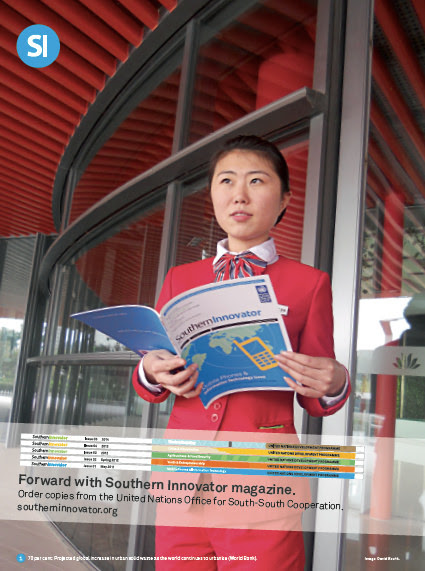
Southern Innovator champions a 21st-century global innovator culture. It is being distributed through the United Nations’ network and partners and reaches some of the world’s poorest and remotest places, as well as the vibrant but stressed growing global megacities. It is hoped the magazine will inspire budding innovators with its mix of stories, essential information, facts and figures, images and graphics.
Published: November 2013
Resources
1) Global South-South Development Expo: The Global South-South Development Expo (GSSD Expo) is the FIRST EVER Expo solely from the South and for the South. It showcases successful Southern-grown development solutions (SDSs) to address the need to meet the Millennium Development Goals (MDGs). Website: http://www.southsouthexpo.org/
2) Southern Innovator online story archive: Organized by theme, the story archive is a treasure trove of innovation stories and resources from the global South stretching back to 2006. Website: southerninnovator.org
3) Southern Innovator on Scribd: Archived copies of the full-color, 60-page magazine can be downloaded here. Website: http://www.scribd.com/SouthernInnovator.
4) Southern Innovator on Twitter: Catch Southern Innovator’s Tweets and keep on top of a growing global network of innovators. Follow @SouthSouth1
Development Challenges, South-South Solutions was launched as an e-newsletter in 2006 by UNDP’s South-South Cooperation Unit (now the United Nations Office for South-South Cooperation) based in New York, USA. It led on profiling the rise of the global South as an economic powerhouse and was one of the first regular publications to champion the global South’s innovators, entrepreneurs, and pioneers. It tracked the key trends that are now so profoundly reshaping how development is seen and done. This includes the rapid take-up of mobile phones and information technology in the global South (as profiled in the first issue of magazine Southern Innovator), the move to becoming a majority urban world, a growing global innovator culture, and the plethora of solutions being developed in the global South to tackle its problems and improve living conditions and boost human development. The success of the e-newsletter led to the launch of the magazine Southern Innovator.
The rise of smartphones – mobile phones capable of Internet access and able to run ‘apps’ or applications – is the latest wave of the global connectivity revolution. Mobile phones rapidly made their way around the world to become almost ubiquitous – the most successful take-up of a piece of communications technology in history – and now smartphones are set to do the same. The number of mobile phone subscriptions in the world surpassed 6 billion in 2012 (out of a population of 7 billion) and, according to the International Telecommunications Union (ITU), the number of mobile phones will exceed the world’s population by 2014.
Over the last five years, with the increasing popularity of smartphones, the focus of the mobile industry has shifted from voice and messaging to apps and data services.
Smartphones are complex pieces of technology and any country that can develop the capability to make them and innovate is set to make a lot of money.
The high export value potential of designing and making “computer equipment, office equipment, telecommunication equipment, electric circuit equipment, and valves and transistors” was flagged up as a priority for developing nations back in 2005 at a UN meeting looking for “New and Dynamic Sectors of World Trade” (UNCTAD).
At present, smartphones have a long way to go to surpass old-style mobile phones: by the end of 2016, according to Portio Research (portioresearch.com), the number of non-smartphones in the Asia-Pacific region alone will still be bigger than the entire worldwide number of all smartphones. Even so, it’s predicted that by 2016, there will be 555 million active smartphones in China alone, as well as half a billion smartphones in Europe by the end of 2014. By 2013, North America’s smartphones will make up 50 per cent of all mobile phones. All in all, a lucrative market.
The main factor holding back the rise of smartphones is price. Smartphones tend to cost more than a basic mobile phone. But as China gets more heavily involved in the smartphone marketplace with its own smartphone and mobile phone brands, low income consumers will find themselves with a wider choice of affordable and powerful smartphones, each one a mini-computer.
Out of the 10 largest global manufacturers of smartphones, four are Chinese: Lenovo, Yulong, Huawei and ZTE (Gartner).
Huawei (http://www.huawei.com/en/), the world’s biggest smartphone seller (according to research firm Canalys) (canalys.com), has started to move some of its design team to London in the United Kingdom, to better tailor its products for foreign markets. It has revenues each year of US $35 billion.
China’s mobile phone market is vast, accounting for a third of all smartphones sold in the world. Getting a foothold in this marketplace places a company in a very strong position to build the expertise and capital to push into the wider global marketplace. And that is what Chinese brands are starting to do. So far, Chinese exports of branded smartphones make up a fifth of those sold around the world (Canalys).
The big global competitors to date have been South Korea’s Samsung (samsung.com) and the American Apple brand (apple.com). Other large competitors are Canada’s troubled Blackberry and Finland’s Nokia.
To compete with them, popular and successful Chinese brands include Xiaomi (xiaomi.cn), which sells more mobile phones in China than does the American Apple brand, and ZTE (http://wwwen.zte.com.cn/en/).
For years, many of the top global brands have had their phones and the components manufactured in China. This meant Chinese manufacturers were assembling the phones but not benefiting from the high value that can be extracted from being the owner of the brand name and the originator of the innovation and holder of the copyrights and trademarks.
But now China’s Lenovo brand (http://www.lenovo.com/uk/en/), for example, has successfully pulled past U.S. electronics maker Hewlett-Packard (www.hp.com) to become the largest seller of personal computers in the world. It is also selling more mobile phones and tablet computers than personal computers.
Lenovo Chief Executive Yang Yuanqing espouses a two-part strategy to defend market share at home in China while going hard at overseas markets. Lenovo started with so-called emerging markets in Russia, India and Indonesia.
“We have very aggressive plans to explore overseas markets,” Lenovo’s mobile phone division head Liu Jun told China Daily. “We hope the overseas market will contribute more than half of Lenovo’s total smartphone revenue in the long run.”
Xiaomi founder Lei Jun is considered part of a new generation of dynamic Chinese technology leaders. His casual clothing and charismatic public presentations have had some equate him to the late Apple founder Steve Jobs. But Jun is not happy with selling smartphones and instead sees the company’s future in software and that the phones are just a tool to access the software. Xiaomi hopes to make even more money from selling games, running online marketplaces and offering social media.
The Chinese-made smartphone brand Coolpad (http://coolpadamericas.com/) – made by Yulong Computer Telecommunication Scientific Co. – is the third best-selling in the Chinese marketplace, surpassing Huawei and Apple and has global annual revenue of US $1.8 billion, according to Forbes magazine. Sino Market Research found 10.2 per cent of China’s smartphone users own a Coolpad, behind Korean brand Samsung and China’s Lenovo.
Coolpad has succeeded by investing heavily in research and development (R&D) and innovation to make the phones cheap but also powerful.
Innovations include technology that lets users have more than one phone number for the same phone by being able to connect to two different network technologies. The phones also include security and privacy protections that make them popular with businesspeople and government officials.
The Coolpad brand has also been frenetic in launching different models of the phones to appeal to its customers. In 2012, it launched 48 different models, selling for between US $50 and US $500.
Coolpad was launched in 2012 in the US as part of the company’s global expansion plans.
China has placed innovation at the core of its economic development policies. China increased its R&D spending in 2009 to US $25.7 billion, a 25.6 per cent rise over 2008, according to Du Zhanyuan, vice minister of the Ministry of Science and Technology. In 2011, China surpassed South Korea and Europe in total patents filed and was in a neck-and-neck race with Japan and the United States.
China now boasts twice as many Internet users as the United States, and is the main global maker of computers and consumer electronics, from toys to games consoles to digital everything.
China is also on course to become the world’s largest market for Internet commerce and computing.
The drive to change and transform China’s global economic role was promoted in 2011’s Beijing International Design Week (http://www.bjdw.org/en/), with its theme of transforming “Made in China to Designed in China.”
Published: September 2013
Resources
1) iHub Nairobi: iHub – Nairobi’s Innovation Hub for the technology community is an open space for the technologists, investors, tech companies and hackers in the area. This space is a tech community facility with a focus on young entrepreneurs, web and mobile phone programmers, designers and researchers. Website: http://www.ihub.co.ke/
2) Venture Capital for Africa: Venture Capital for Africa (www.vc4africa.biz) is the continent’s leading founder’s network, the largest and fastest growing community of entrepreneurs and investors building promising companies in Africa. Website: https://vc4africa.biz/
Red Dot: The red dot logo stands for belonging to the best in design and business. The red dot is an internationally recognized quality label for excellent design that is aimed at all those who would like to improve their business activities with the help of design. Website: http://www.red-dot.de
C3: C3 offers product design and product engineering services in Shanghai, China. Their strong point is managing innovative design processes from scratch (market research) until production: a one shop service: Website: chinacreativecompany.com
North Korea Tech: North Korea Tech is dedicated to covering and collecting information regarding the state of information technology and related industry in North Korea. You can expect to find articles related to Internet connectivity in the country (yes, it does exist), North Korea’s use of technology, and the country’s centrally-controlled and heavily-censored mass media. Website: http://www.northkoreatech.org/
Note on story: Very few outside of China in 2013 were talking about this topic, let alone the increasing market share of smartphone manufacturer Huawei. This was one of many stories to result from a research trip to China. For the keen-eyed, try and spot the Huawei logo in the accompanying photo taken in Tianjin.
Development Challenges, South-South Solutions was launched as an e-newsletter in 2006 by UNDP’s South-South Cooperation Unit (now the United Nations Office for South-South Cooperation) based in New York, USA. It led on profiling the rise of the global South as an economic powerhouse and was one of the first regular publications to champion the global South’s innovators, entrepreneurs, and pioneers. It tracked the key trends that are now so profoundly reshaping how development is seen and done. This includes the rapid take-up of mobile phones and information technology in the global South (as profiled in the first issue of magazine Southern Innovator), the move to becoming a majority urban world, a growing global innovator culture, and the plethora of solutions being developed in the global South to tackle its problems and improve living conditions and boost human development. The success of the e-newsletter led to the launch of the magazine Southern Innovator.
The proliferation of mobile phones across the global South, reaching even the poorest places on the planet, has given birth to whole new ways of making money. A phenomenon called ‘crowdsourcing’ – in which the power of individuals is harvested to achieve a goal – is now being used to create networks of people earning extra income.
One technology called Txteagle (http://txteagle.com/index.html), works like this: somebody performs small tasks with their mobile phone, such as translating a document into a local language, and in return receives credits or cash, so-called ‘micro-payments.’ By having many people perform these tasks in their spare time or down time at work, a large project can be completed and people can top-up their income. The secret is that the task must be able to be broken up into bite size chunks: the elephant must be eaten with a small fork.
For the poor, or people who are just getting by in a poor country, this can be a much-needed survival top-up in hard economic times. It is also an opportunity for people normally frozen out of formal employment opportunities or living in slum conditions.
Txteagle is being pioneered in Kenya using text messages or a low bandwidth, interactive protocol known as USSD (http://en.wikipedia.org/wiki/USSD) (usually used to check prepaid phone balances).
The rapid growth in take-up has made mobile phones the big success story of the 21st century. With such reach, finding new applications for mobile phones that are relevant to the world’s poor and to developing countries is a huge growth area. It is estimated that by 2015, the global mobile phone content market could be worth over US $1 trillion: relegating basic voice phone calls to just 10 percent of the way people use mobile phones.
The technological success story of mobile phones is impressive: China is home to the same number of mobile-phone users (surpassing 650 million in 2009) as the whole of Europe. According to India’s telecoms regulator (http://www.trai.gov.in/Default.asp), half of all urban dwellers now have mobile – or fixed – telephone subscriptions and the number is growing by eight million a month. In Tanzania, mobile phone use grew by 1,600 percent between 2002 and 2008.
Txteagle is the brainchild of Nathan Eagle of EPROM (Entrepreneurial Programming and Research on Mobiles) (http://eprom.mit.edu/ ). He works on developing new mobile phone applications with computer science departments in 10 Sub-Saharan African countries including: the University of Nairobi (http://www.uonbi.ac.ke/) (Kenya), Makerere University (http://mak.ac.ug/makerere/) (Uganda), GSTIT (http://www.gstit.edu.et/) (Ethiopia), Ashesi University (http://www.ashesi.org/) (Ghana), and the Kigali Institute of Science and Technology (http://www.kist.ac.rw/) (Rwanda).
Eagle has pioneered Txteagle in Nairobi, Kenya with students at the University of Nairobi. Drawing on his experience in East Africa, where he has lived since 2006, Eagle has a powerful message about mobile phones in the South. “This is their technology. The mobile phone is theirs,” he told a conference in March of this year. “It has had a far greater impact on their lives than it has on ours.”
Eagle says typical Txteagle users are “literate people in Nairobi who have significant idle time, like taxi drivers, security guards” or high school students. Like many Southern countries, Kenya has a plethora of languages: 62 in all. It can be laborious and costly to translate into all these languages. But by using crowd-sourcing on mobile phones, mobile phone company Nokia’s (www.nokia.com) phone menus have been translated into 15 local languages.
Already there are more people wanting to earn money this way than there are tasks to do. Eagle has had to cap payments at US $1.50 a day. The service needs to grow, and it is looking to offer people in the United States the opportunity to have easily broken-up tasks done in Kenya. Eagle believes his algorithms (http://en.wikipedia.org/wiki/Algorithm) ensure a 95-percent accuracy rate. One possible market is the US $15 billion medical transcription industry.
Kenya, a nation of 32 million, relies on its small business sector for most employment. In 2005, the government’s Economic Survey (www.cbs.go.ke/) found the small business sector created 437,900 jobs – mostly because of the boom in mobile phones. According to the Massachusetts Institute of Technology (MIT), adding an additional 10 mobile phones per 100 people boosts a typical developing country’s GDP growth by 0.6 percent. The boost comes from the innovative use of mobile phone technology by local entrepreneurs.
Kenya is making significant headway on innovating with mobile phones. Already, 30 percent of Kenyans pay for their electricity with their mobile phones instead of waiting in line.
“We have transformed the majority of phones in East Africa into a platform that people can use to make money,” Eagle told the conference. “There are 15 million Africans ready to start working on their mobile phones.”
Development Challenges, South-South Solutions was launched as an e-newsletter in 2006 by UNDP’s South-South Cooperation Unit (now the United Nations Office for South-South Cooperation) based in New York, USA. It led on profiling the rise of the global South as an economic powerhouse and was one of the first regular publications to champion the global South’s innovators, entrepreneurs, and pioneers. It tracked the key trends that are now so profoundly reshaping how development is seen and done. This includes the rapid take-up of mobile phones and information technology in the global South (as profiled in the first issue of magazine Southern Innovator), the move to becoming a majority urban world, a growing global innovator culture, and the plethora of solutions being developed in the global South to tackle its problems and improve living conditions and boost human development. The success of the e-newsletter led to the launch of the magazine Southern Innovator.
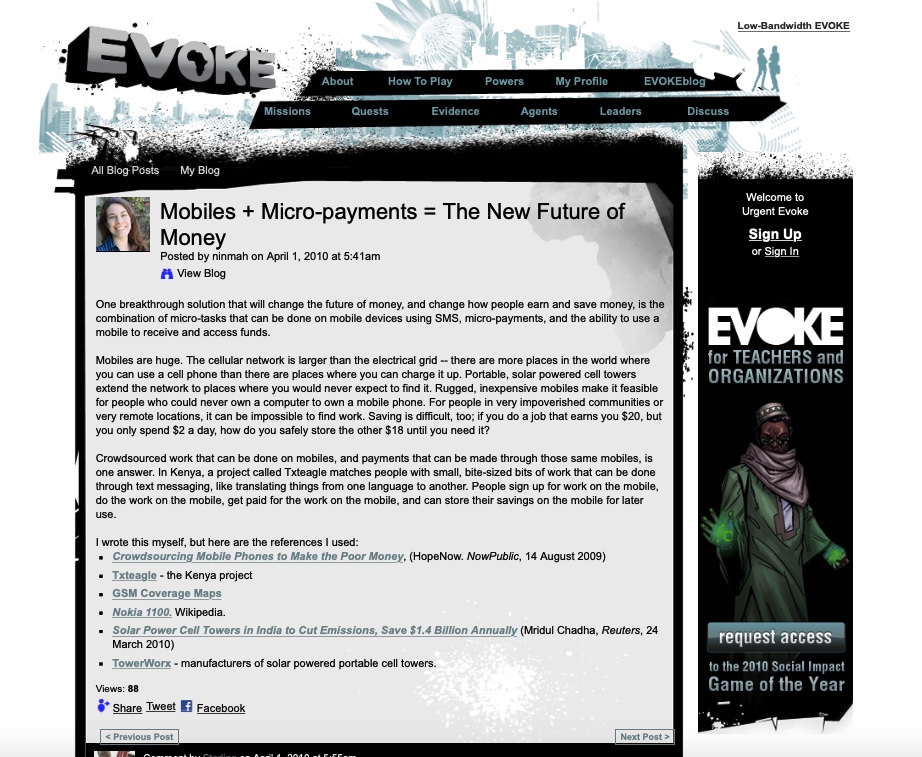
In 2010 the story was cited in Evoke’s Mobiles + Micro-payments = The New Future of Money (April 1, 2010).











 David South Consulting
You must be logged in to post a comment.