Around the world, traditional music stores selling vinyl records, tapes and CDs (compact discs) are closing down. Digital downloads distributed over the Internet and mobile phones make it unnecessary to build a music collection in these hard formats.
While this has been a revolution that has made acquiring music as simple as firing up a digital download service like iTunes, it has many downsides as well. One of them has been the loss of vast swathes of musical history, as many songs recorded in the past have not made their way into digital downloads. And how can you find music online if you only remember part of a tune or song and can’t remember its title or the musician?
The background and knowledge that was once imparted by an informed person in a music store has been lost in the world of digital downloads.
A Mauritanian music shop is showing how a traditional record store can stay relevant and commercially viable in the 21st century. Entrepreneur Mohamed Vall’s Saphire d’Or store in Mauritania’s capital Nouakchott (http://en.wikipedia.org/wiki/Nouakchott), is a treasure trove of the sort of long-lost recorded songs that normally vex lovers of African music. Pictures of the shop can be seen at the sahelsounds blog (http://sahelsounds.com/?p=887).
Vall has run the shop for three decades and amassed a large collection of rare African music on records and tapes. He has married this trove of African creativity to a clever business model: Vall doesn’t let customers buy the precious records themselves but instead will transfer the songs to a disc or a USB stick (http://en.wikipedia.org/wiki/USB_flash_drive) for US 30 cents each.
He has also used traditional hospitality to create an atmosphere that encourages people to interact and keep coming back.
“I have the biggest collection in Mauritania,” Vall told The Guardian newspaper. “Any music you want from Africa – I mean the kind of music that puts Africa on the map – I have it.”
The shop is down an alleyway in the bustling capital and offers a refuge for music lovers.
The atmosphere encourages friendly conversation and lets customers take their time making a selection. Customers can relax in armchairs while browsing and drink some traditional mint tea or enjoy a snack from a communal bowl.
The shop uses traditional Mauritanian nomadic hospitality to improve the customer experience. It also uses the music it sells to heal rifts between the different cultures that cross Mauritania, as it bridges Arabic-speaking North Africa and the majority black sub-Saharan Africa.
“When you are here, it doesn’t matter who you are,” Vall said. “We get youngsters wanting 1940s ballads and old people whose minds are musical museums. We get toubabs (white people) who heard one song decades ago.”
One of the treasure troves held in the shop is the recordings made by West African orchestras during the post-colonial period.
The shop also acts as an interactive museum and archive of many African musical greats, from Senegal’s Youssou N’Dour to Nigerian afrobeat pioneers, Guinean pop legends and Maliaian and Congolese musicians.
Its collection ranges beyond Africa to take in musical genres from around the world, from blues to salsa to rock.
“The music allows you to travel in your head,” said one customer, teacher Abdoul Kaba.”When I first came to Mauritania from Guinea, I went round and round looking for zouk (West African funk) music that everybody listens to in Guinea until I ended up here.”
The shop also serves as a sanctuary for many from life’s everyday hardships.
“It’s not about the music any more. People come back because in here you can be free. You can listen to music and forget this hard life,” Kaba said.
Published: June 2012
Resources
1) The African Music Encyclopedia: Search by alphabetical listing the continent’s musicians. Website: http://africanmusic.org/
2) African Musicians Profiles: African Musicians Profiles (AMP) is a website for the promotion and publicity of African musicians. Each musician “has a profile, and there are pages on news of recent and future events, special features, recommended CDs, relevant reading (biographies, reference books and magazines) and photos”. Website: http://www.africanmusiciansprofiles.com/
In 1994 I was hired by start-up Youth Culture to be Editor-in-Chief of Toronto’s Watch Magazine, a bi-weekly distributed to the city’s high schools and to all youth hang-outs. In 1996 I was hired again to help with preparing the magazine for its national launch.
About
In 1994, the Internet had not arrived in any great form (though Watch Magazine was on top of its emergence as Internet cafes popped up in the city) and the digital economy was still minimal. There was no such thing as ‘start-up culture’ for youth. There was an urgent need to create opportunity for youth, to create new markets, and to change the business culture of the city of Toronto, which had been hit hard by an economic crash and austerity.
Watch Magazine had had a brief false start prior to my arrival in 1994. The previous format had not worked and the magazine needed a vision and somebody with the experience and dedication to see it through. It was also entering a competitive marketplace for readers, with already existing free magazines capturing most of the advertising spend for youth-oriented marketing in Toronto (though failing to offer a genuine youth content experience as could be found in Europe – the UK especially – at that time). As an example, Toronto lacked sharp and credible coverage of youth popular culture in the early 1990s. Drawing on my extensive experience as a journalist (including at Toronto’s established alternative weekly, Now Magazine) and editor, I assembled a team of youth editors and writers to work on making the content and magazine’s design appealing to the youth demographic in Toronto. The magazine needed to turn a profit in short order and become credible to advertisers, its main source of income (in Canada, 64 per cent of magazine revenues come from advertisers)*. The design and content needed to appeal to a youth audience but work with a tight (but increasing) budget. It was doing this in a tough economy with high unemployment, austerity, business failures, and a generally negative business environment.
By having an actual youth editorial team, Watch Magazine quickly developed an authentically young 1990s voice. The magazine also benefited from its youth team’s ability to spot trends bubbling under the surface ready to explode into mainstream society. As an example, they had this to say on the Internet in a piece on Toronto’s coffee shops, “Some mean places for bean”: “The powers-that-be think we should cocoon in our houses and rent videos, play with the Internet and order in food …”
Youth unemployment was high in the early to mid 1990s in Canada. It reached 19.3 per cent for those 15 to 19 years old in 1993. “It should be noted, however, that youth unemployment relative to that of adults has worsened since the 1990-91 recession (Youth Unemployment in Canada by Kevin B. Kerr, 2000).”
The Canadian economy overall severely contracted and unemployment was at 11.4 per cent by 1993 (Statistics Canada), and as Statistics Canada said, “Because employment recovered at a snail’s pace after the recession of the early 1990s, the decline in the unemployment rate was delayed until 1994”.
As the Bank of Canada also said: “In early 1994, Canada’s economic situation was not that favourable—our economy was facing some rather serious problems. … the recession here was more severe than in the United States.
“Working their way out of these difficulties was disruptive and painful for Canadian businesses. Defaults, restructurings, and downsizings became the order of the day. With all this, unemployment took a long time to recover from the 1990–91 recession …” *
And the media in general could not avoid the crisis. According to the book The Missing News: Filters and Blind Spots in Canada’s Press (Robert A. Hackett and Richard S. Garneau, Canadian Centre for Policy Alternatives, University of Toronto Press 2000), Canada’s media was also in a crisis throughout the 1990s, as declining resources, staff layoffs and media closures reduced the breadth and depth of news coverage.
In less than a year, Watch Magazine had gone from being an unknown quantity, to being a fast-growing and profitable youth publication, significantly increasing its advertising revenue: a key metric for a magazine reliant on this as its main source of income. It had expanded in size and audited distribution and was able to make a move to new digs (the Watch Magazine “crib” – a studio and work space) at innovative “arts-and-culture hub” start-up space 401 Richmond Street in Toronto – at the centre of Toronto’s emerging media and design neighborhood in its former fashion district. All the contributors were high-school-age youth drawn from talent across the city; many had already shown their ability by starting their own publications and media. They gained first-hand experience in investigative journalism skills, business skills in a start-up, and magazine and media production skills.
“… thanks to David [South] for all his hard work on Watch magazine! I learned a lot from him and it was a great experience.” William White
In 1996, I was hired again to help with preparing the content format for Watch’s expansion to a national magazine – further proof of its success as a publication and a business.
* (Bank of Canada: Canada’s Economic Future: What Have We Learned from the 1990s?)
* The Missing News: Filters and Blind Spots in Canada’s Press (Robert A. Hackett and Richard S. Garneau, Canadian Centre for Policy Alternatives, University of Toronto Press 2000)
Brief descriptions of sample issues are below:
Youth Gangs Cover
In 1994, with Canada’s economy still in the doldrums, Watch Magazine exploded into Toronto’s high schools. Staffed by talented youth, it shook up the staid publishing scene and proved young people did have something to say. This first issue still remains relevant, with its exploration of youth gangs and violence in the school system.
Therapy Cover
After its successful launch, Watch Magazine was grabbing readers and getting the attention of advertisers and television. It was time to improve the design and introduce the latest in graphic design software. The results paid off: the magazine looked sharper and quickly ran from its cheeky launch, when we had basically avoided all traditional approaches to a launch (like actually having a designer).
For anoraks out there, this photo shoot with Irish band Therapy took place outside the former Wellesley Hospital emergency department in Toronto. And, yes, that is a genuine restraining ‘straitjacket’ used by psychiatric hospitals to restrain mental health patients.
Digable Planets Cover
By this issue, Watch had hit its stride: we were the first to seriously review the ballooning zine culture, get immersed in the rave and late-night party scene, and dig deep into “chopsocky world”: Hong Kong and Asian film fans. But “Hip-Hop Comb-munism”? What were we thinking?
It was also the biggest issue to date.
Beck Cover
Highly talented Beck gave Watch his eloquent thoughts on the media’s infatuation with Generation X and how it always desperately needs to sell young people more stuff. Watch took on Ontario’s film censors over the GG Allin documentary, Hated: GG Allin and the Murder Junkies, and let students across the city blow off steam on life in the 1990s.
Bass is Base Cover
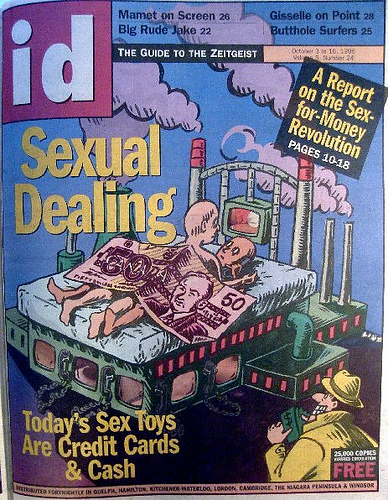
By October 1994 the magazine’s investigative powers were in full flow. Two investigations – a sex scandal at an alternative school, and whether the Battle of the Bands contests, a fixture at most high schools, are really worth it – joined a profile of the band Bass is Base and more coverage on the growing rave scene in Toronto.
Oasis Cover
In 1994, Oasis were still an indie band with a lot of bottle and big mouths. Riding a tsunami of hype from the UK, they washed up in North America to face their biggest challenge: could they become as big as The Beatles or The Rolling Stones? Lead singer Liam Gallagher does not disappoint, as he gives me an expletive-laden exposition on everything under the sun.
This was the first published print interview with the band in Canada.
Sloan Cover
Canada’s answer to the ‘Madchester’ scene of the early 1990s, Sloan, played the pop game with gusto. In the photo shoot for the feature, it was pants down and prayer hands to an unseen religious icon.
Timeline
1994: Hired to re-launch and expand Watch Magazine in Toronto.
1996: Hired to re-develop editorial content for Watch Magazine’s national launch.
Testimonials
“As one of those high school kids and the guy who wrote (most of) this article, I’d like to say thanks to David [South] for all his hard work on Watch magazine! I learned a lot from him and it was a great experience.”William White
Impact
Micro
Toronto’s first youth culture media start-up. Introduced ‘youth culture’ concept to Canada
oversaw two format re-launches of the magazine as it expanded and grew
assembled talented youth editorial team
grew magazine and its profile as the main media source for reaching Toronto’s youth
writers trained and appeared on TV as youth commentators
first profile in Canada of British band Oasis, among many other story firsts
became first stop for anyone wishing to target the youth market, or seeking intelligence on the youth market
Macro
created youth culture market in Toronto
first magazine to be based at new start-up hub in Toronto – pioneering concept at the time
Note: Complete issues of the magazine’s first year await professional digital scanning. This could be of interest to a library, scholar or university interested in archiving this authentic artefact of 1990s youth culture. Please send an email if you would like to get in touch or share a thought: mailto: davidsouthconsulting@gmail.com.
“Free teen publication Watch Magazine is going national this month – promising to more than double its high school penetration.
The self-described youth culture magazine, which last year at this time went province-wide – delivering copies to 350 high schools across Ontario – plans to send out 125,000 copies to 800 participating high schools across Canada.
Going national only four years after its inception (the magazine started as a Toronto-only vehicle in 1993) could make national advertisers interested in reaching the elusive teen market very happy.”
“The self-described youth culture magazine, which last year at this time went province-wide – delivering copies to 350 high schools across Ontario – plans to send out 125,000 copies to 800 participating high schools across Canada.”
“Owned by marketing company Youth Culture Group, these gender – specific magazines attempt to construct a teen image that is built on spending.”
“Youth Culture originally produced a younger, unisex magazine called Watch, which eventually became Bang.”
By Dimetre Alexiou, Published April 4, 1995. Some context on poor youth representation in Canadian media in the early to mid 1990s.
Watch Magazine Editor-in-Chief David South photographed at Toronto’s Beaches neighbourhood in 1994. Watch Magazine was Toronto’s first youth culture media start-up and led the way on Toronto’s revival after the economic crisis of the early 1990s. Photo: Margaret South.
Note: Complete issues of the magazine’s first year await professional digital scanning. This could be of interest to a library, scholar or university interested in archiving this authentic artifact of 1990s youth culture. Please send an email if you would like to get in touch or share a thought: mailto: davidsouthconsulting@gmail.com.You can also fund this goal through our PayPal account here:
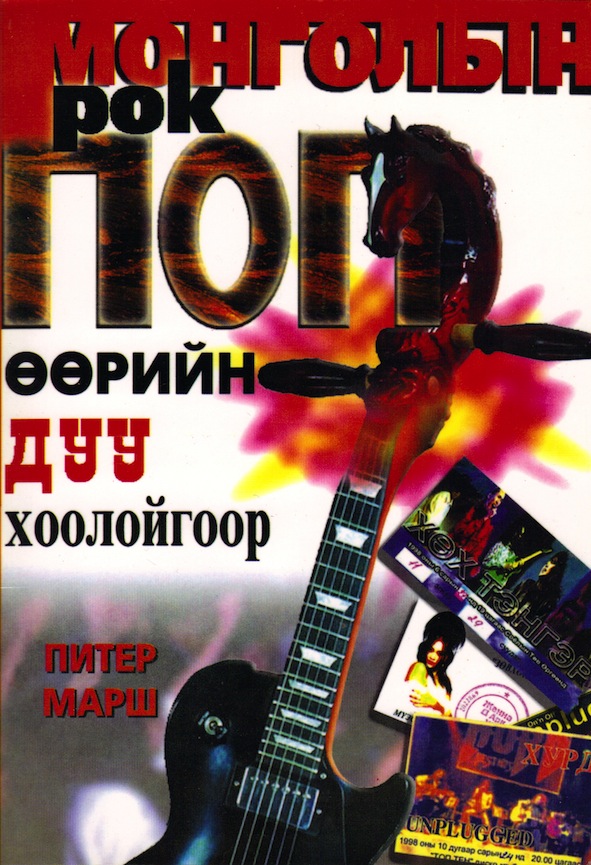
It was the late 1990s. Mongolia was still recovering from “one of the biggest peacetime economic collapses ever” (Mongolia’s Economic Reforms: Background, Content and Prospects, Richard Pomfret, University of Adelaide, 1994). But it was the country’s young musicians who were showing the way out of the crisis, setting an example for entrepreneurship in the new, free-market economy that emerged in the country after 1990.
As UNDP Communications Officer N. Oyuntungalag wrote in the Blue Sky Bulletin (BSkyB) newsletter, “A thriving pop and rock scene has emerged over the last four years. .. The energy of these musicians and singers has not gone unnoticed by the burgeoning advertising market. Pop bands are promoting many things, from face creams to beer. … [but] there has been little serious writing on the business of popular music.”
As the book’s author, American ethnomusicologist Peter Marsh, said in an interview with UNDP’s Blue Sky Bulletin newsletter, “we thought our book would provide important ideas about the direction and nature of the nation’s development.
“My impression about Mongolian pop-rock is that it is a lively, diverse and at times innovative Mongolian art form that closely reflects many of the hopes, fears and aspirations of its primary audience, Mongolian youth.”
The book still stands as an unusual and innovative contribution to thinking around the role played by youth in development and business and in crisis recovery.
Google Books Key Words: авдаг адил аль англи аялан байж байлаа байх байхад байхгүй бараг барууны бас бензин Бид нар бидний биз бизнес бий биш болох бөгөөд бусад бүжиг бүр бүтээлчид бүх гадаад гадаадад









 David South Consulting
You must be logged in to post a comment.